Average Daily Range Forex Indicator: ADR, Range & Volatility Guide

The Average Daily Range forex indicator shows how far a currency pair usually moves in a day. Traders use ADR to compare daily volatility, judge how much of the day’s range may already be used, and avoid planning targets or entries without range context.
 
Written byHenry Green
Published
Last updated

Key Takeaways

  • The Average Daily Range forex indicator measures the average high-low movement of a currency pair over a selected number of days.
  • ADR is mainly a volatility and range tool, not a trend indicator, reversal signal, or complete trading system.
  • Traders often use ADR to estimate realistic intraday range expectations, compare currency-pair movement, and avoid chasing stretched moves.
  • ADR is different from ATR because ADR usually focuses on daily high-low range, while ATR uses true range logic.
  • ADR levels still need price action, market context, confirmation, invalidation, and risk control before they become part of a trade plan.
Risk note: Forex trading involves risk of loss. The Average Daily Range forex indicator can help organize volatility and range analysis, but it cannot predict direction, remove spread, prevent slippage, or guarantee that price will stop after reaching its average range.

What Is the Average Daily Range Forex Indicator?

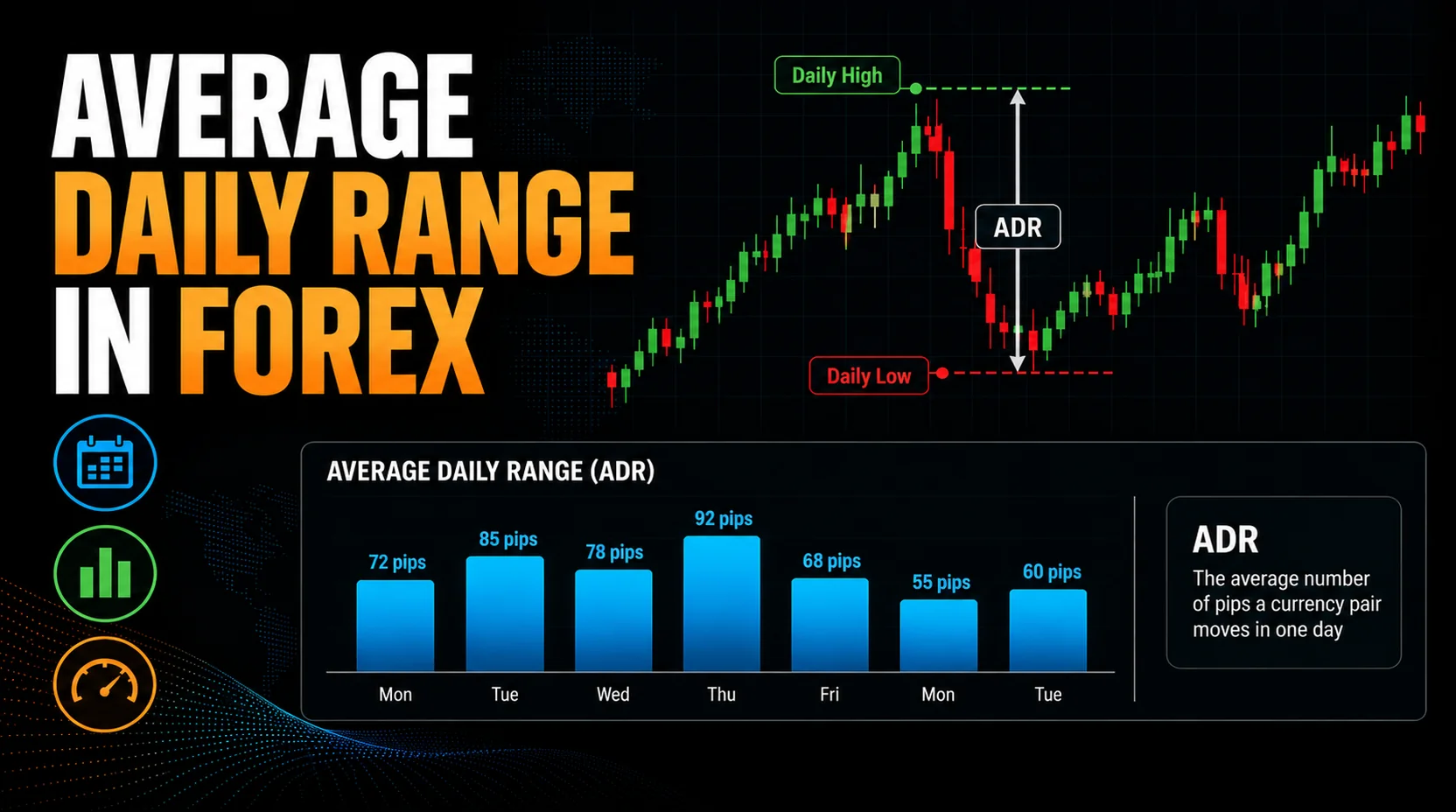
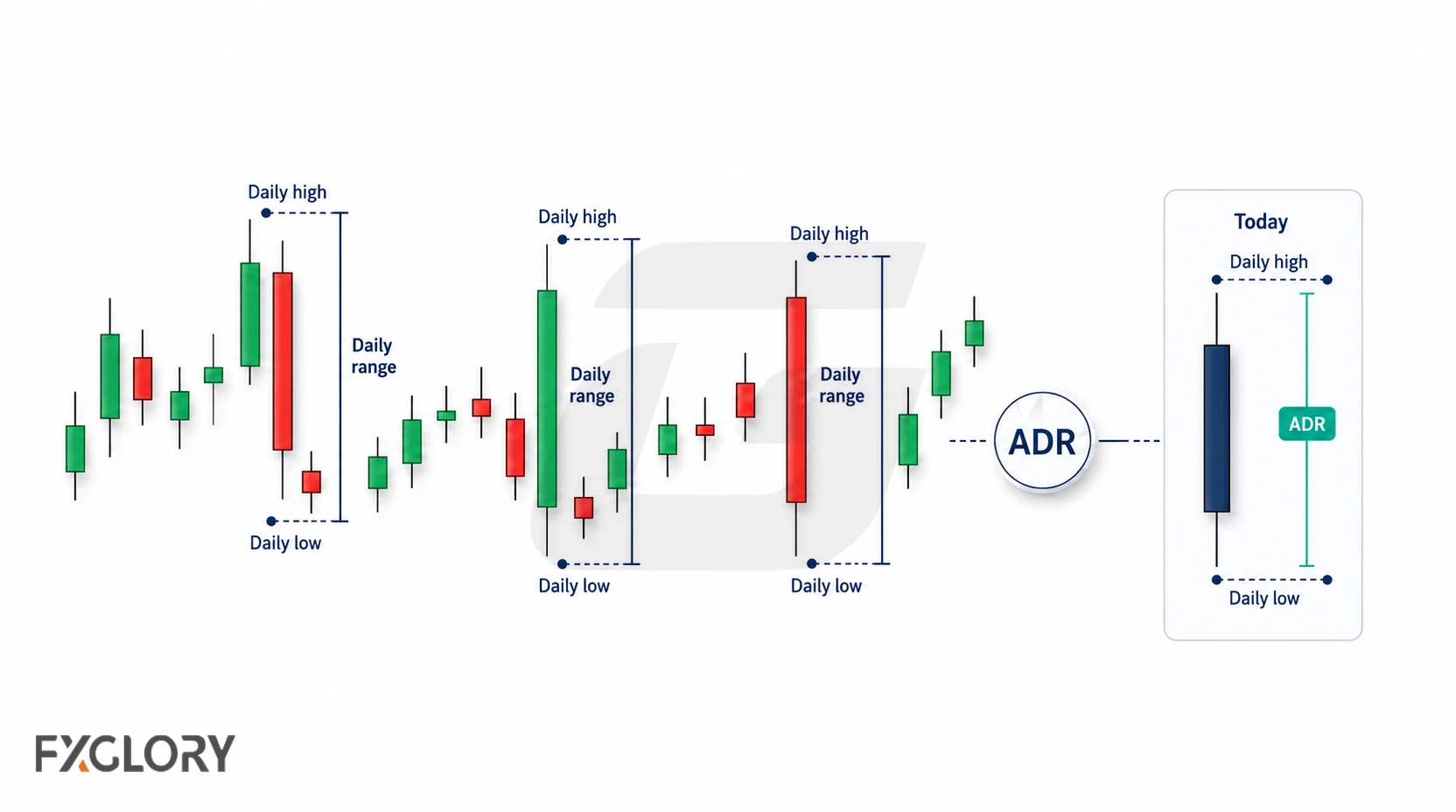
The Average Daily Range forex indicator, often shortened to ADR, measures how far a currency pair usually moves in one trading day. It focuses on the daily distance between the high and low over a selected number of past days.
ADR is a volatility and range tool. It does not show whether the pair should rise or fall. Instead, it gives the trader a reference for how much movement is normal for that pair over the selected lookback period.

This makes ADR useful for intraday planning. If a pair usually moves 80 pips per day and has already moved close to that amount, a trader may think more carefully before chasing the same direction without fresh context. If the pair has moved only a small part of its usual range, there may still be room for movement, but direction still needs a separate reason.

ADR belongs with technical indicators used for volatility and range analysis. It should not replace price action, support and resistance, trend structure, or risk planning.

Plain-English idea: ADR answers a range question: how far does this pair usually move in a day, and how much of that range may already be used?

Average Daily Range Formula

A common ADR calculation starts with the daily range:
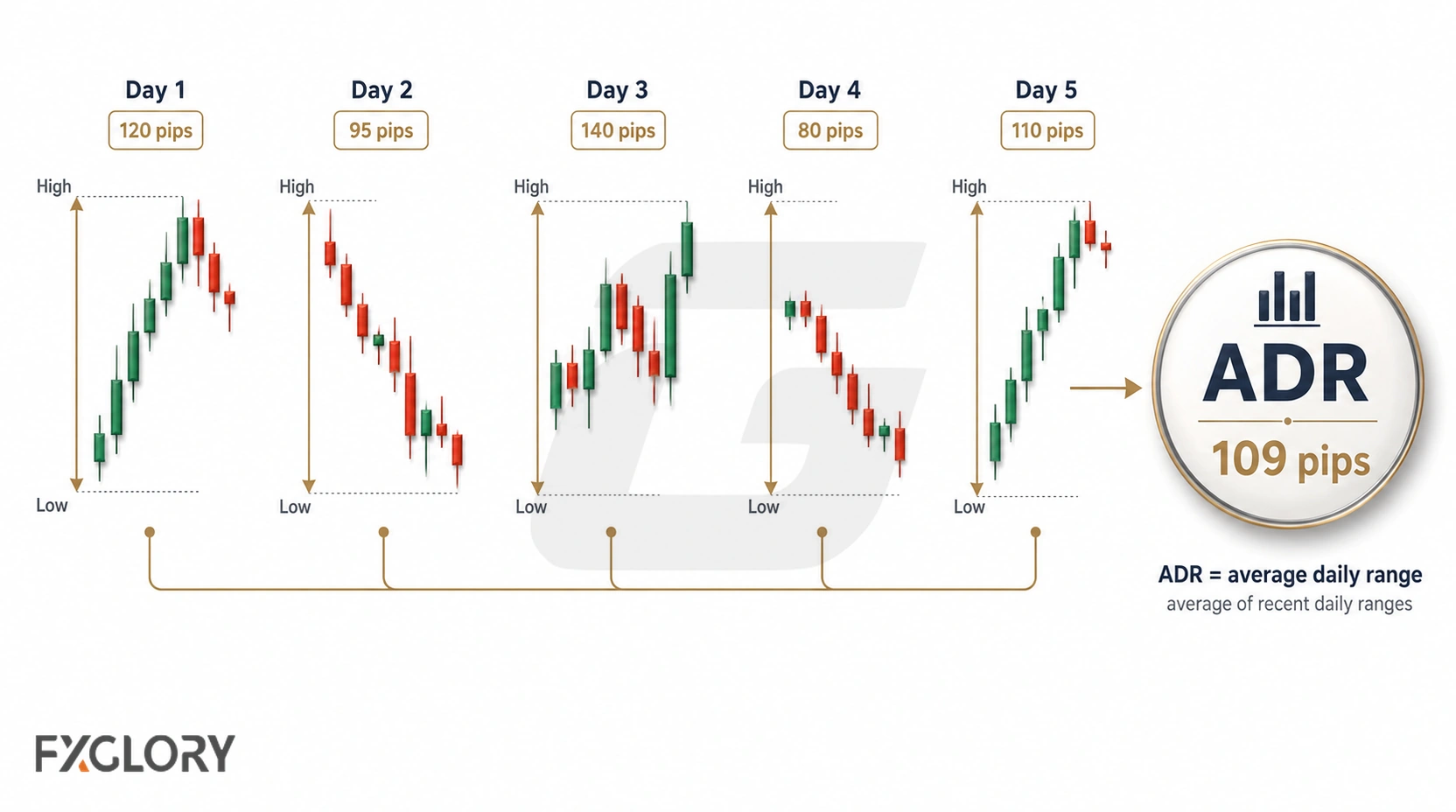
Daily Range = Daily High - Daily Low

Then the indicator averages those daily ranges over a selected number of days:

ADR = Sum of Daily Ranges over N days / N

For example, if a trader uses a 10-day ADR, the indicator reviews the high-low range of each of the last 10 days, adds those ranges together, and divides by 10. The result shows the average daily movement for that period.

ADR can be shown in pips, points, or percentage terms depending on the platform and market. In forex education, it is often discussed in pips because traders commonly compare currency-pair movement that way.

Calculation note: Not every ADR tool is built the same way. Some tools project range markers from the daily open, while others use the current high, current low, or custom upper and lower boundaries. Always check the indicator settings before comparing readings.

How ADR Works on a Forex Chart

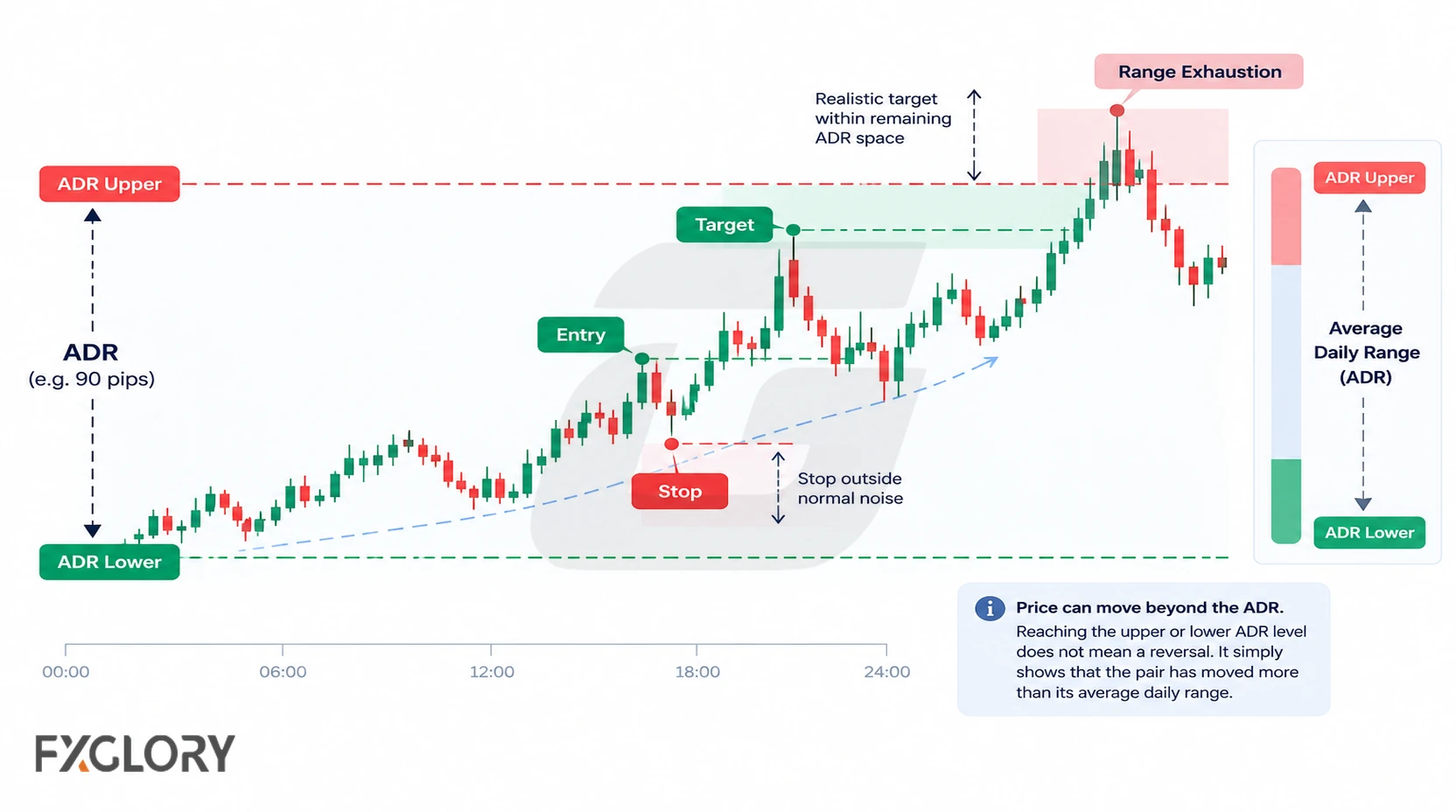
On a chart, ADR may appear as a number, a percentage of range used, or projected upper and lower range areas. The purpose is to compare current price movement with the pair’s normal daily movement.
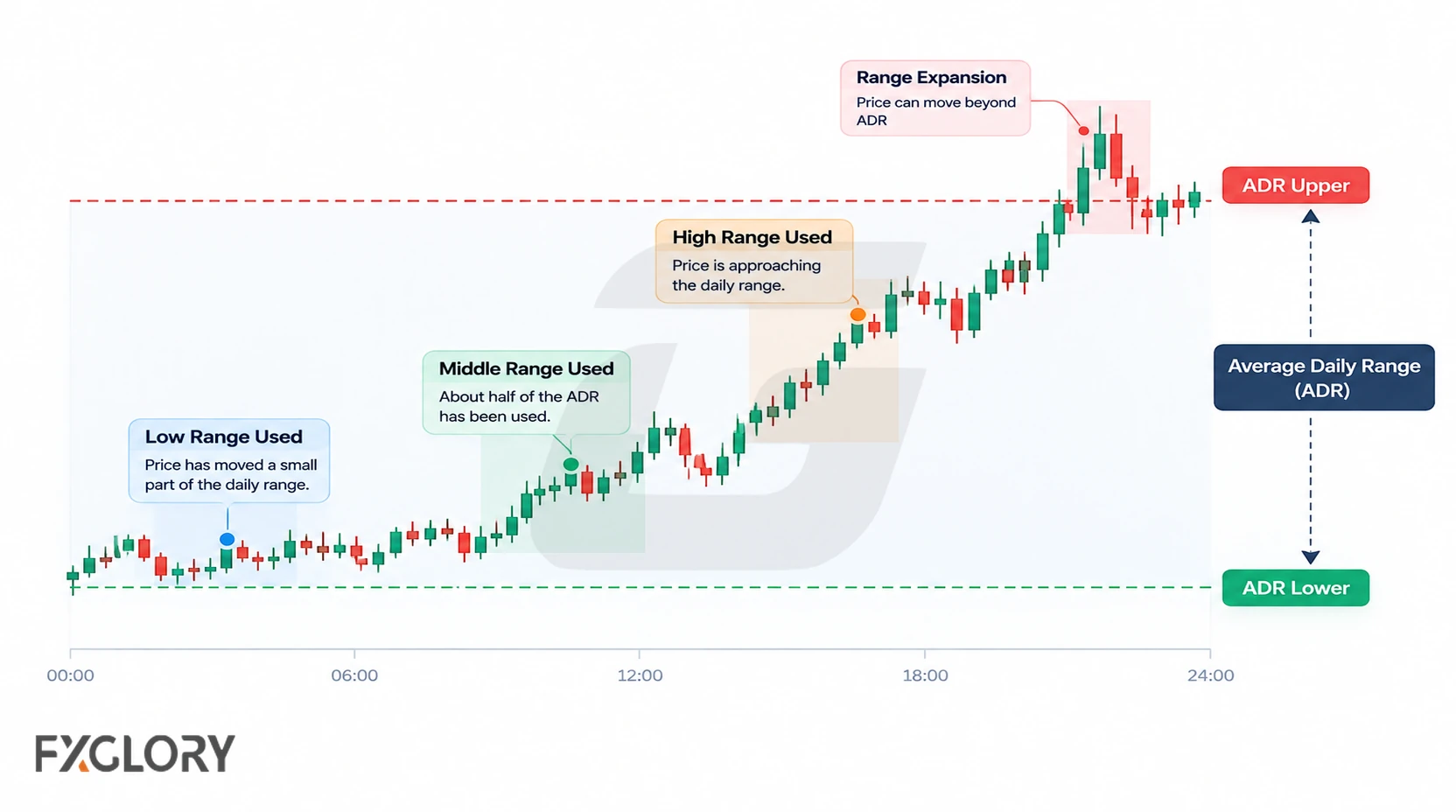
Some ADR tools show how far price is from the current day’s high or low. Others plot projected daily range boundaries. These visual levels can help traders ask whether the current move is still developing, already stretched, or moving beyond normal range for the selected period.

ADR does not decide whether price should reverse at a boundary. A pair can exceed its average daily range during strong trends, high-impact news, or wider volatility conditions. The indicator gives context, not certainty.

For broader background, traders can compare ADR with other tools used for reading range expansion and contraction.

  • Low range used: Price has moved only a small part of its average daily range.
  • Middle range used: Price is moving inside a more normal daily movement window.
  • High range used: Price is close to or beyond its usual range for the selected period.
  • Range expansion: Price moves beyond the usual range, often because volatility has increased.

ADR Settings: 5, 10, 14, and 20 Days

The ADR period controls how many previous daily ranges are included in the average. A shorter setting reacts faster to recent volatility, while a longer setting smooths the reading.
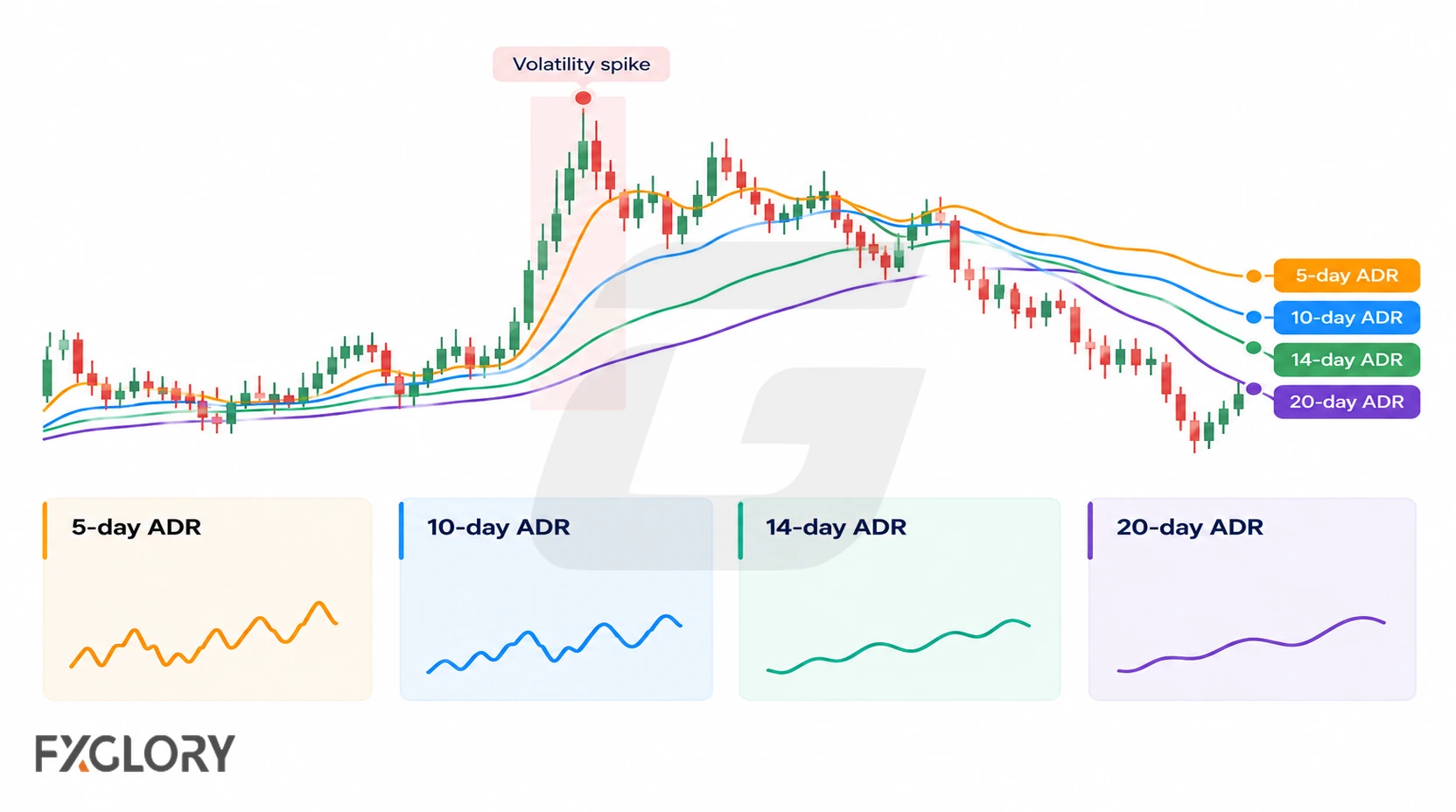
  • 5-day ADR: Reacts quickly to the most recent week of trading. It can adapt fast but may be more sensitive to one unusual day.
  • 10-day ADR: Gives a short-term view that many intraday traders find easier to compare with recent conditions.
  • 14-day ADR: Offers a balanced setting that sits close to common volatility-indicator lookback periods.
  • 20-day ADR: Gives a smoother view of roughly one trading month of daily movement.

No setting is automatically best. A trader studying short-term range may prefer a shorter ADR, while a trader comparing broader pair behavior may prefer a longer one. The important point is to keep the setting consistent during review.

Setting rule: Changing the ADR period changes the reading. A 5-day ADR and a 20-day ADR can give different range expectations on the same pair.

How Much of Today’s ADR Has Price Used?

One of the most practical ADR questions is how much of the day’s normal range has already been used. This can be estimated by comparing the current day’s high-low range with the ADR value.
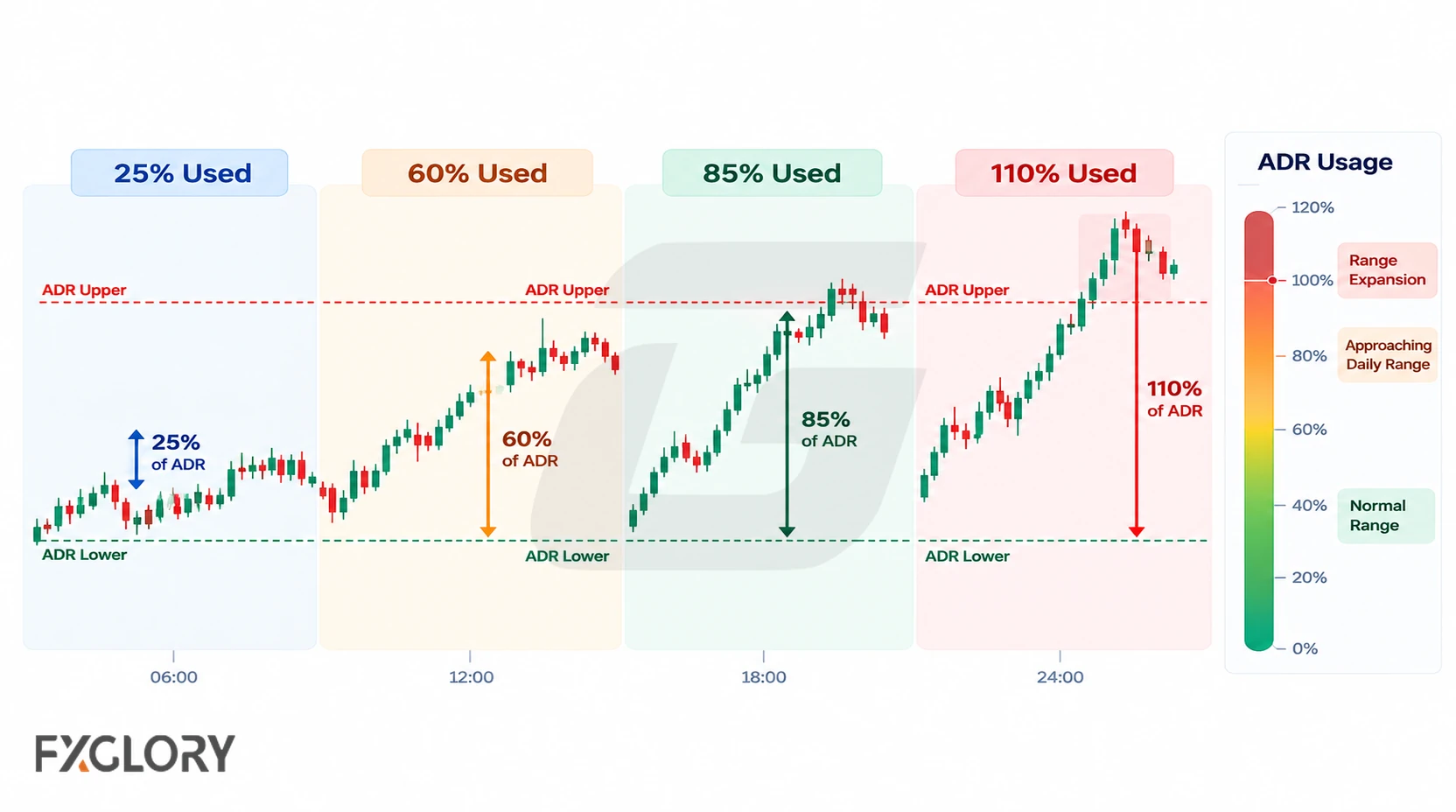
Range Used % = Current Day Range / ADR × 100

Suppose a pair has a 90-pip ADR and today’s high-low range is already 75 pips. The pair has used about 83% of its average daily range. That does not mean the move must stop, but it does tell the trader that the day is already close to its normal movement for the selected ADR period.

This is where ADR can help prevent unrealistic planning. If a target requires another large move after most of the average range has already been used, the trader needs a stronger reason than the target simply looking attractive on the chart.

Range-used rule: A high ADR percentage is not a reversal signal. It is a warning to check trend strength, news, session timing, price action, and nearby levels before chasing.

Using ADR for Targets, Stops, and Range Exhaustion

ADR can help traders review whether a target or stop is realistic compared with the pair’s normal daily movement. It is not a target generator by itself, and it should not be the only reason for stop placement.

ADR and Intraday Targets

If a pair has already moved close to its average daily range, a far target in the same direction may need fresh momentum, news, or volatility expansion to remain realistic. If the pair has used only a small part of its ADR, there may be more room for movement, but the trader still needs direction, structure, and confirmation.

ADR and Stop Distance

A stop that is too tight relative to current volatility may be hit by normal movement. A stop that is too wide may create poor risk. ADR can provide daily range context, while the difference between ADR and ATR becomes important when the trader needs true-range volatility context.

ADR and Range Exhaustion

Range exhaustion means price has already traveled a large part of its usual daily movement. Some traders watch this area for slowdown, consolidation, or a possible pullback. Safer analysis does not assume reversal. It asks whether price is still accepting higher or lower prices, or whether momentum is starting to weaken.

Range exhaustion is a caution zone, not a reversal setup. Price can still continue beyond ADR during strong trends, news-driven movement, or wider volatility conditions.

ADR boundaries can also overlap with other references. For example, daily levels that may overlap with ADR boundaries can create an area to watch, but the overlap still needs reaction and invalidation.

ADR vs ATR: What Is the Difference?

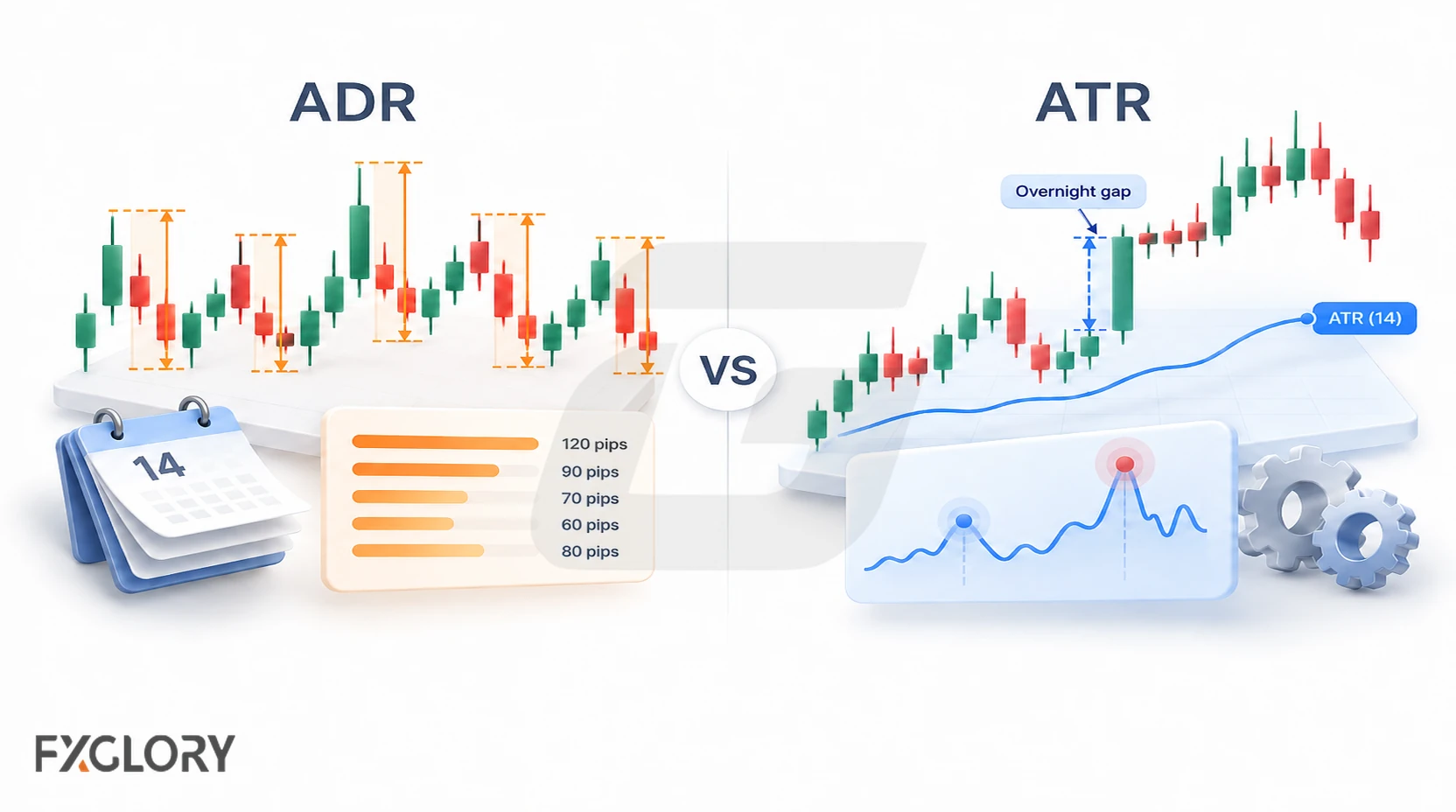
ADR and ATR both help traders think about volatility, but they are not the same tool.

  • ADR: Usually averages the daily high-low range. It is useful for understanding typical daily movement and intraday range expectations.
  • ATR: Uses true range logic, which can include the relationship between the current range and the previous close. It is often used for broader volatility context and stop-distance planning.
  • ADR question: How far does this pair usually move in a day?
  • ATR question: How much true-range volatility is this market showing over the selected period?

ADR is often simpler for day-range analysis. ATR is often better when the trader wants a fuller volatility measure, especially where gaps, sharp opens, or prior-close movement matter. Traders who need broader volatility context can compare ADR with ATR-based range analysis.

ADR is usually more useful for daily range expectation, while ATR is the stronger reference when true range, gaps, or stop-distance planning are the main question.

ADR on TradingView, MT4, and MT5

ADR tools can appear differently depending on the platform. TradingView provides an ADR indicator with settings such as length, timeframe, style, precision, and visibility. On MT4 and MT5, ADR is commonly used through custom indicators or scripts, so traders should verify the source, calculation method, and settings before relying on the output.

  • TradingView: Check length, timeframe, display style, precision, and visibility before comparing ADR readings.
  • MT4 and MT5: Confirm whether the tool is a custom indicator or script and whether it uses daily high-low range or another calculation.
  • Custom ADR tools: Some tools show current range used, distance from daily high or low, or projected ADR boundaries.
  • Data differences: Session time, broker feed, symbol format, and calculation method can cause ADR values to differ across platforms.
Platform caution: Do not install untrusted indicator files or assume two ADR tools calculate the same value. Different session times, symbols, brokers, and settings can change the reading.

Average Daily Range by Currency Pair

ADR can help compare how much different currency pairs usually move. Some pairs often have wider daily movement than others, while quieter pairs may show smaller average ranges. The exact reading changes over time as volatility changes.

This is useful for pair selection. A trader who prefers smaller daily movement may study lower-ADR pairs. A trader who wants more intraday movement may compare pairs with wider ADR readings. A pair with a wider ADR may offer more intraday movement, but it can also require wider stops and stricter position sizing than a quieter pair.

For a live-pair example, traders can compare ADR ideas with live EUR/USD technical readings. The goal is not to predict direction from ADR, but to compare range context with current price behavior and other technical references.

Data note: Avoid treating old ADR tables as permanent rankings. Pair volatility changes with market conditions, central-bank expectations, news, liquidity, and broader risk sentiment.

Average Daily Range Table: How to Read Pair Ranges

An ADR table can help traders compare typical movement across currency pairs. The values should be treated as changing data, not permanent pair rankings. When volatility changes, the table should update with fresh daily high-low data.

The table below shows how an ADR comparison should be structured. Values should be populated from the same data source, session definition, and lookback period so that pair comparisons remain consistent.

PairADR PeriodAverage Daily RangeHow to Read It
EUR/USD10 or 14 daysUse live calculated valueCompare current day movement with the pair’s recent normal range.
GBP/USD10 or 14 daysUse live calculated valueReview whether wider movement also requires wider risk planning.
USD/JPY10 or 14 daysUse live calculated valueCheck whether current volatility is normal or expanding.
XAU/USD10 or 14 daysUse live calculated valueUse extra caution because wider movement can change stop and target assumptions.
Table rule: ADR table values should update regularly. A static value can become misleading when volatility changes.

Common ADR Mistakes and Limits

ADR is simple, but it can be misused when traders treat the average range as a hard boundary. Averages describe past movement. They do not control future price.

  • Assuming reversal at 100% ADR: Price can exceed its average daily range during strong trends or news.
  • Ignoring session timing: Range behavior can differ between Asian, London, and New York sessions.
  • Using stale settings: A long ADR period may react slowly after volatility changes, while a short period may overreact to one unusual day.
  • Confusing ADR with direction: ADR measures range, not bullish or bearish trend.
  • Forcing targets: A target beyond normal daily range needs stronger supporting context.
  • Ignoring spread and slippage: Wider spreads or fast movement can change trade execution around range boundaries.
  • Comparing different ADR tools blindly: Different tools may use different session data or calculations.

When ADR Is Less Useful

ADR is less useful when a major news event changes volatility, when the market is moving in an unusually strong trend, when session data is inconsistent, or when the trader cannot define invalidation clearly.

  • Do not use ADR as a reversal signal by itself.
  • Do not treat ADR as a complete trading system.
  • Do not use ADR to ignore trend, support and resistance, or news risk.
  • Do not assume average range means maximum range.

Final Thoughts on the Average Daily Range Forex Indicator

The Average Daily Range forex indicator is most useful when it is treated as a daily range reference. It helps traders understand normal movement, compare volatility between pairs, and judge whether a same-day move may already be stretched.

Good ADR analysis stays practical: choose a consistent setting, compare current range with average range, check whether price still has context to continue, and define invalidation before using the information in a plan.

ADR does not predict direction or guarantee exhaustion. It gives range context, and that context becomes more useful when combined with price action, volatility, technical structure, and risk control.

Frequently Asked Questions

What is the Average Daily Range forex indicator?

The Average Daily Range forex indicator, or ADR, measures the average high-low movement of a currency pair over a selected number of days. It helps traders understand how much a pair usually moves during a trading day.

How is ADR calculated in forex?

A common ADR calculation takes each day’s high-low range, adds the ranges over a selected number of days, and divides the total by that number of days.

Is ADR a volatility indicator?

Yes. ADR is best understood as a volatility and range indicator because it measures typical daily movement. It does not show trend direction by itself.

What is the difference between ADR and ATR?

ADR usually measures average daily high-low movement. ATR measures average true range, which can include true range logic based on the previous close. ADR is often used for daily range expectations, while ATR is often used for broader volatility and stop-distance context.

What ADR setting is best for forex?

There is no single best ADR setting for every pair or trader. A 5-day ADR reacts quickly to recent volatility, 10 or 14 days gives a more balanced short-term reading, and 20 days gives a smoother view of recent daily range.

Can ADR predict reversals?

No. ADR does not predict reversals. If price has already moved close to or beyond its average daily range, traders may become more cautious about chasing the move, but price can still continue during strong trends or news-driven conditions.

How do traders use ADR in forex trading?

Traders commonly use ADR to estimate daily range expectations, compare volatility between pairs, judge whether a move is already stretched, and review whether targets or stops are realistic for current market conditions.

Does ADR work on TradingView, MT4, or MT5?

TradingView provides an ADR indicator with settings such as length, timeframe, style, precision, and visibility. On MT4 and MT5, ADR is commonly used through custom indicators or scripts, so traders should verify the calculation method and source.

Is ADR useful for scalping and day trading?

ADR can be useful for intraday traders because it gives daily range context. It should still be combined with price action, spread, session timing, volatility, and invalidation.

Can ADR be used with support and resistance?

Yes. ADR boundaries may overlap with support, resistance, pivot points, or previous highs and lows. The overlap can create an area to watch, but it should not be treated as a signal by itself.

Related Contents

Forex Technical IndicatorsReview how indicators are grouped by trend, momentum, volatility, volume, and other chart-reading jobs.
Volatility Forex IndicatorLearn how volatility tools help traders read range expansion, contraction, and changing market movement.
ATR Indicator ForexCompare ADR with ATR and learn how true range is used for volatility and stop-distance context.
EUR/USD Technical AnalysisReview live EUR/USD technical readings when comparing range context with other technical references.

Practice ADR Analysis on Demo

Use an FXGlory demo account to practice reading average daily range, comparing volatility between pairs, and testing trade decisions before using real funds.

Open a Demo Account