

What Is An Inside Bar In Forex?
An inside bar in forex is a two-candle formation where the second candle forms completely inside the high-low range of the previous candle. The previous candle is often called the mother bar, and the smaller contained candle is called the inside bar.
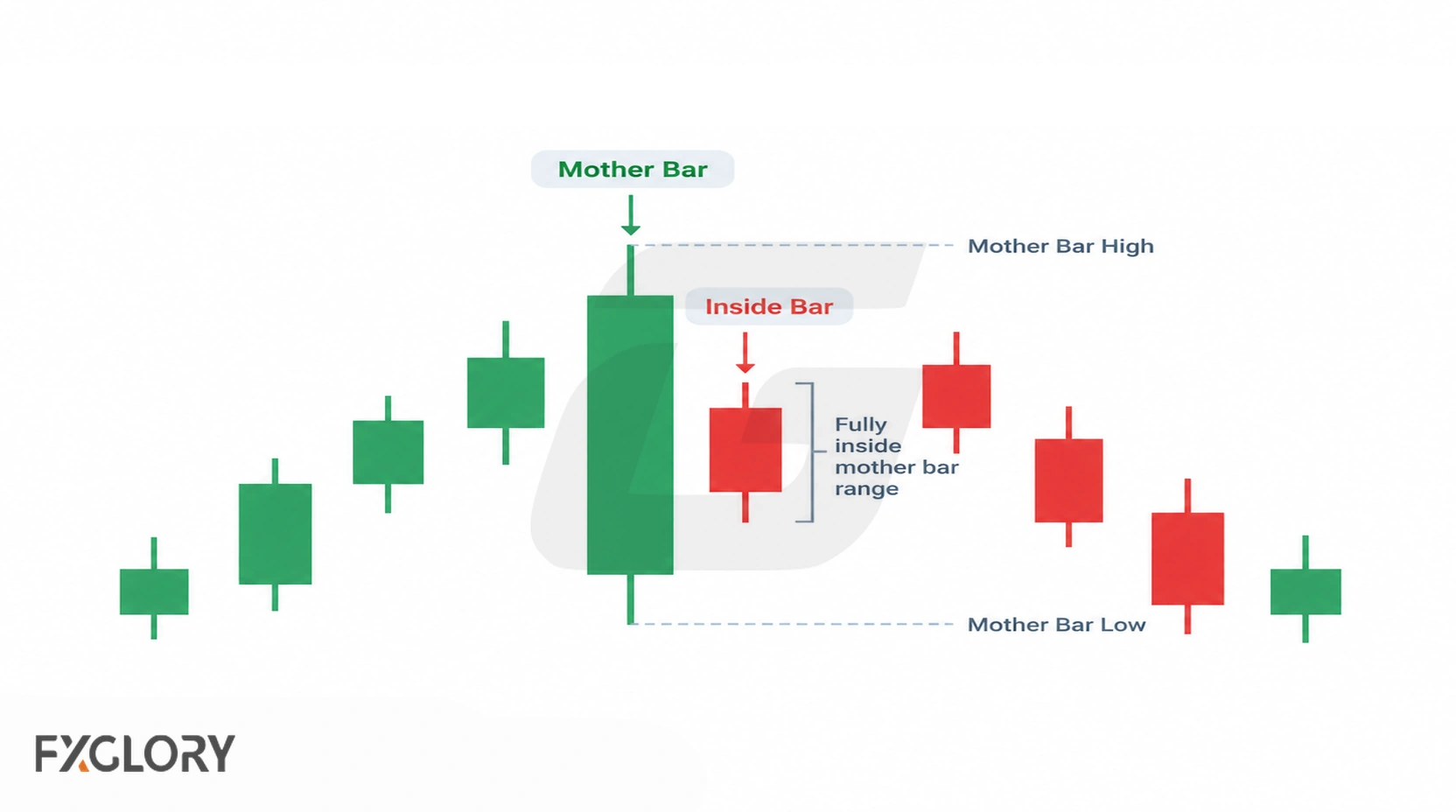
An inside bar describes one-candle range contraction relative to the mother bar. It does not by itself prove a broader decrease in market volatility or confirm a future breakout, trend continuation, or reversal.
If you need candle anatomy first, review the open, high, low, close, body, and wick relationship. Inside bars use those same candle parts, but compare two completed candles instead of one.
Inside Bar Anatomy: Mother Bar And Inside Candle
The first candle in the pattern is the mother bar. It creates the range that the next candle must stay inside. The second candle is the inside bar. It should have a smaller high-low range than the mother bar and sit fully within the mother bar's high and low.
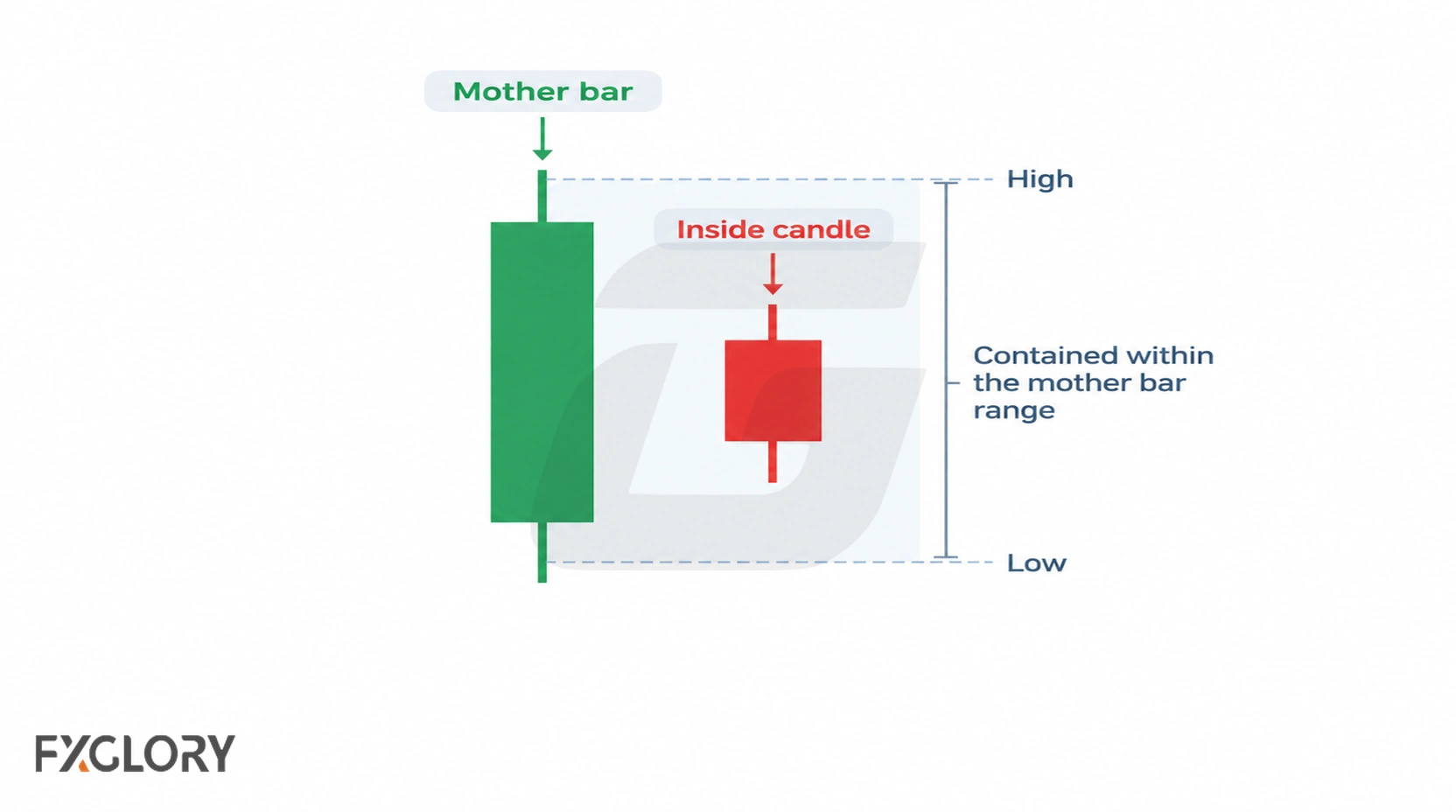
The mother bar can be bullish or bearish. The inside bar can also be bullish, bearish, doji-like, or small-bodied. Candle color can add context, but it does not define the formation. The high-low containment does.
| Inside Bar Part | Structure | What It Shows | Reading Caution |
|---|---|---|---|
| Mother bar | The first candle with the wider high-low range. | Creates the range that contains the second candle. | A very large mother bar may reflect news or abnormal volatility. |
| Inside bar | The second candle with a lower high and higher low. | Shows narrower movement during the next candle period. | The candle should be reviewed after it closes. |
| Mother bar high | The upper boundary of the pattern. | Marks the top of the containment range. | A break above it can still fail and return inside the range. |
| Mother bar low | The lower boundary of the pattern. | Marks the bottom of the containment range. | A break below it can still fail and return inside the range. |
| Inside bar body | May be bullish, bearish, small, or doji-like. | Can add extra context, but does not define the pattern. | Body-only containment belongs closer to harami logic. |
Wait for the second candle to complete before classifying it. A still-forming candle can move outside the mother bar’s boundaries before closing.
Strict vs Loose Inside Bar Definitions
A strict inside bar has a lower high and higher low than the mother bar. This is the cleanest version because the second candle is fully contained inside the prior candle's range.
Hypothetical example: If a mother bar has a high of 1.1050 and a low of 1.1000, a completed next candle with a high of 1.1040 and a low of 1.1010 is strictly inside. A high of 1.1050 with the same low is an equal-high variant, not a strict inside bar. These prices are illustrative, not observed market data.
Some chart readers also track equal-high or equal-low variants. These satisfy non-strict containment conventions rather than the strict definition; equality does not itself demonstrate an inferior signal, and neither version guarantees a useful trade.
In forex, small differences can also appear because of broker feed, spread, liquidity, and timeframe settings. A candle that looks like an exact inside bar on one platform may have a marginally different high or low on another. This does not mean every near-inside candle should be forced into the label.
| Version | Structure | How To Read It | Caution |
|---|---|---|---|
| Strict inside bar | Second candle has lower high and higher low than the mother bar. | Clean range compression. | Still needs context and follow-up movement. |
| Equal-high version | Second candle high equals the mother bar high, but low remains higher. | Loose compression with upper-side contact. | Less clean than strict containment. |
| Equal-low version | Second candle low equals the mother bar low, but high remains lower. | Loose compression with lower-side contact. | Less clean than strict containment. |
| Boundary-breach version | Second candle breaks above or below the mother bar range. | Not a strict inside bar. | A one-sided breach is not necessarily an outside bar, which requires both extremes to be exceeded. |
What An Inside Bar Shows About Compression
The smaller second-candle range may reflect a pause after an unusually wide mother bar or consolidation within an existing market structure. Assess sustained volatility separately over multiple bars rather than inferring it from this pair alone.
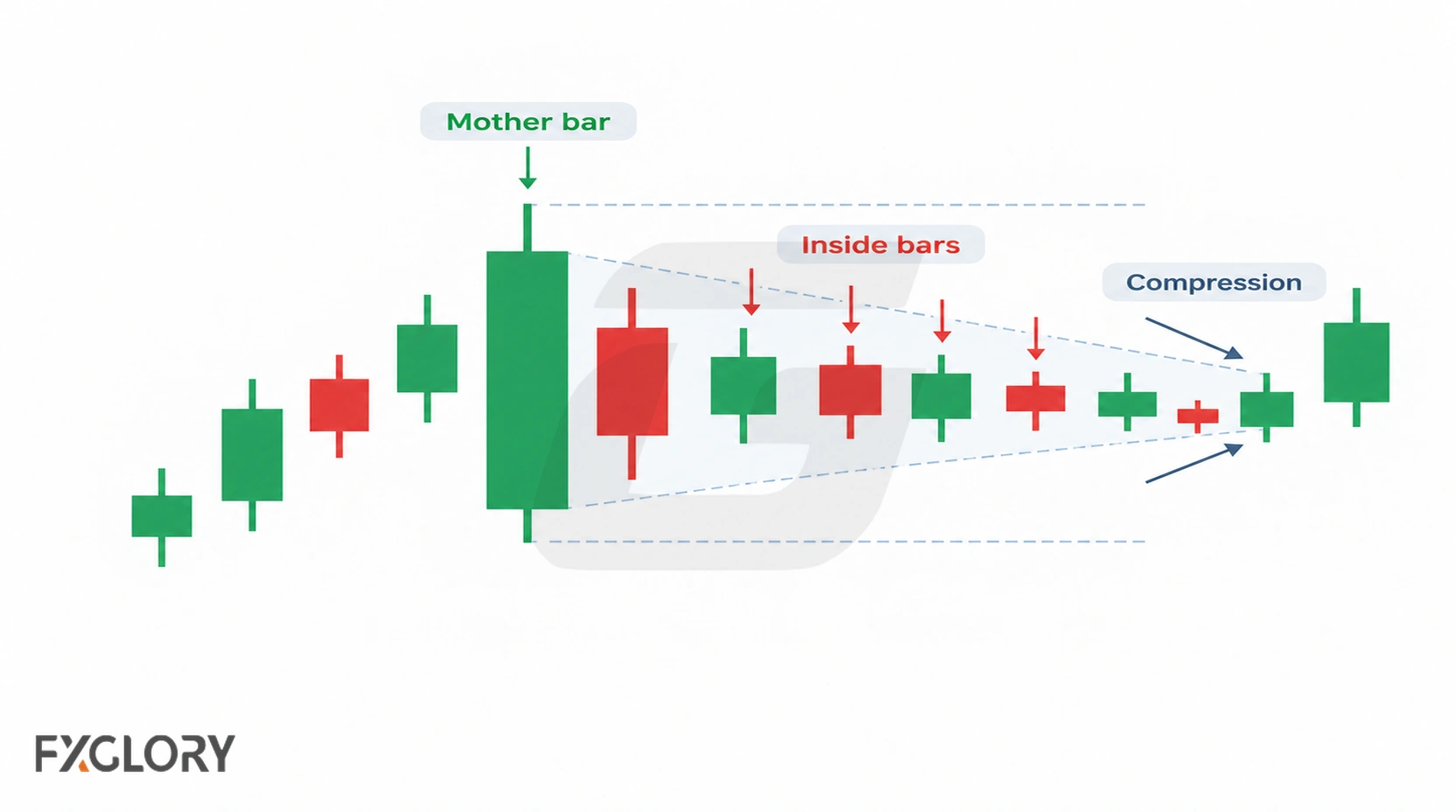
Compression narrows the range, but the next candles decide whether that range remains respected, breaks cleanly, turns into a false break, or continues sideways. The inside bar itself does not choose the next direction.
The inside bar's meaning changes with the candle before it. If the mother bar was very large, the inside bar may only show a pause after fast movement. If the mother bar formed near support or resistance, the inside bar may show hesitation around that area. If both candles appear in the middle of a choppy range, the pattern may be weak.
- After a wide candle: The inside bar may show a pause after expansion.
- Inside a trend: The inside bar may show temporary consolidation within the broader direction.
- Near a level: The inside bar may show hesitation around support, resistance, a range edge, or a swing point.
- Inside a messy range: The inside bar may be ordinary overlap with limited meaning.
Inside Bar In Trend, Range, Support, And Resistance Context
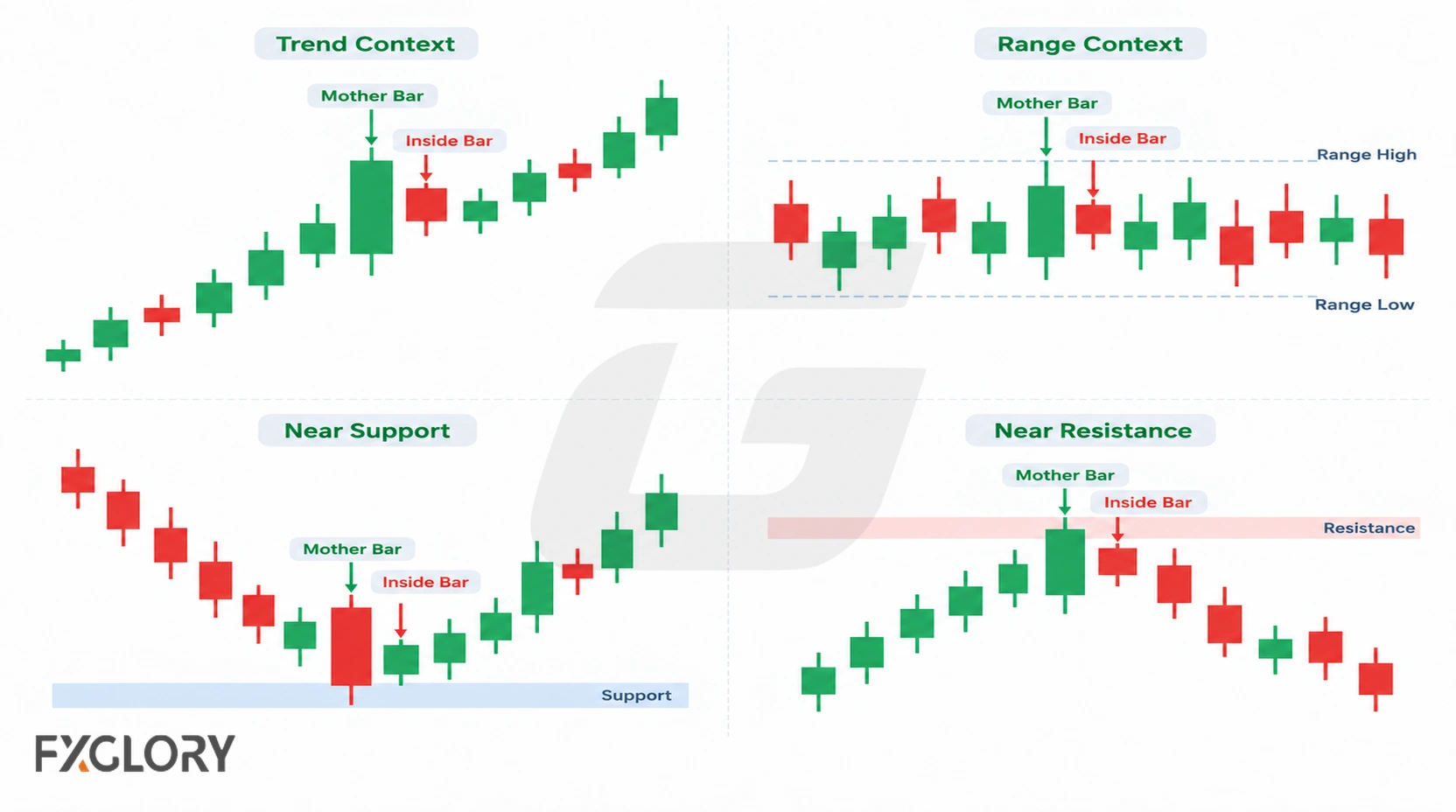
An inside bar becomes easier to interpret when it appears in a clear chart environment. The same two-candle structure can carry different meaning in a trend, a range, after a sharp move, or near a tested level.
Inside Bar After A Trend Move
An inside bar can appear after a directional candle in an existing trend. In that setting, it may show that price paused inside the prior candle's range before the market decides whether the broader move continues, slows, or fails.
A trend-context inside bar is usually clearer when the broader structure is already visible. If the market is choppy, overlapping, or moving without direction, the inside bar may simply be another small candle inside noise.
Inside Bar Near Support
An inside bar near support can show reduced movement after price tests a lower area. The pattern does not confirm that support will hold, but the location gives the compression a clearer reference point.
Inside Bar Near Resistance
An inside bar near resistance can show reduced movement after price tests a higher area. The pattern does not confirm that resistance will hold, but the location helps explain why the mother bar range may matter.
Inside Bar Inside A Range
Inside bars can appear often inside sideways markets. Near range edges, they may be easier to review because the edge gives them a location. In the middle of a range, they can be less useful because overlapping candles are common there.
Inside Bar After News Or Wide Volatility
An inside bar after a large news candle may look clean, but the mother bar may be wide because conditions were unstable. Spread, slippage, and fast price movement can make the structure difficult to interpret in real time.
For observation, a trader can compare inside-bar compression on live market pages such as GBP/USD during active session movement or gold during wider candle ranges. These pages are useful for chart review, not as standalone trading reasons.
Context quality: An orderly trend or tested range edge makes the containment easier to interpret; extensive candle overlap, an unusually large news-driven mother bar, or thin-liquidity conditions can make the pattern less informative. These are contextual judgments, not changes to the inside-bar definition.
Multiple Inside Bars And Coiling Inside Bars
Sometimes more than one inside bar forms inside the same mother bar. This creates a longer compression phase because several candles remain trapped within the original mother bar range.
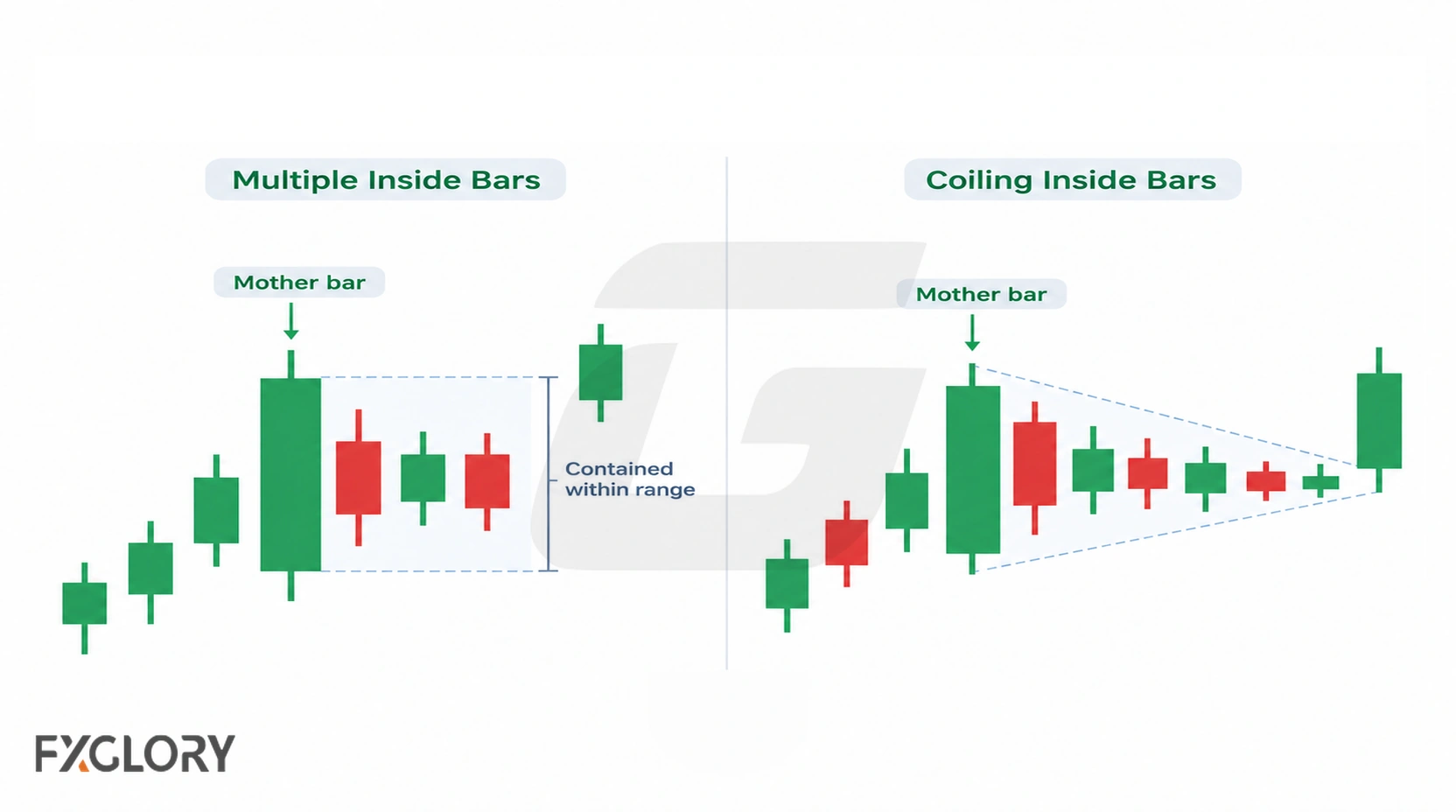
Multiple inside bars can show that price continues to narrow after a larger candle. Some traders call this coiling because the chart appears to compress inside the mother bar before later movement expands. The name does not make the pattern predictive. It only describes the way candles are forming inside the earlier range.
| Structure | What It Looks Like | Possible Reading | Caution |
|---|---|---|---|
| Single inside bar | One candle inside the mother bar range. | Basic two-candle compression. | Needs chart context. |
| Double inside bar | Two candles remain inside the same mother bar range. | Longer pause or narrowing movement. | Can still break falsely or remain sideways. |
| Coiling inside bars | Several candles compress within the mother bar or inside each other. | Extended compression. | More candles do not guarantee cleaner direction. |
When multiple inside bars appear, the mother bar high and low remain important reference points because they define the original containment area.
Inside Bar vs Three Inside Up And Three Inside Down
Three Inside Up and Three Inside Down are traditionally three-candle reversal formations built from a harami-type real-body containment relationship and a subsequent confirming candle. The second candle does not have to satisfy full high-low inside-bar containment.
An inside bar is identified using two completed candles and full-range containment. Three Inside Up/Down adds a directional third candle and relies on a different, body-based middle-candle condition.
| Formation | Basic Structure | How It Differs From Inside Bar |
|---|---|---|
| Inside bar | Second candle range sits inside the prior candle range. | Two-candle compression structure. |
| Three inside up | Bearish first candle; smaller second real body inside the first body; a third bullish candle confirming upward movement. | Three-candle harami-based bullish reversal formation, not necessarily a strict inside bar. |
| Three inside down | Bullish first candle; smaller second real body inside the first body; a third bearish candle confirming downward movement. | Three-candle harami-based bearish reversal formation, not necessarily a strict inside bar. |
Inside Bar Position Inside The Mother Bar
The inside bar's location within the mother bar can add context. An inside bar near the upper part of the mother bar range may look different from one near the lower part or one in the middle.
This detail should be used carefully. The position of the inside bar can help describe the compression, but it still does not decide the next direction.
| Inside Bar Position | Possible Reading | What To Check |
|---|---|---|
| Near the upper part of the mother bar | Price compressed closer to the mother bar high. | Check resistance, trend context, and later movement. |
| Near the lower part of the mother bar | Price compressed closer to the mother bar low. | Check support, trend context, and later movement. |
| Near the middle of the mother bar | Price paused in the center of the prior range. | May be less useful without a clear level. |
| Very small inside bar inside a large mother bar | Strong compression after a wide range. | Check whether the mother bar was news-driven or abnormal. |
Inside Bar vs Harami
Inside bar and harami are often confused because both involve a smaller second candle after a larger first candle. The difference is the measurement.
An inside bar is defined by full range containment. The second candle's high must sit below the mother bar high, and the second candle's low must sit above the mother bar low. The full wick-to-wick range matters.
A traditional harami is defined by the second candle’s real body being contained within the first candle’s real body. The second candle’s wicks may extend beyond that body, so full-range containment is not required. By contrast, an inside bar is measured from high to low, including both wicks.
| Pattern | Main Measurement | Core Structure | Best Deeper Guide |
|---|---|---|---|
| Inside bar | High-low range. | Second candle's full range sits inside the mother bar's full range. | This page. |
| Harami | Body relationship. | Second candle’s real body is contained within the first candle’s real body; wicks need not be contained. | inside-body contraction explained in the harami guide. |
Some formations meet both definitions. Check the complete high-low ranges for an inside bar, and compare real-body boundaries for a harami. Neither pattern alone establishes future direction.
Inside Bar vs Outside Bar
Inside and outside bars describe contrasting two-candle range relationships. An outside bar exceeds both the preceding high and low; a candle that breaches just one boundary is neither a strict inside bar nor necessarily an outside bar.
| Pattern | Second Candle Range | Common Chart Message | Main Difference |
|---|---|---|---|
| Inside bar | High is lower than prior high, and low is higher than prior low. | Narrower second-candle range or a pause. | Second candle is contained inside the mother bar. |
| Outside bar | High breaks above prior high, and low breaks below prior low. | Expansion, wider movement, or a broader range test. | Second candle expands beyond the previous candle. |
This comparison is important because both patterns use the full high-low range. The inside bar asks whether the second candle stayed inside the previous range. The outside bar asks whether the second candle moved beyond both sides of the previous range.
Inside Bar vs Engulfing
Inside bar and engulfing formations point in opposite structural directions. Inside bar contracts. Engulfing expands through body takeover.
In an engulfing formation, the second candle's body overtakes the previous candle's body. In an inside bar, the second candle's full high-low range is contained inside the mother bar. This makes inside bar a compression pattern and engulfing a pressure-shift pattern.
| Pattern | Main Focus | Core Difference |
|---|---|---|
| Inside bar | Full range containment. | Second candle narrows inside the mother bar. |
| Engulfing candle | Body takeover. | Second candle body overtakes the previous body. |
For the two-candle body-takeover structure, review the engulfing candle pressure-shift guide.
Inside Bar vs Doji, Spinning Top, And Pin Bar
Inside bar is a two-candle pattern. Doji, spinning top, and pin bar are single-candle structures. This difference matters because a single small or long-wick candle does not become an inside bar unless it forms inside the previous candle's range.
| Candle Or Pattern | Structure | How It Differs From Inside Bar |
|---|---|---|
| Doji | Open and close are the same or nearly the same. | One-candle open-close balance, not two-candle range containment. |
| Spinning top | Small body with upper and lower shadows. | One-candle two-sided hesitation, not necessarily inside the prior range. |
| Pin bar | Long wick with close away from the tested extreme. | One-candle rejection structure, not necessarily a contained second candle. |
| Inside bar | Second candle range sits inside the mother bar range. | Two-candle range-compression structure. |
An inside bar can also be shaped like a doji, spinning top, hammer, or pin bar. In that case, two readings exist at the same time: the candle shape describes the second candle, while the inside-bar label describes its relationship to the mother bar.
For single-candle comparisons, review open-close balance in doji candles, two-sided hesitation in spinning tops, or long-wick rejection in pin bars.
How To Identify And Interpret An Inside Bar In Forex
A simple identification workflow can keep the inside bar from being overused. The goal is to confirm the structure first, then decide whether the chart context makes it worth reviewing.
- Wait for the candles to close: Do not label an inside bar while the second candle is still forming.
- Mark the mother bar: Identify the previous candle's high and low.
- Check full range containment: Confirm that the inside bar high is lower and the inside bar low is higher.
- Separate range from body: Do not confuse inside bar with harami body contraction.
- Check the mother bar quality: Review whether the first candle is normal, unusually wide, news-driven, or part of a clear chart structure.
- Check location: Look for trend context, support, resistance, range edge, or swing area.
- Review volatility conditions: Consider spread, rollover, session changes, liquidity, and scheduled news.
- Watch later movement: Review whether price respects, rejects, breaks, or returns inside the mother bar range.
Some traders compare inside bars with technical indicators for context. For example, ATR can help review whether the mother bar or inside bar is unusually large or quiet, Bollinger Bands can add range and expansion context, and RSI can add momentum context around compression. These tools can support chart review, but they do not remove trading risk.
False Breaks Around Inside Bar Patterns
Inside bars are often discussed with false breaks because the mother bar high and low create obvious reference points. Price may move beyond one side of the mother bar range and then return back inside or move in the opposite direction.
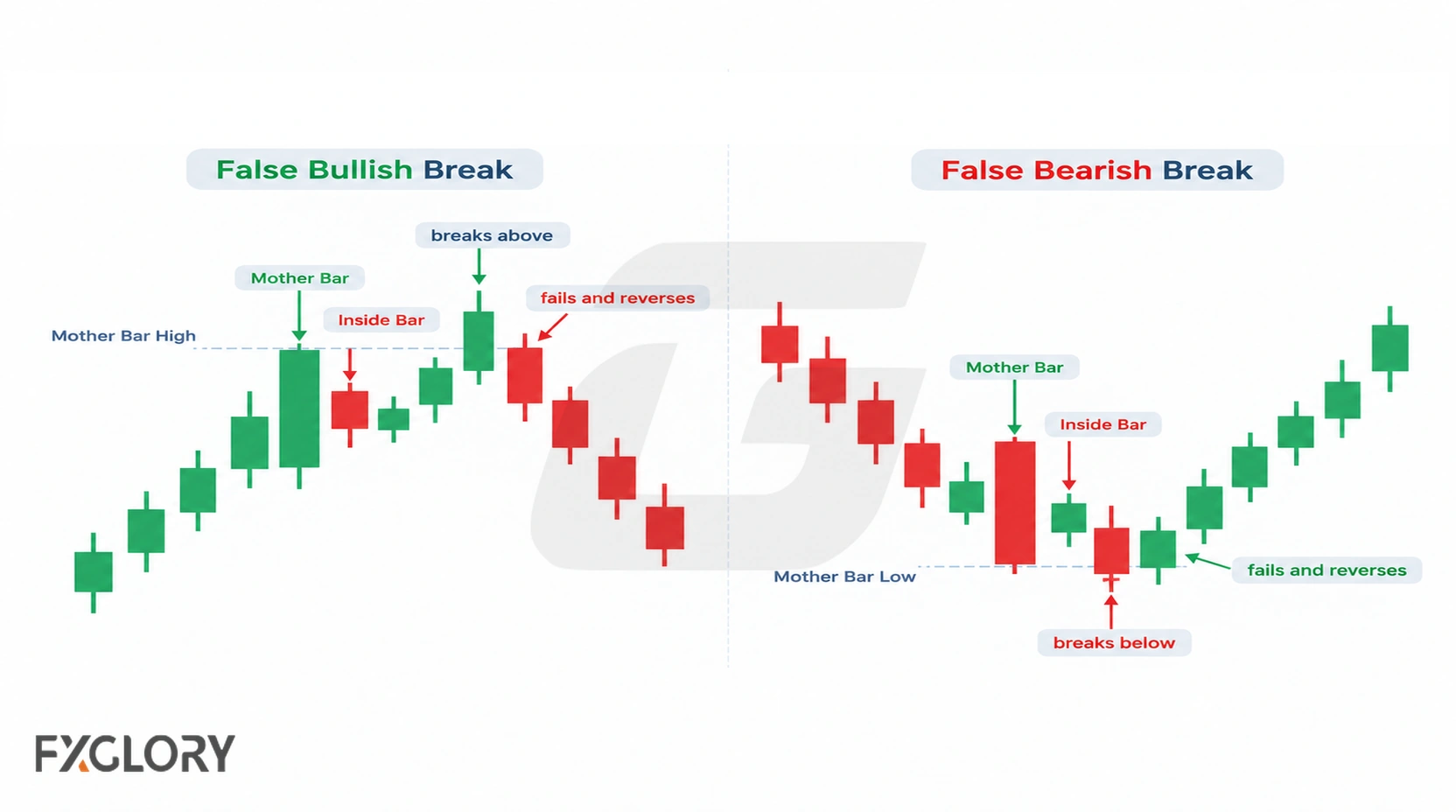
Some traders describe false-break sequences around inside bars as fakey or hikkake setups, although those labels may carry additional formation rules. A brief intrabar breach followed by a return inside is different from a failed confirmed breakout: the latter requires a defined confirmation event, such as a completed close beyond a boundary, before subsequent price action negates it.
| Concept | What It Adds | Safe Reading |
|---|---|---|
| Inside bar | The second candle remains inside the mother bar range. | Compression or pause inside a prior range. |
| False break | Price moves beyond the mother bar range and then returns. | The first break may fail instead of continuing. |
| Fakey logic | A false-break idea around an inside-bar structure. | A caution concept, not a standalone instruction. |
| Hikkake logic | A false-break sequence that starts from inside-bar compression. | A reminder that contained ranges can break and reverse quickly. |
False breaks can happen during news, thin liquidity, session changes, or ordinary range movement. They can also happen when the inside bar forms in a crowded or obvious area where price briefly tests one side of the range and returns.
- Do not assume the first break is final: Price can break the mother bar range and then return.
- Be careful near news: Fast candles can create clean-looking breaks that are difficult to interpret in real time.
- Watch spread and liquidity: Low-liquidity periods can distort candle shapes and range breaks.
- Check the broader chart: A false break may only matter if the pattern formed near a meaningful area.
For inside-bar breakout planning, false-break cancellation rules, stops, targets, and risk controls, use the Forex Inside Bar Strategy guide.
What To Study After Inside Bars
After learning inside bars, the next step is to compare compression with expansion, contraction, and rejection structures. This prevents the inside bar label from being applied to every small second candle.
For the closest two-candle comparison, review harami body contraction and engulfing body takeover. For single-candle rejection comparison, review pin bar long-wick rejection. For trade-planning around the inside bar pattern itself, use the Forex Inside Bar Strategy guide. For the broader pattern library, return to forex candlestick pattern groups.