
What Is A Central Bank Forex Strategy?
A central bank forex strategy is a rule-based way to review how monetary-policy expectations may affect currency pairs. It studies how central banks set or guide interest rates, respond to inflation and growth, communicate future policy, and influence market expectations.
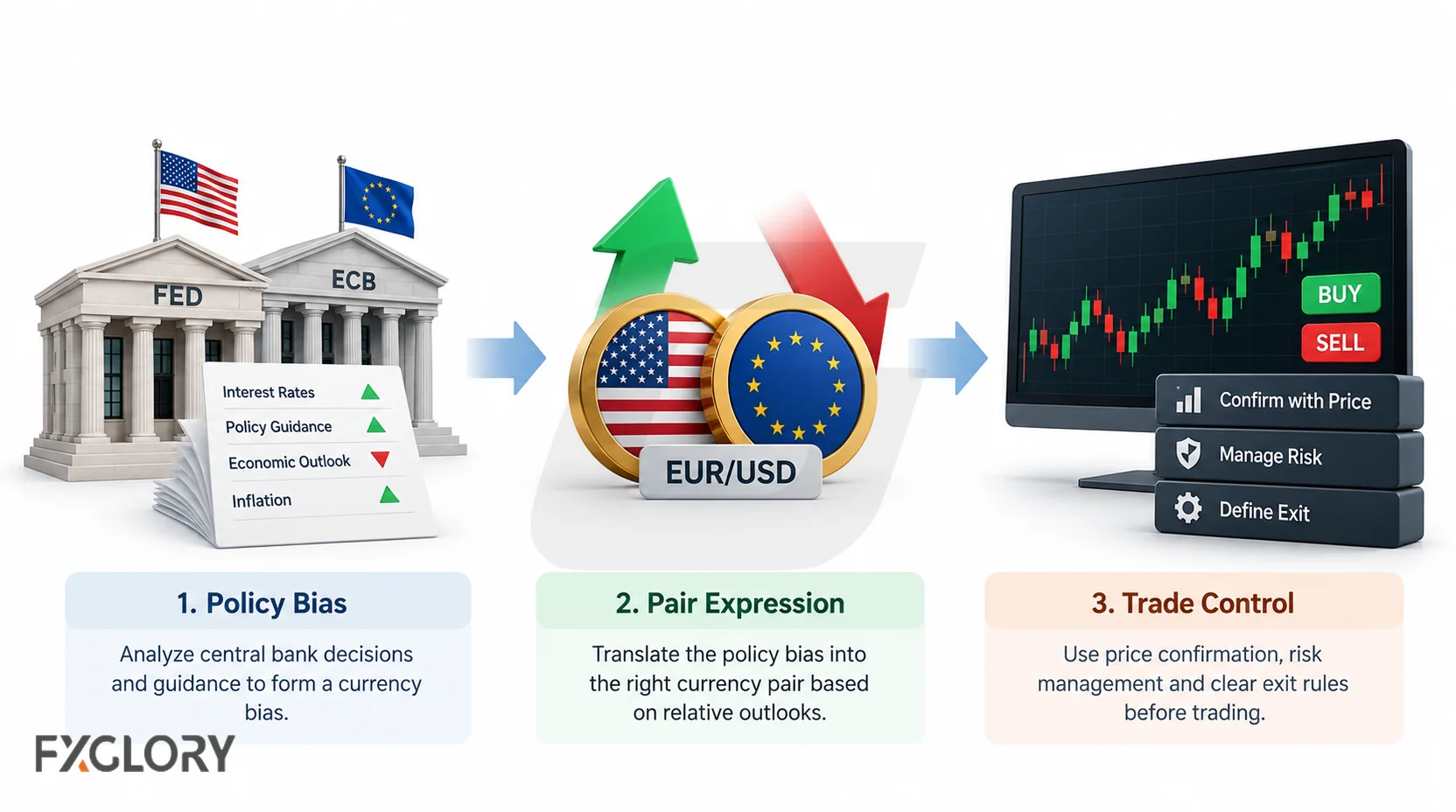
The strategy does not mean buying every currency after a rate hike or selling every currency after dovish language. Forex reactions depend on what markets expected, what changed, how the message compares with the other central bank in the pair, and whether price confirms or rejects the first reaction.
A complete central-bank strategy therefore has three layers: policy bias, pair expression, and trade control. Policy bias explains what the central bank may be signaling. Pair expression decides which currency pair actually reflects the idea. Trade control defines entry timing, invalidation, cost checks, margin, and exit rules.
Central Bank Strategy vs Fundamental Strategy
A central-bank forex strategy is one part of a wider forex fundamental strategy. Fundamental strategy may review growth, inflation, employment, trade flows, fiscal risk, commodity exposure, and risk sentiment. Central-bank strategy focuses more narrowly on monetary policy and how policy expectations affect currency demand.
| Approach | Main Focus | Useful Question | Weak Use |
|---|---|---|---|
| Fundamental strategy | Broad economic and policy backdrop. | Which currency has the stronger overall outlook? | Collecting many headlines without a trade rule. |
| Central-bank strategy | Policy rates, guidance, inflation response, and rate expectations. | Did policy expectations change relative to the other currency? | Trading one sentence from a statement without context. |
| Event trading | Timing and execution around a release or statement. | Is the market reaction tradable after spread and slippage? | Trying to catch the first spike without an exit rule. |
| Carry-aware trading | Rate differential, rollover, swap, and holding cost. | Does the interest-rate backdrop support or damage the holding plan? | Assuming positive swap removes price risk. |
For interest-rate differential and rollover logic, use the carry trade forex guide. For holding-period and reassessment rules, use the long-term forex trading guide.
What Central Banks Influence
Central banks influence the market through policy tools and communication. Traders often focus on the policy rate, but the rate decision is only one part of the policy message.
| Central-Bank Input | What Traders Review | Possible Currency Relevance | Reading Caution |
|---|---|---|---|
| Policy rate | Rate hike, rate cut, or rate hold. | Can change expected return and funding conditions. | The decision may already be priced in. |
| Forward guidance | Signals about future hikes, cuts, pauses, or higher-for-longer policy. | Can move expectations beyond the current decision. | Guidance can be conditional and later changed. |
| Inflation view | Whether inflation is too high, slowing, sticky, or uncertain. | Can affect the expected path of policy rates. | One inflation print may not change the full policy path. |
| Growth and employment view | Whether the economy can absorb tighter policy. | Can shape the balance between inflation control and growth support. | Strong growth can support a currency, but overheating or recession fears can complicate the reaction. |
| Balance-sheet policy | Asset purchases, asset runoff, or liquidity operations. | Can affect financial conditions and risk sentiment. | Balance-sheet language may be indirect and harder to translate into pair direction. |
| Press conference or speeches | Tone, emphasis, confidence, uncertainty, and policy conditions. | Can revise the market's interpretation of the statement. | A single phrase can be overread when the full message is mixed. |
| Minutes and projections | Internal debate, forecast changes, rate-path projections, and risk balance. | Can affect expectations between meetings. | Minutes describe a past meeting and may already be partly reflected in price. |
Hawkish And Dovish Policy Signals
Hawkish and dovish are words traders use to describe central-bank tone. Hawkish usually means the central bank sounds more focused on inflation control and tighter policy. Dovish usually means the central bank sounds more willing to support growth, employment, or easier financial conditions.
For a deeper definition, review hawkish meaning in forex. Inside a strategy, the key point is not the label. The key point is whether the policy message changed expectations compared with what traders already expected.
| Policy Tone | Common Message | Possible Currency Reading | Strategy Caution |
|---|---|---|---|
| Hawkish hike | Rates rise and the central bank warns that inflation remains a concern. | May support the currency if stronger than expected. | Can disappoint if markets expected an even tougher message. |
| Dovish hike | Rates rise, but guidance suggests the tightening cycle may slow or end. | May weaken the currency despite the hike. | The headline hike is not enough to read the reaction. |
| Hawkish hold | Rates stay unchanged, but the bank signals rates may stay high or rise later. | May support the currency if markets expected easier guidance. | Price may reverse if the statement lacks follow-through. |
| Dovish hold | Rates stay unchanged and the bank emphasizes growth risk or future cuts. | May weigh on the currency if expectations shift lower. | Reaction can be limited if dovishness was already priced in. |
| Hawkish cut | Rates fall, but the cut is smaller than expected or guidance resists more cuts. | May support the currency if markets expected deeper easing. | Growth fear may still dominate. |
| Dovish cut | Rates fall and guidance points to further easing. | May weaken the currency if expectations shift sharply lower. | Safe-haven flows or the other currency's weakness can offset the move. |
Policy Expectations And Priced-In Reactions
Central-bank trading often fails when the trader reacts to the headline and ignores expectations. The market may already expect a rate hike, rate cut, hawkish statement, or dovish press conference before the event begins.
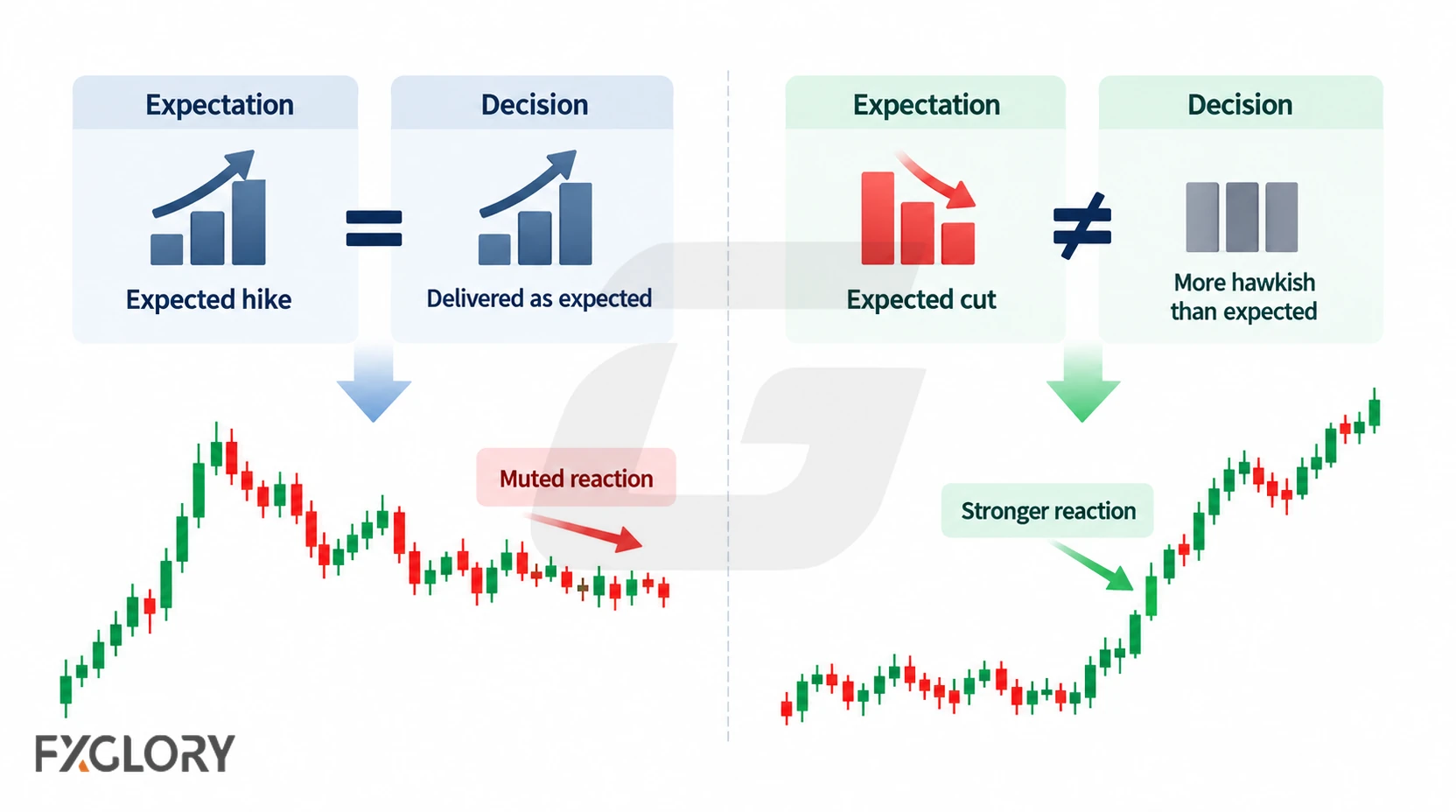
A policy decision can therefore create a different reaction from what the headline suggests. A currency can fall after a rate hike if the hike was smaller than expected, paired with weaker guidance, or already priced in. A currency can rise after a rate cut if the cut was smaller than expected, if the bank signals fewer future cuts, or if the other currency has an even weaker policy outlook.
| Expectation Issue | What To Compare | Possible Problem | Better Review |
|---|---|---|---|
| Expected decision | Market expectation vs actual rate decision. | Trading a result that price already reflected. | Check whether the decision surprised the market. |
| Guidance surprise | Statement and press tone vs expected future path. | Ignoring the part of the message that changed future expectations. | Review whether the next-meeting outlook changed. |
| Projection change | Updated inflation, growth, unemployment, or rate-path projections. | Focusing only on the current rate. | Check whether projections support or weaken the policy bias. |
| Relative policy | One central bank vs the other central bank in the pair. | Calling one currency strong without comparing the other side. | Review the policy gap between both currencies. |
| First reaction | Initial spike vs later acceptance or rejection. | Entering after a fast move that has already used the available target room. | Wait for price structure and spread conditions to become reviewable. |
Interest-Rate Differentials And Currency Pairs
Central-bank policy matters in forex because currency pairs compare two monetary-policy outlooks. A trader is not buying or selling one economy in isolation. Buying EUR/USD means buying EUR and selling USD. Selling EUR/USD means selling EUR and buying USD.
Interest-rate differentials can affect currency demand, but they should not be treated as a guaranteed direction rule. A higher-rate currency can fall if the market expects cuts, if inflation credibility weakens, if growth risk rises, or if the other currency becomes more attractive. A lower-rate currency can rise during risk-off periods or when markets expect its central bank to become less dovish.
| Pair Review | Question | Weak Version | Stronger Version |
|---|---|---|---|
| Base currency policy | Is the base currency's central bank becoming more or less supportive? | Only reading the base-currency headline. | Compare the policy path and price reaction. |
| Quote currency policy | Is the quote currency's central bank changing faster? | Ignoring the other side of the pair. | Compare both central banks before choosing direction. |
| Rate gap | Is the expected rate differential widening or narrowing? | Assuming current rates are enough. | Review future expectations, not only the current level. |
| Swap impact | Will holding the position create swap credit or cost? | Ignoring rollover in a policy-based hold. | Check swap/rollover before longer holding periods. |
| Price structure | Does the chart support the policy idea? | Entering because the macro story sounds logical. | Require timing, invalidation, and target room. |
When a policy idea depends heavily on rate differentials and longer holding, compare it with the carry trade forex framework instead of treating rate advantage as a standalone signal.
Central Bank Divergence
Central-bank divergence happens when two central banks appear to move in different policy directions. One may be tightening, delaying cuts, or warning about inflation, while another may be easing, preparing cuts, or emphasizing growth weakness.
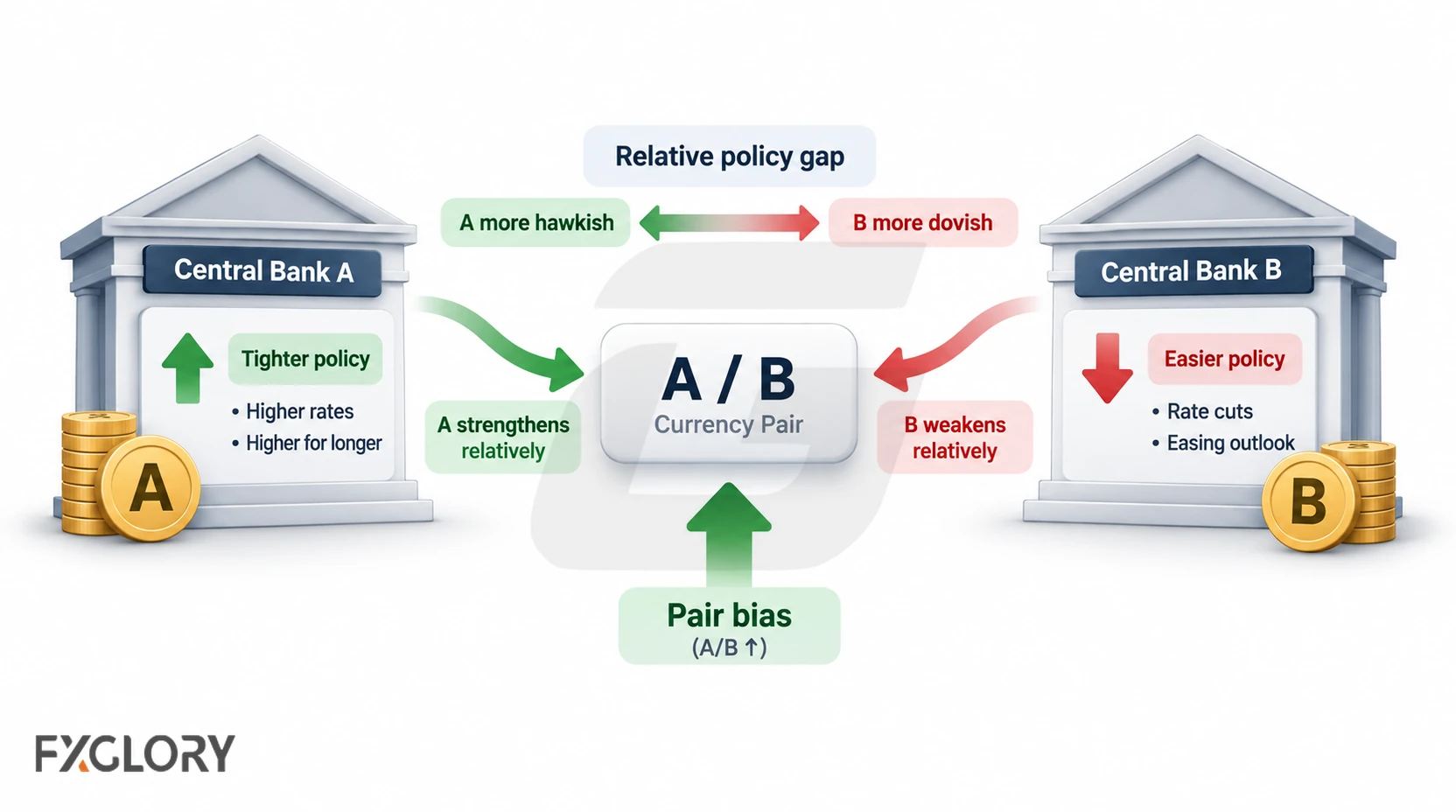
Divergence can make a currency pair easier to review because the two sides of the pair have different policy pressures. It still needs chart confirmation and account-level risk control. A clear policy gap can fail if the idea is already priced in, if data changes, if risk sentiment overwhelms the pair, or if price is already extended.
| Divergence Type | Example Logic | Possible Strategy Role | Main Risk |
|---|---|---|---|
| Tightening vs easing | One bank signals higher rates while another signals cuts. | May support the tightening currency against the easing currency. | The market may have priced the gap before entry. |
| Higher-for-longer vs faster cuts | One bank resists cuts while another prepares to ease. | Can support a relative policy-bias review. | Growth fear can weaken the higher-rate currency. |
| Inflation concern vs growth concern | One bank prioritizes inflation while another prioritizes slowdown risk. | Can clarify hawkish vs dovish comparison. | Mixed data can blur the policy path. |
| Surprise guidance divergence | One statement changes expectations more than the other. | Can create a new currency-bias review. | First reaction may reverse after the market digests details. |
Decision, Statement, Press Conference, And Minutes
A central-bank event is not only the rate decision. The full communication chain can create several separate reactions. A trader should know which part of the event the strategy is reviewing.
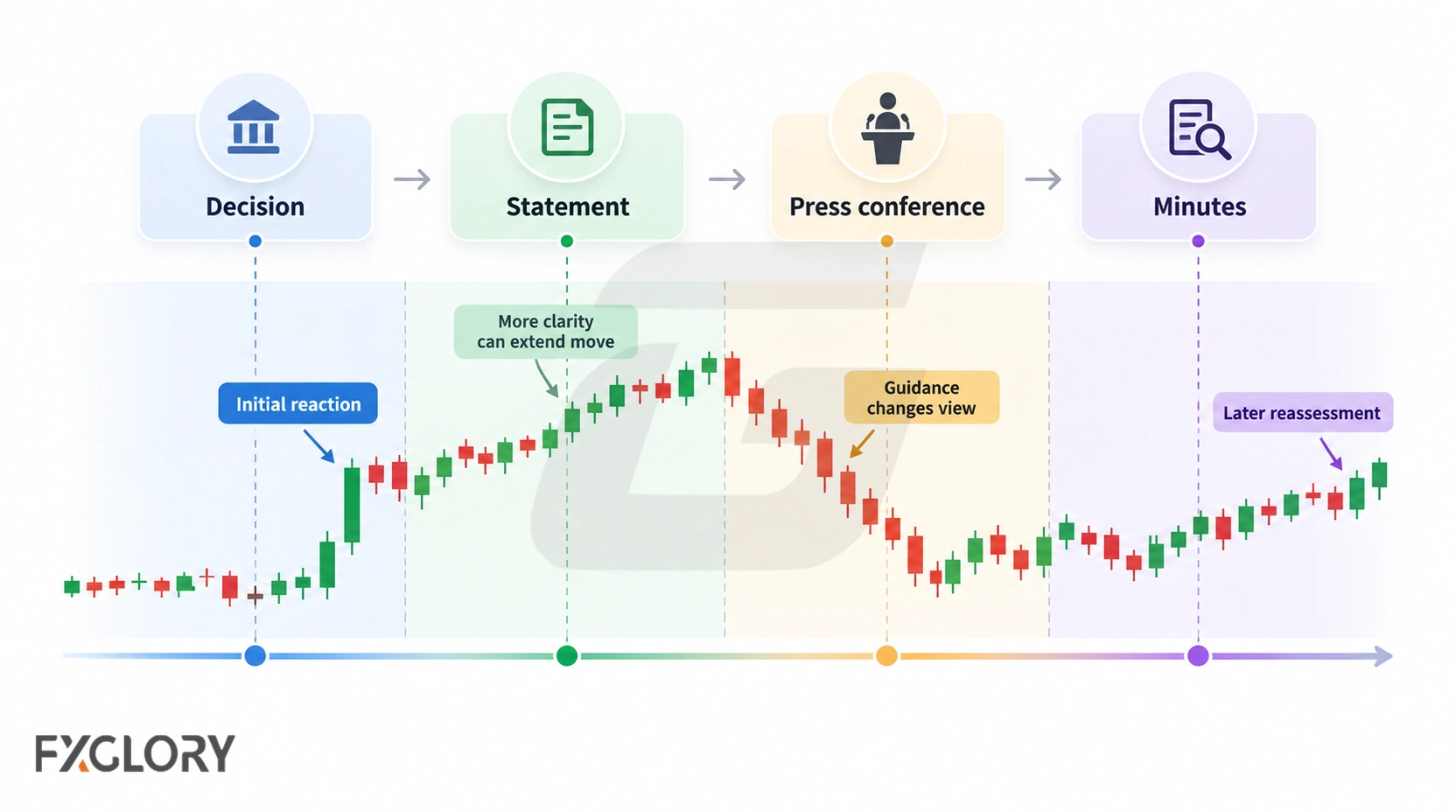
| Communication Stage | What It Can Change | Trading Risk |
|---|---|---|
| Rate decision | Current policy setting and immediate surprise. | Fast first move, spread changes, and slippage risk. |
| Policy statement | Inflation wording, growth wording, risk balance, and future conditions. | The statement can contradict the headline decision. |
| Press conference | Confidence, uncertainty, policy thresholds, and follow-up guidance. | Price can reverse as answers change interpretation. |
| Projections | Expected path for rates, inflation, growth, or employment. | Markets may react more to projections than the current decision. |
| Minutes | Internal disagreement, policy debate, and earlier reasoning. | The information can be stale if conditions changed after the meeting. |
| Speeches | Between-meeting tone and clarification. | Single-speaker comments may not represent the full committee. |
Economic Data That Changes Policy Expectations
Economic data matters because it can change what traders expect central banks to do. Inflation data can affect rate-hike or rate-cut expectations. Employment and growth data can affect whether the economy can handle tighter policy or needs support. Wage data, retail sales, PMIs, and trade data can add extra context.
| Data Area | Why It Matters For Central Banks | Strategy Caution |
|---|---|---|
| Inflation | Can pressure a central bank to keep policy tight or delay cuts. | One print may not override trend, revisions, or guidance. |
| Employment | Can show labor-market strength or weakness. | Strong jobs can support rates, but wage and participation details matter. |
| Growth | Can show whether the economy can absorb tighter policy. | Too much weakness can shift attention toward cuts. |
| Wages | Can affect inflation persistence expectations. | Wage pressure can be interpreted differently across economies. |
| Retail sales and consumption | Can reveal demand strength or slowdown risk. | Consumer strength can support growth but also inflation concern. |
| PMIs and business surveys | Can show changing activity before official data. | Survey data can be noisy and should be compared with other evidence. |
| Trade balance | Can affect currency demand and external strength. | Policy reaction may be indirect unless it changes growth or inflation expectations. |
Release timing and session context matter because liquidity and spreads can change around important data. For session awareness, review the best time to trade forex.
Turning Policy Bias Into A Trade Plan
A central-bank bias should be translated into a trade plan before exposure is considered. The plan should state what the policy idea is, which pair expresses it, what price structure supports it, where the idea becomes wrong, and how the trade will be reviewed if the policy message changes.
| Trade-Plan Layer | Question | Pass Condition | Fail Condition |
|---|---|---|---|
| Policy reason | What changed in policy expectations? | The rate path, guidance, inflation view, or relative policy gap changed. | The only reason is that a headline sounded important. |
| Pair expression | Which pair best expresses the policy difference? | Both currencies are compared and the pair reflects the bias. | The trader ignores the quote currency. |
| Chart context | Does price support the policy idea? | Trend, level, range break, pullback, or structure supports review. | Price is moving against the idea or already extended. |
| Entry rule | What allows entry now? | A written trigger appears under acceptable cost conditions. | The trader enters during a spike without a rule. |
| Invalidation | Where is the policy-trade idea wrong? | A price level, statement change, data reversal, or time rule is defined. | The trader plans to decide later. |
| Risk check | Does the trade fit the account? | Stop distance, size, margin, spread, and leverage are reviewed. | Conviction decides trade size. |
For broader structure, use a written forex trading system. For trigger, invalidation, and exit planning, use forex entry and exit rules.
Chart Timing After A Central Bank Bias
Policy bias can define direction for review, but price timing decides whether the trade can be considered. A trader may wait for a higher-timeframe level, a trend continuation, a pullback, a breakout, or a failed reaction after the policy message is digested.
Multiple timeframes can help separate the policy idea from the entry trigger. A weekly or daily chart may show whether the market is accepting the policy theme. A lower timeframe may help review timing, but it should not override the larger policy and risk structure by itself.
| Chart Role | Useful For | Weak Use |
|---|---|---|
| Higher timeframe | Trend, major level, broader acceptance, and policy-theme context. | Entering only because a monthly candle points one way. |
| Trading timeframe | Setup structure, entry trigger, stop area, and target room. | Forcing an entry before the policy reaction becomes clear. |
| Lower timeframe | Refining timing after the setup exists. | Letting short-term noise cancel the larger plan without a rule. |
| Post-event reaction | Checking whether price holds or rejects the first move. | Assuming the first spike is the final direction. |
For timeframe role separation, review forex multiple time frame analysis.
Spread, Slippage, Liquidity, And Event Risk
Central-bank events can create fast price movement. That can change spread, order fill quality, slippage, liquidity, and stop behavior. A strategy should decide whether it is designed to trade during the event, after the event, or only after the market has stabilized.
Small targets and tight stops can become unrealistic when spreads widen or price jumps. A valid policy idea can still be a poor trade if the execution conditions are unstable.
| Execution Issue | Why It Matters | Rule To Define Before Entry |
|---|---|---|
| Spread widening | Can reduce target room and trigger stops faster. | Maximum acceptable spread or stand-aside rule. |
| Slippage | Can fill orders away from the expected level. | Whether to avoid market orders during fast policy reaction. |
| Thin liquidity | Can make price jumps larger and less orderly. | Session and event-timing filter. |
| Fast reversal | Can turn a correct first read into a losing entry. | Confirmation or time-delay rule. |
| Margin pressure | Can increase when volatility expands or stop distance grows. | Position-size and margin check before entry. |
Before trading around policy volatility, compare the plan with current spread conditions, margin requirements, and leverage conditions.
Holding Horizon: Event, Swing, Position, Or Carry
A central-bank idea can be used across different holding horizons, but the rules change. A short event reaction, a swing trade, a position trade, and a carry-aware trade do not need the same stop distance, review schedule, or cost check.
| Holding Horizon | Central-Bank Role | Extra Review Needed |
|---|---|---|
| Event reaction | Policy surprise or statement reaction. | Spread, slippage, first-spike reversal, and exit timing. |
| Swing trade | Policy bias supports a multi-day directional idea. | Chart structure, pullbacks, news follow-up, and invalidation. |
| Position trade | Policy divergence supports a longer-horizon view. | Swap, margin, data reassessment, and thesis review. |
| Carry-aware trade | Rate differential and swap affect holding logic. | Rollover, price risk, and policy-path change. |
For longer holding, compare the setup with long-term forex trading rules. For rate-differential holding, compare it with the carry trade forex framework.
Why Central Bank Forex Strategies Fail
Central-bank strategies often fail because traders treat policy language as certainty. A central-bank view can be reasonable and still fail as a trade because price had already moved, the other currency had a stronger policy shift, the data mix changed, or execution conditions were poor.
- Trading the headline: The trader reacts to the rate decision without reading guidance or expectations.
- Ignoring the other currency: The strategy reviews one central bank but forgets that every forex pair compares two currencies.
- Entering after the reaction is extended: The policy idea may be right, but the available target room is gone.
- Overreading one phrase: A single hawkish or dovish sentence may not represent the full policy message.
- Ignoring priced-in expectations: The result may have been expected and already reflected in price.
- Forgetting execution conditions: Spread, slippage, and liquidity can damage a setup during policy events.
- Overleveraging conviction: A macro view does not reduce stop distance, margin pressure, or loss risk.
- No reassessment rule: The trader keeps holding after new data or guidance changes the original policy reason.
Central Bank Strategy Decision Sequence
A written sequence helps keep policy analysis from turning into headline trading.
- Identify the central-bank driver: Rate path, inflation pressure, growth concern, speech, statement, minutes, or projections.
- Compare expectation vs outcome: Ask what changed compared with what markets likely expected.
- Compare both currencies: Review the base and quote currency central-bank outlooks.
- Select the pair: Choose the pair that most clearly expresses the policy difference.
- Check price structure: Confirm whether trend, level, range, breakout, or pullback context supports review.
- Check execution conditions: Review spread, volatility, liquidity, slippage risk, and session timing.
- Define trigger and invalidation: Write what allows entry and what cancels the idea.
- Review risk: Check stop distance, position size, margin, leverage, and correlated exposure.
- Set reassessment rule: Decide when new data, speeches, or price behavior forces review.
- Record the result: Track whether the trade followed the policy, timing, risk, and exit rules.
No-Trade Conditions
A no-trade rule is especially important around central-bank themes because convincing policy stories can make traders ignore price and risk.
| No-Trade Condition | Why To Skip |
|---|---|
| The policy message is mixed. | Conflicting statement, projections, and press comments make the currency bias unclear. |
| The other currency is not reviewed. | A one-sided central-bank view is incomplete in a forex pair. |
| The move is already extended. | Late entry may leave poor target room and wider stop distance. |
| Spread or liquidity is unstable. | Execution risk can overwhelm the setup. |
| There is no invalidation point. | The trader cannot define when the policy idea is wrong. |
| Margin is strained. | Volatility expansion can make the position harder to hold. |
| The reason keeps changing. | A shifting explanation cannot be reviewed clearly. |
| The trade is based on emotion after a speech or headline. | Central-bank wording can create urgency, but urgency is not a trade rule. |
Testing And Review Before Live Trading
Central-bank strategy should be tested with records, not memory. Review whether the policy message was interpreted consistently, whether the pair choice expressed the idea, and whether the entry and exit matched the written plan.
| Review Item | What To Record |
|---|---|
| Central-bank event or driver | Decision, statement, speech, minutes, projections, inflation data, or employment data. |
| Expected vs actual message | What the market seemed to expect and what changed. |
| Pair choice | Why this pair expressed the policy difference better than another pair. |
| Chart context | Trend, support, resistance, breakout, pullback, range, or unclear condition. |
| Execution condition | Spread, slippage, liquidity, volatility, and order timing. |
| Risk details | Stop distance, position size, margin, leverage, and maximum planned loss. |
| Reassessment trigger | New data, statement change, price invalidation, or time review. |
| Outcome review | Whether the trade followed the policy, timing, risk, and exit rules. |
For account-level risk review, use the forex risk management strategy guide.
Policy-Event Timing Study Notes For Central Bank Forex Strategy
This hypothetical educational study uses one central-bank policy-event timing model. It reviews mapped rate decisions, policy statements, press conferences, minutes, projections, reports, and central-bank speeches, then measures event-day pair direction and forward pair response over fixed daily windows. It does not simulate entries, stops, targets, position size, leverage, margin, profit factor, or expectancy in R.
The study reviewed EURUSD, GBPUSD, USDJPY, AUDUSD, USDCAD, and USDCHF on public yfinance daily OHLC data where available. Event data comes from a one-time public TradingView/Reuters economic-calendar endpoint snapshot saved with the study record.
Although the model structure can map several central-bank event categories, this completed run produced a mapped sample of rate-decision events only. The results should therefore be read as a rate-decision timing study, not a full study of every central-bank communication type.
| Study Area | Educational Model Rule |
|---|---|
| Study type | Central-bank policy-event timing study |
| Trade simulation | None |
| Event filter | High-impact policy events only, with supported currencies and mapped central-bank event categories |
| Currency universe | USD, EUR, GBP, JPY, AUD, CAD, and CHF |
| Mapped categories | Rate decisions, policy statements, press conferences, minutes, policy reports or projections, and central-bank speeches |
| Pair inclusion | Only pairs where the event currency is the base or quote currency |
| Event-day direction | Event-day close compared with previous trading-day close |
| Forward response windows | 1, 3, 5, and 10 trading days |
| Measured outcomes | Continuation rate, reversal rate, forward pips in the event-day direction, absolute movement, cost-hurdle pass rate, pair-level behavior, currency-level behavior, and event-category behavior |
| Cost Hurdle Input | Assumptions Used |
|---|---|
| Spread | 0.5, 1.5, and 3.0 pips |
| Slippage | 0.1, 0.5, and 1.0 pips per side |
| Baseline comparison | 1.5-pip spread and 0.5-pip slippage per side |
| Swap and rollover | Not included |
Educational Policy-Event Timing Study Results
The completed study used a one-time public calendar snapshot and public daily OHLC data. It identified 6,815 high-impact events, mapped 368 central-bank policy events, and produced 296 unique event-pair observations. The mapped sample contained rate-decision events only.
| Dataset Item | Study Count |
|---|---|
| Raw calendar items found | 103,966 |
| Normalized calendar events saved | 88,157 |
| High-impact events loaded | 6,815 |
| Mapped policy events | 368 |
| Event-pair observation rows | 1,472 |
| Unique event-pair observations | 296 |
| Mapped policy category | Rate decision |
The forward-window table uses the mapped rate-decision event count as the observation base. Event-pair observation rows and unique event-pair observations are separate dataset-control counts and should not be read as the same field.
| Forward Window | Mapped Rate-Decision Events | Continuation Rate | Reversal Rate | Avg Pips In Event-Day Direction | Median Pips In Event-Day Direction | Avg Absolute Forward Pips | Baseline Cost-Hurdle Pass Rate |
|---|---|---|---|---|---|---|---|
| 1 trading day | 368 | 49.46% | 50.54% | -1.8683 | -1.2500 | 70.7343 | 47.55% |
| 3 trading days | 368 | 45.92% | 53.53% | -11.2258 | -6.2704 | 94.3010 | 45.11% |
| 5 trading days | 368 | 49.18% | 50.82% | -10.0937 | -1.8494 | 115.7093 | 48.37% |
| 10 trading days | 368 | 45.65% | 54.35% | -16.2939 | -16.4020 | 139.4453 | 45.38% |
The baseline cost hurdle used a 1.5-pip spread and 0.5-pip slippage per side. This hurdle is not executed profit or loss; it only checks whether forward movement in the event-day direction was larger than the assumed round-turn cost.
| Pair | 10-Day Observations | 10-Day Continuation Rate | 10-Day Reversal Rate | 10-Day Avg Pips In Event-Day Direction | 10-Day Median Pips In Event-Day Direction |
|---|---|---|---|---|---|
| EURUSD | 144 | 38.89% | 61.11% | -37.0476 | -41.5104 |
| GBPUSD | 75 | 49.33% | 50.67% | -10.3391 | -2.2447 |
| USDCAD | 75 | 54.67% | 45.33% | 1.5828 | 15.3005 |
| USDJPY | 74 | 45.95% | 54.05% | -0.0621 | -11.2000 |
What This Policy-Event Timing Study Shows
The overall rate-decision sample did not show broad continuation after the event-day currency move. Continuation rates were below 50% in the 1, 3, 5, and 10-day windows, and the average forward movement in the event-day direction was negative in each window.
The 10-day pair-level view was uneven. USDCAD showed a 54.67% continuation rate with a small positive average movement in the event-day direction, while EURUSD showed a 38.89% continuation rate and a larger negative average movement in the event-day direction. These differences support using policy events as structured review points rather than automatic direction signals.
The study is useful for reviewing rate-decision timing risk, continuation risk, and cost-hurdle sensitivity around mapped central-bank rate decisions. It does not test whether a central bank forex strategy works, and it does not replace a defined entry, invalidation, position-size, and risk-control plan.
Central Bank Forex Strategy Checklist
- The central-bank driver is defined before the trade.
- The expected outcome is compared with the actual decision, guidance, or data.
- The other currency in the pair is reviewed.
- The pair choice clearly expresses the policy difference.
- Hawkish or dovish wording is not treated as a signal by itself.
- Chart context supports the policy idea.
- Spread, slippage, liquidity, and session timing are checked.
- Entry trigger, invalidation, stop, target, and exit rules are written.
- Swap, margin, and leverage exposure are reviewed when holding beyond the event.
- A no-trade rule exists for mixed messages, extended moves, or unstable execution conditions.
- A reassessment rule is written for new data, speeches, minutes, or price invalidation.