

What Is Forex Scalping?
Forex scalping is a short-term trading style where a trader tries to capture small price movements from the forex market, usually by opening and closing trades within minutes or sometimes seconds. The main idea is not to predict a large trend. The goal is to decide quickly whether a small, planned movement is available, define the risk, and exit before the trade turns into a different type of position.
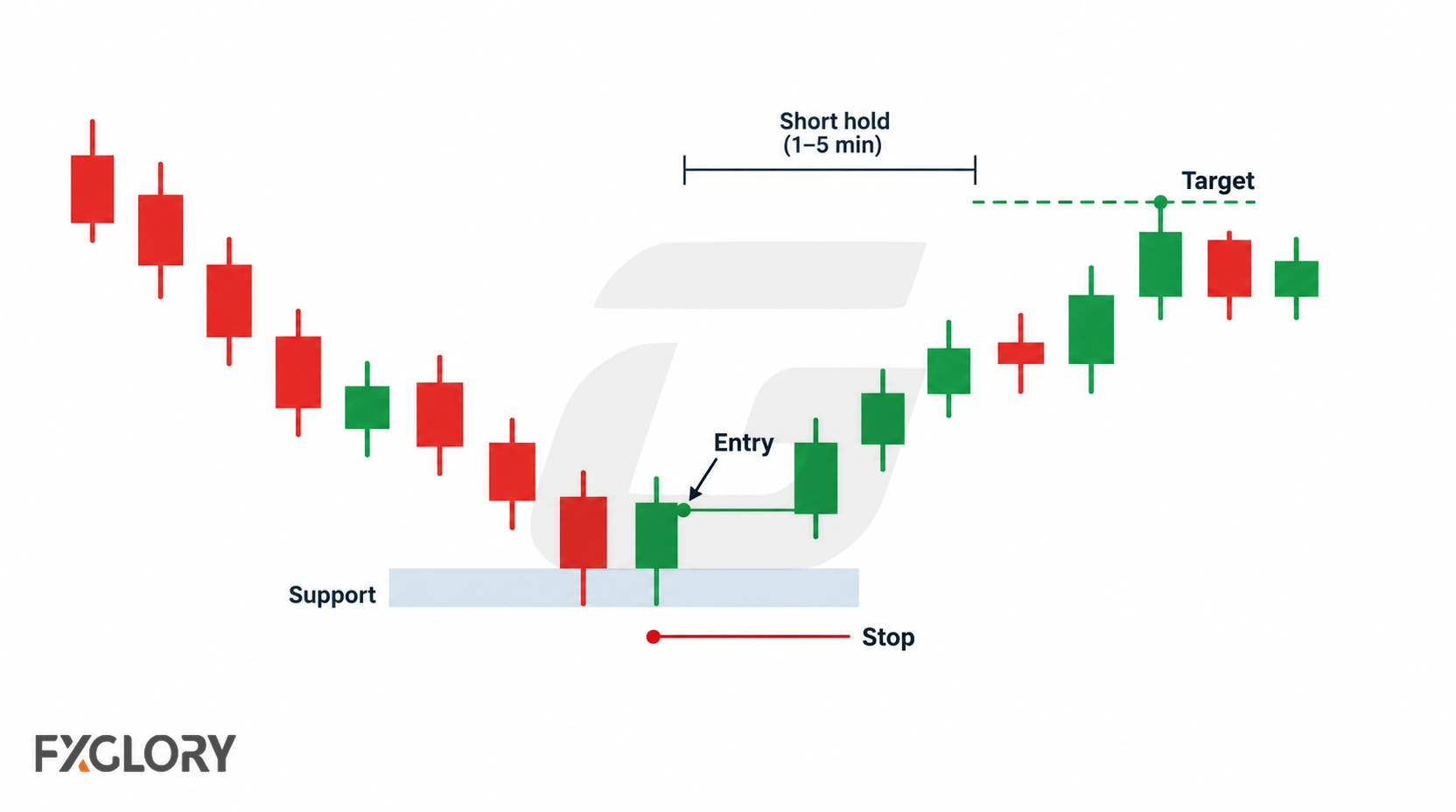
In simple terms, scalping in forex means trading small intraday movements with strict entry, stop, target, and no-trade rules. A scalp trade should already have a planned reason to enter, a specific point where the idea is wrong, and a clear exit rule before the order is placed.
A complete scalping plan should separate the short-term trading style from the wider trading system behind it. For the wider structure behind any strategy, use the trading system rule set. For the setup-level checklist, use the setup framework that separates context, trigger, invalidation, and review.
What Is A Forex Scalper?
A forex scalper is a trader who focuses on short-lived price opportunities instead of holding positions for longer intraday swings or multi-day moves. The scalper usually watches lower timeframes, waits for a specific condition, enters near the planned area, and exits when the small objective, stop, or invalidation rule is reached.
A scalper does not need to trade every movement. The better question is whether the current market condition gives enough room after spread and whether the trade can be managed without hesitation. If the answer is unclear, the setup should be skipped.
| Scalper Decision | What It Means | Weak Version |
|---|---|---|
| Market selection | Choose instruments that fit the system's movement, spread, and session rules | Open every chart until something moves |
| Fast entry | Use a planned trigger only after context is clear | Buy or sell because a candle moved quickly |
| Small objective | Exit at a planned target, stop, time rule, or changed-condition rule | Hold a scalp after the original reason has disappeared |
| Strict stopping | Use max-trade, max-loss, and no-trade rules | Keep trading to recover a previous result |
How Forex Scalping Works
A forex scalping trade should move through a short decision chain. The trader first checks whether the market is active enough for the system. Then the trader checks whether the spread is acceptable relative to the expected movement. Only after that should a setup and trigger matter.
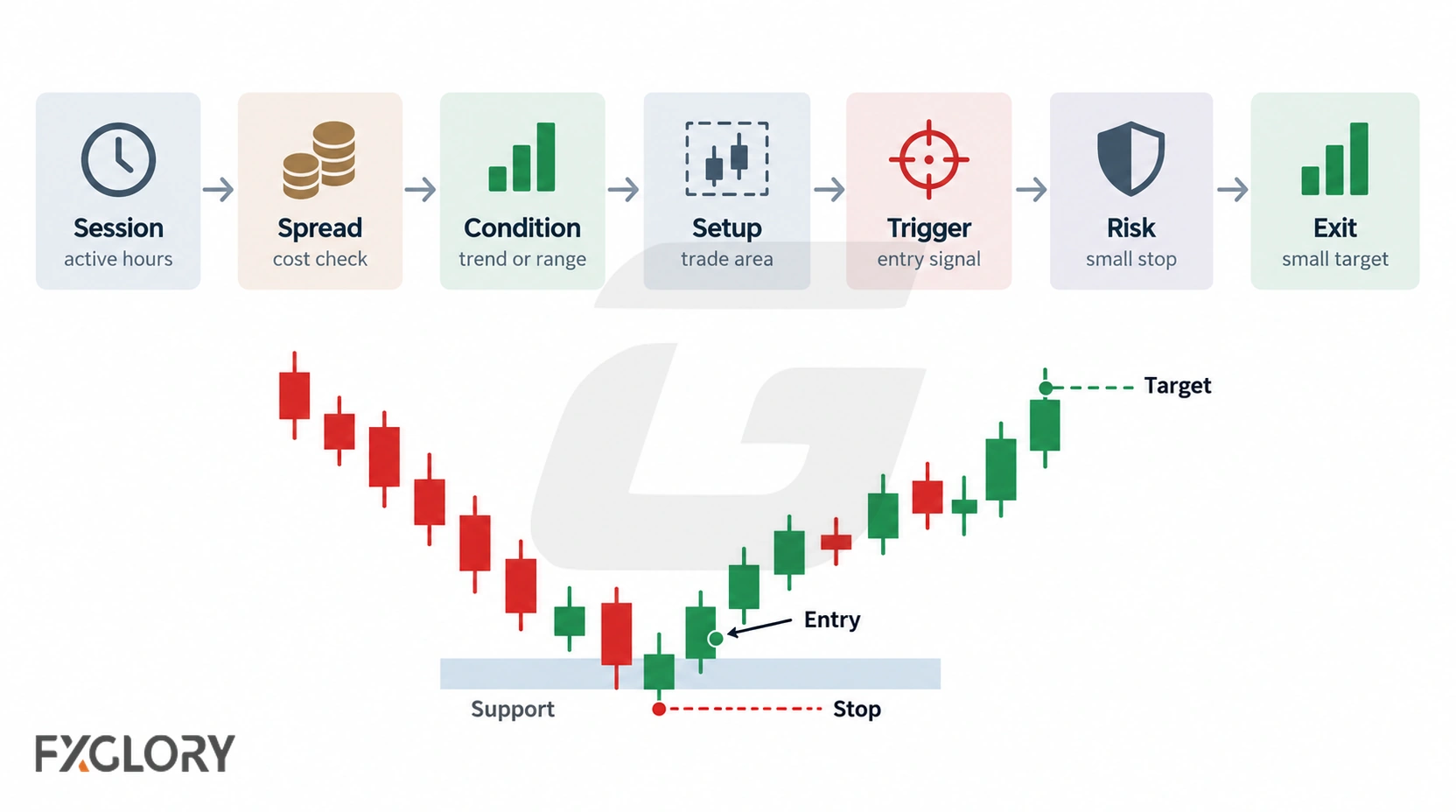
A common mistake is starting from the entry signal. In scalping, the entry is the last permission, not the first decision. The market condition, cost, stop distance, target realism, and daily risk limit should already be known.
| Step | Question Before Entry | Continue Only If |
|---|---|---|
| 1. Session check | Is the market active enough for this scalping method? | The current trading window matches the system rules |
| 2. Cost check | Is the spread small enough compared with the planned target? | The expected move still makes sense after trading cost |
| 3. Condition check | Is price trending, ranging, breaking out, compressing, or unclear? | The condition matches the scalping method |
| 4. Setup check | Is there a planned location and invalidation point? | The reason for the trade and the wrong point are visible |
| 5. Trigger check | Has the entry condition appeared at the planned area? | The trigger is not late or far from the plan |
| 6. Risk check | Do stop distance, position size, margin, and exposure fit? | The trade fits the account rules before entry |
| 7. Exit check | How will the trade close if it works, fails, or stalls? | Target, stop, time, or changed-condition rules are written |
Forex Scalping vs Day Trading vs Swing Trading
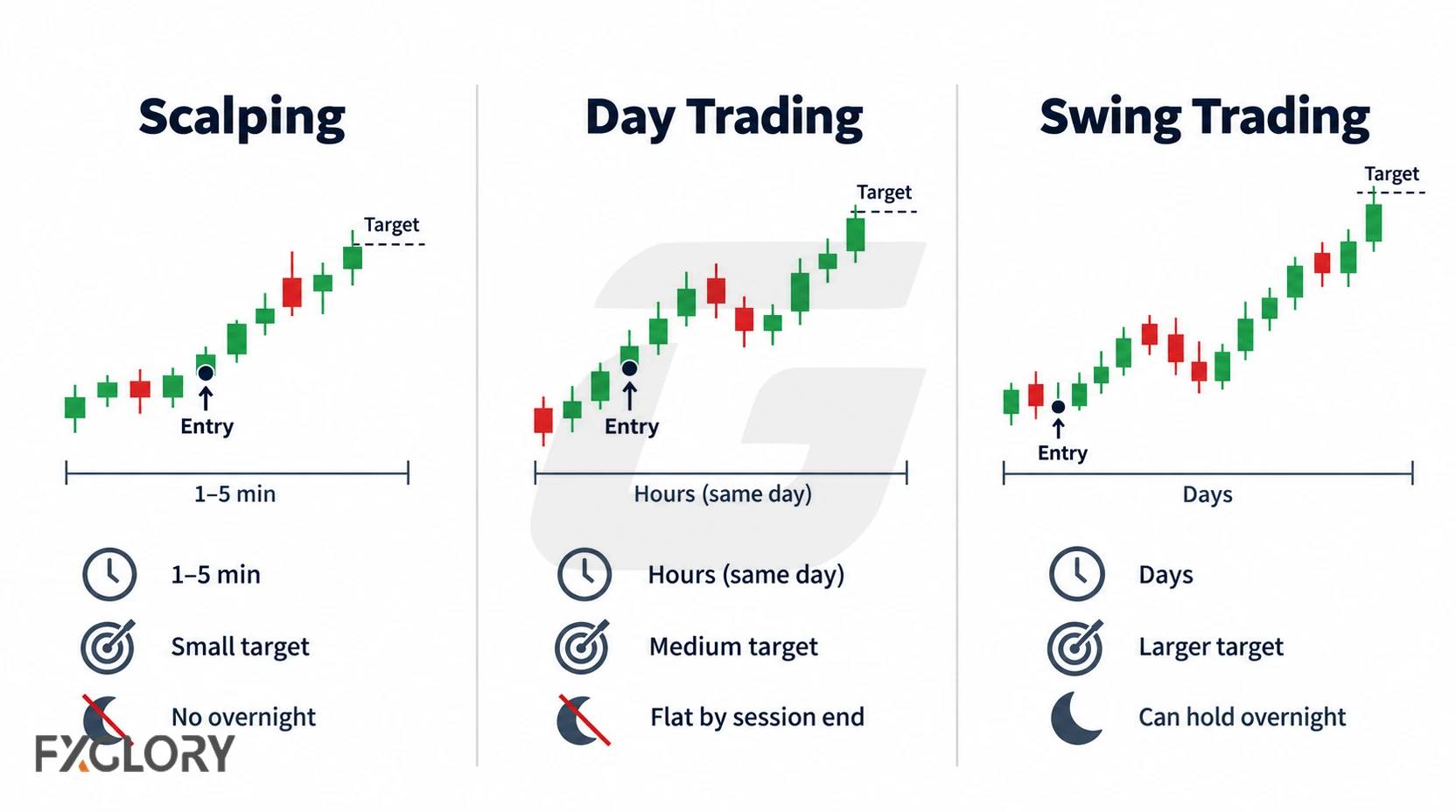
Every scalp trade is usually an intraday trade, but not every intraday trade is scalping. The difference is the holding style, decision speed, target size, and cost sensitivity. This matters because mixing styles can cause a trader to hold a failed scalp as if it were a day trade or swing trade.
| Style | Typical Holding Logic | Main Focus | Common Risk |
|---|---|---|---|
| Scalping | Very short-term trades, often minutes or less | Small movements, tight decision rules, spread control | Overtrading, cost pressure, fast emotional decisions |
| Day trading | Trades usually opened and closed within the same trading day | Intraday setups, session movement, planned exits before the day ends | Turning a day trade into unplanned overnight exposure |
| Swing trading | Trades may be held across multiple sessions or days | Larger price swings, wider context, more patience | Using short-term entries without wider structure |
For broader intraday structure, use the day-trading strategy framework. Forex scalping needs a narrower rule set because small targets leave less room for spread, late entries, and hesitation.
What Forex Scalping Can And Cannot Do
Scalping can give a trader a structured way to focus on short-term movement, but it does not remove the difficulty of trading. The same speed that creates frequent decisions can also multiply weak entries, repeated losses, and emotional reactions.
| Scalping Can Help With | Scalping Cannot Solve |
|---|---|
| Working with short trading windows when the market is active | Poor risk control, late entries, or unclear stops |
| Keeping exposure time short compared with longer holding styles | Total risk from large size, repeated entries, or correlated exposure |
| Creating repeatable short-term setup rules | The need for patience and no-trade rules |
| Keeping trade ideas focused on immediate price behavior | Overtrading, revenge trading, or oversized positions |
| Testing whether small targets fit a trader's workflow | The need to review results over a meaningful sample of trades |
Can Forex Scalping Be Sustainable?
Forex scalping is sustainable only when the trading process can survive normal losing trades, changing spreads, missed entries, slow decisions, and emotional pressure. One good session does not prove a scalping method works. One bad session does not prove the method is useless. The useful question is whether the same rules can be followed and reviewed across enough trades to judge the process.
A scalping method becomes weak when the trader needs more size after a loss, changes the stop after entry, adds trades to recover quickly, or keeps trading after the daily limit is reached. Sustainability depends on whether the rules protect the account when the trader is wrong, not only whether the entry sometimes catches a fast move.
| Sustainability Check | Healthy Rule | Warning Sign |
|---|---|---|
| Daily stop | Trading stops after the planned loss, drawdown, or trade-count limit | The trader keeps entering to recover the session |
| Cost control | Spread is checked before each small-target trade | Targets are planned without trading-cost awareness |
| Rule consistency | The same setup, trigger, stop, and exit rules are used repeatedly | Rules change after every win or loss |
| Position size | Size is linked to stop distance and account risk | Size increases because the last trade lost |
| Review quality | Trades are reviewed by rule-following, not only outcome | Only profit or loss is recorded |
Forex Scalping Is Not Market Making
Forex scalping and market making are sometimes confused because both relate to small price differences. They are not the same activity. A retail forex scalper is a trader trying to enter and exit short-term market movements under a personal trading plan. A market maker provides liquidity and may quote bid and ask prices as part of its market function.
For a retail trader, the important issue is not whether scalping resembles market making. The important issue is whether the scalp trade has a valid setup, acceptable spread, clear execution workflow, defined risk, and an exit rule before the order is placed.
When Forex Scalping Fits And When It Does Not
Forex scalping may fit traders who can follow rules quickly, monitor the chart without distraction, accept small planned losses, and stop trading after the daily rule is reached. It may not fit traders who need more time to decide, dislike frequent decisions, widen stops under pressure, or chase after missed moves.
| Scalping May Fit When | Scalping Is Usually Weak When |
|---|---|
| The trader can watch the market during the planned window | The trader is checking charts while distracted |
| Spread and target distance are checked before entry | The target is small but cost is ignored |
| The setup has a visible invalidation point | The stop is guessed after the trade opens |
| The trader can stop after a max loss or max trade count | The next trade is taken to recover the last result |
| The method matches the current market condition | The same entry is forced in trend, range, and news conditions |
- Do not scalp because the chart looks active. Activity without structure can create late entries.
- Do not scalp if the spread is too large compared with the planned movement.
- Do not scalp when the stop distance is unknown.
- Do not scalp after the daily loss limit or max-trade rule has been reached.
- Do not turn a scalp into a longer trade just to avoid accepting the planned stop.
Market, Pair, Session, And Spread Rules
Scalping is highly sensitive to trading cost because the target is usually small. A setup that looks attractive on the chart may become weak if the spread takes too much of the expected movement or if volatility changes faster than the trader can manage the position.
Before using a frequent-entry method, review the spread conditions that affect small-target trading. When position size, leverage exposure, and margin need to be checked together, use the margin calculator before the trade is placed.
| Rule Area | Scalping Question | Why It Matters |
|---|---|---|
| Pair selection | Does this instrument usually provide enough movement for the method? | Small targets need movement after cost |
| Session timing | Is this the planned trading window for the system? | Scalping outside the plan can reduce consistency |
| Spread check | Is the spread acceptable compared with the target? | Cost can consume a large part of a small move |
| Volatility check | Is movement tradable rather than chaotic? | Sudden jumps can make stops and exits harder to manage |
| Execution workflow | Can the order, stop, and exit be handled without delay? | Slow decisions can change the trade before it starts |
For session planning, use the trading-window guide. When using a major pair such as EUR/USD as a scalping example, review the EUR/USD live market page before deciding whether the setup still fits the plan.
Forex Scalping Timeframes
Scalpers often watch lower timeframes, but the timeframe itself is not the strategy. A one-minute chart can show a trigger, while a higher chart may still be needed to understand whether price is trending, ranging, breaking out, or rejecting a level.
The one-minute, five-minute, and fifteen-minute decision should come after the method and chart roles are clear. Use the dedicated scalping-timeframe guide for that decision. The important rule here is that every chart must have a job.
| Chart Role | Question It Answers | Weak Use |
|---|---|---|
| Context chart | Is the market condition suitable? | Ignored because the entry chart looks exciting |
| Setup chart | Where is the trade idea forming? | Changed until a signal appears |
| Trigger chart | When is entry allowed? | Used without context, invalidation, or cost check |
For chart-role separation, use multiple-timeframe analysis before the entry decision.
Common Forex Scalping Strategy Types
Scalping can be built around different market conditions. The method should match the condition first; the indicator or entry pattern should come later. A breakout method is different from a range method, and both can fail when the market is unclear.
| Scalping Type | Market Condition | Basic Rule Idea | Avoid When |
|---|---|---|---|
| Breakout scalping | Price leaves a tight range or defined intraday level | Enter only when the breakout and invalidation are clear | The move is already extended or the breakout level is unclear |
| Range scalping | Price respects short-term support and resistance | Look for planned reactions near range edges | Price has broken the range or volatility has changed the condition |
| Momentum scalping | Short-term movement expands in one direction | Trade only when momentum has room before the next obstacle | The entry comes after most of the movement has already happened |
| Pullback scalping | A short trend pauses without breaking structure | Wait for a pullback and a trigger near the planned area | The pullback breaks the structure that made the trend valid |
| Moving-average scalping | Trend or dynamic support/resistance is being filtered | Use the average as context, not as the whole trade reason | The market is flat and price is whipsawing around the average |
| News-aware scalping | Scheduled events may change volatility and spread | Define whether to avoid, reduce, or pause trading around events | Spread, speed, or volatility moves outside the system's rules |
When indicators are used, assign each one a job before trading. For role-based indicator use, review indicator strategies built around context, confirmation, and risk.
Scalping Execution Workflow
A scalping setup should be executable before the trigger appears. The trader should not be searching for the pair, changing chart layout, guessing position size, deciding the stop, or choosing the exit after price has already reached the entry area.
A cleaner workflow is: chart prepared, spread checked, order ticket ready, stop logic known, target logic known, cancel rule defined, and daily stop visible. If one part is missing, the trade should wait. Review FXGlory trading platforms when building the charting, order-placement, and trade-management workflow around the strategy.
| Workflow Part | Ready Before Entry | Not Ready If |
|---|---|---|
| Chart | The context, setup, and trigger charts are already assigned | The trader changes charts to justify the entry |
| Order ticket | The trader knows the order type and entry area before the trigger | The order is prepared after the move is already extended |
| Stop | The invalidation point is known before the order is placed | The stop is chosen after the trade is open |
| Target | The target or exit review area is realistic after spread | The target is smaller than the trade cost can justify |
| Cancel rule | The trade is canceled if price, spread, or condition changes before entry | The trader enters because the setup almost happened |
| Daily stop | The session limit is visible before the first trade | The trader decides the limit after losses begin |
- Open only the instruments included in the scalping plan.
- Set the chart layout before the planned trading window begins.
- Know which chart gives context, which chart gives the setup, and which chart gives the trigger.
- Check spread before accepting a small target.
- Define the stop and target before the order is placed.
- Cancel the trade if price moves away from the planned area before execution.
- Stop trading if platform, connection, focus, or order-management conditions are not suitable.
Scalping Setup, Entry, Stop, And Exit Rules
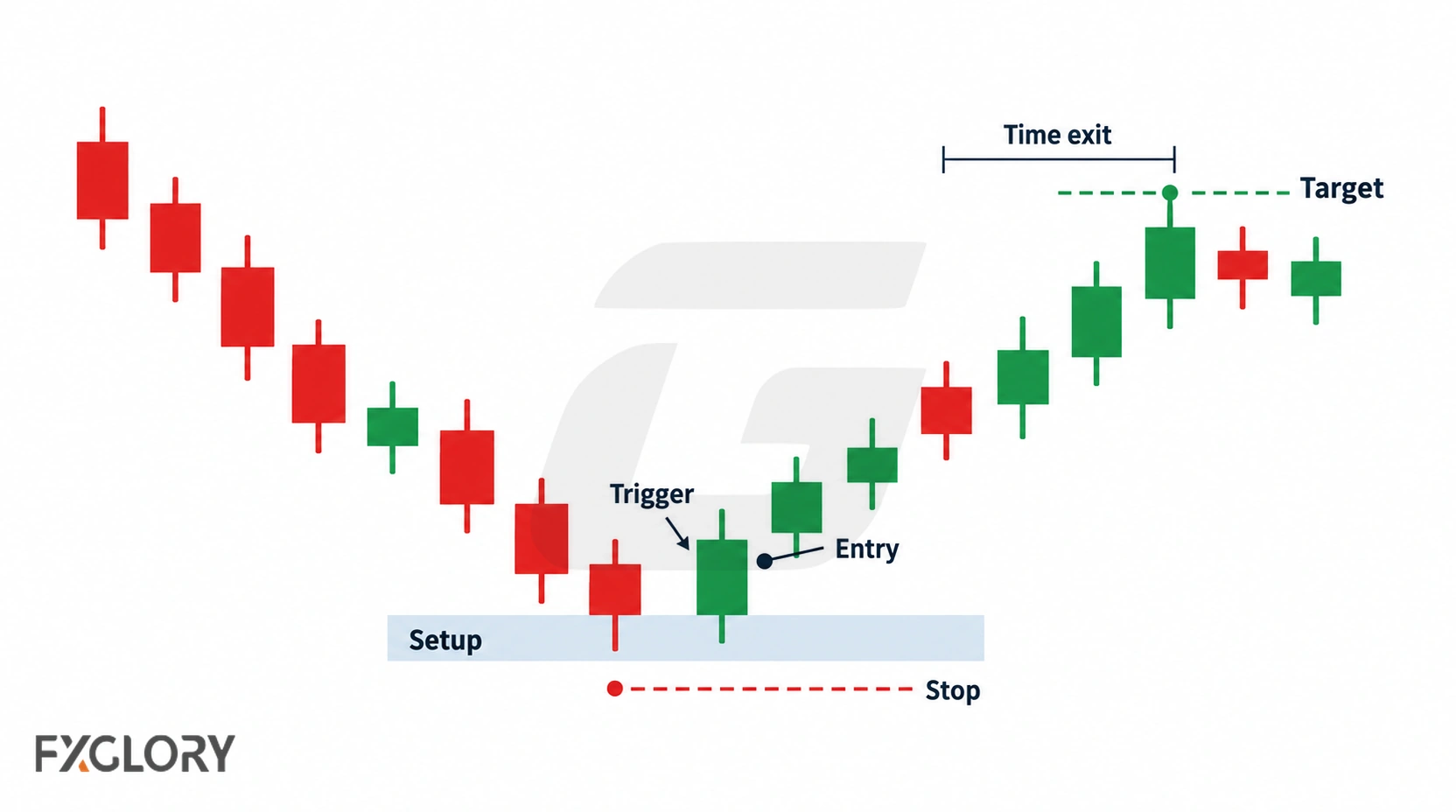
A forex scalping setup is not complete because price moved quickly. It becomes complete only when the trader can explain the condition, planned entry area, stop logic, target logic, and cancellation rule.
| Rule | Scalping Version | Skip The Trade If |
|---|---|---|
| Setup | Market condition and location match the method | The trader cannot name the condition |
| Entry | Trigger appears at the planned area before price is extended | The entry is late or based on fear of missing out |
| Stop | Invalidation point is visible before order placement | The stop is chosen only by emotion or account comfort |
| Target | Expected movement is realistic after spread | The target is too small after cost |
| Time rule | Trade is reviewed or closed if it does not develop quickly enough | A stalled scalp becomes unplanned exposure |
| Cancel rule | Trade is skipped if context, spread, event risk, or entry quality changes | The trader enters because the setup almost happened |
For the full entry-to-exit relationship, use the entry and exit rule chain. For signal tools used around entry or exit, use the entry and exit indicator guide.
Risk, Costs, Leverage, And Margin In Forex Scalping
Scalping can make risk feel small because each trade targets a small move. That feeling can be misleading. Many small trades can create large daily exposure if the trader increases size, ignores spread, adds positions, or continues after the plan says to stop.
Risk should be checked before the trade, not after the first loss. A useful scalping rule connects stop distance, position size, spread, margin, and daily loss limit in one decision.
| Risk Area | Scalping Control | Problem Sign |
|---|---|---|
| Stop distance | Stop is placed where the scalp idea is invalid, not where the trader hopes loss will stop | The stop moves wider after entry |
| Position size | Size is chosen after stop distance is known | Size is fixed before the risk point is visible |
| Spread | Spread is checked before small targets are accepted | The cost is noticed only after entry |
| Margin | Margin requirement is reviewed before placing the order | The trader focuses only on entry and ignores exposure |
| Daily loss | Trading stops when the daily rule is reached | The trader keeps entering to recover |
| Trade count | The number of allowed attempts is limited | Every candle becomes a new trade idea |
For wider risk rules, use the forex risk-management strategy page.
Forex Scalping No-Trade Rules
No-trade rules are especially important for scalpers because a weak decision can become an open trade quickly. The trader should know exactly when to stand aside.
- No spread fit: The planned target is too small after trading cost.
- No invalidation point: The chart does not show where the scalp idea is wrong.
- Late trigger: Price already moved away from the planned entry area.
- Flat market: The market is too quiet for the method, even if a minor signal appears.
- Chaotic volatility: Movement is fast but not manageable under the system rules.
- Event uncertainty: A scheduled event may change spread, speed, or volatility beyond the plan.
- Timeframe conflict: The context chart and trigger chart disagree.
- Daily stop reached: The trader has already reached the planned loss, drawdown, or trade-count limit.
- Emotional entry: The trade is based on revenge, boredom, or fear of missing out.
Scalping Psychology And Review
Scalping puts pressure on discipline because feedback comes quickly. A trader can win, lose, re-enter, increase size, and break the daily plan within a short time. The goal is not to react to every tick. The goal is to follow the written process repeatedly and review whether the process was followed.
A scalping journal should not record only profit or loss. It should record whether the setup was valid, whether spread was acceptable, whether entry was late, whether the stop was respected, whether the trader stopped after the daily rule, and whether any trade was taken for emotional reasons.
- Pair, session, and timeframe used.
- Market condition before entry: trend, range, breakout, compression, or unclear.
- Spread check before entry.
- Setup type and planned entry area.
- Trigger quality: planned, late, early, or emotional.
- Initial stop and reason for invalidation.
- Exit reason: target, stop, time rule, changed condition, or manual mistake.
- Whether the trade followed the scalping system.
- Whether the trader stopped at the daily limit.
Forex Scalping Checklist
Before a short-term signal becomes a scalp trade, every item below should already be answered.
- Define the scalping method: breakout, range, momentum, pullback, moving-average, or another written approach.
- Choose the trading window before looking for entries.
- Check spread before accepting the target.
- Confirm the market condition on the assigned context chart.
- Find the planned setup location.
- Define the invalidation point before entry.
- Choose position size only after stop distance is known.
- Check margin and leverage exposure before placing the trade.
- Prepare the chart, order ticket, stop, target, and cancel rule before the trigger appears.
- Enter only if the trigger appears at the planned area.
- Exit by the target, stop, time rule, or changed-condition rule.
- Stop trading when the daily loss, drawdown, or trade-count rule is reached.
- Record whether the trade followed the plan, not only whether it made or lost money.
Backtesting Notes For Forex Scalping
This hypothetical educational model uses one 5-minute scalping rule: an EMA(20)/EMA(50) trend filter, EMA(20) pullback, completed-candle confirmation, ATR volatility filter, ATR-based stop placement, 1R target comparison, no-progress exit, time exit, daily trade cap, daily loss pause, and spread/slippage sensitivity. It does not test breakout scalping, range scalping, news scalping, market making, one-minute tape reading, discretionary lower-timeframe analysis, or every scalping method.
The model reviewed EURUSD, GBPUSD, USDJPY, AUDUSD, USDCAD, and USDCHF on public yfinance 5-minute OHLC data where available. Intraday data availability is limited, and the dataset is not FXGlory broker execution data.
| Rule Area | Educational Model Rule |
|---|---|
| Strategy type | 5-minute EMA pullback scalping continuation |
| Signal window | 07:00 to 15:30 UTC |
| Long trend context | Close above EMA(50), EMA(20) above EMA(50), and EMA(20) slope over 6 completed candles positive |
| Short trend context | Close below EMA(50), EMA(20) below EMA(50), and EMA(20) slope over 6 completed candles negative |
| Volatility filter | ATR(14) at least 0.5 pip and no more than 20 pips |
| Pullback window | Previous 4 completed candles must pull into the EMA(20) area without closing beyond EMA(50) against the trade |
| Long confirmation | Signal candle trades into the EMA(20) area, closes above EMA(20), closes above its open, closes in the upper 40% of its range, and is not more than 0.60 ATR(14) above EMA(20) |
| Short confirmation | Signal candle trades into the EMA(20) area, closes below EMA(20), closes below its open, closes in the lower 40% of its range, and is not more than 0.60 ATR(14) below EMA(20) |
| Entry | Next 5-minute open after the completed signal candle |
| Stop | Beyond the 4-candle pullback-window extreme with a 0.20 ATR(14) buffer |
| Stop-distance filter | At least 2 pips and no more than 20 pips |
| Target comparison | Fixed 1R target from entry |
| No-progress exit | After 6 holding candles, exit if maximum favorable movement has not reached 0.25R and price closes back through EMA(20) against the trade |
| Maximum holding review | 12 five-minute candles after entry |
| Daily controls | Maximum 8 accepted trades per UTC day, daily pause at -3R baseline net result, and no overlapping trade on the same pair |
The review records candidate count, accepted trades, rejected candidates, rejection reasons, trade count, win rate, average win in R, average loss in R, expectancy in R, profit factor, maximum drawdown in R, worst losing streak, average holding period, pair-level behavior, direction-level behavior, exit reasons, and spread/slippage sensitivity.
| Cost Input | Assumptions Used |
|---|---|
| Spread | 0.5, 1.5, and 3.0 pips |
| Slippage | 0.1, 0.5, and 1.0 pips per side |
| Baseline comparison | 1.5-pip spread and 0.5-pip slippage per side |
| Swap and rollover | Not included |
Educational Sensitivity-Test Results
The completed hypothetical educational run used 60 days of public 5-minute yfinance data. Under the baseline assumption of 1.5-pip spread and 0.5-pip slippage per side, the model produced a negative baseline result: -0.5399R expectancy and -178.6961R total net result across 331 accepted trades. These figures do not prove future live-trading performance and do not represent FXGlory execution data.
| Control Item | Value |
|---|---|
| Raw candidates | 777 |
| Accepted trades | 331 |
| Rejected candidates | 446 |
| Acceptance rate | 42.6% |
| Daily trade cap | 8 accepted trades |
| Daily loss pause | -3.0R |
| Rejection Reason | Count |
|---|---|
| daily loss pause | 341 |
| daily trade cap | 105 |
| Baseline Metric | Result |
|---|---|
| Number of trades | 331 |
| Win rate | 45.02% |
| Average win | 0.3976R |
| Average loss | -1.3073R |
| Expectancy | -0.5399R |
| Profit factor | 0.249 |
| Maximum drawdown | -178.4942R |
| Worst losing streak | 6 |
| Average holding period | 4.57 five-minute candles |
| Median holding period | 3 five-minute candles |
| Total net result | -178.6961R |
Pair-Level Baseline Results
| Pair | Trades | Win Rate | Expectancy | Profit Factor | Max Drawdown | Total Net Result |
|---|---|---|---|---|---|---|
| EURUSD | 18 | 66.67% | -0.1306R | 0.6158 | -3.7472R | -2.3517R |
| GBPUSD | 47 | 38.3% | -0.8483R | 0.1686 | -38.1284R | -39.8686R |
| USDJPY | 84 | 40.48% | -0.5994R | 0.2163 | -50.8779R | -50.3472R |
| AUDUSD | 16 | 31.25% | -0.9296R | 0.0742 | -13.0332R | -14.8738R |
| USDCAD | 107 | 48.6% | -0.326R | 0.4094 | -34.2088R | -34.8857R |
| USDCHF | 59 | 47.46% | -0.6164R | 0.1825 | -36.1667R | -36.3691R |
Direction-Level Baseline Results
| Direction | Trades | Win Rate | Expectancy | Profit Factor | Max Drawdown | Total Net Result |
|---|---|---|---|---|---|---|
| Long | 190 | 40.53% | -0.5723R | 0.2403 | -108.0395R | -108.7398R |
| Short | 141 | 51.06% | -0.4961R | 0.262 | -68.9872R | -69.9563R |
Exit Reason Counts
| Exit Reason | Count |
|---|---|
| no progress close | 9 |
| stop first same bar | 2 |
| stop loss | 133 |
| target 1R | 158 |
| time exit | 29 |
Spread And Slippage Sensitivity
| Spread | Slippage Per Side | Trades | Win Rate | Expectancy | Profit Factor | Total Net Result |
|---|---|---|---|---|---|---|
| 0.5 pips | 0.1 pips | 331 | 50.45% | -0.1137R | 0.7782 | -37.6372R |
| 0.5 pips | 0.5 pips | 331 | 50.15% | -0.3031R | 0.4963 | -100.33R |
| 0.5 pips | 1.0 pips | 331 | 45.02% | -0.5399R | 0.249 | -178.6961R |
| 1.5 pips | 0.1 pips | 331 | 49.85% | -0.3505R | 0.4385 | -116.0033R |
| 1.5 pips | 0.5 pips | 331 | 45.02% | -0.5399R | 0.249 | -178.6961R |
| 1.5 pips | 1.0 pips | 331 | 29.91% | -0.7766R | 0.1112 | -257.0622R |
| 3.0 pips | 0.1 pips | 331 | 35.65% | -0.7056R | 0.1413 | -233.5524R |
| 3.0 pips | 0.5 pips | 331 | 24.77% | -0.895R | 0.0752 | -296.2452R |
| 3.0 pips | 1.0 pips | 331 | 15.71% | -1.1318R | 0.0355 | -374.6113R |