
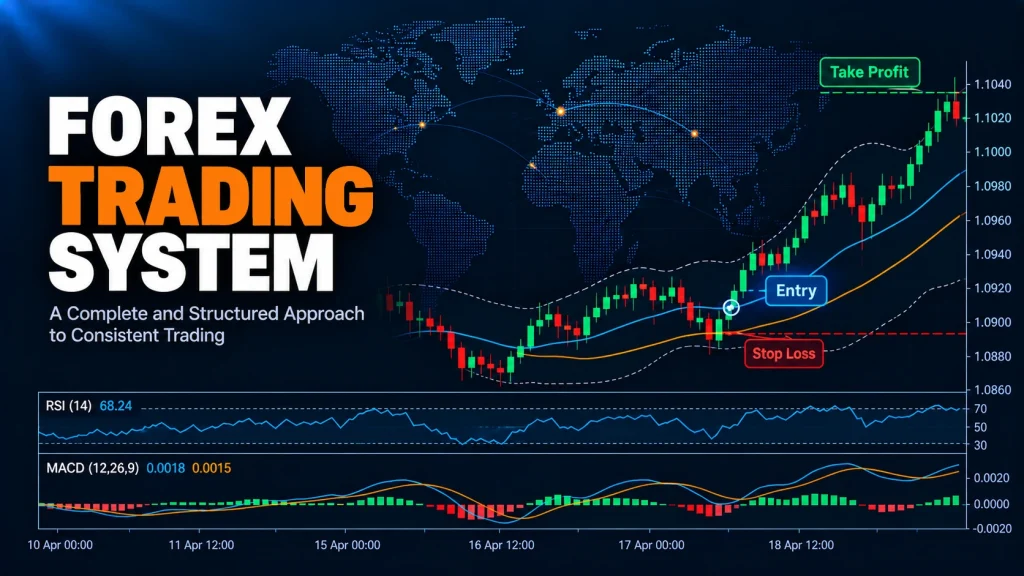
What Is A Forex Trading System?
A forex trading system is the complete rule set used to select markets, identify valid conditions, enter trades, manage risk, exit positions, skip unsuitable trades, and review results.
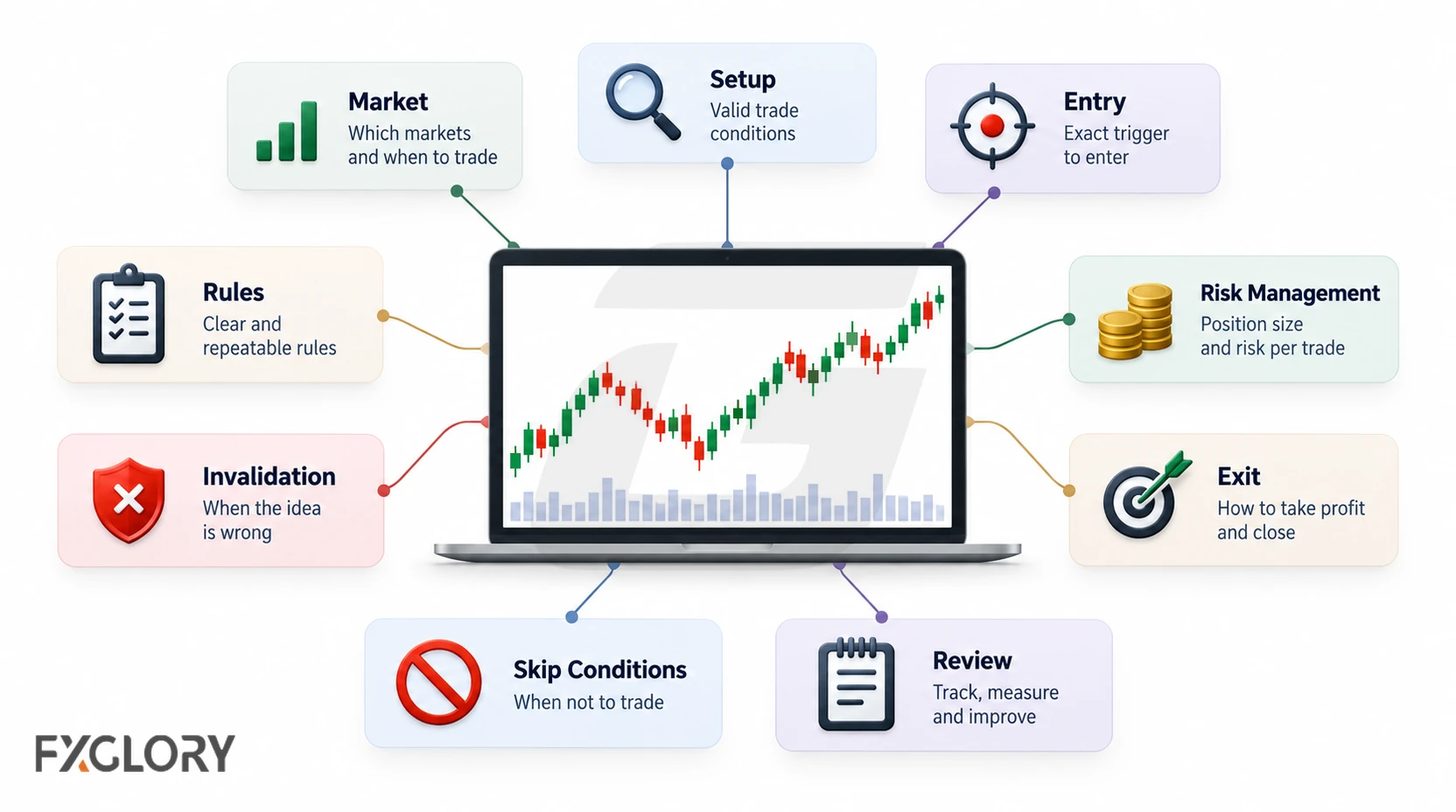
A system is not just an indicator, signal, template, robot, forum method, performance page, or single setup. It should explain how the trade is found, why the trade is valid, when risk starts, where the idea is wrong, how the position is managed, and how the result is reviewed.
This page focuses on system structure. For choosing the broader method, use strategy selection by condition and style. For individual setup construction, use the setup rule framework. For the written account-level document, use the trading plan template.
Forex Trading System vs Strategy vs Setup vs Plan
Many traders use these words as if they mean the same thing. They do not. The distinction matters because identifying a promising setup does not, on its own, define risk, execution, exits, or account-level operating limits.
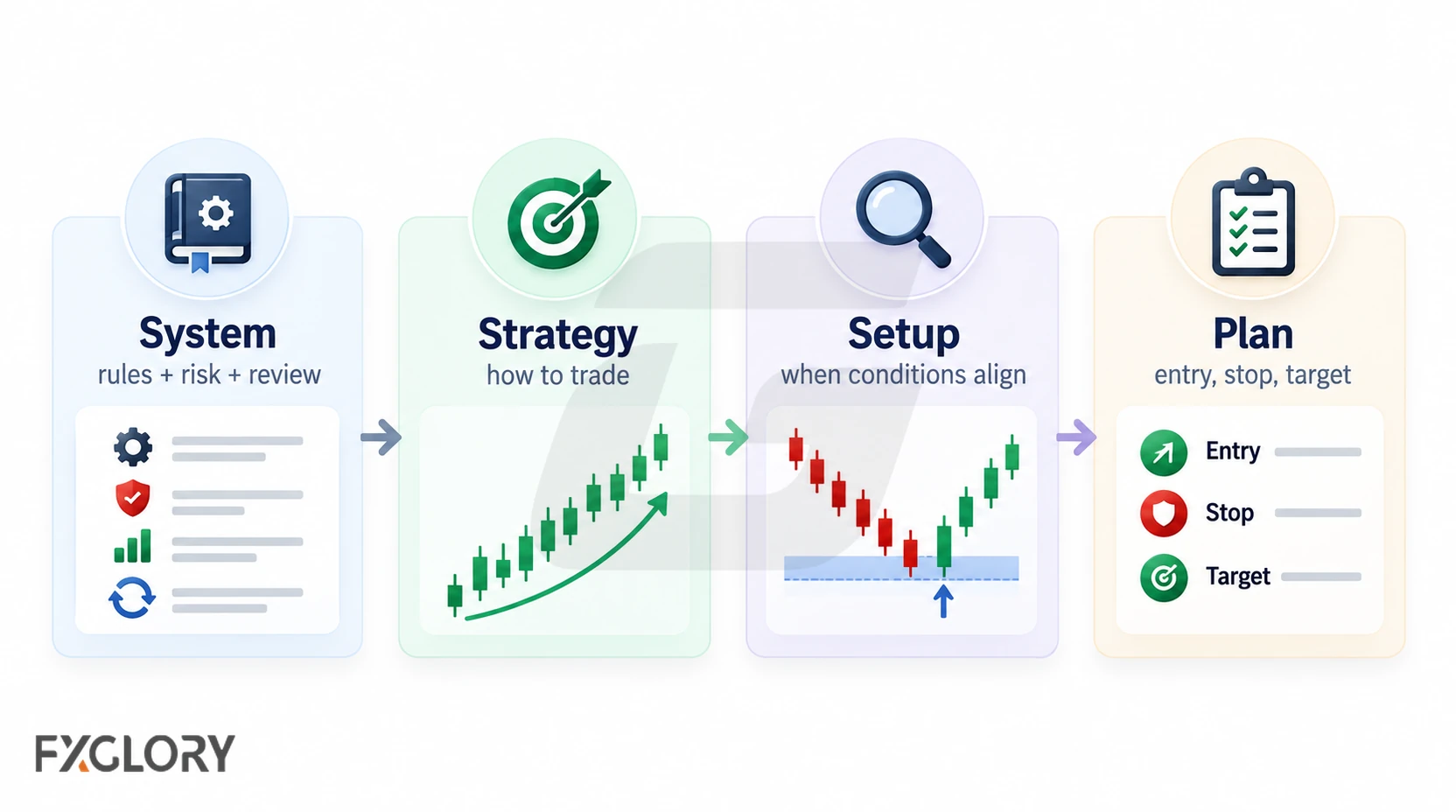
| Term | What It Controls | Example | Common Mistake |
|---|---|---|---|
| Trading strategy | The market approach | Trend following, breakout trading, range trading, day trading, indicator-based trading | Calling one strategy a full system |
| Trading setup | The specific condition that creates a trade idea | Breakout retest, pullback reaction, range rejection, indicator-confirmed setup | Entering from a setup without exit and risk rules |
| Trading system | The complete rule set for selecting, entering, managing, exiting, and reviewing trades | Market filter, timeframe, setup, trigger, stop, target, risk, no-trade rule, review | Changing rules after each trade |
| Trading plan | The wider operating document around the system | Schedule, account rules, risk limits, markets, routine, journal, review habits | Using a system without account-level limits |
When the question is which broad approach fits the trader, use the method-selection guide. When the question is how one trade idea becomes complete, use context, trigger, invalidation, exit, and review rules.
What A Complete Forex Trading System Includes
A complete system should answer each decision before the trade is open. Missing rules usually appear later as emotional choices.
| System Part | Question It Answers | Better Rule | Weak Rule |
|---|---|---|---|
| Market selection | Which pairs or instruments are reviewed? | Only review markets that fit the system's spread, session, and movement requirements | Trade any chart that looks active |
| Timeframe rule | Which chart gives context, setup, and trigger? | Separate higher-timeframe context from entry timing | Switch timeframes until a signal appears |
| Setup rule | When is a trade idea valid? | Trade only when market condition and planned setup align | Enter because a candle or indicator changed |
| Entry rule | When does risk start? | Enter only after the planned trigger appears at the planned area | Enter after price has already moved too far |
| Invalidation rule | Where is the idea wrong? | Stop or review where price breaks the reason for the trade | Exit only when the loss feels uncomfortable |
| Exit rule | How is the trade closed or managed? | Use target, trailing, partial, time-based, or invalidation rules written before entry | Decide after entry |
| Risk rule | Does the trade fit the account? | Check stop distance, position size, leverage exposure, margin, and spread before entry | Choose size before the stop is known |
| Review rule | Can the system be improved? | Record whether the system rules were followed | Judge only by profit or loss |
Forex Trading System Decision Sequence
A system should decide in the same order each time. If the trader starts with entry first, the rest of the system is usually invented under pressure.
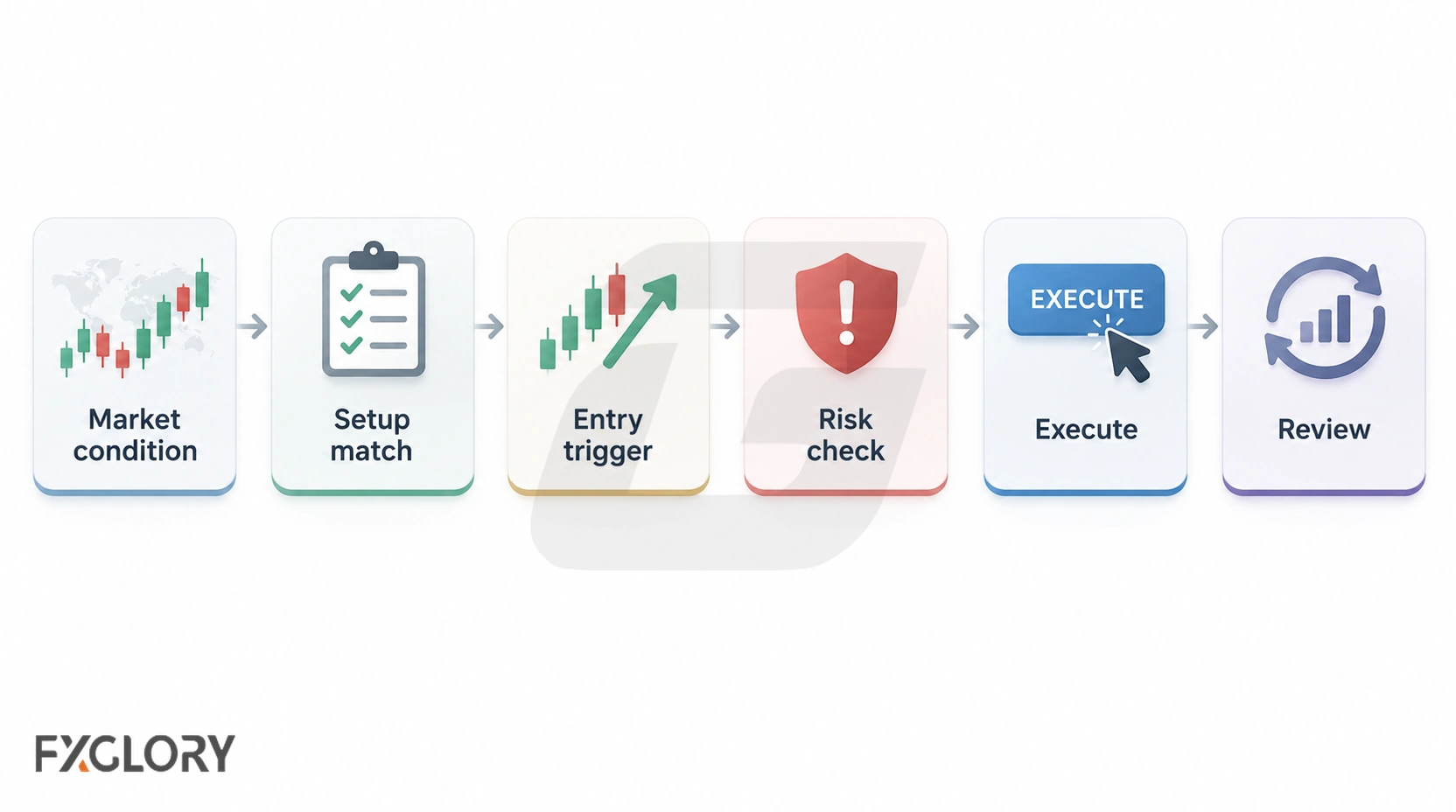
| Step | System Question | Continue Only If |
|---|---|---|
| 1. Market allowed? | Does this pair, session, and timeframe fit the system? | The market matches the written operating rules |
| 2. Condition valid? | Is the market trending, ranging, breaking out, compressing, or unclear? | The condition matches the system type |
| 3. Setup present? | Is there a planned trade idea? | The setup has context, location, and invalidation |
| 4. Entry allowed? | Has the trigger appeared at the planned area? | The trigger appears before price becomes extended |
| 5. Risk acceptable? | Do stop distance, position size, spread, and margin fit? | The trade fits the account rules before entry |
| 6. Management defined? | How will the trade be closed or reviewed? | Exit, trail, target, time, and no-progress rules are written |
| 7. Review possible? | Can the decision be checked later? | The rule-following result can be recorded |
Manual vs Automated Forex Trading Systems
A forex trading system can be manual, rule-based, automated, or partly automated. The important question is not whether the system uses software. The important question is whether the rules are clear, risk-aware, and reviewable.
This page does not evaluate, recommend, or verify third-party robots, expert advisors, copied systems, forum systems, or performance pages. The focus is how to judge whether any system has clear rules, risk controls, and review logic.
Automated or shared systems still need the same checks as manual systems: rule clarity, risk exposure, spread sensitivity, stop behavior, margin requirements, monitoring, and review.
| System Type | How It Works | What To Check | Main Risk |
|---|---|---|---|
| Manual system | The trader follows written rules manually | Rule clarity, emotional discipline, review notes | Rules change under pressure |
| Mechanical system | Rules are highly defined and repeated | Whether entry, exit, and risk rules are testable | False precision if market condition is ignored |
| Automated system | Software may handle some or all execution rules | Risk controls, spread sensitivity, stop behavior, margin exposure, monitoring | Automation is treated as risk removal |
| Shared or forum system | Rules come from another trader or community | Whether the trader understands the logic and limitations | Copying rules without knowing when to skip |
Market, Pair, Session, And Timeframe Rules
A system should define where it is allowed to operate. A method built for active intraday movement may not fit slow conditions. A system with small targets may become weak when spread is large relative to the expected move.
| Rule Area | System Question | Useful Rule | Weak Rule |
|---|---|---|---|
| Market or pair | Which markets fit the system? | Choose markets that fit spread, session, movement, and available observation time | Trade every available pair |
| Session | When should the system be active? | Use the session that matches the system's movement and liquidity needs | Trade whenever a signal appears |
| Timeframe | Which chart controls the decision? | Assign chart roles before looking for entry | Switch charts to justify the trade |
| Spread sensitivity | Can the target absorb cost? | Check spread before small-target or frequent-trading systems | Ignore trading cost |
| Event conditions | Can scheduled events affect the system? | Define whether to pause, reduce, or avoid exposure around events | Let event risk surprise the system |
For chart-role separation, use the multiple-timeframe workflow. For timeframe choice, use timeframe selection rules. For session timing, use trading-window selection.
Setup Rules: When A Trade Idea Is Valid
A setup rule decides when the system is allowed to consider a trade. It should describe the market condition, location, structure, and confirmation required before the entry trigger matters.
| Setup Type | System Condition | Valid Setup Example | Invalid Setup Example |
|---|---|---|---|
| Trend pullback | Trend context remains intact | Price pulls back to a planned area and reacts without breaking trend structure | The pullback breaks the trend structure before entry |
| Breakout | Price leaves a defined range or level | Breakout occurs from a clear structure and has a planned retest or continuation rule | Entry happens after an extended move with no invalidation point |
| Range reaction | Range boundaries remain respected | Price reacts at planned support or resistance inside the range | Price breaks the range instead of reacting |
| Indicator-supported setup | Indicator supports existing price context | Indicator confirms trend, momentum, volatility, or location already defined by the setup | Indicator is the only reason for the trade |
| Day-trading setup | Setup fits the planned session | Context, trigger, stop, target, and time rule fit the trading window | The trade requires holding beyond the planned session |
For detailed setup construction, use the complete setup framework.
Entry Rules: When The System Allows A Trade
An entry rule defines the exact condition that allows the trade to open. It should not be the first part of the system. Entry only matters after market, timeframe, setup, invalidation, and risk checks are clear.
The system should also define what cancels the entry. If the entry trigger appears too late, spread becomes unsuitable, price moves too far from the planned level, or event risk changes the condition, the trade should not be forced.
| Entry Question | System Rule | Skip If |
|---|---|---|
| What allows entry now? | Use a planned trigger at a planned area | The trigger appears after price is already extended |
| Where does risk start? | Entry level and stop distance are known before the trade | The stop cannot be defined |
| Does spread fit? | Expected movement remains realistic after spread | The target is too small after trading cost |
| Does the trade fit the timeframe? | Context, setup, and trigger charts are aligned by rule | The trader changes chart roles mid-decision |
| Is the system still active? | Session and event conditions still match the plan | The setup appears outside the planned operating window |
For entry-to-exit pairing, use the entry and exit rule chain.
Exit Rules: When The System Closes Or Manages A Trade
A system needs exit rules before entry. The exit can be a stop loss, target, trailing stop, partial close, time-based review, no-progress rule, changed-condition rule, or invalidation condition. The system should define which rule controls the trade and what happens if exit conditions conflict.
| Exit Rule | System Purpose | Weak Version |
|---|---|---|
| Initial stop loss | Defines the planned loss point | Stop is moved because the loss feels uncomfortable |
| Take-profit rule | Defines the target or profit-review area | Target is chosen after the trade is open |
| Trailing rule | Defines how the stop may move after price develops | Trailing method changes after every candle |
| Time-based rule | Defines what happens if price does not move or session ends | Short-term trade becomes unplanned long-term exposure |
| Changed-condition rule | Defines what happens when volatility, spread, or event risk changes | The system ignores conditions that made the trade valid |
Risk Rules: Stop Distance, Position Size, Margin, And Exposure
Risk rules connect the system to the account. A setup can be technically valid and still fail the system if the stop distance, spread, position size, or margin requirement does not fit.
| Risk Area | System Question | What To Check |
|---|---|---|
| Stop distance | How far is the invalidation point? | Whether the stop fits structure, volatility, and account risk |
| Position size | How much exposure does the trade create? | Whether size is chosen after stop distance is known |
| Margin | Does the position fit available margin requirements? | Whether leverage exposure and margin are reviewed before entry |
| Spread | Does the expected move remain meaningful after cost? | Whether small targets or frequent entries still make sense |
| Correlation and concentration | Is the system taking similar exposure across trades? | Whether multiple trades create the same directional risk |
Before using systems with frequent entries or small targets, review FXGlory spreads. Before connecting stop distance, size, leverage exposure, and account risk, use the FXGlory margin calculator.
No-Trade Rules
A signal should be ignored when the condition that made it valid is missing. No-trade rules keep the system from turning unclear charts, late entries, unsuitable spreads, or emotional pressure into positions.
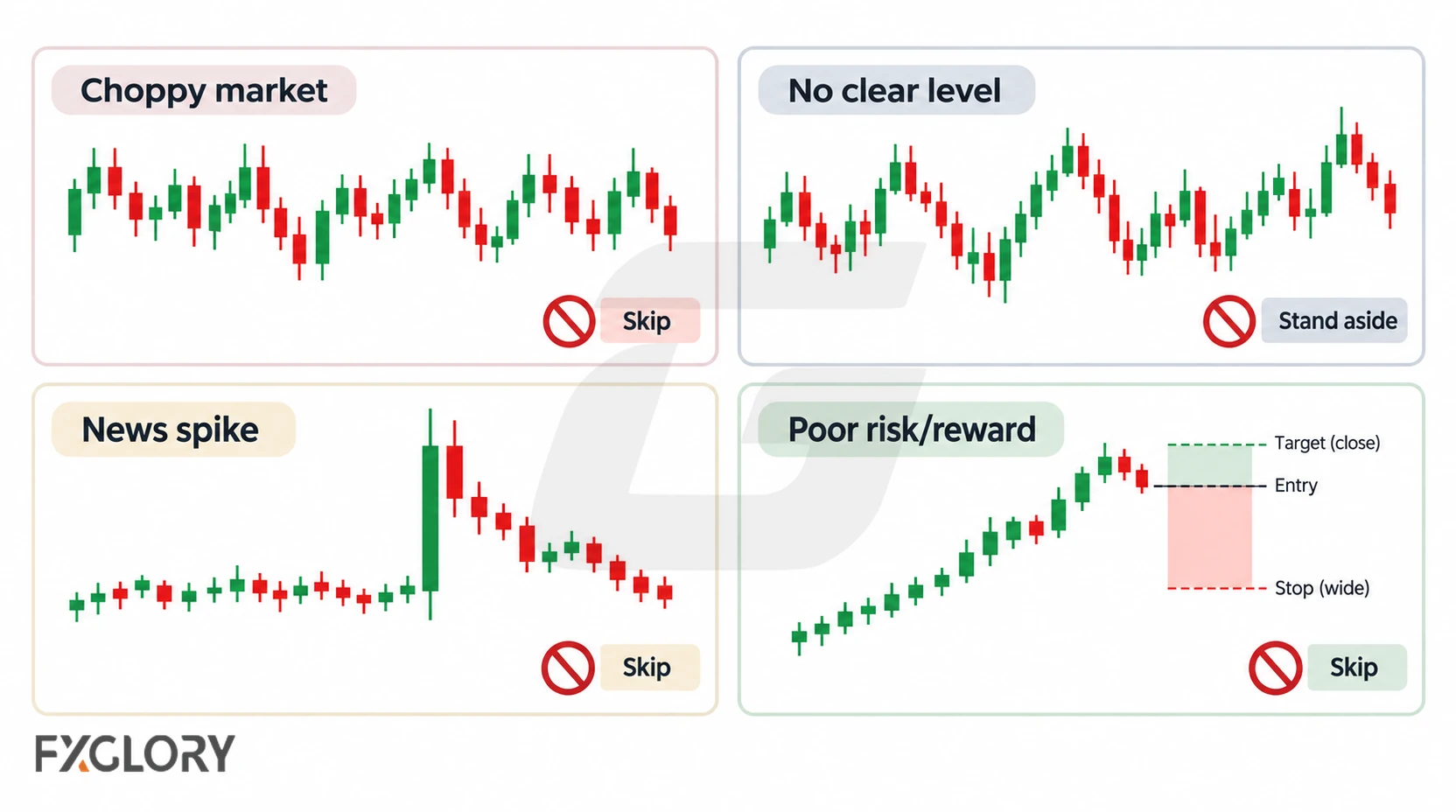
- No clear setup: The trader cannot explain the market condition or trade reason.
- No invalidation point: The trade idea has no defined wrong point.
- Spread problem: The expected move is too small after trading cost.
- Stop too wide for account risk: The setup requires more room than the account plan allows.
- Event risk: Scheduled events may change volatility, spread, or execution conditions beyond the system's rules.
- Timeframe conflict: Context, setup, and trigger charts do not align by rule.
- Late entry: Price has already moved far from the planned entry area.
- No exit rule: The entry is visible, but management or close rules are missing.
- Emotional pressure: The trade exists because of boredom, revenge, or fear of missing out.
Indicator Rules Inside A Trading System
Indicators can belong inside a system only when each one has a job. One indicator may define trend context, another may review momentum, and another may check volatility. If several indicators repeat the same information, the system may become noisy instead of clearer.
| Indicator Role | System Use | Weak Use |
|---|---|---|
| Trend filter | Shows whether trend logic is allowed | Used as the whole entry system |
| Momentum review | Checks whether movement is stretched, fading, or confirming | Every overbought or oversold reading becomes a trade |
| Volatility review | Checks stop distance, target realism, or movement condition | Used as a direction signal |
| Exit review | Supports trailing, exhaustion, or changed-condition rules | Added after entry to avoid a planned stop |
| Confirmation tool | Confirms a setup already defined by price context | Used to justify unclear trades |
For indicator roles, use the indicator strategy framework. For entry and exit timing roles, use the entry and exit indicator guide.
How To Evaluate A Forex Trading System
A system should be evaluated by rule quality, not by one result. One profitable trade can still break the system. One losing trade can still follow the system correctly.
A performance page or public system record can show reported history, but it does not replace understanding the rules, risk controls, drawdown behavior, spread sensitivity, and conditions where the system should stop trading.
| Evaluation Area | Question | Problem Sign |
|---|---|---|
| Rule clarity | Can the entry, exit, and skip rules be written in plain language? | The trader explains rules differently after each trade |
| Repeatability | Can the same condition be recognized again? | Every trade needs a new interpretation |
| Risk control | Does the system control stop distance, size, margin, and exposure? | Position size is chosen before risk is known |
| Market fit | Does the system match the pair, session, and timeframe? | The same system is forced into every condition |
| Cost fit | Does the target still make sense after spread? | The system depends on small moves without cost checks |
| Review quality | Can trades be reviewed beyond profit or loss? | No notes on rule-following, skipped trades, or changed conditions |
System Review Notes To Record
- Pair, session, and timeframe used.
- Market condition before entry.
- Setup type and reason the trade was allowed.
- Entry trigger and whether it appeared at the planned area.
- Initial invalidation point and stop distance.
- Spread and margin check before entry.
- Exit rule used: target, stop, trail, partial, time, or changed-condition rule.
- Whether any rule was changed after entry.
- Whether the result came from following the system or breaking it.
- What condition would cause the system to skip the same trade next time.
For platform access, charting, and order workflow context, review FXGlory trading platforms.
System-Gate Test Notes For Forex Trading System
This hypothetical educational model tests one complete forex trading system gate stack: market selection, 4H context, 1H setup, 15M trigger, risk gate, cost gate, exposure gate, stop placement, fixed target, system-invalidation exit, and holding-period review. It does not test every forex trading system, automated system, discretionary system, robot, indicator template, or trading plan.
The model reviewed EURUSD, GBPUSD, USDJPY, AUDUSD, USDCAD, and USDCHF using public yfinance 15-minute OHLC data where available. The research record lists the earliest downloaded observation for all six pairs as 2026-04-07 23:00 UTC and the latest as 2026-06-30 08:45 UTC. However, it also specifies a requested 60-day data period; these timestamps span more than 60 calendar days. They describe recorded data availability, not independently verified first and last eligible trade dates. The original acquisition script and trade log are needed to reconcile the period and establish the exact tested trade window. The 1H and 4H candles are resampled from the same 15-minute data so that each chart has a defined role.
| System Area | Educational Model Rule |
|---|---|
| System sequence | Market gate, 4H context, 1H setup, 15M trigger, risk gate, cost gate, exposure gate, exit, and review |
| Market gate | EURUSD, GBPUSD, USDJPY, AUDUSD, USDCAD, and USDCHF only |
| Operating window | 07:00-17:59 UTC, with Friday triggers after 16:00 UTC rejected |
| Context chart | 4H EMA(20), EMA(50), and EMA(20) slope define long or short context |
| Setup chart | 1H EMA(20) pullback-and-confirmation candle defines setup direction and stop structure |
| Trigger chart | 15M break of the previous 8-candle trigger range refines entry timing only |
| Risk gate | Stop distance must be between 6 and 220 pips |
| Cost gate | Baseline round-turn cost must be 35% or less of stop distance |
| Exposure gate | One open trade per pair and one open same-direction USD exposure |
| Stop | 1H setup candle extreme with a 0.25 ATR(14) buffer |
| Target comparison | Fixed 1.4R target from entry |
| System-invalidation exit | 15M close beyond the 1H setup candle extreme against the trade |
| Maximum holding review | 48 completed 15-minute candles after entry |
| Cost Input | Assumptions Used |
|---|---|
| Spread | 0.5, 1.5, and 3.0 pips |
| Slippage | 0.1, 0.5, and 1.0 pips per side |
| Baseline comparison | 1.5-pip spread and 0.5-pip slippage per side |
| Swap and rollover | Not included |
The review records setup candidates, triggered trades before risk and exposure filters, accepted trades, rejected conditions, rejection reasons, trade count, win rate, average win in R, average loss in R, expectancy in R, profit factor, maximum drawdown in R, worst losing streak, holding time, pair-level behavior, direction-level behavior, session-level behavior, exit reasons, USD-exposure overlap rejections, and spread/slippage sensitivity.
Resampling verification: The research rules specify completed 4H context candles, but the summary does not establish the precise 1H/4H bar boundaries or whether every higher-timeframe value was withheld until its candle had closed. The original script should be checked for this potential look-ahead issue; the results and rules are not changed here.
Educational System-Gate Test Results
The baseline run was slightly negative: -0.0521R expectancy and -2.1883R total net result across 42 trades. The test used a 1.5-pip spread and 0.5-pip slippage per side. These figures are hypothetical historical results from one educational system-gate rule model, not proof of future live-trading performance.
| Metric | Baseline Result |
|---|---|
| Setup candidates | 409 |
| Triggered trades before risk and exposure filters | 78 |
| Accepted trades | 42 |
| Rejected candidates | 367 |
| Trigger acceptance rate | 19.07% |
| System gate rejection rate | 89.73% |
| Win rate | 45.24% |
| Average win | 0.8946R |
| Average loss | -0.8341R |
| Expectancy | -0.0521R |
| Profit factor | 0.8859 |
| Maximum drawdown | -3.7784R |
| Worst losing streak | 4 |
| Average holding period | 430.71 minutes |
| System-invalidation exit rate | 2.38% |
| Average cost share of stop | 14.25% |
| Rejected Condition | Count |
|---|---|
| Outside operating window or Friday cutoff | 107 |
| Setup invalidated before trigger | 65 |
| No valid 15M trigger | 159 |
| Same-pair overlap | 7 |
| Same-direction USD exposure overlap | 29 |
Pair-Level Baseline Results
| Pair | Trades | Win Rate | Expectancy | Total Net | Max Drawdown | Worst Losing Streak | Average Cost Share Of Stop |
|---|---|---|---|---|---|---|---|
| AUDUSD | 5 | 40% | -0.1044R | -0.5221R | -1.2053R | 2 | 19.57% |
| EURUSD | 4 | 50% | -0.0988R | -0.3954R | -0.6168R | 2 | 9.68% |
| GBPUSD | 3 | 0% | -1.0785R | -3.2355R | -2.211R | 3 | 11.96% |
| USDCAD | 16 | 43.75% | -0.0674R | -1.0783R | -2.862R | 4 | 12.23% |
| USDCHF | 8 | 62.5% | 0.2427R | 1.9419R | -1.2019R | 2 | 15.21% |
| USDJPY | 6 | 50% | 0.1835R | 1.1012R | -1.5848R | 3 | 18.13% |
Direction-Level Baseline Results
| Direction | Trades | Win Rate | Expectancy | Total Net | Max Drawdown | Worst Losing Streak | System-Invalidation Exit Rate |
|---|---|---|---|---|---|---|---|
| Long | 32 | 46.88% | -0.0115R | -0.3683R | -3.9693R | 3 | 0% |
| Short | 10 | 40% | -0.182R | -1.8199R | -3.0988R | 4 | 10% |
Session-Level Baseline Results
| Entry Session | Trades | Win Rate | Expectancy | Total Net | Max Drawdown | Worst Losing Streak | Average Cost Share Of Stop |
|---|---|---|---|---|---|---|---|
| London morning | 20 | 55% | 0.1576R | 3.1523R | -3.358R | 3 | 15.75% |
| London/New York overlap | 14 | 35.71% | -0.192R | -2.6878R | -3.276R | 4 | 13.17% |
| Early New York afternoon | 7 | 42.86% | -0.2326R | -1.6283R | -1.8783R | 3 | 12.07% |
| Rollover or off-hours | 1 | 0% | -1.0245R | -1.0245R | 0R | 1 | 14.8% |
Exit Reason Counts
| Exit Reason | Count |
|---|---|
| Stop loss | 14 |
| System invalidation exit | 1 |
| Target 1.4R | 12 |
| Time exit | 15 |
Spread And Slippage Sensitivity
| Spread Pips | Slippage Pips Per Side | Win Rate | Expectancy | Total Net | Max Drawdown | Average Cost Share Of Stop |
|---|---|---|---|---|---|---|
| 0.5 | 0.1 | 50% | 0.0505R | 2.1225R | -3.0435R | 3.99% |
| 0.5 | 0.5 | 47.62% | 0.0049R | 0.2066R | -3.2159R | 8.55% |
| 0.5 | 1 | 45.24% | -0.0521R | -2.1883R | -3.7784R | 14.25% |
| 1.5 | 0.1 | 47.62% | -0.0065R | -0.2724R | -3.259R | 9.69% |
| 1.5 | 0.5 | 45.24% | -0.0521R | -2.1883R | -3.7784R | 14.25% |
| 1.5 | 1 | 45.24% | -0.1091R | -4.5831R | -4.8516R | 19.96% |
| 3 | 0.1 | 45.24% | -0.092R | -3.8647R | -4.4553R | 18.25% |
| 3 | 0.5 | 45.24% | -0.1376R | -5.7805R | -5.9404R | 22.81% |
| 3 | 1 | 42.86% | -0.1947R | -8.1754R | -8.1443R | 28.51% |
What This System-Gate Test Shows
This complete system-gate stack produced negative baseline expectancy in the tested sample. The main review points were gate rejection, trigger selectivity, exposure overlap, time exits, cost sensitivity, and session-level differences.
The system identified 409 setup candidates, but only 42 trades passed the trigger, risk, cost, and exposure gates. Rejected conditions were mostly no valid 15M trigger, outside operating window or Friday cutoff, setup invalidation before trigger, same-direction USD exposure overlap, and same-pair overlap.
The London morning group was positive in this run, but the total baseline result remained negative. The educational use of the test is to review how a complete rule set filters conditions before entry and how costs, session timing, exits, and exposure controls change system behavior.
Common Forex Trading System Mistakes
- Calling a signal a system: A signal can alert the trader, but it does not define market selection, risk, exit, or review.
- Using too many indicators: Extra indicators can repeat the same information and create conflict.
- No market-condition filter: Trend, range, breakout, and unclear conditions are treated the same.
- No no-trade rule: The system has entries but no rule for when to stand aside.
- No exit rule before entry: The trade starts before stop, target, trailing, or time rules are defined.
- Ignoring spread: A short-target system becomes weaker after trading cost.
- Ignoring margin exposure: Stop distance and position size are not checked together.
- Copying a system without understanding it: The trader cannot explain when the system should not be used.
- Changing rules after losses: The system cannot be reviewed because the rule set keeps moving.
- Judging only by one trade: The result is reviewed without checking whether rules were followed.
Forex Trading System Checklist
Before using a forex trading system, answer these questions.
- Which markets or pairs does the system allow?
- Which session or trading window does the system use?
- Which timeframe gives context, setup, and trigger?
- What market condition must exist before a trade is considered?
- What exact setup makes the trade idea valid?
- What trigger allows entry?
- What condition cancels the entry?
- Where is the trade idea invalid?
- Where is the stop loss placed or reviewed?
- What target, trailing, partial, or time-based exit rule is used?
- How is position size chosen after stop distance is known?
- Does the trade still make sense after spread?
- Does the position fit margin and leverage exposure rules?
- What conditions require the system to skip trading?
- Which indicators are used, and what job does each one have?
- How will trades, skipped trades, and rule changes be reviewed?