
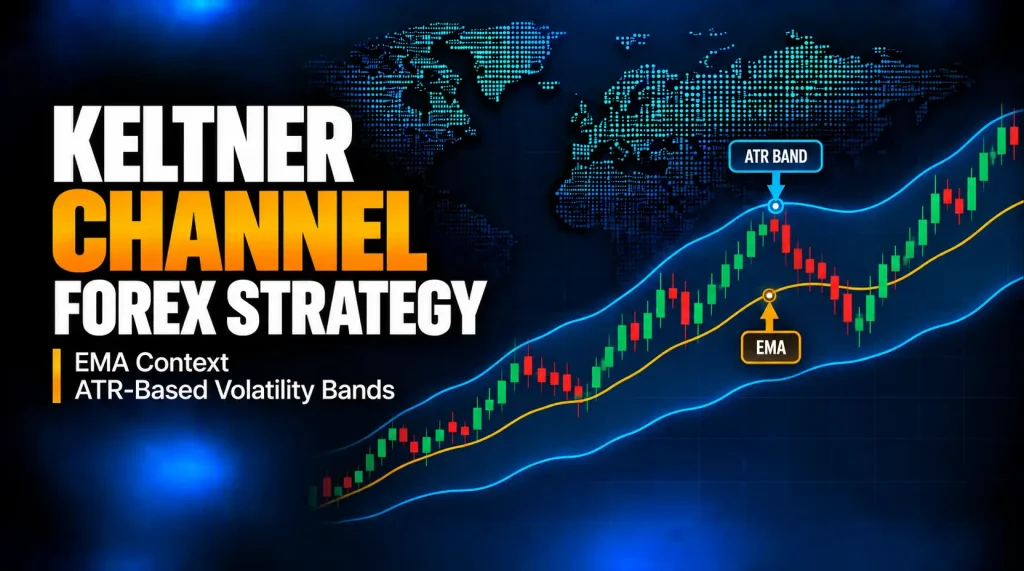
What Is A Keltner Channel Forex Strategy?
A Keltner Channel forex strategy reviews price around a moving-average baseline and upper and lower bands that are commonly built from Average True Range. The middle line can help review trend context, while the outer bands can help review volatility range and expansion attempts.
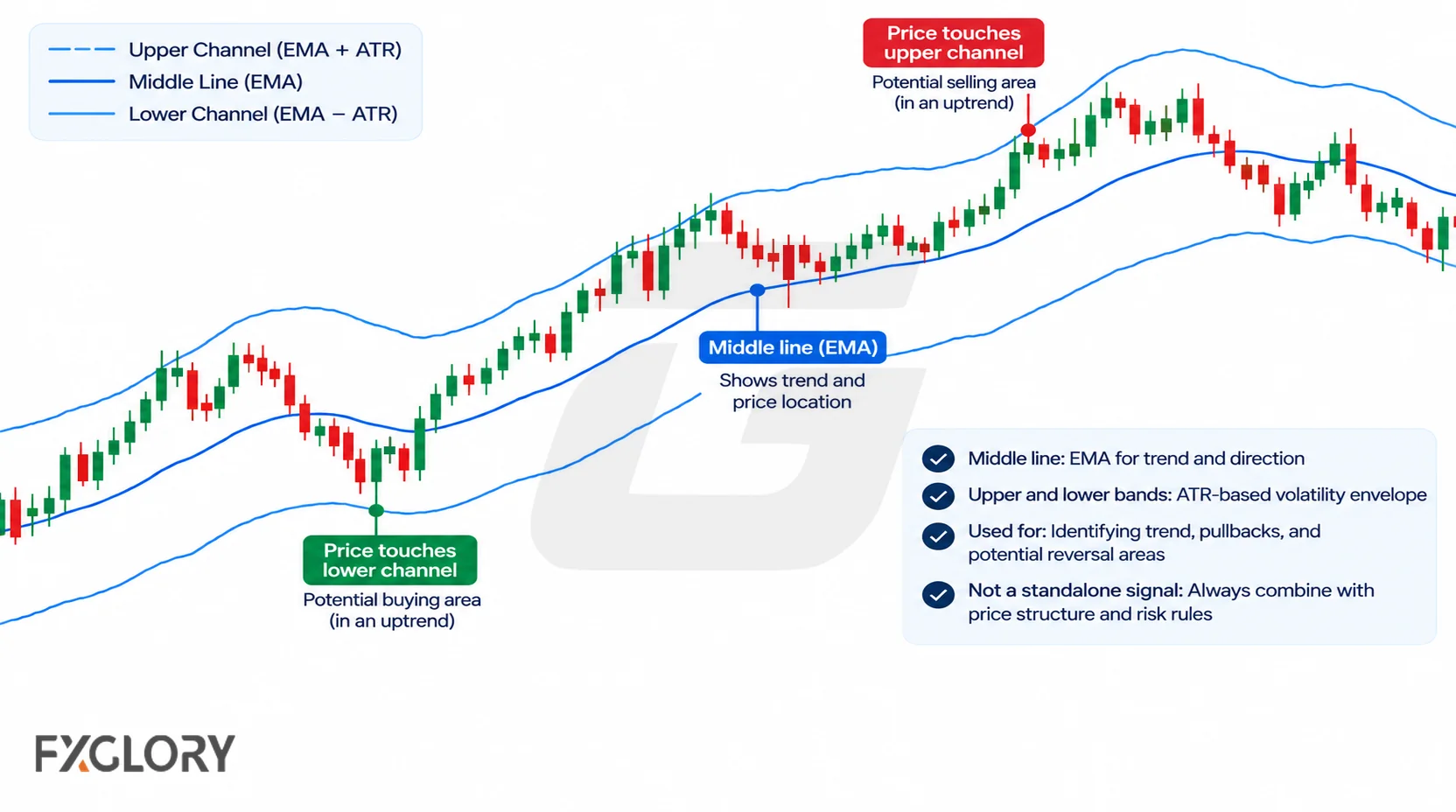
The channel does not create a trade by itself. A touch of the upper band, a move below the lower band, or a return to the middle line should be treated as a condition to review, not as a complete trade reason.
This page does not cover every EMA, ATR, or Bollinger-style channel strategy. It focuses only on how Keltner Channels can be reviewed inside a forex setup. For the broader indicator-strategy framework, review forex indicator strategies. For moving-average mechanics, use the Forex Moving Average guide. For ATR-specific volatility rules, use ATR as volatility and risk support.
Keltner Channel Signal vs Full Forex Strategy
The common mistake is to treat a Keltner Channel band touch or band break as a complete trade signal. The same band interaction can mean different things depending on whether the market is trending, ranging, compressing, or extending.
| Keltner Reading | What It May Suggest | What Still Needs To Be Checked | Main Risk |
|---|---|---|---|
| Price holds above the middle line | Bullish context may be present | Trend structure, support, trigger, and stop distance | The market may still be ranging |
| Price holds below the middle line | Bearish context may be present | Trend structure, resistance, trigger, and stop distance | The move may be a short-term pullback |
| Price breaks above the upper band | Upside expansion may be starting | Breakout structure, close, retest, and invalidation | The break may fail quickly |
| Price breaks below the lower band | Downside expansion may be starting | Breakdown structure, close, retest, and invalidation | The break may return inside the channel |
| Price rotates around the middle line | Trend condition may be unclear | Range boundaries or no-trade rule | The strategy may force trades in chop |
When a Keltner condition needs to become a full trade plan, use the forex trading setups framework before adding more indicators.
How Keltner Channels Are Built
Modern Keltner Channels are commonly built from three parts: a middle moving-average line, an upper band, and a lower band. The middle line is often an EMA, while the outer bands are commonly placed using an ATR-based distance from that middle line.
| Channel Part | Common Role | Strategy Use | Main Risk |
|---|---|---|---|
| Middle line | Moving-average baseline | Trend context, pullback area, price-position review | Treating the line as exact support or resistance |
| Upper band | ATR-based distance above baseline | Upside expansion, overextension, breakout review | Assuming every upper-band touch is a buy or sell |
| Lower band | ATR-based distance below baseline | Downside expansion, overextension, breakdown review | Assuming every lower-band touch is a buy or sell |
| ATR multiplier | Controls channel width | Tests tighter or wider volatility envelopes | Changing settings after each result |
A simple formula reference is: middle line, plus or minus ATR multiplied by a chosen multiplier. This is a testing reference, not a universal setting.
| Line | Simple Reference Formula | Meaning |
|---|---|---|
| Middle line | EMA or chosen moving-average baseline | Reviews price context around the average |
| Upper band | Middle line + ATR × multiplier | Reviews upper volatility envelope |
| Lower band | Middle line − ATR × multiplier | Reviews lower volatility envelope |
Keltner Channel Slope And Market Context
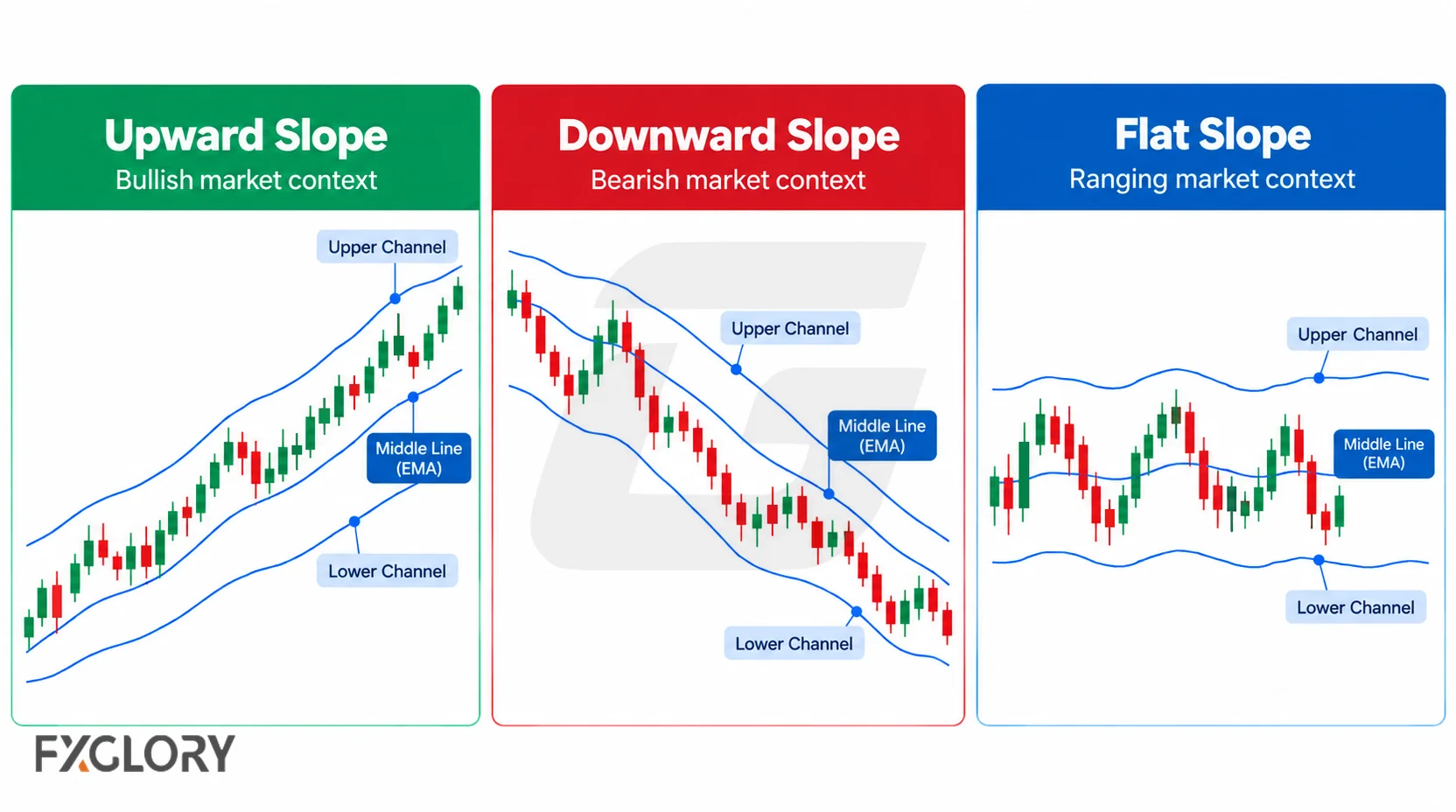
The slope of the Keltner Channel can help review whether the market is trending or moving sideways. Slope is still context, not a trade signal.
| Channel Behavior | Possible Context | What To Check | Main Risk |
|---|---|---|---|
| Channel slopes upward | Bullish trend context may be present | Higher lows, pullback reaction, and invalidation | Entering after price is already extended |
| Channel slopes downward | Bearish trend context may be present | Lower highs, pullback reaction, and invalidation | Entering after a late downside move |
| Channel is flat | Range or unclear context may be present | Support, resistance, and no-trade rules | Forcing trend trades in sideways conditions |
Keltner Channel Forex Decision Chain
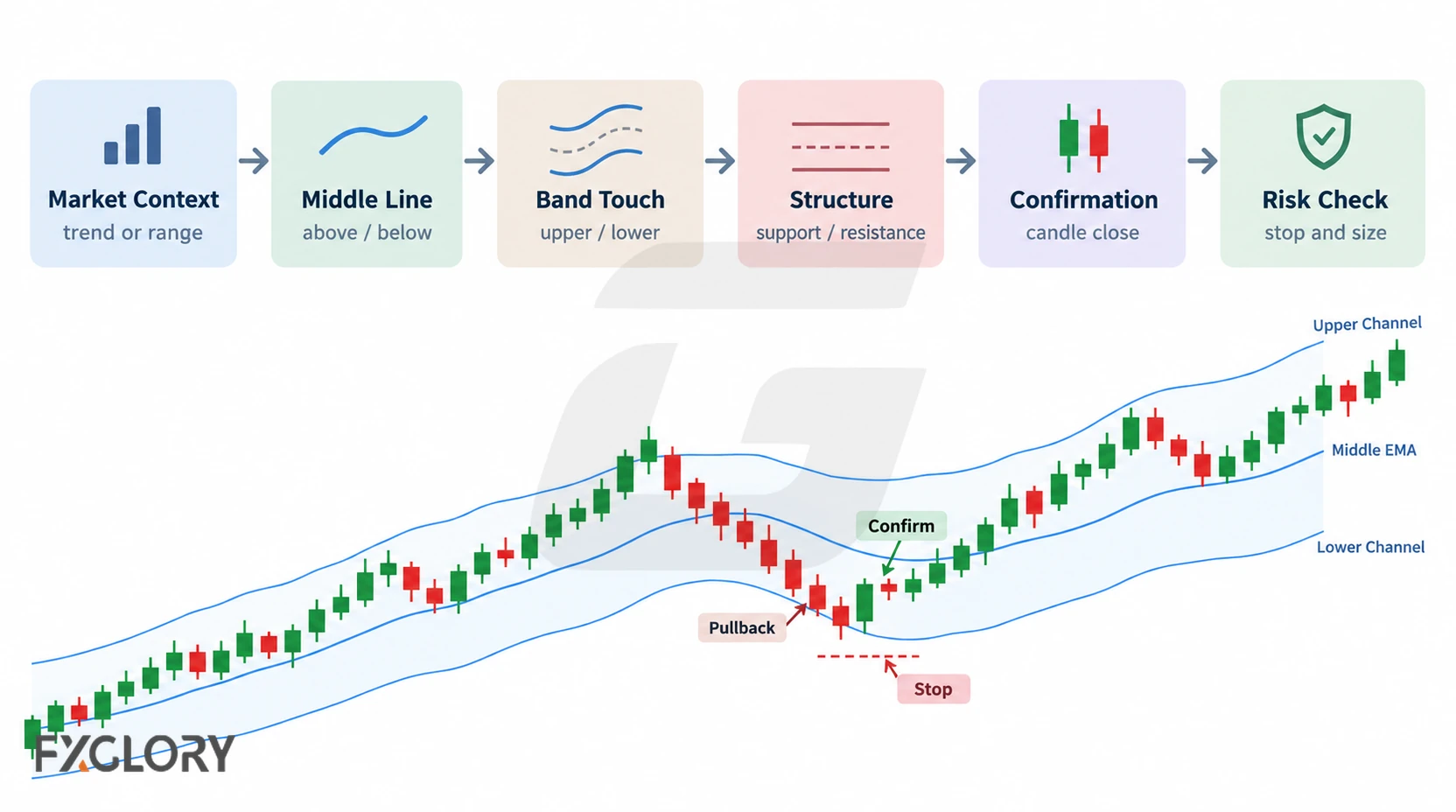
A Keltner Channel strategy should move in order. The market condition comes first. Price location inside or outside the channel comes second. Confirmation and risk checks come before the trade is accepted.
| Step | Question | Tool Or Context | Decision |
|---|---|---|---|
| 1 | Is the market trending, ranging, compressing, or unclear? | Price structure and higher timeframe | Choose trend, range, breakout, or no-trade context |
| 2 | Where is price relative to the middle line? | Keltner baseline | Review bullish, bearish, pullback, or unclear context |
| 3 | Is price interacting with an outer band? | Upper or lower channel band | Review expansion, overextension, or false-break risk |
| 4 | Did price confirm through structure? | Support, resistance, close, retest, swing behavior | Decide whether a setup exists |
| 5 | Can the trade be managed? | Spread, stop distance, position size, margin | Accept, reduce, delay, or skip |
Keltner Channel Forex Strategy Types
The examples below are role snapshots, not complete standalone systems. A full Keltner breakout strategy, Keltner scalping strategy, Keltner and RSI strategy, or Keltner and ADX strategy would need narrower rules for market condition, trigger, invalidation, stop distance, exit, and review.
Keltner Trend-Following Context
In a trending market, price may spend more time on one side of the middle line. The channel can help review whether price is holding a directional context, but the trend still needs structure.
- Context: Price shows higher highs and higher lows, or lower highs and lower lows.
- Keltner role: Reviews price position around the baseline and bands.
- Trigger: Price confirms continuation from a defined structure.
- Invalidation: Price breaks the structure behind the trend idea.
- Skip rule: Skip if price only rotates around the middle line without clean trend structure.
Middle-Line Pullback Setup
The Keltner middle line can act as a dynamic reference area during a trend. It should not be treated as an exact price. The pullback still needs a reaction, structure, and a defined risk area.
- Context: Price trends, then pulls back toward the baseline or nearby structure.
- Keltner role: Helps review pullback depth and price location.
- Trigger: Price reacts from the pullback area and confirms continuation.
- Invalidation: Price breaks the pullback structure or removes the trend idea.
- Skip rule: Skip if the middle-line touch has no reaction or the stop distance is unclear.
Outer-Band Breakout Setup
A move outside the upper or lower band can suggest volatility expansion, but it should not be used alone. The breakout needs structure, confirmation, and a failed-breakout rule.
- Context: Price compresses or builds near support, resistance, or a range boundary.
- Keltner role: Reviews expansion beyond the channel.
- Trigger: Price breaks and holds beyond a defined structure or retests it in a manageable way.
- Invalidation: Price returns inside the broken structure and removes the breakout idea.
- Skip rule: Skip if the band break is only a spike or price is already far from invalidation.
Failed Breakout Or Channel Re-Entry
A failed Keltner breakout happens when price pushes outside a band and then quickly returns inside the channel or previous structure. This can be a warning that the breakout condition is weak.
- Context: Price breaks an outer band but cannot hold outside structure.
- Keltner role: Shows the expansion attempt and return inside the envelope.
- Trigger: No new trade is accepted unless a separate failed-breakout rule exists.
- Invalidation: The original breakout idea is invalid once price returns inside the defined structure.
- Skip rule: Skip if the trade depends only on the first band break.
Range Or Mean-Reversion Caution
In ranging markets, price may move from one side of the channel toward the other. That does not automatically make every outer-band touch a reversal trade. Range boundaries should be defined first.
Outer-band areas may be reviewed as overextended zones only after the market context is defined. In a flat or ranging market, an outer-band reaction may matter near support or resistance. In a strong trend, the same outer-band touch may be part of continuation instead of reversal.
- Context: Price rotates between visible support and resistance.
- Keltner role: Helps review price location inside the range.
- Trigger: Price reacts from a range boundary with a defined invalidation point.
- Invalidation: Price breaks the range boundary or volatility expands against the idea.
- Skip rule: Skip if there is no clear support, resistance, or range structure.
Keltner Channels vs Bollinger Bands
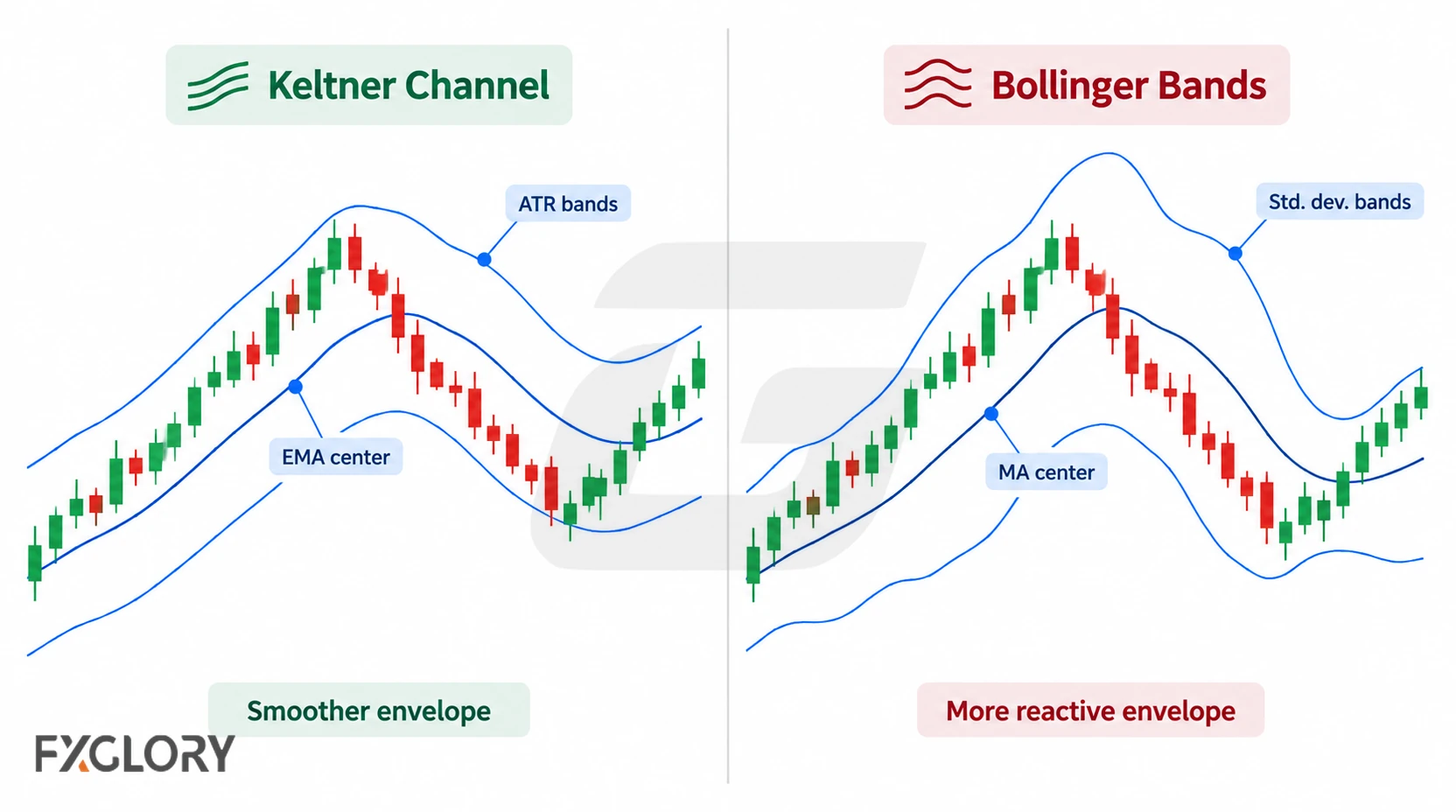
Keltner Channels and Bollinger Bands can look similar because both create an upper and lower envelope around price. The main difference is how the outer bands are calculated. Keltner Channels commonly use ATR-based width, while Bollinger Bands use standard deviation.
| Tool | Middle Line | Band Width | Common Use | Main Risk |
|---|---|---|---|---|
| Keltner Channel | Often EMA-based | Commonly ATR-based | Trend context, pullbacks, volatility envelope, breakouts | Band touch is mistaken for signal |
| Bollinger Bands | Usually moving-average based | Standard deviation-based | Volatility expansion, compression, price-location review | Band expansion or squeeze is misread as direction |
Keltner Channels can also appear in squeeze-style workflows when traders compare Bollinger Bands with Keltner Channels. This page does not replace a dedicated TTM Squeeze or BB/KC Squeeze strategy page. It only explains the Keltner Channel side of the comparison.
For the broader Bollinger framework, review Bollinger Bands as volatility and price-location context. For compression and breakout workflows, review Bollinger Band squeeze strategy rules.
Keltner Channel Settings And Timeframes
Common testing references include a 20-period moving-average baseline and an ATR multiplier such as 1.5x or 2x. Some traders test different ATR lengths, baseline periods, and multipliers. These are testing references, not universal settings.
| Reference | Strategy Use | Main Risk |
|---|---|---|
| 20-period baseline | Common middle-line reference | Not automatically suitable for every pair or timeframe |
| ATR 10 or ATR 20 | Common volatility-width references | Different ATR lengths change channel behavior |
| 1.5x ATR | Tighter channel test | More band interactions and possible noise |
| 2x ATR | Wider channel test | May create later or fewer outer-band signals |
| Lower timeframes | More frequent channel interactions | More spread sensitivity and false breaks |
| Higher timeframes | Cleaner structure in some conditions | Wider stops and larger exposure may need review |
Settings should be chosen before testing and kept consistent long enough to review clean trends, pullbacks, false breaks, ranges, short-term signals, and skipped setups.
Confirmation Tools For Keltner Channel Setups
Confirmation should answer a specific question. Adding more indicators does not automatically make a Keltner Channel setup cleaner. Each tool should have one job.
| Tool Or Context | Question It Helps Answer | Use Carefully Because |
|---|---|---|
| Support and resistance | Where is the breakout, rejection, or range boundary? | Levels are usually zones, not exact prices. |
| Higher timeframe | Does the Keltner reading agree with broader structure? | Lower-timeframe band breaks may only be pullbacks. |
| ADX | Is trend strength developing after a breakout or continuation? | ADX may confirm late and does not show direction alone. |
| RSI | Is momentum supporting or rejecting the move? | RSI should not replace price structure. |
| ATR stop-loss review | Does stop distance fit current volatility? | ATR does not confirm direction. |
| Bollinger squeeze context | Is compression or expansion part of the setup? | Compression does not predict direction by itself. |
When the setup depends on a level, review support and resistance in forex. For trend-strength confirmation, use ADX as a trend-strength filter. For momentum review, use RSI forex strategy rules.
Day Trading And Scalping Considerations
Lower-timeframe Keltner Channel setups can appear often because price interacts with the baseline and bands more frequently. More channel interactions do not automatically make the method easier to use.
| Short-Term Issue | Why It Matters | What To Check |
|---|---|---|
| Spread sensitivity | Small pullback or breakout targets can be reduced by trading cost | Check whether the target still makes sense after spread |
| False breaks | Price may break an outer band and return inside quickly | Use a failed-breakout rule before entry |
| Baseline noise | Price can rotate around the middle line in chop | Use trend or no-trade rules |
| Fast volatility changes | ATR-based width can change with recent movement | Check stop distance and position size before entry |
| Platform workflow | Indicators, alerts, and custom tools may calculate channels differently | Know the baseline, ATR length, multiplier, and confirmation rule |
Platform availability can vary by terminal, chart package, or custom indicator. Do not assume that a Keltner Channel, alert, or script uses the same baseline, ATR length, multiplier, or update method across platforms.
Before testing lower-timeframe Keltner rules, review FXGlory spreads. When stop distance and position size need to be checked together, use the FXGlory margin calculator. Review FXGlory trading platforms when the strategy depends on charting tools, indicator settings, alerts, order placement, or trade-management workflow.
Worked Example: One Keltner Channel Setup, Four Decisions
Assume a currency pair is trading above the Keltner middle line and pulls back toward the baseline during a visible uptrend. That does not automatically create a buy setup. The same reading can lead to different decisions depending on structure and risk.
| Observation | Possible Meaning | Next Check | Decision Risk |
|---|---|---|---|
| Price reacts near the middle line and forms a higher low | Trend pullback may be holding | Check trigger, invalidation, spread, and stop distance | Entry may still be too far from risk area |
| Price breaks above the upper band after compression | Upside expansion may be starting | Check breakout structure, retest, and failed-break rule | The break may be a spike |
| Price breaks the upper band and returns inside quickly | Failed breakout may be developing | Apply the failed-breakout rule | The trader holds because the first break looked strong |
| Price rotates around the middle line with flat structure | Trend context may be unclear | Use range or no-trade rule | Repeated entries may occur in chop |
When Keltner Channel Strategies Fail
Keltner Channel strategies often fail when the channel is treated as a complete trade plan. The most common problem is not the indicator itself; it is using the bands without market context and risk control.
- Band touch used as a signal: The trader enters because price touched a band, not because a setup exists.
- Trend and range context ignored: The same band reading is used in every market condition.
- Middle line treated as exact support or resistance: Price may react around an area, not one exact line.
- Outer-band break chased late: The trade is accepted after price is already far from invalidation.
- No failed-breakout rule: Price returns inside the channel but the trade is still held.
- ATR width misunderstood: Wider or narrower bands are used without reviewing volatility, stop distance, or target realism.
- Settings overfit: Baseline period or ATR multiplier is changed after each result.
- Spread ignored: A short-term Keltner setup has too little room after trading cost.
- Stop distance ignored: The setup looks clean, but the stop does not fit the account plan.
- Platform calculation ignored: The trader assumes all Keltner Channel tools use the same baseline, ATR length, multiplier, and update method.
Testing A Keltner Channel Forex Strategy
A Keltner Channel forex strategy should be tested as a full rule set, not as a band-touch signal. Testing should include clean trends, pullbacks, outer-band breakouts, failed breaks, range conditions, volatile periods, lower-timeframe examples, and skipped setups.
- What market condition does the Keltner setup need?
- What baseline period will be tested?
- What ATR length and multiplier will be tested?
- Is the setup based on trend context, pullback, breakout, failed breakout, or range behavior?
- What price structure confirms the Keltner reading?
- Where is the setup invalid?
- Does the stop distance still make sense after spread?
- Does stop distance fit position size and margin exposure?
- What defines a failed break?
- Does the platform or indicator use the expected baseline, ATR length, multiplier, and update method?
- Are late entries, range signals, and skipped setups recorded?
- Does the result change across selected currency pairs or timeframes?
Review available currency pairs before applying the same Keltner Channel rule everywhere.
Keltner Channel Forex Strategy Checklist
Before using a Keltner Channel rule, answer these questions.
- Is the market trending, ranging, compressing, or unclear?
- What baseline, ATR length, and multiplier are being tested?
- Is the channel sloping upward, downward, or flat?
- Is price above, below, or rotating around the middle line?
- Is price interacting with an outer band, and why does that matter?
- Does price structure confirm the channel reading?
- Where is the trade idea invalid?
- What makes the channel reading a failed breakout or no-trade?
- Does the setup still make sense after spread?
- Does stop distance fit position size and margin?
- Are confirmation tools being used for separate jobs?
- What condition makes the Keltner setup a no-trade?
A Keltner Channel forex strategy is useful only when the channel reading is treated as one condition inside a full setup. The baseline and ATR bands help review price location and volatility; price structure, confirmation, invalidation, spread, stop distance, and risk rules decide whether the trade can be used.