Rising Three Methods Forex Pattern: Meaning, Structure & Context

Learn how the rising three methods pattern forms in forex, why it is treated as a bullish continuation structure, how its middle candles differ from inside bars and harami, and when the pattern may be weak or misleading.
 
Written byHenry Green
Published
Last updated

Key Takeaways

  • The rising three methods is a bullish continuation candlestick pattern that appears inside an existing upward move.
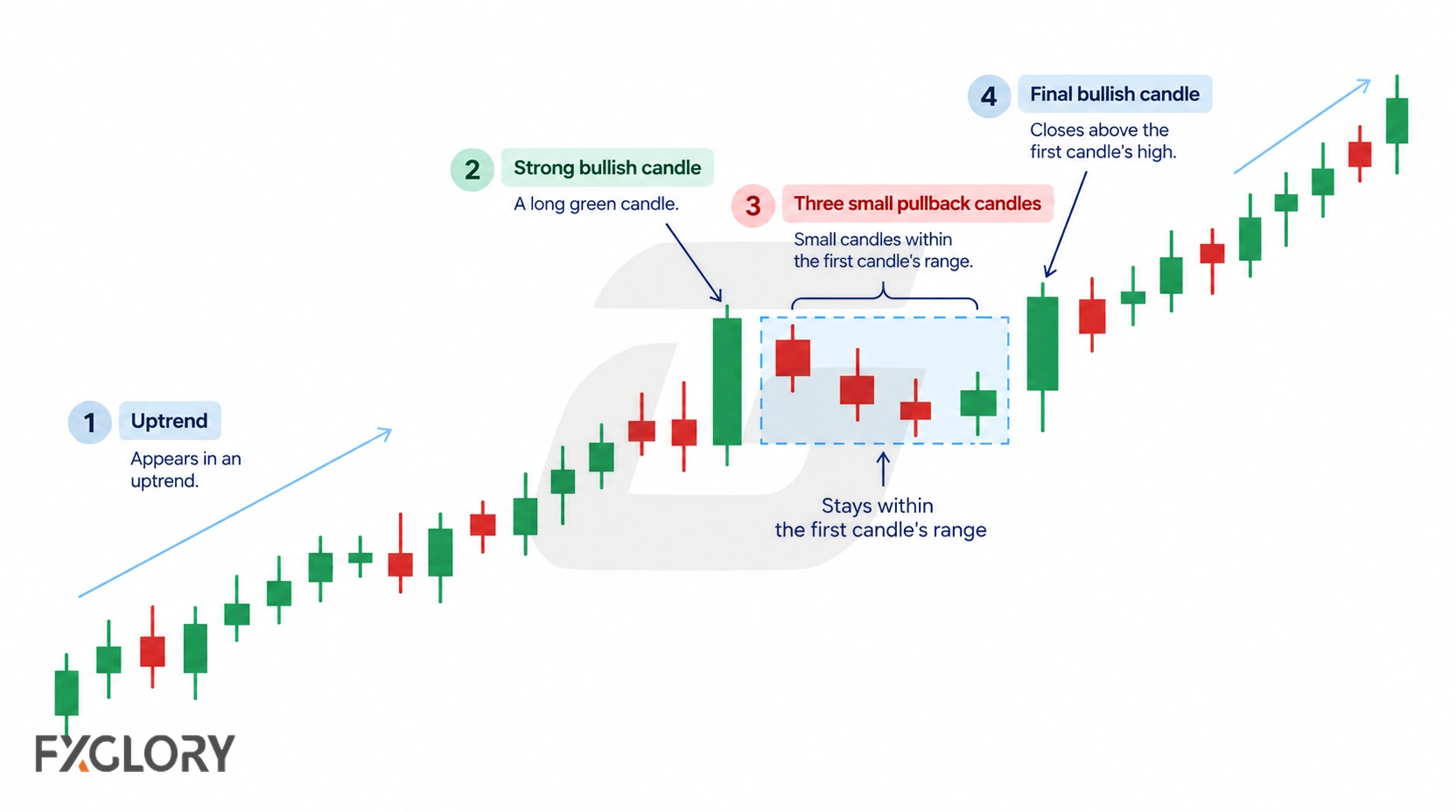
  • The classic structure has a strong bullish candle, three or more smaller pullback candles contained within the first candle's range, and a final bullish candle that resumes upward pressure.
  • The middle candles usually show a controlled pause, not a full reversal, because they remain contained inside the first candle's range.
  • The pattern is different from three white soldiers because rising three methods includes a pullback phase between two bullish candles.
  • Rising three methods should be reviewed with trend quality, candle containment, final candle strength, volatility, spread, and follow-up price action.
Risk note: Forex trading involves risk of loss. A rising three methods pattern can help organize chart observations, but it cannot remove spread, slippage, volatility, leverage risk, news-event risk, low-liquidity conditions, false-continuation risk, or execution mistakes.

What Is The Rising Three Methods Pattern In Forex?

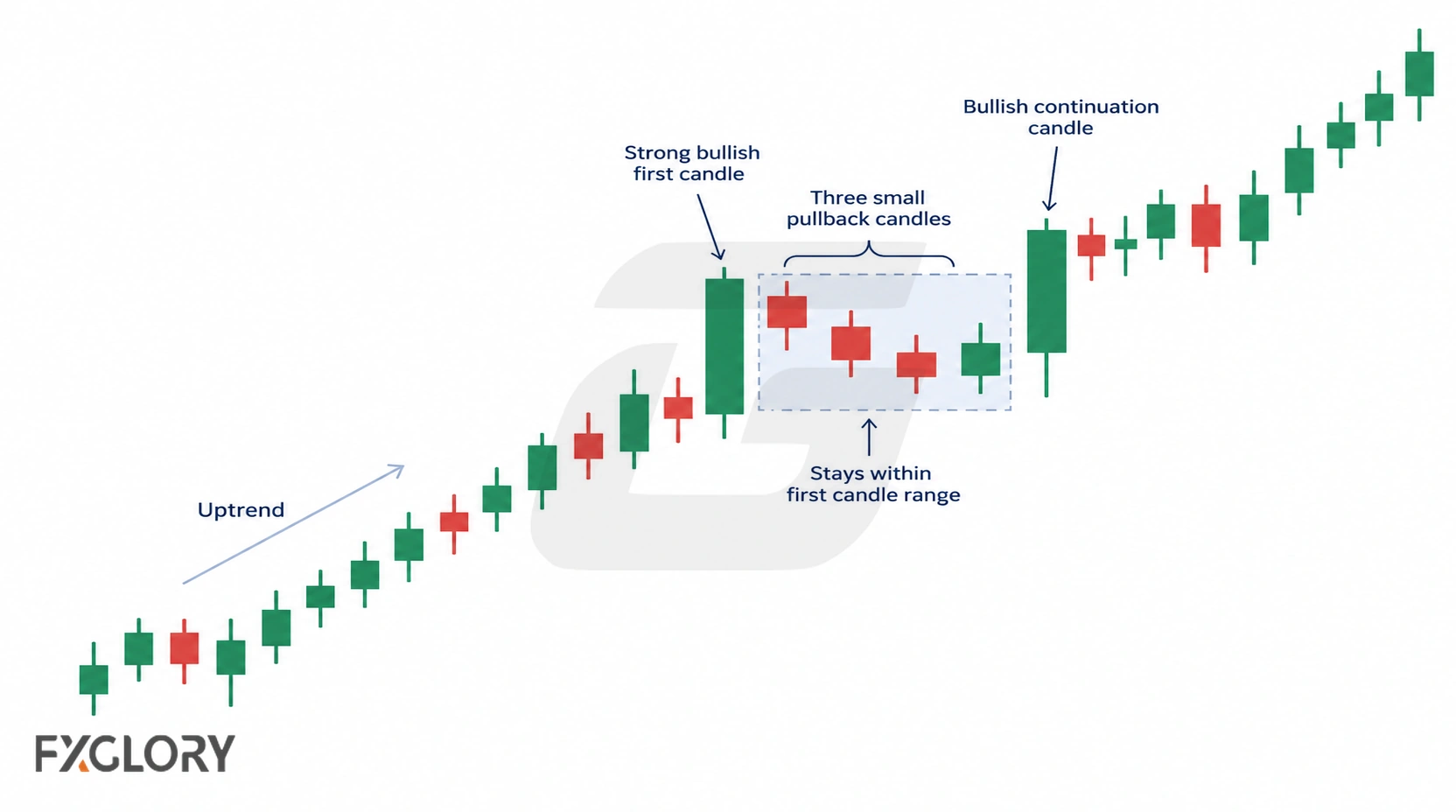
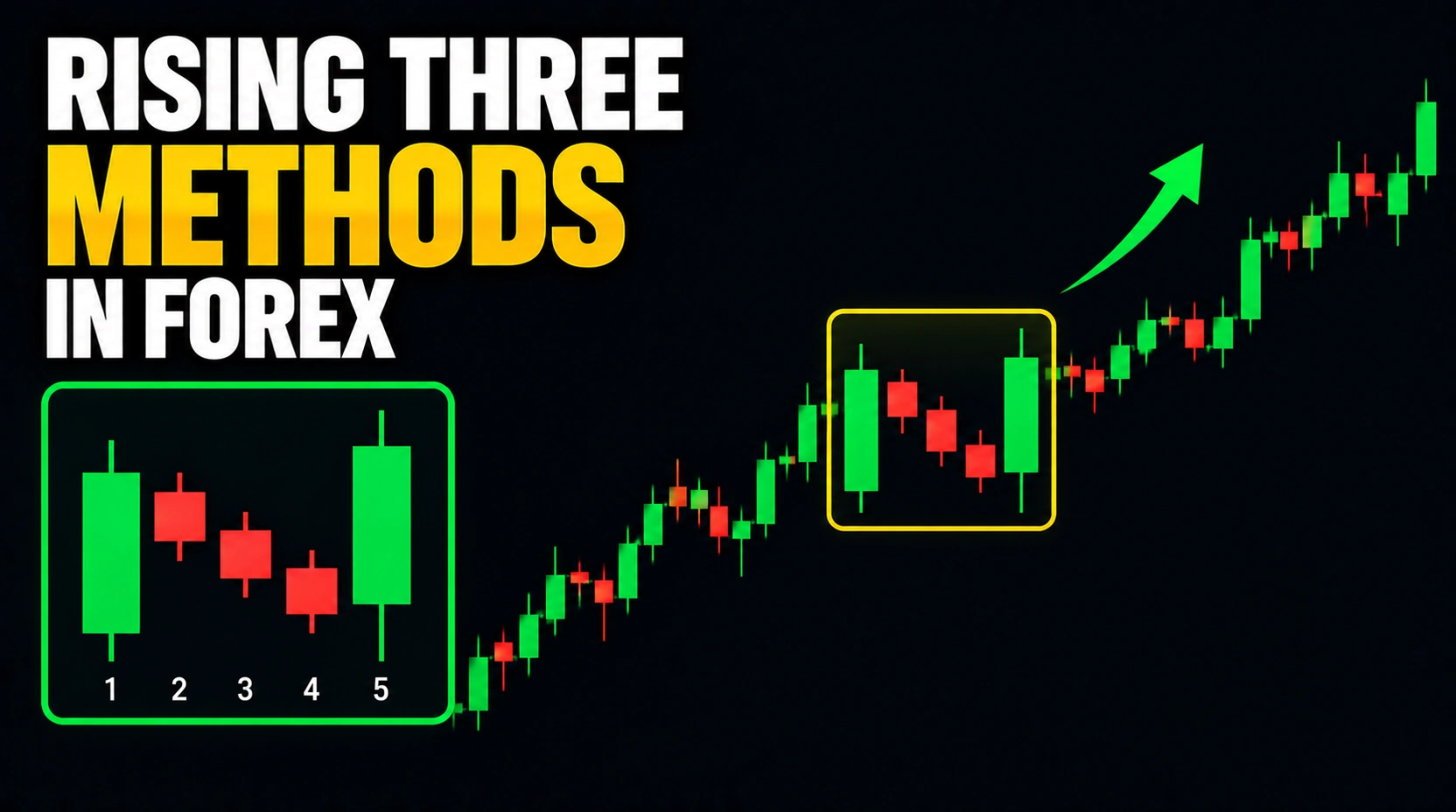
The rising three methods pattern in forex is a bullish continuation candlestick formation that usually appears during an existing upward move. It shows a strong bullish candle, a controlled pause or pullback, and then another bullish candle that resumes upward pressure.

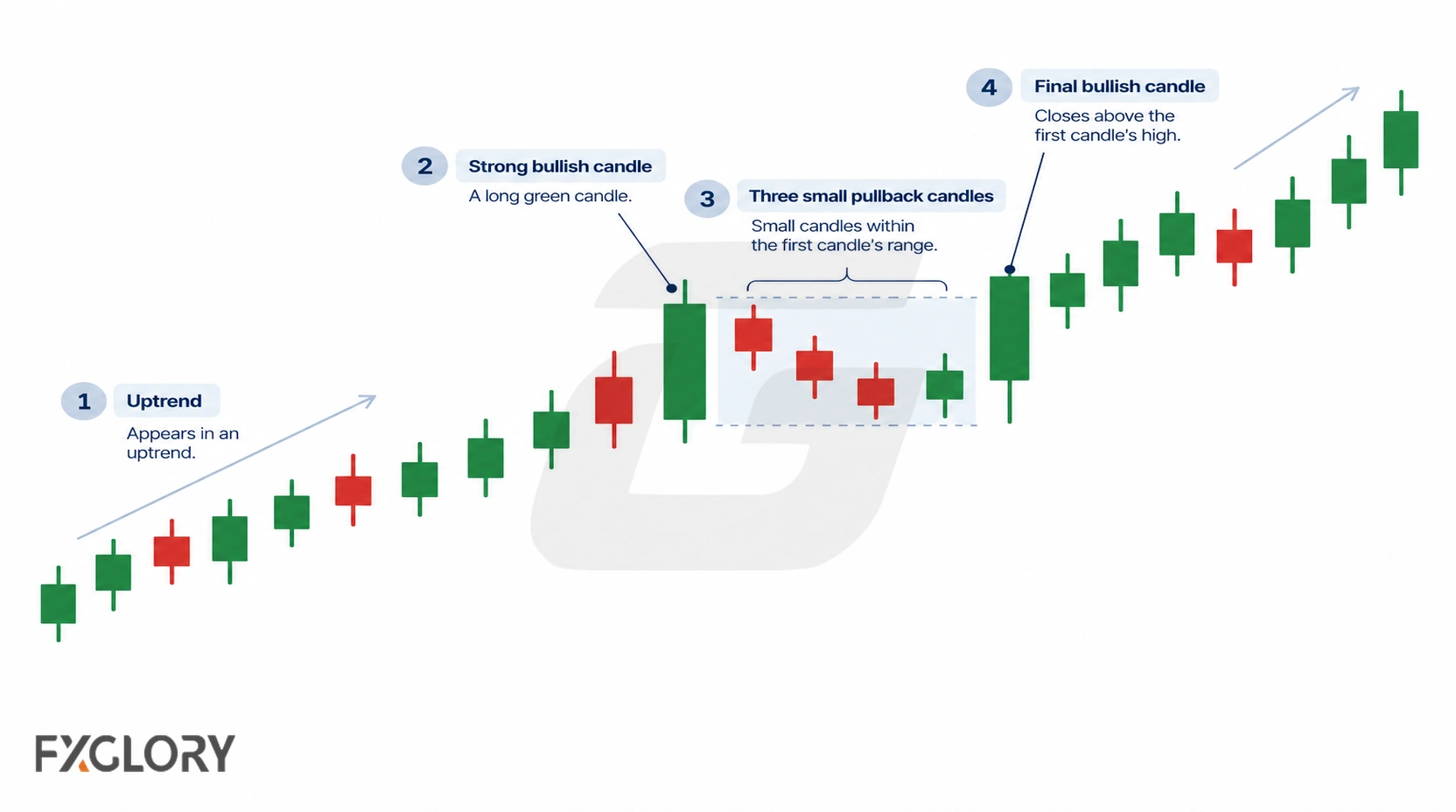
The classic structure has five candles. The first candle is a strong bullish candle. The next three candles are smaller candles that usually move against the first candle or pause inside its range. The final candle is bullish and shows renewed buying pressure after the controlled pullback.

The pattern is not defined by the number three alone. Some chart readings allow more than three middle candles if the pause remains controlled and contained within the first candle's range. The important idea is the sequence: upward pressure, contained pullback, upward response.

Rising three methods should not be read as a standalone trading reason. It is a multi-candle structure that needs trend context, clean containment, a meaningful final candle, and follow-up price action.

If you need candle anatomy first, review the open, high, low, close, body, and wick relationship. Rising three methods uses those same candle parts, but organizes them into a longer continuation sequence.

Simple definition: Rising three methods is a bullish continuation pattern where a strong bullish candle is followed by contained smaller pullback candles and then another bullish candle.

Why It Is Called Rising Three Methods

The name comes from traditional Japanese candlestick terminology. Rising three methods belongs to the broader three methods family of continuation patterns, where a trend pauses through smaller candles before the larger trend direction attempts to resume.

The word rising points to the bullish direction of the sequence. The three methods part refers to the classic middle pause of three smaller candles, although some chart readings allow more middle candles when the pause remains controlled and contained.

This background is useful because it keeps the pattern focused on continuation. The pattern is not simply any five candles on a chart; it is a structured pause-and-resume formation inside an upward move.

Rising Three Methods Pattern Anatomy

The rising three methods pattern is built from a first pressure candle, a middle pause, and a final response candle. Each part matters because the pattern is a sequence, not a single candle.

Pattern PartTypical StructureWhat It ShowsReading Caution
Existing uptrendPrice is already moving upward before the pattern.The formation is reviewed as continuation, not as a bottom reversal.Without a prior upward move, the pattern loses its main context.
First candleStrong bullish candle with a visible body.Initial upward pressure.A news-driven candle may be less clean than normal trend pressure.
Middle candlesThree or more smaller candles, often bearish or mixed.Controlled pause or pullback.The cleaner version keeps these candles inside the first candle's range.
Final candleBullish candle that closes above the first candle's close and may push above the first candle's high.Buyers respond after the contained pullback.A weak final candle can reduce the quality of the reading.
Full sequenceBullish pressure, contained pause, bullish response.Continuation attempt inside an uptrend.The pattern still needs chart context and later price action.

The middle candles are not random filler. They are the pause that separates rising three methods from patterns that only show consecutive bullish candles.

Rising Three Methods Recognition Quality

Rising three methods should be recognized by structure quality, not by candle count alone. The best examples show a clear upward move, a strong first candle, a contained middle pause, and a final bullish candle that restores upward pressure.

Recognition LevelStructureReading Quality
IdealClear uptrend, strong bullish first candle, three small contained candles, and strong bullish final candle closing above the first candle's close.Cleanest version of the pattern.
AcceptableMore than three small middle candles, if the pullback remains controlled and contained inside the first candle's range.Still usable as a longer pause, but needs careful review.
WeakNo clear uptrend, large middle candles, broken containment, or weak final candle.Continuation reading is reduced.
AvoidRandom five-candle group in a range, news-driven volatility sequence, or messy candle overlap.Do not force the pattern label.
Recognition check: The pattern should look like upward pressure, controlled pause, and renewed upward pressure. If it only looks like five nearby candles, the label is probably being forced.

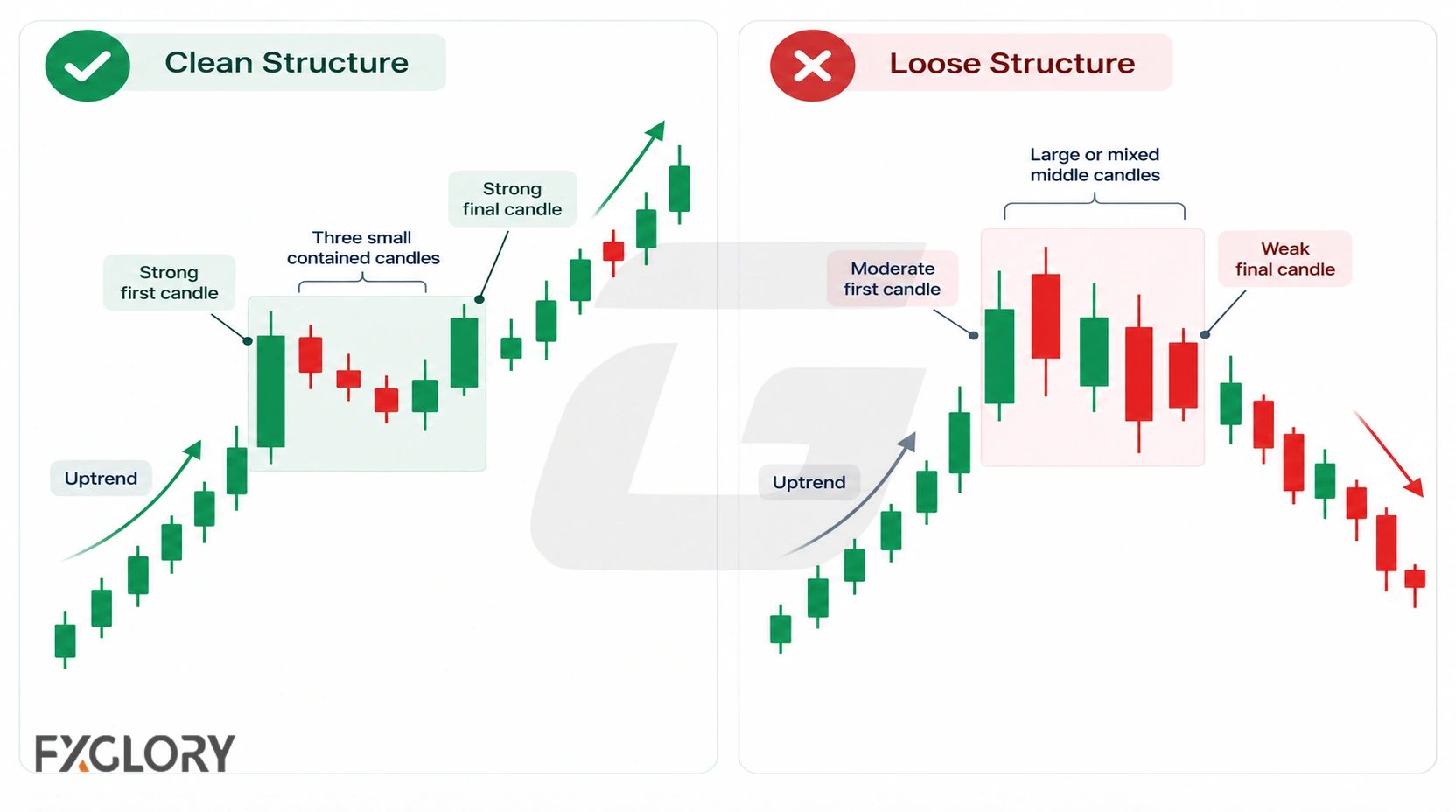
Clean vs Loose Rising Three Methods Structure

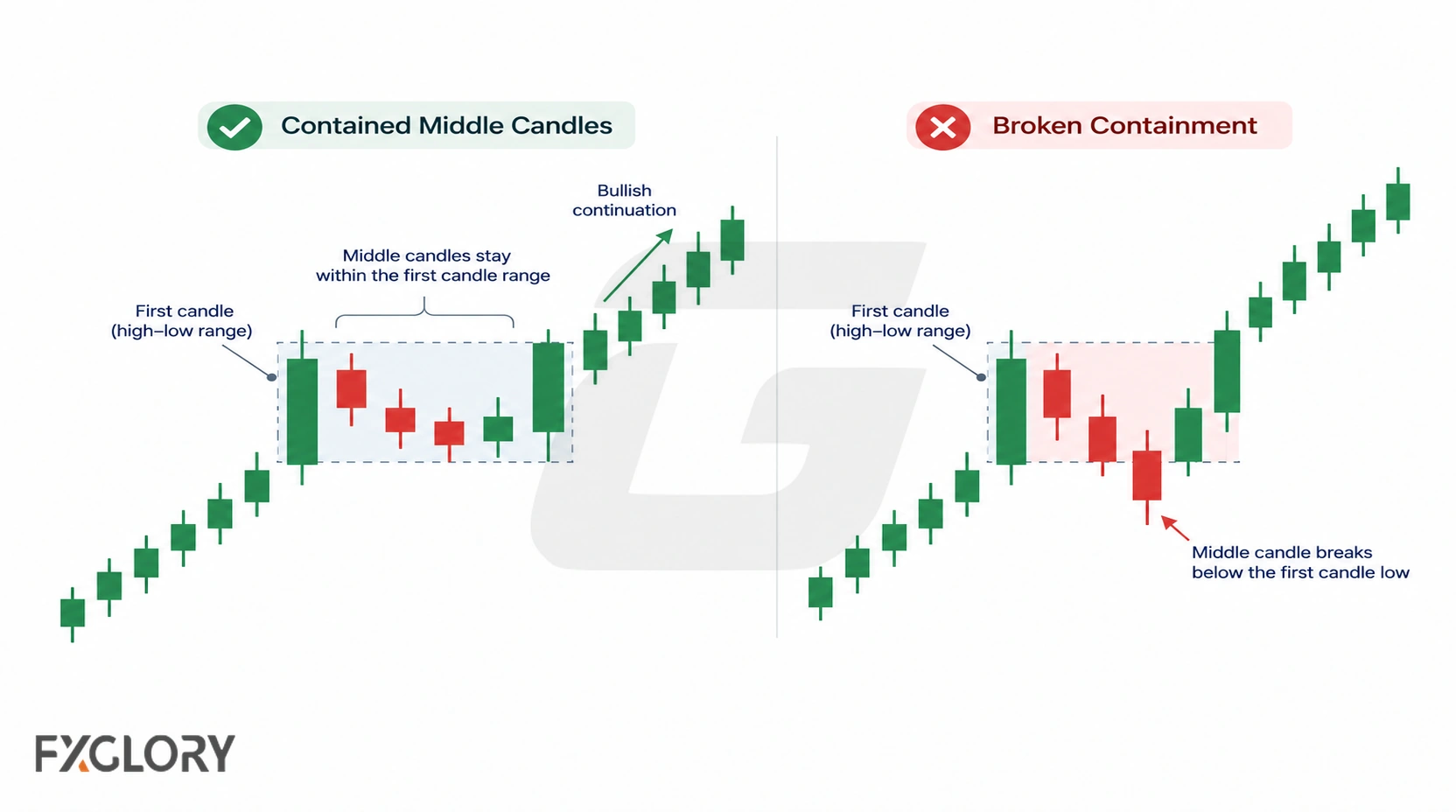
A clean rising three methods pattern has a strong bullish first candle, smaller middle candles that remain inside the first candle's high-low range, and a final bullish candle that shows renewed upward pressure. In the cleaner version, the final bullish candle closes above the first candle's close and may also push above the first candle's high.

Looser versions may include more than three middle candles or slightly mixed middle-candle colors. The structure becomes weaker when the middle candles are too large, when they break below the first candle's low, or when the final bullish candle cannot recover the middle-candle pullback.

VersionStructureHow To Read ItCaution
Clean versionStrong bullish candle, contained small pullback candles, strong bullish final candle.Clear pause-and-resume continuation structure.Still needs trend context and follow-up movement.
More-than-three middle candlesFour or more small candles remain controlled inside the first candle's range.Longer pause inside the same continuation idea.Too many middle candles can shift the chart into range behavior.
Mixed-color middle candlesMiddle candles are small and mixed rather than all bearish.Pause or consolidation may still be present.Structure weakens if the pause becomes wide or messy.
Broken containmentMiddle candles move below the first candle's low.Continuation reading becomes weaker.This may no longer be a clean rising three methods pattern.
Weak final candleFinal candle does not close above the first candle's close or does not restore upward pressure.Continuation reading remains unresolved.The sequence may be only a pause, not a clean resumption.
Structure caution: The pattern is strongest when the pullback stays controlled. If the middle candles become large or break the first candle's range, the continuation reading weakens.

What Rising Three Methods Shows About Market Pressure

Rising three methods describes a pause inside an upward move. The first candle shows upward pressure. The middle candles show that price pulled back or moved sideways without fully undoing that pressure. The final candle shows that buyers responded after the pause.

This sequence is why the pattern is usually treated as continuation rather than reversal. It does not start from a downtrend low like a bullish reversal pattern. It appears after upward pressure already exists.

The middle candles are important because they show whether the pullback is controlled or aggressive. A controlled pullback stays relatively small and contained. An aggressive pullback can damage the continuation reading.

  • First candle: Shows initial upward pressure.
  • Middle candles: Show a pause, pullback, or consolidation phase.
  • Final candle: Shows renewed upward pressure after the pause.
  • Full sequence: Shows a possible continuation attempt inside an existing upward move.

Why Trend Context Matters

Rising three methods needs an upward context. Without a visible upward move before the pattern, the formation becomes much harder to interpret. A bullish candle, a few small candles, and another bullish candle do not automatically create a continuation pattern unless there is something to continue.

The pattern is usually cleaner when it forms inside an orderly upward move. It becomes weaker when it appears after an exhausted rise, inside a choppy range, or after a news-driven candle that may not reflect normal market rhythm.

Trend ContextReading QualityWhy It Matters
Orderly upward moveCleaner continuation context.The pattern appears inside visible upward structure.
Extended upward moveNeeds caution.The sequence may form after pressure is already stretched.
Choppy sideways movementWeak reading.The pattern may be ordinary candle overlap, not continuation.
News-driven first candleTreat carefully.The first candle may reflect abnormal volatility instead of clean trend pressure.
No clear prior uptrendLow-quality reading.Continuation logic is weak when there is no clear move to continue.

For observation, a trader can compare multi-candle continuation behavior on live market pages such as GBP/USD during active session movement or gold during wider candle sequences. These pages are useful for chart review, not as standalone trading reasons.

Middle Candle Containment In Rising Three Methods

The middle candles are the heart of the pattern. They should show a controlled pause rather than a full bearish reversal. In the cleaner version, the middle candles remain inside the high-low range of the first bullish candle.

The middle candles are often bearish, but they do not have to show heavy selling. Their job is to show that the market paused without breaking the structure created by the first candle.

Middle Candle BehaviorPossible ReadingPattern Quality
Small candles inside the first candle rangeControlled pullback or pause.Cleaner.
Small mixed candles inside the first candle rangeConsolidation after upward pressure.Still usable if contained.
Large bearish middle candlesPullback may be too aggressive.Weaker.
Middle candles break below the first candle lowFirst candle structure is damaged.Weak or invalid for clean reading.
Too many middle candlesPause may turn into a range.Needs caution.
Containment check: In a clean rising three methods pattern, the middle candles should look like a pause inside the first candle's structure, not a full loss of that structure.

How To Review The Final Bullish Candle

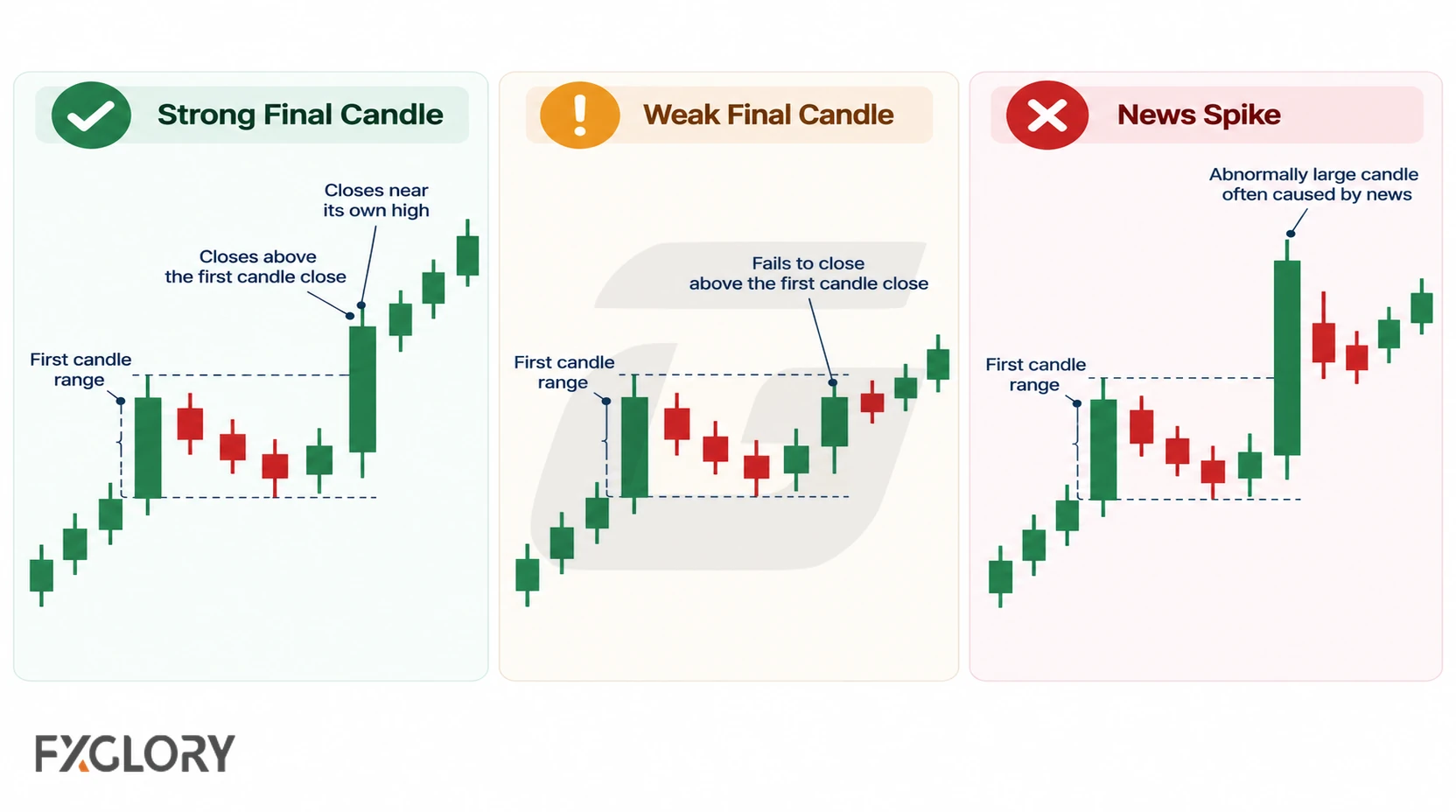
The final candle is the response candle. It shows whether upward pressure returned after the middle pause. A stronger final candle usually has a visible bullish body and finishes in the upper part of its own range.

In the cleaner version, the final bullish candle closes above the first candle's close and may also push above the first candle's high. A final candle that cannot recover the middle-candle pullback leaves the sequence weaker.

Final Candle FeatureCleaner ReadingWeaker Reading
Body sizeVisible bullish body.Small body or hesitation candle.
Close locationClose near the upper part of the candle.Close near the middle or lower part.
Relationship to first candleCloses above the first candle close and may push above the first candle high.Fails to recover the middle-candle pullback.
Volatility conditionFinal candle fits normal chart rhythm.Final candle is a sudden news-driven spike.

A strong final candle improves the sequence reading, but it does not remove the need for broader chart context.

Rising Three Methods vs Three White Soldiers

Rising three methods and three white soldiers are both bullish formations, but they are not the same structure.

Three white soldiers has three consecutive bullish candles. Rising three methods has a strong bullish candle, a middle pullback phase, and a final bullish response. The pause between the first and final bullish candles is the main difference.

PatternCore StructureMain MessageDeeper Guide
Rising three methodsBullish candle, contained pullback candles, bullish continuation candle.Pause-and-resume structure inside an uptrend.This page.
Three white soldiersThree consecutive bullish candles.Sustained buyer response across three candles.three consecutive bullish candles explained.

This boundary matters because rising three methods is not just a run of bullish candles. It is a continuation sequence with a controlled interruption.

Rising Three Methods vs Morning Star

Rising three methods and morning star can both end with a bullish response, but their market context is different.

Morning star is usually reviewed after selling pressure as a bullish reversal pattern. Rising three methods is usually reviewed after buying pressure already exists as a bullish continuation pattern.

PatternUsually Appears AfterSequence TypeDeeper Guide
Rising three methodsAn existing upward move.Bullish continuation sequence.This page.
Morning starSelling pressure or a downward move.Bullish reversal sequence.bullish pause-and-response reversal sequence.

The same bullish final candle can mean different things depending on what came before it. That is why the prior trend matters.

Rising Three Methods vs Inside Bar And Harami

The middle candles in rising three methods can look like compression, but the full pattern is not the same as an inside bar or harami.

An inside bar is a two-candle range-compression pattern where the second candle stays inside the previous candle's high-low range. A harami is a two-candle contraction structure focused on the second candle sitting inside the prior candle's body or range. Rising three methods is a larger continuation sequence with first-candle pressure, a contained pause, and a final continuation candle.

PatternMain MeasurementCore Difference
Rising three methodsMulti-candle sequence.Uses a contained pullback between two bullish pressure candles.
Inside barFull high-low range containment across two candles.Only describes two-candle compression.
HaramiBody contraction across two candles.Only describes two-candle inside-body contraction.

For comparison, review two-candle range compression and two-candle inside-body contraction.

Rising Three Methods vs Marubozu And Engulfing

The first and final candles in a rising three methods pattern can sometimes look like strong body-pressure candles. That does not make the whole formation a marubozu or engulfing pattern.

Marubozu is a one-candle full-body pressure structure. Engulfing is a two-candle body-takeover structure. Rising three methods is a multi-candle continuation sequence that uses a pause between two bullish pressure areas.

PatternStructureHow It Differs
Rising three methodsStrong bullish candle, contained pullback, strong bullish candle.Multi-candle continuation sequence.
MarubozuOne full-body candle with little or no wick.One-candle pressure, not a sequence.
EngulfingSecond candle body overtakes the prior candle body.Two-candle body takeover, not a five-candle pause-and-resume structure.

For body-pressure comparisons, review full-body pressure candles and two-candle body takeover.

Rising Three Methods vs Falling Three Methods

Rising three methods has a bearish opposite called falling three methods. The difference is direction. Rising three methods appears in an upward move and uses a bullish continuation structure. Falling three methods appears in a downward move and uses a bearish continuation structure.

PatternMarket ContextBasic Sequence
Rising three methodsExisting upward move.Strong bullish candle, contained pullback, strong bullish candle.
Falling three methodsExisting downward move.Strong bearish candle, contained upward pause, strong bearish candle.

This page focuses only on the bullish continuation version. The bearish opposite should be studied separately so the two patterns do not overlap.

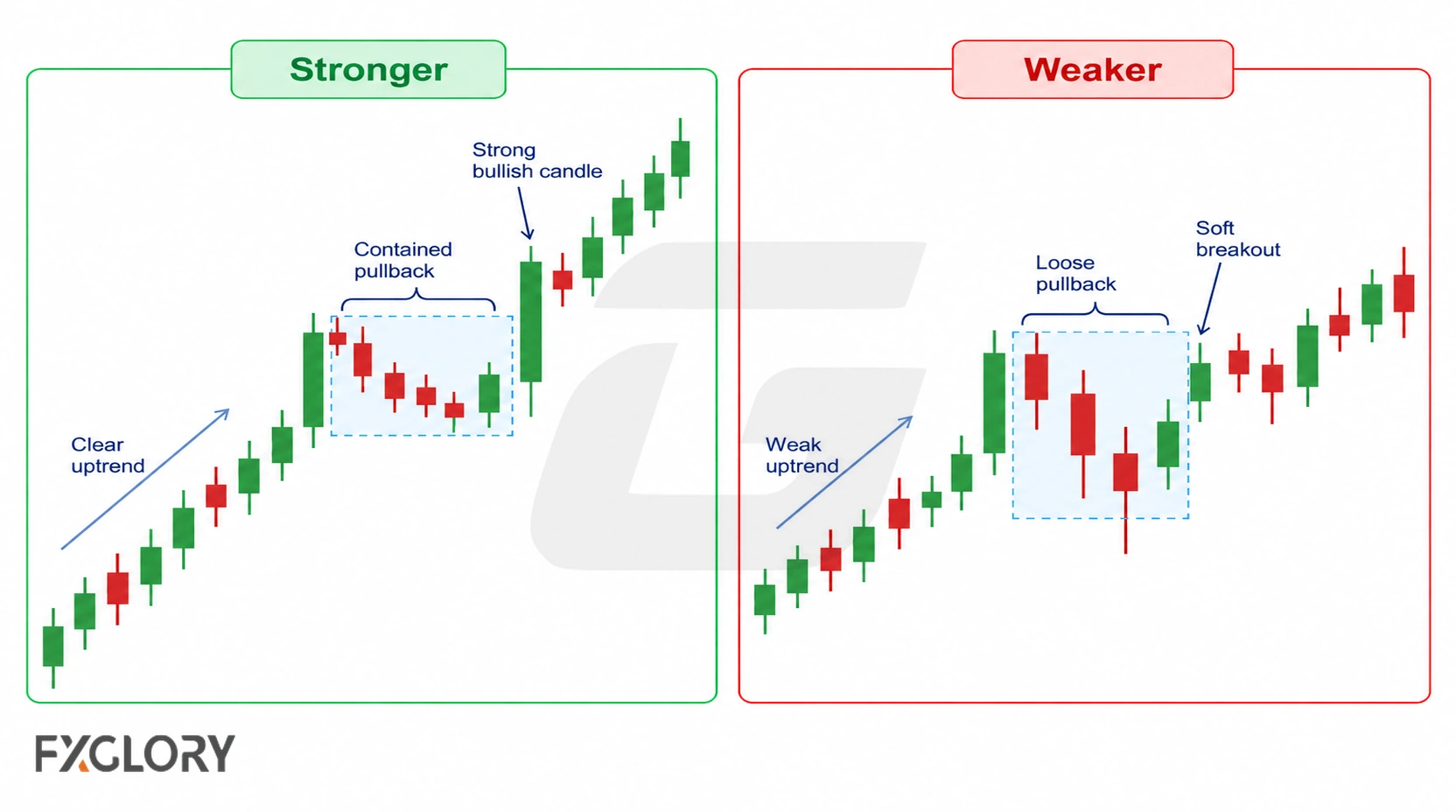
Rising Three Methods Strength Filter: Stronger vs Weaker Readings

A rising three methods pattern does not carry the same value in every chart condition. A clean sequence inside an orderly upward move is easier to review than a similar-looking group of candles inside messy movement.

FactorCleaner ReadingWeaker Reading
Prior trendVisible upward move before the pattern.No clear uptrend or choppy movement.
First candleStrong bullish candle with clear body pressure.Small or unclear first candle.
Middle candlesSmall and contained inside the first candle range.Large, messy, or breaking below the first candle low.
Final candleStrong bullish response after the pause.Weak close, small body, or unresolved candle.
VolatilitySequence fits normal market rhythm.Pattern forms around news, rollover, or thin liquidity.
Follow-up movementLater price action keeps the continuation area relevant.Price quickly cancels the sequence or returns into messy overlap.
Practical point: A cleaner rising three methods pattern has a visible prior uptrend, contained middle candles, and a final bullish candle that restores upward pressure.

Rising Three Methods Forex Reading Table

The table below shows how rising three methods can be reviewed in different chart settings. It is a reading aid, not a trading instruction.

Chart SituationPossible ReadingWhat To Check Next
Orderly uptrendPattern may show a pause inside an existing upward move.Check middle-candle containment and final candle quality.
After a very large bullish candleMiddle candles may only show a pause after expansion.Check whether the first candle was news-driven or abnormal.
Middle candles stay containedPullback remains controlled.Check whether the final candle restores upward pressure.
Middle candles break below first candle lowContinuation structure weakens.Review whether the pattern is still valid.
Final candle closes weaklyContinuation reading remains unclear.Check later candles before giving the sequence more weight.
Pattern forms in a rangeSequence may be ordinary overlap.Check whether there is a clear trend to continue.

How To Read Rising Three Methods In Forex

A structured workflow helps keep the pattern from being forced onto any group of five candles. Confirm the trend first, then review the candle sequence.

  1. Start with the prior move: Check whether price was already moving upward before the pattern formed.
  2. Review the first candle: Look for a clear bullish candle that creates the structure for the pause.
  3. Check the middle candles: Confirm that the pullback candles are smaller and remain controlled.
  4. Watch containment: In the cleaner version, the middle candles stay inside the first candle's high-low range.
  5. Review the final candle: Check whether the last candle closes above the first candle's close and restores upward pressure.
  6. Check chart location: Review whether the pattern forms in an orderly trend or in a messy range.
  7. Review volatility conditions: Consider spread, rollover, session changes, liquidity, and scheduled news.
  8. Watch follow-up movement: See whether later candles respect the continuation structure or cancel it.

Some traders compare continuation patterns with technical indicators for context. For example, ATR can help review whether the candles are unusually wide or quiet, and RSI can add momentum context around the upward move. These tools can support chart review, but they do not remove trading risk.

Useful question: Before calling the sequence rising three methods, ask whether there was a real upward move, whether the pullback stayed controlled, and whether the final candle restored upward pressure.

False Rising Three Methods Readings

A false rising three methods reading happens when a candle sequence looks like bullish continuation but later price action does not support that idea. This can happen when the middle candles are too large, the final candle is weak, or the broader chart is not actually trending upward.

The pattern can also be misleading when it forms during abnormal volatility. A large first candle during a news event may create a range that makes the following candles look contained, even though the structure is not part of a clean trend.

Rising three methods should not be forced onto ordinary candle clusters. Some historical pattern studies describe the formation as relatively rare, which is another reason to treat clean structure as more important than simply finding five nearby candles.

False-Reading TypeWhat HappensSafe Reading
No prior uptrendThe sequence appears in sideways movement.Continuation logic is weak.
Middle candles break containmentThe pullback moves below the first candle's low.The controlled-pause structure weakens.
Weak final candleThe final candle does not close above the first candle's close or restore upward pressure.The pattern remains unresolved.
News-driven first candleThe first candle is unusually wide because of fast movement.Treat the structure as volatility first.
Immediate reversal after completionLater candles cancel the continuation area quickly.The pattern did not hold its reading.
  • Do not force five candles into a pattern: The sequence needs trend context and controlled middle candles.
  • Watch the first candle: If it is abnormal or news-driven, the whole structure may be harder to read.
  • Do not ignore the middle candles: A deep pullback is not the same as a controlled pause.
  • Check the final candle: Continuation logic weakens when the final candle does not show clear upward response.
False-continuation caution: Rising three methods describes a continuation attempt, not a guaranteed continuation.

Common Mistakes With Rising Three Methods In Forex

Rising three methods can be easy to mislabel because traders may focus on the five-candle count and ignore the sequence quality. The shape matters, but the trend and containment matter more.

  • Ignoring the prior uptrend: The pattern is a continuation structure, so it needs an upward move to continue.
  • Counting any five candles: A random five-candle group is not rising three methods.
  • Ignoring middle-candle containment: The pause should remain controlled inside the first candle's structure in the cleaner version.
  • Confusing it with three white soldiers: Three white soldiers has consecutive bullish candles, while rising three methods has a pullback phase.
  • Confusing it with morning star: Morning star is a bullish reversal sequence, while rising three methods is a bullish continuation sequence.
  • Confusing it with inside bar: Inside bar is a two-candle range-compression pattern, not a full continuation sequence.
  • Overvaluing volume references: Spot forex volume data can vary by source, so candle structure and price context should remain central.
  • Ignoring news and volatility: A sequence around abnormal volatility may be harder to interpret.
  • Reading before the final candle closes: The pattern is incomplete until the final candle finishes.
  • Replacing risk planning with pattern confidence: A continuation pattern does not replace risk limits, position sizing, or a clear invalidation area.

What To Study After Rising Three Methods

After learning rising three methods, compare it with nearby bullish continuation, bullish pressure, and bullish reversal structures. This keeps the page focused on pause-and-resume continuation rather than every bullish candle sequence.

For bullish pressure without a pullback phase, review three consecutive bullish candles. For a bullish reversal sequence after selling pressure, review the morning star guide. For contained two-candle structures, review inside-bar range compression and harami body contraction. For the broader library, return to forex candlestick pattern groups.

Frequently Asked Questions

What is the rising three methods pattern in forex?

The rising three methods is a bullish continuation candlestick pattern that usually forms during an existing upward move. It has a strong bullish candle, a controlled pullback phase made of smaller candles, and a final bullish candle that resumes upward pressure.

How many candles are in the rising three methods pattern?

The classic version has five candles: one strong bullish candle, three smaller pullback candles, and one final bullish candle. Some chart readings allow more than three middle candles if they remain small and contained within the first candle's range.

Can rising three methods have more than three middle candles?

Yes. The classic version has three small middle candles, but some chart readings allow more if the candles remain small, controlled, and contained within the first candle's range. If the pause becomes wide or messy, the pattern becomes weaker.

Is rising three methods bullish or bearish?

Rising three methods is generally reviewed as a bullish continuation pattern because it appears in an upward move and includes a controlled pause followed by another bullish candle.

What do the middle candles mean in rising three methods?

The middle candles usually show a pause or controlled pullback inside the first candle's range. They should not show a strong bearish breakdown beyond the first candle's low in the cleaner version.

What should the final candle do in rising three methods?

In the cleaner version, the final bullish candle closes above the first candle's close and may also push above the first candle's high. A final candle that cannot recover the middle-candle pullback leaves the sequence weaker.

What is the difference between rising three methods and three white soldiers?

Three white soldiers is made of three consecutive bullish candles. Rising three methods includes a strong bullish candle, then smaller pullback candles, then another bullish candle. The pullback phase is the main difference.

What is the difference between rising three methods and morning star?

Morning star is usually reviewed as a bullish reversal sequence after selling pressure. Rising three methods is usually reviewed as a bullish continuation sequence inside an existing upward move.

Is rising three methods the same as an inside bar?

No. An inside bar is a two-candle range-compression pattern. Rising three methods is a multi-candle continuation sequence. The middle candles may be contained inside the first candle's range, but the full pattern needs the first bullish candle and final bullish continuation candle.

Is rising three methods reliable?

Rising three methods is not reliable as a standalone trading reason. Its usefulness depends on trend quality, middle-candle containment, final candle structure, volatility, spread, timeframe, and follow-up price action.

When should rising three methods be ignored?

The pattern is often better ignored when it forms in a messy range, after an exhausted upward move, during abnormal news volatility, when the middle candles break below the first candle's low, or when the final candle is weak.

Related Contents

Forex Candlestick GuideReview candle anatomy, bodies, wicks, open, close, high, and low before studying multi-candle continuation structures.
Forex Candlestick PatternsSee where rising three methods fits inside broader continuation and multi-candle pattern groups.
Inside Bar In ForexCompare the contained middle candles with two-candle range compression.
Outside Bar ForexCompare rising three methods containment with a two-candle range-expansion structure.
Harami Candle ForexCompare the middle-pause area with two-candle inside-body contraction.
Marubozu Candle ForexCompare the strong first or final candle with one-candle full-body pressure.
Forex Engulfing CandleCompare the final bullish continuation candle with a two-candle body-takeover structure.
Three White Soldiers ForexCompare a bullish continuation sequence with three consecutive bullish candles.
Morning Star ForexCompare bullish continuation with a three-candle bullish reversal sequence after selling pressure.
ATR Indicator ForexReview volatility context when the first or final candle in the sequence is unusually large.
Forex RSIUse RSI as one way to review momentum context around continuation patterns.

Practice Reviewing Multi-Candle Patterns On A Demo Account

Use a free FXGlory demo account to observe rising three methods patterns across pairs, timeframes, trend conditions, volatility phases, and follow-up price action before trading with real funds.

Open a Free Demo Account