
What Is the Mat Hold Candlestick Pattern?
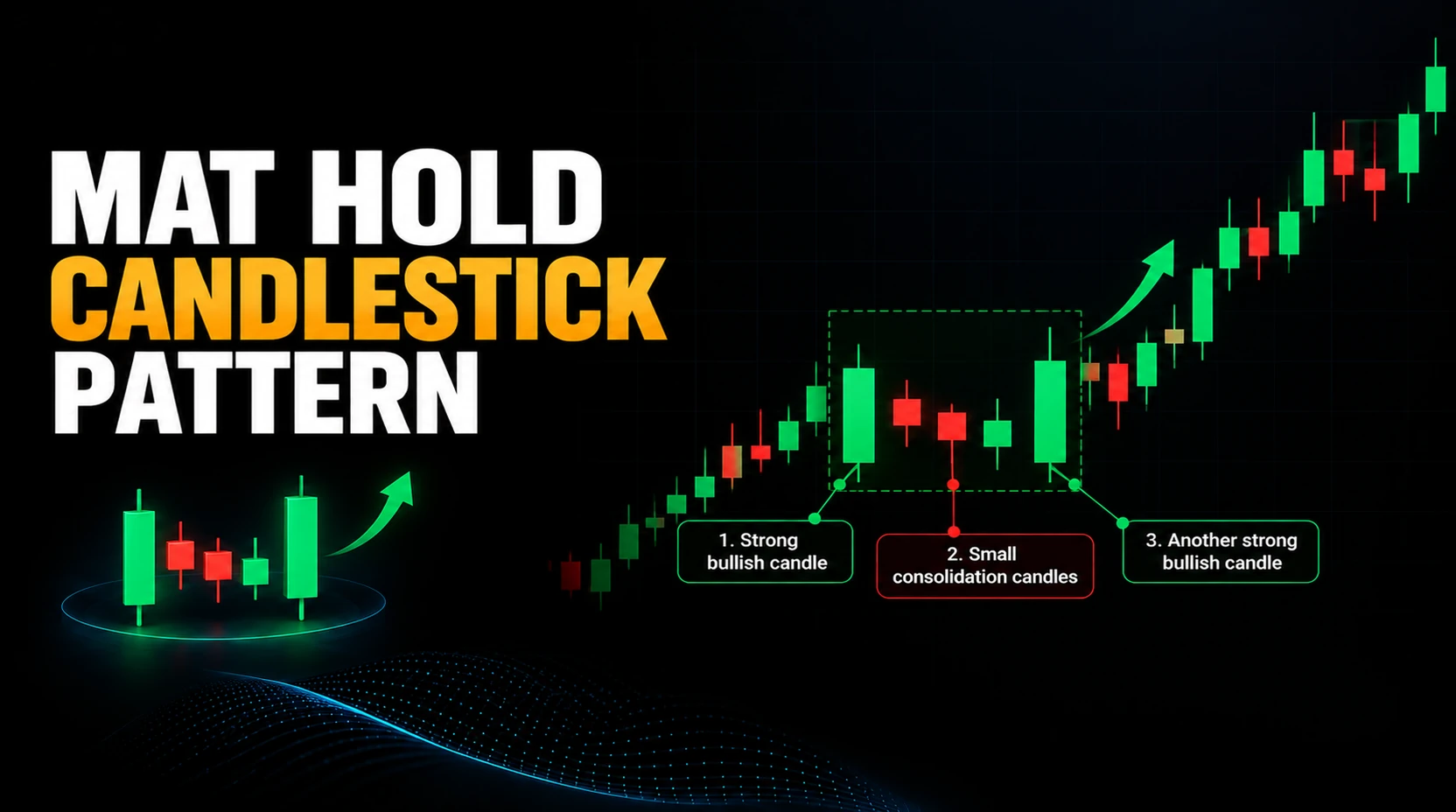
Mat Hold is commonly described as a bullish five-candle continuation pattern after an established upward move. A strong first bullish candle is followed by three smaller pause or pullback candles and a fifth bullish candle that resumes the advance. Classical bullish descriptions emphasize an upward gap at the second candle and a relatively shallow retracement. A mirrored bearish variation can be studied in a downtrend, although sources do not always treat both directions as identically named textbook patterns.
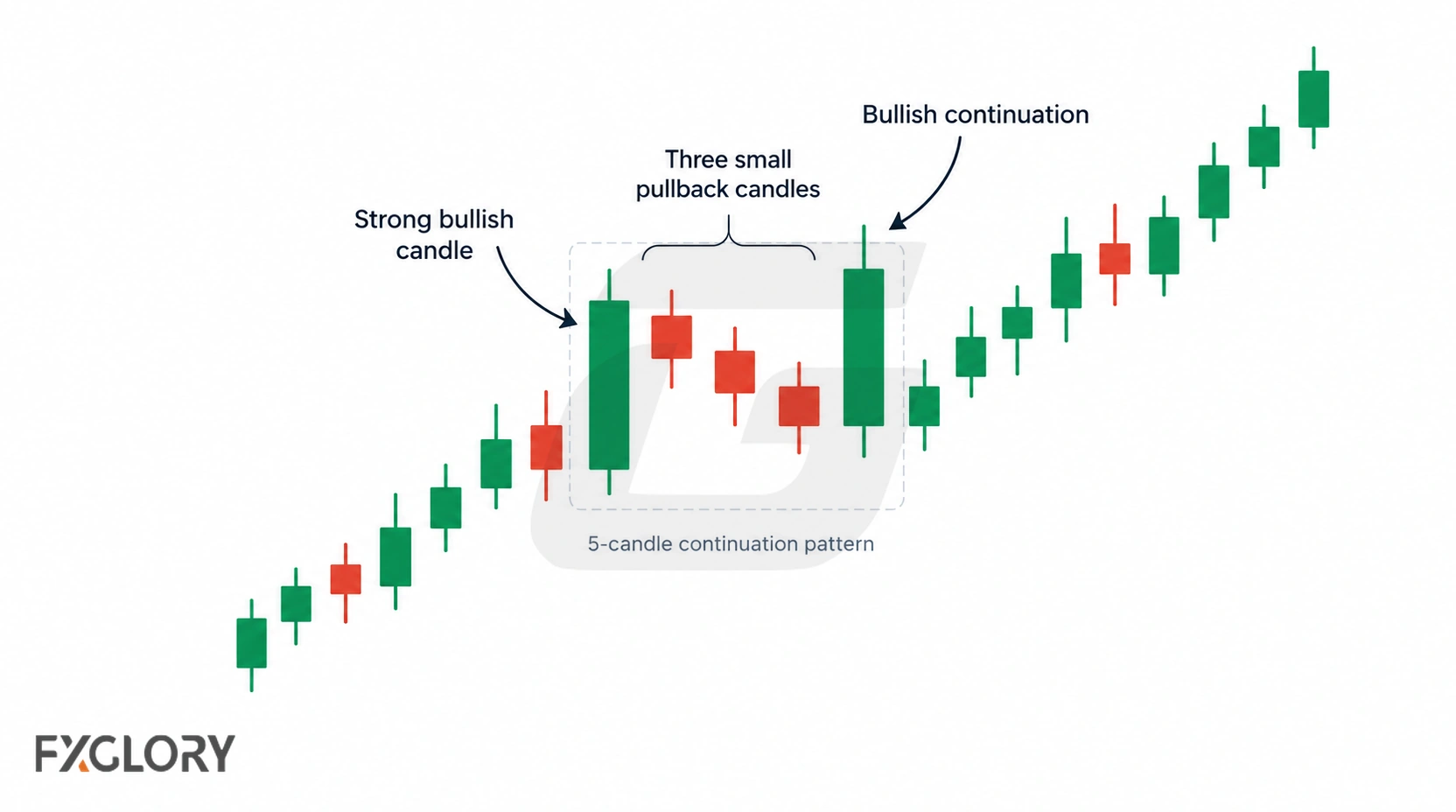
The formation describes a trend, a short countertrend pause, and a renewed move. Its relative rarity does not establish a higher probability of success. A sideways cluster of five candles without an identifiable preceding trend should not automatically receive this label.
Five-Candle Mat Hold Structure
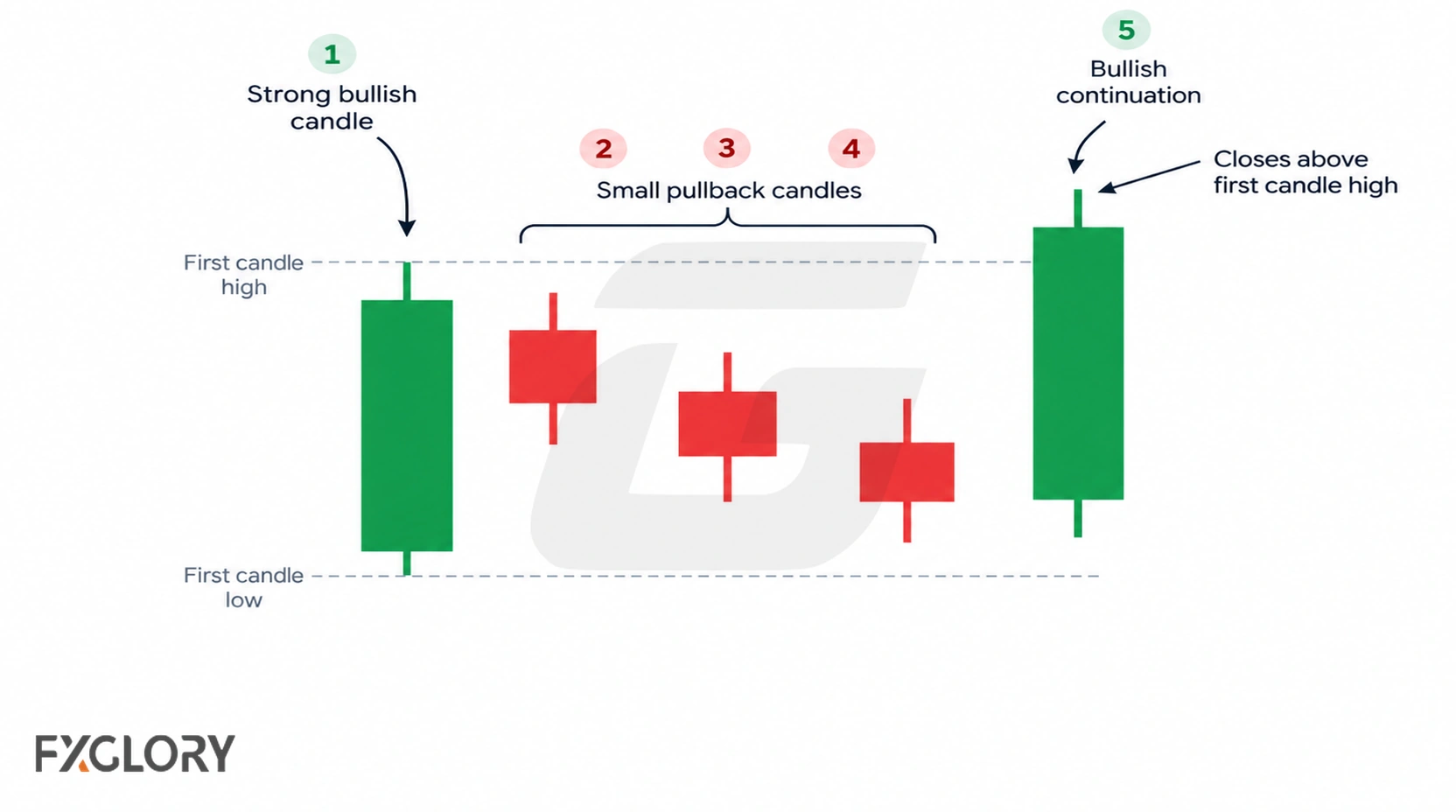
The classical five-candle count is one directional candle, three smaller intervening candles, and one final continuation candle. These roles should be read together, not as five unrelated candles.
| Stage | Classical bullish reading | Bearish mirror |
|---|---|---|
| Candle 1 | Substantial bullish body within an existing uptrend | Substantial bearish body within a downtrend |
| Candles 2–4 | Typically begin with an upward gap and form a small, shallow pullback without crossing below candle 1’s low | Mirrored downward opening displacement and controlled upward pause without crossing above candle 1’s high |
| Candle 5 | Bullish completion candle satisfying the chosen closing-price rule | Bearish completion candle satisfying the corresponding mirrored rule |
Published descriptions do not use a single identical gap or fifth-candle benchmark. Choose a specified definition before labeling a chart or comparing historical outcomes. A five-candle formation is not structurally incomplete simply because a trader has not yet set a stop.
Bullish Mat Hold
A bullish Mat Hold is examined after a discernible rise. A strong first candle is followed by an upward opening displacement in the classical presentation; the next three relatively small candles may drift lower but should not retrace through the first candle’s low. The fifth candle then closes strongly in the direction of the earlier advance.
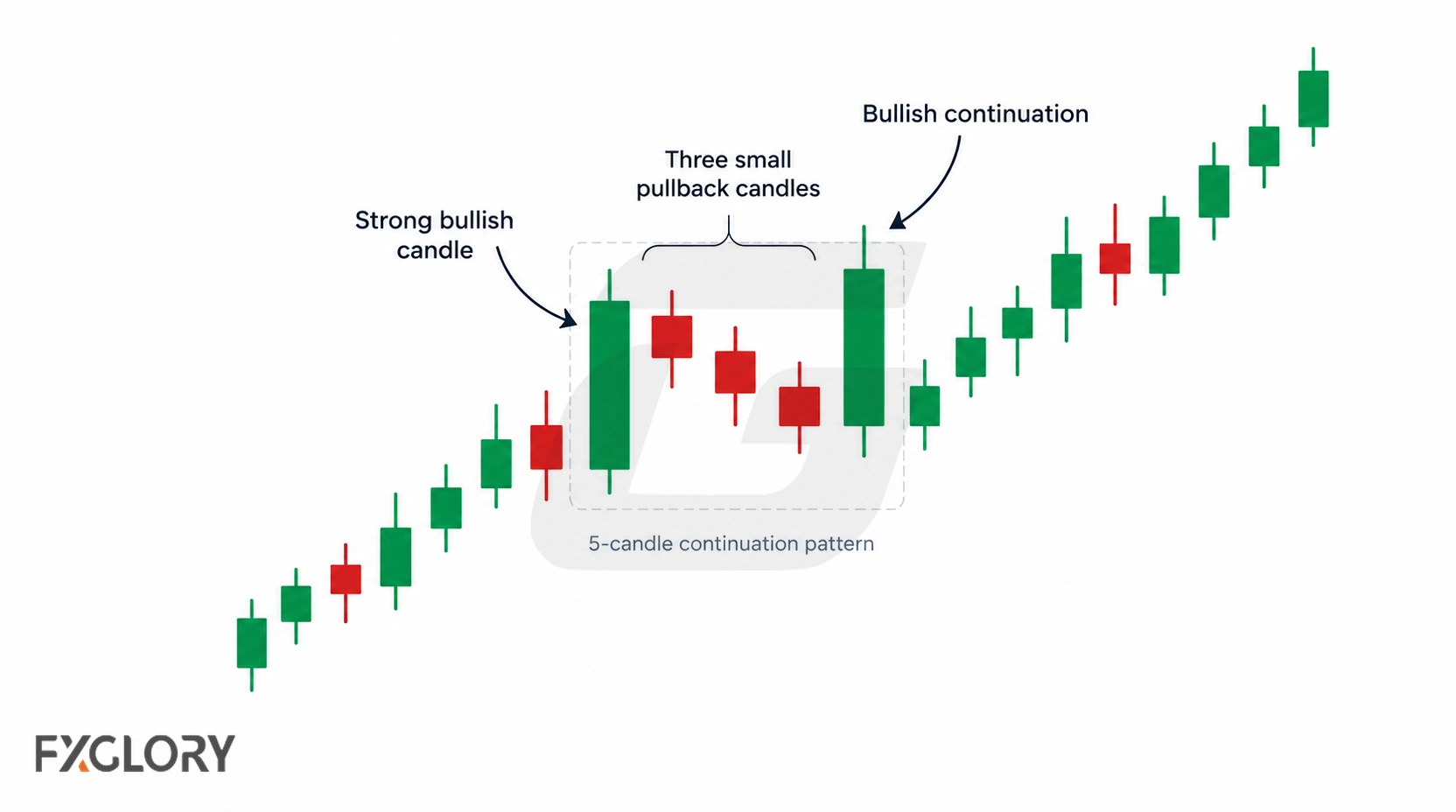
Compare the three intervening lows with the first candle’s low and measure the depth of the pullback rather than calling it merely “controlled.” The closing test for candle five must be defined in advance; some descriptions require a close beyond the first candle’s high, while other published recognition rules use a different reference such as the second candle’s open. Those definitions should not be mixed within one assessment.
Bearish Mat Hold Variation
A bearish Mat Hold variation mirrors the price relationships in a downward trend: a substantial bearish first candle, three relatively small upward or sideways intervening candles, and a decisive fifth bearish candle. Under a mirrored strict rule, the intervening highs should not exceed the first candle’s high. This is a useful comparison, but the classical term Mat Hold is most commonly applied to the bullish setup.
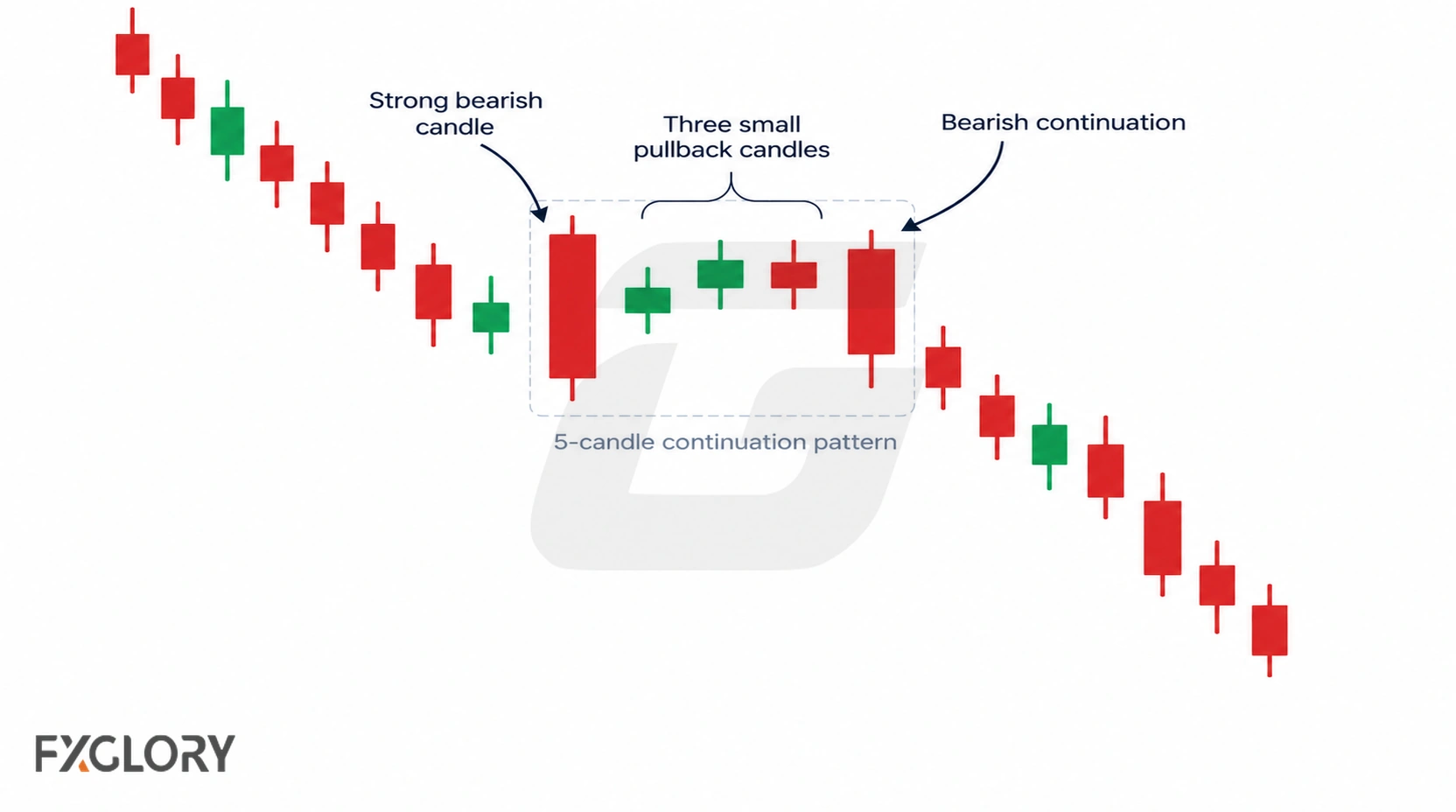
If the intervening candles rise above the chosen boundary or the fifth candle does not satisfy the selected bearish closing benchmark, describe the structure as an incomplete candidate or a different continuation arrangement instead of automatically declaring a completed bearish Mat Hold.
Classical Mat Hold Gaps vs Forex Adaptations
The upward gap between the first and second candles is a key feature in many textbook bullish Mat Hold descriptions. It helps distinguish the formation from an ordinary contained pullback. A bearish mirror reverses the directional relationship. The gap is an observable opening-price difference, not a synonym for strong trend momentum.
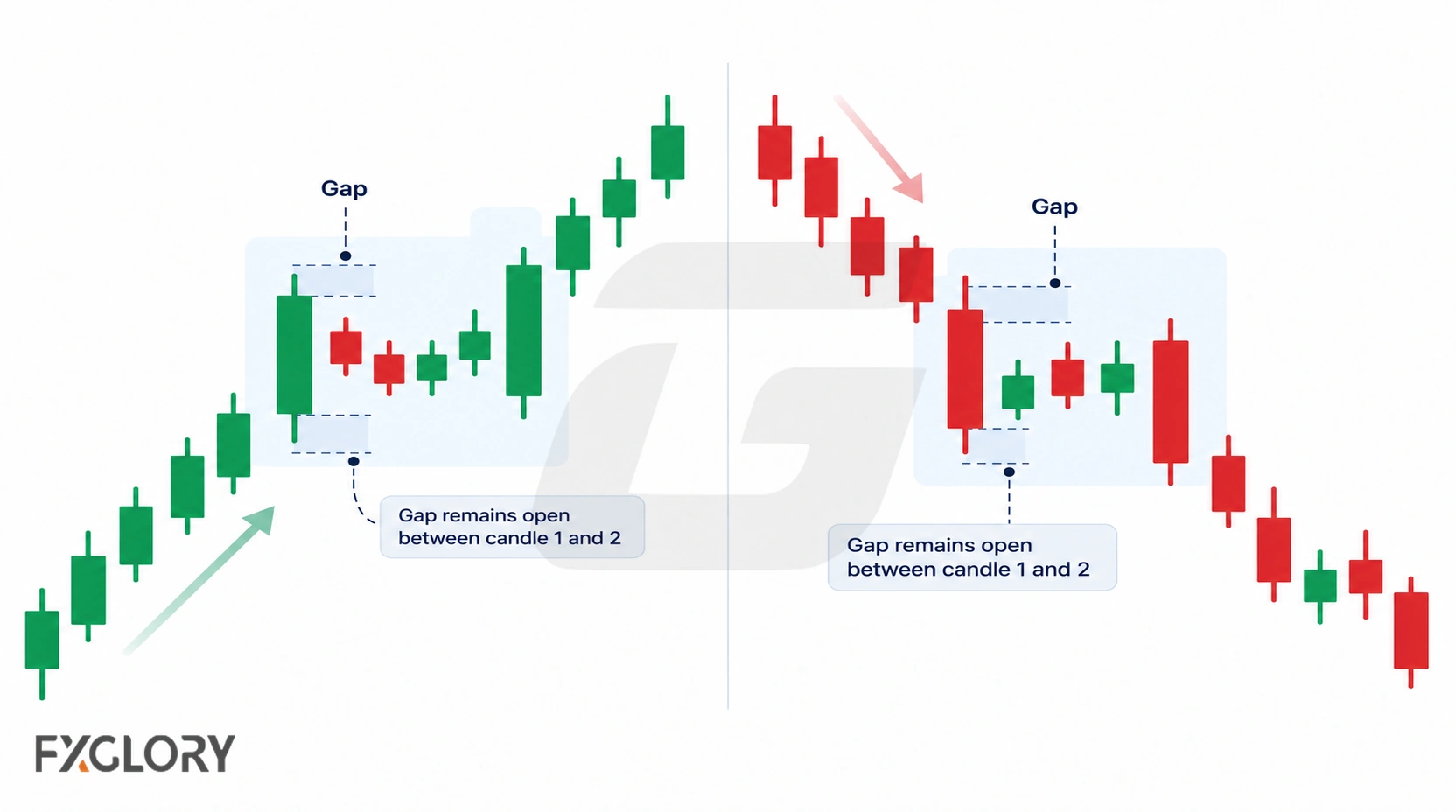
Spot forex quotes are nearly continuous through the trading week, so these gaps may be absent on ordinary intraday charts or vary across feeds and session boundaries. A five-candle impulse–pause–resumption sequence without the prescribed gap can be discussed as a gap-relaxed forex variation, but should not silently be counted as a strict classical example. Weekend reopenings and thin-liquidity periods can also produce gaps alongside materially wider spreads.
Mat Hold vs Rising and Falling Three Methods
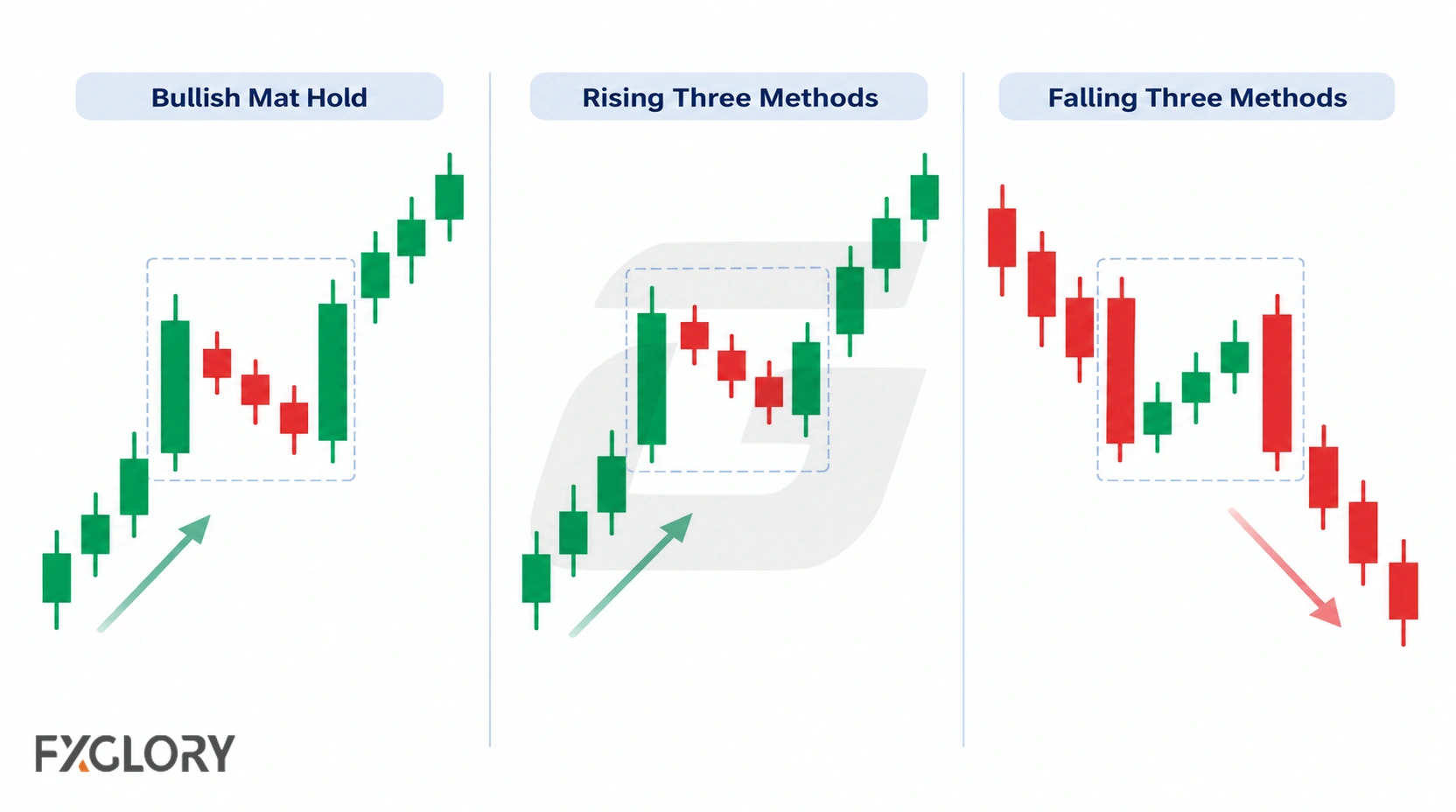
These related continuation patterns share a strong first candle, a three-candle pause, and a fifth candle in the prevailing direction. Their useful distinction lies in the opening relationships and pullback boundaries—not an undefined claim that one “holds better.”
| Pattern | Primary structural focus |
|---|---|
| Classical bullish Mat Hold | Commonly an upward second-candle gap and shallow three-candle retracement that does not cross the first candle’s low |
| Rising Three Methods | Three small intervening candles traditionally contained within the first bullish candle’s full high–low range |
| Falling Three Methods | Bearish continuation counterpart with a contained countertrend rise inside the first bearish candle’s range |
| Gap-relaxed Mat Hold-like sequence | Similar shallow continuation pause without a required classical gap; explicitly label as a variation |
For the contained-pullback definitions, see Rising Three Methods and Falling Three Methods. The diagrams are instructive comparisons, not evidence that the patterns have identical performance.
How to Identify and Complete Mat Hold
- Establish the preceding trend: Identify upward or downward price progression before candle one; do not infer a trend solely from the five candles.
- Choose the convention: Decide whether the textbook gap is required, which range boundary limits the middle pause, and the exact fifth-candle closing threshold.
- Inspect candle one: Compare its directional real body and range with nearby candles.
- Check candles two to four: Count exactly three smaller candles and test their highs and lows against the specified boundary.
- Wait for candle five to close: Only then decide whether the complete formation meets the chosen close criterion.
- Assess subsequent movement separately: Later price action may support or contradict continuation but does not retroactively change the five completed candles.
A price move beyond a level during the fifth candle is not equivalent to a completed close beyond it. Holding beyond a level, a retest, and later follow-through are additional, distinct observations. For background on trend direction, see forex trends.
Incomplete Patterns and Failed Continuations
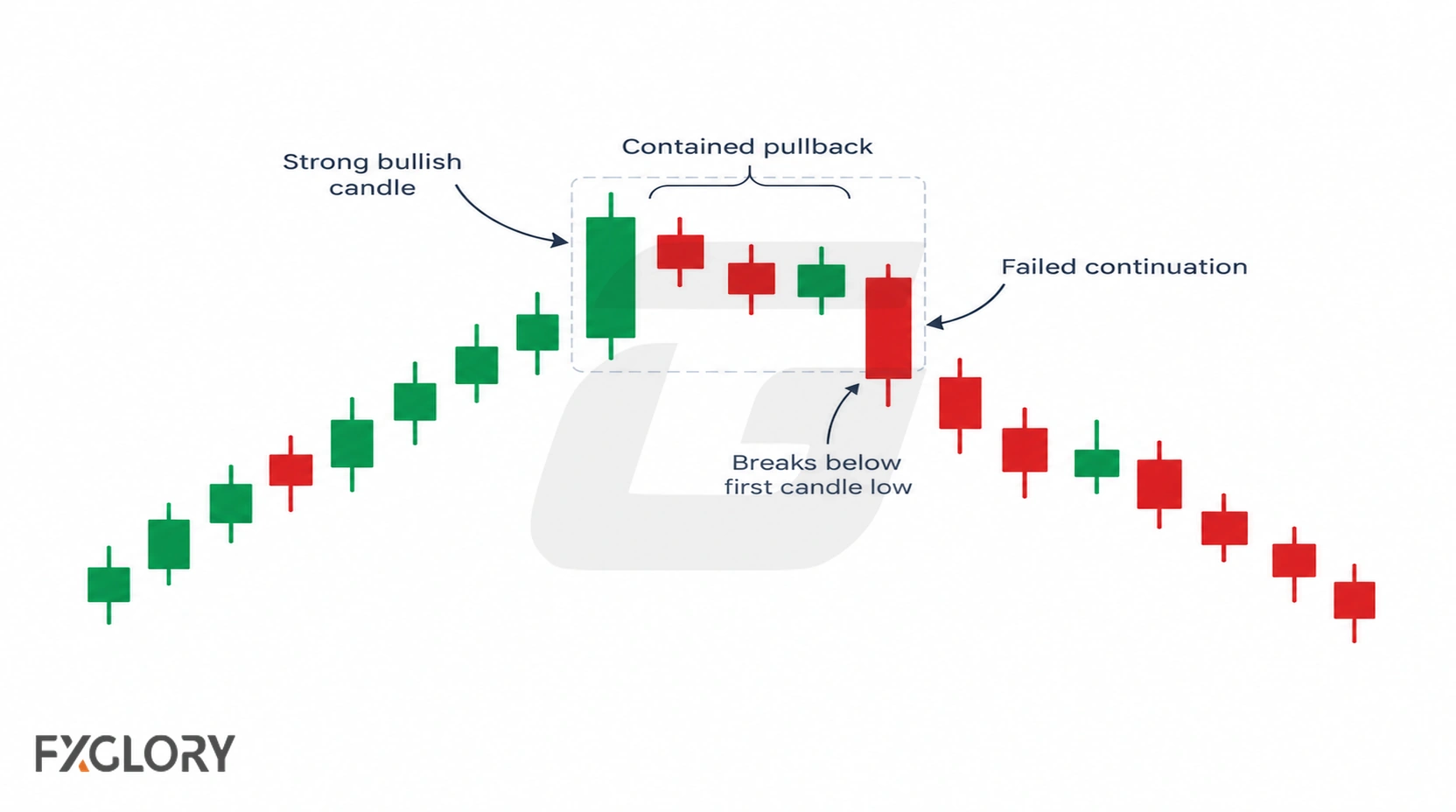
- Unfinished candidate: Candle five has not closed, or fails the selected completion threshold.
- Structural mismatch: The middle candles exceed the specified low or high boundary, the candle count differs, or the classical gap is absent under a strict gap-based definition.
- Context mismatch: No identifiable prior trend exists, so the sequence lacks its continuation interpretation.
- Completed pattern with failed follow-through: After completion, price reverses through a relevant pre-identified level. This undermines the continuation hypothesis without erasing the finished candles.
- Trade-plan invalidation: A particular entry, stop or risk rule is breached. This is separate from structural pattern identification.
Support, resistance and nearby swing levels are relevant only when defined in observable price terms. For example, bullish continuation directly below a prior resistance high may face a barrier, while bearish continuation directly above prior support may do the same. Neither outcome is certain.
Forex Conditions and Trade-Risk Planning
Wider spreads, slippage, session transitions and economic releases may complicate execution even when the five candles match a pattern rule. Compare unusually large candle ranges with recent ranges on the same feed and timeframe; no universal “normal rhythm” threshold applies. On a lower timeframe, note any nearby higher-timeframe support, resistance or opposing structure explicitly rather than saying the pattern “fights” the larger chart.
Spot-forex tick or broker-platform activity is not consolidated global exchange volume. Such activity can be contextual information, but it cannot independently establish the pattern’s reliability. ATR can describe recent price-range volatility; it does not determine direction or set a universally appropriate stop.
For a proposed trade, define entry, trade invalidation, stop placement, position size, transaction costs and acceptable monetary risk separately. Position size depends on stop distance, pip or contract value and the predetermined risk limit. A formation can be identifiable without already being a trade-ready setup.
What to Study Next
Compare Mat Hold with the dedicated Rising Three Methods and Falling Three Methods articles, or use the forex candlestick-pattern guide to place these within the broader continuation family. The existing demo-account CTA provides a way to practise recognizing the formations without duplicating that instruction here.