Forex Trading Quotes: The Quick Answer
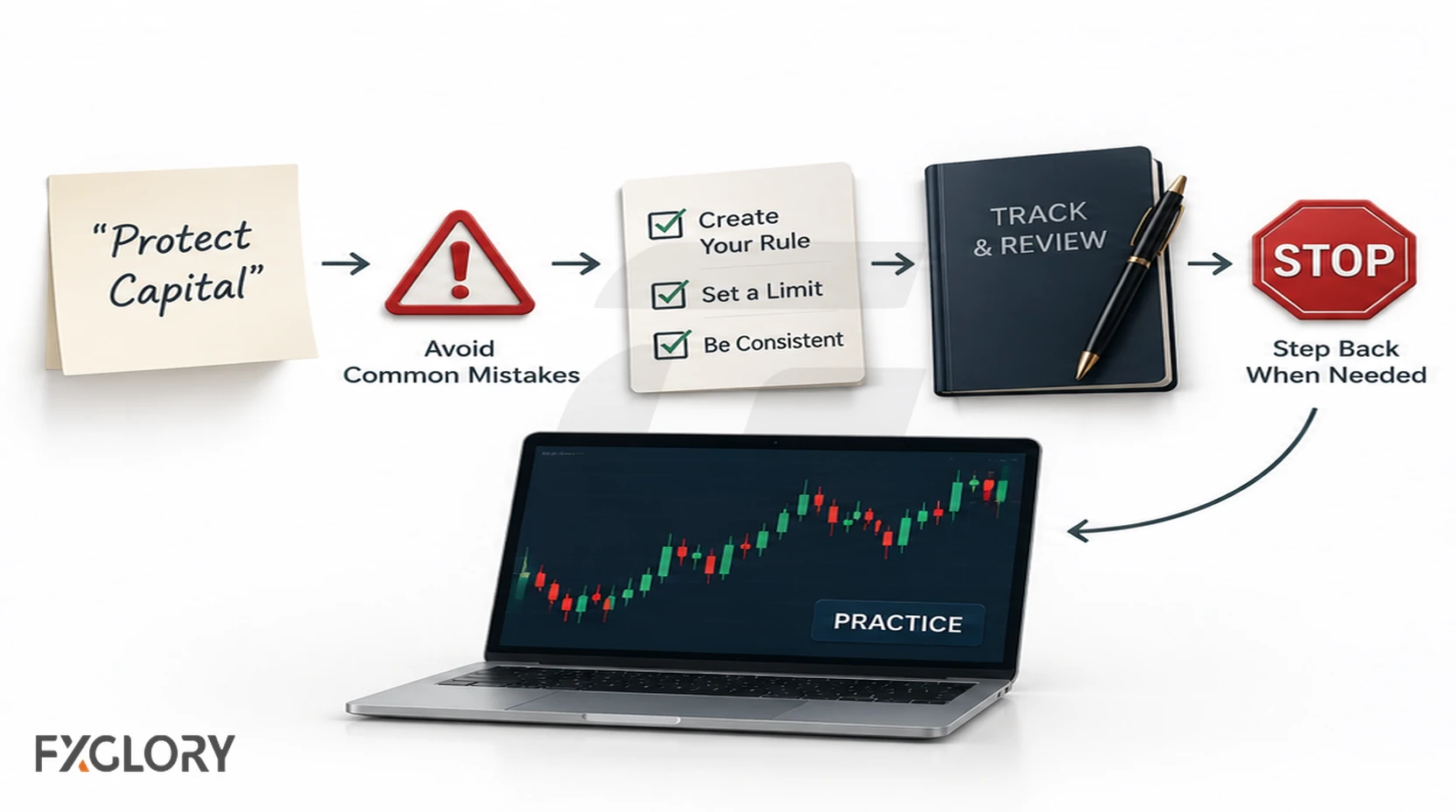
The best forex trading quotes are not useful because they sound clever. They are useful when they change what a trader risks, records, avoids, or practices. A quote about patience should become a waiting rule. A quote about losses should become a stop rule. A quote about discipline should become a journal field that can be checked after the trade.
A beginner should not use forex motivational quotes as fuel to trade more. A developing trader should use them as short reminders to protect capital, define risk before entry, avoid revenge trading, stop after rule breaks, and review decisions honestly.
The strongest forex trade quotes usually point to the same lesson: survival comes before profit. A trader who protects capital, respects position size, accepts losses, avoids emotional entries, and records mistakes has a better learning process than a trader who only collects inspiring words.
| Quote Type | What It Should Teach | Forex Mistake It Should Reduce | Best FXGlory Follow-Up |
|---|---|---|---|
| Risk quote | Protect capital before thinking about profit. | Oversizing, moving stops, ignoring margin, or adding to losers. | Forex risk management strategy |
| Patience quote | Waiting is part of trading. | Forced entries, FOMO, boredom trades, and unclear setups. | FOMO trading in forex |
| Psychology quote | Emotions must be managed before orders are placed. | Revenge trading, tilt, fear, greed, and rule negotiation. | Forex trading psychology |
| Success quote | Success means process quality, not excitement. | Chasing profit claims, copying outcomes, and ignoring losses. | Forex trading success stories |
| Loss quote | Losses are part of trading and must be contained. | Revenge entries, larger lots after a loss, and refusal to stop. | Forex failure stories |
30 Forex Trading Quotes By Lesson
Use the list below as a fast starting point. The practical value is not the wording alone; the value is the rule each quote creates for risk, patience, psychology, losses, or review.
| Quote Or Quote Idea | Typical Attribution / Type | Forex Lesson | Rule To Write |
|---|---|---|---|
| “Cut your losses short and let your winners run.” | Common trading maxim | A losing idea should be contained before it grows. | My invalidation point and stop logic must be written before entry. |
| “I’m always thinking about losing money.” | Often attributed to Paul Tudor Jones | Risk comes before reward. | I write planned loss before target or profit idea. |
| “Losers average losers.” | Often attributed to Paul Tudor Jones | Adding to a losing position without a plan can turn one mistake into larger damage. | I do not add to a losing trade unless the add-on rule existed before entry. |
| “Markets can remain irrational longer than you can remain solvent.” | Often attributed to John Maynard Keynes | A logical opinion can still lose if risk is too large. | I do not use leverage to prove an opinion right. |
| “Risk comes from not knowing what you’re doing.” | Often attributed to Warren Buffett | Unclear setups, instruments, costs, or rules increase danger. | I skip trades I cannot explain in plain language. |
| “There is a time to go long, a time to go short, and a time to go fishing.” | Often attributed to Jesse Livermore | No-trade conditions are part of trading discipline. | I allow a planned no-trade session without calling it failure. |
| “When in doubt, stay out.” | Common trading saying | Unclear market conditions do not require an order. | I do not trade when entry, stop, and reason are unclear. |
| “Do not anticipate and move without market confirmation.” | Often attributed to Jesse Livermore | Jumping early can create emotional entries. | I wait for the condition written in my plan. |
| “Money is made by sitting, not trading.” | Livermore-style lesson | Patience can protect a trader from overtrading. | I track whether each trade came from the plan or from boredom. |
| Wait for the trade that matches the plan. | Rule-based reminder | Movement is not the same as opportunity. | I need pair, timeframe, session, level, risk, and reason before entry. |
| “Anything can happen.” | Mark Douglas-style lesson | No setup is certain. | I size the trade as if a loss is possible. |
| “Hope is not a strategy.” | Common trading saying | Holding without a rule is not patience. | I exit by plan, not by hope. |
| “Markets are never wrong; opinions often are.” | Often attributed to Jesse Livermore | The market does not owe the trader agreement. | I do not move risk limits to defend an opinion. |
| “Plan the trade and trade the plan.” | Common trading saying | A plan matters only if behavior follows it. | I record which rule was followed or broken. |
| Confidence means being able to accept a losing trade. | Psychology reminder | Real confidence is process-based, not outcome-based. | I do not increase lot size because a setup feels certain. |
| “Do more of what works and less of what doesn’t.” | Often attributed to Steve Clark | Improvement needs evidence. | I review similar trades before changing a rule. |
| “Never, ever argue with your trading system.” | Often attributed to Michael Covel | A system is useless if the trader negotiates every rule. | I do not override the plan after entry without a written reason. |
| Most traders damage good systems by trying to make them perfect. | System-development reminder | Constant adjustment can hide poor discipline. | I do not change a method after one loss. |
| Trade what is happening, not what you think should happen. | Market-response reminder | Price behavior matters more than personal prediction. | I mark the invalidation condition before defending a view. |
| Preparation is part of the trade. | Process reminder | The work before entry shapes the decision after entry. | I check spread, news, margin, lot size, and stop distance before entry. |
| The first loss is usually the cheapest loss. | Market proverb | Accepting a planned loss can prevent larger damage. | I do not move a stop because the loss feels unfair. |
| “When in doubt, get out.” | Common trading saying | Confusion after entry can be a warning sign. | I close or reduce only according to the plan, then review. |
| A good trade can lose; a bad trade can win. | Process reminder | Outcome alone does not prove decision quality. | I grade the trade by rule-following before profit or loss. |
| The next trade is not a chance to repair the last one. | Revenge-trading reminder | Recovery pressure can create rushed decisions. | I use a cooldown rule after emotional loss. |
| Protect capital before chasing profit. | Risk reminder | Survival comes before opportunity. | I stop trading at my daily loss or rule-break limit. |
| The goal is to make the best trades; money is secondary. | Elder-style lesson | Decision quality matters before outcome focus. | I review whether the trade matched the plan. |
| Consistency is a behavior before it is a result. | Process reminder | Repeated discipline comes before stable results. | I track the same journal fields for every trade. |
| Survive first, improve second. | Risk reminder | A trader cannot learn if exposure destroys the account. | I lower risk when discipline weakens. |
| Professionals think first about what they could lose. | Risk-management reminder | Loss awareness is not fear; it is planning. | I check worst-case loss before placing the order. |
| Small rule breaks can become large account damage. | Review reminder | Repeated minor exceptions can become major mistakes. | I tag every rule break, even when the trade wins. |
How To Use Forex Trading Quotes Safely
A quote should not decide a trade. It should improve the process around the trade. Before turning a quote into action, ask whether it changes risk, entry quality, exit discipline, journal review, or the decision to stay out.
- Pick one quote at a time: Do not collect dozens of quotes and apply none of them.
- Identify the warning: Decide whether the quote warns against oversizing, chasing, revenge trading, overtrading, moving stops, or trading without a plan.
- Write one measurable rule: Replace vague ideas such as "be disciplined" with a rule that can be checked after the trade.
- Add a journal field: Track planned risk, actual risk, emotion before entry, reason for exit, rule followed, or stop movement.
- Create a stop-trading trigger: Decide what event forces a break from trading before emotion takes over.
- Practice under control: Use chart review, demo practice, or journal review before applying a quote-based rule with real-money exposure.
For risk context, compare any motivational quote with FXGlory's Risk Disclosure and the CFTC/NASAA foreign exchange currency fraud alert. A quote should never make leveraged trading feel certain, easy, or protected from loss.
Forex Trading Quote-To-Rule Worksheet
Use the worksheet below to turn a quote into something practical: a risk rule, a journal field, a stop-trading trigger, and a controlled practice action. It is designed for traders who want quotes to change behavior instead of becoming decoration.
View Forex Trading Quote-to-Rule Worksheet
| Worksheet Field | What To Write | Example |
|---|---|---|
| Quote or quote idea | The sentence or reminder you want to use. | Protect capital before chasing profit. |
| Mistake warned against | The behavior the quote should stop. | Increasing lot size after a loss. |
| My exact rule | One measurable rule you can check later. | I will not increase position size after a losing trade during the same session. |
| Journal field | The field that proves whether the rule was followed. | Planned risk versus actual risk. |
| Stop-trading trigger | The event that ends the session. | Stop after one revenge-trade urge or two rule breaks. |
Forex Trading Quotes About Risk Management
Risk quotes are the most important forex trading quotes because leverage, margin, spread, volatility, and repeated order access can magnify weak decisions. A quote about risk should lead to a smaller, clearer, more controlled trade process.
| Quote Or Quote Idea | Attribution / Type | What It Means For Forex Traders | Rule To Write |
|---|---|---|---|
| "Cut your losses short and let your winners run." | Common trading maxim | The trader should decide where the idea is wrong before entering, not after emotion appears. | My stop and invalidation point must be written before entry. |
| "I'm always thinking about losing money." | Often attributed to Paul Tudor Jones | Risk comes before reward. The first question is not how much can be made, but how much can be lost. | I write planned risk before writing the target. |
| "Losers average losers." | Often attributed to Paul Tudor Jones | Adding to a losing forex position without a written plan can turn one mistake into account damage. | I do not add to a losing trade unless the add-on rule was written before entry. |
| "Cutting losses, cutting losses, and cutting losses." | Often attributed to Ed Seykota | Loss control is not a side habit. It is central to survival. | I record every stop move and whether it was allowed by the plan. |
| Protect capital before chasing profit. | Quote idea | A strong trade idea still needs position size, margin awareness, and a loss limit. | I check lot size, margin, and leverage before placing the order. |
A trader using these quotes should review FXGlory's margin calculator and leverage conditions before treating any setup as affordable. Risk is not only the stop distance; it also includes position size, leverage, margin, spread, slippage, and account exposure.
Forex Motivational Quotes About Patience And Discipline
Patience quotes are useful only when they reduce unnecessary orders. Forex gives constant movement, but movement is not the same as opportunity. A patient trader can wait for the planned pair, timeframe, session, level, and risk condition.
| Quote Or Quote Idea | Attribution / Type | Forex Lesson | Practical Rule |
|---|---|---|---|
| "When in doubt, stay out." | Common trading saying | Unclear conditions do not require a trade. | If I cannot explain the entry, invalidation, and risk in one minute, I do not trade. |
| "The trend is your friend." | Common trading saying | Trend context matters, but the saying does not replace risk control. | I mark the trend and invalidation point before choosing direction. |
| "There is a time to go long, a time to go short, and a time to go fishing." | Often attributed to Jesse Livermore | Not trading is a valid decision when conditions are poor. | I allow a no-trade session without calling it failure. |
| "Money is made by sitting, not trading." | Often linked to Livermore-style lessons | Some traders lose because they cannot wait through a valid setup or stay out during noise. | I track whether each trade came from the plan or from boredom. |
| Wait for the trade that matches the plan. | Quote idea | Patience should be visible in entries, not only in words. | I need pair, timeframe, level, risk, and reason before entry. |
Forex Trading Psychology Quotes
Forex trading psychology quotes matter because many rule breaks happen before the order is placed. The trader feels urgency, frustration, fear, greed, boredom, or pressure, then searches for a reason to act.
| Quote Or Quote Idea | Attribution / Type | Psychology Lesson | Journal Prompt |
|---|---|---|---|
| "Anything can happen." | Mark Douglas-style lesson | No single setup is certain. The plan must survive uncertainty. | Did I size the trade as if loss was possible? |
| "Markets are never wrong; opinions often are." | Often attributed to Jesse Livermore | The market does not owe the trader agreement. | Did I follow price and plan, or defend my opinion? |
| "Hope is not a strategy." | Common trading saying | Holding without a rule is not patience. | Did I keep the trade because of the plan or because I hoped it would turn? |
| "Plan the trade and trade the plan." | Common trading saying | A plan matters only if behavior follows it under pressure. | Which part of the plan did I follow or break? |
| The next trade is not a chance to repair the last one. | Quote idea | Revenge trading turns loss into emotional debt. | Was the entry independent, or was it meant to recover? |
When a quote reveals fear, greed, hesitation, revenge, FOMO, or overconfidence, use FXGlory's forex trading psychology lessons to turn the idea into a repeatable behavior check.
Success Forex Trading Quotes Without Profit Hype
Success forex trading quotes should not make trading sound easy. In a risk topic, success should mean better process, stronger risk control, better review, fewer emotional decisions, and more consistent rule-following. A quote that defines success only as money can create dangerous expectations.
| Quote Or Quote Idea | What Success Should Mean | What To Avoid | Better Rule |
|---|---|---|---|
| Survive first, improve second. | The trader protects learning capital and avoids account-damaging behavior. | Believing one aggressive trade can shortcut development. | I stop trading when my daily loss limit or rule-break limit is reached. |
| Consistency is a behavior before it is a result. | Repeated process quality matters before outcome claims. | Calling random wins proof of skill. | I review whether the trade matched my plan, not only whether it won. |
| A good trade can lose; a bad trade can win. | Quality must be judged by decision process and risk control. | Learning the wrong lesson from one profitable mistake. | I tag each trade as plan-following or plan-breaking. |
| Preparation is part of the trade. | The work before entry affects the decision after entry. | Opening a trade because the market is moving quickly. | I check pair, timeframe, session, news, spread, risk, and invalidation before entry. |
To keep success language grounded, compare these reminders with FXGlory's forex trading success stories. Useful success stories highlight risk control, process, patience, and recovery from mistakes, not guaranteed outcomes.
Forex Trade Quotes About Systems And Strategy
Strategy quotes are useful when they stop the trader from changing methods emotionally. A strategy can only be evaluated when the rules, risk, conditions, and review process are consistent enough to measure.
| Quote Or Quote Idea | Strategy Lesson | Forex Mistake It Warns Against | Rule To Test |
|---|---|---|---|
| Do more of what works and less of what does not. | A trader needs evidence, not feelings, to improve a method. | Changing setups after every loss. | I review at least 20 similar trade examples before changing the rule. |
| A system is only useful if the trader can follow it. | A method must match the trader's time, psychology, and risk tolerance. | Choosing a scalping style while unable to handle fast decisions. | I only trade strategies that fit my session, attention, and risk limit. |
| One setup is enough if it is understood well. | Depth can beat constant method-hopping. | Switching indicators or timeframes after every losing trade. | I track one setup long enough to review real patterns. |
| Testing protects the trader from story-based confidence. | A strategy should be tested before live exposure. | Trading a quote, screenshot, or example as if it proves the method. | I demo-test or review historical examples before applying the idea live. |
For deeper strategy context, compare quote-based ideas with FXGlory's forex strategies lessons before treating any short saying as a complete method.
Forex Quotes About Losses And Blown Accounts
Loss quotes should reduce damage after a losing trade. They should not make losses feel heroic or normal enough to ignore. Every trader can have losing trades, but a trader should not let one loss become revenge trading, tilt, oversized risk, or refusal to stop.
| Quote Or Quote Idea | Loss Lesson | Dangerous Reaction | Protective Action |
|---|---|---|---|
| The first loss is usually the cheapest loss. | Accepting a planned loss can prevent larger damage. | Moving the stop because the loss feels unfair. | Record whether the stop was respected. |
| Do not let one trade become the whole account story. | One decision should not control the next five decisions. | Opening a recovery trade immediately after a loss. | Use a cooldown rule after emotional loss. |
| A loss is information only if it is reviewed honestly. | Review turns loss into a learning record. | Ignoring mistakes because the loss is painful. | Write reason for entry, exit, emotion, and lesson. |
| Capital protection is a trading skill. | Not losing control is part of development. | Increasing lot size to recover. | Keep position size fixed after a loss unless the written plan allows change. |
Loss-focused quotes connect naturally with FXGlory's revenge trading, trading tilt, and forex failure stories resources. The lesson is not to fear every loss. The lesson is to stop one loss from becoming uncontrolled behavior.
Quote Attribution And Misuse
Many famous trading quotes are repeated with different wording or uncertain attribution. That does not make every quote useless, but it does mean the trader should avoid hero worship. When attribution is unclear, focus on the practical lesson and do not force a speaker name.
| Problem | Why It Matters | Better Approach |
|---|---|---|
| Unclear attribution | A quote may be repeated online with different names attached. | Write "common trading saying" or leave the speaker blank if unsure. |
| Hero worship | A famous name can make a risky idea sound safer than it is. | Ask what rule the quote creates for your own trading plan. |
| Missing context | A quote from a professional trader may not fit a retail forex account, leverage setting, or session routine. | Adapt the lesson to position size, margin, spread, and account risk. |
| Motivation without limits | A quote can push action when the better decision is to wait. | Pair every quote with a stop-trading trigger. |
How To Put Forex Trading Quotes In A Journal
A trading journal is where a quote becomes measurable. Without a journal, the trader may remember the quote but forget whether behavior changed.
| Quote Lesson | Journal Field To Add | Yes / No Review Question |
|---|---|---|
| Protect capital. | Planned risk and actual risk. | Did actual risk match planned risk? |
| Wait for the setup. | Reason for entry. | Could I explain the setup before entry? |
| Avoid emotional recovery. | Revenge urge present. | Was this trade meant to recover a loss? |
| Respect the stop. | Moved stop. | Did I move the stop outside the written plan? |
| Trade the plan. | Rule followed. | Was the trade taken from the plan? |
| Stay out during poor conditions. | Spread, volatility, or news condition. | Were market conditions inside my plan? |
FXGlory's forex trading journal and forex trading journal template can help turn quote-based reminders into a review routine. The goal is not to collect more quotes. The goal is to see whether a rule was followed under pressure.
Common Mistakes With Forex Motivational Quotes
Forex motivational quotes can help discipline, but they can also create false confidence. The mistake is not reading them. The mistake is using them without risk limits, journal review, or a clear trading plan.
- Using quotes as signals: A quote cannot tell a trader when to buy, sell, hold, or exit.
- Trading bigger after inspiration: Motivation should not change lot size or account exposure.
- Ignoring attribution problems: A repeated quote may have uncertain wording or speaker attribution.
- Collecting quotes instead of rules: A quote that does not change behavior is only a sentence.
- Using success quotes as profit promises: Success in trading should be linked to process, risk control, and consistency, not guaranteed income.
- Forgetting forex conditions: Spread, slippage, leverage, margin, session timing, and news can change how a lesson applies.
- Skipping review after losses: Quotes about losses matter only when the trader reviews what happened and stops the same mistake from repeating.
What To Do After Reading Forex Trading Quotes
Choose one quote or quote idea that matches a real weakness. Do not choose the quote that sounds most impressive. Choose the one that can prevent the next avoidable mistake.
If the weakness is risk, write a position-size or loss-limit rule. If the weakness is FOMO, write a waiting rule. If the weakness is revenge trading, write a cooldown rule. If the weakness is stop movement, write a stop-review field. If the weakness is overtrading, write a maximum-trade rule for the session.
Then test the rule with chart review, demo practice, or journal review before using it with real-money exposure. A quote should not make trading feel easy. It should make the trader more careful, more selective, and more accountable.
For basic order workflow and practice without real-money exposure, use an FXGlory demo account. Before live trading, review account conditions, margin requirements, leverage settings, instruments, and platform workflow carefully.
Frequently Asked Questions
What are forex trading quotes?
Forex trading quotes are short reminders about trading behavior, risk control, patience, discipline, psychology, losses, and decision-making. They should be used as learning prompts, not as trading signals, investment advice, or proof that a trader can make profit.
What is the best forex trading quote for beginners?
A useful beginner reminder is the common trading maxim: cut losses short and let winners run. For a new forex trader, the practical rule is to define risk, stop placement, and invalidation before entering a trade instead of deciding under pressure later.
Can forex motivational quotes improve trading?
Forex motivational quotes can help only when they change behavior. A quote that leads to a written rule, a journal field, a smaller risk decision, or a stop-trading trigger can be useful. A quote that only creates excitement to trade can be dangerous.
Are forex trading quotes enough to become profitable?
No. Quotes cannot make a trader profitable by themselves. Profitability depends on market understanding, risk management, position sizing, emotional control, execution, spread, slippage, margin, leverage, journal review, and the ability to follow rules over time.
What are the best forex quotes about risk management?
The strongest risk-management quotes usually focus on cutting losses, protecting capital, thinking about possible loss before possible profit, avoiding emotional position sizing, and not adding risk after a losing trade.
What are the best forex quotes about patience?
Useful patience quotes remind traders that not every market move needs a trade. In forex, patience means waiting for a valid setup, respecting the session plan, avoiding trades during unclear conditions, and being willing to stay flat.
What are the best forex quotes about trading psychology?
Good psychology quotes remind traders that anything can happen, the market does not care about personal opinions, hope is not a strategy, and discipline must be visible in behavior. These reminders should become journal prompts and stop-trading rules.
What are success forex trading quotes?
Success forex trading quotes should define success as process quality, risk control, patience, consistency, preparation, and survival. They should not make success sound like guaranteed income, fast profit, or a result that can be copied from another trader.
How should I use a trading quote in my journal?
Write the quote or quote idea, the mistake it warns against, the exact rule you will follow, the journal field that proves whether the rule was followed, and the stop-trading trigger that protects the session if emotion takes over.
Are famous trading quotes always correctly attributed?
No. Many trading quotes are repeated with different wording or uncertain attribution. When attribution is unclear, do not force it. Focus on the practical lesson, risk warning, and behavior rule instead of treating the quote as proof of authority.
Can trading quotes be dangerous?
Yes. Trading quotes can be dangerous when they create overconfidence, urgency, hero worship, larger position sizes, revenge entries, or belief in certainty. A quote should reduce risky behavior, not encourage more trading.
Should I print or save forex trading quotes?
Printing or saving forex trading quotes can help if the quote is attached to a rule. A printed quote without a rule is decoration. A printed quote with a risk limit, journal field, and stop-trading trigger can support better discipline.
What is the difference between a forex quote and a forex trading quote?
A forex quote can mean a currency price quote, such as bid and ask prices for a pair. A forex trading quote in this context means a short lesson or saying about trading behavior, risk, patience, psychology, or discipline.
What are short forex trading quotes I can save?
Useful short forex trading quotes include reminders such as “When in doubt, stay out,” “Plan the trade and trade the plan,” “Hope is not a strategy,” and “Protect capital before chasing profit.” Save only the quotes that you can turn into a rule or journal prompt.
Where can I find good forex trading quotes?
Good forex trading quotes often come from trading books, interviews, market biographies, education libraries, and trading psychology material. Always check attribution carefully, because many famous quotes are repeated with different wording or speaker names.
Should I use forex trading quotes for social media motivation?
You can save or share quotes as reminders, but do not let them become performance claims, trading advice, or pressure to trade bigger. A quote is most useful when it points back to a risk rule, journal field, or stop-trading trigger.
Related Contents
Turn Trading Quotes Into Rules Before Live Exposure
Create an FXGlory account to review the trading environment, platform workflow, account conditions, instruments, margin requirements, leverage settings, and order process before placing a real-money trade.
Create an FXGlory Account