

What Is A 200 SMA Forex Day Trading Strategy?
A 200 SMA forex day trading strategy uses the 200-period simple moving average as a trend or location filter inside a same-day trading plan. The 200 SMA can help show whether price is generally trading above, below, or around a longer average for the selected chart.
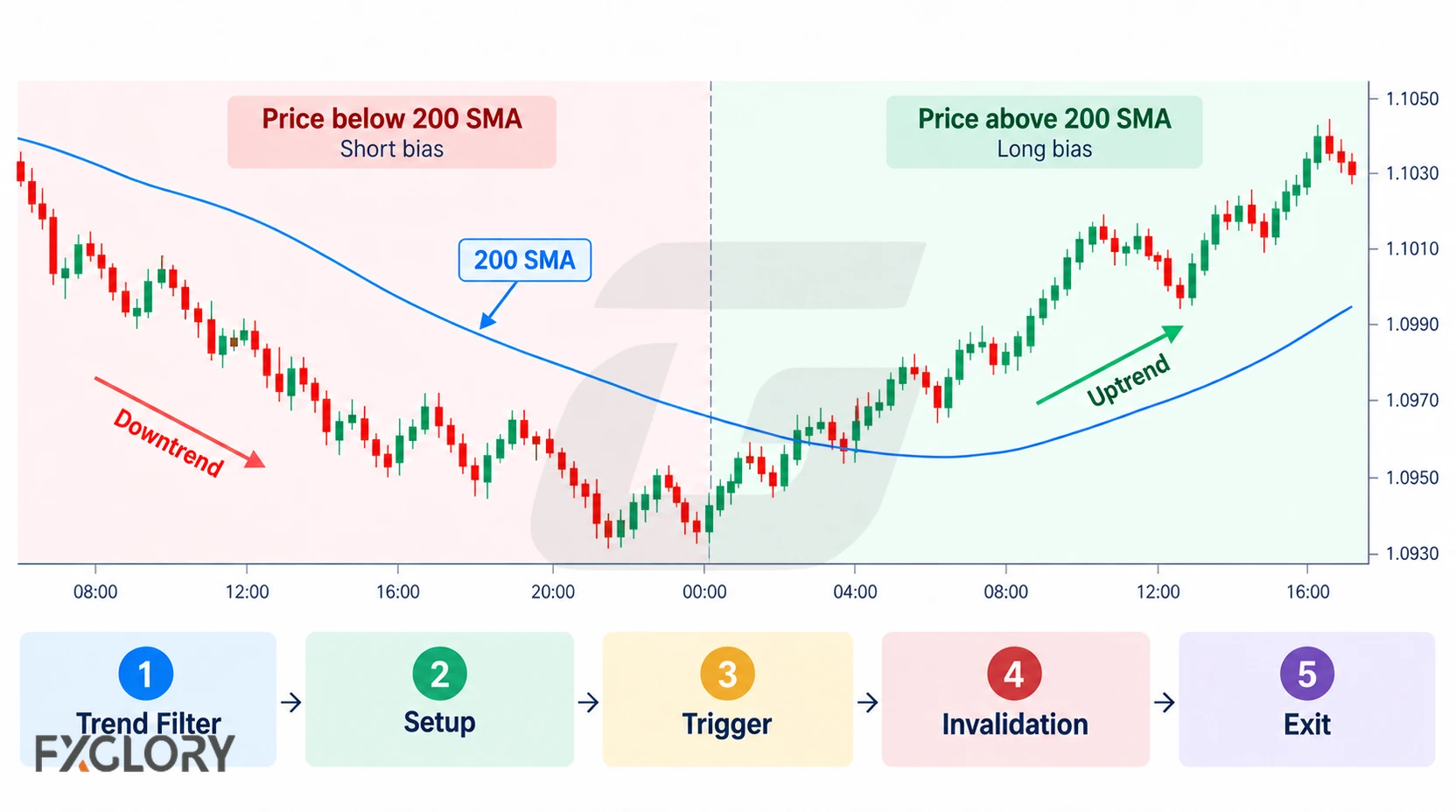
The 200 SMA should not create the whole trade. Price above the 200 SMA may support long-side planning, and price below it may support short-side planning, but the trade still needs a session, pair, setup, trigger, invalidation, spread check, news filter, and exit rule.
For the full same-day workflow, start with the forex day trading strategy guide. For the broader rule structure behind indicator-based methods, use the forex indicator strategies framework. This page focuses only on adding the 200 SMA to an intraday process.
What The 200 SMA Means In Forex Day Trading
SMA means simple moving average. A 200 SMA calculates the average closing price of the last 200 candles on the chart where it is applied. The meaning changes with the chart interval.
| Chart | What a 200 SMA represents | How day traders may use it |
|---|---|---|
| Daily chart | Average of the last 200 daily candles | Broad long-term trend or major location context |
| 4H chart | Average of the last 200 four-hour candles | Higher intraday or short-swing context |
| 1H chart | Average of the last 200 hourly candles | Main intraday trend or location filter |
| 15M chart | Average of the last 200 fifteen-minute candles | Shorter intraday structure filter |
This distinction matters because a 200 SMA is not always a 200-day moving average. A trader using a 200 SMA on 1H is reading the last 200 hourly candles, not the last 200 trading days.
What The 200 SMA Can And Cannot Do
The 200 SMA can reduce visual noise and help classify whether price is trading above, below, or around a longer average. It can also act as a watched area where traders look for reactions, pullbacks, or breaks.
It cannot predict reversals, remove false signals, or replace trade management. Because it is based on past candles, the 200 SMA reacts after price has already moved. In sideways conditions, price can cross above and below the average several times without giving a clean direction.
The slope matters. A rising or falling 200 SMA can support cleaner trend context, while a flat 200 SMA with repeated crossings is often a warning that price is chopping around the average rather than respecting it.
| Can help with | Cannot do |
|---|---|
| Classifying broad direction on the selected chart | Guarantee that the next move continues |
| Identifying a possible dynamic area of interest | Replace a setup, trigger, stop, or exit rule |
| Filtering long-side or short-side ideas | Remove lag or whipsaw risk |
| Keeping the chart routine more organized | Make a quiet or news-driven session safe to trade |
Timeframes For A 200 SMA Day-Trading Setup
A 200 SMA day-trading routine should keep chart roles clear. The higher chart can own context, the middle chart can own the setup, and the lower chart can refine timing only when the setup already exists.
A practical structure can use 4H or 1H for 200 SMA context, 15M for the setup, and 5M only when entry timing needs more detail. The chart order should be chosen before the session begins and should not be changed after entry to justify a weak trade.
| Timeframe | Role in the 200 SMA routine | Main mistake |
|---|---|---|
| 4H | Broad trend and major location filter | Using it for exact entries |
| 1H | Main intraday 200 SMA context chart | Ignoring nearby structure because price is above or below the average |
| 15M | Setup chart for pullback, break, range, or rejection structure | Entering before invalidation is clear |
| 5M | Optional timing chart after the setup is valid | Letting the lowest chart create a trade against the plan |
Use the day-trading timeframe guide for deeper 1H, 15M, and 5M routine planning. Use the multiple-timeframe analysis guide when assigning context, setup, and trigger roles.
The 4H-1H-15M 200 SMA Routine
The 4H-1H-15M routine keeps the 200 SMA from becoming a one-chart signal. The higher charts provide location and direction. The 15M chart decides whether there is an intraday setup that can be planned before entry.
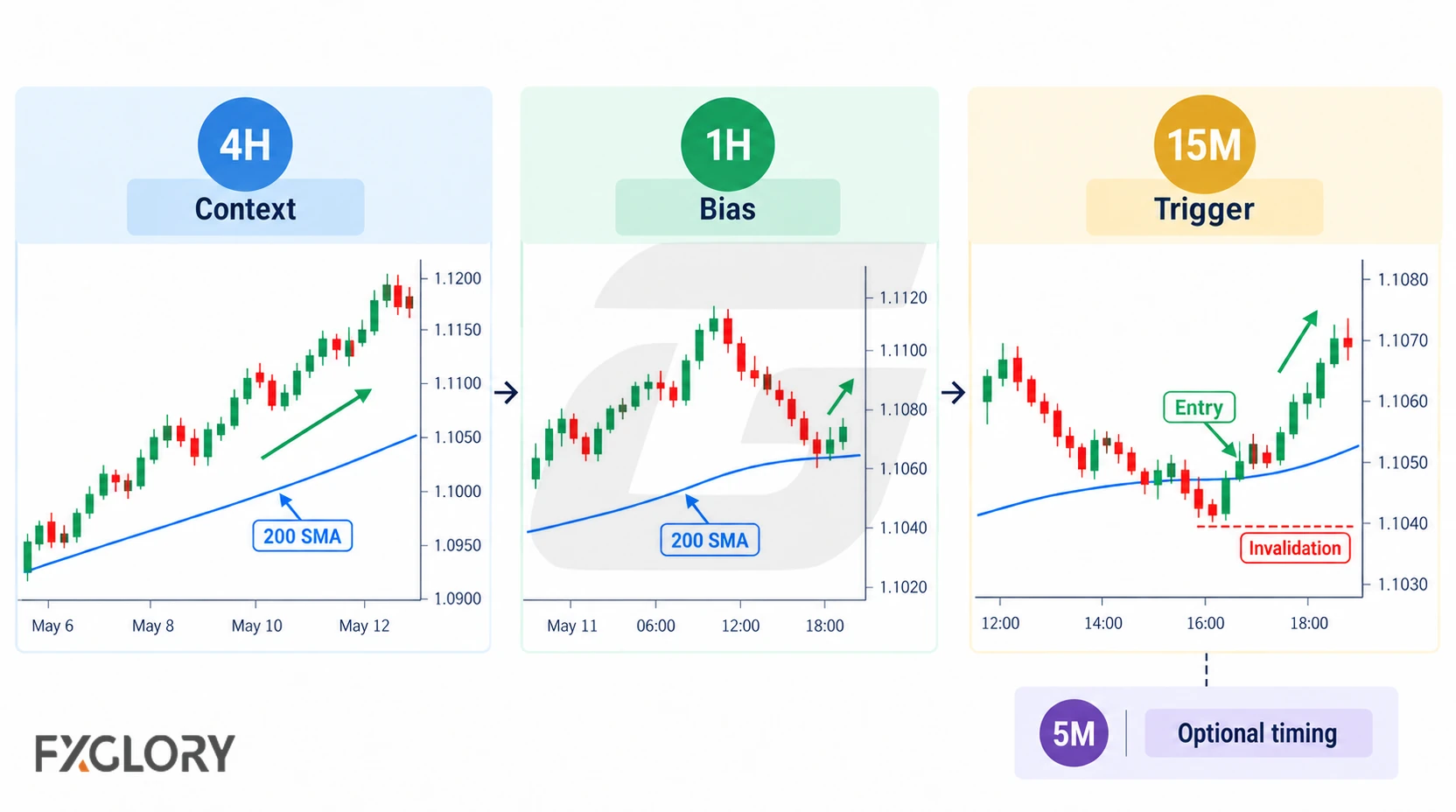
- Start with 4H: Check whether price is above, below, or repeatedly crossing the 200 SMA. Mark major structure and nearby obstacles.
- Move to 1H: Decide whether the intraday bias is clear enough to plan long-side, short-side, or no-trade conditions.
- Use 15M for the setup: Wait for a pullback, break-and-retest, range reaction, or rejection pattern that has clear invalidation.
- Use 5M only if needed: Drop lower only to refine timing after the 15M setup is already valid.
- Check session and spread: Make sure the pair is active enough and the expected move is still practical after costs.
- Define exit before entry: Decide whether the trade uses a target area, invalidation exit, or time-based close rule.
Example: 200 SMA Pullback Plan
This example shows how the 200 SMA can support a structured day-trading plan. It is a testing template, not a promise that every similar setup should be traded.
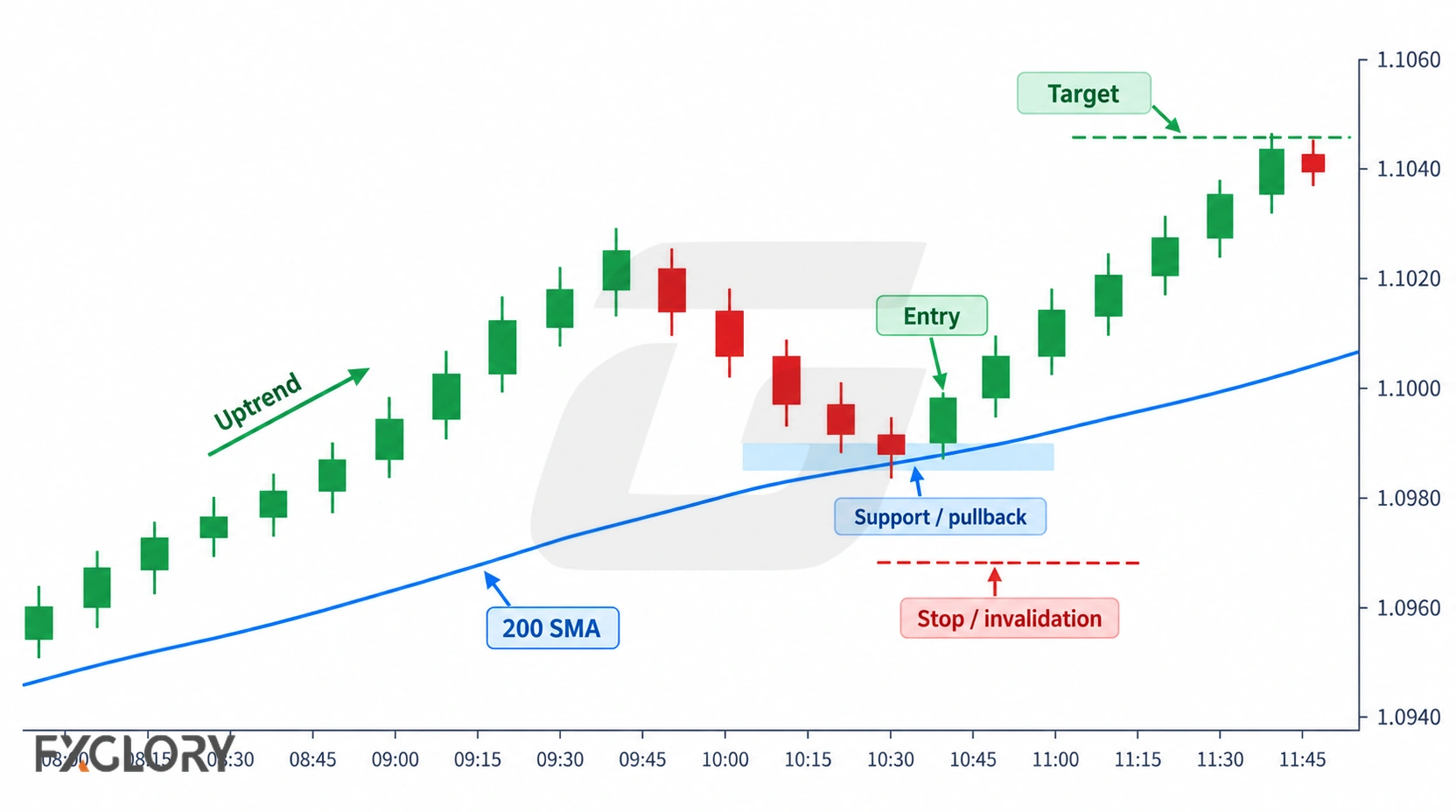
| Step | Example rule | Skip condition |
|---|---|---|
| Session | Trade only during the planned active session for the selected pair | The setup appears during a quiet or unsuitable window |
| Pair | Use one selected currency pair during the test | The trader switches pairs because the first market is quiet |
| Context | Use 1H to check whether price is above the 200 SMA for long-side planning or below it for short-side planning | Price is chopping through the 200 SMA with no clear direction |
| Setup | Use 15M to wait for a pullback toward a planned area with visible structure | The pullback has no clear invalidation area |
| Trigger | Use a defined trigger only after the 15M setup exists | The trigger appears before the setup is valid |
| Cost and news | Check spread and scheduled news before entry | The expected move is too small after spread or news risk is immediate |
| Exit | Use the planned invalidation, target area, or time-based close rule | The trader holds because the 200 SMA still appears supportive after the setup fails |
| Review | Record whether the 200 SMA helped filter the setup or only justified a trade after the fact | The result cannot be explained from the written plan |
The key is not the moving average alone. The key is whether the 200 SMA, session, setup, trigger, cost check, and exit rule all point to the same written plan.
200 SMA Crossover Vs Pullback Strategy
A crossover approach uses price crossing above or below the 200 SMA as a signal. It is simple, but it can be late because the average moves after price. In sideways markets, repeated crosses can create whipsaws.
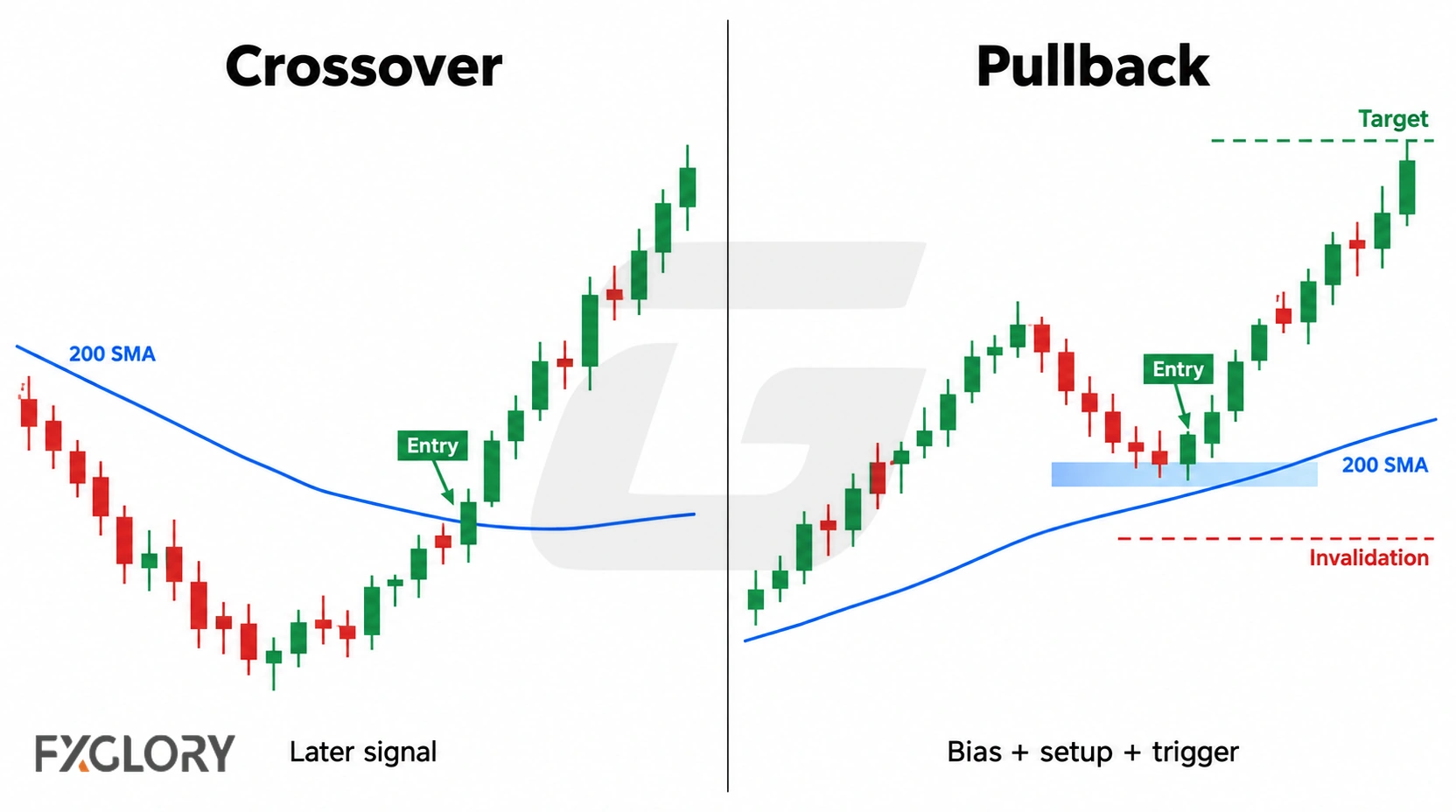
A pullback approach uses the 200 SMA as a location or direction filter, then waits for a separate setup. This can keep the moving average in its proper role: filter first, setup second, trigger third.
| Approach | How it works | Main risk |
|---|---|---|
| Crossover | Price crosses above or below the 200 SMA | Late entries and whipsaws in sideways markets |
| Pullback | Price trades with a 200 SMA bias, then pulls back into a planned area | Assuming every pullback will continue the trend |
| Break and retest | Price breaks through the 200 SMA area and retests with structure | False breaks during thin or news-driven movement |
When Not To Use The 200 SMA
The 200 SMA is less useful when the market is not respecting direction or structure. If price keeps crossing above and below the average, the moving average may be showing indecision rather than opportunity.
- Flat 200 SMA: A flat average with repeated crossings can warn that price is rotating instead of trending.
- Sideways price action: Repeated crossings can create false confidence and whipsaws.
- No clear session activity: A quiet window can make moving-average reactions weak or choppy.
- Immediate news risk: Scheduled releases can overpower technical filters.
- Spread is too large: A short-target day trade may become impractical after costs.
- No invalidation: If the setup cannot define where it is wrong, the 200 SMA should not be used to force entry.
- Late chart switching: Do not change the 200 SMA timeframe after entry to find a more comfortable reason to stay in the trade.
Spread, News, Stop, And Exit Rules
A 200 SMA day-trading plan still needs normal intraday risk controls. A moving average does not decide position size, stop distance, news exposure, or whether the expected move is large enough after spread.
- Spread check: Is the expected move still practical after spread?
- Stop-distance check: Does the stop match the setup chart instead of a random distance from the SMA?
- News check: Is a major release scheduled for the pair or related currency?
- Session check: Is the active window still suitable for the planned trade?
- Exit check: Is the target, invalidation exit, or time-based close rule defined before entry?
Use FXGlory spread information when testing short-target 200 SMA setups, and use the margin calculator before comparing stop distance and position size.
200 SMA Intraday Backtest Notes For 200 SMA Forex Day Trading Strategy
This hypothetical educational 200 SMA intraday backtest reviewed one day-trading routine: 4H and 1H 200 SMA context, 15M pullback setup, 15M trigger timing, session filtering, ATR-based stop placement, fixed 1.3R target, invalidation exits, spread/slippage assumptions, and same-day exits. Scope excludes discretionary day-trading, crossover-only rules, every moving-average method, and complete trading-plan execution.
The model reviewed EURUSD, GBPUSD, USDJPY, AUDUSD, USDCAD, and USDCHF using public yfinance 15-minute OHLC data where available. The 1H and 4H candles are resampled from the same 15-minute data so that each chart has a defined role.
| Rule Area | Educational Model Rule |
|---|---|
| Context chart | 4H SMA(200) price position and slope |
| Bias chart | 1H SMA(200) price position and slope |
| Setup chart | 15M pullback toward SMA(200) with candle confirmation |
| Trigger chart | 15M break of the previous 6-candle trigger range |
| Long context | 4H and 1H closes above SMA(200), with positive SMA(200) slope |
| Short context | 4H and 1H closes below SMA(200), with negative SMA(200) slope |
| Long setup | 15M pullback near SMA(200), bullish close, upper 40% close location, and limited extension from SMA(200) |
| Short setup | 15M pullback near SMA(200), bearish close, lower 40% close location, and limited extension from SMA(200) |
| Session filter | London morning, London/New York overlap, and early New York afternoon only |
| Entry | Next 15M open after the completed trigger candle |
| Stop | 15M setup candle extreme with a 0.25 ATR(14) buffer |
| Target comparison | Fixed 1.3R target from entry |
| Invalidation exit | 15M close beyond the setup candle extreme against the trade |
| Same-day exit | Forced close at the last available 15M close at or before 20:45 UTC |
| Cost Input | Assumptions Used |
|---|---|
| Spread | 0.5, 1.5, and 3.0 pips |
| Slippage | 0.1, 0.5, and 1.0 pips per side |
| Baseline comparison | 1.5-pip spread and 0.5-pip slippage per side |
| Swap and rollover | Not included because trades are forced flat before the same-day cutoff |
The review records setup candidates, triggered trades, accepted trades, rejected candidates, rejection reasons, trade count, win rate, average win in R, average loss in R, expectancy in R, profit factor, maximum drawdown in R, worst losing streak, holding time, same-day cutoff exits, session-level behavior, pair-level behavior, direction-level behavior, exit reasons, and spread/slippage sensitivity.
Educational 200 SMA Intraday Backtest Results
Baseline assumptions: 1.5-pip spread, 0.5-pip slippage per side, and no swap or rollover because positions are forced flat before the same-day cutoff. The baseline result was positive: 0.1619R expectancy and 5.5034R total net result across 34 trades. The accepted sample was small, and the highest tested cost case turned negative, so these figures are for studying 200 SMA filter behavior, session behavior, cost sensitivity, and same-day risk, not proof of future performance.
The positive baseline came from only 34 accepted trades out of 308 setup candidates. It should be read as a small-sample intraday filter observation, not evidence that the method is reliable.
| Metric | Baseline Result |
|---|---|
| Setup candidates | 308 |
| Triggered trades before overlap filter | 55 |
| Accepted trades | 34 |
| Rejected candidates | 274 |
| Trigger acceptance rate | 17.86% |
| Setup rejection rate | 88.96% |
| Win rate | 52.94% |
| Average win | 0.7921R |
| Average loss | -0.5471R |
| Expectancy | 0.1619R |
| Profit factor | 1.6287 |
| Maximum drawdown | -3.5778R |
| Worst losing streak | 4 |
| Average holding period | 238.24 minutes |
| Same-day cutoff exit rate | 23.53% |
| Session | Trades | Win Rate | Expectancy | Total Net Result | Max Drawdown | Cutoff Exit Rate |
|---|---|---|---|---|---|---|
| Early New York afternoon | 7 | 28.57% | -0.0822R | -0.5757R | -0.5802R | 100.00% |
| London/New York overlap | 15 | 66.67% | 0.3151R | 4.7270R | -1.5979R | 0.00% |
| London morning | 12 | 50.00% | 0.1127R | 1.3521R | -3.1170R | 8.33% |
| Pair | Trades | Win Rate | Expectancy | Total Net Result | Max Drawdown |
|---|---|---|---|---|---|
| AUDUSD | 4 | 50.00% | 0.3811R | 1.5243R | -0.2253R |
| EURUSD | 5 | 60.00% | 0.2462R | 1.2312R | -1.3495R |
| GBPUSD | 2 | 100.00% | 0.7263R | 1.4527R | 0.0000R |
| USDCAD | 12 | 50.00% | 0.1289R | 1.5467R | -1.1648R |
| USDCHF | 3 | 66.67% | 0.1447R | 0.4342R | -1.1862R |
| USDJPY | 8 | 37.50% | -0.0857R | -0.6856R | -2.2687R |
| Direction | Trades | Win Rate | Expectancy | Total Net Result | Max Drawdown |
|---|---|---|---|---|---|
| Long | 24 | 45.83% | 0.0431R | 1.0344R | -2.5585R |
| Short | 10 | 70.00% | 0.4469R | 4.4690R | -1.1386R |
| Exit Reason | Count |
|---|---|
| same day cutoff exit | 8 |
| stop loss | 5 |
| target 1.3R | 9 |
| time exit | 12 |
| Cost Scenario | Spread | Slippage Per Side | Expectancy | Total Net Result | Profit Factor |
|---|---|---|---|---|---|
| Low tested cost | 0.5 pips | 0.1 pips | 0.2976R | 10.1185R | 2.5177 |
| Baseline | 1.5 pips | 0.5 pips | 0.1619R | 5.5034R | 1.6287 |
| High tested cost | 3.0 pips | 1.0 pips | -0.0267R | -0.9065R | 0.9226 |
What This 200 SMA Intraday Backtest Shows
The baseline run produced positive expectancy and positive total net result under the tested rules, but the sample was small, filtered heavily, and cost-sensitive. The model accepted 34 trades from 308 setup candidates, and most candidates were rejected before entry because no valid 15M trigger formed, the trigger appeared outside the operating window, the setup was invalidated before trigger, or same-pair overlap was filtered.
The London/New York overlap contributed most of the baseline total net result. Early New York afternoon was negative under baseline assumptions, and every early-afternoon trade exited at the same-day cutoff. The high-cost sensitivity case was negative, so the figures should remain tied to the exact rule model, data source, session windows, stop rule, target rule, and cost assumptions used in this hypothetical educational backtest.
Use the result as a review prompt, not as a live-trading conclusion. Test one pair, one session window, one 200 SMA context rule, one setup rule, one target, and one cost assumption before comparing 200 SMA day-trading routines.
Common 200 SMA Forex Day Trading Mistakes
- Buying every touch above the 200 SMA: Location is not a complete setup.
- Selling every break below the 200 SMA: A break can fail, especially in sideways or thin conditions.
- Using the 200 SMA as the stop: The stop should come from the setup structure, not from the indicator alone.
- Ignoring price structure: The 200 SMA should not replace support, resistance, trend, range, or invalidation analysis.
- Changing the 200 SMA timeframe after entry: This turns the indicator into a justification tool instead of a filter.
- Trading through major news without a plan: News can overpower the moving-average filter.
- Forcing trades during chop: If price keeps crossing the 200 SMA, the market may not be suitable for that plan.
- Testing too many pairs at once: The review becomes unclear when several pairs, sessions, and chart routines are mixed together.
Practice One 200 SMA Routine Before Trading Live
A 200 SMA forex day trading strategy should be tested one session at a time before live trading. Choose one pair, one session, one chart routine, one setup type, and one review process. Do not change all of them during the same test.
- Before the session: Choose the pair, session, 200 SMA chart, setup chart, and key news events. Use the currency-pair list to keep the test focused on a selected market.
- During the session: Record whether price is above, below, or chopping through the 200 SMA.
- Before entry: Check setup quality, spread, stop distance, news timing, and invalidation.
- After exit: Record whether the 200 SMA acted as a useful filter or an after-the-fact excuse.
- After several sessions: Review whether losses came from sideways conditions, poor setup quality, spread impact, news, timing, or rule-breaking.
Use the demo account information to practice one 200 SMA routine before applying it to live trading conditions. Review FXGlory trading platforms when adding SMA indicators to a chart workspace, and keep the SMA period, method, applied price, and timeframe consistent during the sample.