

Best Forex Pairs for the Asian Session: Quick Answer
The best forex pairs to watch during the Asian session usually include USD/JPY, AUD/USD, AUD/JPY, NZD/USD and NZD/JPY. EUR/JPY is another candidate, especially when yen activity continues into the European handover. These are watchlist candidates, not a guaranteed ranking: the best pair for a particular session is the one with a clear reason to move, a manageable spread, enough observed range for the planned setup, and acceptable risk.
If you are starting out, compare just USD/JPY and AUD/USD before adding more pairs. Check the economic calendar and current quotes first; skip trading if the expected movement is too small after costs. This guide concentrates on choosing pairs during Asia-Pacific hours. For a wider view of all sessions, read FXGlory’s forex session timing guide; for choosing pairs independent of time of day, see best forex pairs for beginners.
What Is the Asian Forex Trading Session?
The phrase Asian forex session often means the Tokyo trading window, conventionally 00:00–09:00 UTC (09:00–18:00 Japan Standard Time). Japan does not use daylight saving time, so that reference stays fixed in UTC. The broader Asia-Pacific trading period begins earlier as Wellington and Sydney participants come online and also includes activity in other Asian financial centres.
These are conventional market-centre business windows, not a single opening bell for the global decentralized forex market. Currency trading continues across time zones during the trading week, and liquidity changes gradually as banks, funds and clients begin and finish their work.
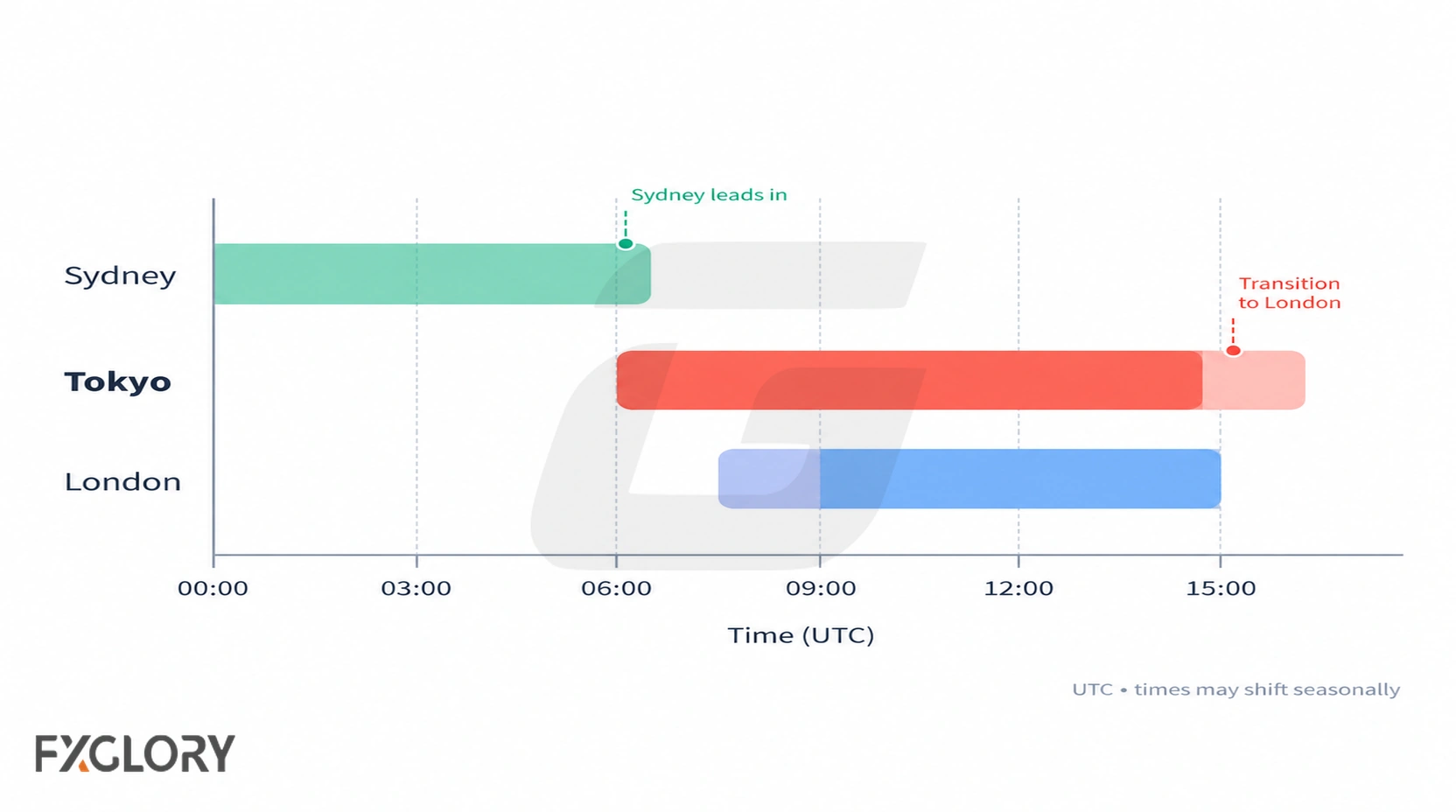
The most relevant timing distinction is Tokyo versus the broader Sydney–Tokyo window. An Australian employment release can move AUD pairs before Japanese offices are fully active. Later, Japanese data or Bank of Japan communication may dominate JPY pairs. Toward Europe, EUR/JPY can react to an entirely different set of drivers.
Do not confuse UTC with broker-server time: the candles in MetaTrader may be stamped in the broker's chosen timezone. Convert every planned window to the clock on your actual platform, and pay particular attention to holidays, daylight-saving changes outside Japan and the timing of economic announcements.
Best Forex Pairs to Trade During the Asian Session: Comparison
Start with a shortlist that connects one or both currencies to Japan, Australia or New Zealand. The table compares typical reasons traders monitor each pair. It does not rank future returns or imply that one cross will move more on every trading day.
| Pair | Asian-session reason to watch | Common catalyst | Main selection caution |
|---|---|---|---|
| USD/JPY | JPY focus during Tokyo; widely monitored major pair | BOJ signals, Japanese data, yields and US-dollar developments | It can move strongly outside Asia on US events, too |
| AUD/USD | Australian participation during Sydney/Tokyo | RBA, Australian data, China-sensitive sentiment | May lack meaningful range without a fresh driver |
| AUD/JPY | Both currency areas are linked to regional activity | Australia versus Japan policy and broader risk appetite | Spread cost and sudden risk reversals matter |
| NZD/USD | New Zealand and early Asia-Pacific focus | RBNZ, NZ data, dairy and global growth sentiment | Quiet stretches can overwhelm small-target setups |
| NZD/JPY | NZ and JPY policy/risk drivers can meet in Asian hours | RBNZ/BOJ, carry sentiment and regional data | Cross-pair costs and correlated yen risk |
| EUR/JPY | JPY activity in Tokyo and euro activity toward Europe | BOJ/ECB expectations, yields and session transition | European catalysts may matter more later in the day |
FXGlory lists all six instruments in its currency-pair market section. Availability in a particular account or demo environment, quote settings, trade size and execution conditions still need to be checked on the platform. These pair descriptions are watchlist hypotheses; verify observed conditions rather than treating them as a measured league table.
USD/JPY: A Major Pair to Watch During Tokyo Hours
USD/JPY is a natural first pair to study during Tokyo because the Japanese yen is active in its home market and the dollar remains globally important. Traders may watch Japanese wage or inflation releases, Bank of Japan decisions and commentary, the path of Japanese government-bond yields, US Treasury yields, and changes in the expected difference between US and Japanese interest rates.
One useful comparison is to note how USD/JPY behaves around a Japanese announcement versus a quiet Tokyo morning. In the former case, price may accelerate and spreads can change rapidly; in the latter, there may be little reason for price to travel far enough to offset costs. Overnight news from the US can also leave USD/JPY responding to moves that began before Tokyo opened.
When USD/JPY may deserve a place on your watchlist
- A Japanese economic or policy event is scheduled and you have a defined approach to event risk.
- The pair has an observable, liquid trading environment and a price structure you can explain.
- The planned stop, potential target and spread make sense in the same pip units; for most JPY pairs one conventional pip is 0.01 yen, while quote display points may be smaller.
When to skip: the pair is stuck in a range too narrow for your proposed target, an unplanned central-bank statement makes execution unpredictable, or the current spread does not fit the setup. Review FXGlory’s USD/JPY chart and specifications rather than assuming the published typical spread is your live deal price.
AUD/USD and AUD/JPY: Australian Dollar Opportunities
AUD/USD and AUD/JPY both reflect Australian-dollar factors, but they are not interchangeable. AUD/USD pits the Australian dollar against the US dollar; AUD/JPY pits it against the yen. That changes the role of US interest rates, Japanese policy and global sentiment in each chart.
AUD/USD: focus on Australia, China-sensitive themes and the dollar
AUD/USD can attract attention around Australian inflation, employment, Reserve Bank of Australia communication and shifts in expectations for Chinese growth or commodity demand. Those factors may matter during Sydney or Tokyo hours. But the USD side remains important, so US releases later in the day can produce a very different profile.
If an Australian release causes a sharp jump, wait until you can measure the spread and define a risk level; an active market is not automatically a well-priced trade. Consult FXGlory’s AUD/USD market page for current account-specific information.
AUD/JPY: a cross that mixes Australia and Japan
AUD/JPY also responds to RBA and Australian news, while Japanese yields, Bank of Japan developments and broader risk sentiment can change demand for yen. Traders sometimes use it to observe shifts between risk-seeking and defensive positioning, but that relationship is not stable enough to use as an automatic signal.
Because AUD/JPY is a cross, check its bid/ask spread and stop-distance rules instead of assuming it trades like AUD/USD. See AUD/JPY specifications. If you already have an AUD/USD or USD/JPY position, adding AUD/JPY may increase exposure to the same underlying drivers rather than diversify risk.
NZD/USD and NZD/JPY: New Zealand Dollar Pairs
NZD/USD is worth monitoring around New Zealand data, Reserve Bank of New Zealand guidance, local business activity and changes in the outlook for global growth. Dairy-sector developments can matter to the New Zealand economy, although short-term price reactions are neither immediate nor predictable. The pair may react before Tokyo begins and again when US-dollar news dominates later.
NZD/JPY adds the yen side. A shift in Japanese rates or funding conditions can change the cross even when New Zealand-specific news is absent. The result can be either a meaningful move or an unproductive session with a spread that consumes much of a small target.
| Question | NZD/USD | NZD/JPY |
|---|---|---|
| What other currency drives the quote? | US dollar | Japanese yen |
| What extra calendar matters? | US data and Federal Reserve decisions | Japanese data and BOJ communication |
| What deserves extra care? | Quiet-market range versus spread | Cross-pair costs and risk-sentiment turns |
Review NZD/USD trading information and NZD/JPY trading information before choosing a symbol. FXGlory's demo environment may not show every instrument available live; if one is missing, use another available candidate to practise your method instead of assuming a technical fault.
EUR/JPY and Other Pairs: When to Look Beyond AUD, NZD and JPY Majors
EUR/JPY offers a useful contrast because the yen may be active in Tokyo while the euro side becomes more influential as European trading approaches. The cross can reflect BOJ versus ECB expectations, bond yields and risk sentiment. It is not exclusively an Asian-session instrument, and there may be more meaningful developments near Europe than during Tokyo's quiet middle hours.
Some traders also monitor EUR/USD or GBP/USD overnight, but a currency pair does not become an attractive Asian-session candidate simply because a trading platform shows a quote. If a major US or European event occurred earlier, those pairs may continue adjusting; without a catalyst, they can spend long periods moving too little for short-target strategies.
Use FXGlory’s EUR/JPY market page to review the cross, and compare its observed spread and session behavior with one or two primary candidates. Rather than adding ten charts to a workspace, establish what new information EUR/JPY contributes. If it behaves like another yen position you already hold, there may be no benefit in adding it.
Which Asian-Session Pairs Offer the Best Volatility and Spreads?
There is no credible universal answer to which Asian-session forex pair moves the most or has the best spread at every hour. Volatility describes the size and speed of movement; liquidity concerns the ability to trade with limited price impact; the spread is the gap between bid and ask. These are related but different measures. A pair can move quickly while quotes become less favorable around a major announcement.
FXGlory's public instrument pages showed the following published typical spreads when checked on 10 October 2026. These are not Asian-session averages, measured intraday historical samples, or promises about live execution:
| FXGlory pair | Published typical spread | Interpretation |
|---|---|---|
| USD/JPY | 3 pips | Compare with the observed Tokyo range |
| AUD/USD | 3 pips | Compare with Australian-news activity |
| AUD/JPY | 5 pips | A larger cost hurdle for small targets |
| NZD/USD | 4 pips | Measure range and spread together |
| NZD/JPY | 4 pips | Review risk and cross-pair quote behavior |
| EUR/JPY | 3 pips | Compare Tokyo with the European handover |
The public display may differ from your specific account, the quote shown on your platform, or conditions around rollover or news. For up-to-date figures, check FXGlory’s spreads page and the relevant live instrument card.
A worked example: spread versus a 20-pip mid-price move
Imagine a market moves 20 pips in your favor when measured from the midpoint of the bid and ask quotes. Assume you buy at the ask, later sell at the bid, and the spread stays constant. The approximate gross outcome in pips is favorable mid-price movement minus spread; it is not the same as taking 20 pips of profit with no transaction cost.
| Hypothetical spread | 20-pip favorable mid move | Approx. gross pips after spread | Share of move consumed |
|---|---|---|---|
| 1 pip | 20 pips | 19 pips | 5% |
| 3 pips | 20 pips | 17 pips | 15% |
| 5 pips | 20 pips | 15 pips | 25% |
| 8 pips | 20 pips | 12 pips | 40% |
For a tighter 10-pip move, a 5-pip spread would consume half the favorable movement under the same simplified assumptions. Small-target scalping therefore needs especially careful cost checks; a quiet range does not become favorable just because a chart appears orderly.
Also check the correct pip convention: most non-JPY pairs traditionally treat 0.0001 as a pip, while JPY-quoted pairs conventionally use 0.01. A platform may display a fractional pip or a point. Convert all quotes, chart ranges, spreads and stops into consistent units before comparing pairs. Read what liquidity means in forex for broader context.
Trading Asian-Session Ranges, Breakouts and News Events
Session timing can help organize observation, but it does not produce a trading signal by itself. Below are three market conditions worth distinguishing. They are educational frameworks, not tested or recommended strategies, and each can fail.
1. A defined range during quieter conditions
When a pair repeatedly turns near an observable session high and low, traders can study whether price respects those boundaries. Before considering a range idea, ask whether the range is wide enough after spread, whether the stops would be sensible, and whether a scheduled news release could invalidate the pattern. A range can break without warning.
2. A breakout and possible retest
A move beyond a clearly marked range may attract attention, especially when fresh information is involved. One candle through a level does not establish continuation. Examine whether price holds beyond the range, whether quotes remain executable, and where the idea would be invalidated. A failed breakout is a routine possibility, not an exception.
3. A regional news-driven move
RBA, RBNZ and BOJ announcements can change the environment quickly. The immediate reaction may include spread widening, gaps, slippage, reversals and very rapid repricing. Beginners can learn more from observing and recording the first response on a demo chart than from assuming a scheduled event guarantees a directional opportunity.
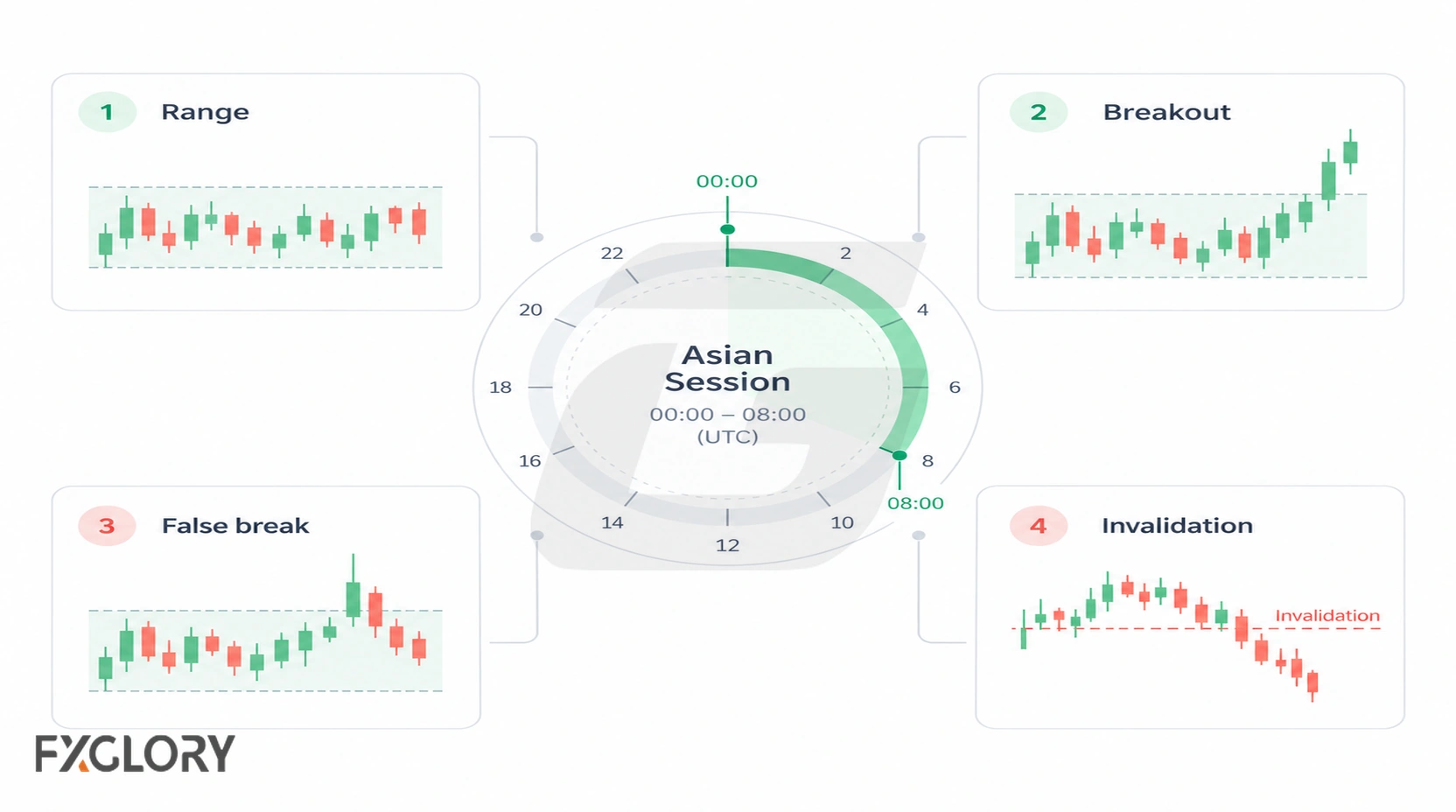
Any approach must also specify position size, risk limit and conditions for not trading. Use FXGlory’s forex risk management guide to develop those rules rather than treating session patterns as stand-alone strategies.
How to Choose Your Asian-Session Forex Watchlist
A useful Asian-session watchlist is short and repeatable. Try selecting two or three symbols for several sessions before expanding it. The aim is to understand what you are observing, not to search every chart for movement.
- Choose a realistic time window: Convert Tokyo or Sydney activity into your local and broker-platform time. Check daylight-saving changes outside Japan.
- Start with pair relevance: Pick one major such as USD/JPY or AUD/USD, then optionally compare a JPY cross.
- Read the economic calendar: Note Japanese, Australian, New Zealand and China-related releases, major global events, central-bank decisions and market holidays.
- Record observable conditions: Note live bid/ask spread, session range, directional movement, key levels and whether quotes are stable.
- Filter the setup by cost: Compare spread and potential slippage with the stop and possible target. Reject situations where costs make the plan implausible.
- Check combined exposure: Two JPY crosses or two AUD pairs may respond to the same event. Count correlated positions as overlapping risk.
- Review instead of guessing: After several sessions, compare your observed spreads, range and execution by pair and time window. Avoid declaring a winner from one good day.
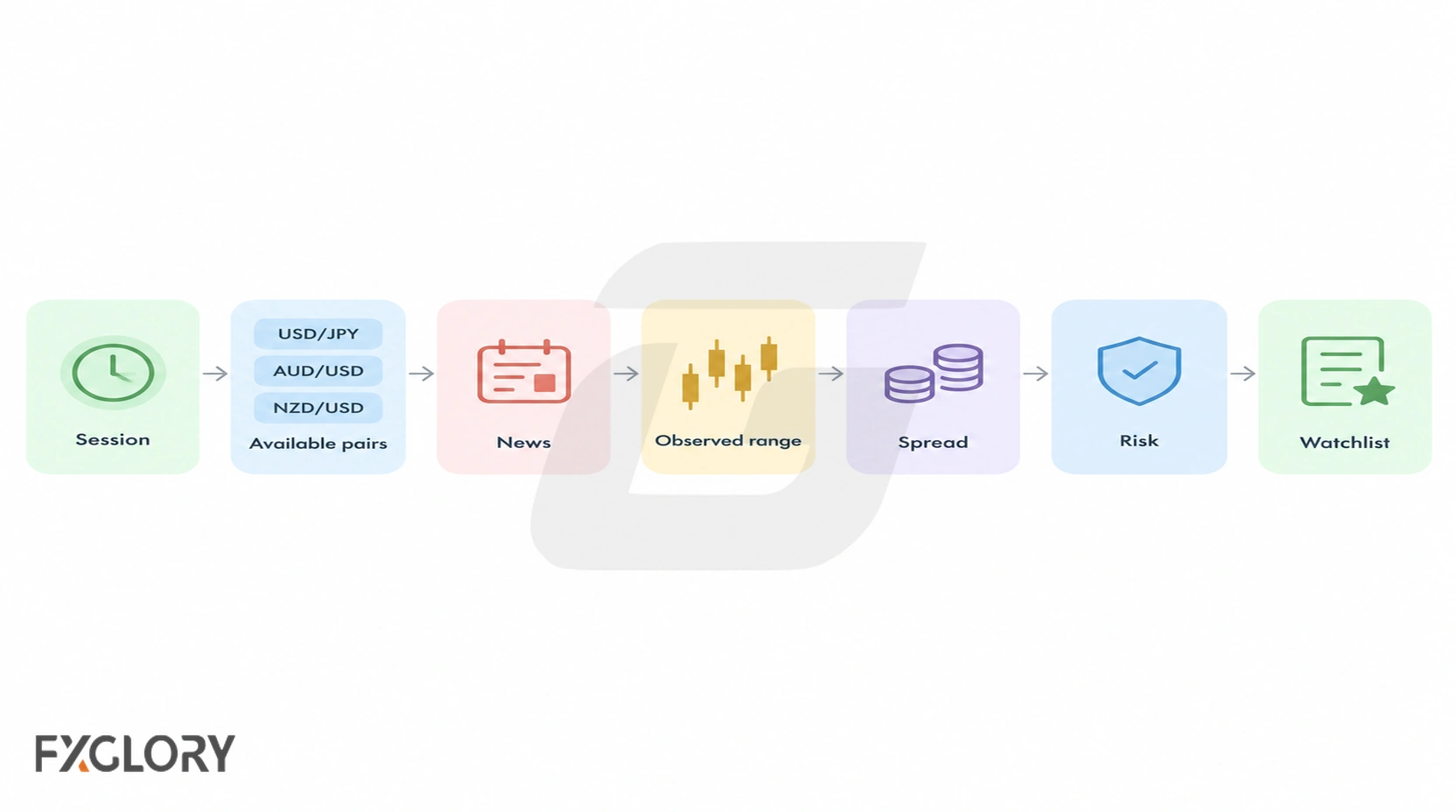
Record decisions in a forex trading journal. Useful fields include date, platform-server time, UTC window, pair, catalyst, spread at entry and exit, session range, stop distance, reason to avoid or take a setup, and whether other positions shared the same currency exposure.
Asian-Session Trading Mistakes and Demo Checklist
The most common error is assuming that the Asian session is always quiet or that a JPY/AUD/NZD symbol must produce a good trade. Neither is true. Unexpected BOJ communication, major data releases or sudden global risk events can overturn a narrow-range assumption. Conversely, a familiar pair may hardly move on a particular day.
| Mistake | More useful habit |
|---|---|
| Choosing the pair described as “most volatile” without data | Measure the pair’s own range and quote conditions during the hours you trade |
| Ignoring the spread on a small intended target | Calculate how much movement costs consume before the trade |
| Assuming Tokyo, Sydney and London hours never shift | Use UTC correctly and revisit daylight-saving changes |
| Opening multiple JPY or AUD positions as if unrelated | Check shared currency and event exposure first |
| Trading an announcement without an execution plan | Observe the release or stand aside when fills are uncertain |
| Believing one demo result proves the best pair | Record a series of sessions under consistent rules |
A simple five-session demo exercise
- Before each session: Check current news, session timing and the quotes for USD/JPY and AUD/USD, if available in your demo account.
- At a fixed observation time: Write down bid, ask and spread in pips, and mark the session high/low so far.
- During the window: Note meaningful market changes and whether a clearly defined setup appears; no trade is a valid outcome.
- At the end: Record the range, the biggest quote/spread changes you observed, and whether costs would have distorted a small target.
- After five sessions: Compare the records, identify recurring limitations, and decide whether to keep the same two pairs or replace one for further observation.
FXGlory explains that its demo platform may display fewer instruments than a live account and that order handling can differ. Practise only on available instruments, and do not assume demo execution precisely represents live market fills. Learn more about FXGlory’s demo account and available currency pairs before moving from observation to live exposure.