Forex Trader Salary: Average Pay, Independent Income & Realistic Expectations

Compare employed forex trader salary estimates with independent trader income, account-size examples, professional earnings, trading costs, and the risk warnings behind income claims.
 
Written byHenry Green
Published
Last updated
Forex Trader Salary

Key Takeaways

  • A salaried forex trader and an independent retail forex trader are not the same. A job pays salary; a personal trading account does not.
  • Public U.S. salary sources show very different employed forex trader estimates because they use different job titles, samples, locations, and data methods.
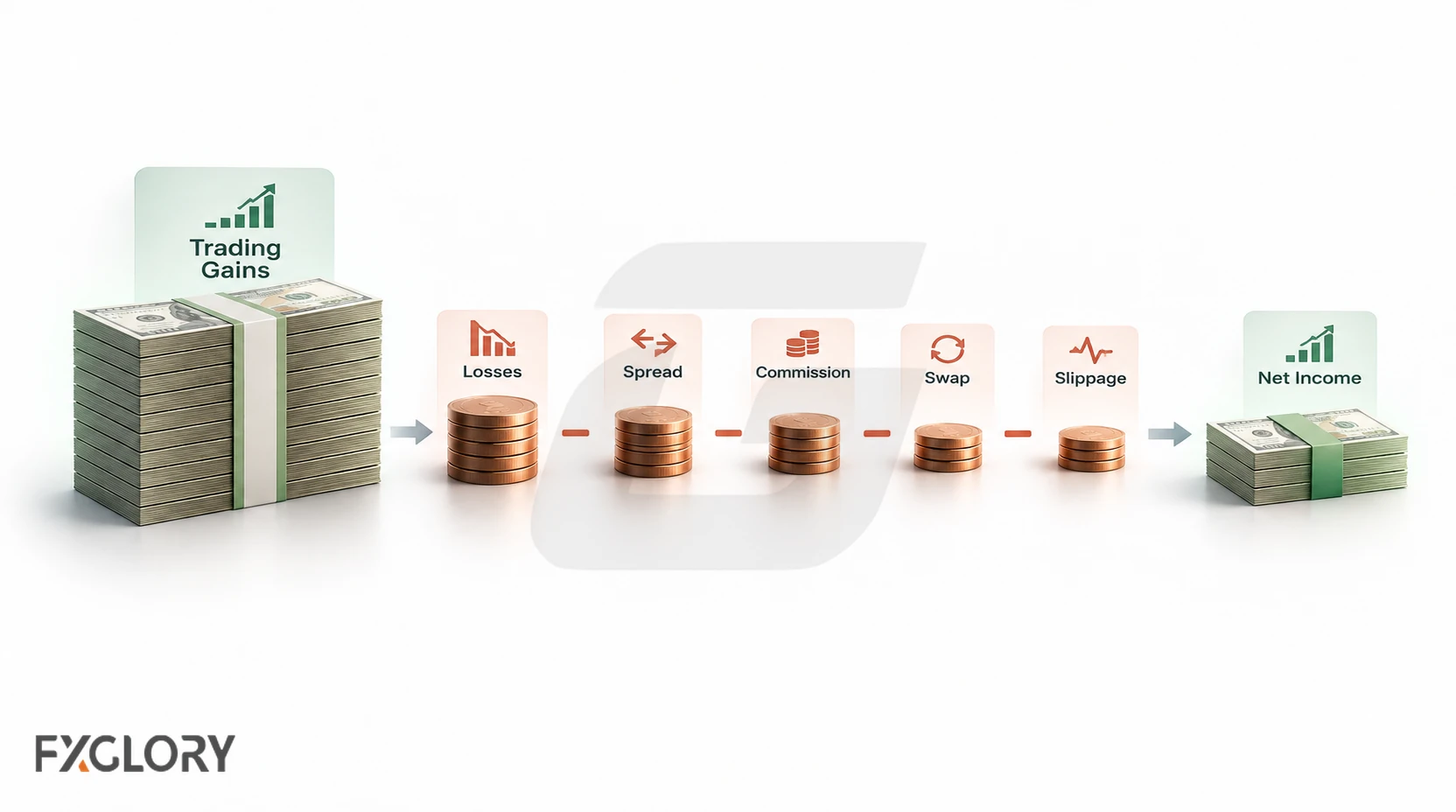
  • Independent forex trader income is not a fixed wage. It is withdrawn net profit after losses, spreads, commissions, swaps, taxes, and risk.
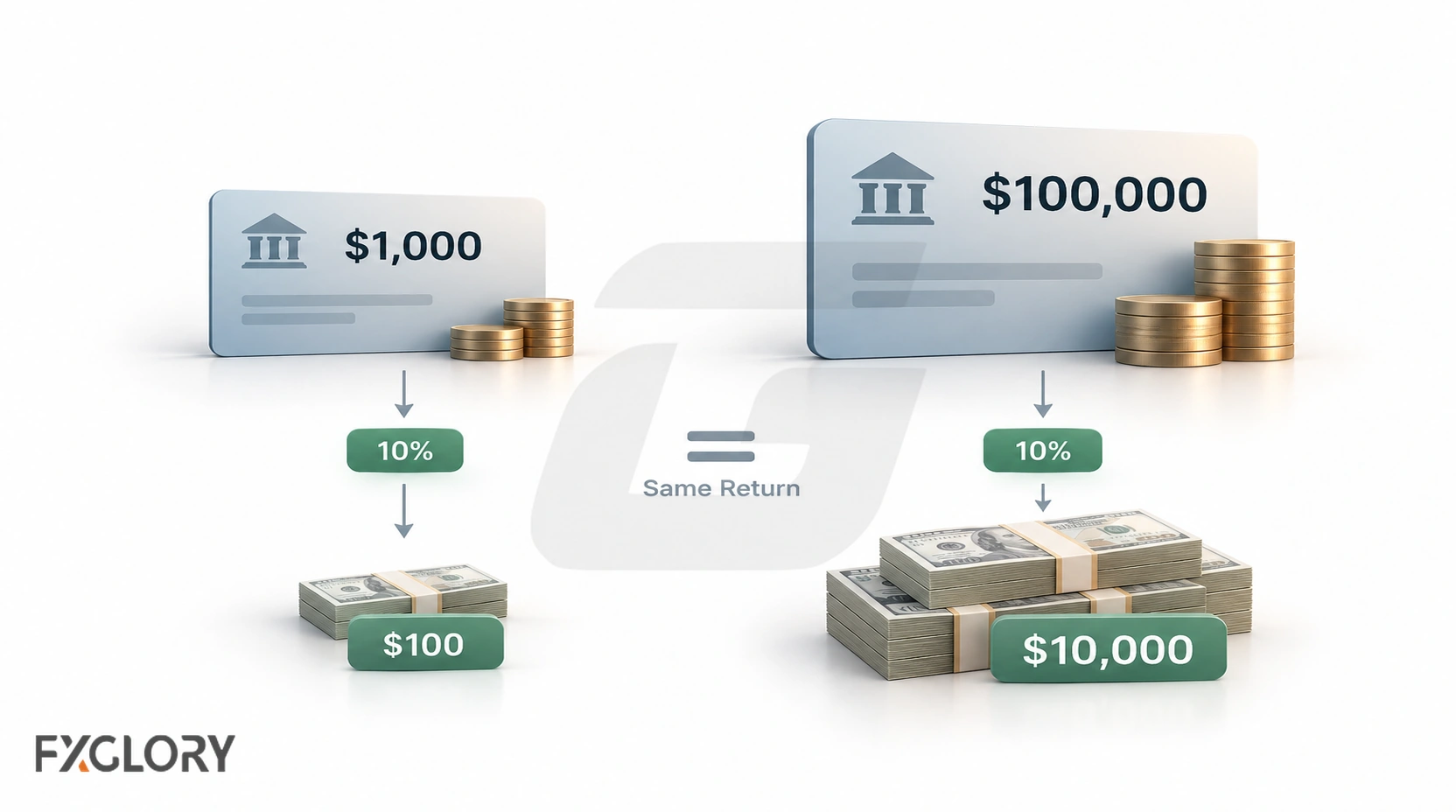
  • Account size changes income math. A 10% yearly return on $1,000 is $100 before costs and taxes, while the same return on $100,000 is $10,000 before costs and taxes.
  • Forex income is never guaranteed. Many independent traders make no consistent income or lose money, especially when leverage, poor risk control, and unrealistic salary expectations are involved.
Risk note: Forex trading involves risk of loss. Salary data for employed traders does not predict independent retail trading income. A personal trading account can lose money, and no strategy, account size, platform, or risk tool can guarantee income. This page is educational content, not personal financial advice, tax advice, or career advice.

Forex Trader Salary: Quick Answer

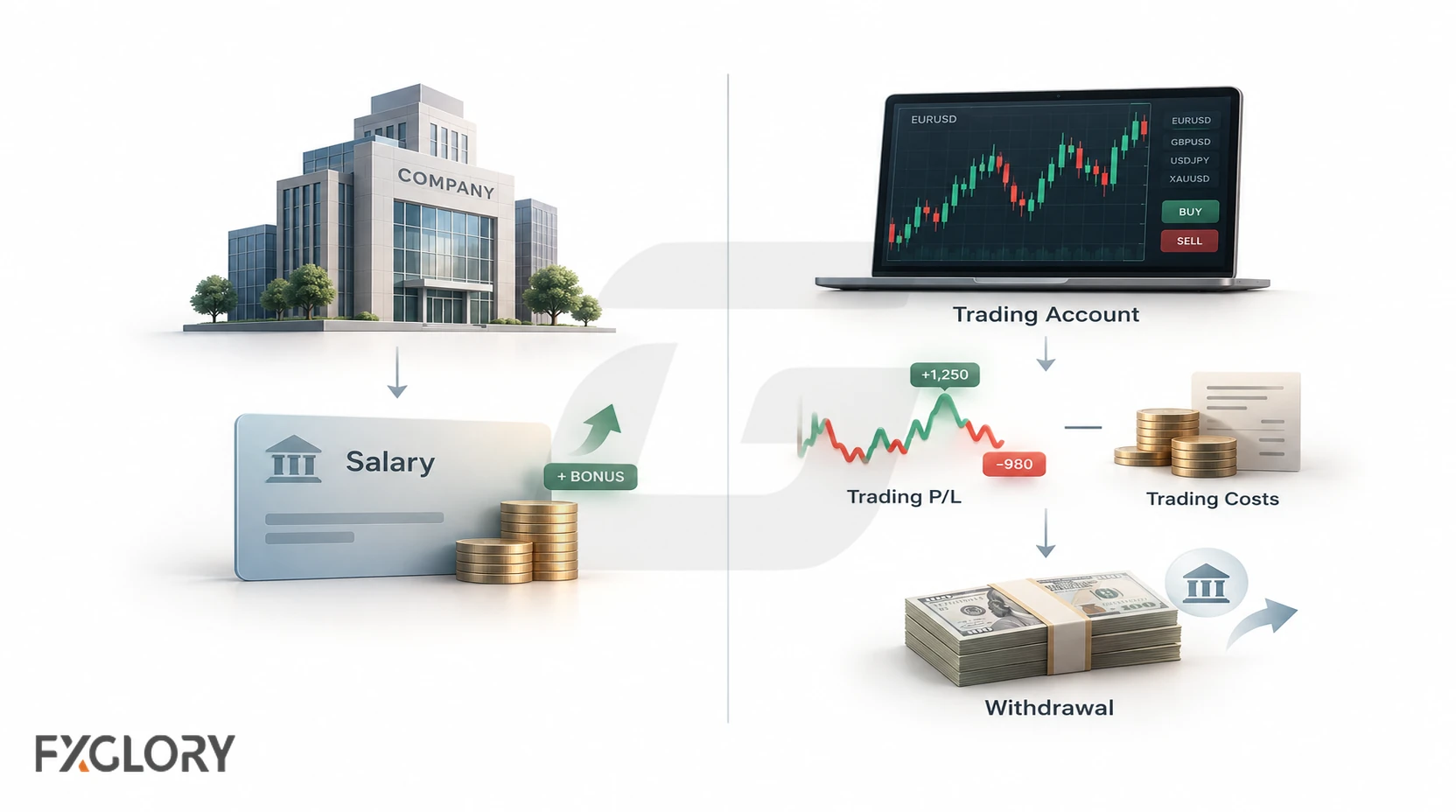
A salaried forex trader working for a bank, fund, broker, trading firm, or financial institution may earn base pay, bonuses, or commissions. Public U.S. salary estimates vary widely: some sources show employed forex trader figures around $76,000 to $181,000+ per year, depending on job title, source, location, seniority, and sample size.

An independent retail forex trader does not have a salary. Their income is any net trading profit they can withdraw after losses, spreads, commissions, swaps, taxes, and risk. Many independent traders make no consistent income or lose money.

Simple answer: A job pays salary. A personal forex trading account does not. Independent trading income depends on capital, performance, costs, drawdown, taxes, and whether the trader is profitable at all.

Before judging income claims, understand what a forex trader is responsible for and why risk control matters more than a salary headline.

Forex Trader Salary vs Forex Trading Income

The phrase “forex trader salary” can mean two very different things. This is why many answers online feel confusing.

MeaningWho It Applies ToWhat The Money Is
Employed forex trader salaryTrader at a bank, hedge fund, broker, investment firm, trading firm, or corporation.Base salary, possible bonus, commission, or performance pay.
Independent forex trader incomeRetail trader using personal funds in a trading account.Withdrawn net profit after losses, trading costs, taxes, and risk.

These should not be mixed. A salary estimate from a job site does not tell an independent trader what they will earn from a personal account.

Average Forex Trader Salary: Public Data Compared

Salary data is useful only when the source and job type are understood. The numbers below are public estimates and should not be treated as guarantees.

SourceReported FigureWhat It MeasuresImportant Caution
GlassdoorAverage U.S. forex trader salary: $121,936 per year. Typical range: $91,452 to $170,710.65 U.S. salary submissions for employees with the Forex Trader title, shown as of July 2026.Small sample and employee-focused. It does not estimate retail account income.
Indeed salary pageAverage U.S. foreign exchange trader base salary: $181,063 per year. Low: $73,211. High: $447,800.76 job-posting salaries from the past 36 months, updated June 27, 2026.Job postings can skew toward senior, institutional, or specialized roles.
ZipRecruiter Forex TraderAverage U.S. pay: $101,533 per year. Most salaries: $57,500 to $181,000.Forex Trader job-title salary estimate as of July 2026.Job-title data can vary sharply by posting and location.
ZipRecruiter Forex TradingAverage U.S. pay: $76,005 per year.Related “Forex Trading” salary label.Different wording produces a very different estimate.
Indeed forex jobs guideForeign exchange trader: $86,598 per year. Related roles include analyst, broker, risk manager, and software engineer.Career-path examples for jobs connected to the forex market.Useful for career context, not a precise retail trading-income estimate.
U.S. Bureau of Labor StatisticsMedian annual wage for securities, commodities, and financial services sales agents: $78,140 in May 2024.Broader financial-market occupation group.Not forex-specific, but useful as an official labor-market benchmark.
InstaTrade summaryMentions a 2020 DailyFX survey figure around $50,000 per year and says many traders may earn no income or lose money early on.Older secondary discussion of independent trader income.Weaker and older than job-market sources; useful mainly for the warning that income varies greatly.
Important: These numbers are not a forecast. They describe different datasets, roles, and job titles. They do not mean a beginner or independent retail trader should expect those amounts.

Why Forex Trader Salary Estimates Differ So Much

Forex salary estimates differ because the sources are often measuring different things.

  • Different job titles: Forex Trader, Foreign Exchange Trader, Forex Trading, Trader, Analyst, Broker, and Risk Manager can produce different pay ranges.
  • Different data sources: Some datasets use employee submissions, while others use job postings or broader labor categories.
  • Different seniority: A junior analyst, trader, senior portfolio manager, and risk professional are not the same role.
  • Different locations: New York, London, remote roles, regional offices, and smaller firms may pay differently.
  • Different pay structures: Salary, bonus, commission, and performance pay are often mixed together.
  • Independent trading confusion: Some pages mix job salary with personal trading profit, which creates unrealistic expectations.

The safest interpretation is simple: employed roles may have salary data, but independent trading income cannot be estimated from job sites.

Employed Forex Trader vs Independent Forex Trader

An employed forex trader and an independent forex trader face different income structures and different risks.

TopicEmployed Forex TraderIndependent Forex Trader
Income typeBase salary, possible bonus, commission, or performance pay.Withdrawn net trading profit, if any.
Capital usedUsually firm, client, or institutional capital.Personal capital.
Income stabilityMore stable if the job is retained.Unstable; can be zero or negative.
Risk to personal fundsUsually lower, depending on role and contract.Direct personal capital risk.
Main pressurePerformance targets, clients, employer rules, compliance, long hours.Losses, costs, discipline, drawdown, income pressure, emotional control.
Review processMay include employer systems, managers, limits, and reporting.Must be self-created through a plan, journal, and risk rules.

If you are considering the independent route, first review the learning path for becoming a forex trader instead of starting with income targets.

How Much Do Independent Forex Traders Make?

There is no reliable single average for independent retail forex trader income. A personal trading account can grow, stay flat, or lose money. Income depends on capital, net return, withdrawal rules, trading costs, taxes, and whether the trader survives drawdowns.

A profitable trader with a small account may still earn a small dollar amount. A trader with a larger account may need lower risk and lower percentage returns to protect capital. High percentage returns on tiny accounts do not automatically translate into stable full-time income.

Reality check: If a trader needs forex profits to pay bills every month, income pressure can encourage oversized positions, revenge trading, and loss chasing. That can turn a weak month into serious account damage.

Use a forex trading journal to record net results, withdrawals, costs, mistakes, and emotional decisions instead of judging income from memory.

Why Account Size Changes Income Potential

Account size matters because percentage returns become very different dollar amounts. The examples below are simple math only. They are not targets, promises, or suggested returns.

Account Size5% Yearly Return10% Yearly Return20% Yearly Return
$1,000$50$100$200
$10,000$500$1,000$2,000
$50,000$2,500$5,000$10,000
$100,000$5,000$10,000$20,000

These figures are before spreads, commissions, swaps, slippage, taxes, withdrawals, and losing periods. A trader can also lose money.

This table explains why “full-time income from a tiny account” usually requires extreme assumptions. Extreme assumptions usually mean extreme risk.

How Much Do Professional Forex Traders Make?

Professional forex trader earnings depend on the definition of professional. Some professionals are employees. Some manage institutional or client capital. Some trade personal funds full time. Some work in analysis, risk, brokerage, or technology rather than placing trades directly.

Professional earnings can include salary, bonus, performance compensation, or personal withdrawals. But performance compensation often depends on risk limits, mandates, drawdown tolerance, and employer rules. The goal is not always the highest percentage return possible.

  • Institutional trader: May receive salary and bonus, but must follow employer limits and reporting requirements.
  • Fund or portfolio role: Compensation may depend on assets managed, performance, seniority, and risk controls.
  • Independent full-time trader: Income depends on net profits and withdrawals from personal capital.
  • Retail trader calling themselves professional: The label does not prove stable profitability or a reliable income.

If income pressure causes emotional trades, review whether trading behavior is becoming gambling-like.

Forex Trader Salary vs Forex Career Salaries

Not every forex-related career is a trader job. Some people work around the forex market without directly trading personal funds.

RoleWhat The Role May InvolveIncome Structure
Foreign exchange traderBuying and selling currencies for a firm, institution, or corporate need.Salary, bonus, or performance pay.
Market analystResearching economic data, currency drivers, and market conditions.Salary.
Broker or client services roleHelping clients with accounts, transactions, questions, and market access.Salary, commission, or mixed pay depending on employer.
Risk managerMonitoring exposure, reports, limits, and market or operational risk.Salary and possible bonus.
Trading technology roleBuilding or supporting software, data, platforms, or tools.Salary and possible bonus.

This distinction matters because someone searching for forex trader salary may actually be asking about finance careers, not independent retail trading. Do not use career salary data as proof that a personal trading account will produce income.

Salary, Bonus, Commission And Withdrawals

Different types of forex income should not be blended together.

Pay TypeWho May Receive ItWhy It Matters
Base salaryEmployees.More predictable while employed, but not proof of trading profit.
BonusSome employees or institutional roles.May depend on performance, firm policy, and market conditions.
CommissionSome broker, sales, or trading-related roles.Can vary with activity, client base, or employer structure.
WithdrawalIndependent traders.Comes from account profit only if there is profit to withdraw.
Unrealized gainAny trader with open positions.Not income until positions are closed and funds are actually withdrawn.

A trader should separate gross profit, net profit, open profit, closed profit, and withdrawn money. They are not the same.

Net-income formula: Withdrawable trading income = closed gains - losses - spreads - commissions - swaps - slippage - taxes - fees.

First-Year Forex Trader Income

A realistic first-year expectation for an independent beginner is not a salary. It is learning, recordkeeping, risk control, and avoiding large losses.

  • Many beginners lose money: Early trades often expose weak risk control, unclear setups, and emotional mistakes.
  • Small wins do not prove income: A few profitable trades do not equal a stable annual salary.
  • Demo results are not live income: Demo practice helps build process, but live-fund emotions are different.
  • Income goals can distort behavior: Needing a fixed monthly amount can push a beginner toward oversized trades.
  • Learning costs matter: Time, tools, data, spreads, commissions, and mistakes can all reduce results.

Before expecting income, a beginner should build a written plan, understand how lot size changes account exposure, and record every trade honestly.

Can You Make A Living Trading Forex?

It may be possible for some traders, but it is not a safe assumption. Making a living from forex requires enough capital, net profitability, withdrawal discipline, low enough drawdown, emotional control, and the ability to handle losing periods without forcing trades.

The math is often less exciting than the marketing. A trader trying to withdraw $3,000 per month needs $36,000 per year after costs and taxes. On a $10,000 account, that would require unrealistic and dangerous assumptions for most traders. On a larger account, the same dollar goal may require lower percentage returns, but the capital at risk is larger.

Income-pressure warning: If a trader needs the next trade to pay rent, debt, bills, or family expenses, live trading may be unsuitable. Do not trade money you cannot afford to lose.

What Affects Forex Trader Income?

Forex trader income depends on more than being right or wrong about price direction.

FactorHow It Affects Income
CapitalDetermines how much a percentage return is worth in dollars.
ReturnPositive returns can create profit, but returns are never guaranteed.
DrawdownLosing periods reduce capital and can reduce future income potential.
Risk per tradeHigh risk can increase short-term swings and account-damage risk.
LeverageCan magnify gains and losses, increasing margin pressure.
Trading styleScalping, day trading, swing trading, and longer-term approaches have different time, cost, and risk profiles.
CostsSpreads, commissions, swaps, slippage, and fees reduce net results.
TaxesTax treatment can reduce net withdrawable income and varies by jurisdiction.
DisciplineRule-breaking, revenge trading, and overtrading can damage results.
Job factorsFor employees, location, seniority, employer, bonus structure, and performance targets matter.

Trading style matters too. Review the main types of forex traders before assuming every trader has the same time commitment or income profile.

Costs That Reduce Forex Trading Income

Income discussions often focus on gross profit and ignore costs. Net income is what remains after costs and losses.

  • Spread: The difference between bid and ask prices can matter heavily for short-term trading.
  • Commission: Some account types or instruments may include trade commissions.
  • Swap or rollover: Overnight positions may include financing adjustments.
  • Slippage: Fast markets or low liquidity can cause execution away from the expected price.
  • Leverage costs and margin pressure: Larger exposure can magnify both gains and losses.
  • Taxes: Tax obligations vary by jurisdiction and should be handled with qualified guidance.
  • Platform, data, or tool costs: Paid tools can reduce net results if they do not improve the process.

Before calculating possible income, review FXGlory spread conditions, FXGlory leverage conditions, and the FXGlory margin calculator.

Risk Warning: Salary Claims vs Real Trading Risk

Salary claims can make forex sound more stable than it is. Employed salary data is not the same as retail trading income. Independent trading can produce losses, and leverage can cause losses to grow quickly.

Regulators have warned that retail off-exchange forex can be extremely risky and that losses can accrue rapidly. They also warn against high-return, low-risk claims, pressure tactics, and promises that sound too good to be true.

  • No guaranteed income: No forex strategy can promise salary-like income.
  • No guaranteed monthly withdrawals: A losing month can erase previous gains.
  • No risk-free leverage: Leverage can magnify losses as well as gains.
  • No shortcut from salary data: Job salaries do not prove independent trading profitability.
  • No safety from labels: Calling yourself professional does not make income stable.

For emotional and behavior risk, review the psychology patterns behind overconfidence, fear, revenge trading, and income pressure.

How To Think About Forex Income Responsibly

A responsible income estimate starts with risk, not desired salary. Work backward from capital, maximum loss, realistic costs, and whether the trading process has been reviewed over enough trades.

  1. Separate job salary from account profit: Do not compare employee pay with personal trading results.
  2. Use conservative examples: Account-size math should be used to understand limits, not to promise returns.
  3. Track net results: Record costs, losses, withdrawals, mistakes, and taxes separately.
  4. Avoid fixed-income pressure: Do not force trades to meet a monthly bill target.
  5. Review risk first: A high return with extreme drawdown may be unsuitable.
  6. Use a journal: Record whether income pressure changed position size or discipline.
  7. Stay skeptical: Treat “six figures quickly,” “low risk,” and “double your money” claims as warning signs.

For a broader process, pair this page with responsible trading habits and review routines.

Sources Used

The sources below were used to compare employed salary data, independent income explanations, career-role context, broader labor-market benchmarks, retail forex risk warnings, and user questions about professional returns.

Frequently Asked Questions

What is a forex trader salary?

A forex trader salary usually means the pay received by someone employed by a bank, hedge fund, broker, investment firm, or financial institution. An independent retail forex trader does not receive a salary from the market. Their income is any net trading profit they can withdraw after losses, costs, taxes, and risk.

How much does a forex trader make a year?

For employed U.S. forex traders, public salary estimates vary widely. Glassdoor lists an average around $121,936 per year, Indeed lists foreign exchange trader average base salary around $181,063, and ZipRecruiter lists Forex Trader average pay around $101,533. These figures describe jobs, not guaranteed retail trading income.

What is the average forex trader salary?

There is no single average forex trader salary. Different sources use different job titles, samples, locations, and data methods. The more honest answer is that employed salary estimates vary widely, while independent traders do not have a fixed salary at all.

How much does the average forex trader make?

The average employed forex trader may earn a salary, bonus, or commission depending on the role. The average independent retail trader cannot be summarized with one number because income depends on account size, return, costs, drawdown, tax situation, and whether the trader is profitable at all.

How much do forex traders make a month?

Employed forex traders may receive a regular paycheck. Independent forex traders do not have reliable monthly income unless they have consistent net profits and choose to withdraw them. A profitable month can be followed by a losing month.

How much do professional forex traders make?

Professional forex trader earnings depend on whether the trader is employed, managing firm capital, receiving bonuses, trading personal funds, or working under a risk mandate. Higher capital does not automatically mean higher percentage returns because larger accounts often use stricter risk limits.

Do independent forex traders have a salary?

No. Independent forex traders do not have a salary from the market. They use their own capital and may withdraw profits if they are profitable. They may also make no income or lose money.

Can a forex trader make a living?

A small number of traders may make a living from forex, but it requires sufficient capital, consistent net profitability, strict risk control, realistic withdrawal rules, and the ability to survive drawdowns. It is not realistic to assume that a small account will quickly replace a full-time income.

Can beginner forex traders make money?

A beginner can have winning trades, but that does not mean they have stable income. Many beginners lose money while learning. Beginners should focus on education, risk control, demo practice, journaling, and avoiding unrealistic income targets.

How much can a forex trader make with $1,000?

A 10% yearly return on $1,000 is $100 before costs and taxes. A trader can also lose part or all of the account. A $1,000 account is not a realistic base for replacing a salary unless someone takes extreme risk, which can lead to rapid losses.

How much can a forex trader make with $10,000?

A 10% yearly return on $10,000 is $1,000 before costs and taxes. Higher returns require higher risk or unusually strong performance and are not guaranteed. Losing money is also possible.

Why do salary websites show different forex trader salaries?

Salary websites use different data sources, job titles, samples, locations, and update dates. One site may measure employees called Forex Trader, another may measure Foreign Exchange Trader job postings, and another may measure broader forex-related roles.

Does forex trader salary vary by country or location?

Yes. Forex trader salary can vary heavily by country, city, employer type, regulation, seniority, bonus structure, and whether the role is institutional, brokerage-related, analytical, or independent retail trading. Public salary estimates are usually country-specific and should not be treated as global averages.

Is forex trader salary the same as trading profit?

No. Salary is employment income. Trading profit is the result of market gains and losses after costs. A salaried trader may receive base pay even when performance is weak, while an independent trader has no salary if their account is not profitable.

Do forex traders earn bonuses?

Some employed traders may receive bonuses, commissions, or performance compensation depending on their employer and role. Independent traders do not receive bonuses from the market; they only have trading results and withdrawals.

What affects forex trader income?

Forex trader income can be affected by capital, return, drawdown, risk per trade, leverage, spread, commission, swaps, taxes, trading style, discipline, market conditions, job location, seniority, and bonus structure.

Can forex trading provide regular monthly income?

Forex trading should not be treated as guaranteed monthly income. Even experienced traders can have flat or losing months. Independent withdrawals should be based on net results, capital needs, and risk limits, not on a fixed income fantasy.

What costs reduce forex trading income?

Trading income can be reduced by spreads, commissions, swaps or rollover, slippage, platform costs, data costs, taxes, payment fees, and losses from poor execution or oversized positions.

Is forex trader salary guaranteed?

An employment salary may be contractually paid by an employer, but bonuses can vary and jobs can be lost. Independent forex trading income is never guaranteed. Any promise of certain forex income should be treated as a warning sign.

Is forex trading a realistic full-time career?

Forex can be part of a financial career path for people working in banks, funds, brokerages, analysis, risk, technology, or client services. Full-time independent retail trading is much less predictable and requires enough capital, risk control, and emotional discipline.

What is the difference between a retail forex trader and a professional forex trader?

A retail forex trader usually trades personal funds through a retail account. A professional forex trader may work for an institution, trade larger capital, follow stricter rules, use more advanced systems, or receive salary and bonus compensation.

Related Contents

Forex TraderUnderstand what a forex trader actually does before judging salary or income claims.
How to Become a Forex TraderBuild the learning path before risking live funds or setting income expectations.
How to Be Successful in Forex TradingReview the habits, preparation, discipline, and risk controls behind more responsible trading.
Types of Forex TradersCompare how scalping, day trading, swing trading, and longer-term styles affect time, risk, and expectations.
Forex Trading PsychologyUnderstand the emotional pressure that can appear when a trader treats profits as required income.
Forex Trading JournalRecord results, withdrawals, mistakes, risk, and trading behavior instead of relying on memory.
Is Forex Gambling?Check whether income pressure is turning trading into loss-chasing or gambling-like behavior.
Forex Risk Management StrategySet risk limits before thinking about withdrawals or income targets.
What Is a Lot Size in Forex?Understand how position size changes account exposure and profit-or-loss impact.
FXGlory Margin CalculatorEstimate margin pressure before using leverage and judging income potential.

Review Trading Conditions Before Setting Income Expectations

Create an FXGlory account to review platform access, account features, spread conditions, leverage conditions, and margin requirements before deciding whether live forex trading fits your plan, capital, and risk limits.

Create an FXGlory Account