

What Is A Forex Trading Journal?
A forex trading journal is a structured record of each trade and the decision process around it. Useful fields can include the currency pair, session, timeframe, setup, entry reason, invalidation, entry and exit prices, stop distance, position size, spread, planned risk, result, screenshot, emotional state, rule-following, mistake tags, and review notes.
The purpose is to preserve enough information to review decisions after the outcome is known. Over time, the records can be grouped by setup, pair, session, rule-following, costs, or behavior to look for repeated patterns in the trader's own data.
A journal can be kept in a spreadsheet, notebook, database workspace, or dedicated journal app. Choose a format that keeps the required fields consistent and makes regular review practical.
If you are still learning the role of a trader, the forex trader guide explains the broader responsibilities around preparation, execution, and review. Forex trading psychology covers emotional patterns that can be tagged in the journal.
Why Forex Traders Keep Journals
A written journal preserves details that can be forgotten or reconstructed differently once the outcome is known. Recording the plan, risk, execution, and result creates an audit trail that can be reviewed later.
The review can then distinguish a planned loss from a rule break, or a profitable trade from a decision that violated the plan. It can also show whether particular setups, pairs, sessions, costs, or emotional states repeatedly appear alongside stronger or weaker process quality.
- Decision review: Preserves the reason for the trade before the result can influence the explanation.
- Risk review: Shows whether invalidation, stop distance, position size, and the chosen risk limit were defined consistently.
- Behavior review: Allows repeated FOMO, revenge trading, hesitation, overconfidence, or boredom tags to be compared with actual decisions.
- Strategy review: Shows which setups, pairs, sessions, and conditions were actually traded.
- Improvement review: Turns recurring process issues into specific questions or rule changes to test.
A journal is useful when the record is complete enough to compare the original plan with what actually happened.
Trade Log vs Trading Journal
A trade log and a trading journal are related, but they are not the same. A trade log records trade facts. A trading journal records the decision process and review.
| Item | Trade Log | Trading Journal |
|---|---|---|
| Main purpose | Record what happened. | Explain why it happened and what should be reviewed. |
| Typical fields | Date, pair, direction, entry, exit, size, result. | Setup, reason, risk, emotion, screenshot, rule-following, mistake tag, lesson. |
| Usefulness | Good for basic recordkeeping. | Adds context for identifying repeated behavior and process mistakes. |
| Main weakness | May focus only on profit and loss. | Requires honesty and regular review. |
A trade log can tell a trader that EUR/USD lost money on Tuesday. A journal can show whether the trade was taken during a planned session, whether the stop was moved, whether the spread was acceptable, and whether the entry was caused by FOMO.
What To Record Before Opening A Trade
The most useful pre-trade notes are written before the result is known. They preserve the original reasoning, invalidation, and risk assumptions for later comparison.
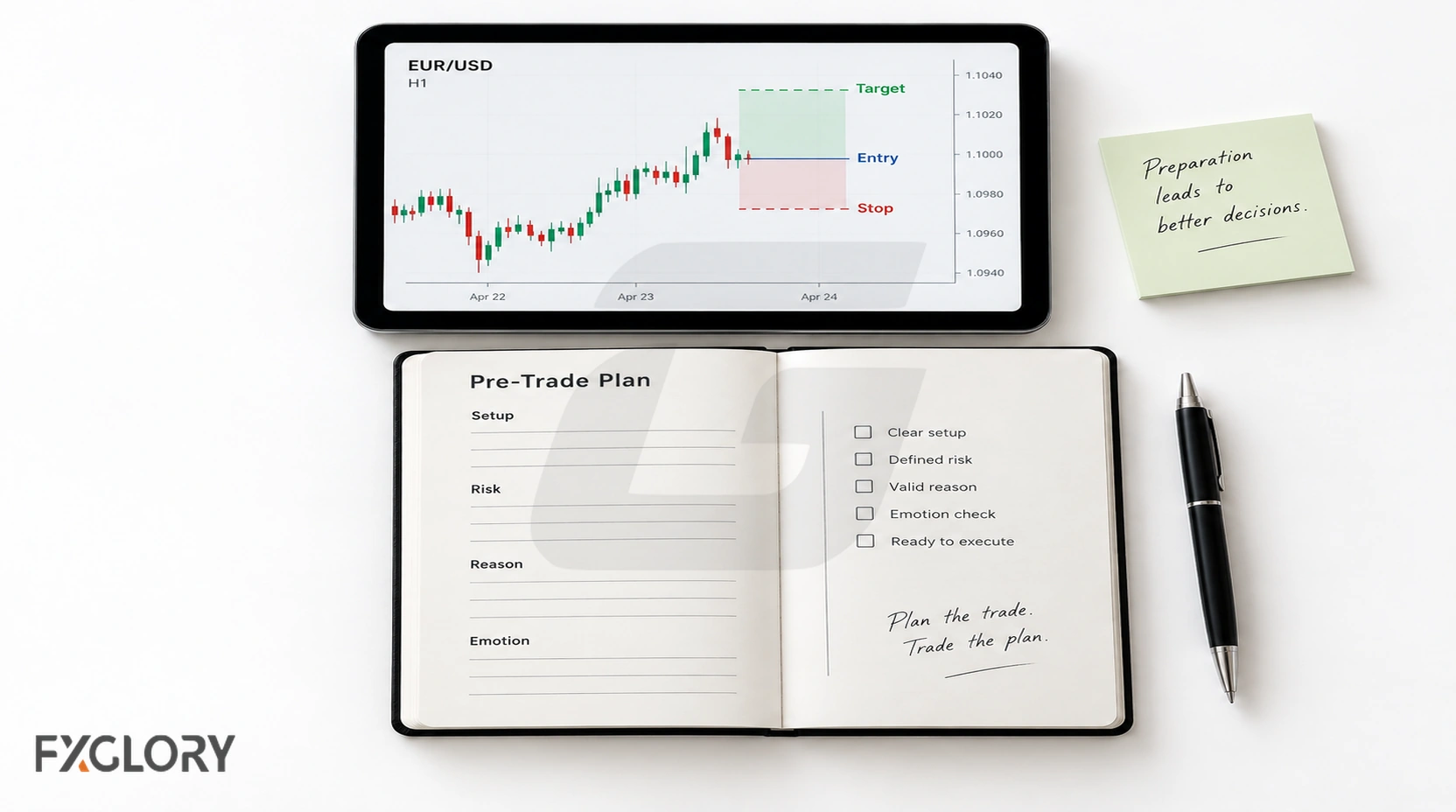
Before opening a forex trade, record enough context to reconstruct the decision later. Define where the idea becomes invalid before calculating stop distance, position size, and margin.
| Before-Trade Field | What To Record | Why It Matters |
|---|---|---|
| Currency pair | Example: EUR/USD, GBP/USD, USD/JPY. | Allows results and process quality to be grouped by pair. |
| Session | London, New York, Asian session, overlap, or another defined time window. | Allows comparison by time of day and trading conditions. |
| Timeframe | Chart timeframe used for context, setup, and entry. | Keeps different analysis horizons distinguishable during review. |
| Setup name | Trend pullback, breakout, range rejection, news reaction, or another defined setup. | Lets comparable trades be grouped under the same rule set. |
| Entry reason | The specific condition that justified entry before the result was known. | Preserves the original reasoning for later review. |
| Invalidation | The price or condition that would make the trade idea no longer valid. | Provides the reference point for stop placement or another exit rule. |
| Planned risk | Chosen account risk limit, invalidation level, resulting stop distance, and position size. | Checks that position size was calculated from the risk limit and stop distance rather than chosen independently. |
| Cost check | Current spread, possible slippage conditions, and swap or rollover if the position may remain open overnight. | Keeps transaction and financing costs visible when reviewing the result. |
| Margin check | Estimated margin after position size has been calculated, plus remaining free margin where relevant. | Separates margin requirements from position sizing and the amount chosen to be risked. |
| Emotion before entry | A short tag such as calm, rushed, fearful, excited, revenge-driven, bored, or uncertain. | Creates a consistent label that can be compared with later rule-following. |
For risk notes, compare each trade with the written trading plan so the journal records whether the decision followed rules defined before the setup appeared.
What To Record After Closing A Trade
After the trade closes, record both the outcome and how the trade was executed. A profitable result can come from a rule break, while a planned trade can lose money without showing that the process was wrong.

| After-Trade Field | What To Record | Review Question |
|---|---|---|
| Exit reason | Stop hit, target hit, manual exit, time exit, news exit, or rule break. | Was the exit planned or emotional? |
| Result in pips | Price movement measured in pips when relevant. | How much did the pair move? |
| Result in account currency | Actual gain or loss after position size and applicable trading costs. | How did the movement affect the account? |
| R-multiple | Trade result divided by the amount initially planned to be risked. | What result did the trade produce relative to the initial risk? |
| Rule-following score | A consistent yes/no scale or predefined score. | Did the trade follow the plan? |
| Execution quality | On-plan, late, early, chased, slipped, resized, moved stop, or another defined execution tag. | Did execution follow the written entry and exit rules? |
| Emotion after exit | Relief, anger, greed, regret, calm, confidence, fear, or tilt. | Could the next trade be affected by this result? |
| Screenshot | Entry chart, exit chart, or marked-up review image. | Does the chart support the written reason? |
| Lesson | One specific review conclusion or question to test. | What should be repeated, changed, or investigated? |
Recording outcome and process separately makes it easier to review whether results came from planned decisions or from deviations that happened to work.
Forex Trading Journal Template Fields
A forex trading journal template should capture the information needed for review without creating fields that are never used.
The table below can be used as the base for a spreadsheet, database workspace, notebook layout, or app checklist.
For a ready-made version, the FXGlory forex trading journal template includes an Excel workbook, CSV starter, and PDF guide.
| Template Section | Fields To Include | Keep It Simple By Asking |
|---|---|---|
| Basic details | Date, pair, direction, session, timeframe, account type, trade number. | What market and time did I trade? |
| Trade plan | Setup, entry reason, invalidation, planned stop, planned target, planned holding time. | Why did this trade exist before entry? |
| Risk | Invalidation, stop distance, chosen risk limit, position size, estimated margin, and free margin. | Did sizing follow the stop distance and risk limit? |
| Cost | Spread, observed slippage after execution, and swap or rollover when applicable. | How did costs affect the net result? |
| Execution | Entry price, exit price, entry quality, exit reason, order type. | Did I follow the planned execution? |
| Result | Pips when relevant, account-currency result, R-multiple, and outcome category. | What happened relative to the plan and initial risk? |
| Psychology | Emotion before entry, emotion after exit, FOMO, revenge, fear, overconfidence, tilt. | What emotion affected the decision? |
| Review | Screenshot, rule-following score, mistake tag, lesson, next action. | What should I repeat or stop? |
Copyable Forex Trading Journal Spreadsheet Header
The header row below can be copied into Excel, Google Sheets, or another spreadsheet. Start with consistent raw fields first, then add formulas or dashboards only for metrics you actually review.
Date,Trade Number,Account Type,Pair,Direction,Session,Timeframe,Setup,Entry Reason,Invalidation,Entry Price,Stop Price,Target or Exit Plan,Stop Distance,Position Size,Planned Risk %,Planned Risk Amount,Estimated Margin,Spread,Slippage Note,Swap/Rollover Check,News Event,Order Type,Exit Price,Exit Reason,Result Pips,Result Account Currency,R-Multiple,Emotion Before,Emotion After,Mistake Tag,Rule-Following Score,Screenshot Link,Lesson,Next ActionSample Forex Trading Journal Row
The example below shows how one journal entry can be structured without using historical market data or implying a trading result.
| Field | Example Entry |
|---|---|
| Date | Record the actual trade date. |
| Pair | EUR/USD |
| Direction | Buy or sell. |
| Session | Record the session or time window used. |
| Timeframe | Record the context and entry timeframes. |
| Setup | Name the setup exactly as it appears in the trading plan. |
| Entry reason | Write the condition that justified entry before the result was known. |
| Invalidation | Record the price or condition that would make the idea invalid. |
| Entry price | Record the actual fill price. |
| Stop price | Record the stop or other invalidation-based exit level. |
| Target price | Record the planned target or exit condition. |
| Planned risk | Record the chosen risk limit and the position size calculated from stop distance. |
| Spread note | Record the spread observed around entry. |
| News note | Record relevant scheduled event risk or state that none was identified in the plan. |
| Exit reason | Record whether the exit followed the stop, target, time, news, or another written rule. |
| Result | Record the net account-currency result and R-multiple after applicable costs. |
| Emotion before entry | Use a short predefined tag. |
| Emotion after exit | Use a short predefined tag. |
| Mistake tag | Use a predefined tag or record none. |
| Rule-following score | Apply the same scoring method used across the journal. |
| Lesson | Write one specific conclusion or question for the next review. |
Spreadsheet, App, Database, PDF Or Notebook: Which Format Works?
Forex journals can be kept in several formats. Choose based on the fields you need, how trades will be entered, and how you plan to review the data.
| Journal Format | Useful For | Weakness To Watch |
|---|---|---|
| Spreadsheet | Custom columns, formulas, filters, charts, and summaries. | Complex formulas or inconsistent data entry can make analysis harder. |
| Notebook | Simple reflection, emotional notes, pre-trade reasoning. | Harder to calculate metrics and compare pairs or sessions. |
| Database workspace | Organized pages, tags, screenshots, and flexible review databases. | Can become more complex than the review process requires. |
| PDF or printable journal | Manual discipline, checklist-style review, offline use. | Harder to filter, calculate, and update over time. |
| Journal app or platform | Imports, tagging, screenshots, analytics, dashboards, and reports. | Requires checking data access, permissions, cost, and export options. |
Start with the smallest structure that answers your review questions. Add automation or analytics when they solve a specific problem rather than simply adding more data.
App, Import And Broker-Sync Safety
Some journal apps offer broker sync, MetaTrader imports, CSV uploads, screenshots, dashboards, or automated reports. Those features can reduce manual entry, but the connection method and data permissions should be reviewed before use.
- Check permissions: Identify whether the service can only read trade data or can perform other account actions.
- Check authentication: Prefer official authorization or read-only methods where available and understand whether passwords, tokens, or local software are involved.
- Check storage: Review how trade history, account details, screenshots, and notes are stored and retained.
- Check removal: Confirm how to disconnect the service, revoke permissions, and export or delete journal data when applicable.
- Check uploads: Before uploading CSV or report files, remove data that is not needed for the journal.
Automation should reduce journaling work without giving a service more access or data than the review process requires.
Forex-Specific Fields Many Journals Miss
A generic trading journal may track only symbol, entry, exit, and result. Forex review often benefits from additional fields for pairs, sessions, spreads, position size, leverage, margin, and overnight financing.
- Currency pair: The pair matters because volatility, spread, and session behavior can differ.
- Session: London, New York, Asian session, and overlaps can affect movement and liquidity.
- Spread: Record the spread around entry and exit when transaction cost matters to the review.
- Slippage: Compare the intended order price with the actual fill when execution differs.
- Position size: Record the actual size because the same price movement can have a different account impact at different exposures.
- Leverage and margin: Track the margin required for the chosen position, but do not treat margin as the amount at risk.
- Swap or rollover: Record overnight financing adjustments when they apply to the holding period.
- News events: Record whether a trade was placed before, during, or after scheduled high-impact news.
For position-size context, lot size in forex explains exposure, while how to calculate pips helps separate price movement from account profit or loss. FXGlory spread conditions can be used when recording transaction-cost context.
After position size has been calculated from the invalidation distance and chosen risk limit, compare the resulting exposure with FXGlory leverage conditions. The FXGlory margin calculator estimates margin requirements; it is not a position-sizing calculator.
How To Review Your Forex Journal Weekly
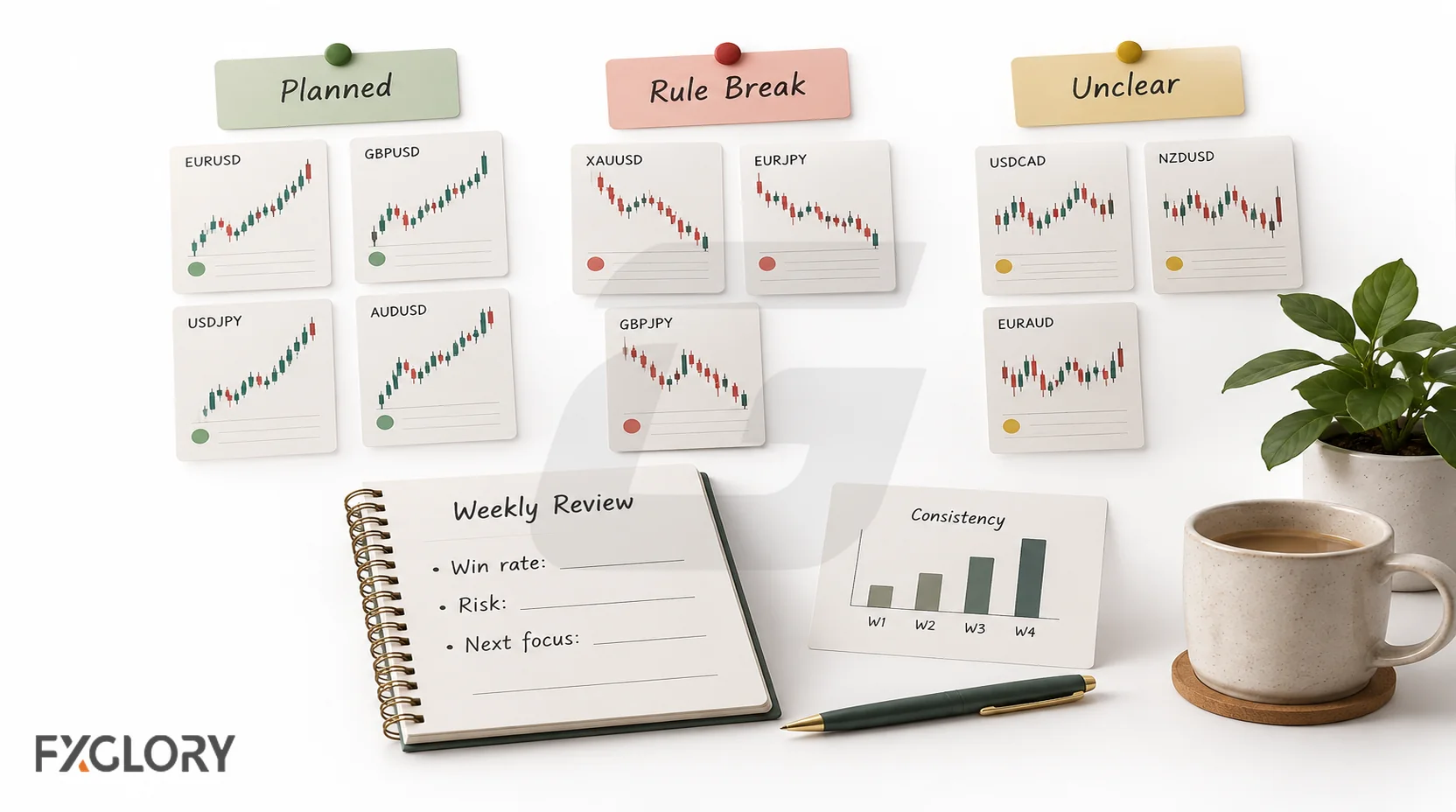
A weekly review can focus on repeated process issues rather than the outcome of one isolated trade.
| Weekly Review Question | What It Reveals | Possible Action |
|---|---|---|
| How many trades followed the plan? | Rule-following consistency. | Identify what prevented plan adherence before changing size or trade frequency. |
| Which mistake appeared most often? | Repeated process issue. | Check whether a clearer checklist, rule, or preparation step should be tested. |
| Which pair had the most rule breaks? | Whether rule breaks cluster around a particular pair. | Investigate whether the issue is the pair, the setup selection, or the trader's process before changing the watchlist. |
| Where was decision quality strongest or weakest? | How decision quality varies by time window. | Compare sessions only after enough comparable trades have been recorded. |
| Were losses within planned risk? | Risk discipline. | Check invalidation, stop distance, position-size calculations, and any deviations from the planned limit. |
| Did emotion affect the next trade? | Whether an emotional state was followed by a rule break. | Apply a pre-written cooldown rule if one exists, or flag the sequence for further review. |
A practical weekly sort is planned trades, rule-broken trades, and unclear trades. Review the reasons for each category before increasing size, frequency, or strategy complexity.
How To Review Your Forex Journal Monthly
A monthly review can look for broader patterns across several weeks. Avoid changing a strategy because of one emotional day or a very small sample; look for repeated evidence in comparable trades.
- Review pair selection: Which pairs were associated with stronger or weaker rule-following and execution?
- Review trading style: Did your actual trades match scalping, day trading, swing trading, or another style?
- Review risk consistency: Were risk and lot size stable, or did they change after wins and losses?
- Review setup quality: Which setups were planned and which were forced?
- Review costs: Did spread, slippage, commission, or overnight financing materially affect the net result?
- Review emotional patterns: Did FOMO, revenge trading, fear, greed, boredom, or overconfidence appear repeatedly?
- Review plan changes: Is a rule change supported by repeated journal evidence, or is the issue inconsistent execution of the existing plan?
If the journal shows that a trading style does not fit your schedule, review whether your journal matches your trading style before changing strategies again.
Journal Metrics That Matter
Journal metrics should be interpreted together with the rules and risk used to produce them. Profit and loss alone does not show whether the process was consistent.
| Metric | What It Shows | Common Misread |
|---|---|---|
| Win rate | Percentage of winning trades. | A high win rate can still lose money if losses are much larger than wins. |
| Average win and average loss | Size relationship between gains and losses. | Ignoring loss size can hide poor risk control. |
| R-multiple | Result compared with planned risk. | Useful only if planned risk was honest before entry. |
| Maximum drawdown | Largest peak-to-trough decline in the chosen equity, balance, or R-based series over the review period. | Always record the unit; do not convert R drawdown into account-percentage drawdown without an explicit sizing model. |
| Rule-following rate | How often trades followed the plan. | A high score is meaningful only if the underlying rules are clear and applied consistently. |
| Mistake frequency | How often the same mistake repeats. | Requires honest tags, not vague notes. |
| Session breakdown | How results and process quality differ across recorded trading windows. | Differences may reflect setup mix, schedule, costs, volatility, or a small sample. |
| Pair breakdown | How results and process quality differ across currency pairs. | Do not label a pair suitable or unsuitable from a few trades. |
Use metrics to generate review questions, not to justify a conclusion from one number or a small subset of trades.
Psychology And Rule-Following Tags
Psychology tags make a forex journal more useful because they show which emotional patterns repeat. The tag should be short and specific.
| Tag | When To Use It | Review Control |
|---|---|---|
| FOMO | Entered late because price already moved. | Add missed-trade notes instead of chasing entries. |
| Revenge trade | Entered to recover a previous loss. | Use a cooldown after losses or rule breaks. |
| Overconfidence | Increased size after wins without a plan change. | Keep size fixed until a scheduled review. |
| Fear | Exited early or skipped a trade that met the written rules because of fear. | Compare the decision with the pre-trade invalidation and exit rules. |
| Hesitation | Delayed entry or exit because of uncertainty. | Check whether the setup rules are too vague. |
| Boredom | Entered because no planned setup appeared. | Add a no-trade rule for unclear conditions. |
| Tilt | Traded while frustrated after a loss or mistake. | Use any pre-written cooldown or daily stop rule and record whether it was followed. |
For deeper emotion-control work, use the psychology guide to identify FOMO, revenge trading, fear, greed, and tilt.
Common Forex Journal Mistakes
A journal loses value when records are incomplete, edited after the outcome, or interpreted more strongly than the data supports.
- Recording only profit and loss: Result without decision quality hides the real problem.
- Editing the reason after the result: This makes the journal dishonest.
- Skipping losing trades: Omitting losses biases the record and makes comparisons unreliable.
- Adding too many columns too early: A complicated journal may stop being used.
- Ignoring spread and costs: A setup may look better than it was after execution costs.
- Using vague emotion notes: Labels are more useful when tied to an observable decision such as chasing, moving a stop, or skipping a rule-compliant trade.
- Changing strategy after a tiny sample: A few trades are not enough to prove or disprove a method.
- Using the journal as self-criticism: The goal is review, not punishment.
- Treating the journal as proof of an edge: Recordkeeping can reveal patterns, but the journal itself does not establish that a strategy will remain profitable.
- Connecting tools without checking permissions: Review authentication, data access, storage, and revocation before enabling imports or broker sync.
Beginner Forex Trading Journal Checklist
A beginner can start with a simple checklist instead of a complex dashboard. The journal should be easy enough to complete every time.
- Write the trade idea before entry: Do not wait until after the result.
- Record the currency pair, session, and timeframe: These fields help compare conditions later.
- Record invalidation, stop distance, and position size: Define invalidation first, calculate the stop distance, then calculate position size from the chosen account-risk limit.
- Record spread and execution costs: Note the observed spread and any slippage or financing that affected the trade.
- Save a screenshot: Keep the chart context visible.
- Tag the emotion: Use simple words like calm, rushed, fear, FOMO, revenge, or overconfidence.
- Score rule-following: Separate good process from lucky outcomes.
- Write one lesson: Keep the lesson specific enough to act on.
- Review weekly: Look for repeated patterns, not isolated trades.
- Keep the journal honest: A journal that hides mistakes cannot help.
If you are practising before using live funds, demo trading can be used to practise platform actions and journaling habits. Demo fills, costs, and emotional pressure may differ from live trading.