

What Is Forex Position Trading?
Forex position trading is a longer-term trading style built around a higher-timeframe idea. The trader is not trying to react to every intraday move. The decision to continue holding is reviewed against defined thesis drivers, chart structure, account-risk limits, swap and margin costs, and event exposure.
A position trade may last longer than a typical day trade or short swing trade, but holding longer does not reduce risk by itself. Longer holding periods can add swap cost, rollover cost, margin pressure, larger stop distance, weekend exposure, event risk, and more time for the original thesis to change.
A longer holding horizon should not be used to relabel an unplanned short-term loss as a position trade. If the trade is only a short-term swing, use swing trading rules. If the trade is mainly based on interest-rate differential or rollover logic, it belongs closer to carry-trade planning.
Position Trading vs Swing Trading vs Carry Trading vs Trend Trading
Position trading overlaps with several strategy types, but its main difference is the holding plan. The trade is managed around a higher-timeframe thesis instead of a short-term setup alone.
| Topic | Main Question | Role In A Position Trade | Main Risk |
|---|---|---|---|
| Position trading | Can the higher-timeframe thesis stay valid long enough to justify holding? | Focuses on thesis, invalidation, review schedule, and holding cost | Holding after the thesis breaks |
| Swing trading | Can price complete a shorter swing? | Useful when the trade is tactical and shorter | Calling a swing trade a position trade to avoid exiting |
| Carry trading | Does swap or interest-rate differential support holding? | Can support one type of position idea | Ignoring price risk because rollover seems favorable |
| Trend trading | Is price aligned with a larger trend? | Can provide direction and structure for the position | Entering late after the trend is overextended |
| Breakout trading | Has price accepted beyond a key level? | Can start a long-hold idea if the breakout holds | Holding a failed breakout as if it were a position thesis |
Use trend structure rules when the position idea depends on staying aligned with a larger trend. Use breakout confirmation rules when the position starts after a break and hold.
Position Trading vs Position Sizing
Position trading and position sizing are not the same thing. Position trading describes the holding style. Position sizing decides how much to trade after the stop distance and risk limit are known.
| Concept | What It Means | Why It Matters |
|---|---|---|
| Position trading | A longer-term holding plan based on a higher-timeframe thesis | Defines why the trade is opened, held, reviewed, and exited |
| Position sizing | The calculation of trade size based on risk, stop distance, and account exposure | Controls loss size if the trade is wrong |
| Wider stop distance | The invalidation point may be farther away on higher timeframes | Usually requires smaller trade size |
| Margin requirement | Capital tied to the open position | Can increase pressure during long holds or adverse movement |
| Exposure limit | Total risk across correlated open trades | Prevents several positions from becoming one oversized currency bet |
Holding style does not determine the account-risk budget. Size is calculated separately from the trade’s invalidation level and the monetary exposure allowed by the plan.
Who Position Trading Fits — And Who Should Avoid It
Suitability is better assessed through observable habits and constraints: can the trader follow scheduled reviews, account for holding costs and available margin, and act when predefined invalidation is reached? The table contrasts behaviors worth reviewing; it is not a universal suitability test.
| May Fit | May Not Fit |
|---|---|
| Can wait for weekly or daily structure to develop | Needs frequent entries every session |
| Can define invalidation before entry | Widens the stop whenever price approaches it |
| Can tolerate fewer trades | Overtrades because holding feels boring |
| Can review macro events and holding costs | Ignores swap, margin, and event risk |
| Can separate patience from stubbornness | Defends a broken thesis as long-term conviction |
Why Forex Position Trading Needs A Written Thesis
A position trade lasts long enough for emotions, news, and short-term noise to challenge the decision. A written thesis reduces the chance of changing the reason for the trade after entry.
The thesis should explain the higher-timeframe reason for the trade, the structure that supports it, the event risks that can change it, the cost of holding, and the exact conditions that cancel it.
The Position Trading Thesis Stack
The thesis stack below connects each planning decision with a specific failure warning, so unresolved weaknesses can be identified before an order is placed.
| Stack Step | What To Define | Failure Warning |
|---|---|---|
| 1. Market thesis | Why the pair may move over the higher timeframe | The trade is opened only because price moved recently |
| 2. Technical structure | Trend, range break, higher low, lower high, breakout hold, or major level | The chart does not support the thesis |
| 3. Entry logic | Breakout, pullback, retest, structure confirmation, or staged entry | The entry is random or too far from invalidation |
| 4. Invalidation | The price, structure, or event that proves the thesis wrong | The stop is moved because the trader still believes |
| 5. Holding cost | Swap, rollover, spread, slippage, margin, weekend exposure, and time exposure | Costs are checked only after the trade is open |
| 6. Review schedule | Weekly review, daily close review, event-based review, or weekend review | The trader reacts to every intraday fluctuation |
| 7. Exit rule | Target, thesis failure, structure break, time review, cost review, or exposure limit | The trade is held because exiting feels uncomfortable |
Use the failure-warning column as a rejection test: if a necessary rule is unclear, resolve it or skip the position.
Forex Position Trading System: What The Rules Must Include
A position trading system makes the decisions repeatable across trades. Unlike the thesis stack, which organizes a single idea, system rules specify how comparable setups are accepted, monitored, and exited consistently.
| System Part | What It Controls | Weak Version |
|---|---|---|
| Thesis rule | Why the position should exist beyond a short-term setup | The trader holds because the trade is already open |
| Structure rule | Weekly, daily, or H4 level that supports the trade | Lower-timeframe noise rewrites the plan |
| Entry rule | Breakout, retest, pullback, structure confirmation, or staged entry | The entry is chosen only because the thesis sounds convincing |
| Risk rule | Stop distance, position size, margin, leverage, and correlated exposure | Position size is chosen before invalidation is known |
| Holding-cost rule | Swap, rollover, spread, slippage, weekend exposure, and margin pressure | Costs are checked only after the position is open |
| Review rule | Weekly close, daily structure, central-bank event, data release, or weekend exposure | The trader reacts to every candle or ignores major changes |
| Exit rule | Thesis failure, structure break, target, time review, cost review, or exposure limit | The position is held because the timeframe is long |
Higher-Timeframe Structure: Weekly, Daily, And H4 Roles
One practical timeframe arrangement uses weekly charts for the broader thesis, daily charts for supporting structure, and H4 for optional entry refinement. This is one implementation rather than a requirement of position trading; other combinations can work when each timeframe has a predefined role. Lower-timeframe observations should change the thesis only when the written plan gives them that role.
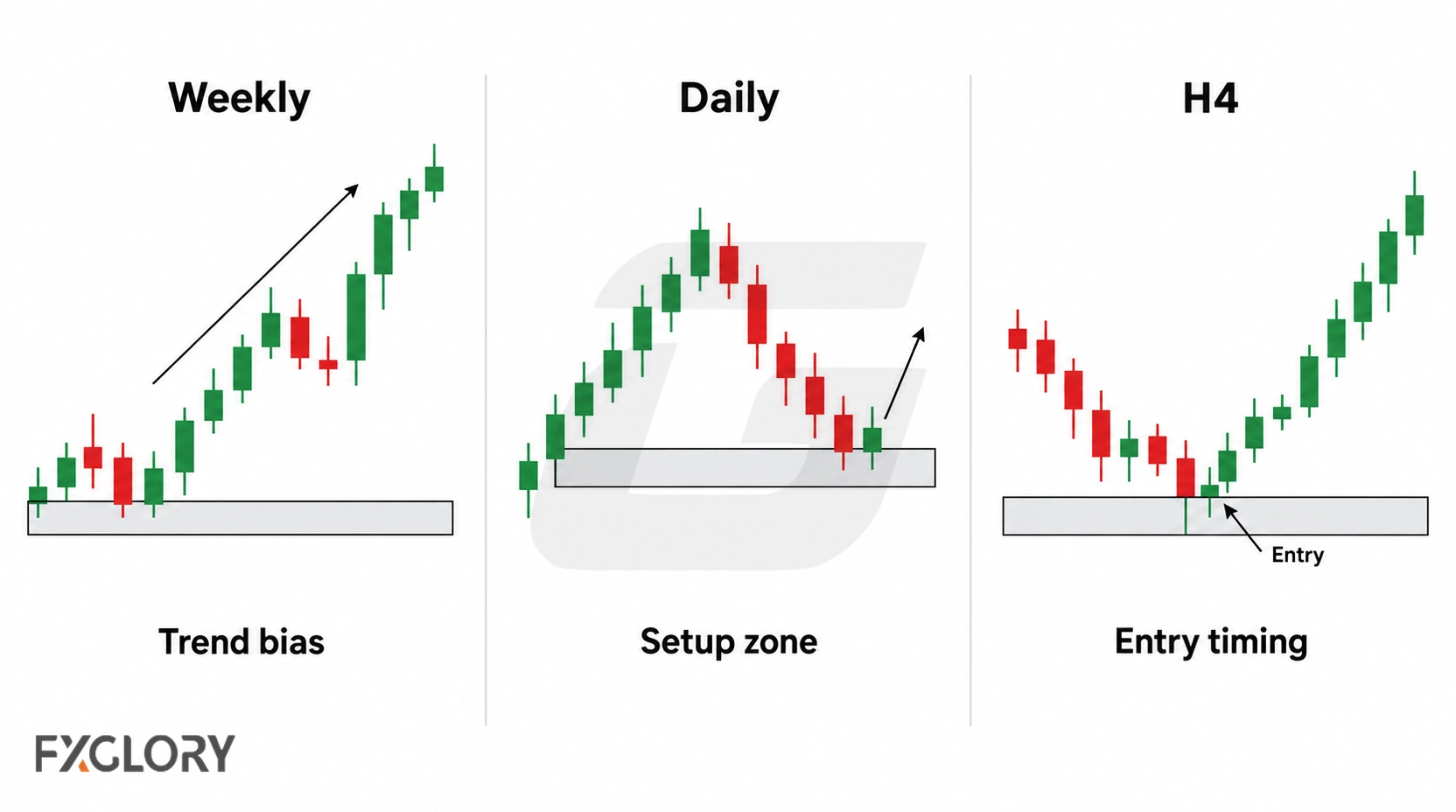
| Timeframe | Role In Position Trading | Weak Use |
|---|---|---|
| Weekly | Defines major trend, long-term support or resistance, and broad structure | Using one weekly candle to justify any direction |
| Daily | Defines trade structure, breakout acceptance, pullback behavior, and invalidation area | Ignoring daily closes that weaken the thesis |
| H4 | Can refine entry, retest, pullback, or early structure change | Letting H4 noise override the position thesis without a rule |
| Intraday | Can help with execution only if the plan allows it | Over-checking small candles and exiting emotionally |
Use daily timeframe rules when the position plan depends on daily candle review and close-based decisions.
Fundamental Drivers To Review Before Holding Longer
Longer holding periods make market drivers harder to ignore. A position trade can be affected by central bank decisions, inflation data, labor data, GDP releases, risk sentiment, geopolitical events, and changes in the expected path of interest rates.
Forex position trading should review both currencies in the pair. A bullish view on one currency is incomplete unless the other currency's policy path, growth outlook, risk role, and event calendar are also reviewed.
| Driver | Why It Matters | Review Question |
|---|---|---|
| Central bank policy | Can change rate expectations and currency direction | Does the trade thesis depend on policy staying unchanged? |
| Inflation data | Can affect rate expectations and currency repricing | Can the next release invalidate the thesis? |
| Employment data | Can shift growth and policy expectations | Is the position exposed to a major labor release? |
| GDP and growth data | Can change long-term currency strength expectations | Does growth data support or weaken the thesis? |
| Risk sentiment | Can affect safe-haven or higher-risk currencies | Is the position exposed to broad risk-on or risk-off movement? |
| Geopolitical risk | Can create sharp repricing and liquidity changes | Should risk be reduced before uncertain events? |
A position trade does not need a complex macro model, but it does need a list of events that can change the reason for holding.
Forex Position Trading Setups And When To Use Them
A trend-following position, breakout-and-hold position, and carry-supported position should not be tested as the same method. Each one needs its own thesis, entry rule, invalidation, holding-cost check, and exit plan.
| Setup Type | Use When | Main Risk | Rule To Check Before Entry |
|---|---|---|---|
| Long-term trend following | Weekly or daily trend remains intact and pullbacks respect structure | Entering after the trend is already overextended | how trend structure stays valid |
| Support or resistance continuation | Price reacts from a major level and continues the higher-timeframe idea | Level breaks after the position is opened | how major levels define invalidation |
| Breakout-and-hold | Price breaks a key level and accepts beyond it | False breakout turns into a long-hold loss | how breakout acceptance is confirmed |
| Pullback into long-term trend | Higher-timeframe trend remains valid and price pulls back toward predefined support, a moving-average reference, or a prior breakout level | Pullback becomes a real reversal | how pullbacks avoid early entries |
| Fibonacci pullback inside a position thesis | Price retraces inside a larger trend and the level aligns with structure | The Fibonacci level is treated as a reason to hold without price confirmation | Check whether the retracement still respects the higher-timeframe thesis |
| Range-to-trend transition | A long range resolves into accepted directional movement | Range resumes after a failed expansion | how range failure changes the plan |
| Carry-supported position idea | Swap or rollover conditions support the holding plan | Price loss overwhelms holding benefit | Check carry logic separately before using it as a reason to hold |
| Macro or theme-based position idea | A longer-term driver supports the technical structure | Driver changes while the trader keeps the old thesis | Define event-based review before entry |
Carry can support a position idea, but not replace price-risk control. The carry-trade strategy explains how interest-rate differentials, swap, policy changes, and currency-price risk can affect that approach.
Entry Rules: Breakout, Pullback, Retest, Or Structure Confirmation
A position trade still needs an entry rule. A long-term thesis does not justify entering anywhere on the chart.
| Entry Type | How It Works | Use When | Main Risk |
|---|---|---|---|
| Breakout entry | Entry after price accepts beyond a major level | Position thesis begins with range expansion or level break | False breakout creates early loss |
| Retest entry | Entry after the broken level holds from the other side | Trader wants confirmation after breakout | Retest may not happen or may fail |
| Pullback entry | Entry after price pulls back into higher-timeframe trend structure | Trend remains valid but entry needs better location | Pullback becomes reversal |
| Structure confirmation | Entry after higher low, lower high, trendline hold, or daily close confirmation | Thesis needs technical proof before entry | Confirmation appears too late for acceptable stop distance |
| Staged entry | Position is built in parts under predefined rules | Risk is capped and add levels are written before entry | Adding becomes emotional averaging |
An entry may be confirmed yet arrive too late: compare the distance to planned invalidation with the realistic room to the next objective before accepting the trigger.
Stop Placement And Wider Invalidation
Higher-timeframe invalidation often lies beyond major daily or weekly swings rather than small intraday fluctuations. Place the stop where the chosen structure invalidates the idea; position sizing then determines whether the account can support that distance.
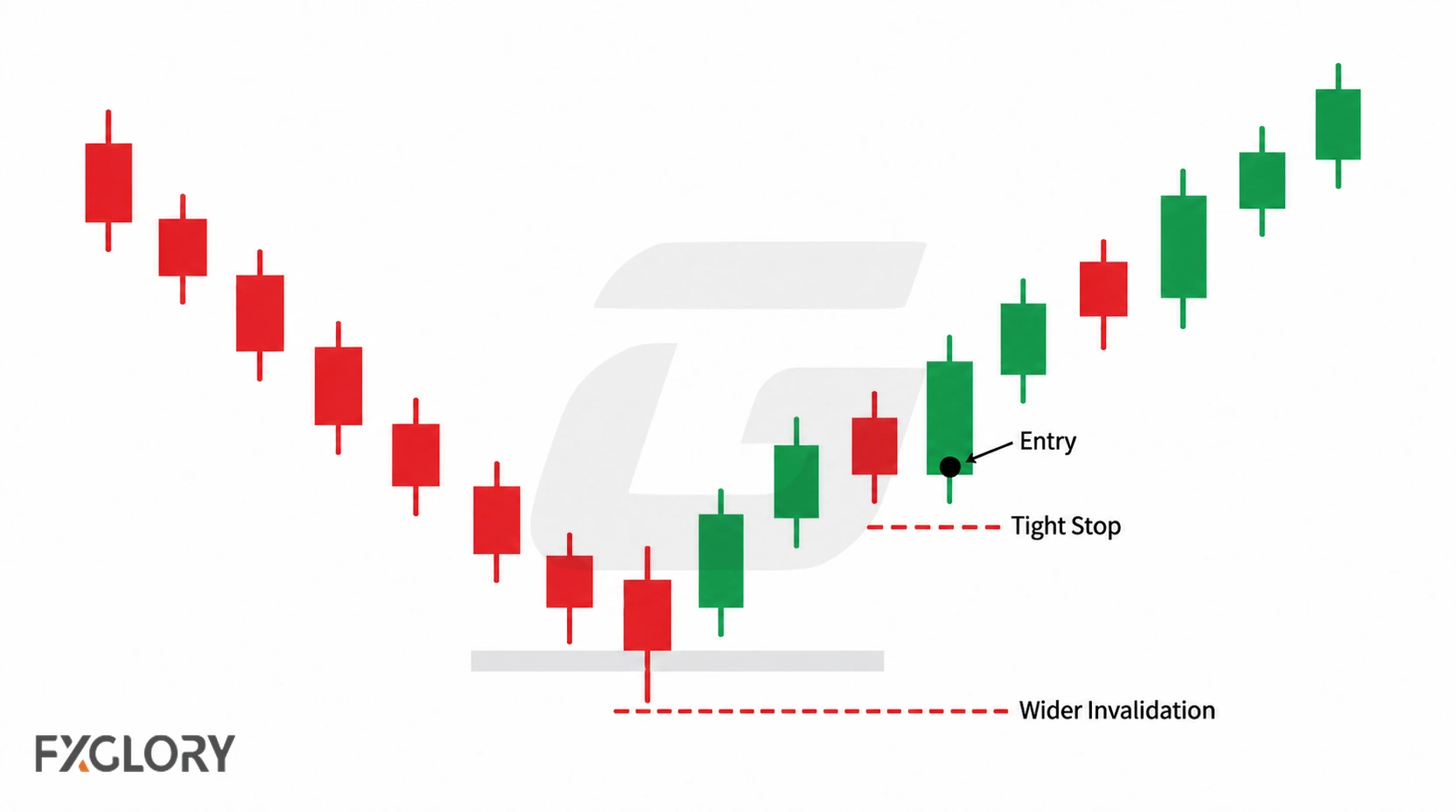
| Position Setup | Possible Invalidation Area | Bad Stop Logic |
|---|---|---|
| Trend-following position | Beyond the higher-timeframe swing that breaks the trend thesis | Stop placed on a small intraday fluctuation |
| Breakout-and-hold | Back inside the broken range or beyond the failed retest structure | Holding after breakout acceptance fails |
| Pullback into trend | Beyond the pullback low or high that cancels continuation | Stop moved because the trader still likes the trend |
| Support or resistance continuation | Beyond the major level or failed reaction area | Stop placed randomly to reduce position size |
| Macro-supported position | Price structure or event change that invalidates the thesis | Ignoring price invalidation because the macro view remains appealing |
Invalidation should be written before entry. A position trade should not become an excuse to keep moving the stop farther away.
Position Sizing For Wider Stops
After identifying the stop level, estimate the potential monetary loss per unit of position from stop distance and the instrument’s pip value. For the same account-risk budget and pip value, a wider stop generally permits fewer units; verify lot increments and any applicable trading costs.
| Decision | What To Check | Risk If Ignored |
|---|---|---|
| Stop distance | How far is the invalidation area from entry? | Trade size becomes too large for the true risk |
| Planned loss | How much account risk is accepted if invalidation is reached? | One position can damage the account more than planned |
| Margin requirement | How much margin is tied to the position? | Adverse movement creates pressure before thesis review |
| Leverage exposure | How much notional exposure is controlled by the position? | Small price movement can create oversized loss |
| Correlated positions | Are several trades exposed to the same currency or driver? | Multiple positions can become one larger bet |
Use the FXGlory margin calculator after the invalidation distance is known, and review leverage conditions before increasing exposure.
Swap, Rollover, Spread, Slippage, Margin, And Leverage Checks
Position trading keeps trades open long enough for trading conditions to matter. A setup that looks acceptable on the chart may become weak after swap, rollover, spread, slippage, margin, and leverage are included.
| Condition | Why It Matters For Position Trades | Decision It Should Change |
|---|---|---|
| Swap or rollover | Longer holding periods can add cost or credit depending on the pair and direction | Review holding cost before entry and during reviews |
| Spread | Entry and exit cost still matters, especially during volatile periods | Avoid entering during unstable spread conditions |
| Slippage | Major events can change entry, stop, or exit quality | Use event rules before holding through releases |
| Margin | Longer exposure can tie up capital and pressure decisions | Resize or skip if margin pressure is too high |
| Leverage | Long-hold exposure can magnify losses during adverse movement | Reduce size if leverage makes the thesis hard to hold |
| Correlation | Several positions can depend on the same currency or macro driver | Limit duplicated exposure across trades |
| News and event risk | Major releases can change the thesis or cause sharp repricing | Review or reduce exposure before planned events if rules require it |
Review FXGlory spreads before entry and after volatile periods. Swap, rollover, margin, and leverage should be checked before holding a position live.
Weekend, Gap, And Event Exposure
Weekend closes and major events present two separate decisions: whether to carry exposure into the event and whether its outcome changes the original thesis. Identify the relevant releases, gap or spread-reopening risks, and planned response beforehand.
- Before an important event, define which outcomes would require reducing, closing, or retaining exposure.
- Do not ignore spread reopening or gap risk just because the trade is long term.
- Do not add to a position before an event unless the total exposure and invalidation are already written.
- After the event, compare its outcome with the predefined thesis drivers and apply the corresponding exit or review rule.
Long And Short Position Planning
Long and short position trades need separate checks because the cost of holding, event exposure, and market behavior can differ by direction and pair.
| Planning Item | Long Position | Short Position |
|---|---|---|
| Thesis | Why the base currency may strengthen or quote currency may weaken | Why the base currency may weaken or quote currency may strengthen |
| Swap or rollover | Check whether holding cost or credit supports or weakens the plan | Check whether holding cost or credit supports or weakens the plan |
| Invalidation | Usually below the structure that supports the long thesis | Usually above the structure that supports the short thesis |
| Event risk | Data or policy that can weaken the long thesis | Data or policy that can weaken the short thesis |
| Exit rule | Target, structure break, thesis failure, or time review | Target, structure break, thesis failure, or time review |
Swap treatment, price exposure, and event sensitivity can differ between long and short positions in the same pair, so assess the two directions separately.
Review Schedule: Weekly Checks And Major Events
A position trade needs planned reviews because market conditions can change while the trade is open. The review schedule should be written before entry so the trader does not react to every small move or ignore major changes.
| Review Trigger | What To Check | Possible Decision |
|---|---|---|
| Weekly close | Does higher-timeframe structure still support the thesis? | Hold, reduce, move to planned management rule, or exit |
| Daily close near key level | Has price broken or rejected important structure? | Review invalidation or target progress |
| Central bank event | Did policy guidance change the thesis? | Hold only if the thesis still matches the new information |
| Major economic release | Did inflation, labor, or growth data change expectations? | Reduce or exit if the driver breaks |
| Weekend or market close | Can gap risk, spread reopening, or weekend news change the plan? | Hold only if the weekend rule allows the exposure |
| Swap or margin change | Has holding cost or margin pressure changed? | Resize or exit if cost no longer fits |
| Correlation exposure | Are several open trades now the same currency view? | Reduce duplicated exposure |
A review is not a reason to rewrite the thesis. It is a check to see whether the original reason for holding still exists.
Exit Rules: Thesis Failure, Structure Break, Target, Or Time Review
Exits may be triggered by price structure, a change in the macro thesis, accumulated holding costs, an event, or elapsed time. The table separates these reasons so a review leads to a specific decision.
| Exit Type | When It Applies | Risk If Missing |
|---|---|---|
| Thesis failure | The macro, technical, or event reason for the trade changes | Trader keeps holding for the old reason |
| Structure break | Weekly or daily structure invalidates the position | Loss grows beyond the planned invalidation |
| Target reached | Price reaches the planned higher-timeframe objective | Winning trade becomes an emotional hold |
| Time review | Trade has not progressed within the planned review window | Capital stays tied to a stale idea |
| Cost exit | Swap, margin, or exposure no longer fits the plan | Holding cost weakens the trade |
| Event exit | A planned event can change the thesis and risk is not acceptable | Position is exposed to unmanaged repricing |
For each exit type, specify the observable trigger—such as a completed candle close, event outcome, cost threshold, or review date—rather than delaying a decision after that condition occurs.
Position Trading Psychology Traps
Position trading requires patience, but patience is not the same as refusing to exit. The trader needs a way to separate normal fluctuation from thesis failure.
| Trap | How It Appears | Control Rule |
|---|---|---|
| Over-checking | Trader reacts to intraday candles that are not part of the plan | Review at scheduled times or levels |
| Thesis drift | The reason for holding changes after entry | Compare each review with the written thesis |
| Stubborn holding | Trader calls a broken trade long-term conviction | Exit when invalidation is reached |
| Premature exit | Trader closes because normal pullback feels uncomfortable | Use the planned invalidation and review schedule |
| Adding without rule | Trader increases size because the long-term idea still feels right | Add only if levels, risk, and total exposure were written before entry |
A journal can distinguish rule-based patience from delayed exits: both involve holding, but only one follows the documented conditions.
What Makes A Position Trade Weak?
A weak position trade usually fails before entry. The trader may like the long-term idea, but the plan does not define risk, holding cost, or invalidation clearly enough.
- No written thesis: the trade is opened because price recently moved, not because a clear higher-timeframe idea exists.
- No invalidation: the trader cannot state where the position is wrong.
- Stop too wide for the account: the invalidation is real, but the position size is not adjusted.
- Ignoring swap or rollover: holding cost is checked only after the trade is open.
- Event risk ignored: central bank or data releases can change the thesis.
- Weekend exposure ignored: gap risk, spread reopening, or weekend news is not reviewed before market close.
- Short-term noise controls decisions: intraday movement overrides the written plan.
- Thesis drift: the trader changes the reason for holding after entry.
- Correlation pile-up: several positions repeat the same currency or macro exposure.
- Carry used as an excuse: rollover logic is used to ignore price invalidation.
No-Trade Conditions
Most long-term ideas should be skipped unless the trader can define the thesis, invalidation, cost, and review process before entry.
- Skip if the higher-timeframe thesis cannot be written clearly.
- Skip if the trade is only a short-term setup being stretched into a position trade.
- Skip if the invalidation area is too wide for acceptable position size.
- Skip if swap, rollover, margin, or leverage makes the holding plan unsuitable.
- Skip if the next major event can change the thesis and there is no event rule.
- Skip if weekend exposure, gap risk, or spread reopening has not been reviewed.
- Skip if several open trades already depend on the same currency or macro driver.
- Skip if the entry is far from the structure that defines risk.
- Skip if the trader plans to move the stop instead of accepting thesis failure.
- Skip if carry is the only reason to hold while price structure is invalidated.
- Skip if the review schedule is not written before entry.
Backtesting Notes For Forex Position Trading
This framework converts the position-trading idea into fixed rules before historical data is reviewed. It is an educational testing framework, not a performance claim or a trading recommendation.
Example Numerical Rule Model
| Rule Part | Example Test Setting | Why It Matters |
|---|---|---|
| Market universe | EURUSD, GBPUSD, USDJPY, AUDUSD, USDCAD, and USDCHF tested separately. | One pair can make a rule look stronger or weaker than it really is. |
| Minimum history | 10 years of daily and weekly data if available. | Short samples can hide trend, range, volatility, and event-regime failures. |
| Higher-timeframe filter | Long setups are reviewed only when the weekly close is above the weekly 50 EMA. Short setups are reviewed only when the weekly close is below the weekly 50 EMA. | The test needs a fixed long-term direction filter before entries are reviewed. |
| Parameter sensitivity | Repeat the same test with weekly 40 EMA, 50 EMA, and 60 EMA. | A rule that only works with one exact setting may be curve-fitted. |
| Daily structure filter | Price must pull back toward the daily 20 EMA or retest a broken daily structure level while the weekly filter remains valid. | The position trade needs a defined location, not a random entry inside a trend. |
| Entry trigger | Enter long after a daily candle closes back above the daily 20 EMA or after a daily retest holds above the broken level. Reverse the logic for short setups. | The test should use a repeatable trigger instead of discretionary chart reading. |
| Invalidation | For long setups, invalidation is below the latest daily swing low or failed breakout area. For short setups, invalidation is above the latest daily swing high or failed breakdown area. | Position size should be calculated from the real stop distance. |
| Position size model | Risk is calculated from stop distance. The example risk unit is 1R planned loss before costs. | Wider position-trading stops should not create larger account risk. |
| Target model | Compare a 2R target with exit on weekly trend break or daily structure failure. | The test should show whether fixed targets or structure-based exits behave differently. |
| Maximum holding review | Review or exit if the trade has not reached target or invalidation after 60 daily candles. | A position trade should not become an indefinite hold without review. |
| Spread assumptions | Run the same test with 0.5 pip, 1.5 pip, and 3.0 pip spread assumptions. | Results can change when normal and stressed cost assumptions are included. |
| Slippage assumptions | Run the same test with 0.1 pip, 0.5 pip, and 1.0 pip slippage assumptions. | Major events and fast exits can weaken theoretical results. |
| Swap or rollover | Review separately because daily or weekly public OHLC data usually does not include broker-specific swap. | Long-hold forex results can change when holding cost is included. |
| Validation | Compare results by pair, year, trend/range regime, high-volatility periods, and nearby EMA settings. | This reduces curve-fitting and one-sample bias. |
Backtest Metrics To Review
Completed tests should report the following metrics from the stated data and cost assumptions. These metrics should not be estimated from chart appearance.
| Metric | What It Shows |
|---|---|
| Number of trades | Whether the sample is large enough to review. |
| Win rate | How often the rule closes positive after the selected cost assumptions. |
| Average win in R | Average winning trade compared with planned risk. |
| Average loss in R | Average losing trade compared with planned risk. |
| Expectancy in R | Average result per trade after wins, losses, and costs. |
| Profit factor | Gross winning R divided by gross losing R under the tested rules. |
| Max drawdown | Largest historical equity decline under the tested rules. |
| Worst losing streak | Longest run of losing trades in the sample. |
| Average holding period | How long trades stayed open under the rule model. |
| Performance by pair | Whether results depend on one currency pair. |
| Spread and slippage sensitivity | Whether the rule changes materially under higher trading costs. |
Educational Sensitivity-Test Results
This educational sensitivity test used the stated rule model and yfinance public research data from 2014 to 2024. The purpose is to show why a position-trading idea should be tested before live use, not to present the rule model as a profitable system.
The data source was public research data, not FXGlory broker execution data. The test used assumed spread and slippage values and did not include broker-specific swap, rollover, liquidity, rejected orders, or fill quality.
| Metric | Result | How To Read It |
|---|---|---|
| Trades across all sensitivity runs | 13,098 | Total trades across tested pairs, EMA settings, spread assumptions, and slippage assumptions. |
| Win rate | 33.75% | The tested rule closed positive on about one third of combined-batch trades. |
| Average win | +1.75R | Average winning trade compared with planned risk. |
| Average loss | -0.97R | Average losing trade compared with planned risk. |
| Expectancy | -0.05R | The combined batch was negative on average after the selected assumptions. |
| Profit factor | 0.92 | Gross winning R was lower than gross losing R in the combined batch. |
| Combined-batch max drawdown | -954.66R | This aggregates multiple EMA, spread, and slippage scenarios; it should not be read as one live-account drawdown. |
| Worst losing streak | 13 trades | The longest losing run in the combined batch. |
| Average holding period | 20.94 days | Average time trades stayed open under the tested rule model. |
Pair-Level Sensitivity-Test Summary
| Pair | Trades | Win Rate | Expectancy | Profit Factor | Max Drawdown | Average Hold |
|---|---|---|---|---|---|---|
| AUDUSD | 2,088 | 36.35% | -0.00R | 1.00 | -29.05R | 21.48 days |
| EURUSD | 2,229 | 34.99% | -0.06R | 0.91 | -146.79R | 22.28 days |
| GBPUSD | 2,304 | 40.54% | +0.17R | 1.29 | -13.96R | 18.46 days |
| USDCAD | 2,304 | 33.38% | -0.03R | 0.96 | -84.10R | 19.60 days |
| USDCHF | 2,250 | 25.20% | -0.22R | 0.67 | -500.08R | 19.23 days |
| USDJPY | 1,923 | 31.83% | -0.20R | 0.72 | -385.14R | 25.39 days |
Under this educational sensitivity batch, the broad rule model did not show robust positive expectancy across the full tested pair set. GBPUSD was positive in the pair-level summary, AUDUSD was approximately flat, and the other tested pairs were negative. This pair difference is the main lesson of the test: a position-trading rule should not be judged from one pair or one clean chart example.
The script, trade log, and summary file should be kept with the backtest record. If the script, data source, cost model, exit logic, or parameter settings change, the results should be regenerated.
Testing And Journal Checklist
Forex position trading should be reviewed by thesis type. A breakout-and-hold position, pullback-into-trend position, range-to-trend transition, Fibonacci pullback position, and carry-supported position should not be mixed into one result unless the rules are identical.
- Define the position type: trend-following, breakout-and-hold, pullback into trend, Fibonacci pullback inside a position thesis, range-to-trend transition, carry-supported idea, or macro/theme-based idea.
- Write the thesis: technical reason, fundamental driver, structure, and expected holding condition.
- Review both currencies: policy path, growth outlook, risk role, event calendar, and swap or rollover impact for both sides of the pair.
- Define the timeframe roles: for example, weekly thesis, daily structure, optional H4 entry refinement, and intraday execution if used.
- Write the entry rule: breakout, retest, pullback, Fibonacci pullback with structure, structure confirmation, or staged entry.
- Write invalidation: price level, structure break, macro change, event change, weekend exposure rule, or exposure limit that cancels the idea.
- Calculate size from stop distance: position size comes after the invalidation distance is known.
- Record trading conditions: spread, slippage, swap, rollover, margin, leverage, liquidity, and spread reopening risk.
- Record event exposure: central bank decisions, inflation, employment, GDP, geopolitical risk, weekend risk, and risk sentiment changes.
- Record review schedule: weekly close, daily close near key levels, event review, weekend review, swap review, and margin review.
- Record exit reason: target, thesis failure, structure break, time review, cost review, event rule, or risk exposure limit.
- Record mistake tags: no thesis, late entry, stop too wide, size too large, ignored swap, ignored weekend risk, ignored event, thesis drift, stubborn holding, or correlation pile-up.
- Review a sufficient sample: document trade counts, market regimes, cost assumptions, and variability for each defined method. No fixed number of trades guarantees reliable conclusions.