

What Is A Forex Counter Trend Strategy?
A forex counter trend strategy is a rule-based method for trading against a clearly defined prevailing move on a stated timeframe. The goal is usually to capture a temporary correction, reaction from a level, failed continuation, or short-term move back toward nearby structure. A fade at a range boundary is not necessarily counter to a prevailing trend unless the reference move and timeframe are specified. It should not be treated as proof that the whole trend has reversed.
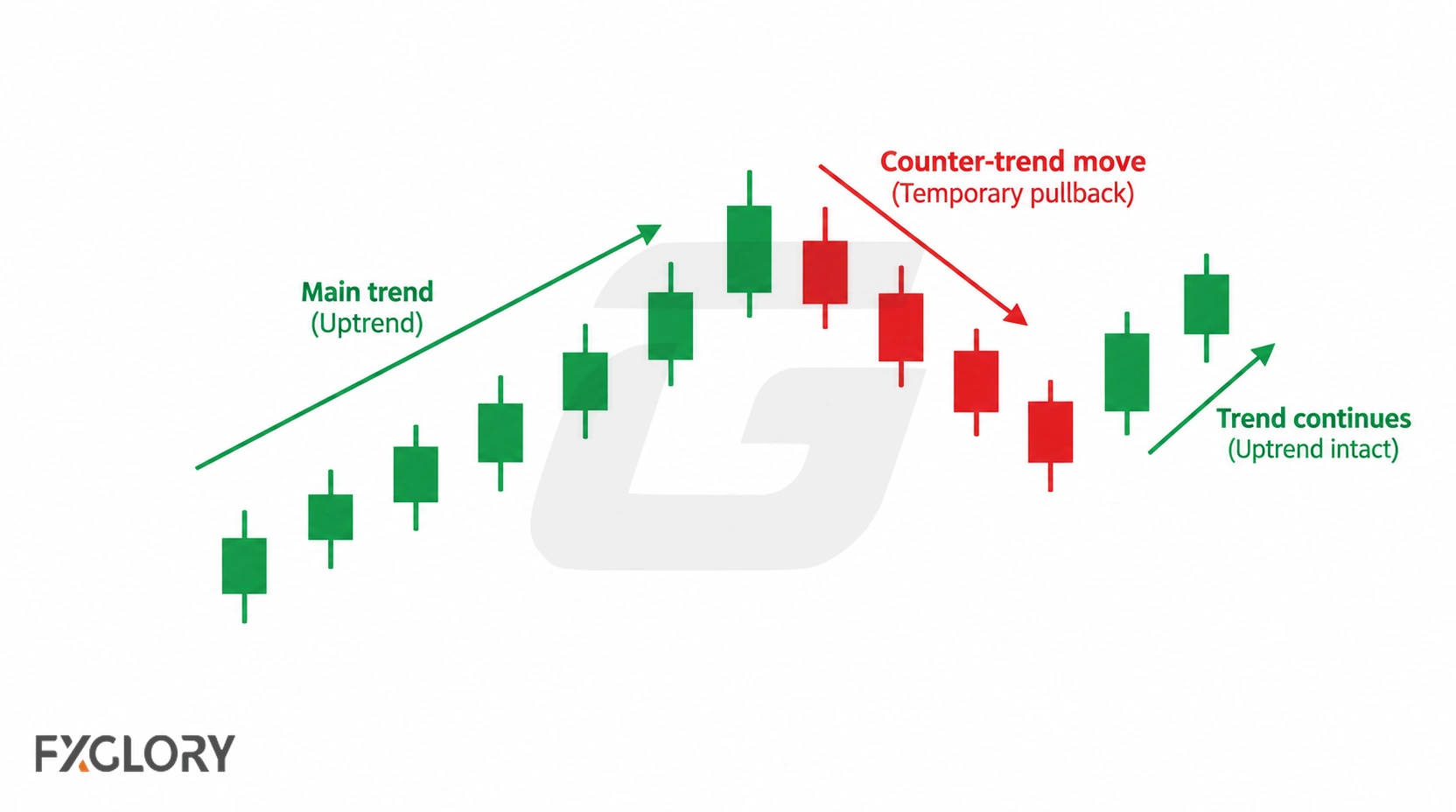
Counter-trend trading is difficult because the trader is working against recent pressure. A strong trend can continue farther than expected, and a market that looks stretched can become even more stretched. The setup needs location, confirmation, invalidation, and conservative target planning before entry.
Indicators and levels can support a counter-trend idea, but the trade still needs proof that the current move is pausing or failing. RSI, MACD, Bollinger Bands, Fibonacci levels, trendlines, support and resistance, and candle patterns are only useful when they help define the correction case, stop placement, target room, and risk limits.
A counter-trend plan focuses on temporary reactions. If price later confirms a larger structure shift, the trade idea should be reassessed as a reversal setup, not managed as a simple correction.
Counter Trend vs Reversal vs Mean Reversion vs Trend Trading
Counter-trend trading overlaps with reversal trading and mean reversion, but the purpose is different. A counter-trend trade often targets a shorter reaction against the current move, while a reversal trade needs stronger evidence of a larger direction change.
| Topic | Main Question | Role In A Counter-Trend Plan | Main Risk |
|---|---|---|---|
| Counter trend strategy | Can price correct against the current move? | Focuses on temporary reaction, strict invalidation, and conservative targets | Fighting a trend that keeps going |
| Reversal strategy | Is the larger direction changing? | Used only if counter-trend reaction develops into confirmed structure shift | Calling a correction a full reversal too early |
| Mean reversion | Can price return toward an average or range center? | Can support range or Bollinger-style correction trades | Using average return logic in a strong trend |
| Trend trading | Is price continuing in the current direction? | Acts as the main danger filter before counter-trend entry | Shorting strength or buying weakness too early |
| Range trading | Is price rotating between boundaries? | Can support counter-trend trades at range edges | Range breaks and trend expands |
Use reversal confirmation rules when a counter-trend reaction may become a larger trend change. Use momentum checks when the current move may still be too strong to fight.
Counter-Trend vs Mean Reversion: Where They Overlap And Differ
Counter-trend and mean reversion often overlap, but they are not the same decision. A counter-trend trade simply goes against the current move. A mean-reversion trade needs a reason to expect price to return toward an average, range center, middle band, or fair-value area.
| Concept | What It Means | Useful When | Weak Use |
|---|---|---|---|
| Counter-trend reaction | Trade goes against the current move | Price rejects a level, fails to continue, or pauses after an impulse | Assuming every stretched move must correct |
| Mean reversion | Trade expects price to return toward an average or range center | Market is ranging, rotating, or extended relative to a tested reference | Using average-return logic inside a strong trend |
| Bollinger correction | Price stretches beyond volatility bands and may return toward the middle band | Trend strength weakens and price confirms rejection | Fading a band-walk in a strong trend |
| Range mean return | Price reacts from a range edge toward midpoint or opposite side | Range structure remains valid | Keeping range logic after breakout acceptance |
For a method built specifically around return-to-average rules, compare the forex mean reversion strategy. A counter-trend trade without mean-reversion structure should use conservative targets. A mean-reversion idea without trend-strength checks can still fail when the market starts trending.
Why Counter-Trend Trading Is Risky
Counter-trend trading is risky because the market does not need to correct just because it has moved far. A strong trend can stay strong, overbought conditions can remain overbought, and oversold conditions can continue lower while price continues to make lower lows and lower closes.
| Risk | How It Hurts Counter-Trend Trades | Safer Rule |
|---|---|---|
| Strong trend continuation | The market keeps moving against the counter-trend entry | Skip when momentum is expanding and structure is intact |
| Early entry | The trader enters before rejection, failed continuation, or structure shift | Wait for confirmation near a planned level |
| Tight stop | Normal volatility hits the stop before the idea is invalid | Place the stop where the counter-trend idea is actually wrong |
| Large target expectation | The trader expects a full reversal from a temporary correction | Use nearby structure or conservative correction targets first |
| Averaging into losers | Exposure grows while the main trend continues | Do not add unless a tested plan defines each add and total risk |
| News volatility | Fast movement can break levels, widen spreads, or trigger slippage | Check event risk before entering |
When Counter-Trend Trading Makes Sense
A counter-trend setup is stronger when it appears at a planned location and the current move stops sustaining new highs or lows. The trade should be treated as a reaction first, not a full trend change.
| Condition | Why It Helps | What Still Needs Confirmation |
|---|---|---|
| Major support or resistance | Gives the reaction a clear location | Rejection, failed continuation, or structure shift |
| Range boundary | Counter-trend trade can target the range midpoint or opposite side | Range must still be valid |
| Failed breakout | Price has failed to hold beyond the broken level | Price must accept back inside prior structure |
| Impulse is stretched | Correction risk may increase after extended movement | Exhaustion alone is not enough |
| Divergence near a level | The indicator may show weaker momentum | Price confirmation is still required |
| Bollinger or volatility extreme | Price may be extended relative to recent movement | Trend strength must be checked first |
Use support and resistance reactions when the counter-trend setup depends on a planned level.
When Counter-Trend Trading Is A Bad Idea
Some markets should not be faded. A counter-trend setup is weak when the current move is still organized, momentum is expanding, and there is no confirmed rejection from a meaningful level.
Warning signs include a breakout that holds its retest, momentum still expanding, and a target too close to cover realistic costs. The detailed no-trade checklist also addresses news, exposure, and missing invalidation.
5-Step Counter-Trend Workflow
A counter-trend setup should be simple enough to reject quickly. If the setup cannot pass the first steps, it should not reach the entry stage.
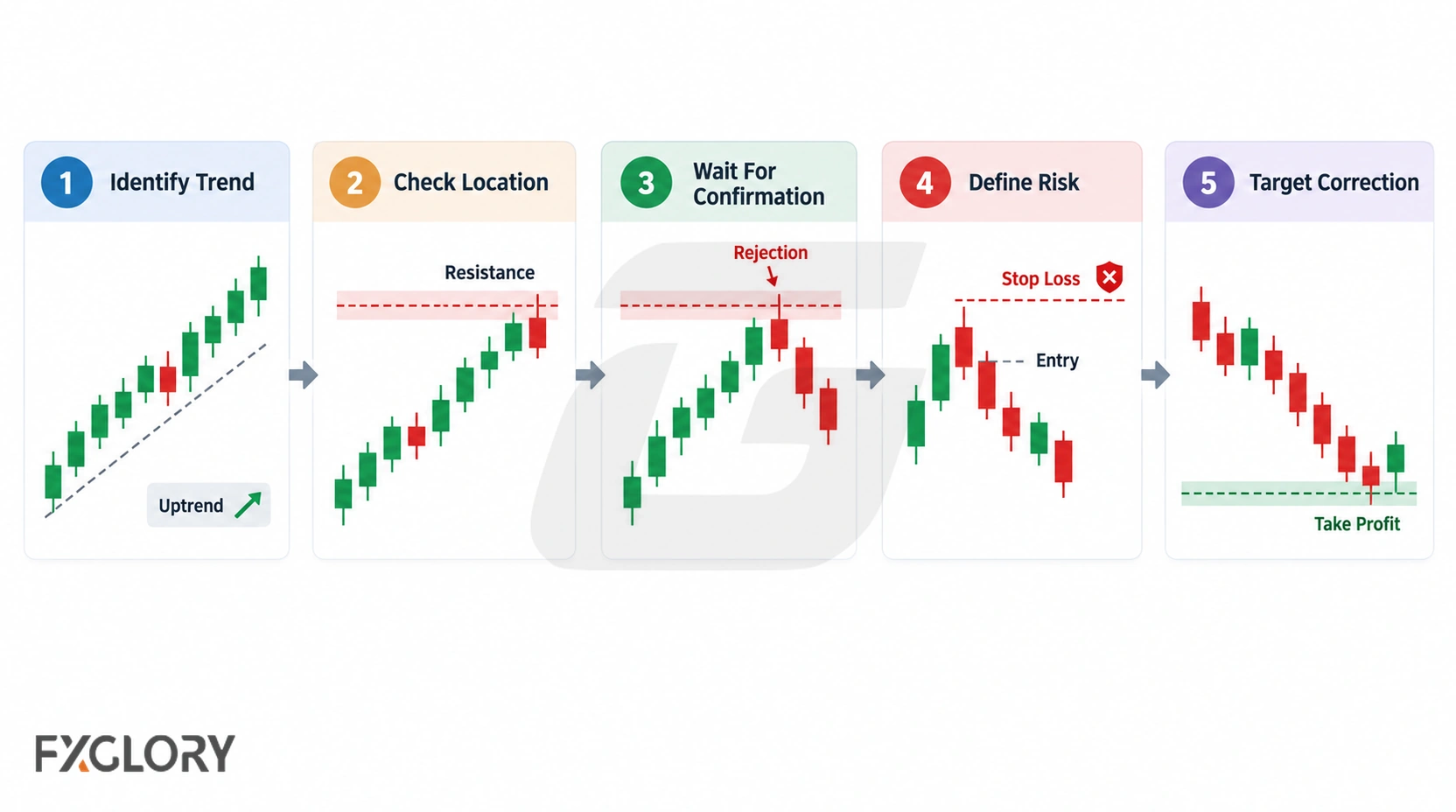
| Step | Question | Required Decision |
|---|---|---|
| 1. Identify the active move | What direction is price currently pressing? | Define the trend, impulse, breakout, or range expansion first |
| 2. Check whether fading is reasonable | Is the move near a level, range edge, band extreme, or failed continuation area? | Reject random fades in the middle of a strong move |
| 3. Wait for confirmation | Has rejection, failed continuation, retest failure, divergence plus price action, or small structure shift appeared? | Do not enter only because price looks stretched |
| 4. Define risk | Where is the counter-trend idea wrong? | Set invalidation, stop distance, and position size before entry |
| 5. Plan a conservative exit | Where is the nearest realistic correction target? | Use nearby structure before assuming a full reversal |
This workflow is strict because a counter-trend trade starts without the active move on its side.
Execution and cancellation checks: After confirming the five-step setup, measure stop distance against target room after spread and slippage; check news, swap, margin, leverage, correlated positions, and expected holding time. Specify whether the exit occurs at the target, at structural invalidation, when the original trend resumes, or when a timed rule expires. Use risk rules before the counter-trend entry to determine acceptable exposure before placing an order.
Counter-Trend Setups And When To Use Them
A failed breakout fade, a Bollinger correction, and a range-edge reaction do not behave the same way. Each one needs its own confirmation, invalidation, target rule, and no-trade condition.
| Setup Type | Use When | Main Risk | Helpful Next Step |
|---|---|---|---|
| Correction after impulse | Price moves strongly, then stalls near structure | Impulse continues without correction | momentum strength check |
| Failed breakout | Price breaks a level but accepts back inside | Breakout resumes after a shallow pullback | breakout failure context |
| Range-edge reaction | Price reacts from range support or resistance | Range breaks and trend expands | range boundary rules |
| Bollinger Band correction | Price stretches beyond volatility bands and loses follow-through | Band-walk continues in a strong trend | Bollinger context |
| Fibonacci retracement reaction | Price reacts near a retracement area after an impulse | Level is treated as magic instead of structure | pullback structure |
| Counter trendline break | Trendline guiding the current move fails and retest behavior changes | Minor line break becomes noise | structure shift review |
| Divergence-supported setup | Momentum weakens near a planned level | Divergence appears too early | indicator role planning |
Counter-Trend Correction After An Impulse
A correction-after-impulse setup looks for a temporary reaction after a strong move. The trade is not built on the idea that the whole trend has reversed. It is built on the idea that price may correct toward nearby structure before the main move decides what to do next.
- Identify the impulse and the level or structure where it begins to stall.
- Check whether momentum is still expanding or starting to fade.
- Wait for rejection, failed continuation, or a smaller structure shift.
- Define invalidation beyond the impulse extreme or failed continuation area.
- Target nearby structure first instead of assuming a full reversal.
Failed Breakout And Failed Continuation
A failed breakout counter-trend setup appears when price breaks a level, cannot hold beyond it, and accepts back inside the prior structure. This can create a reaction against the breakout direction, but the failure must be confirmed.
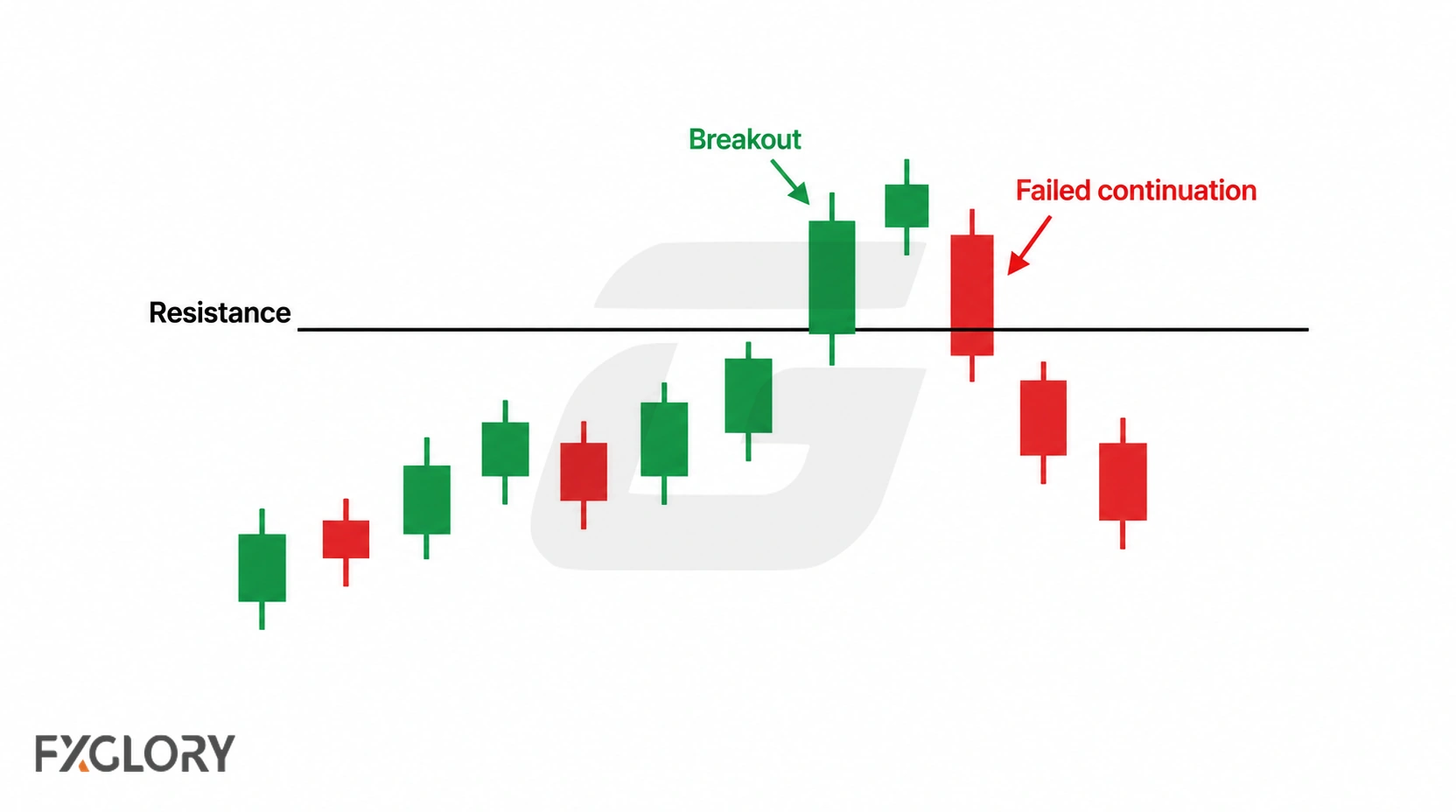
| Step | What To Check | Skip If |
|---|---|---|
| Break | Was the level marked before price broke it? | The level is drawn after the failed move |
| Failure | Does price accept back inside the prior structure? | Price only wicks back but closes beyond the level |
| Retest | Does the broken level fail to hold from the breakout side? | The retest holds and breakout continuation resumes |
| Target | Is there room back toward the range midpoint or next level? | The target is too close after spread and slippage |
| Invalidation | Where is the failed-break idea wrong? | The stop is random or inside normal volatility |
When the failed break becomes a full direction-change case, use larger reversal confirmation. When it is only a temporary reaction, keep the counter-trend target conservative.
Range-Edge Counter-Trend Setup
Range-edge counter-trend trading looks for reactions from support or resistance while price remains inside a range. The setup is weaker when the range is breaking, news is close, or the current candle has already moved too far from invalidation.
- Do not buy the range low before price rejects or fails to continue lower.
- Do not sell the range high before price rejects or fails to continue higher.
- Do not target the full opposite side of the range if midpoint structure is close.
- Do not keep range logic after price accepts outside the boundary.
Bollinger Band Counter-Trend Correction
Bollinger Bands can show when price is extended relative to recent volatility, but a move outside the band is not automatically a counter-trend entry. In strong trends, price can walk the band and continue in the same direction.
| Bollinger Condition | Possible Meaning | Counter-Trend Risk |
|---|---|---|
| Price touches outer band | Price is extended relative to recent volatility | Trend can continue along the band |
| Rejection from outer band | Move may be losing short-term pressure | Rejection can be only a pause |
| Middle-band target | Can act as a conservative correction target | Target may be unrealistic if trend resumes quickly |
| Band expansion | Volatility is increasing | Fading expansion too early can be dangerous |
Use Bollinger Bands as context only. Price structure and invalidation decide whether the counter-trend trade exists.
Fibonacci Retracement Counter-Trend Setup
Fibonacci retracement levels can help organize possible reaction areas after an impulse. They should not be treated as guaranteed turning points. A retracement level is useful only when it aligns with structure, exhaustion, or confirmation.
- Do not enter only because price touches a Fibonacci level.
- Do not use Fibonacci levels without marking support, resistance, or swing structure.
- Do not assume a shallow retracement means the trend is weak.
- Do not keep the trade if price invalidates the reaction area.
Counter Trendline Break Setup
A counter trendline break setup looks for failure in the line or structure that has been guiding the current move. A line break alone is weak because trendlines can be redrawn and minor breaks can become noise.
| Trendline Step | What To Check | Weak Use |
|---|---|---|
| Trendline | The line was drawn before the break and matches visible structure | Forcing a line to create a trade |
| Break | Price closes or accepts beyond the line | Entering on a small wick through the line |
| Retest or structure shift | Price fails to regain the old trendline structure | Assuming every line break is a reversal |
| Target | Nearby level, moving average area, or correction zone is realistic | Expecting the full trend to reverse immediately |
Market Sentiment Extremes: Context, Not Entry
Sentiment extremes can explain why a counter-trend reaction may appear, but sentiment should not replace price confirmation. A crowded move can stay crowded if the trend remains supported by price structure, liquidity, or news.
| Clue Type | Possible Use | Why It Is Not Enough |
|---|---|---|
| One-sided narrative (sentiment context) | Shows a common market view, but does not establish positioning | Views and actual positions are different measurements |
| Sharp reaction after news (price action) | Shows a price response that can be checked against structure | A candle alone does not establish market sentiment |
| Extreme oscillator readings (indicator) | May show stretched price-derived conditions | They are not measurements of trader sentiment or positioning |
| Failed continuation after a sharp move (price action) | May identify a rejected break or failure to hold new extremes | The price pattern alone does not identify who initiated trades |
Actual sentiment or positioning analysis needs independent evidence, such as a documented positioning report or survey. This article does not supply such a dataset. Oscillator readings and candle reactions remain price-derived observations; none should be treated as proof of participant intent.
Multi-Day Counter-Trend Pattern And ATR Filter
Some counter-trend systems review multi-day candle patterns after several candles move in the same direction. A sequence of strong daily candles can warn that price is stretched, but it should not become an automatic fade.
An ATR or volatility filter can help identify whether current movement is unusually large compared with recent behavior. That filter can support review, but it does not replace stop placement or confirmation.
| Review Item | What It May Show | Risk To Control |
|---|---|---|
| Several candles in one direction | Move may be extended | Trend may continue without a clean correction |
| Large daily range | Volatility is elevated | Stop distance and slippage may increase |
| ATR above recent average | Movement is larger than usual | High volatility can create both opportunity and danger |
| Time-based exit | Trade is not allowed to drift forever | Exit timing must be tested by setup type |
| No traditional stop | Some systems use time or signal exits | Live trading still needs maximum loss and exposure limits |
A multi-day counter-trend pattern should be tested separately from intraday counter-trend setups because holding time, swap, volatility, and stop distance are different.
RSI, MACD, And Divergence Support
RSI, Stoch RSI, MACD, stochastic, and other indicators can support counter-trend review, but they should not be the main reason for entry. Overbought and oversold readings often appear during strong trends.
| Indicator Evidence | Useful Role | Weak Use |
|---|---|---|
| RSI overbought or oversold | Shows possible extension | Entering only because RSI is high or low |
| Stoch RSI turn | May show short-term momentum shift | Using a turn without price confirmation |
| RSI divergence | Shows momentum disagreement | Trading divergence before price confirms |
| MACD momentum fade | Shows pressure may be weakening | Using MACD as a standalone entry trigger |
| Stochastic turn | Can support a reaction near structure | Using oscillator turns in a strong trend without level context |
| Moving average distance | Can show price stretched from a reference area | Assuming price must return immediately |
Use indicator role planning when technical tools become part of the counter-trend rules.
Counter-Trend Confirmation Stack
Confirmation does not make the trade safe. It only gives the trader enough structure to define the setup, stop, target, and cancellation point.
| Stack Step | What To Look For | Why It Matters |
|---|---|---|
| 1. Trend-strength check | Momentum is fading, not expanding | Avoids fighting the strongest part of the move |
| 2. Location | Support, resistance, range edge, failed breakout, band extreme, or retracement area | Prevents random fading in the middle of a move |
| 3. Reaction evidence | Rejection, failed continuation, false break, divergence plus price action, or trendline break | Shows the current move may be pausing or correcting |
| 4. Entry trigger | Retest, completed candle, break of small structure, or pullback failure | Improves timing and defines invalidation |
| 5. Conservative target | Nearby level, midpoint, moving average area, or retracement zone | Matches the temporary nature of many counter-trend trades |
A counter-trend trade with no trend-strength check is usually just a guess against momentum.
Forex Counter Trend Strategy Example Flow
The example below is educational. It is not a trading signal or a recommendation to trade any specific pair.
| Step | Example Flow | Decision |
|---|---|---|
| Current move | Price has risen strongly into a planned resistance area | Watch for reaction; do not sell blindly |
| Trend strength | Follow-through weakens and the next candle fails to hold a new high | Review possible counter-trend reaction |
| Confirmation | Price rejects resistance and breaks a small supporting structure | Define invalidation above the failed high or rejection area |
| Entry | Retest or completed candle confirms the reaction | Skip if entry is far from invalidation |
| Target | First target is nearby support or a midpoint correction area | Do not assume a full trend reversal |
| Risk check | Spread, slippage, news, margin, leverage, swap, and correlation are reviewed | Resize, wait, or skip if conditions weaken the plan |
| Exit | Exit at target, old trend resumption, or failed follow-through | Do not defend the trade if the main trend returns |
The same workflow can be reversed for bullish counter-trend reactions after a sharp decline. Direction changes; confirmation, invalidation, conservative target planning, and risk control do not.
Entry Rules: Rejection, Retest, Trendline Break, Or Pullback Failure
A counter-trend entry should improve risk control. It should not be an emotional response to a fast candle or a belief that the trend has moved too far.
| Entry Type | How It Works | Best Use | Main Risk |
|---|---|---|---|
| Rejection entry | Entry after price rejects a planned support or resistance area | Level-based reaction | Entering before the rejection is complete |
| Retest entry | Entry after broken minor structure holds from the other side | Controlled timing after reaction | Retest fails and trend resumes |
| Trendline break entry | Entry after the line guiding the current move fails | Correction after an extended move | Minor break becomes noise |
| Pullback failure entry | Entry when the trend tries to resume but fails | Failed continuation setup | Trend resumes after shallow pause |
| Indicator-supported entry | Entry when price structure aligns with RSI, MACD, Bollinger, or stochastic evidence | Supportive confirmation | Indicator signal appears without tradable location |
The entry should be close enough to invalidation to keep risk controlled. If price has already corrected far from the stop area, the counter-trend setup may be late.
Stop Placement And Invalidation
Counter-trend stop placement should be based on the point where the reaction idea is wrong. A stop that is too tight can fail inside normal volatility, while a stop that is too wide can distort position size.
| Setup Type | Possible Invalidation Area | Bad Stop Logic |
|---|---|---|
| Resistance fade | Beyond the failed high or rejection area | Stop placed randomly inside the wick |
| Support fade | Beyond the failed low or rejection area | Stop too tight under the entry candle |
| Failed breakout | Beyond the false-break extreme or failed retest area | Stop placed where normal retest movement can hit it |
| Counter trendline break | Beyond the structure that would restore the old trend | Stop ignores the line-break context |
| Bollinger correction | Beyond the reaction extreme if structure supports it | Stop based only on band distance |
Use the FXGlory margin calculator after the stop distance is known, and review leverage conditions before increasing exposure.
Conservative Target Rules
Counter-trend trades should usually plan conservative targets first because the main trend may return. The first target should usually be a fraction of the nearby range or correction zone, not a full trend reversal.
| Target Type | When It Fits | Risk |
|---|---|---|
| Nearby support or resistance | Level-based counter-trend reaction | Target may be too close after spread |
| Range midpoint | Range-edge counter-trend setup | Range may break before midpoint |
| Bollinger middle band | Band-extension correction setup | Strong trend may not return to the middle band |
| Fibonacci retracement area | Correction after impulse | Retracement level may not hold or may be too shallow |
| Broken minor structure | Trendline or small structure break setup | Old trend may resume before target |
A more distant target does not change the trade's counter-trend classification; it requires separate justification because the established move may resume before price reaches it. If the first realistic target is too close relative to transaction costs and the planned risk, the setup may not be worth taking.
Low RR And High Win-Rate Counter-Trend Risk
Frequent small counter-trend wins can hide the real risk. One strong continuation move can erase several small wins if the stop, position size, and maximum loss are not fixed before entry.
| Counter-Trend Assumption | Risk | Control Rule |
|---|---|---|
| Small targets are easier to reach | One large loss can offset many small gains | Keep stop, size, and max loss fixed before entry |
| High win rate means the method is safe | Win rate says nothing without average loss size | Review average win, average loss, and worst-case continuation |
| The market usually pulls back | Some trends do not give tradable corrections | Skip strong momentum conditions |
| Averaging improves entry price | Exposure grows while the trend continues | Avoid adding unless the plan is tested and capped |
In a hypothetical plan with an average 0.5R gain on wins and an average 1R loss on losses, the break-even win rate is 66.67% before costs (1 ÷ [1 + 0.5]). Costs would raise the required rate. This is a calculation example, not a measured result from the five-candle backtest. Win rate alone is not an edge if the average loss is large enough to erase several small wins.
Judge the setup by average win, average loss, worst-case continuation, and total exposure, not only by how often small reactions appear.
Averaging Into Counter-Trend Trades
Averaging into a losing counter-trend trade is one of the fastest ways to turn a small idea into a large loss. The market can continue trending while the trader keeps adding exposure in the wrong direction.
- Do not add to a losing counter-trend trade only because the entry looks cheaper.
- Do not average unless the total maximum risk is written before the first entry.
- Do not increase size because the trend looks overextended.
- Do not use averaging to avoid admitting the setup failed.
- Do not let multiple counter-trend adds exceed the original risk limit.
- Do not ignore margin pressure created by repeated adds.
If the tested plan does not define add levels, maximum adds, total exposure, invalidation, margin impact, and exit rules, averaging should be treated as a risk error.
Counter-Trend Psychology Traps
Counter-trend trading can reward patience, but it can also pull traders into decisions that feel logical while price keeps moving against them. The setup must cancel when the evidence fails.
| Trap | How It Appears | Control Rule |
|---|---|---|
| FOMO | Entering because the first reaction candle was missed | Wait for the next valid trigger or skip |
| Confirmation bias | Looking only for signs that the trend is over | Check whether momentum and structure still support the trend |
| Overtrading | Fading every extended candle | Require location, confirmation, invalidation, and target room |
| Defending a failed fade | Holding or adding after the old trend resumes | Exit when invalidation is reached |
| Revenge fading | Taking another counter-trend entry after a stop-out without a new setup | Wait for a fresh setup and written risk limit |
A counter-trend idea that needs emotional defense after entry was not defined clearly enough before entry.
Correlation And Multiple-Pair Exposure
Several counter-trend trades can look separate but depend on the same currency move. For example, fading a strong currency across multiple pairs can create one large bet against the same trend.
| Exposure Issue | Why It Matters | Control Rule |
|---|---|---|
| Same currency leg repeated | Several trades may lose together if the strong currency keeps moving | Limit duplicated exposure before entry |
| Correlated pairs | Different charts can share the same macro driver | Check whether trades are independent or the same idea repeated |
| Repeated fades | Several small counter-trend attempts can stack into large risk | Set a maximum number of attempts per move or session |
| Margin pressure | Multiple fades can raise margin use quickly | Review total margin, not only single-trade risk |
Counter-trend risk should be reviewed across all open trades, not only one chart.
News, Spread, Slippage, Swap, Margin, And Leverage Checks
Counter-trend strategies can be sensitive to execution conditions because they often form near volatility extremes, failed moves, or fast reactions. A setup that looks valid on the chart may become weak after spread, slippage, news, correlation, or leverage exposure is included.
| Condition | Why It Matters For Counter-Trend Trades | Decision It Should Change |
|---|---|---|
| Spread | Small counter-trend targets can lose value to transaction cost | Skip if spread consumes too much of the planned move |
| Slippage | Fast correction candles can change entry, stop, and exit quality | Avoid entering after sudden spikes without a plan |
| News | Event moves can create false corrections or violent continuation | Delay, reduce risk, or skip if event rules are not defined |
| Thin liquidity | Poor liquidity can make price choppy and fills less predictable | Use stricter confirmation or skip |
| Swap | A short correction trade may stay open longer than planned | Review holding cost before entry |
| Margin | Averaging or repeated attempts can increase exposure | Resize or skip if exposure is too large |
| Leverage | Losses can accelerate when fighting the active direction | Reduce size or skip if margin pressure becomes excessive |
| Correlation | Several positions can become one large bet against the same currency | Reduce duplicated exposure across pairs |
| Execution risk | Fast trend resumption can affect stop and exit quality | Use stricter conditions or skip during unstable movement |
Review FXGlory spreads when counter-trend targets are short or volatility is high. Check the economic calendar before trading counter-trend setups near major data releases, because event-driven moves can break levels, widen spreads, or trigger slippage before the technical setup has time to develop.
No-Trade Conditions
Use these conditions to reject a weak setup before entry. A trade based only on a stretched candle, indicator extreme, or an expected full reversal does not establish a controlled correction. In particular, distinguish a planned reaction level from a fade in the middle of unclear structure.
- Skip if the trend is strong and no failed continuation has appeared.
- Skip if the move is only overbought or oversold by an indicator.
- Skip if price is not near a meaningful support, resistance, range edge, failed breakout, or reaction area.
- Skip if momentum is still expanding in the trend direction.
- Skip if the entry is far from invalidation after a large reaction candle.
- Skip if the first target is too close after spread and slippage.
- Skip if high-impact news can distort the level or confirmation.
- Skip if thin liquidity makes entry and stop quality unreliable.
- Skip if the stop must be placed randomly because structure is unclear.
- Skip if the plan depends on adding to a losing position without defined maximum risk.
- Skip if several open trades already fade the same strong currency.
- Skip if the trader is entering only because they want to catch the correction before others see it.
Backtesting Notes For Forex Counter Trend Strategy
This numerical review uses one hypothetical educational rule model: a daily five-candle impulse-failure counter-trend setup with an ADX trend-strength filter, EMA(20) extension filter, failed-continuation candle confirmation, ATR-based stop placement, a 1R target comparison, a trend-resumption exit, and spread/slippage sensitivity. It does not test Bollinger corrections, Fibonacci reactions, failed breakouts, range-edge fades, trendline breaks, divergence setups, averaging, or discretionary counter-trend entries.
The model reviews EURUSD, GBPUSD, USDJPY, AUDUSD, USDCAD, and USDCHF on daily candles using public yfinance OHLC data where available. The setup enters against a short-term impulse only after the signal candle attempts to continue the move and then closes against that continuation attempt. A close-to-close change compares successive daily closing prices, not each candle's close with its open. The five completed-candle impulse window precedes the separate signal candle. The supplied summary does not identify the exact indicator sampling bar and indexing used in the Python implementation, so full reproduction requires the original script.
| Rule Area | Educational Model Rule |
|---|---|
| Counter-trend type | Daily five-candle impulse failure correction |
| Short setup context | Previous 5 completed daily candles show a net upward move of at least 1.50 ATR(14), with at least 4 upward close-to-close changes |
| Long setup context | Previous 5 completed daily candles show a net downward move of at least 1.50 ATR(14), with at least 4 downward close-to-close changes |
| Extension filter | Previous daily close must be at least 0.75 ATR(14) away from EMA(20) in the impulse direction |
| Trend-strength filter | ADX(14) must be no more than 30 |
| Short confirmation | Signal candle trades above the previous high, closes below its open, and closes below the previous close |
| Long confirmation | Signal candle trades below the previous low, closes above its open, and closes above the previous close |
| Entry | Next daily open after the failed-continuation signal candle |
| Stop | Beyond the signal candle extreme with a 0.25 ATR(14) buffer |
| Target comparison | Fixed 1R target from entry |
| Trend-resumption exit | Exit at daily close if price closes beyond the signal candle extreme in the original impulse direction after entry |
| Maximum holding review | 10 daily candles after entry |
The review records trade count, win rate, average win in R, average loss in R, expectancy in R, profit factor, maximum drawdown in R, worst losing streak, average holding period, pair-level behavior, direction-level behavior, exit reasons, and spread/slippage sensitivity. The ADX indicator is a trend-strength measure, not a directional forecast; the threshold in this model is a research setting, not a universal trading cutoff.
| Cost Input | Assumptions Used |
|---|---|
| Spread | 0.5, 1.5, and 3.0 pips |
| Slippage | 0.1, 0.5, and 1.0 pips per side |
| Baseline comparison | 1.5-pip spread and 0.5-pip slippage per side |
| Swap and rollover | Not included |
Educational Sensitivity-Test Results
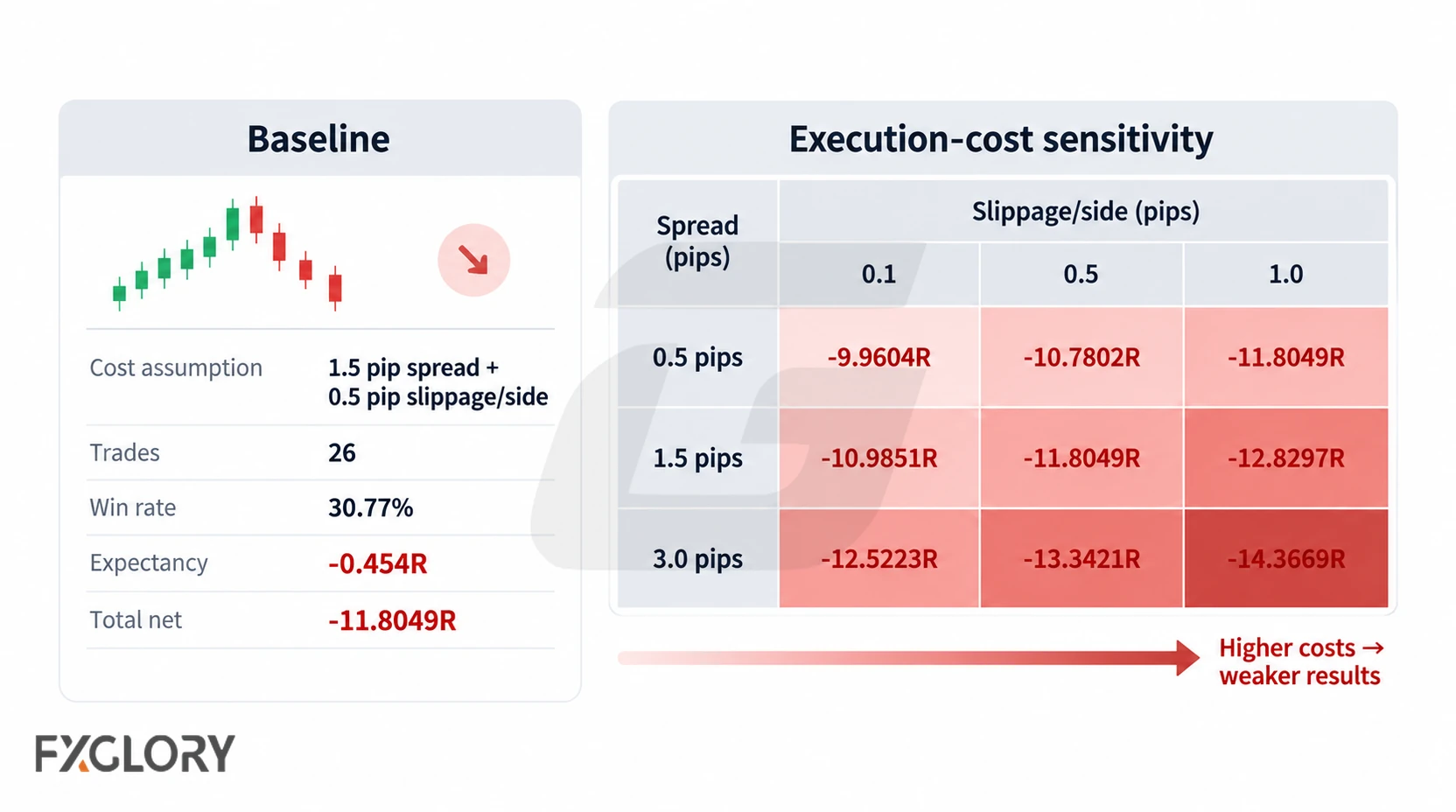
The hypothetical backtest covered the review window from 2016-06-29 to 2026-06-29, with warmup data starting on 2015-05-26 for indicator calculation. The baseline cost assumption used a 1.5-pip spread and 0.5-pip slippage per side. The baseline result was negative: expectancy was -0.454R and the total net result was -11.8049R across 26 trades.
| Metric | Baseline Result |
|---|---|
| Number of trades | 26 |
| Win rate | 30.77% |
| Average win | 0.929R |
| Average loss | -1.0687R |
| Expectancy | -0.454R |
| Profit factor | 0.3863 |
| Maximum drawdown | -12.5515R |
| Worst losing streak | 5 |
| Average holding period | 2.5 daily candles |
| Median holding period | 1 daily candles |
| Total net result | -11.8049R |
Pair-Level Baseline Results
| Pair | Trades | Win Rate | Expectancy | Profit Factor | Max Drawdown | Total Net |
|---|---|---|---|---|---|---|
| AUDUSD | 7 | 14.29% | -0.7961R | 0.1488 | -4.5171R | -5.5728R |
| EURUSD | 4 | 50% | 0.1411R | 1.4356 | -1.2959R | 0.5644R |
| GBPUSD | 7 | 28.57% | -0.6212R | 0.2896 | -3.235R | -4.3487R |
| USDCAD | 3 | 0% | -1.047R | 0 | -2.1111R | -3.1409R |
| USDCHF | 2 | 50% | -0.0694R | 0.873 | 0R | -0.1387R |
| USDJPY | 3 | 66.67% | 0.2772R | 1.7996 | 0R | 0.8317R |
Small-sample interpretation: Each currency pair contributes only 2 to 7 trades, and the full baseline contains 26 trades. These samples do not establish a reliable ranking of which pairs are better suited to the model; pair-level performance differences are descriptive only.
Direction-Level Baseline Results
| Direction | Trades | Win Rate | Expectancy | Profit Factor | Total Net |
|---|---|---|---|---|---|
| Long | 13 | 30.77% | -0.4763R | 0.3781 | -6.192R |
| Short | 13 | 30.77% | -0.4318R | 0.3952 | -5.613R |
Exit Reasons
| Exit Reason | Trades |
|---|---|
| stop first same bar | 3 |
| stop loss | 14 |
| target 1r | 8 |
| time exit | 1 |
Spread And Slippage Sensitivity
| Spread | Slippage Per Side | Expectancy | Profit Factor | Max Drawdown | Total Net |
|---|---|---|---|---|---|
| 0.5 pips | 0.1 pips | -0.3831R | 0.4405 | -10.8894R | -9.9604R |
| 0.5 pips | 0.5 pips | -0.4146R | 0.4154 | -11.6281R | -10.7802R |
| 0.5 pips | 1 pips | -0.454R | 0.3863 | -12.5515R | -11.8049R |
| 1.5 pips | 0.1 pips | -0.4225R | 0.4094 | -11.8128R | -10.9851R |
| 1.5 pips | 0.5 pips | -0.454R | 0.3863 | -12.5515R | -11.8049R |
| 1.5 pips | 1 pips | -0.4935R | 0.3596 | -13.4749R | -12.8297R |
| 3 pips | 0.1 pips | -0.4816R | 0.3674 | -13.1979R | -12.5223R |
| 3 pips | 0.5 pips | -0.5132R | 0.3471 | -13.9366R | -13.3421R |
| 3 pips | 1 pips | -0.5526R | 0.3233 | -14.86R | -14.3669R |
Testing And Review Checklist
Forex counter-trend strategies should be tested by setup type. A failed breakout, Bollinger correction, Fibonacci reaction, range-edge trade, counter trendline break, multi-day ATR-filter setup, and divergence-supported setup should not be mixed into one result unless the rules are identical.
- Choose the counter-trend type: correction after impulse, failed breakout, range-edge reaction, Bollinger correction, Fibonacci reaction, counter trendline break, sentiment-extreme reaction, multi-day pattern, or divergence-supported setup.
- Define the current move: trend, impulse, breakout, range expansion, session move, or unclear.
- Check trend strength: expanding momentum, fading momentum, failed continuation, or unclear pressure.
- Mark the reaction area: support, resistance, range edge, false-break zone, band extreme, Fibonacci area, trendline break area, moving average reference, or ATR/volatility condition.
- Write the confirmation rule: rejection, false-break close, retest failure, trendline break, divergence plus price action, sentiment reaction plus price confirmation, or completed candle.
- Write invalidation: the price or structure that cancels the counter-trend idea.
- Measure stop and target: compare stop distance with conservative target room after spread and slippage.
- Record trading conditions: news, spread, slippage, swap, margin, leverage, execution risk, thin liquidity, correlation exposure, and holding time.
- Record exposure rules: no averaging, or tested add levels with maximum total risk if the strategy explicitly allows scaling.
- Record skipped setups: strong trend, expanding momentum, indicator-only entry, no level, poor target room, duplicated exposure, and news distortion should be reviewed too.
- Review enough examples: collect enough independently identified examples to assess variation by setup and market regime, report uncertainty, and examine separate out-of-sample periods. No fixed sample count guarantees reliable estimates.
- Record mistake tags: fought trend, entered early, used indicator alone, averaged loser, target too large, stop too tight, ignored correlation, ignored news, or no exit rule.