
What Is A Forex Fundamental Strategy?
A forex fundamental strategy is a rule-based way to review currencies through economic conditions, central-bank policy, interest-rate expectations, inflation, employment, growth, trade flows, political risk, and risk sentiment.
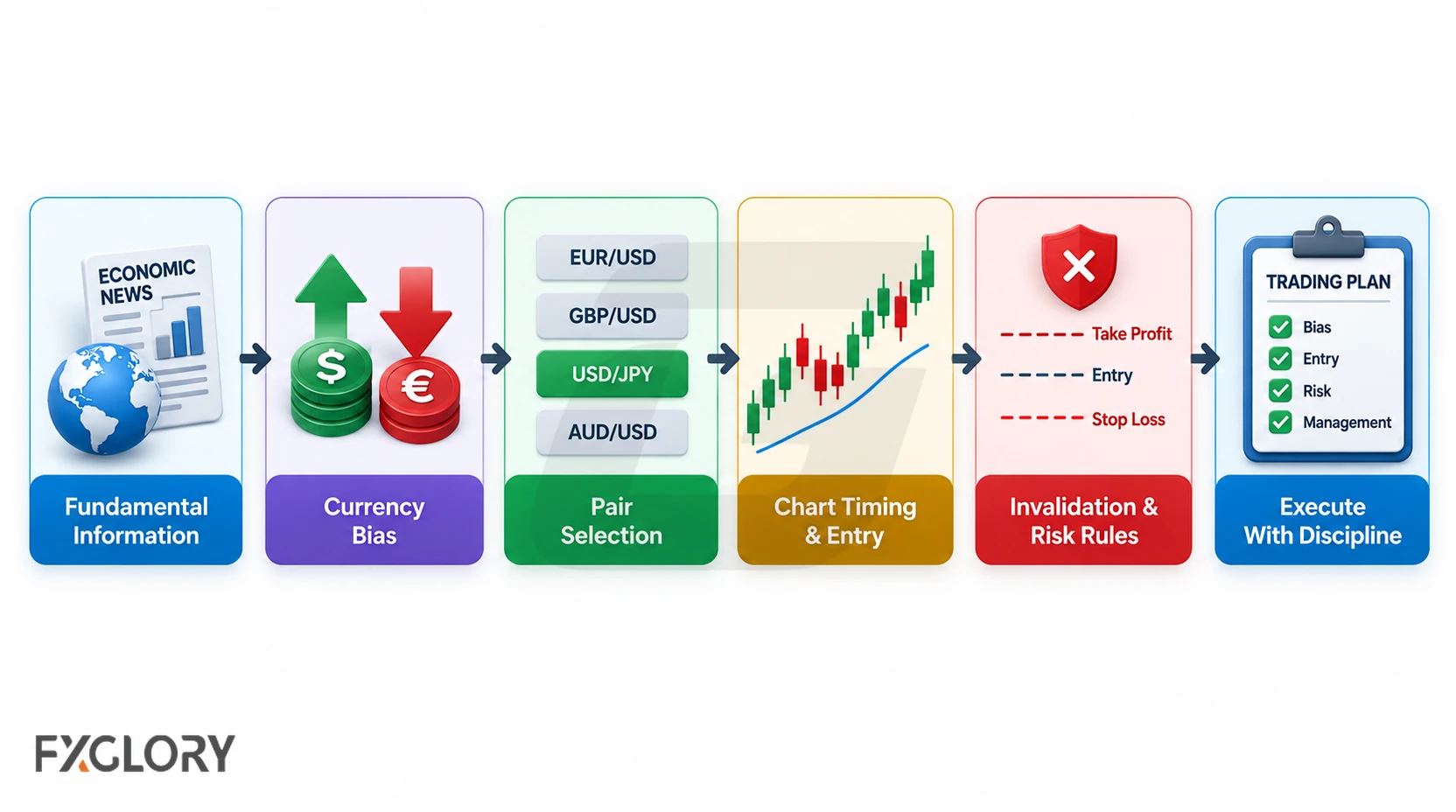
The strategy does not stop at reading the news or deciding that one economy looks stronger than another. A forex trade always compares two currencies. A trader still has to decide which pair expresses the idea, whether the current price already reflects the information, where the trade becomes invalid, how much risk the account can accept, and when the idea should be reviewed or closed.
A useful fundamental strategy therefore has two parts. The first part builds a currency bias. The second part turns that bias into a controlled trading plan with timing, execution, risk, and review rules.
For the wider rule framework that connects market condition, setup, entry, invalidation, target, risk, and review, use a complete forex trading-system structure.
Fundamental Analysis vs Fundamental Strategy
Fundamental analysis and forex fundamental strategy are related, but they are not the same job. Fundamental analysis studies the information. Fundamental strategy decides how that information is used in a trade plan.
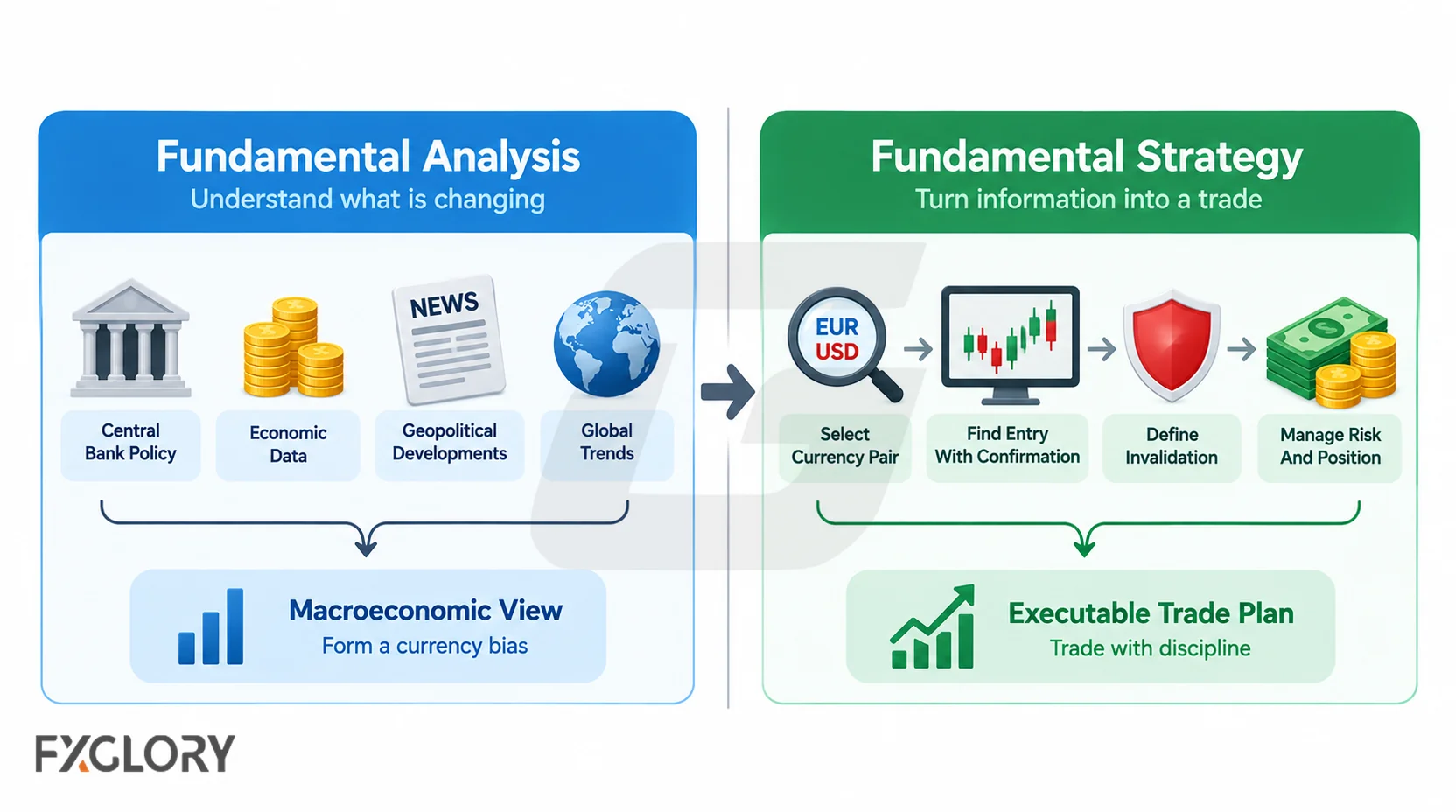
This distinction matters because a trader can understand an economic theme and still enter too late, choose the wrong pair, overleverage the idea, ignore spread or swap, or hold after the original thesis has changed.
| Process | Main Question | What It Includes | Weak Version |
|---|---|---|---|
| Fundamental analysis | What is changing in the economy or policy outlook? | Economic data, central-bank statements, inflation, employment, growth, trade balance, politics, and risk sentiment. | Reading headlines without knowing how they affect the pair. |
| Fundamental bias | Which currency looks stronger or weaker under the current information? | Comparison between two currencies, not one currency in isolation. | Calling one currency strong without checking the other side of the pair. |
| Fundamental strategy | How will the bias be traded, managed, reviewed, or rejected? | Pair selection, timing, entry trigger, invalidation, stop logic, exit rule, cost check, and risk limit. | Entering because the story sounds convincing. |
Short-term event execution belongs to forex news trading rules. A fundamental strategy is broader: it can use news, but it also studies the larger policy and economic picture behind the release.
Retail Limits: Keep The Macro Model Tradeable
A forex fundamental strategy should be simple enough to use before the trade, not only after the chart has moved. Retail traders usually do not have the same research staff, flow data, pricing models, or policy access that institutional macro desks may use. That makes a smaller, repeatable process more useful than a long list of unranked economic opinions.
The strategy should define which inputs are allowed, how they are compared, when they become outdated, and which chart or risk condition can cancel the idea. Without those limits, a trader can always find one economic reason to support an open position, even after the original reason has weakened.
| Retail Limitation | Practical Rule | Weak Version |
|---|---|---|
| Too many data points | Use a short list of drivers that matter to the pair. | Collecting every headline and changing the reason after entry. |
| Delayed information | Check whether the market has already reacted. | Trading an old theme as if it were new. |
| No institutional model | Use a written comparison process instead of pretending to know fair value. | Calling a currency cheap or expensive without a rule. |
| Policy uncertainty | Wait for clearer guidance when central-bank messages conflict. | Forcing a trade from one phrase or one data point. |
| Chart disagreement | Require price structure and risk rules before exposure. | Holding only because the macro story sounds right. |
What Fundamental Traders Actually Compare
Forex is relative. A currency can look strong on its own and still fall against a currency with a stronger outlook. A currency can look weak and still rise against a currency facing larger problems.
That is why a fundamental strategy should compare two sides of a pair. The trader reviews whether the base currency has a stronger or weaker outlook than the quote currency, then checks whether the chart and risk rules support the idea.
| Comparison Area | Stronger-Currency Clue | Weaker-Currency Clue | Reading Caution |
|---|---|---|---|
| Interest-rate expectations | Markets expect higher rates, delayed cuts, or tighter policy. | Markets expect lower rates, faster cuts, or easier policy. | The expected path may already be priced in. |
| Inflation backdrop | Inflation may keep policy restrictive or support the currency through rate expectations. | Falling inflation may allow easier policy, depending on the central bank. | High inflation is not automatically currency-positive if growth is weak or policy credibility is questioned. |
| Growth and employment | Growth, jobs, wages, or demand look resilient relative to the other economy. | Growth slows, unemployment rises, or data misses expectations. | Markets may care more about policy impact than the headline number. |
| Risk sentiment | The currency benefits from the current risk-on or risk-off environment. | The currency is pressured by capital outflow or weak demand. | Global sentiment can override domestic data. |
| Political and fiscal risk | Policy appears stable and credible. | Uncertainty, fiscal stress, or sudden policy shifts increase risk. | Political risk can reprice quickly and unevenly. |
Strong Currency vs Weak Currency Logic
A strong-currency and weak-currency approach starts by comparing two economic and policy backdrops. The goal is not to find a perfect economy. The goal is to find a clearer relative difference that the market has not already fully priced or rejected.
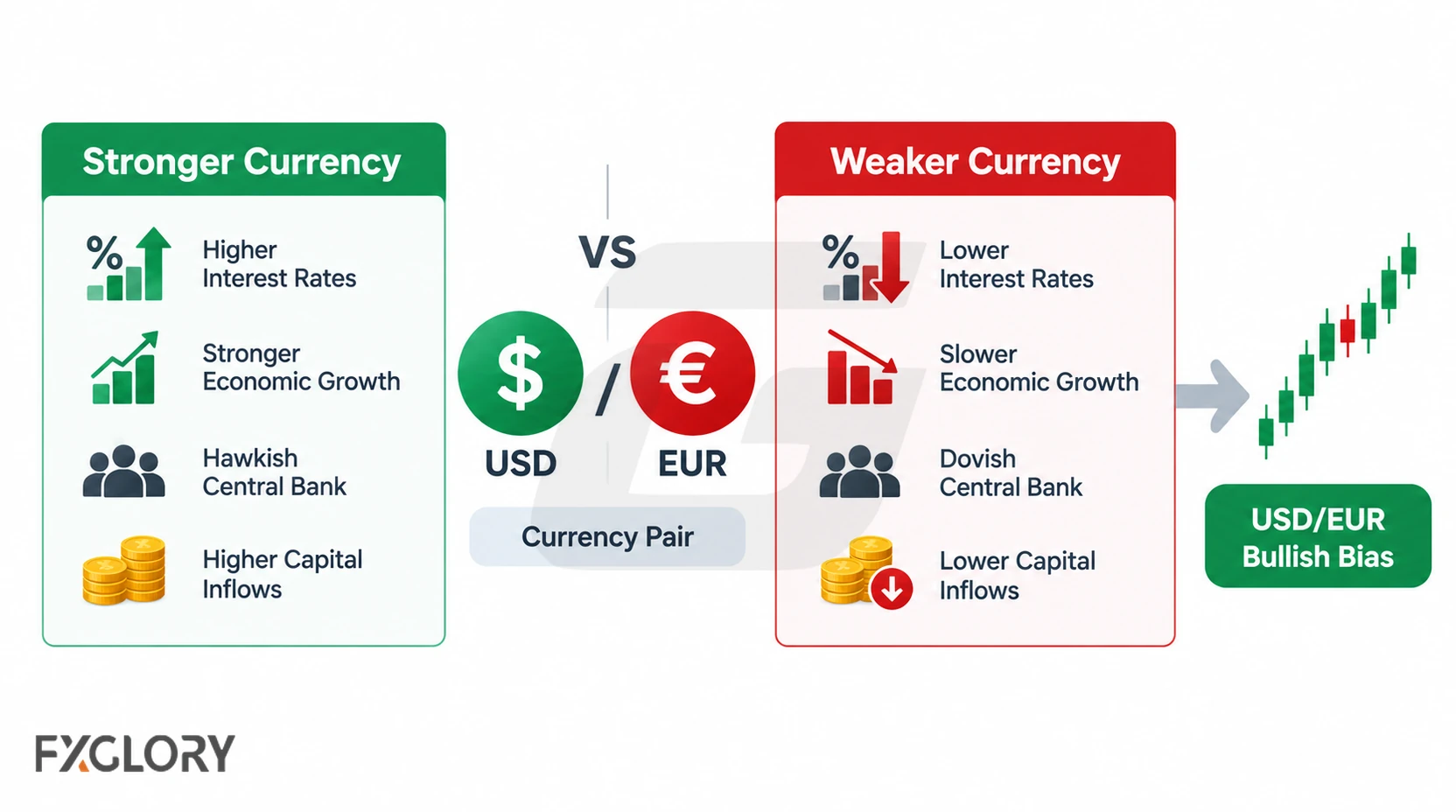
For example, if one central bank is expected to keep policy tighter while another is expected to cut rates sooner, the difference may support a currency-bias review. That review still needs price confirmation, a pair that expresses the difference clearly, and a risk plan that survives normal volatility.
| Step | Question | Weak Use |
|---|---|---|
| 1. Choose two currencies | Which two economies or policy paths are being compared? | Judging one currency in isolation. |
| 2. Review the policy gap | Are rate expectations, inflation pressure, or central-bank tone diverging? | Using an old rate story after guidance has changed. |
| 3. Check growth and risk sentiment | Does the broader environment support or weaken the bias? | Ignoring global risk-on or risk-off movement. |
| 4. Choose the pair direction | Does the pair direction match the stronger-vs-weaker view? | Buying or selling the wrong side of the pair. |
| 5. Wait for trade structure | Does price give a level, trend, pullback, breakout, or invalidation point? | Entering only because the macro story sounds strong. |
Pair choice should be checked against available instruments and market structure. FXGlory's currency-pairs market hub can be used to review listed forex markets before choosing which pair best expresses a currency comparison.
Fundamental Bias vs Market Pricing
A fundamental bias is only a view about which currency may have the stronger case. Market pricing decides whether that view is still useful. A currency can have supportive data and still fall if traders expected stronger data, if the policy path was already priced in, or if the other currency has an even stronger driver.
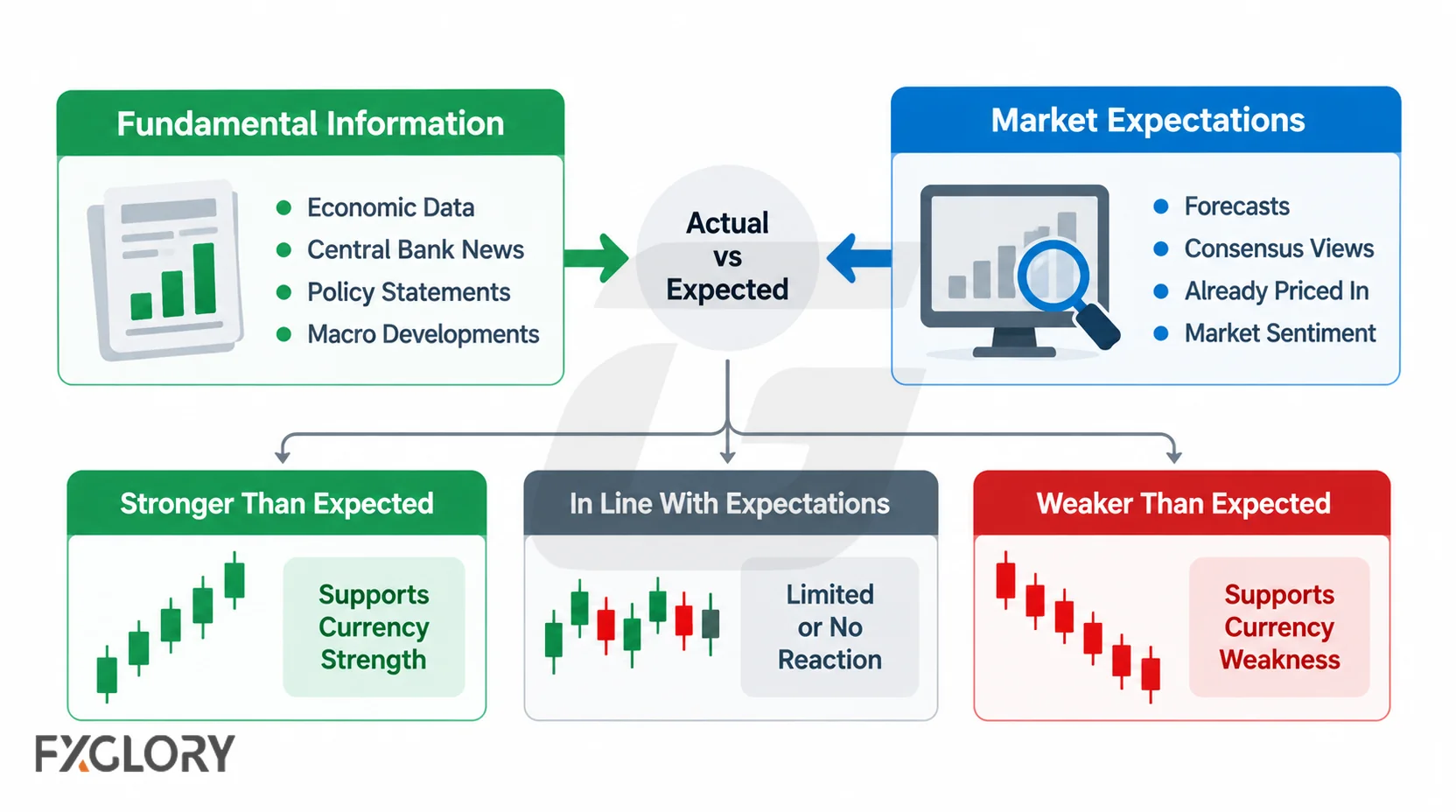
This is why a forex fundamental strategy should compare the new information with expectation, positioning, prior guidance, and price reaction. The question is not only whether the data is good or bad. The question is whether the information changes the relative outlook enough to justify a planned trade.
| Pricing Issue | What It Means | Risk For The Trader |
|---|---|---|
| Already priced in | The market expected the theme before the trader entered. | The currency may not move in the expected direction. |
| Better but not good enough | Data improves but misses the market forecast. | The reaction can look opposite to the headline. |
| Good data, softer guidance | The release looks supportive, but the central bank sounds less restrictive. | The policy path can matter more than the data point. |
| Weak data, weaker other currency | One currency looks poor, but the other side of the pair looks worse. | The pair may still move against the simple headline reading. |
| Risk sentiment override | Global risk-on or risk-off flow dominates local data. | The domestic story may not control the pair. |
Main Fundamental Drivers In Forex
Fundamental drivers matter because they can change expected demand for one currency relative to another. They rarely act alone. A trader should read them together and avoid forcing one data point to carry the whole trade.
| Driver | Why It Matters | Common Trap |
|---|---|---|
| Central-bank policy | Rate decisions, vote splits, statements, speeches, and forward guidance can change expected returns and capital flows. | Focusing only on the headline decision while ignoring tone or guidance. |
| Interest rates | Expected rate paths can affect currency demand and carry-aware holding decisions. | Assuming a higher rate always means the currency must rise. |
| Inflation | Inflation can change policy expectations and confidence in the currency. | Reading high inflation as bullish without checking growth, policy response, and credibility. |
| Employment | Jobs, wages, and unemployment can affect growth and central-bank decisions. | Using the headline job number while ignoring wages, participation, or revisions. |
| GDP and growth | Growth data can affect expectations for future demand, policy, and investment flows. | Trading old data without checking whether markets already expected it. |
| Trade balance | Imports, exports, and external demand can affect currency demand. | Overweighting one trade report in a pair driven by policy or risk sentiment. |
| Fiscal and political events | Budgets, elections, policy uncertainty, and debt concerns can affect confidence. | Ignoring sudden headline risk while holding a macro position. |
| Risk-on and risk-off sentiment | Global risk appetite can shift capital toward or away from specific currencies and metals. | Treating domestic data as the only driver when global risk is dominating. |
When a macro view aligns with clear directional market structure, review it alongside trend-trading context. If the macro view depends on rate differentials and holding costs, review the separate carry-trade framework for rollover and exchange-rate risk.
Central Banks And Interest-Rate Expectations
Central banks are often the core of a forex fundamental strategy because their decisions affect interest-rate expectations, liquidity conditions, inflation control, and confidence in the currency. The headline interest rate is only one part of the review.
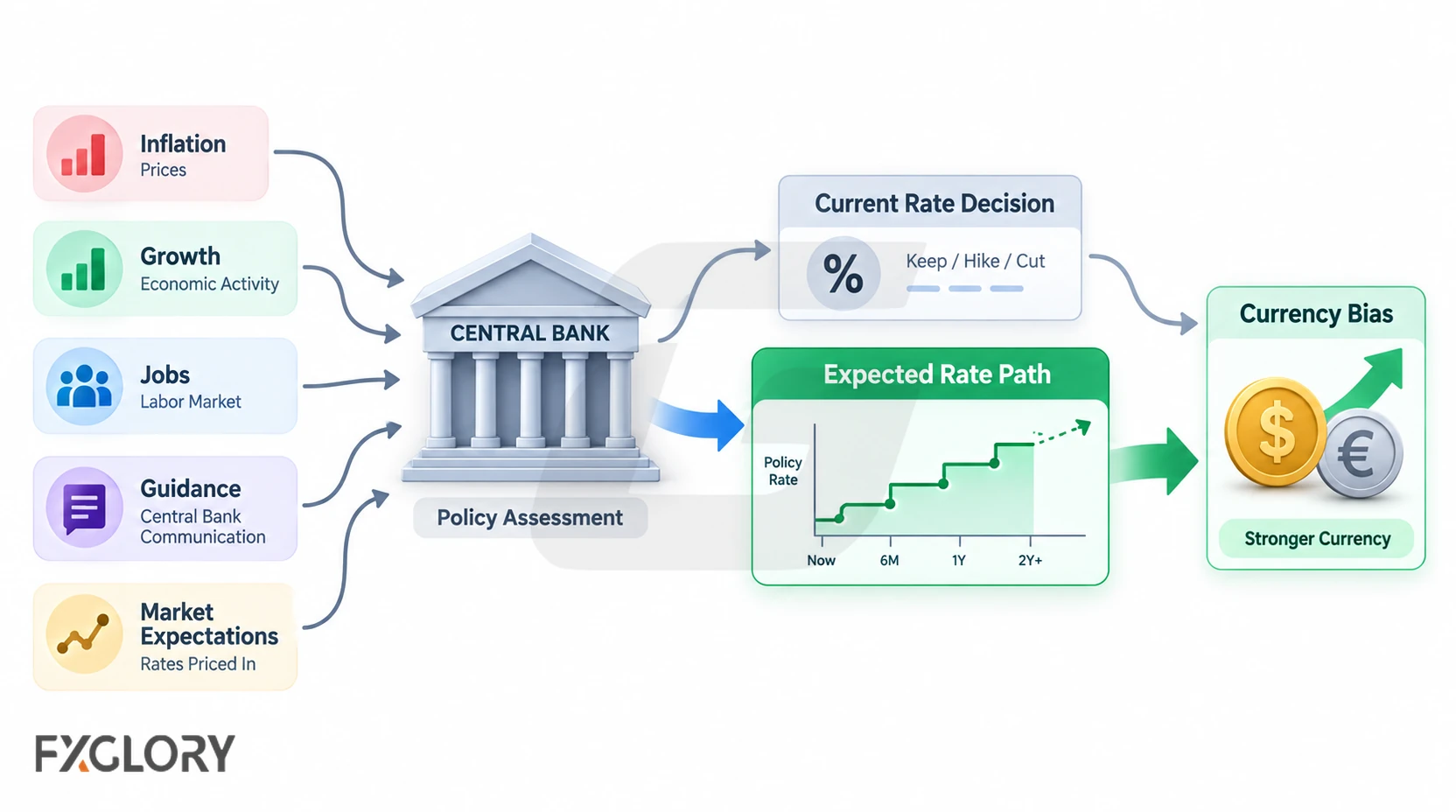
A rate hike can fail to support a currency if it was fully expected or if the central bank signals that tightening may end soon. A rate cut can fail to weaken a currency if the market expected a larger cut or if the central bank sounds less dovish than anticipated. Guidance, tone, forecasts, voting patterns, and press-conference language can change the meaning of the headline decision.
| Central-Bank Element | What To Review | Why It Can Change The Bias |
|---|---|---|
| Headline decision | Hike, cut, hold, or policy adjustment. | The decision may confirm or surprise expectations. |
| Forward guidance | Language about future policy direction. | The future path can matter more than the current decision. |
| Inflation view | Whether inflation is seen as persistent, easing, or uncertain. | It can change the expected rate path. |
| Growth view | Whether the bank sees resilience, slowdown, or recession risk. | It can change policy tolerance and currency demand. |
| Vote split | Whether policymakers were united or divided. | Division can signal uncertainty or a coming shift. |
| Press conference | How policymakers explain the decision. | A single phrase can change market interpretation. |
Using Economic Calendar Data In A Fundamental Strategy
An economic calendar is useful for fundamental strategy because it shows when major data may update the market's view. It should not turn every release into a trade.
For fundamental review, calendar data helps answer whether the economic outlook is improving, weakening, surprising, or becoming mixed. For news trading, the calendar is used for event timing and release-window execution. Those are related but different tasks.
| Calendar Field | Fundamental Strategy Use | News-Trading Use |
|---|---|---|
| Forecast | Shows what the market may be prepared for. | Creates a reference for surprise at release time. |
| Actual | Updates the economic picture. | Can trigger immediate price reaction. |
| Previous | Shows the earlier baseline. | Helps compare whether conditions changed. |
| Revision | Can change the meaning of the latest number. | Can create a second reaction after the headline. |
| Impact level | Helps decide which data deserves attention. | Helps prepare for spread, slippage, and volatility risk. |
For detailed calendar-field and pre-event planning rules, see the economic calendar forex strategy. Release-window execution and spread behavior belong to the separate news-trading approach.
Fundamental Strategy Time Horizons
Fundamental ideas can affect different time horizons. The same economic release may matter for a few minutes, a few days, or a longer policy theme, depending on whether it changes the broader outlook.
| Time Horizon | Typical Focus | Risk |
|---|---|---|
| Event reaction | A specific release, speech, or surprise headline. | Fast volatility, spread widening, slippage, and false reaction. |
| Swing-style bias | A sequence of data and policy expectations over days or weeks. | Mixed data or late entry after the move has already happened. |
| Long-term macro view | Policy divergence, growth divergence, inflation trend, or capital-flow theme. | Large drawdown, swap costs, weekend risk, and thesis drift. |
| Carry-aware view | Interest-rate differential and rollover impact while holding the position. | Exchange-rate movement can outweigh the carry. |
When the idea depends on weeks or months of exposure, pair the macro view with long-term forex trading rules for holding period, review cadence, and account pressure.
Combining Fundamentals With Technical Timing
Fundamentals can create a directional bias, but they do not define an entry by themselves. Technical timing helps decide whether the market is already moving with the bias, rejecting it, consolidating, pulling back, or moving into an area where the trade has poor target room.
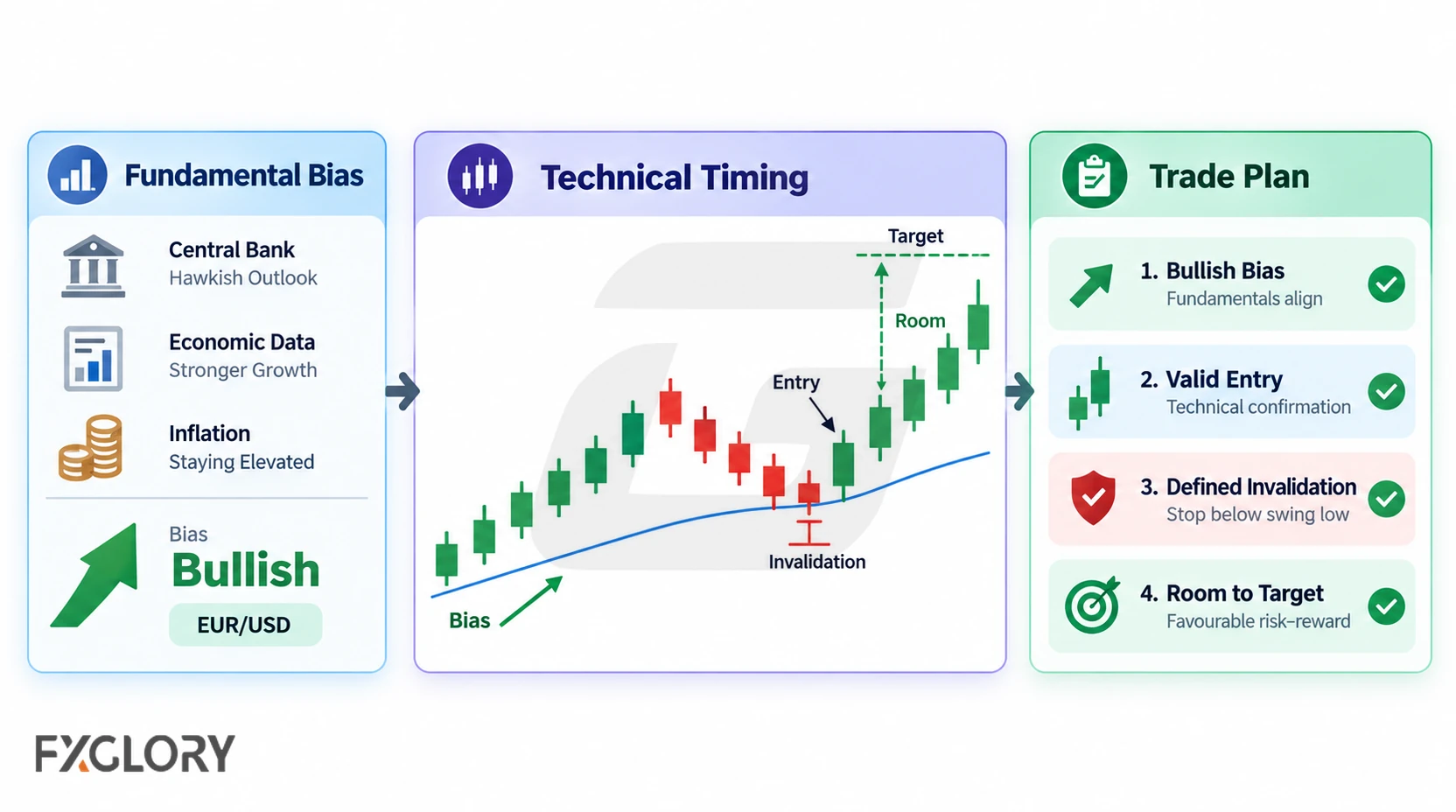
A trader may use higher-timeframe structure to decide whether the fundamental view fits the current market, then use a lower timeframe only to refine timing. The lower timeframe should not be used to justify a trade that conflicts with the main risk rule.
| Technical Check | Useful Question | Weak Use |
|---|---|---|
| Trend | Does price structure support the currency bias? | Forcing a long-term macro story against a strong opposite trend. |
| Support and resistance | Is the planned trade opening directly into an obstacle? | Entering a fundamental idea with no room before the next level. |
| Multiple timeframes | Does the context chart agree with the execution chart? | Using a small-timeframe signal to ignore the larger picture. |
| Entry trigger | What exact condition starts the trade? | Entering because the explanation sounds convincing. |
| Invalidation | Where is the fundamental-and-technical idea wrong? | Moving the stop because the macro story still feels right. |
For chart-role separation, use multiple time frame analysis. For timing, cancellation, targets, and invalidation, use entry and exit rules that are written before the trade. For level quality, use support and resistance strategy rules.
Choosing A Pair For A Fundamental Strategy
Pair selection should express the fundamental comparison clearly. A trader should not choose a pair only because it is familiar. The pair should connect the stronger-currency view with the weaker-currency view and still have enough liquidity, target room, and manageable costs for the plan.
| Pair-Selection Check | Why It Matters | No-Trade Warning |
|---|---|---|
| Both currencies are part of the thesis | The pair should express the actual fundamental comparison. | The trade is really about one currency but the other side is ignored. |
| Liquidity and session fit | Major releases and active sessions can change spread and execution conditions. | The trade is planned during thin liquidity without a spread rule. |
| Correlation with existing trades | Several pairs can create the same currency exposure. | The account is unintentionally overexposed to one macro view. |
| Cost and swap review | Longer holds can be affected by spread and rollover. | The fundamental thesis is small, but costs reduce the practical room. |
| Chart structure | The pair should provide a clear entry, invalidation, and review point. | The trader chooses the pair for the story but cannot define risk. |
Before opening exposure, check whether the instrument, spread, margin, and leverage conditions fit the plan. FXGlory's spread information, leverage conditions, and margin calculator can support this review.
Forex Fundamental Strategy Decision Sequence
A forex fundamental strategy should move in a fixed order. If the trade starts with a story and the rules are added later, the result cannot be reviewed cleanly.
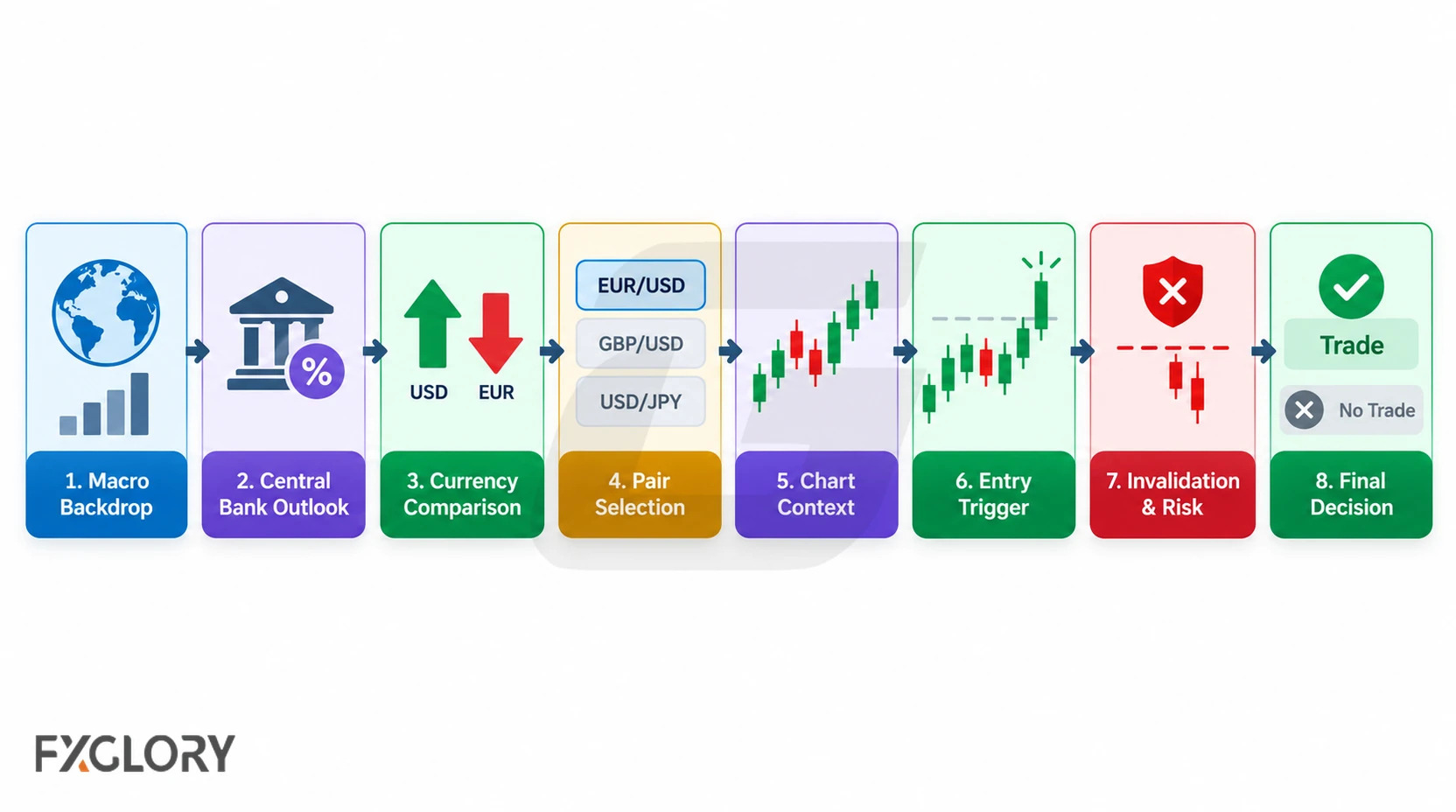
| Step | Decision | Continue Only If |
|---|---|---|
| 1. Economic backdrop | Review growth, inflation, employment, policy, and risk sentiment. | The information is relevant to the currency pair. |
| 2. Central-bank expectation | Review expected rate path, guidance, and policy tone. | The expected path creates a clear currency comparison. |
| 3. Strong vs weak currency | Decide which side has the stronger relative case. | Both sides of the pair have been reviewed. |
| 4. Pair selection | Choose the pair that expresses the view with acceptable liquidity and cost. | The pair direction matches the bias. |
| 5. Chart context | Check trend, support, resistance, volatility, and target room. | Price structure does not contradict the idea. |
| 6. Entry trigger | Define what confirms the trade plan. | The trigger is written before entry. |
| 7. Invalidation | Define where the idea is wrong. | The stop or exit logic fits account risk. |
| 8. Cost and margin review | Check spread, swap, leverage exposure, and required margin. | The account can support the planned trade without stress. |
| 9. Review schedule | Decide which future data or price action can change the thesis. | The trader knows when to reassess, reduce, exit, or stand aside. |
Why Fundamental Forex Strategies Fail
Fundamental strategies often fail when traders treat a convincing explanation as a complete trading plan. Economic logic can be useful, but the market may have priced it already, may care about a different driver, or may react later than expected.
| Failure Reason | What Happens | Better Rule |
|---|---|---|
| Data is already priced in | The currency does not move as expected because traders prepared earlier. | Compare actual information with market expectation, not with personal opinion. |
| Mixed data | One report is supportive while another driver weakens the case. | Stand aside when the fundamental picture is unclear. |
| Wrong pair expression | The chosen pair does not cleanly express the currency comparison. | Review both base and quote currency before choosing direction. |
| No technical timing | The macro idea is valid, but the entry is late or poorly located. | Require chart context and invalidation before entry. |
| Central-bank surprise | Guidance changes the policy path faster than expected. | Reassess after rate decisions, speeches, and press conferences. |
| Story-driven holding | The trader keeps the trade because the original explanation still sounds persuasive. | Exit or reduce if the invalidation rule or thesis-change rule is triggered. |
| Overleverage | A macro view becomes an account-level problem during normal volatility. | Review position size, leverage, margin, and drawdown before entry. |
| Too much information | The trader adds more data after entry to defend a weak position. | Use a limited set of drivers and record why the trade was opened. |
When position size, drawdown, margin pressure, and stop distance need account-level review, use risk-management rules before the trade is placed.
No-Trade Conditions For Fundamental Strategies
A forex fundamental strategy should reject unclear ideas. Skipping a trade is part of the process, especially when the market is reacting to mixed data, changing expectations, or unstable liquidity.
- Skip when the stronger-vs-weaker currency case is unclear.
- Skip when a major release, speech, or policy decision is close and the strategy has no event-risk rule.
- Skip when the pair direction does not express the macro comparison cleanly.
- Skip when price is already extended and the remaining target room is weak.
- Skip when the trade points directly into nearby support or resistance.
- Skip when spread, swap, or margin conditions weaken the idea.
- Skip when existing positions already create the same currency exposure.
- Skip when the trader cannot define invalidation before entry.
- Skip when the only reason for holding is avoiding a realized loss.
Testing And Review Before Live Trading
A forex fundamental strategy should be reviewed on historical examples, demo conditions, or a journal before it is used with real funds. The purpose is not to prove that one economic driver always works. The purpose is to check whether the trader can apply the same bias, timing, cost, and risk rules repeatedly.
Record the information known before entry, not only the explanation after the move. Fundamental trades are easy to rewrite after price moves because traders can usually find a data point that seems to explain the outcome.
- Record the currencies being compared and the reason each side is strong or weak.
- Record the main driver: central bank, rates, inflation, jobs, growth, trade balance, risk sentiment, politics, or carry.
- Record whether the market had already expected the information.
- Record the pair selected and why that pair expresses the idea.
- Record the chart context, timeframe role, entry trigger, invalidation point, and target or exit rule.
- Record spread, swap, leverage, margin, and correlated exposure before entry.
- Record the data, speech, or price behavior that would force reassessment.
- Record whether the trade followed the plan, not only whether it made or lost money.
Forex Fundamental Strategy Checklist
- Identify the two currencies being compared.
- Write the main economic or policy driver before choosing the pair.
- Check whether the driver is new, expected, priced in, revised, or mixed.
- Compare central-bank tone, rate expectations, inflation, employment, growth, trade, political risk, and sentiment.
- Choose the pair only if it expresses the relative view clearly.
- Check the higher-timeframe market condition.
- Use price structure to define timing, target room, and invalidation.
- Review spread, swap, margin, leverage, and correlated exposure.
- Write the entry trigger and cancellation rule before entry.
- Set a review point for future data, central-bank comments, or price behavior.
- Stop reviewing the trade as valid if the original thesis or invalidation rule fails.
Macro-Event Bias-Filter Study Notes For Forex Fundamental Strategy
This hypothetical educational study uses one macro-event bias filter. It reviews high-impact calendar events, maps actual-versus-forecast surprises into simplified currency-supportive or currency-weakening scores, converts those scores into pair-bias observations, and measures forward pair movement over fixed daily windows. It does not simulate entries, stops, targets, position size, leverage, margin, profit factor, or expectancy in R.
The study reviews EURUSD, GBPUSD, USDJPY, AUDUSD, USDCAD, and USDCHF on public yfinance daily OHLC data where available. Event data comes from a one-time public TradingView/Reuters economic-calendar endpoint snapshot saved with the study record.
Recorded research dates: The requested study window was 30 June 2016 to 30 June 2026. The structured research record lists those same first and last available daily-price dates for each of the six currency pairs, with 2,601 downloaded daily rows per pair. The economic-calendar snapshot was saved on 30 June 2026 at 06:48:47 UTC. These dates do not independently establish the first and last event dates in the filtered snapshot, or the first and last event dates matched to usable forward price data; those ranges must be checked in the saved event and observations CSV files.
Timing and source limitation: Scored events are grouped by UTC date, but the supplied aggregate results do not document the exact event-time-to-daily-close alignment or whether each recorded forecast was the value available immediately before its release. The saved snapshot and study script are needed to verify those details. TradingView/Reuters is retained as source attribution, not as a claim of independent dataset verification.
| Study Area | Educational Model Rule |
|---|---|
| Study type | Macro-event currency-bias filter with forward pair-response windows |
| Trade simulation | None |
| Event filter | High-impact events only, with supported currencies and numeric actual-versus-forecast values |
| Currency universe | USD, EUR, GBP, JPY, AUD, CAD, and CHF |
| Currency-supportive surprise | Higher-than-forecast readings for mapped policy-rate, inflation, growth, activity, employment, wages, confidence, retail-sales, industrial-production, or trade-balance events |
| Currency-weakening surprise | Higher-than-forecast readings for mapped unemployment, jobless-claims, continuing-claims, or claimant-count events |
| Daily currency bias | Scored high-impact events are summed by UTC date and currency |
| Pair bias | Base-currency bias minus quote-currency bias |
| Forward response windows | 1, 3, 5, and 10 trading days |
| Measured outcomes | Alignment rate, aligned pips, raw forward pips, cost-hurdle pass rate, pair-level behavior, currency-level behavior, and event-category behavior |
| Cost Hurdle Input | Assumptions Used |
|---|---|
| Spread | 0.5, 1.5, and 3.0 pips |
| Slippage | 0.1, 0.5, and 1.0 pips per side |
| Baseline comparison | 1.5-pip spread and 0.5-pip slippage per side |
| Swap and rollover | Not included |
Educational Bias-Filter Study Results
The macro-event study loaded 7,299 high-impact events from the calendar snapshot. The simplified mapping scored 2,772 events and left 4,527 events unscored because the event was flat, missing numeric actual or forecast data, or not mapped to the rule model. The study created 3,789 unique pair-bias observations across EURUSD, GBPUSD, USDJPY, AUDUSD, USDCAD, and USDCHF.
Observation denominators: The 1-day and 3-day tables each include 3,789 observations, while the 5-day and 10-day windows each include 3,783. The aggregate record does not specify the precise eligibility reason for the six-observation difference, so the longer-window counts should not be interpreted as the same sample without checking the saved observations. The six displayed 10-day event-category counts total 4,188, exceeding 3,783 unique pair observations. Category rows cannot be added as if they were mutually exclusive pair observations; the event-to-pair mapping needs verification from the underlying observations CSV.
| Forward Window | Observations | Alignment Rate | Average Aligned Move | Median Aligned Move | Baseline Cost-Hurdle Pass |
|---|---|---|---|---|---|
| 1 trading day | 3789 | 54.53% | 7.4223 pips | 5.5194 pips | 52.57% |
| 3 trading days | 3789 | 53.84% | 9.5137 pips | 6.6674 pips | 52.39% |
| 5 trading days | 3783 | 52.31% | 7.9521 pips | 8.0943 pips | 51.57% |
| 10 trading days | 3783 | 52.71% | 14.5703 pips | 9.1684 pips | 52.15% |
The baseline cost hurdle used a 1.5-pip spread and 0.5-pip slippage per side. The pass rate shows how often movement in the bias direction exceeded that round-turn hurdle. It is not a trade profit result.
| Pair | 10-Day Observations | 10-Day Alignment Rate | Average Aligned Move | Median Aligned Move |
|---|---|---|---|---|
| AUDUSD | 607 | 49.75% | 4.7006 pips | -0.8041 pips |
| EURUSD | 565 | 52.39% | 8.2548 pips | 8.7368 pips |
| GBPUSD | 681 | 52.28% | 26.5624 pips | 12.8055 pips |
| USDCAD | 737 | 55.22% | 15.2910 pips | 16.0003 pips |
| USDCHF | 548 | 52.74% | 5.9815 pips | 7.1499 pips |
| USDJPY | 645 | 53.33% | 23.2028 pips | 9.8000 pips |
| Mapped Event Category | 10-Day Observations | 10-Day Alignment Rate | Average Aligned Move | Median Aligned Move |
|---|---|---|---|---|
| Employment | 884 | 54.19% | 17.1945 pips | 19.0088 pips |
| Inflation | 894 | 52.57% | 17.9049 pips | 8.3504 pips |
| Pmi Activity | 1134 | 56.53% | 29.3118 pips | 25.0998 pips |
| Retail Sales | 610 | 49.51% | -6.1053 pips | -2.6428 pips |
| Unemployment Rate | 584 | 55.82% | 37.8114 pips | 22.9657 pips |
| Trade Balance | 82 | 53.66% | 27.0987 pips | 17.1495 pips |
| Assumption | Cost Inputs | Round-Turn Hurdle | 1-Day Pass | 3-Day Pass | 5-Day Pass | 10-Day Pass |
|---|---|---|---|---|---|---|
| Lowest tested hurdle | 0.5 spread / 0.1 slippage per side | 0.7 pips | 54.10% | 53.42% | 52.21% | 52.55% |
| Baseline hurdle | 1.5 spread / 0.5 slippage per side | 2.5 pips | 52.57% | 52.39% | 51.57% | 52.15% |
| Highest tested hurdle | 3.0 spread / 1.0 slippage per side | 5.0 pips | 50.44% | 50.78% | 50.83% | 51.33% |
What The Educational Study Shows
The study showed modest directional alignment, not proof of a tradable edge. The 1-day alignment rate was 54.53%, the 3-day alignment rate was 53.84%, the 5-day alignment rate was 52.31%, and the 10-day alignment rate was 52.71%.
Average aligned movement was positive across all four forward windows, but the baseline cost-hurdle pass rate stayed close to the alignment rate. That means the study is most useful for reviewing macro-bias behavior and cost sensitivity, not for claiming that a fundamental strategy works.
Category and pair behavior was mixed. PMI/activity, inflation, employment, unemployment-rate, and trade-balance observations showed different forward-window behavior, while retail-sales observations were weaker in this study. A macro bias still needs pair selection, pricing review, chart timing, invalidation, cost checks, and account-level risk control before any real-money trade is considered.