

What Is A Chandelier Exit Forex Strategy?
A Chandelier Exit forex strategy is an ATR-based trailing-exit method. It uses a recent highest high or lowest low with an ATR multiple to review where the exit line may sit after a trade is already open.
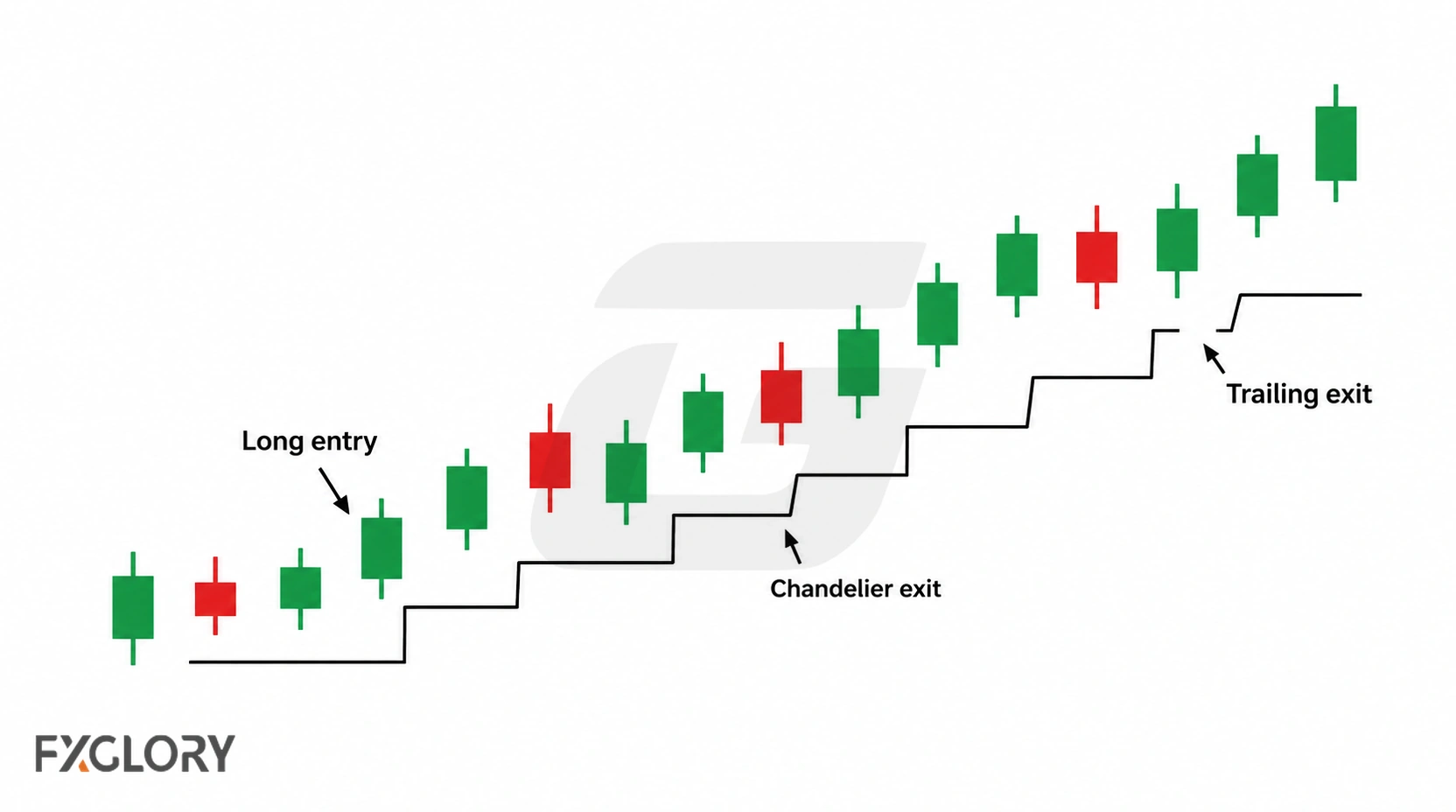
The method is commonly associated with Charles Le Beau and became widely known through trading literature that discussed ATR-based exit management.
The method does not create the trade. It reviews how an open trade may be managed after entry. The trade still needs a setup, direction, trigger, invalidation, spread review, stop-distance review, position-size review, margin review, and a written risk rule.
Use Chandelier Exit for post-entry exit review. For broader volatility context, review ATR as volatility and risk support. For initial stop placement before or at entry, use ATR stop-loss rules. For broader post-entry ATR stop movement, use ATR trailing-stop rules.
Chandelier Exit vs Full Forex Strategy
A Chandelier Exit line can organize an exit decision, but it does not define the whole trade. The trade plan still needs the reason for entry, the area where the idea is wrong, and the risk that can be accepted.
| Part Of The Plan | What It Decides | Chandelier Exit Role | Main Risk |
|---|---|---|---|
| Trade setup | Why the trade exists | No direct role | The exit tool is used as an entry reason |
| Entry trigger | When the trade is opened | No direct role | The trader enters because the line appears on the chart |
| Initial invalidation | Where the original idea is wrong | Separate from the Chandelier line | The initial risk plan is unclear |
| Post-entry exit | How the open trade is reviewed | Main role | The exit rule is changed after price moves |
| Position size | How much exposure the trade carries | Indirect role through stop distance | The Chandelier distance is too wide for the account plan |
When the original trade idea needs context, trigger, invalidation, and review rules, use the forex trading setups framework before applying a trailing-exit method.
How Chandelier Exit Is Calculated
The Chandelier Exit calculation uses a price extreme and an ATR multiple. The price extreme changes depending on trade direction.
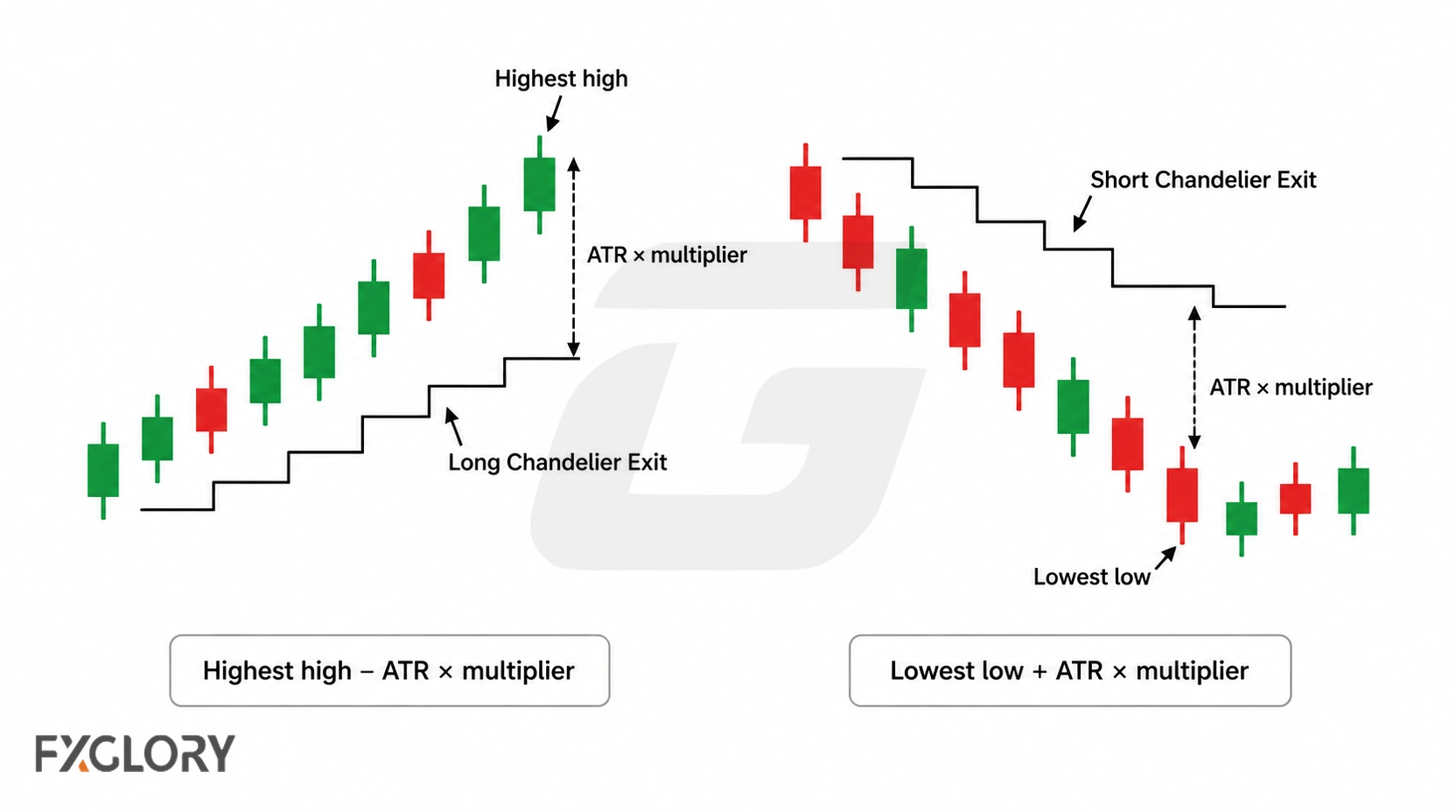
| Trade Direction | Common Formula Reference | Exit Line Location | What It Reviews |
|---|---|---|---|
| Long trade | Highest high over chosen period − ATR × multiplier | Below price | Whether the open long trade still has room to continue |
| Short trade | Lowest low over chosen period + ATR × multiplier | Above price | Whether the open short trade still has room to continue |
The formula is a reference for testing. The period, ATR length, multiplier, pair, timeframe, spread, and trade plan can change how useful the line is in practice.
Long And Short Chandelier Exit Rules
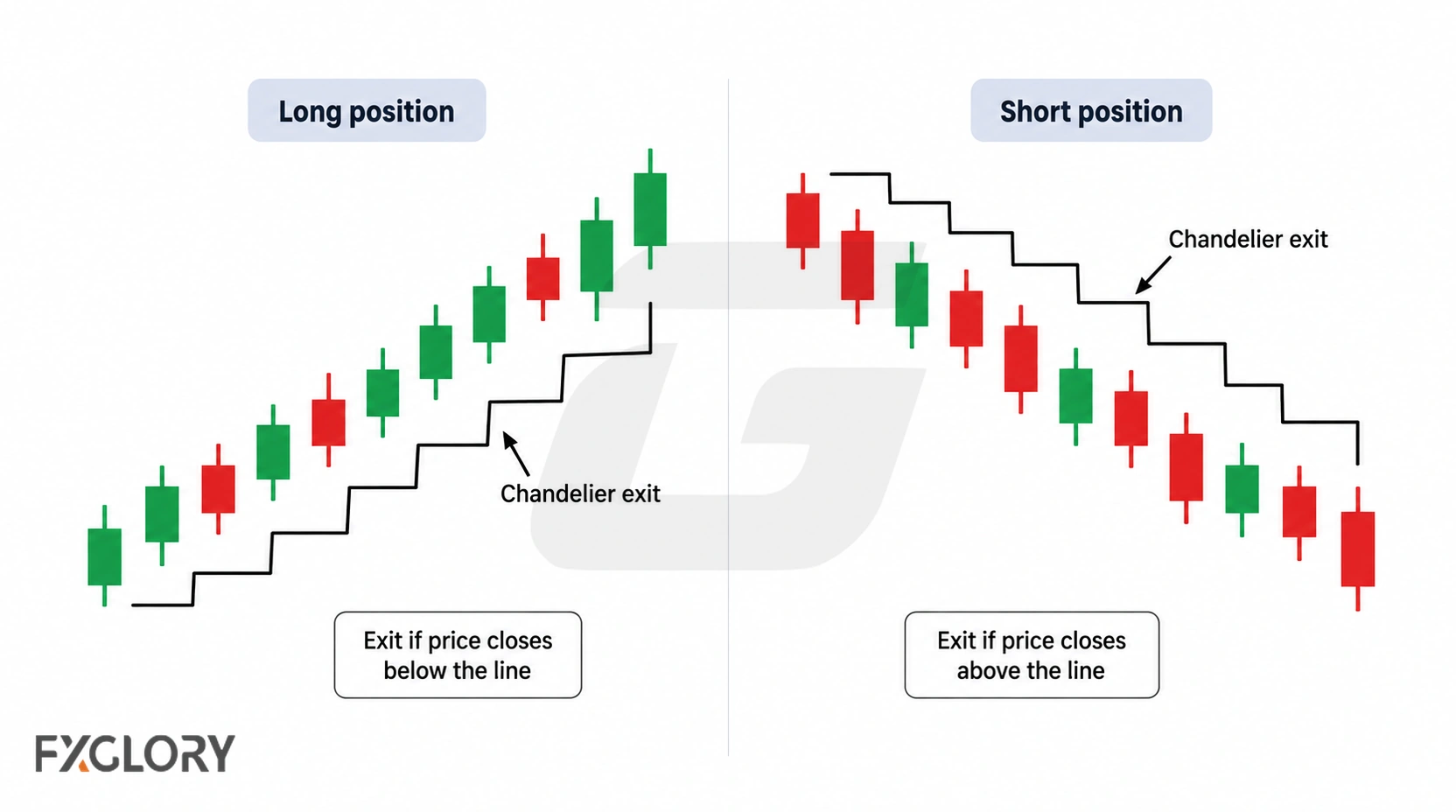
The long and short versions should not be mixed. A long trade uses a recent high as the anchor. A short trade uses a recent low as the anchor.
| Open Trade | Anchor | ATR Distance | Exit Review | Main Risk |
|---|---|---|---|---|
| Long position | Highest high over the selected period | Subtract ATR × multiplier | Review exit if price closes below, breaks below, or triggers the written rule | The trader lowers the stop to avoid an exit |
| Short position | Lowest low over the selected period | Add ATR × multiplier | Review exit if price closes above, breaks above, or triggers the written rule | The trader raises the stop to avoid an exit |
The exit rule should define whether the line is checked by candle close, intrabar break, platform stop order, manual review, or another written condition. A close-based rule may reduce some noise but can respond later. An intrabar rule may react faster but can be more sensitive to volatility and spread.
The Chandelier line is an exit reference. Fast movement, spread changes, gaps, slippage, or platform execution conditions can affect the final exit price.
Chandelier Exit Workflow After Entry
The Chandelier Exit workflow starts only after the trade exists. The order of decisions matters because the exit line can affect stop distance, exposure, and whether the trade can still be managed.
| Step | Question | Tool Or Context | Decision |
|---|---|---|---|
| 1 | Is there already an open trade? | Trade setup and entry record | Use Chandelier Exit only for post-entry review |
| 2 | What is the correct anchor? | Highest high for longs, lowest low for shorts | Set the line from the correct side of the market |
| 3 | What ATR distance is being used? | ATR period and multiplier | Review whether the line is too tight or too wide |
| 4 | How will the line be checked? | Close, break, alert, or order rule | Define the exit trigger before the trade is managed |
| 5 | Can the trade still be managed? | Spread, stop distance, position size, margin | Continue, keep the written exit rule, reduce exposure by plan, or exit by rule |
Chandelier Exit Settings: 22 Periods And 3x ATR
A common Chandelier Exit reference is 22 periods and a 3x ATR multiplier. The 22-period reference is often used to represent roughly one trading month on daily charts, while the 3x ATR multiplier creates a volatility-based distance from the recent high or low.
These are testing references, not universal settings. Shorter settings may react faster but can create more exits. Wider settings may give price more room but can increase stop distance.
| Setting Reference | Possible Use | Main Risk |
|---|---|---|
| 22-period lookback | Common price-extreme reference | May not fit every pair, timeframe, or trade style |
| 3x ATR multiplier | Common volatility-distance reference | Can be too wide or too tight depending on conditions |
| Shorter lookback | Faster response to newer highs or lows | More sensitivity and possible whipsaw |
| Longer lookback | Smoother exit line | Later exits and wider distance |
| Lower multiplier | Tighter trailing line | More frequent exits in noisy markets |
| Higher multiplier | Wider trailing line | Larger giveback and wider loss scenario if not planned |
Some charting tools may offer anchored Chandelier-style variations that calculate from a selected event, price point, or timeframe. Treat those as separate tool settings, not the same rule as the standard highest-high or lowest-low Chandelier Exit calculation.
Settings should be chosen before testing and kept consistent long enough to review trends, pullbacks, ranges, fast reversals, lower-timeframe examples, and skipped setups.
Chandelier Exit vs ATR Stop Loss vs ATR Trailing Stop
ATR can support several different stop and exit decisions. Each one has a different job.
| Method | Main Job | When It Is Used | Best Use |
|---|---|---|---|
| ATR stop loss | Reviews initial stop distance | Before or at entry | Planning the first risk boundary |
| ATR trailing stop | Reviews post-entry stop movement using ATR distance | After entry | Broad trailing-stop workflow |
| Chandelier Exit | Reviews post-entry exit using recent high or low plus ATR distance | After entry | Specific ATR-based trailing exit method |
Use initial ATR stop-loss rules when the first stop is being planned before or at entry. Use ATR trailing-stop rules when comparing broader post-entry trailing methods.
When The Chandelier Exit Line Moves
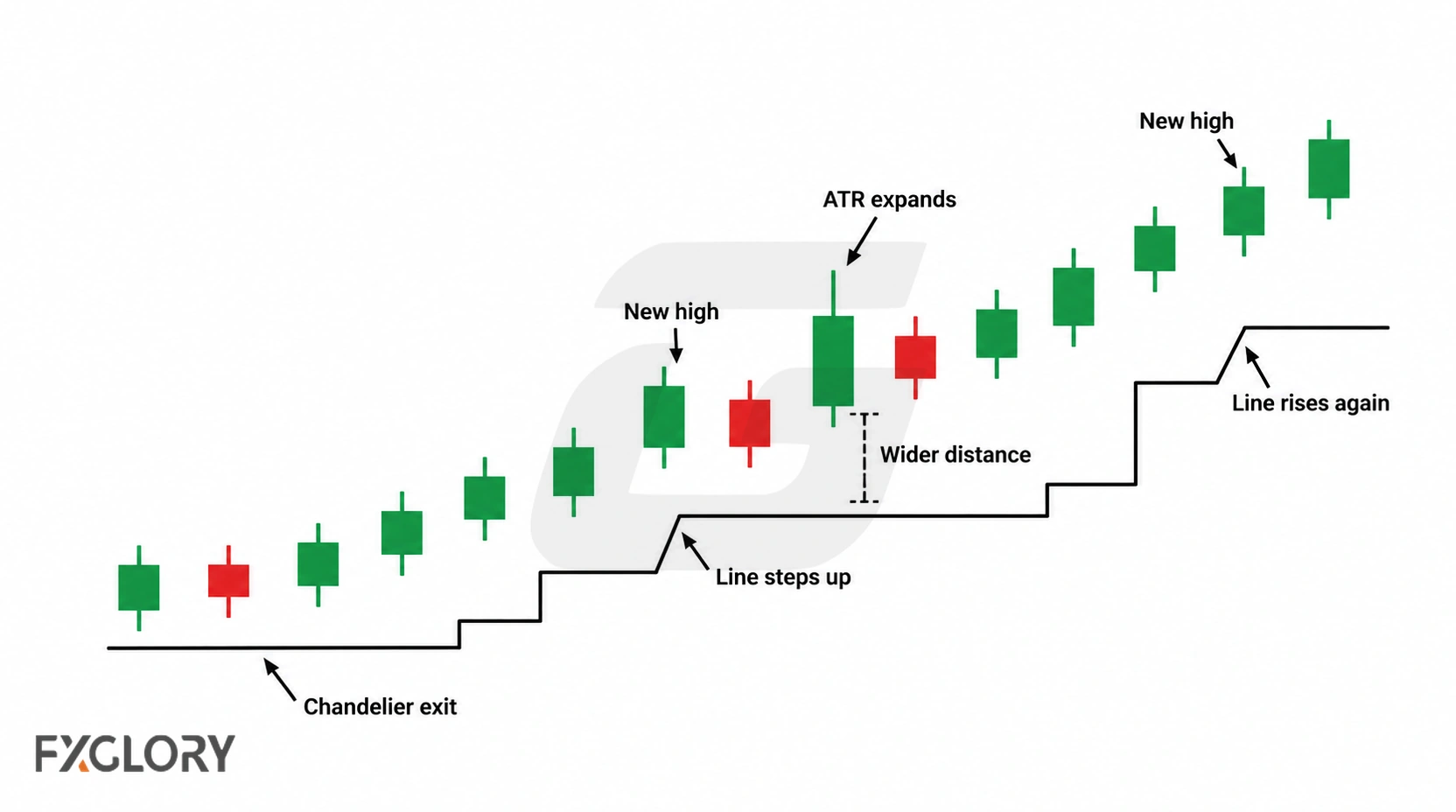
The Chandelier line can change when the recent price extreme changes, when ATR changes, or when a platform recalculates the line based on its chosen settings. The line should be managed by a written rule.
| Line Behavior | Possible Meaning | What To Check | Main Risk |
|---|---|---|---|
| Long line rises as price makes new highs | The trailing exit may be tightening behind the trend | Whether the trade still fits the continuation plan | Exit is moved too close without testing |
| Short line falls as price makes new lows | The trailing exit may be tightening above the move | Whether the trade still fits the continuation plan | Exit is moved too close without testing |
| ATR expands sharply | Volatility distance may increase | Whether the stop distance still fits the plan | Risk becomes wider than expected |
| ATR contracts | The exit line may tighten | Whether the line becomes too sensitive to noise | Premature exits become more likely |
| Price crosses the line in a range | The exit may be triggered by chop | Market condition and no-trade or re-entry rule | Repeated exits and re-entries |
A protective exit rule should not be moved farther from the trade just to avoid an exit. If the rule allows adjustment, the adjustment should be defined before the trade is managed.
Trend, Range, And Whipsaw Conditions
Chandelier Exit is usually easier to interpret when price is moving with structure. In a range, price may cross the line repeatedly.
| Market Condition | How Chandelier Exit May Behave | What To Check | Main Risk |
|---|---|---|---|
| Clean trend | Line may trail behind the move | Higher highs, higher lows, or lower highs and lower lows | Late entry leaves too much distance to the line |
| Pullback inside trend | Price may approach the line without invalidating the trend | Pullback structure and planned exit rule | Exit is triggered before the trend idea is reviewed |
| Sideways range | Price may cross the line often | Support, resistance, and no-trade rule | Whipsaw exits become frequent |
| News-driven volatility | ATR and price movement may change quickly | Spread, slippage, and loss scenario | The exit line may not reflect normal conditions |
| Late-stage trend | Line may trail far behind price | Target realism and giveback tolerance | Large open profit giveback if no review rule exists |
When the exit plan depends on trend quality, review forex trend behavior. When the line interacts with market levels, review support and resistance in forex.
Confirmation Tools For Chandelier Exit
Confirmation should answer a specific management question. Adding more indicators does not automatically improve an exit rule. Each tool should have one job.
| Tool Or Context | Question It Helps Answer | Use Carefully Because |
|---|---|---|
| Trend structure | Is the trade still moving with the original idea? | Trend can weaken before the line is crossed |
| Support and resistance | Is price reacting near a meaningful level? | Levels are usually zones, not exact prices |
| ADX | Is trend strength supporting the open trade? | ADX may confirm late and does not show direction alone |
| Moving average | Is price holding above or below a baseline? | Moving averages can lag and whipsaw in ranges |
| ATR review | Has volatility changed enough to affect stop distance? | ATR does not confirm direction |
| Higher timeframe | Does the open trade still fit broader structure? | Lower-timeframe exits may conflict with broader context |
For trend-strength review, use ADX as a trend-strength filter. For baseline behavior, use the Forex Moving Average guide.
Day Trading And Scalping Considerations
Lower-timeframe Chandelier Exit rules can react quickly because ATR and recent highs or lows can change more often. Faster updates do not automatically make the method easier to use.
| Short-Term Issue | Why It Matters | What To Check |
|---|---|---|
| Spread sensitivity | Tight exits can be affected by trading cost | Check whether the exit distance still makes sense after spread |
| Fast ATR changes | Volatility can change the trailing distance | Review whether the line is too tight or too wide |
| Repeated line crosses | Ranges can trigger frequent exits | Use a no-trade or no-re-entry rule |
| Late exits | A wider Chandelier line can give price more room | Review giveback tolerance before entry |
| Platform workflow | Indicators, alerts, and tools may calculate the line differently | Confirm lookback, ATR length, multiplier, and update behavior |
Before using lower-timeframe Chandelier rules, review FXGlory spreads. When exit distance affects exposure, use the FXGlory margin calculator. Review FXGlory trading platforms when the strategy depends on charting tools, indicators, alerts, order placement, or trade-management workflow.
Platform availability and indicator calculations can vary. Confirm whether the charting tool uses the expected lookback period, ATR length, multiplier, price source, and update method before testing a Chandelier Exit rule.
Worked Example: One Open Trade, Four Exit Decisions
Assume a long trade is already open and price has made a new high. The Chandelier Exit line is calculated below price using the selected lookback and ATR multiplier. The same open trade can lead to different management decisions.
| Observation | Possible Meaning | Next Check | Decision Risk |
|---|---|---|---|
| Price trends higher and stays above the line | The long trade may still fit the trailing plan | Check trend structure, spread, and planned management rule | Holding without review if momentum fades |
| Price pulls back toward the line but structure holds | The trade may still be inside a normal pullback | Check support, trend behavior, and exit trigger rule | Exiting before the written condition triggers |
| Price closes below the line | The exit rule may be triggered | Apply the written close or break rule | Ignoring the exit because the trader wants the move to resume |
| Price crosses the line repeatedly in a range | The method may be reacting to chop | Use range or no-trade review | Repeated exits and re-entries increase decision pressure |
When Chandelier Exit Strategies Fail
Chandelier Exit strategies often fail when the exit tool is treated as a complete trade plan. The most common problem is not the formula itself; it is using the line without structure and risk control.
- Used as an entry signal: The trader opens a trade because the Chandelier line appears, not because a setup exists.
- No original setup: The exit method is added to a trade with no clear reason for entry.
- Stop moved emotionally: The protective exit is moved farther away to avoid an exit.
- Range conditions ignored: Price crosses the line repeatedly in sideways markets.
- Settings changed after each result: The lookback or multiplier is adjusted without a stable test.
- Spread ignored: A lower-timeframe exit has too little room after trading cost.
- Stop distance ignored: The line is too far from price for the account plan.
- Platform calculation ignored: The trader assumes every tool uses the same lookback, ATR length, multiplier, and update behavior.
- Trend weakness ignored: The line is followed mechanically while structure already shows the trade is weakening.
Testing A Chandelier Exit Forex Strategy
A Chandelier Exit forex strategy should be tested as a post-entry exit rule, not as an entry signal. Testing should include clean trends, pullbacks, sideways ranges, fast reversals, news volatility, late entries, lower-timeframe examples, and skipped setups.
- What setup must exist before Chandelier Exit is used?
- Is the trade long or short?
- What lookback period is being tested?
- What ATR length and multiplier are being tested?
- Is the exit checked by close, break, alert, manual review, or stop order?
- Does the Chandelier distance still make sense after spread?
- Does the distance fit position size and margin exposure?
- What happens if price crosses the line during a range?
- What rule prevents moving the stop farther away after entry?
- Are late exits, false exits, and skipped setups recorded?
- Does the result change across selected currency pairs or timeframes?
Review available currency pairs before applying the same Chandelier Exit rule everywhere.
Chandelier Exit Forex Strategy Checklist
Before using a Chandelier Exit rule, answer these questions.
- Does an open trade already exist?
- Was the trade opened from a separate setup?
- Is the trade long or short?
- What lookback period controls the highest high or lowest low?
- What ATR length and multiplier are being tested?
- Will the exit trigger use a close, break, alert, manual review, or order rule?
- Does trend structure still support the open trade?
- Does the line sit at a manageable distance after spread?
- Does exit distance fit position size and margin?
- What condition makes the trade exit by rule?
- What condition prevents moving the stop farther away?
A Chandelier Exit forex strategy is useful only when it is treated as a post-entry exit method. The Chandelier line can organize trailing-exit review; the original setup, trend context, price structure, spread, stop distance, margin, and risk rules decide whether the open trade can be managed.