
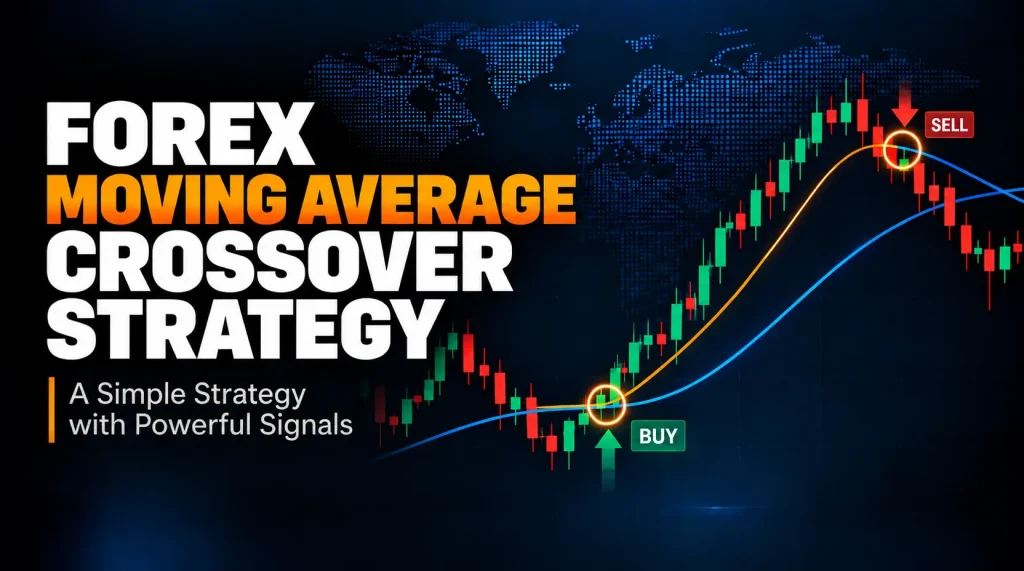
What Is A Forex Moving Average Crossover Strategy?
A forex moving average crossover strategy identifies when a faster moving average changes position relative to a slower one. Under a completed-candle rule, a bullish cross occurs when the fast average was at or below the slow average on the previous closed candle and is above it on the latest closed candle; a bearish cross reverses those comparisons. Define how equal values are handled and whether intrabar readings count.
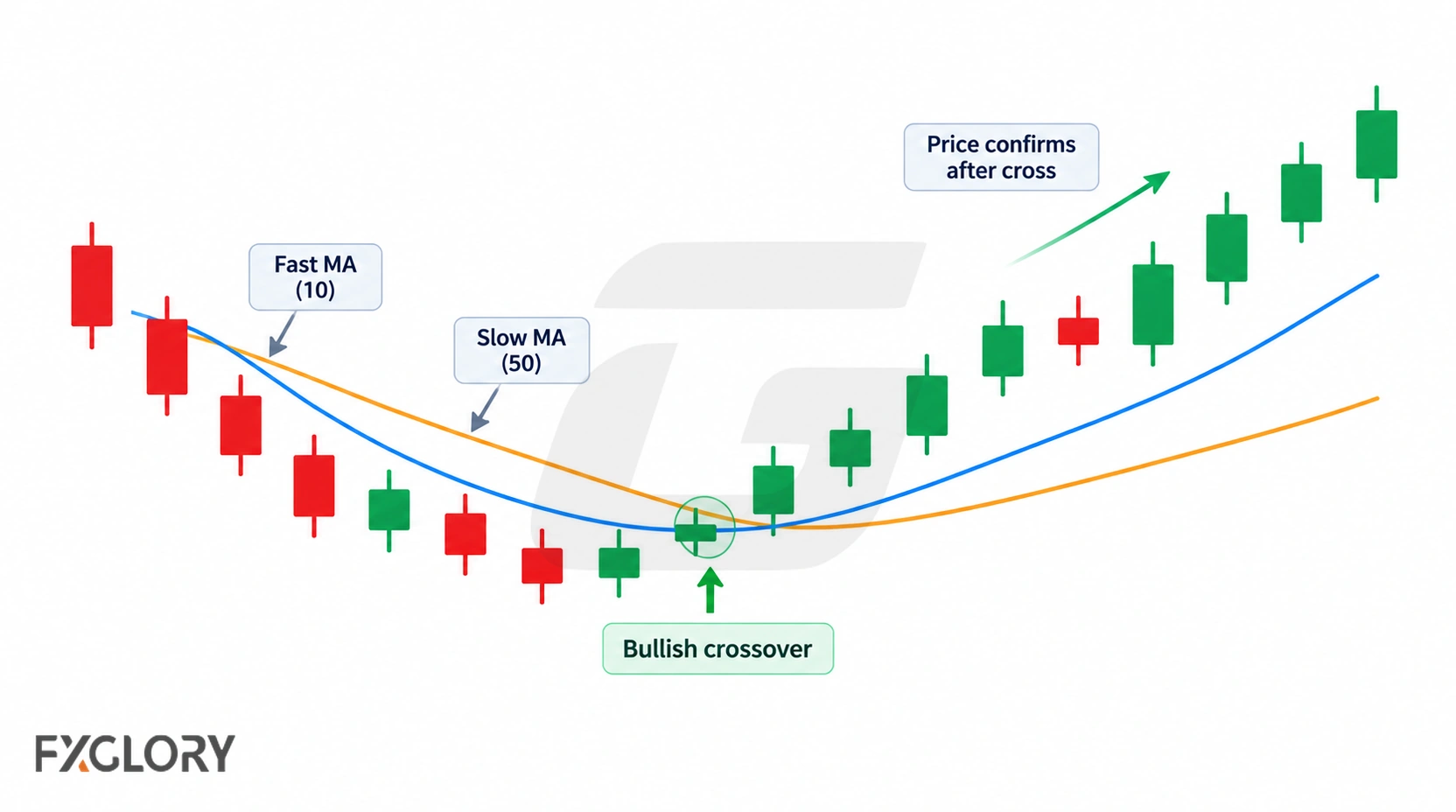
Moving average crossovers lag because both averages are calculated from past prices. A crossover may confirm only after price has already moved, so the distance to invalidation and the remaining target area should be checked before the setup is accepted.
This guide focuses on fast/slow crossover events, their possible entry or exit uses, and how to test the surrounding decision rules. For the broader indicator-strategy framework, review forex indicator strategies. For moving-average mechanics, use the dedicated Forex Moving Average guide.
A crossover may itself be the predefined entry or exit trigger of a mechanical system. Optional structure or trend filters depend on the tested method; protective exits, position sizing, transaction costs, and eligible trading conditions must still be defined.
Moving Average Crossover Signal vs Full Forex Strategy
A crossover identifies a calculable event. It can serve as a direct trigger in a fully specified mechanical system, but a crossing alone does not state how much to trade, when to exit, or whether execution costs make the trade viable.
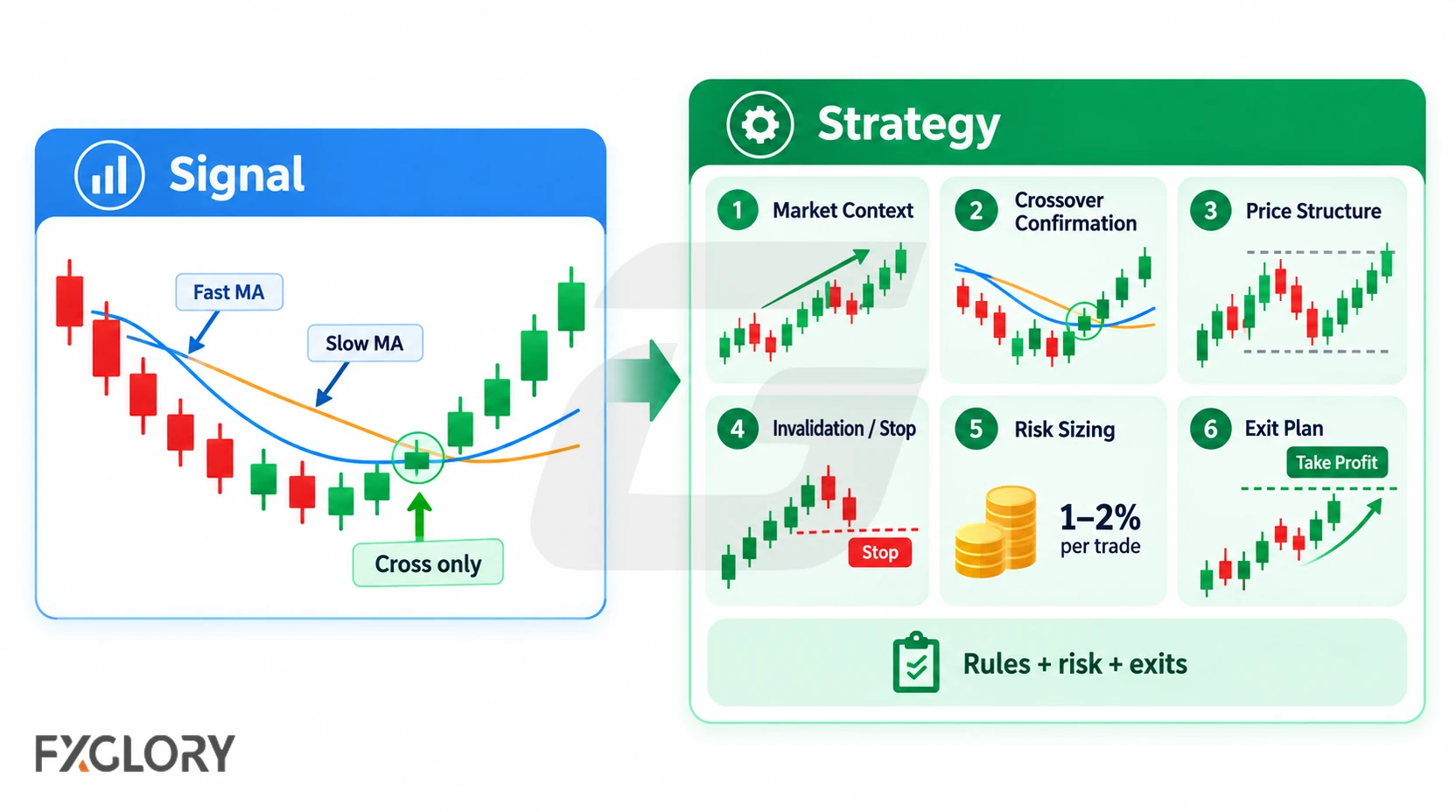
Any per-trade risk percentage shown in this illustration is a hypothetical sizing example, not a universal recommendation; account-risk limits must be selected and checked independently.
| Crossover Condition | What It May Suggest | Optional Filters Or Required Plan Checks | Main Risk |
|---|---|---|---|
| Fast MA crosses above slow MA | Bullish average-price shift may be developing | Selected context filters, entry timing, invalidation, and size | The cross appears inside a range |
| Fast MA crosses below slow MA | Bearish average-price shift may be developing | Selected context filters, entry timing, invalidation, and size | The cross appears after price is already extended |
| Repeated crosses | Market may be choppy or range-bound | Support, resistance, ADX, higher timeframe | Whipsaw entries become frequent |
| Late crossover | A trend may already be visible after the move | Distance to invalidation and target realism | The entry chases the move |
| Flat moving averages | Trend direction may be weak or unclear | Range plan or no-trade rule | The strategy forces trades in unclear conditions |
An intrabar crossing can disappear as the live candle changes. A closed-bar rule fixes the observation after the candle completes, though the resulting entry may be later. Treat intrabar and closed-bar approaches as different specifications when comparing test results.
When a crossover condition needs to become a full trade plan, use the forex trading setups framework before adding more indicators.
Types Of Moving Average Crossovers
Moving average crossover searches often mix several related ideas. They should not all be treated as the same rule.
| Crossover Type | How It Works | May Fit | Main Risk |
|---|---|---|---|
| Price crossing one moving average | Price moves above or below a single average | Price-position or pullback review | Can create many signals without trend context |
| Double moving average crossover | Fast MA crosses slow MA | Trend-shift or continuation review | Can whipsaw in sideways markets |
| Triple moving average alignment | Fast, medium, and slow averages align or cross | Extra trend filter or staged confirmation | Can delay entries and exits |
| Golden cross | Shorter-term average crosses above longer-term average | Broader bullish-context review | May confirm after a large part of the move |
| Death cross | Shorter-term average crosses below longer-term average | Broader bearish-context review | May lag during fast reversals |
| Moving-average ribbon | Several averages spread, compress, or reorder | Trend-quality and compression review | Can become visually complex and harder to test |
A triple-average alignment or moving-average ribbon can remain ordered over many candles without a fresh crossover. Define whether the rule acts on the first crossing, a later alignment, or a reversal of that alignment before treating these variants as comparable.
Bullish And Bearish Moving Average Crossover Rules
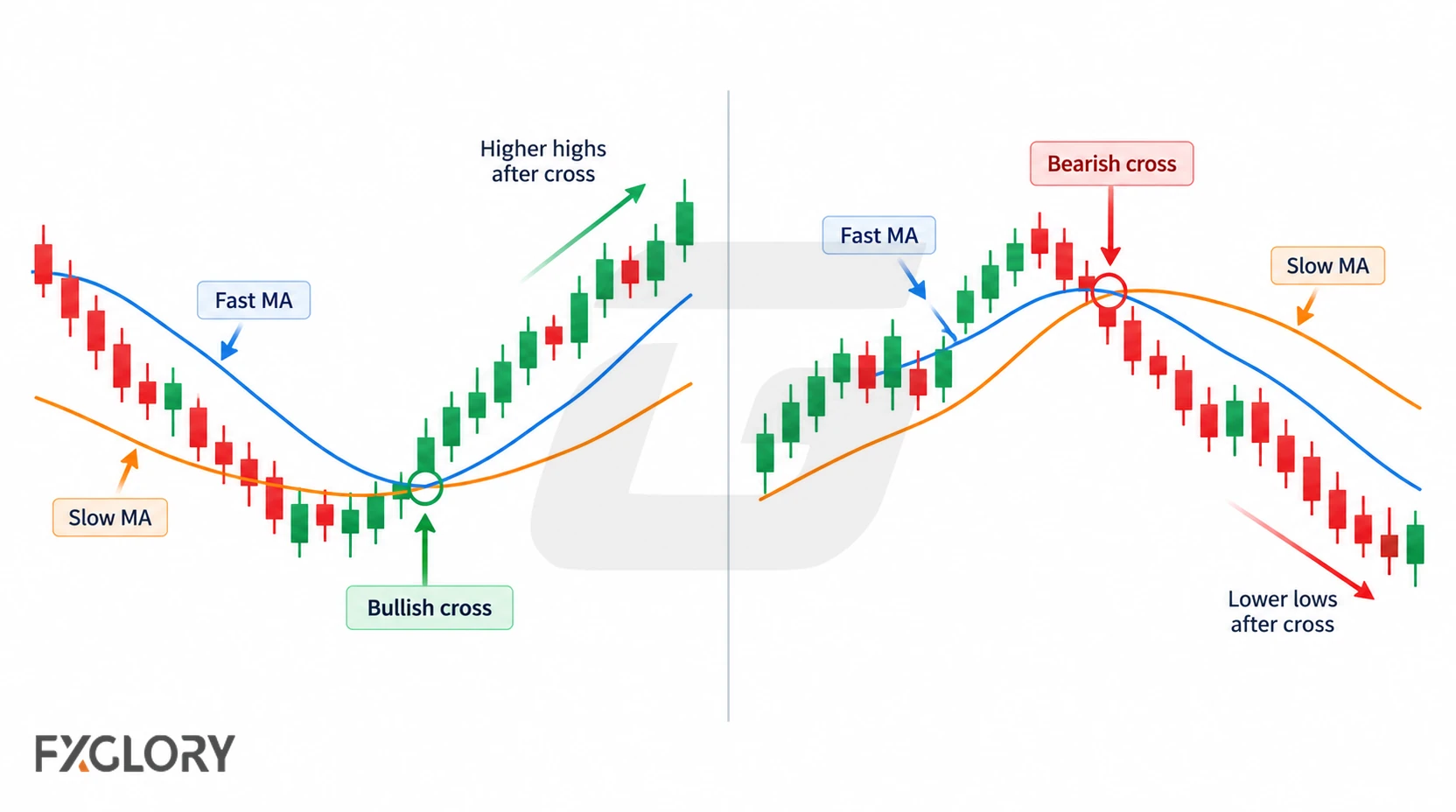
A bullish or bearish crossover is a directional change in the fast/slow average ordering. Depending on the strategy, it can be the entry trigger, an exit condition, or a filter; any additional price confirmation must be specified rather than assumed mandatory.
| Condition | Possible Reading | Possible Structure Filter | Skip When |
|---|---|---|---|
| Fast MA crosses above slow MA | Average price may be shifting upward | Higher low, resistance break, retest, or trend structure | Price is still trapped in a range |
| Fast MA crosses below slow MA | Average price may be shifting downward | Lower high, support break, retest, or trend structure | Price is still trapped in a range |
| Fast MA crosses above while higher timeframe is bearish | Lower-timeframe bounce may be developing | Higher-timeframe resistance and risk area | The setup fights broader structure without a plan |
| Fast MA crosses below while higher timeframe is bullish | Lower-timeframe pullback may be developing | Higher-timeframe support and trend context | The move is only a pullback into structure |
When the crossover depends on trend direction, review forex trend behavior. When the crossover depends on a breakout, retest, or range boundary, review support and resistance in forex.
Entry Crossovers vs Exit Crossovers
A crossover can be used as an entry-condition review or an exit-condition review, but the two jobs should not be mixed. An entry crossover asks whether a new setup may exist. An exit crossover asks whether an existing trade should be reviewed or closed by rule.
| Crossover Use | Question | Still Needs | Main Risk |
|---|---|---|---|
| Entry crossover | Is a new trend condition developing? | Entry timing, invalidation, expected costs, and position sizing | The cross appears inside chop |
| Exit crossover | Is an existing trade losing its original condition? | Specified reversal-close timing, close-or-reverse decision, and an independent protective-risk rule | The exit is delayed or changed emotionally |
Forex Moving Average Crossover Decision Chain
Separating signal detection from trade approval prevents a crossover that occurs after an extended move or directly into an obstacle from becoming an unplanned position. The final accept-or-skip decision remains explicit even when the crossing itself is the entry trigger.
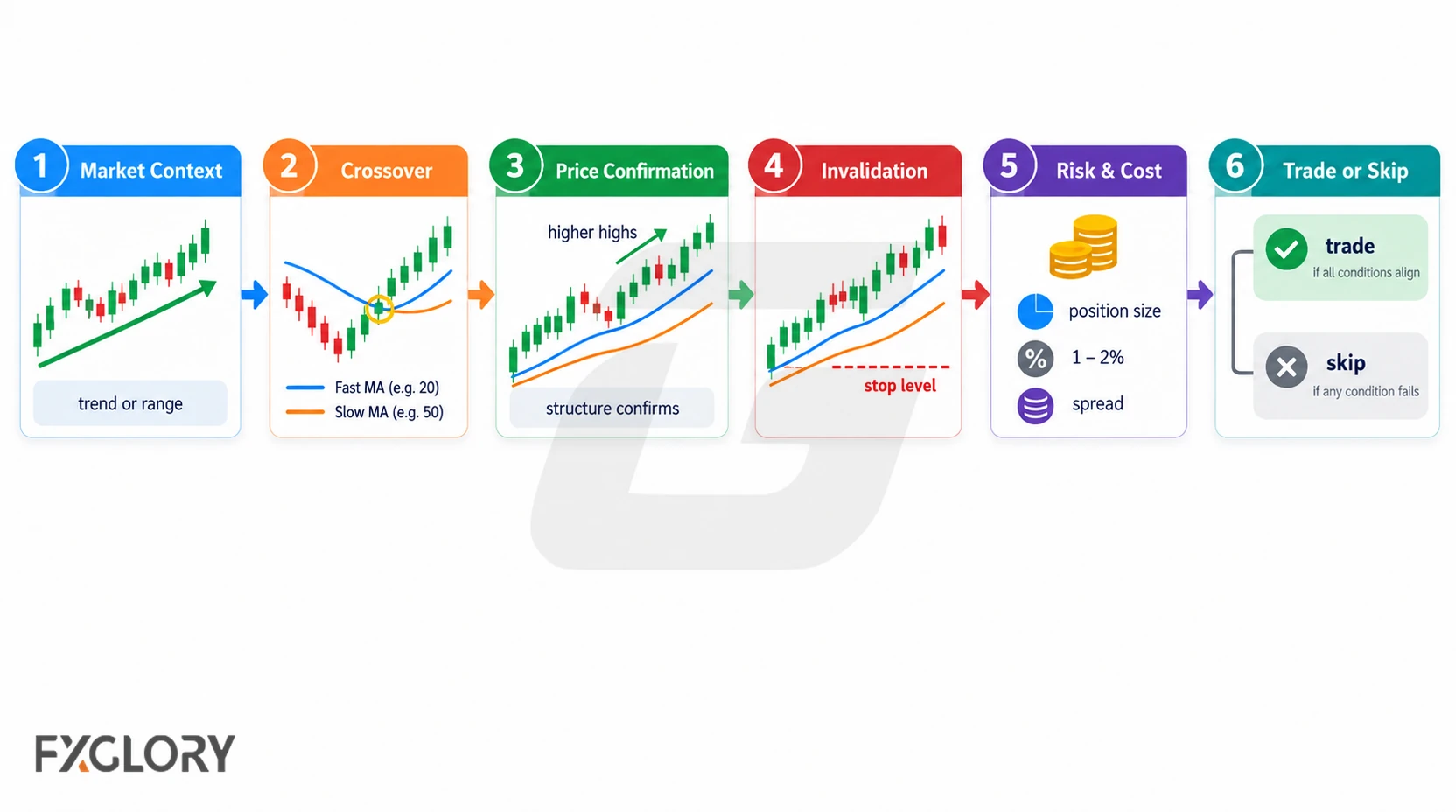
| Step | Question | Tool Or Context | Decision |
|---|---|---|---|
| 1 | Is the market trending, ranging, or unclear? | Price structure, higher timeframe, trend context | Choose trend, range, breakout, or no-trade context |
| 2 | Did a fast and slow average cross? | Moving average pair | Mark the crossover condition |
| 3 | Are the specified trigger and filter conditions satisfied? | Completed-candle check and any preselected price or trend filters | Record whether the defined entry conditions pass |
| 4 | Where is the crossover idea wrong? | Invalidation area and stop distance | Define the risk area |
| 5 | Do cost and account-risk constraints pass? | Spread, stop distance, position size, margin | Record risk approval or a failed constraint |
| 6 | Is the trade authorized by all written rules? | Passed signal, exit and risk conditions | Trade, reduce, delay, or skip as specified |
Crossover vs False Cross
A crossover remains a correctly identified event even if price subsequently moves against the trade. A whipsaw may mean the fast and slow averages cross back in the opposite direction soon afterward; a losing trade is an outcome under separate exit rules. Define the reversal window or other failure test before counting false crosses.
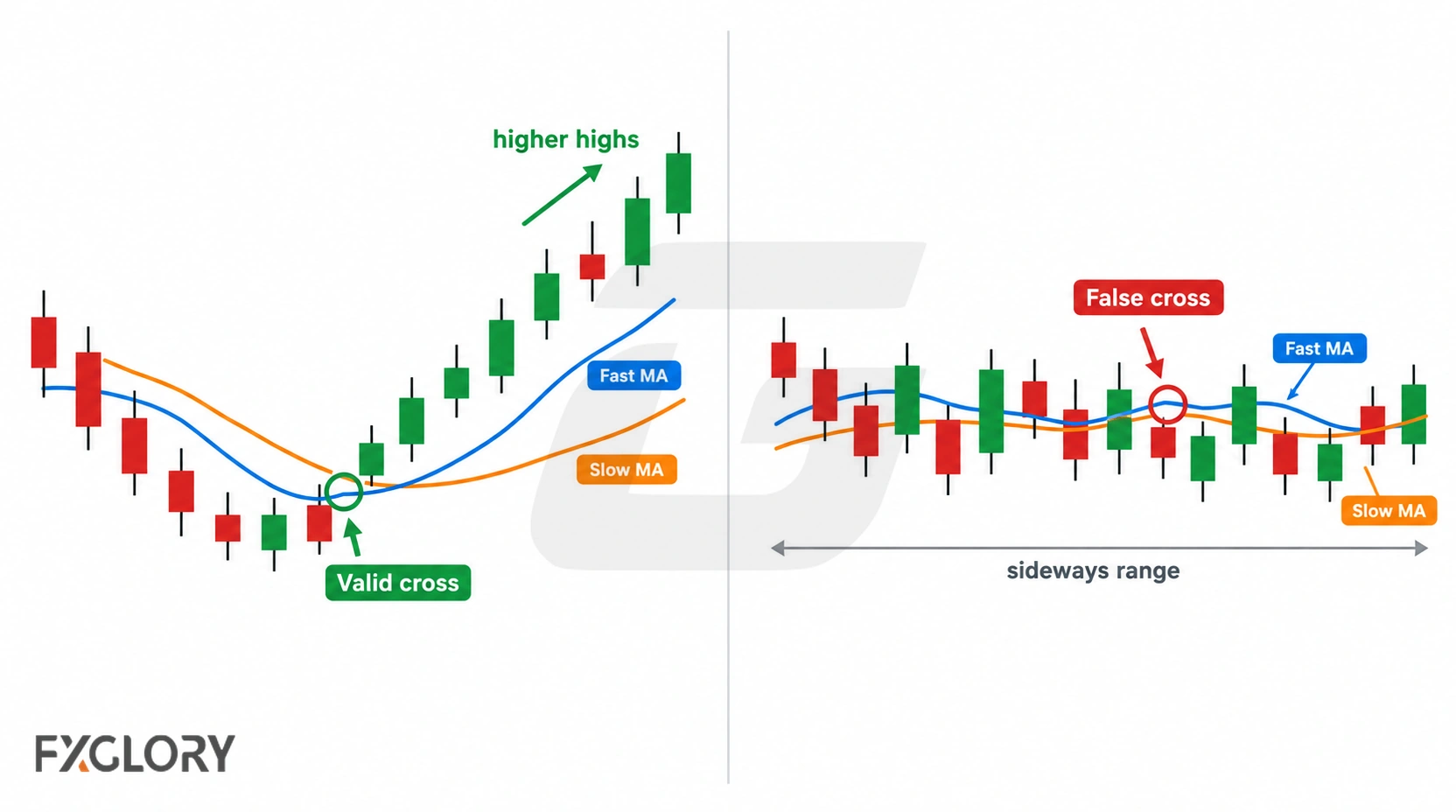
| Whipsaw-Risk Clue | Why It Matters | Response |
|---|---|---|
| Moving averages are flat | Trend direction may be weak | Wait for clearer price structure |
| Price crosses back and forth around the averages | The market may be ranging | Use support/resistance or no-trade rule |
| No higher high or lower low appears | The crossover may lack structure confirmation | Use this as a filter only if the written strategy requires structure confirmation |
| ADX remains weak | Trend strength may not support the cross | Apply an ADX filter only if the selected system specifies one |
| Spread is large relative to target | Short-term crossover may not have enough room | Reject the setup or change the test conditions |
Some crossover systems reverse positions at every opposite crossing; others pause entries when ranges, flat averages, or high costs meet a written exclusion rule. Both designs are testable, but their whipsaw frequency, drawdowns, and transaction costs must be measured under their actual rules.
For trend-strength filtering with moving averages, review ADX and moving average strategy rules. For ADX-specific trend-strength review, use ADX as a trend-strength filter.
Popular Moving Average Crossover Settings
Common crossover references include fast pairs, medium pairs, slow pairs, and broader trend pairs. These are testing references, not universal settings.
| Setting Reference | Possible Use | Main Risk |
|---|---|---|
| 5/8 crossover | Very fast crossover testing reference | High noise and repeated crosses |
| 9/21 crossover | Fast trend-shift or short-term context | Can whipsaw on lower timeframes |
| 10/20 crossover | Short-to-medium crossover testing reference | Still needs structure confirmation |
| 20/50 crossover | Medium trend-context review | May confirm after price has already moved |
| 50/100 crossover | Broader trend review | Can lag during turns |
| 50/200 crossover | Golden/death cross style context | Can be very late for shorter-term trades |
| 5/8/13 or 10/20/50 | Triple moving-average alignment test | More filters can delay signals and complicate testing |
For every settings comparison, record the MA method, applied price, timeframe, crossover timing, and cost assumptions. A period change paired with a different market or execution rule is not a like-for-like comparison.
EMA vs SMA For Moving Average Crossovers
For an equal lookback period, applied price, and timeframe, an EMA gives greater weight to recent prices and may respond sooner, while an SMA weights each observation in the window equally. Neither method guarantees earlier profitable entries, lower risk, or fewer failed trades.
| Average Type | How It Usually Behaves | May Fit | Main Risk |
|---|---|---|---|
| EMA crossover | More responsive to recent price | Faster trend-shift review | More noise and false crosses |
| SMA crossover | Smoother and slower | Broader trend review | Later signals and delayed exits |
| Mixed EMA/SMA | Combines faster and smoother references | Rules built around a specific tested logic | Harder to compare if settings are changed often |
For moving-average types, smoothing, slope, and price-position basics, use the Forex Moving Average guide instead of expanding this crossover page into a mechanics article.
Confirmation Tools For Moving Average Crossovers
Additional filters are choices, not prerequisites to calculating a cross. If a method includes price structure, ADX, RSI, or another condition, define what it measures and evaluate its contribution separately rather than stacking indicators without a testable purpose.
| Tool Or Context | Question It Helps Answer | Use Carefully Because |
|---|---|---|
| Support and resistance | Did price break or reject a meaningful area? | Levels are usually zones, not exact prices |
| Higher timeframe | Does the cross agree with broader context? | Lower-timeframe crosses may only be pullbacks |
| ADX | Is trend strength developing after the cross? | ADX may confirm late and does not show direction alone |
| RSI | Is momentum supporting or rejecting the move? | Extreme RSI readings can persist during directional moves |
| MACD | Is momentum shifting with the crossover? | It can duplicate moving-average logic and lag |
| ATR | Does stop distance fit current volatility? | ATR does not confirm direction |
If the selected strategy enters on a pullback after the cross, specify the observable reaction (such as a completed close back above the chosen MA), the canceling price level, and the permitted cost. That pullback-entry strategy should be evaluated separately from an entry taken immediately on a crossover.
For momentum review, use RSI forex strategy rules. For initial stop-distance review after a crossover setup exists, use ATR stop-loss rules.
Day Trading And Scalping Considerations
Lower-timeframe crossover setups can appear often because fast moving averages react quickly. More signals do not automatically make the method easier to use.
| Short-Term Issue | Why It Matters | What To Check |
|---|---|---|
| Spread sensitivity | Small targets can be reduced by trading cost | Check whether the target still makes sense after spread |
| Repeated crosses | Fast averages can cross back and forth in chop | Use a no-trade rule for flat averages or ranges |
| Late confirmation | Waiting for confirmation can place entry far from invalidation | Check stop distance before accepting the setup |
| News volatility | Fast moves can distort crossover and execution conditions | Skip if spread, slippage, or loss scenario is unclear |
| Platform workflow | Alerts can highlight crosses but cannot decide the trade | Know the MA type, periods, timeframe, and confirmation rule |
Before testing lower-timeframe crossover rules, review FXGlory spreads. When stop distance and position size need to be checked together, use the FXGlory margin calculator. Review FXGlory trading platforms when the strategy depends on charting tools, moving-average settings, alerts, order placement, or trade-management workflow.
Worked Example: One Crossover, Four Decisions
Assume a 9-period EMA crosses above a 21-period EMA on a currency pair. That does not automatically create a buy setup. The same crossover can lead to different decisions depending on chart condition and risk.
| Observation | Possible Meaning | Next Check | Decision Risk |
|---|---|---|---|
| Cross appears after a higher low and resistance break | Bullish context may be developing | Check retest, invalidation, spread, and stop distance | Entry may still be too far from risk area |
| Cross appears inside a sideways range | The signal may be noise | Use range or no-trade rule | Whipsaw entries become likely |
| Cross appears after price already moved sharply | The signal may be late | Check whether a pullback gives a better risk area | Chasing the move increases stop-distance pressure |
| Cross conflicts with higher-timeframe structure | The lower-timeframe move may be a pullback | Review higher-timeframe support, resistance, and trend | The setup fights broader context |
When Moving Average Crossover Strategies Fail
Review losses by mechanism rather than calling every losing position a false crossover. A correctly calculated cross can be entered too late, traded with costs above the model assumptions, or handled contrary to the written exit plan.
- Entry timing not specified: The order is placed at an untested intrabar moment rather than the chosen close or next-bar rule.
- Regime results not separated: Repeated losses in ranges are hidden inside the overall performance figure.
- Repeated-cross exposure unchecked: The journal does not measure frequency and costs of opposite crossings close together.
- Late signal accepted: The trade is taken after price is already far from invalidation.
- Optional filters applied inconsistently: A trader adds or drops a structure condition after seeing the result.
- Exit on reversal undefined: A new opposite crossover appears, but the plan does not specify whether to close, reverse, or stand aside.
- Settings overfit: MA periods are changed after each result.
- Actual costs exceed test assumptions: The recorded entry spread or slippage materially differs from the costs used in evaluation.
- Stop distance ignored: The setup looks clean, but the stop does not fit the account plan.
- Higher timeframe ignored: The lower-timeframe crossover fights broader structure.
Testing A Forex Moving Average Crossover Strategy
Before reviewing outcomes, fix the MA types and periods, applied price, timeframe, intrabar or completed-candle signal convention, entry timing, exits, optional market filters, and cost model. Then examine crossings in trends, ranges, late moves, and different volatility conditions, including trades that the written rules skip.
Log the crossing timestamp, fast/slow values on the preceding and signal candles, eligibility decision, actual or assumed spread, stop and exit conditions, and net outcome. Assess trade count, costs, average win/loss, expectancy and drawdown, and check a separate out-of-sample period before interpreting apparent advantages. Changing periods after each loss undermines that comparison.
- What market condition does the crossover setup need?
- What MA type will be used: EMA, SMA, or another written choice?
- What fast and slow periods will be tested?
- Is the crossover bullish, bearish, or unclear in the broader context?
- Is an additional price-structure filter required, and what objective condition satisfies it?
- Where is the crossover idea invalid?
- Does the stop distance still make sense after spread?
- Does stop distance fit position size and margin exposure?
- What rule classifies a reversed cross, and what separately defines a failed trade?
- Are late entries, range signals, and skipped setups recorded?
- Does the result change across selected currency pairs or timeframes?
Review available currency pairs before applying the same crossover rule everywhere.
Forex Moving Average Crossover Strategy Checklist
Before using a moving average crossover rule, answer these questions.
- Is the market trending, ranging, correcting, or unclear?
- Which moving average type and periods are being tested?
- Is the crossover bullish, bearish, or only a lower-timeframe pullback?
- Do the averages have slope, or are they flat?
- Does price structure confirm the crossover?
- Where is the trade idea invalid?
- What makes the crossover false?
- Does the setup still make sense after spread?
- Does stop distance fit position size and margin?
- Are higher-timeframe conditions aligned or conflicting?
- What condition makes the crossover a no-trade?
For each candidate, record whether the crossing was calculated correctly, whether the selected filters passed, and why the trade was taken or skipped. Evaluate the rule set from those recorded decisions rather than from one favorable chart.