

What Is A Bollinger Band Squeeze Strategy?
A Bollinger Band squeeze strategy reviews periods where the upper and lower Bollinger Bands narrow around price. The narrowing bands show that volatility has contracted. They do not show breakout direction by themselves.
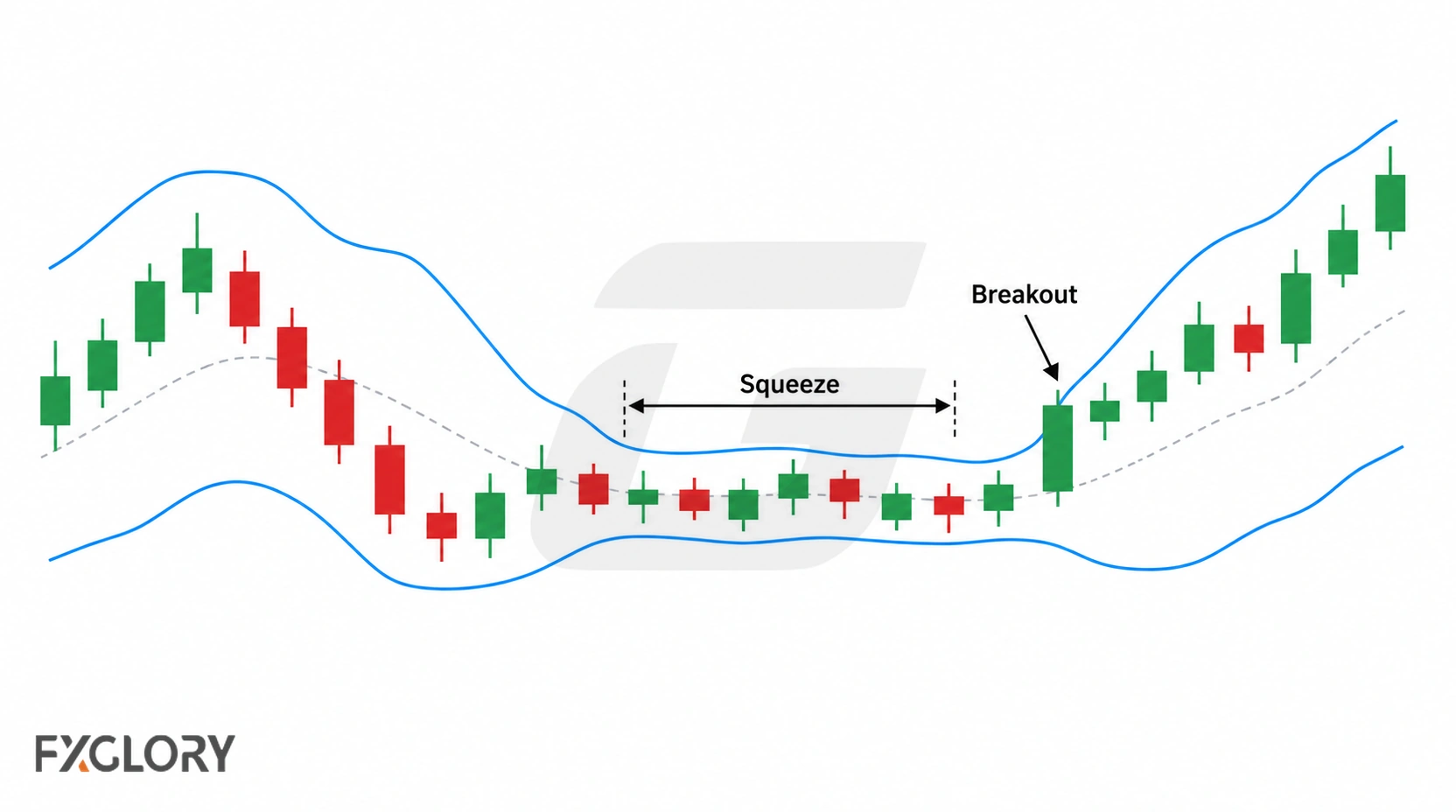
The strategy becomes useful only when compression is connected to price structure. A trader still needs a visible range, support, resistance, breakout area, trigger, invalidation, stop distance, spread check, and review rule.
This page is not a general Bollinger Bands guide. It focuses only on squeeze conditions, breakout confirmation, failed-breakout rules, and risk checks after volatility compression. For the broader indicator framework, review forex indicator strategies. For the broader Bollinger framework, review Bollinger Bands as volatility and price-location context. For indicator mechanics, use the dedicated Bollinger Bands Forex guide.
Bollinger Band Squeeze Signal vs Full Strategy
The common mistake is to treat narrow bands as a trade signal. A squeeze can prepare the chart for a larger move, but the direction and quality of that move still need confirmation.
| Reading | What It May Suggest | What Still Needs To Be Checked | Main Risk |
|---|---|---|---|
| Bands narrow around price | Volatility has contracted | Range, support, resistance, and breakout level | Direction is guessed too early |
| Price breaks the upper band | Upside expansion may be starting | Close, retest, momentum, spread, and invalidation | The breakout may be a spike |
| Price breaks the lower band | Downside expansion may be starting | Close, retest, momentum, spread, and invalidation | The breakout may return inside the range |
| BandWidth reaches a low area | Compression may be stronger than recent conditions | Price structure and breakout confirmation | Compression can last longer than expected |
| Breakout fails quickly | A head fake may be developing | Failed-breakout rule and loss scenario | The trade is held after invalidation |
A wick outside the band is not the same as a confirmed breakout. A squeeze plan should define whether confirmation requires a candle close beyond the band, a break of support or resistance, a retest, or another written structure rule.
When a squeeze condition needs to become a complete trade plan, use the forex trading setups framework instead of adding more signals.
How To Identify A Bollinger Band Squeeze
A squeeze usually starts with visible contraction. The bands narrow, candles often become smaller, and price may stay inside a tighter range. The cleaner setup is usually easier to review when the squeeze forms near a visible support, resistance, rectangle, or range boundary.
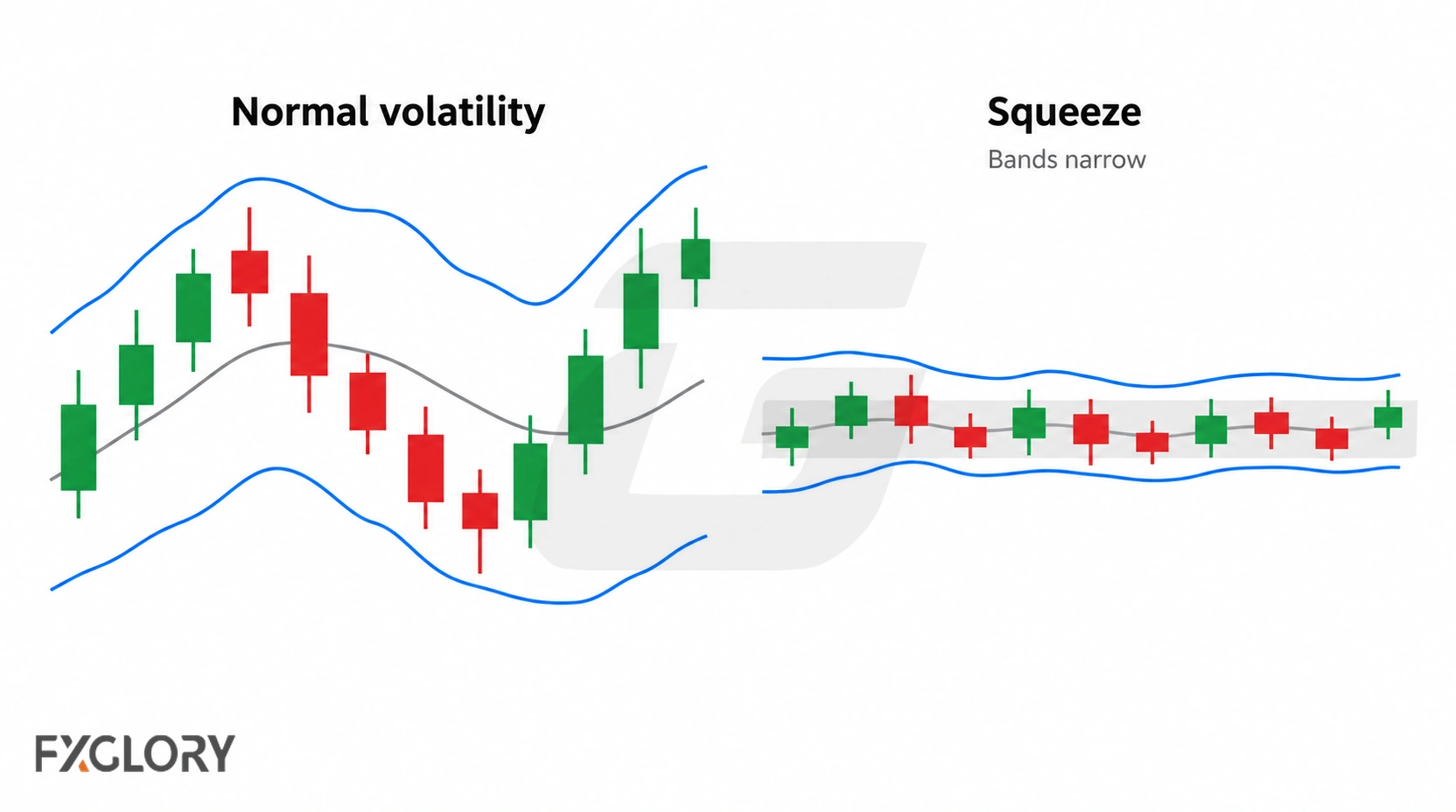
Some squeeze methods compare BandWidth with its recent range, such as a multi-month low. The exact lookback should be treated as a testing rule, not a universal requirement. A low BandWidth reading still needs price structure before it becomes useful.
| Compression Clue | How It Helps | What To Avoid |
|---|---|---|
| Narrowing bands | Shows volatility contraction | Treating narrow bands as direction |
| Low BandWidth | Measures band contraction relative to recent behavior | Using one low reading without price structure |
| Price boxed inside a range | Gives a clearer breakout area | Entering before price leaves the structure |
| Quiet candles near a level | Shows reduced movement before a possible expansion | Assuming quiet price must break immediately |
| %B near band extremes after compression | Can show price pushing toward one side of the bands | Using %B alone as a trade trigger |
When a squeeze depends on a range or breakout level, review support and resistance in forex.
Bollinger Band Squeeze Decision Chain
A squeeze strategy should move in order. Compression comes first. Structure comes second. Breakout confirmation comes after that. Risk checks come before the trade is accepted.
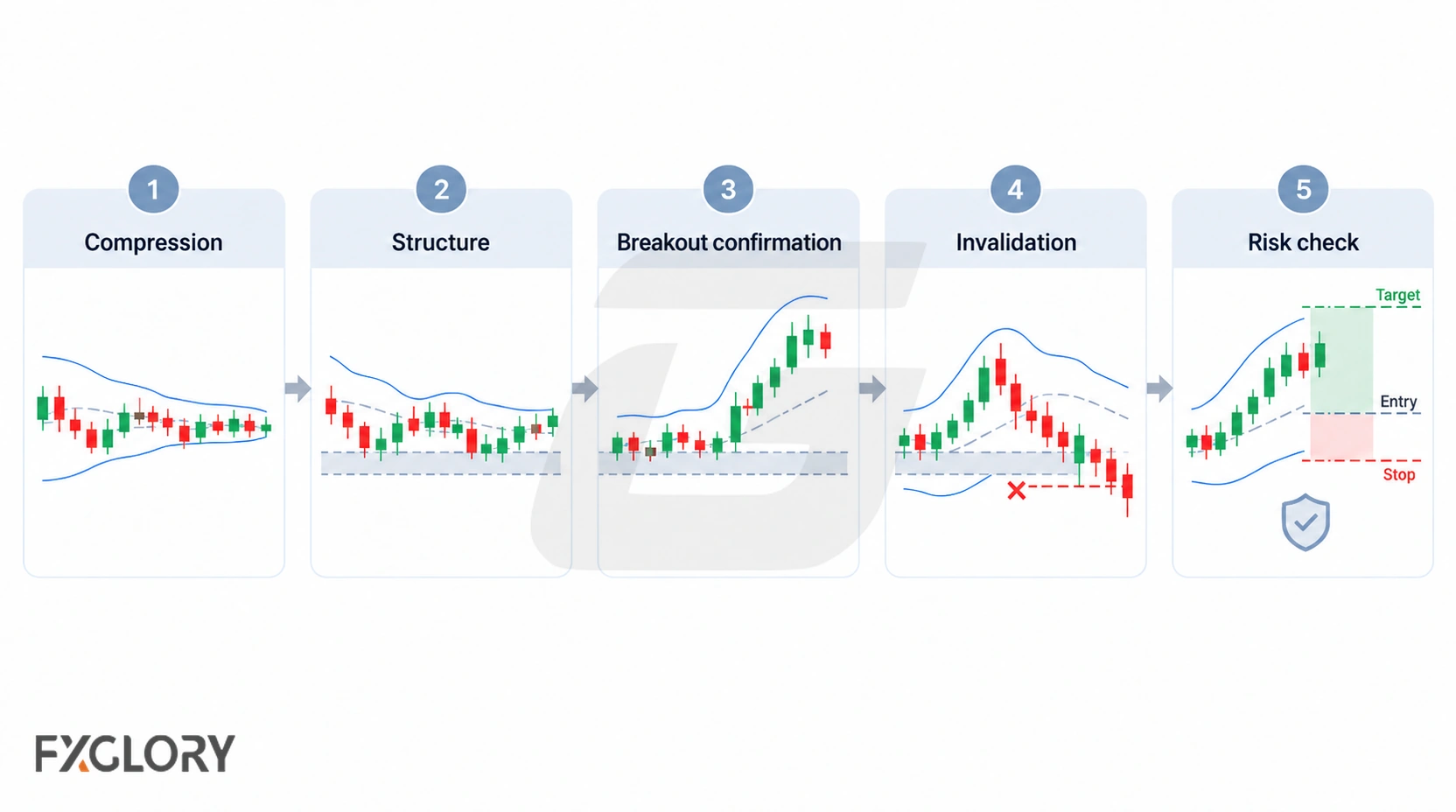
| Step | Question | Tool Or Context | Decision |
|---|---|---|---|
| 1 | Has volatility contracted? | Bollinger Bands, BandWidth, candle size | Mark the squeeze condition |
| 2 | Where is price compressed? | Range, support, resistance, rectangle, trend context | Define breakout area |
| 3 | Did price break with confirmation? | Close, retest, structure shift, %B, momentum tool | Review direction after price acts |
| 4 | Where is the breakout wrong? | Failed-breakout rule and price structure | Define invalidation |
| 5 | Can the trade be managed? | Spread, stop distance, ATR, position size, margin | Accept, reduce, delay, or skip |
Bollinger Band Squeeze Strategy Types
The examples below are role snapshots, not complete standalone systems. A full BB/KC squeeze strategy, TTM squeeze strategy, BandWidth strategy, or squeeze scalping strategy would need narrower rules for market condition, trigger, invalidation, stop distance, exit, and review.
This page mentions BB/KC squeeze, TTM squeeze, BandWidth, and squeeze scalping only as related variations. It does not replace a dedicated TTM squeeze strategy, Bollinger BandWidth strategy, or squeeze scalping page, where settings, trigger logic, exits, and false-break filters would need deeper treatment.
Upper-Band Breakout From A Squeeze
An upper-band breakout starts when price leaves a compressed area toward the upper band or above it. The band break should be reviewed with price structure, not treated as an automatic buy.
- Context: Bands narrow near a range, resistance, or compression area.
- Bollinger role: Shows compression and upside expansion attempt.
- Trigger: Price breaks and holds above a defined structure or retests it in a manageable way.
- Invalidation: Price returns inside the old range or removes the breakout idea.
- Skip rule: Skip if price is already far from invalidation or the breakout is only a spike.
Lower-Band Breakout From A Squeeze
A lower-band breakout starts when price leaves compression toward the lower band or below it. The setup still needs structure, confirmation, and a clear failed-breakout rule.
- Context: Bands narrow near support, a range floor, or a compressed structure.
- Bollinger role: Shows compression and downside expansion attempt.
- Trigger: Price breaks and holds below a defined level or retests it in a manageable way.
- Invalidation: Price returns above the broken structure and removes the breakout idea.
- Skip rule: Skip if the target is too small after spread or the stop distance is unclear.
Range Or Rectangle Squeeze Breakout
A squeeze inside a range or rectangle can give the setup a cleaner structure because the breakout area is visible. The range boundary matters more than the band touch alone.
- Context: Price compresses between visible support and resistance.
- Bollinger role: Shows reduced volatility inside the range.
- Trigger: Price breaks the range boundary and confirms outside the structure.
- Invalidation: Price returns inside the rectangle or range after the breakout.
- Skip rule: Skip if the breakout happens during unclear event volatility or without manageable risk.
Failed Breakout Or Head Fake
A head fake happens when price breaks from the squeeze, then quickly returns inside the old structure or moves the other way. The failed-breakout rule should be written before entry.
- Context: Price breaks from compression but cannot hold outside the structure.
- Bollinger role: Shows the breakout attempt and return inside the band area.
- Trigger: No new trade is accepted unless the failed-breakout plan is written separately.
- Invalidation: The original breakout idea is invalid once price returns inside the defined structure.
- Skip rule: Skip if the trader is only hoping the first breakout will resume.
BandWidth And %B Confirmation
BandWidth can help identify compression, while %B can help review where price sits relative to the bands. These tools should support the squeeze workflow, not replace support, resistance, or breakout confirmation.
- Context: The trader wants a more measurable compression review.
- BandWidth role: Measures how narrow the bands are relative to recent behavior.
- %B role: Reviews price position inside or outside the bands.
- Trigger: Price still needs to confirm outside structure.
- Skip rule: Skip if BandWidth or %B is used without a breakout level.
BB/KC Or TTM Squeeze Variation
Some traders compare Bollinger Bands with Keltner Channels or use TTM-style squeeze tools. These variations can help review compression and momentum, but they should be tested separately from a standard Bollinger Band squeeze rule.
- Context: The trader uses a platform tool that combines Bollinger Bands, Keltner Channels, or momentum display.
- Bollinger role: Part of the compression comparison.
- Momentum role: May help review direction after compression, depending on the tool.
- Skip rule: Skip if the added indicator makes the rule harder to explain, test, or invalidate.
Confirmation Tools For A Bollinger Band Squeeze
During the compression phase, momentum tools may flatten with price and give little directional value. They become more useful after price starts to break structure. If volume-style tools are used in forex, the data source should be reviewed because available volume may depend on the platform or feed.
Confirmation should answer a specific question. Adding more indicators does not automatically make the breakout cleaner. Each tool should have one job.
| Tool Or Context | Question It Helps Answer | Use Carefully Because |
|---|---|---|
| Support and resistance | Where is the breakout level? | The level is usually an area, not an exact price. |
| RSI | Is momentum supporting the breakout after price moves? | RSI should not guess direction before breakout structure appears. |
| ADX | Is trend strength developing after the breakout? | ADX may confirm late after price has already moved. |
| ATR | Does volatility expansion fit stop distance and target realism? | Higher volatility can make stops wider and position size smaller. |
| MACD | Is momentum shifting with the breakout? | Momentum signals can lag or duplicate other confirmation. |
| Volume-style tools | Is participation or accumulation/distribution-style behavior supporting the move? | In forex, available volume data may depend on the platform or feed. |
For momentum confirmation, review Bollinger Bands and RSI strategy rules. For trend-strength confirmation, review ADX as a trend-strength filter. For volatility and stop-distance review, use ATR as volatility and risk support.
Bollinger Band Squeeze Settings And Timeframes
A common starting reference is 20-period Bollinger Bands with 2 standard deviations. Some traders also review BandWidth, %B, or the lowest BandWidth reading over a chosen lookback. These are testing references, not universal settings.
| Reference | Strategy Use | Main Risk |
|---|---|---|
| 20-period / 2 standard deviations | Common baseline for Bollinger Band squeeze review | Not automatically suitable for every pair or timeframe |
| BandWidth | Measures how narrow or wide the bands are | A low reading does not give direction |
| %B | Reviews where price sits relative to the bands | Can be misread as a trigger without structure |
| Shorter settings | Faster squeeze and breakout signals | More noise, false breaks, and spread sensitivity |
| Longer settings | Smoother compression review | Later signals and fewer examples to test |
| Lower timeframes | More frequent squeeze conditions | More timing pressure and trading-cost sensitivity |
| Higher timeframes | Cleaner structure in some conditions | Wider stops and larger exposure may need review |
Settings should be chosen before testing and kept consistent long enough to review successful breakouts, failed breakouts, skipped setups, late entries, and different currency-pair behavior.
Day Trading And Scalping Considerations
Short-term squeeze setups can look attractive because compression and breakout attempts appear more often on lower timeframes. More setups do not automatically make the method easier to trade.
| Short-Term Issue | Why It Matters | What To Check |
|---|---|---|
| Spread sensitivity | Small breakout targets can be reduced by trading cost | Check whether the target still makes sense after spread |
| False breakouts | Price may leave compression and quickly return | Use a failed-breakout rule before entry |
| Timing pressure | Breakouts can move quickly after compression | Define trigger and invalidation before the breakout |
| Stop distance | Volatility can expand after the squeeze | Check whether position size and margin still fit |
| Event volatility | News can widen bands and distort confirmation | Skip if spread, slippage, or loss scenario is unclear |
Before testing short-term squeeze rules, review FXGlory spreads. When stop distance and position size need to be checked together, use the FXGlory margin calculator. Review FXGlory trading platforms when the strategy depends on charting tools, Bollinger Band settings, alerts, order placement, or trade-management workflow.
Worked Example: One Bollinger Band Squeeze, Four Outcomes
Assume a currency pair moves inside narrow Bollinger Bands near a visible resistance level. That does not automatically create a buy setup. The same squeeze can lead to different decisions.
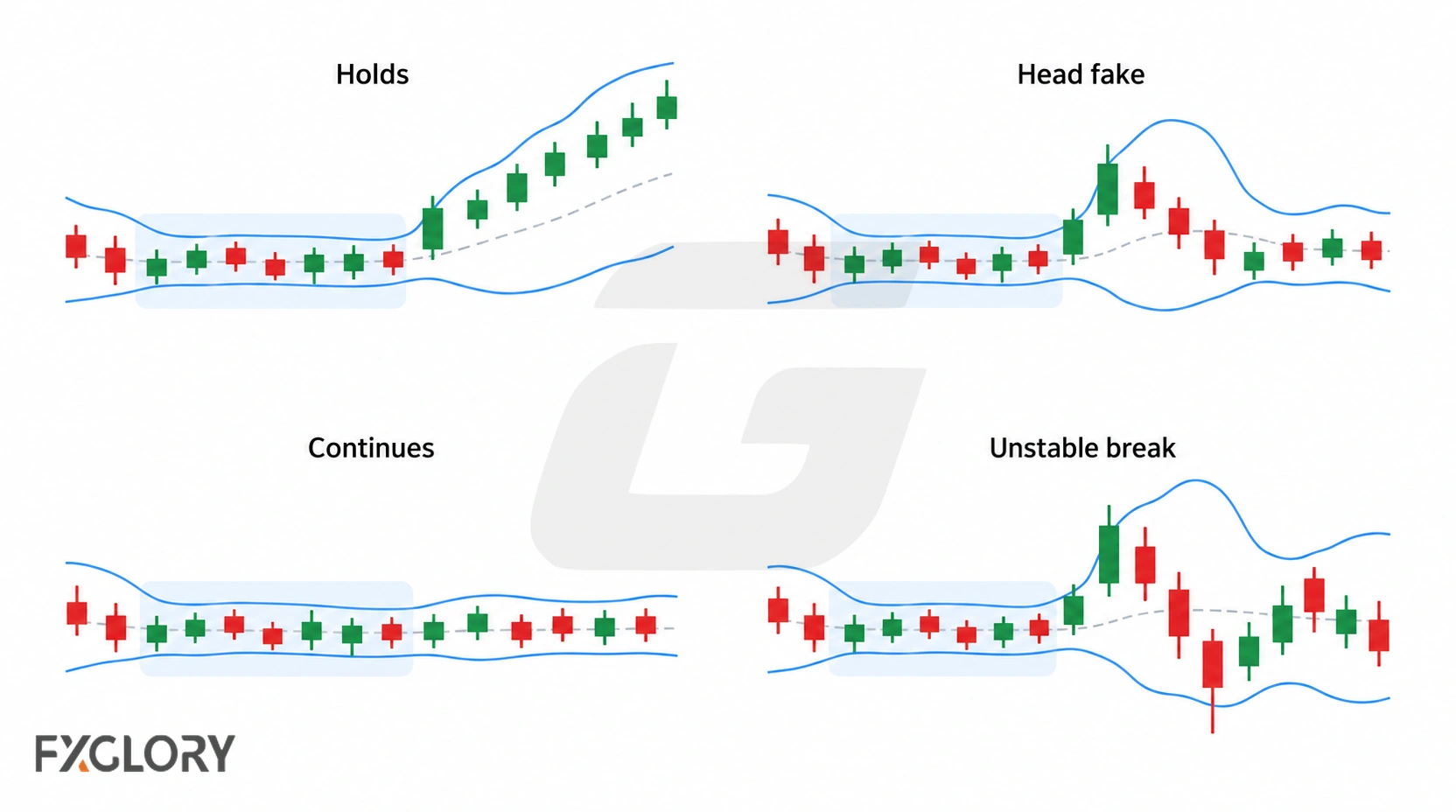
| Observation | Possible Meaning | Next Check | Skip If |
|---|---|---|---|
| Price breaks above resistance and holds | Upside expansion may be starting | Check retest, momentum, stop distance, and spread | The entry is already far from invalidation |
| Price breaks above resistance and returns inside | A head fake may be developing | Apply the failed-breakout rule | The trader holds only because the first breakout looked strong |
| Price stays inside the squeeze | Compression is continuing | Wait for structure to change | The trade requires guessing direction |
| Price breaks during event volatility | Movement may be unstable or disorderly | Check spread, slippage, and loss scenario | The trade cannot be managed with clear rules |
When Bollinger Band Squeeze Strategies Fail
Bollinger Band squeeze strategies often fail when compression is treated as prediction. The most common problem is not the squeeze itself; it is guessing direction before price confirms a structure break.
- Direction guessed too early: The trader enters before price breaks a level.
- Head fake ignored: Price breaks out and returns inside the old structure, but the trade is still held.
- No support or resistance: The squeeze is used without a clear breakout area.
- Late entry: The trade is accepted after price is already far from invalidation.
- BandWidth used alone: Compression is measured but not connected to a setup.
- News volatility: Event movement widens bands before the setup can be managed.
- Spread problem: A short-term breakout target has too little room after trading cost.
- Stop distance ignored: Volatility expansion changes the loss scenario after entry.
- Settings changed too often: Bollinger Band settings or lookback rules are adjusted after each result.
Testing A Bollinger Band Squeeze Strategy
A Bollinger Band squeeze strategy should be tested as a full rule set, not as a narrow-band signal. Testing should include clean breakouts, failed breakouts, head fakes, range squeezes, rectangle squeezes, low BandWidth readings, late breakouts, volatile periods, short-term signals, and skipped setups.
- What market condition does the squeeze setup need?
- How will compression be defined: visual bands, BandWidth, %B, or a chosen lookback?
- Where is the support, resistance, range, or rectangle boundary?
- What confirms the breakout?
- What defines a failed breakout or head fake?
- Where is the idea invalid?
- Does the target still make sense after spread?
- Does stop distance fit position size and margin exposure?
- Are Bollinger Band settings kept consistent during the test?
- Are false breakouts, late entries, news events, and skipped setups recorded?
- Does the result change across selected currency pairs or timeframes?
Review available currency pairs before applying the same squeeze method everywhere. Review forex trend behavior when a breakout needs directional context.
Bollinger Band Squeeze Strategy Checklist
Before using a Bollinger Band squeeze strategy, answer these questions.
- Has volatility contracted, or are the bands only slightly narrower?
- Is the squeeze connected to a visible support, resistance, range, or rectangle?
- What confirms the breakout?
- What invalidates the breakout?
- What is the failed-breakout or head-fake rule?
- Is the entry close enough to a manageable risk area?
- Does the setup still make sense after spread?
- Does stop distance fit position size and margin?
- Are confirmation tools being used for separate jobs?
- Are the settings fixed for testing?
- What condition makes the squeeze a no-trade?
A Bollinger Band squeeze strategy is useful only when compression leads to a clear decision process. The bands show reduced volatility; price structure defines the breakout area; confirmation, invalidation, spread, and risk decide whether the setup can be used.