

What Is Deviation in Forex?
Deviation in forex means distance from a reference point. The reference depends on the context: it may be a moving average, the mean of a data set, an indicator parameter, or the requested price of an order.
This is why the term can mean different things on a chart and in an order window. A chart may use deviation to describe price movement or volatility, while an execution setting may use it to define acceptable price tolerance.
The Main Meanings of Deviation in Forex
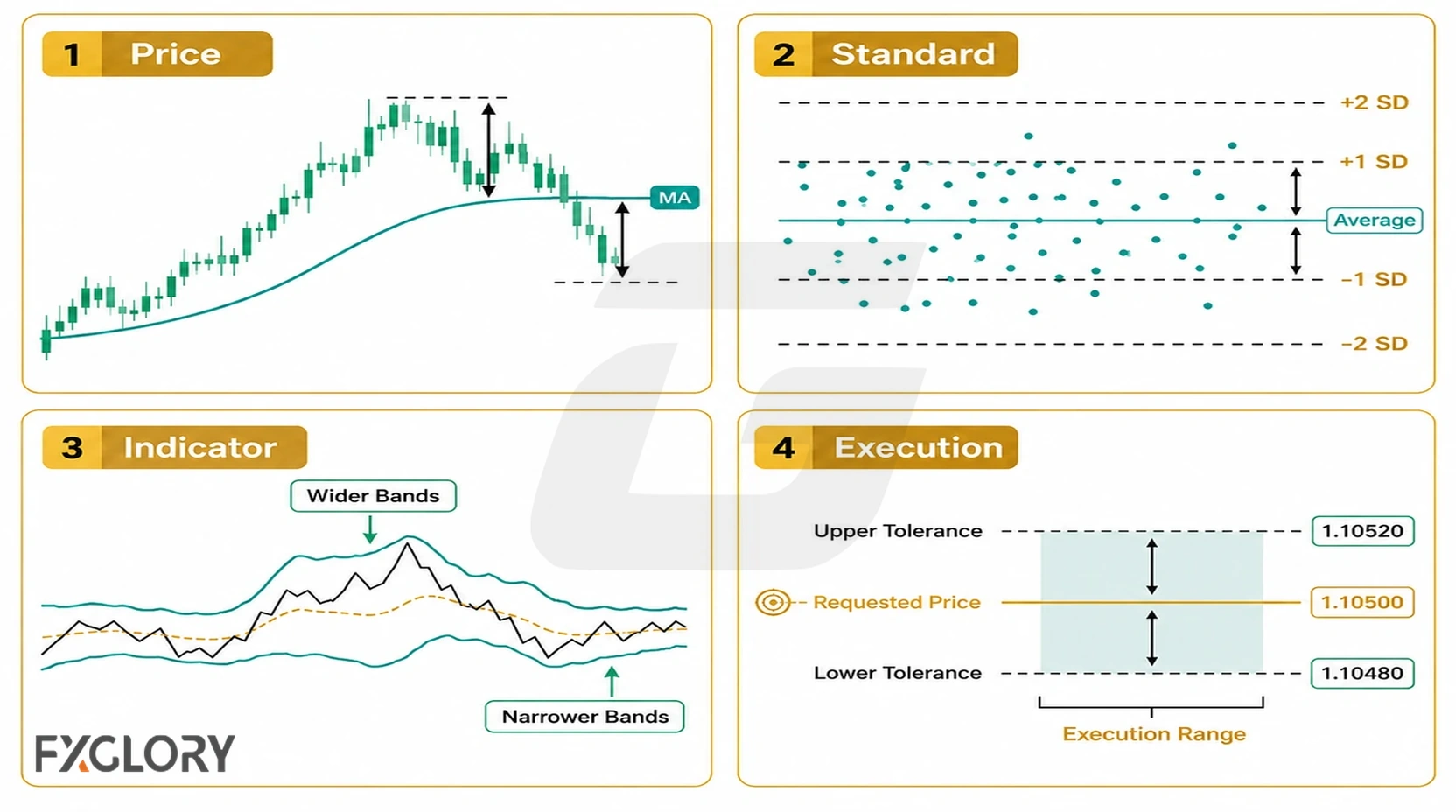
- Price deviation: The distance between current price and a chosen benchmark.
- Standard deviation: A statistical measure of how widely prices are distributed around an average.
- Indicator deviation: A parameter used by some technical indicators to control how calculations or bands are displayed.
- Execution deviation: The price tolerance allowed around the requested order price during execution.
Price deviation and execution deviation should not be treated as the same concept: one describes chart distance, while the other relates to order handling.
Price Deviation From an Average
Price deviation describes how far current price has moved from a chosen benchmark, such as a moving average or recent average price.
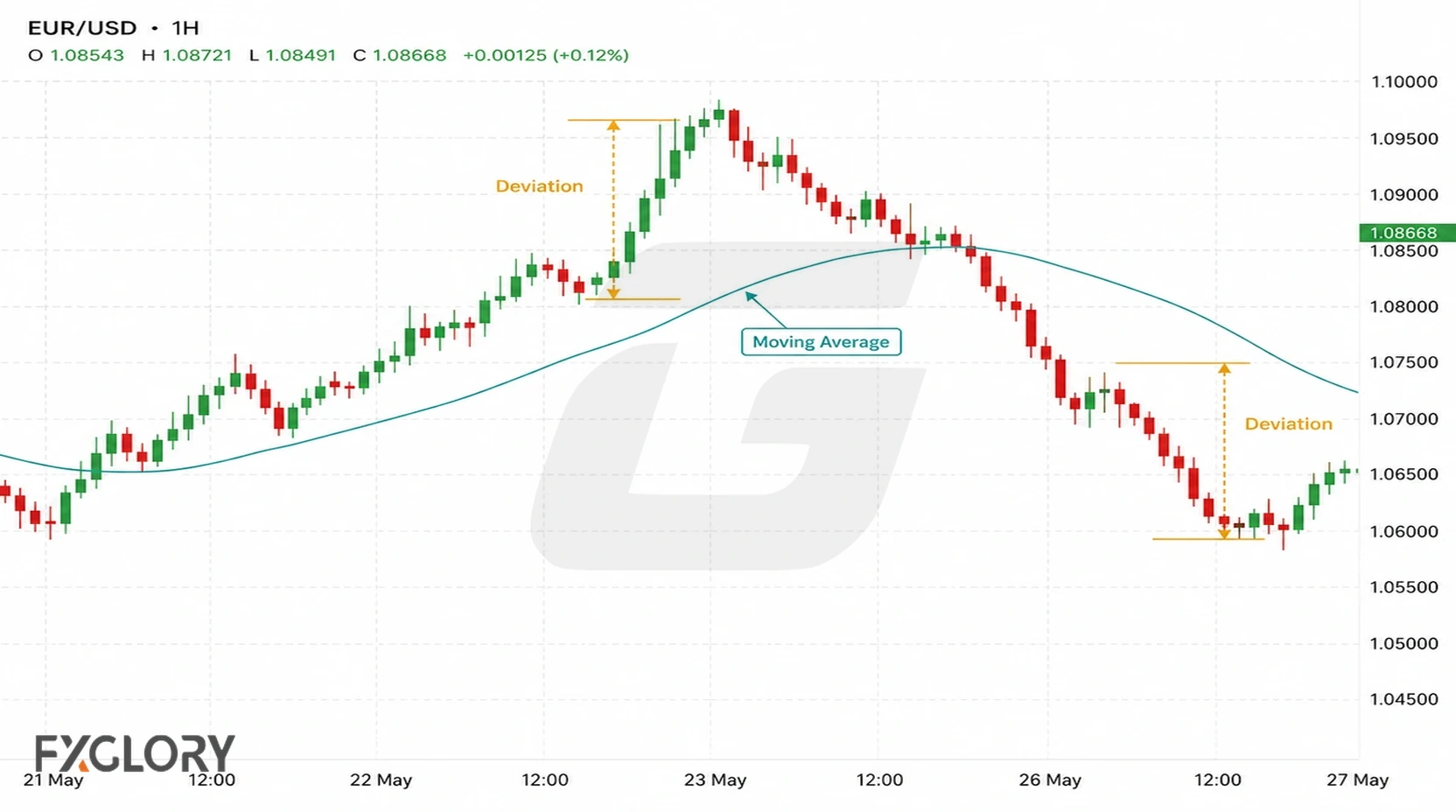
A larger distance means price is farther from that benchmark; a smaller distance means it is closer. The interpretation depends on the reference chosen and current market conditions.
Standard Deviation in Forex
Standard deviation measures how widely price values are distributed around an average. Higher readings generally indicate wider price variation, while lower readings indicate more compressed movement.
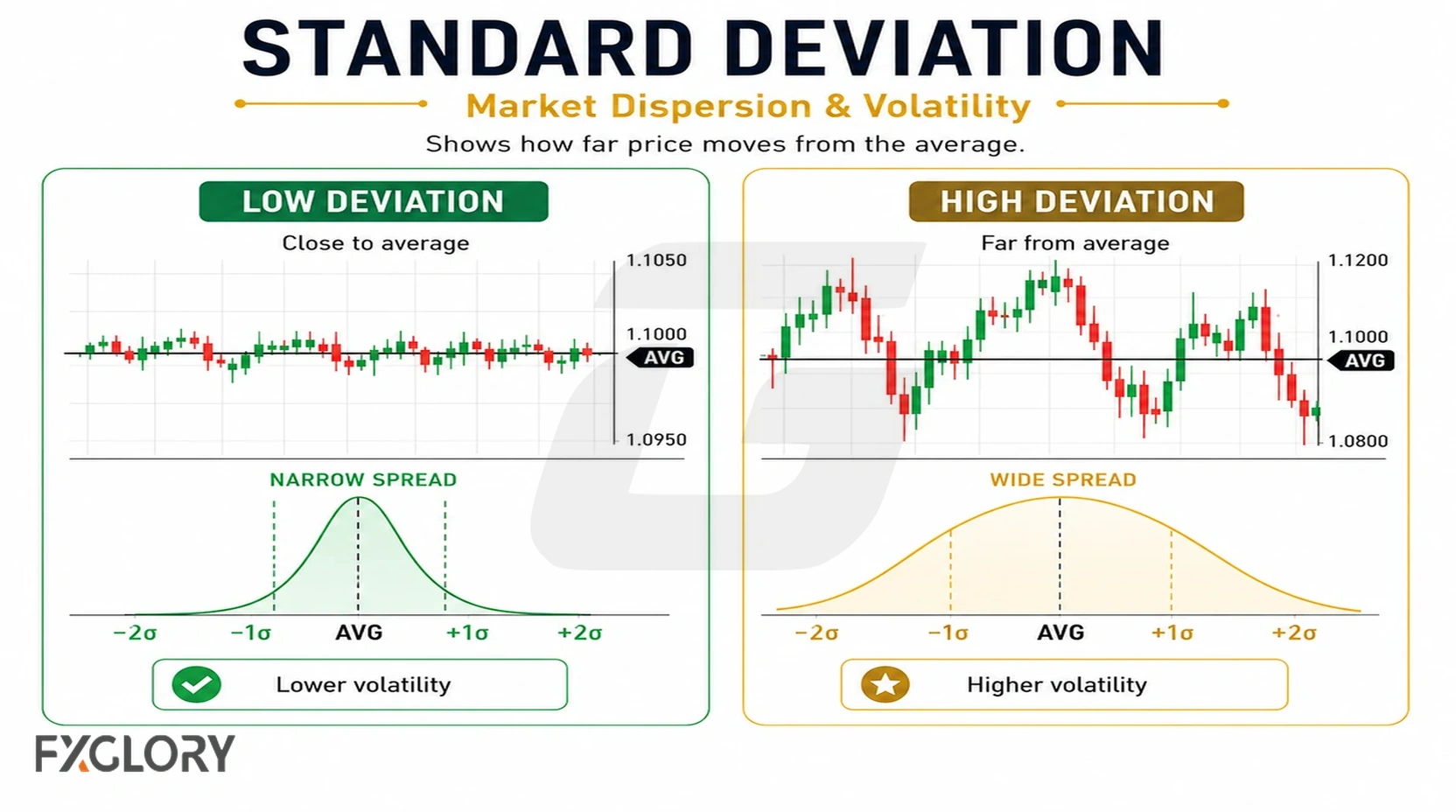
- Higher standard deviation: Prices are more widely dispersed around the average.
- Lower standard deviation: Prices are more tightly clustered around the average.
- Rising standard deviation: Price variation is increasing.
- Falling standard deviation: Price variation is decreasing.
Deviation in Indicator Settings
Some technical indicators use standard deviation as part of their calculation. Bollinger Bands are a common example: the upper and lower bands are placed a selected number of standard deviations from a moving average.
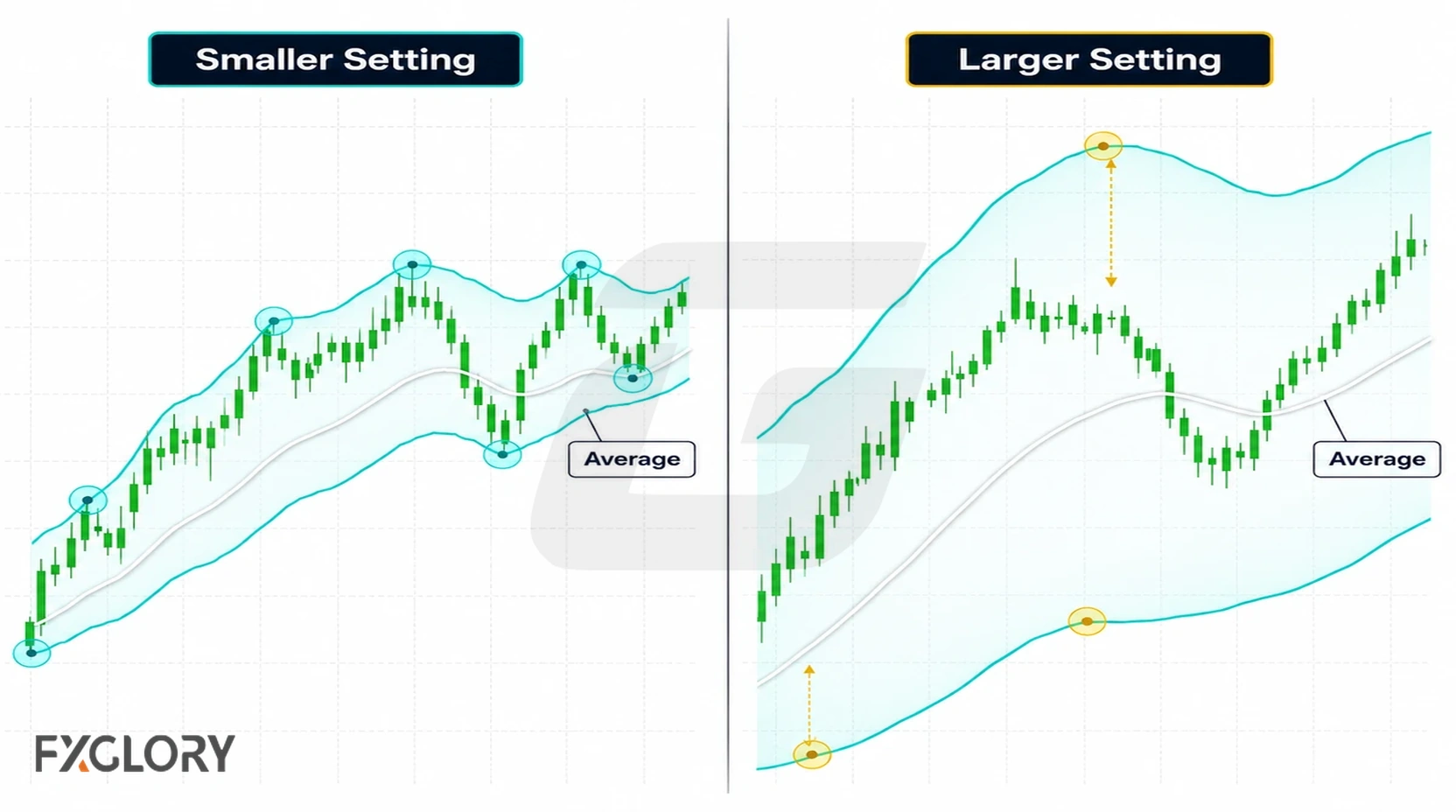
Changing the deviation parameter changes how the indicator is displayed; it does not by itself create a trading signal.
MT4/MT5 Maximum Deviation and Order Execution
In MT4/MT5-style execution settings, deviation can refer to the maximum price difference a trader is willing to accept around the requested order price.
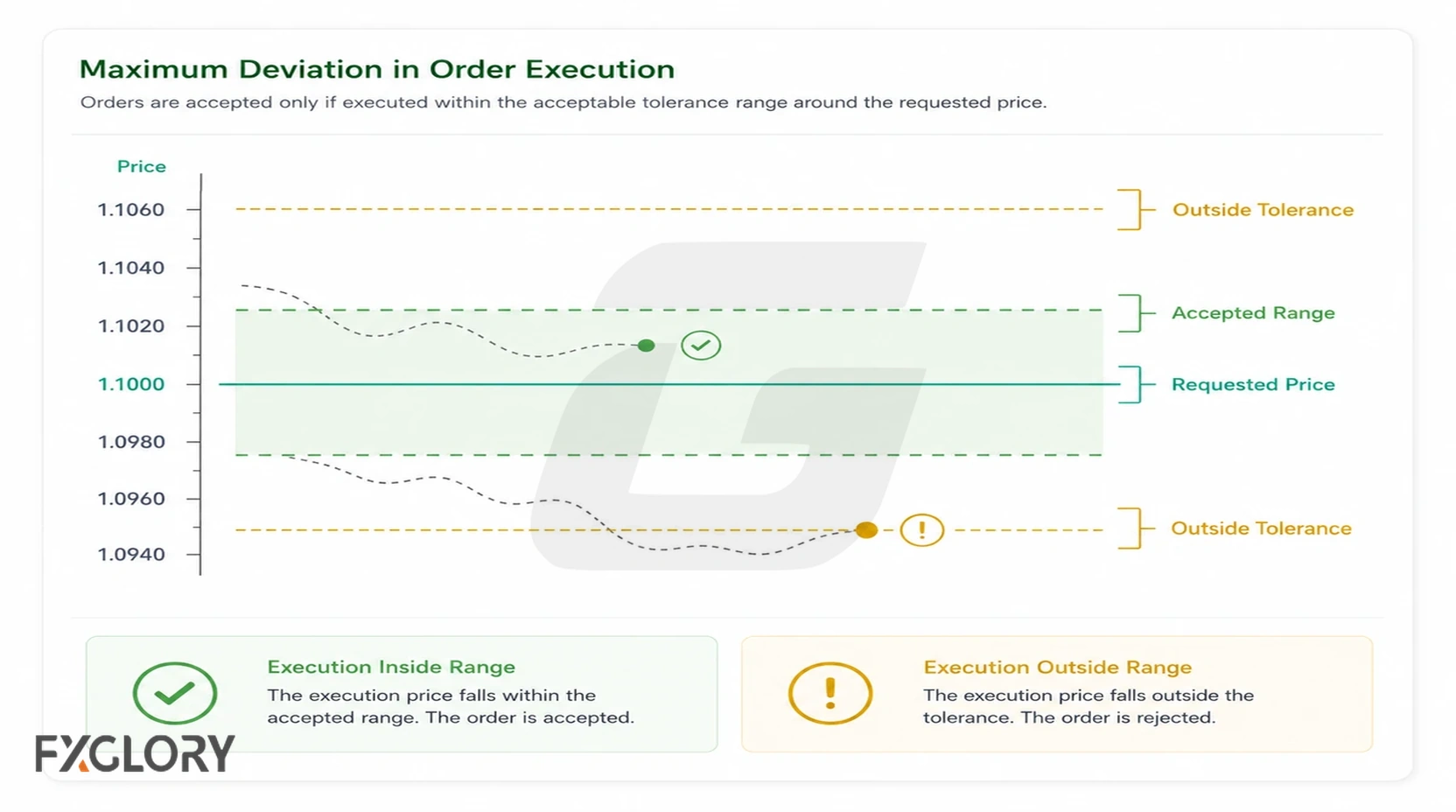
If price moves outside the allowed tolerance before execution, the order may be rejected, requoted, or not filled depending on the platform, order type, and execution model. A wider tolerance can make execution more likely during fast movement, but it can also allow a fill farther from the requested price.
The unit used for the setting should be checked directly in the trading platform or instrument specification before it is changed.
Deviation, Slippage, Spread, and Volatility
Execution deviation and slippage are related but different. Deviation is the permitted tolerance around the requested price; slippage is the actual difference between the expected price and the price at which the order is filled.
Spread also matters because it affects the price available to enter or exit a trade. During fast or thin market conditions, spread and slippage can change even when an execution tolerance has been set. Traders can review spread as a trading cost around execution when studying order conditions.
Volatility can increase the speed and size of price changes, which can make execution outside the originally expected price more likely.
Common Mistakes With Forex Deviation
- Confusing standard deviation with execution deviation: One describes statistical price dispersion; the other relates to order-price tolerance.
- Treating price deviation as a reversal signal: Distance from an average does not show where price must move next.
- Assuming a wider tolerance guarantees execution: Orders can still be affected by liquidity, order type, and platform execution conditions.
- Changing execution tolerance without checking its unit: The platform or instrument specification should be checked before changing the setting.
- Treating indicator deviation as a trading method: A deviation parameter changes an indicator calculation or display but does not provide a complete trade plan.
Final Thoughts on Deviation in Forex
The meaning of deviation depends on the reference point. On a chart, it may describe price distance or statistical dispersion. In an indicator, it may control how a calculation is displayed. In order execution, it can define acceptable price tolerance around the requested price.
Keeping those meanings separate prevents common mistakes such as confusing volatility with execution settings or treating distance from an average as a directional signal.