

How Much Can You Make Trading Forex?
There is no universal dollar amount that a forex trader can make. The result depends on how much capital is being traded, the percentage return on that capital, position size, risk per trade, leverage, trading costs, market conditions, and consistency over time.
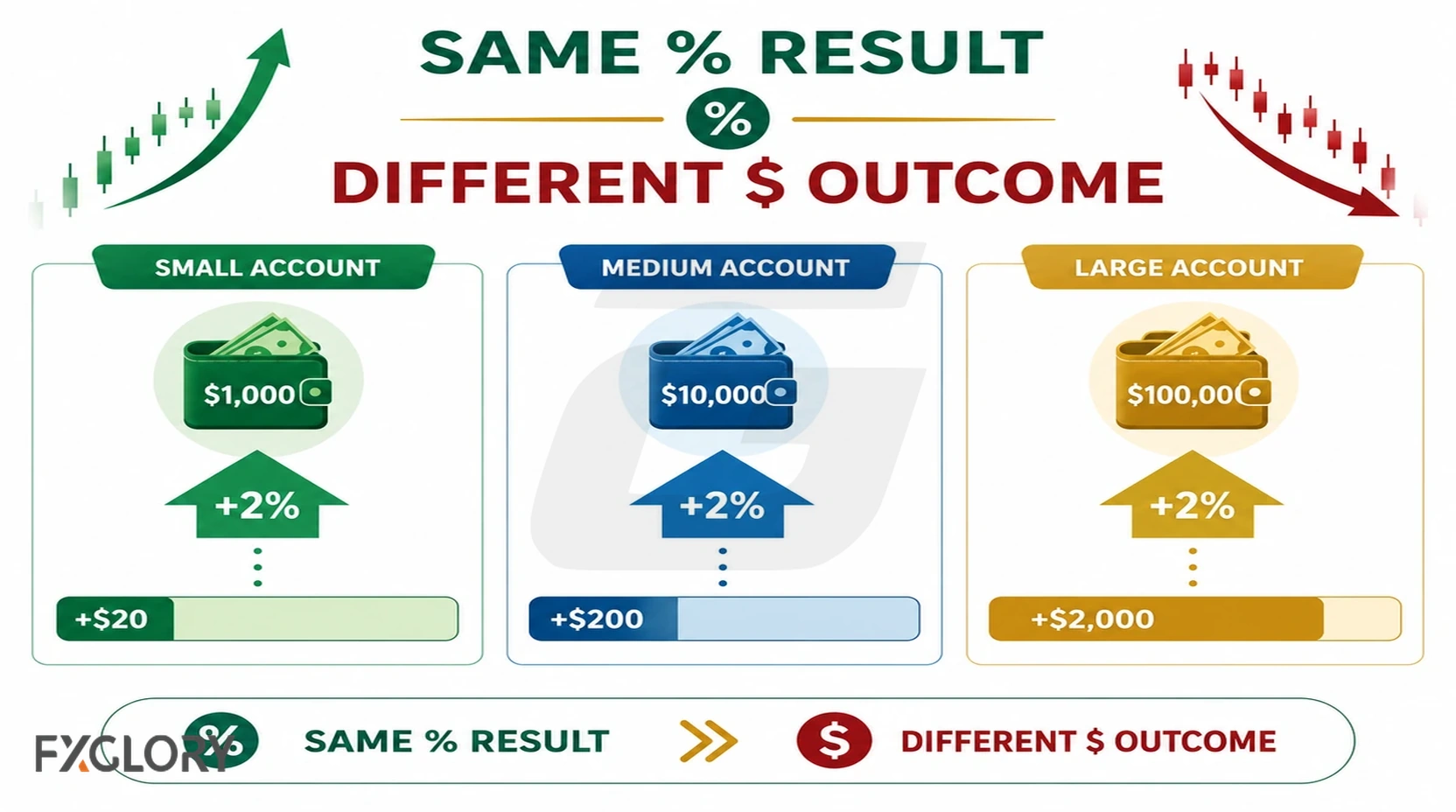
The clearest way to evaluate a profit claim is to convert it into a percentage of the account. A $100 gain is 100% on a $100 account, 10% on a $1,000 account, and 1% on a $10,000 account. The dollar number alone does not show how much risk may have been required to produce it.
For the broader question of whether forex trading can be profitable at all, see can you really make money trading forex. Here, the focus is on estimating the scale of possible results.
Why Percentages Matter More Than Dollar Goals
Percentage returns make results comparable across different account sizes. The same dollar profit can represent a modest change on a large account or an extreme change on a small one.
| Account Size | 1% Result | 3% Result | 5% Result | 10% Loss |
|---|---|---|---|---|
| $50 | $0.50 | $1.50 | $2.50 | -$5 |
| $100 | $1 | $3 | $5 | -$10 |
| $1,000 | $10 | $30 | $50 | -$100 |
| $10,000 | $100 | $300 | $500 | -$1,000 |
| $50,000 | $500 | $1,500 | $2,500 | -$5,000 |
The table shows two things at once: larger accounts convert the same percentage into larger dollar amounts, while losses also scale with capital and position size. That is why income planning should begin with percentage exposure rather than a fixed cash target.
Forex Trading Income vs Forex Trader Salary
The phrase forex trader income can refer to two different things. An employed trader may receive a salary, bonus, or other compensation from a company. An independent retail trader earns or loses money from a personal trading account.
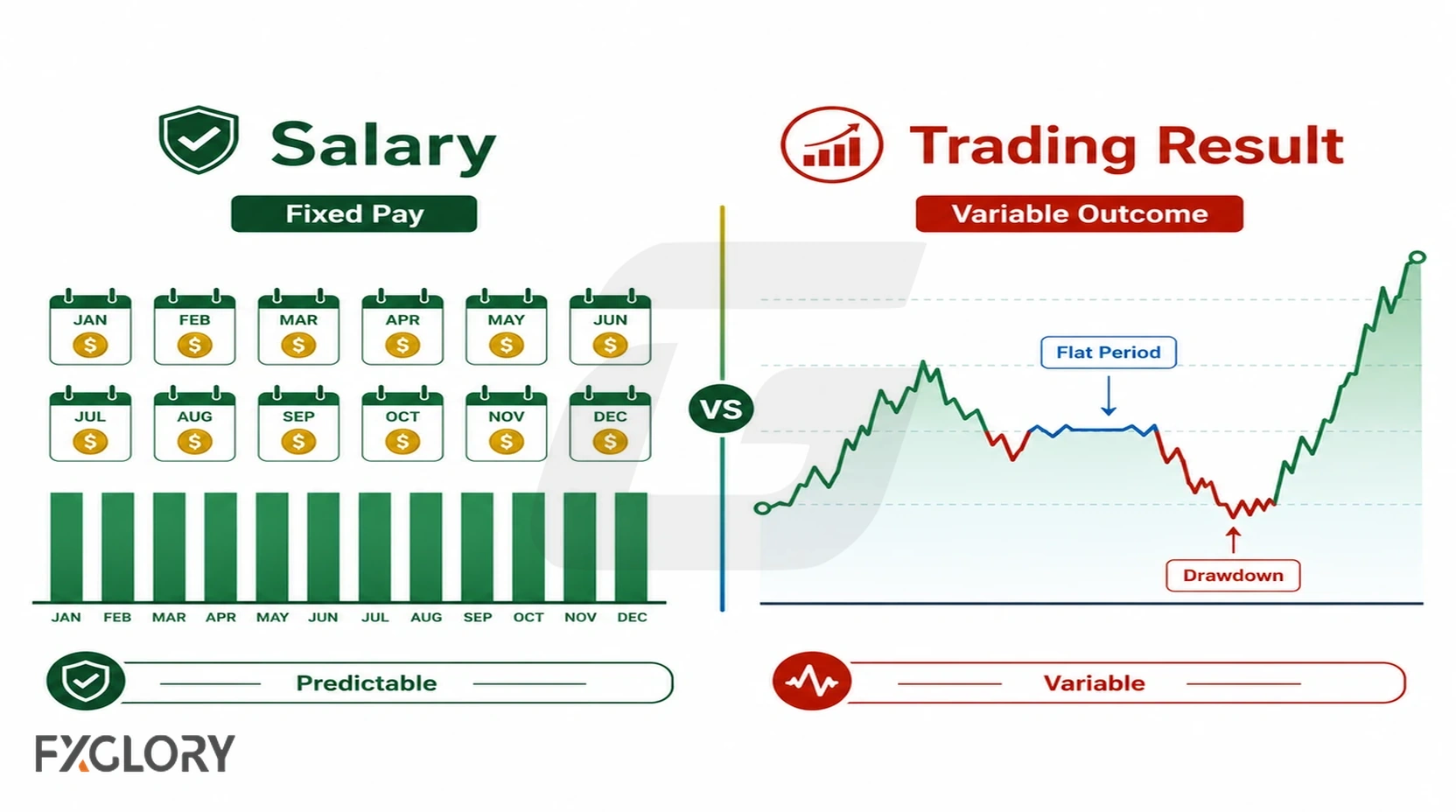
- Forex trader salary: Compensation paid for an employed trading role.
- Retail trading result: Net gains or losses generated in a personal account.
- Percentage return: The account result expressed relative to capital.
- Dollar result: The money outcome after gains, losses, and trading costs.
This distinction matters when searching for figures such as forex trader salary per month. Job-salary data answers a different question from how much an individual can make trading their own account.
What Is the Average Forex Trader Income?
There is no single dependable average for independent retail forex traders. Published salary figures usually describe employed roles, while personal-account results vary with account size, deposits and withdrawals, risk, costs, strategy, market conditions, and the period being measured.
Self-reported profit figures can also be difficult to compare if they omit losing periods, drawdown, or the capital required to produce the result. A percentage return with account size and drawdown context is more informative than a standalone monthly dollar figure.
What Determines How Much Money You Can Make in Forex?
Forex earnings are the outcome of several variables working together. A large account does not guarantee a strong result, and a high win rate does not explain profitability unless trade size, average win, average loss, and costs are also known.
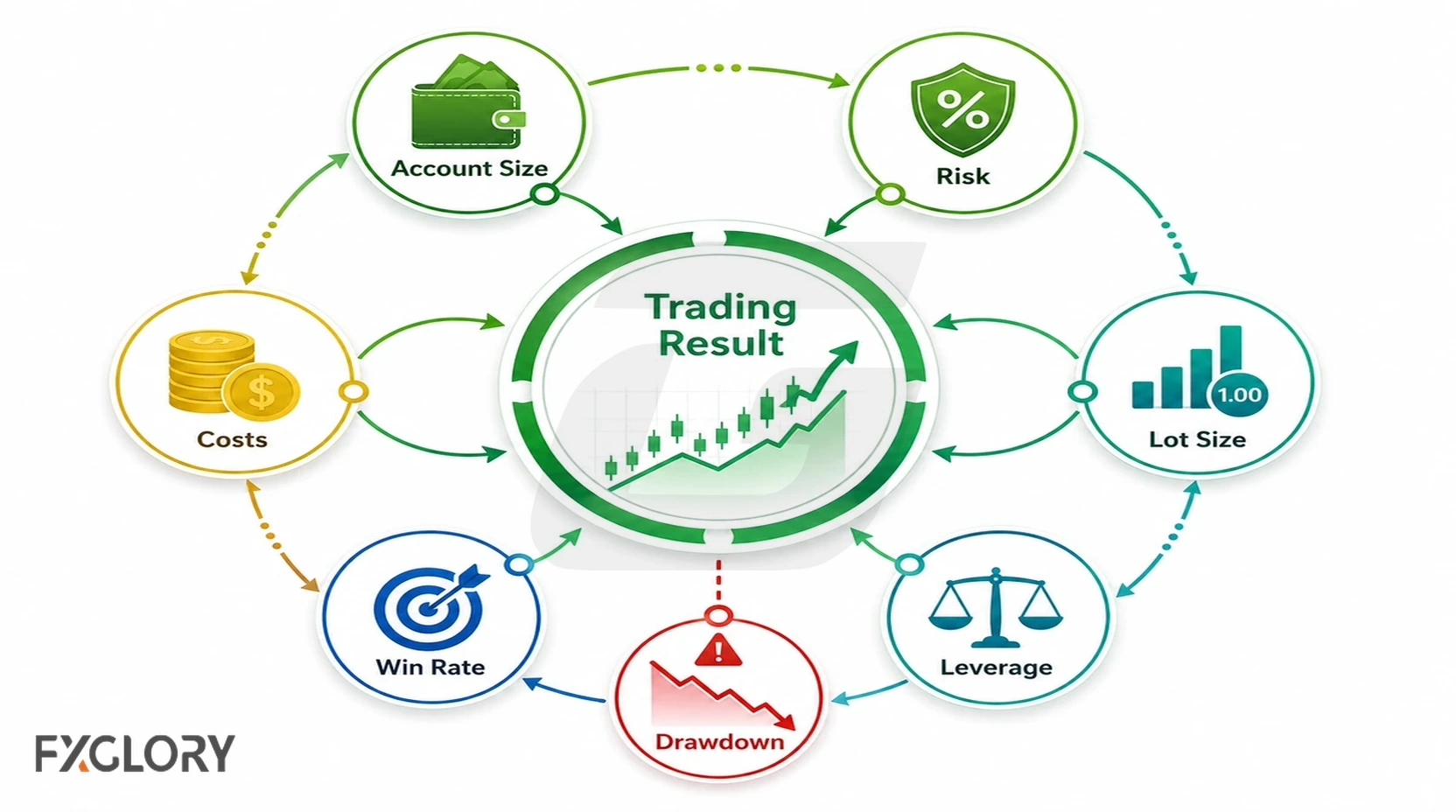
- Account size: Determines how much a given percentage gain or loss is worth in dollars.
- Risk per trade: Controls how much of the account is exposed if a trade fails.
- Lot size: Changes the money impact of each pip movement. Review what is a lot size in forex.
- Leverage: Increases market exposure relative to deposited capital and can magnify gains and losses. Review what is leverage in forex trading.
- Win rate: Shows how often trades close profitably, but not how large wins are compared with losses.
- Reward-to-risk: Compares the average amount gained on winners with the amount risked or lost.
- Trading costs: Spread, swap, commissions where applicable, and slippage reduce net results.
- Drawdown: Measures the decline from a previous account peak and helps show the risk experienced while producing returns.
- Consistency: Shows whether the trader can apply the same process across changing market conditions and losing periods.
How Much Can a Beginner Forex Trader Make Per Day?
There is no useful daily-profit number that applies to every beginner. The same cash result can represent a very different percentage depending on account size, so the first step is to translate the daily target into account percentage.
For example, making $50 in one day would equal 50% of a $100 account, 5% of a $1,000 account, and 0.5% of a $10,000 account. Making $100 would equal 100%, 10%, and 1% on those same balances. These comparisons do not say that any of those daily returns are expected; they show how account size changes the meaning of the target.
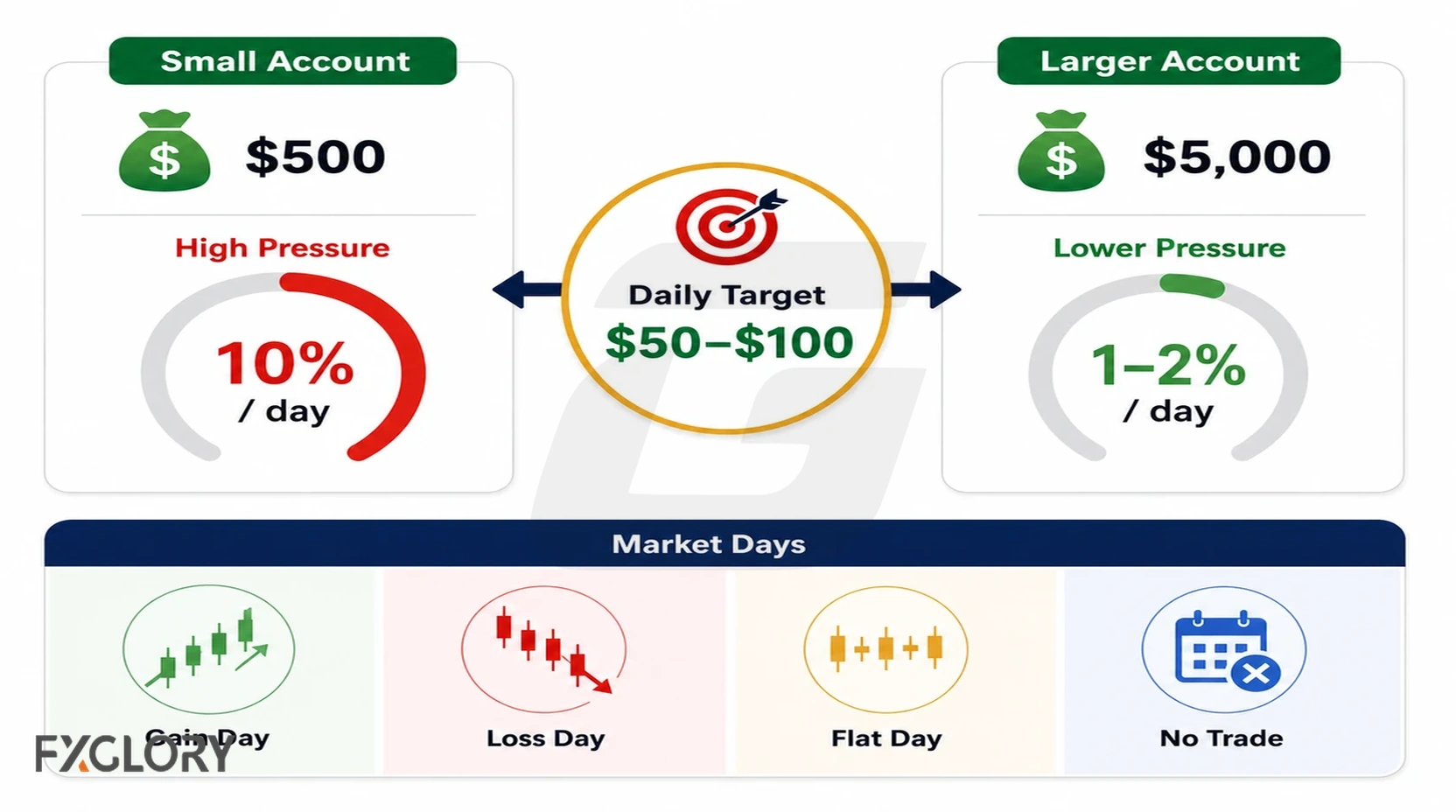
A beginner is better served by tracking whether trades followed the plan, how much was risked, how costs affected execution, and how the account behaved through a series of wins and losses. Daily profit becomes meaningful only when viewed inside that broader record.
- Convert daily dollar results into percentages before comparing them.
- Avoid increasing lot size simply to recover a losing day.
- Do not force a trade because a daily cash target has not been reached.
- Review results over a meaningful sample of trades rather than one session.
How Much Can You Make With $50 or $100 in Forex?
Searches for small-account earnings often focus on the dollar amount, but the percentage math shows why a $50 or $100 account is generally more useful for learning than for generating meaningful income.
| Account | 1% Result | 3% Result | 5% Result | What the Example Shows |
|---|---|---|---|---|
| $50 | $0.50 | $1.50 | $2.50 | Even a noticeable percentage move produces a small dollar result |
| $100 | $1 | $3 | $5 | Meaningful cash income would require either more capital or unusually large percentage returns |
Trying to force a small account to produce large daily cash amounts usually means increasing position size or leverage. That also increases the size of potential losses and the chance that normal market movement creates an outsized drawdown.
For a dedicated guide to practicing with a small balance, see how to trade forex with $100. For the capital side of the question, see how much do you need to start trading forex.
Forex Income Red Flags
Income claims are difficult to evaluate when they present the result but leave out the capital, percentage risk, drawdown, and trading costs required to produce it.
- Daily-profit claims without account size: The same dollar amount can represent a small or extreme percentage result.
- Return claims without drawdown: A profitable period does not show how much the account declined along the way.
- Small-account income claims: Large cash results from very small balances may depend on unusually high exposure.
- Heavy leverage used to force a target: Greater exposure increases the size of adverse moves as well as favorable ones.
- Recovery trading: Increasing risk after losses can deepen a drawdown quickly.
- Gross profit presented as net income: Spread, swap, commissions where applicable, and slippage can reduce the amount retained.
Costs To Subtract From a Forex Profit Estimate
A gross trading result is not the same as a net result. Costs should be considered when estimating how much profit remains after trading activity.
- Spread: The difference between buy and sell prices affects entry and exit.
- Swap: An overnight rollover charge or credit may apply when a position stays open past rollover time. Review what is swap in forex.
- Commission: Some account types or instruments may apply a separate transaction commission.
- Slippage: The executed price can differ from the requested or expected price.
Position size and holding period are not trading costs by themselves, but both can affect how large those costs become in dollar terms.
How To Estimate a Forex Profit or Loss Scenario
A simple scenario can start with account size and a hypothetical gross percentage return, then subtract trading costs. The calculation shows scale rather than predicting what a trader will earn.
Simple estimate: account size × percentage return − trading costs = estimated profit or loss.
For example, if a $1,000 account has a hypothetical 3% gross result, that equals $30 before costs. A $10,000 account at the same 3% equals $300 before costs. If trading costs were $4 and $20 respectively, the simplified net examples would be $26 and $280.
Drawdown should be tracked separately. Drawdown measures how far the account falls from a previous peak; it is a risk and performance measure, not a separate fee to subtract from the profit formula.
- Start with account size: Use the actual capital behind the scenario.
- Choose a hypothetical percentage result: Use it to understand scale, not as an expected return.
- Subtract trading costs: Include the costs relevant to the account and holding period.
- Measure drawdown separately: Record the decline from peak equity or balance during the period.
- Check position size and risk: Make sure the possible loss per trade fits the written plan.
- Review a sample of trades: One profitable day or week is not enough to evaluate consistency.
To connect risk, entries, exits, and review into written rules, use the forex trading plan template.
A Better Way To Think About Forex Trading Income
Instead of asking only for a daily or monthly dollar number, compare results using account size, percentage return, trading costs, and drawdown. This makes it easier to distinguish a modest result on substantial capital from a large percentage swing on a small account.
For beginners, $50 and $100 accounts can help demonstrate position sizing, execution, and percentage math, but the small balance limits the dollar value of reasonable percentage changes. A longer record of net results and drawdowns is more informative than a short run of profitable trades.
A practical learning path is to start with the Forex Basics for Beginners hub, review the guides on leverage and lot size, and practice position sizing and trade review in a demo environment before deciding how much capital to place at risk.