
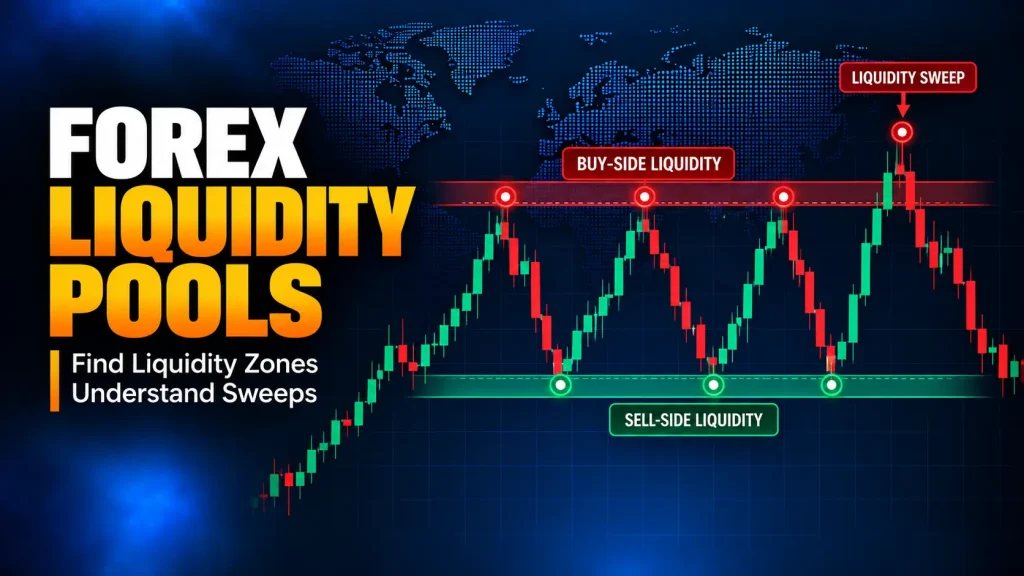
What Are Liquidity Pools in Forex?
In forex price-action analysis, a liquidity pool is a chart area where traders may suspect orders are clustered. These areas are commonly marked around visible highs, visible lows, equal highs, equal lows, or prior reaction areas.
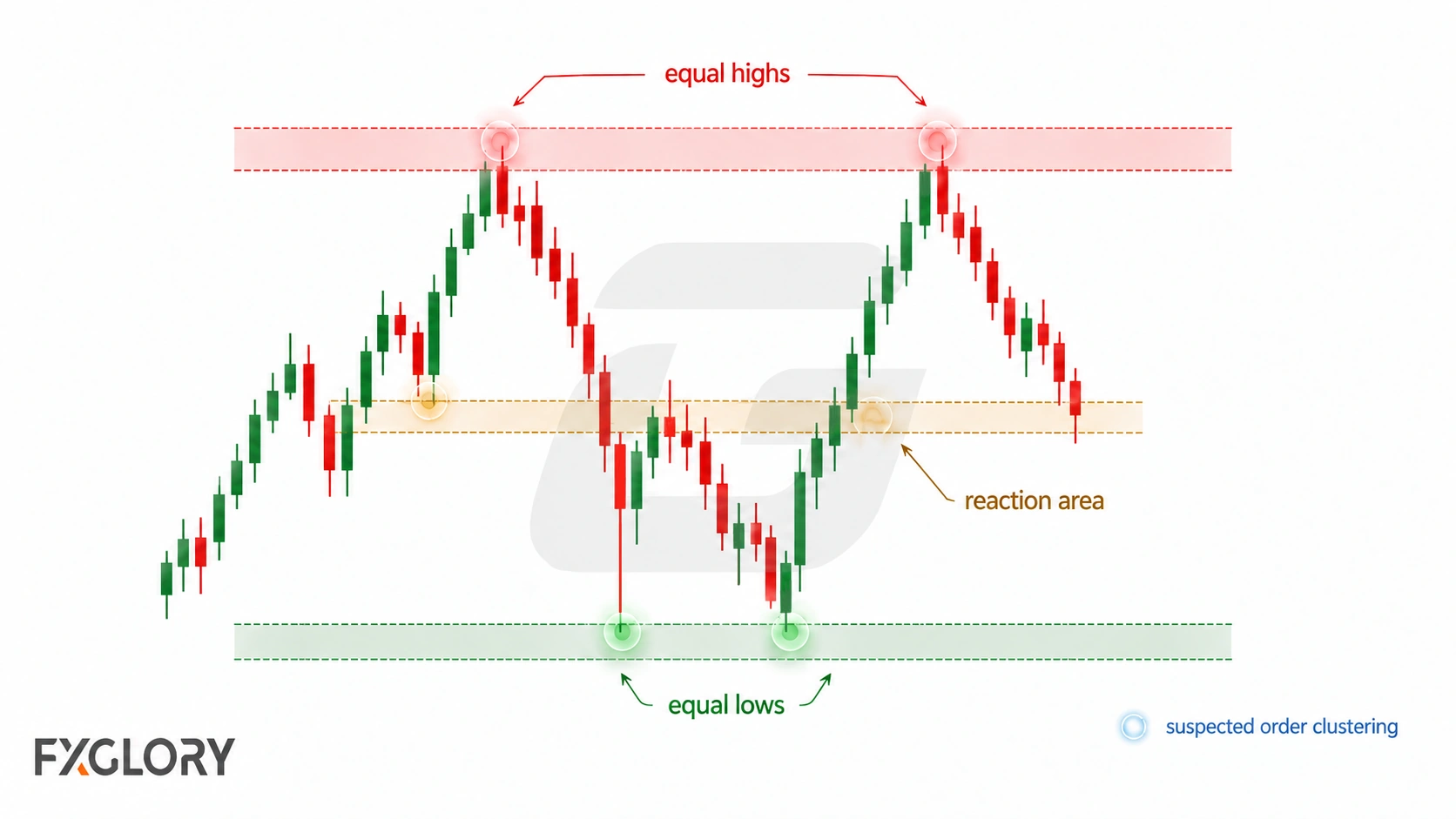
The term describes a chart-based assumption. A standard candle chart does not show the complete live order book or identify who placed the orders.
In this article, liquidity pool also does not mean a DeFi smart-contract pool. The focus is the price-action use of the term.
This page covers the terminology and review process rather than a complete trading strategy. For the broader chart-reading framework, start with price action in forex.
Market Liquidity vs Chart-Based Liquidity Pools
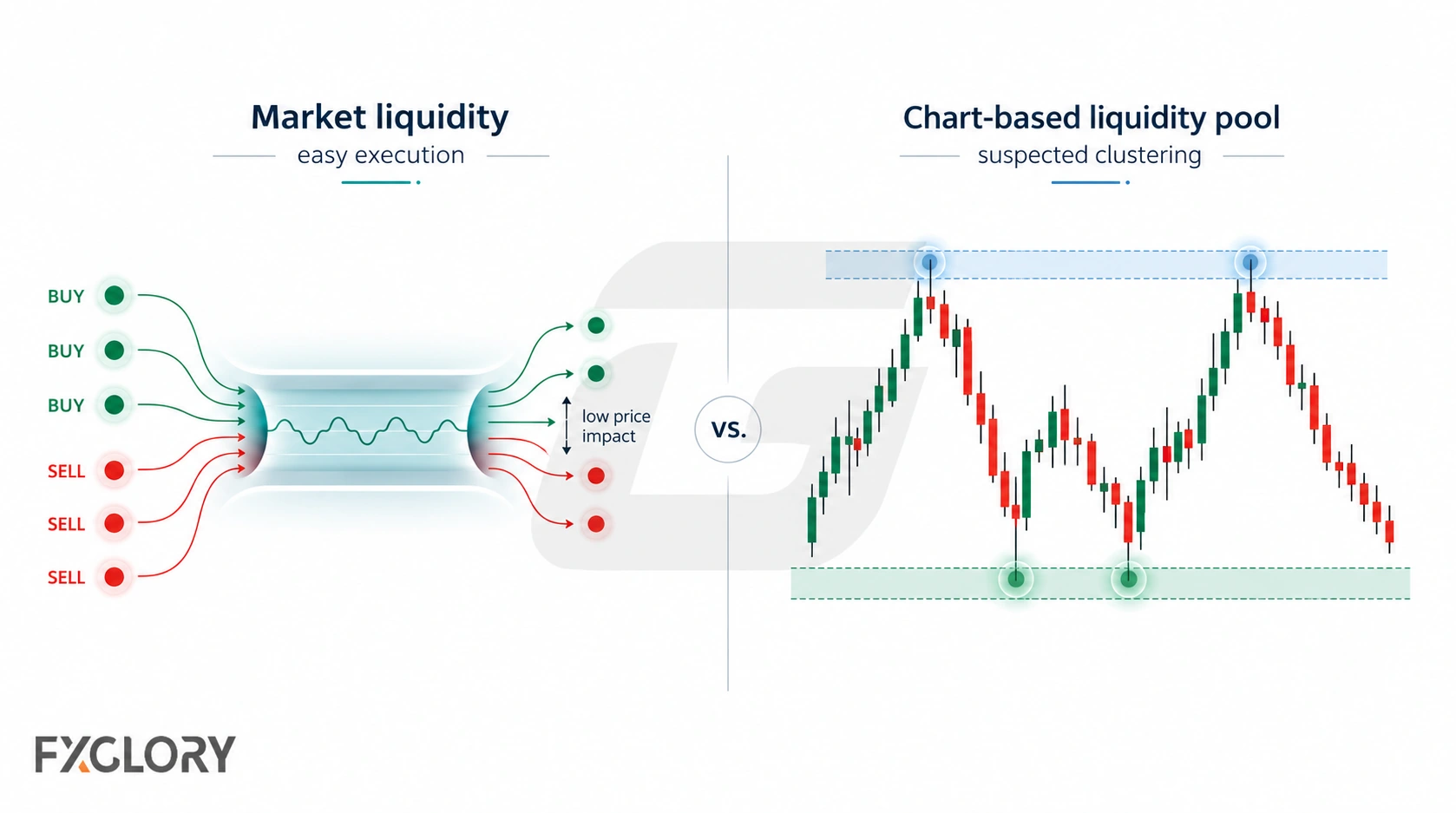
The word liquidity can refer to different market concepts. In execution terms, market liquidity concerns how readily an asset can be traded without a large price impact. A chart-based liquidity pool is different: it is a suspected order-clustering area inferred from visible price structure.
| Liquidity Term | Meaning | Key Distinction |
|---|---|---|
| Market liquidity | How readily an asset can be traded without large price impact | Concerns trading conditions and execution |
| Broker or liquidity-provider pool | Liquidity available through broker or provider infrastructure | Part of execution infrastructure, not a chart label |
| Chart-based liquidity pool | A visible area where traders may suspect orders are clustered | Inferred from chart structure rather than verified from a full order book |
| Order-book liquidity | Resting orders displayed or estimated by a depth or heatmap tool | Depends on the venue, provider, and data source |
| DeFi liquidity pool | A smart-contract pool used in decentralized finance | A separate concept from the price-action meaning used here |
Where Liquidity Pools May Form on a Forex Chart
Liquidity-pool analysis usually starts with chart areas that are easy to identify consistently, such as repeated highs or lows and prior reaction zones. These locations are watched because they provide clear reference points for discussing possible orders around a level.
| Chart Area | Why Traders Watch It | Possible Order Context |
|---|---|---|
| Above visible highs | The high provides a clear reference level | Buy stops or breakout buy orders may be assumed above it |
| Below visible lows | The low provides a clear reference level | Sell stops or breakdown sell orders may be assumed below it |
| Equal highs | Repeated highs create an obvious shared level | Buy-side orders may be suspected above the area |
| Equal lows | Repeated lows create an obvious shared level | Sell-side orders may be suspected below the area |
| Historical reaction areas | Price has previously responded around the zone | Traders may monitor whether the area attracts another response |
The chart should be readable before a liquidity label is added. If the highs, lows, or reactions are difficult to define, review how to read forex charts first.
Buy-Side and Sell-Side Liquidity in Forex
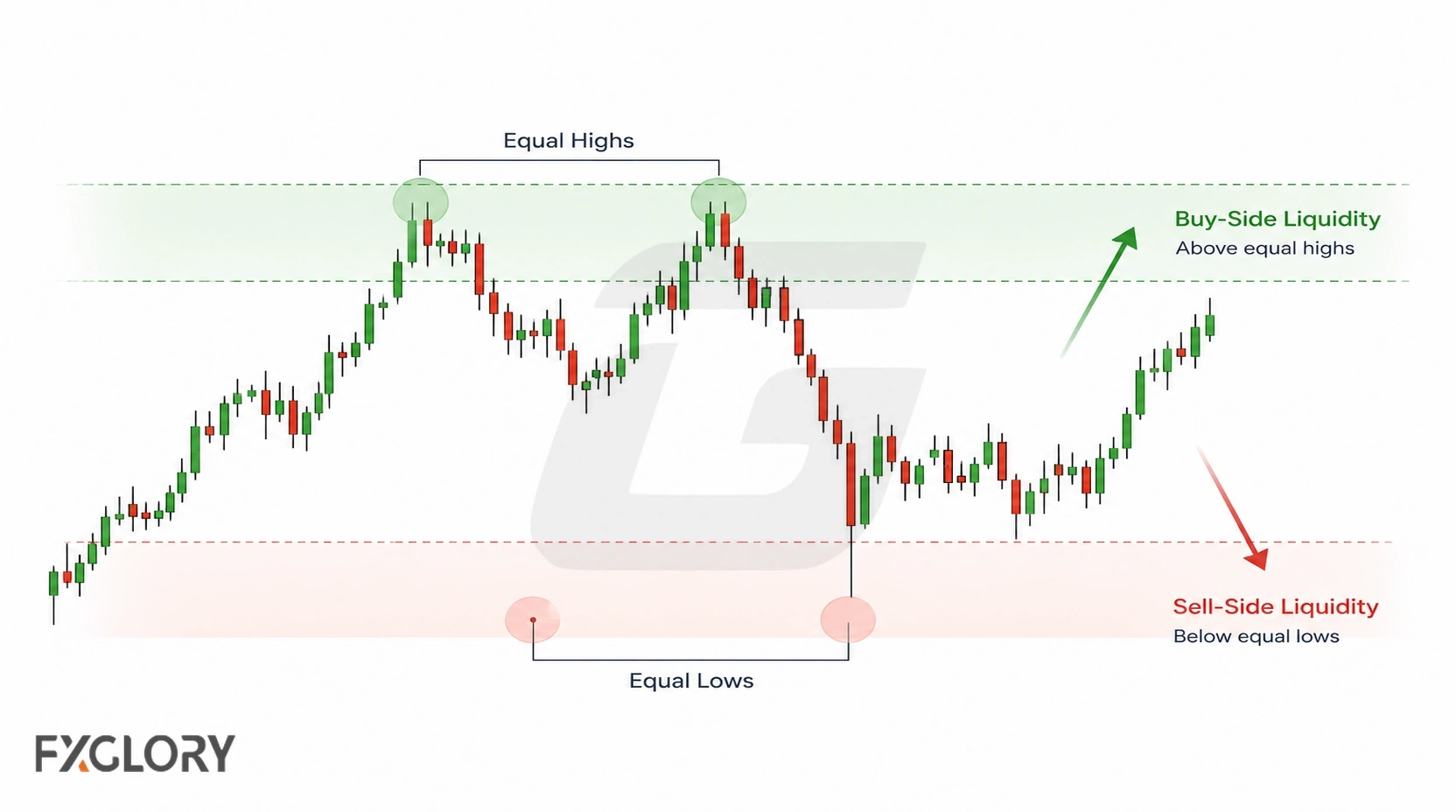
Buy-side and sell-side liquidity describe the side of a visible level where traders may expect certain orders to sit.
| Term | Common Chart Location | Typical Interpretation |
|---|---|---|
| Buy-side liquidity | Above visible highs or equal highs | Buy stops or breakout buy orders may be assumed above the level |
| Sell-side liquidity | Below visible lows or equal lows | Sell stops or breakdown sell orders may be assumed below the level |
| Stop-loss liquidity | Around obvious invalidation or stop areas | Stops may be suspected near the level, but their actual placement is not visible on a standard chart |
Liquidity Grab vs Liquidity Sweep
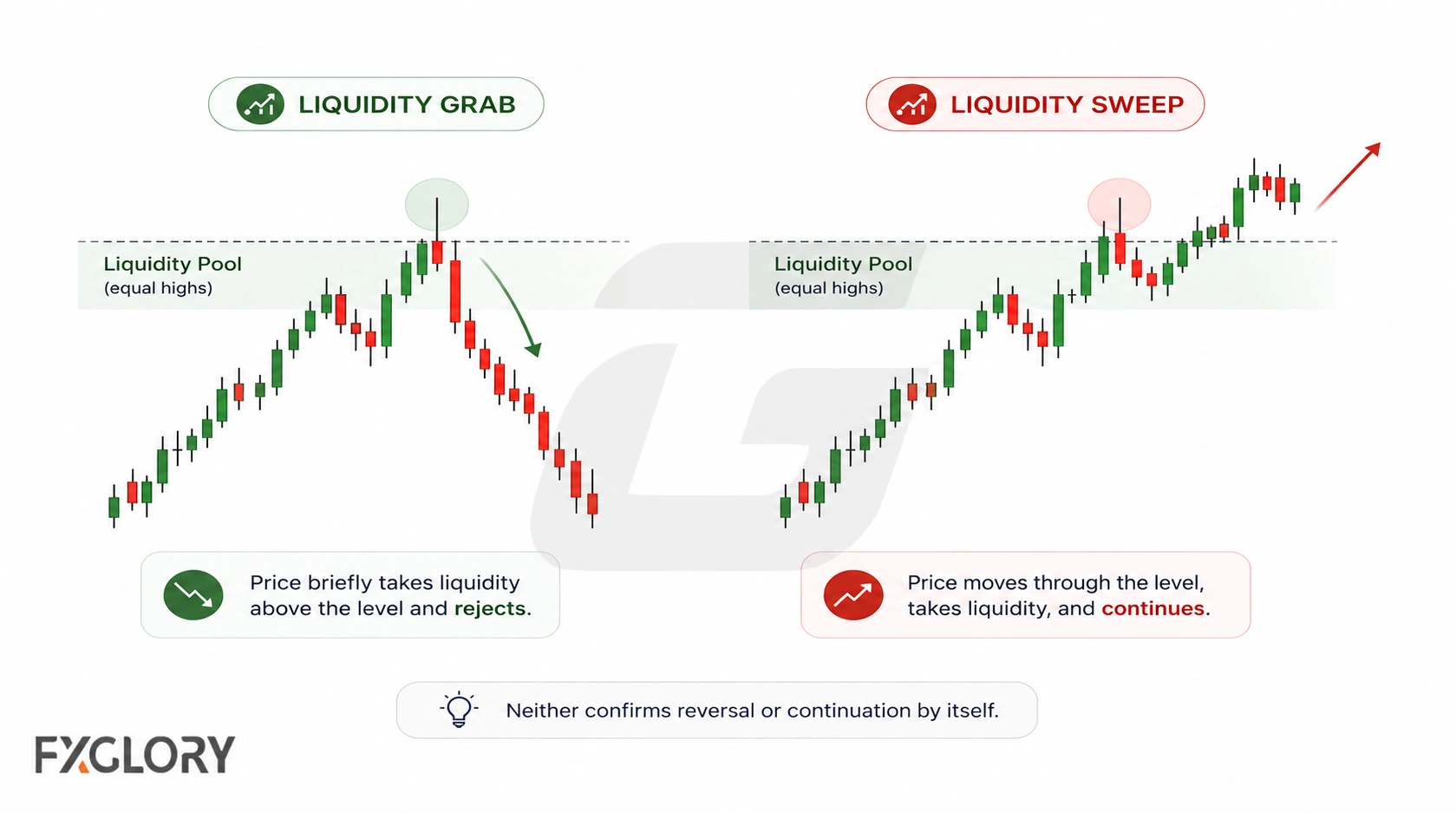
Liquidity grab and liquidity sweep are common trading terms for price interacting with a suspected liquidity area. Usage varies, so the price behavior matters more than the label.
| Term | Common Use | What to Check Next |
|---|---|---|
| Liquidity grab | Price quickly trades into or beyond a suspected liquidity area | Whether price rejects or keeps expanding |
| Liquidity sweep | Price trades through a visible high or low area | Whether the move is rejected, accepted, or develops into a breakout |
| Sweep failure | The expected rejection does not develop | Whether the original scenario has been invalidated |
A move through a visible level should therefore be evaluated after the break rather than assumed to be a reversal in advance.
Fast movement can also leave a visible imbalance, but that is a separate price-action concept covered in the fair value gap guide.
Stop-Loss Liquidity in Forex
Stop-loss liquidity is a phrase used when traders discuss possible stop clusters around obvious chart levels. For example, stops may be expected above a prior high or below a prior low because those locations can serve as straightforward invalidation points for some positions.
Are Liquidity Pools Proof of Stop Hunting?
No. Price moving beyond an obvious high or low shows what happened on the chart, not why it happened.
The move could occur during a breakout, a news reaction, a volatility expansion, ordinary price discovery, or other market activity. Without evidence beyond the chart itself, assigning deliberate stop-hunting or institutional intent goes beyond what the price action establishes.
Liquidity Zones vs Support and Resistance
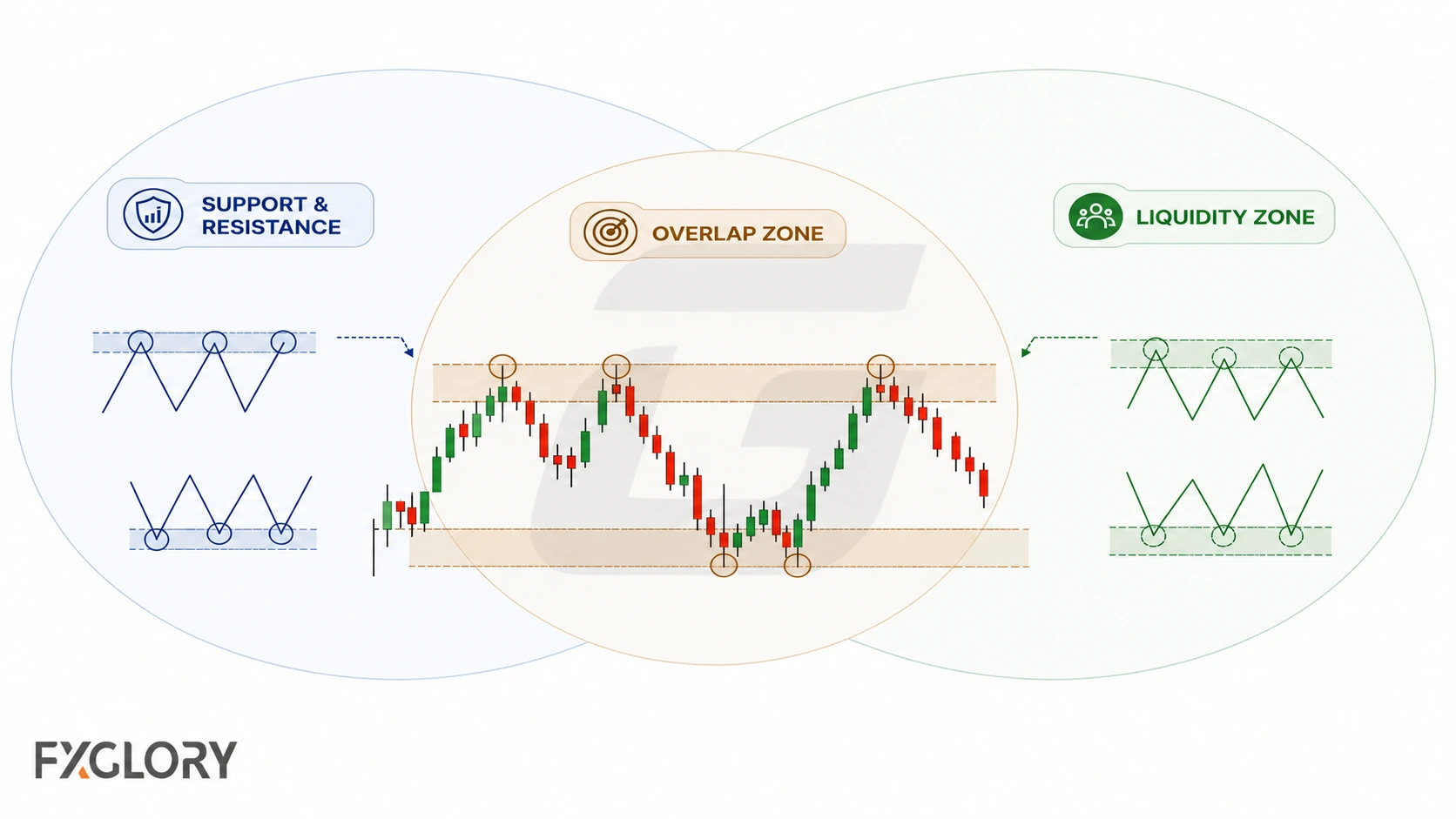
Liquidity zones and support and resistance can overlap, but they describe different aspects of the same chart area.
| Concept | Primary Focus | Typical Question |
|---|---|---|
| Support and resistance | Historical price reactions | Has price previously responded around this area? |
| Liquidity zone | Possible order clustering around a visible level | Could orders be concentrated around this high, low, or reaction area? |
| Overlap area | Both prior reaction and a visible reference level | How does price behave if it revisits or trades through the area? |
Liquidity Indicators and Heatmaps
Different tools can represent different kinds of liquidity information, so the data source matters.
- Heatmaps: May display visible or estimated resting liquidity from a particular venue, feed, or model.
- Order-book tools: May show depth where that data is available, but spot forex has no single centralized order book covering the entire market.
- Liquidity indicators: Often mark chart features such as highs, lows, equal levels, or other rule-based zones.
- Manual review: Helps distinguish what the tool actually measures from what the trader is inferring.
Before relying on a tool, check whether it is showing venue-specific depth data, estimated liquidity, or simply chart-based zones.
How Traders Review Liquidity Pools
A liquidity pool is more useful as a chart scenario than as an automatic trade instruction. The review should connect the marked level to surrounding price structure.
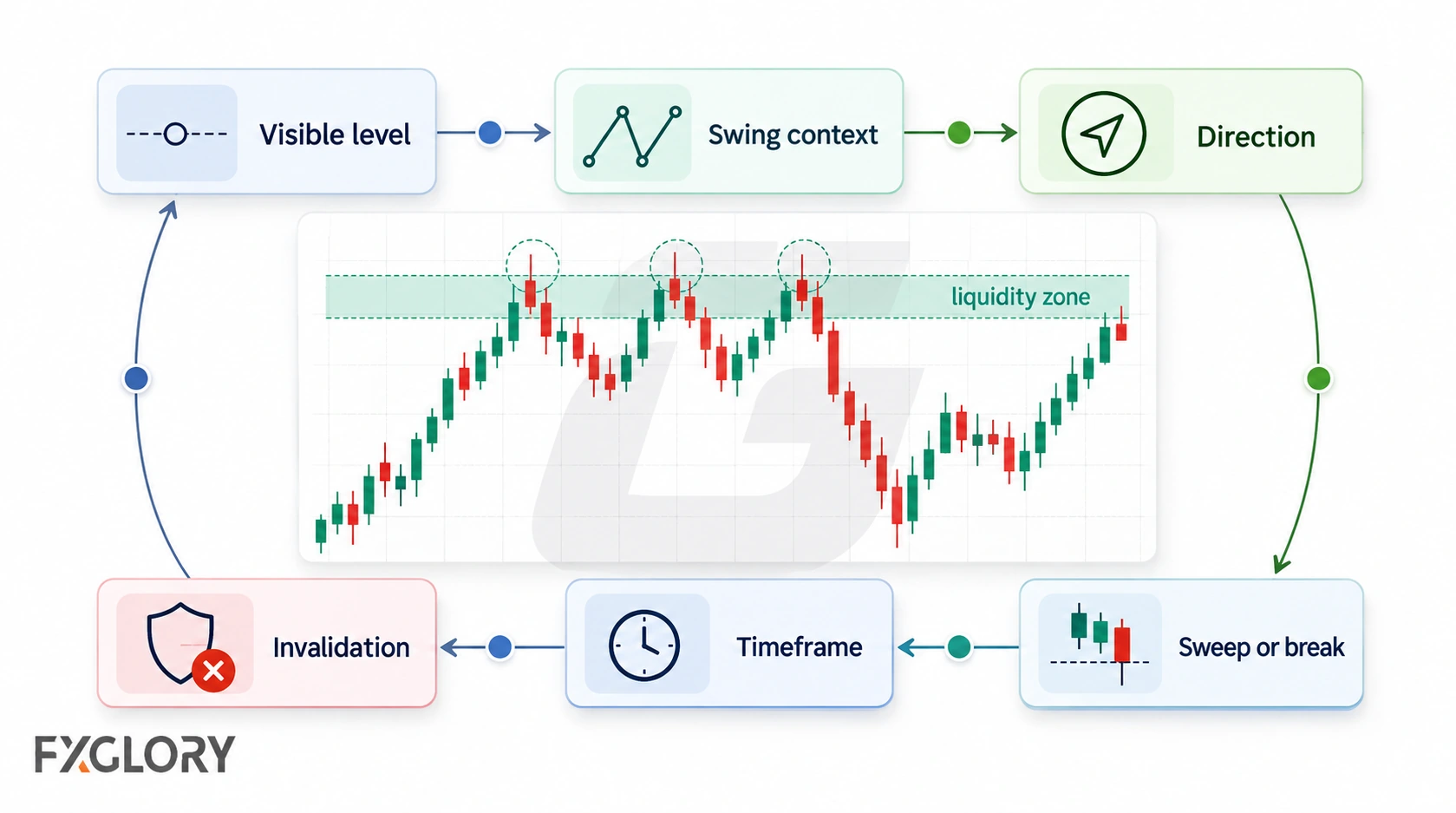
- Start with a visible level: Mark a high, low, equal level, or reaction area that can be identified without forcing the chart.
- Check swing context: Decide where the level sits within the broader highs and lows. See forex market structure for that layer.
- Check direction: Note whether the surrounding market is trending upward, trending downward, ranging, or unclear. The forex trend guide covers that distinction.
- Observe the interaction: If price reaches the area, note whether it rejects, closes through it, continues, or becomes indecisive.
- Check the timeframe: A level that looks important on a small timeframe may be minor within a larger structure.
- Define invalidation: State what price behavior would make the original liquidity-zone scenario no longer useful.
When Liquidity Pool Analysis Is Not Clear Enough
Some charts do not provide a clean enough structure for a useful liquidity-zone reading. Warning signs include:
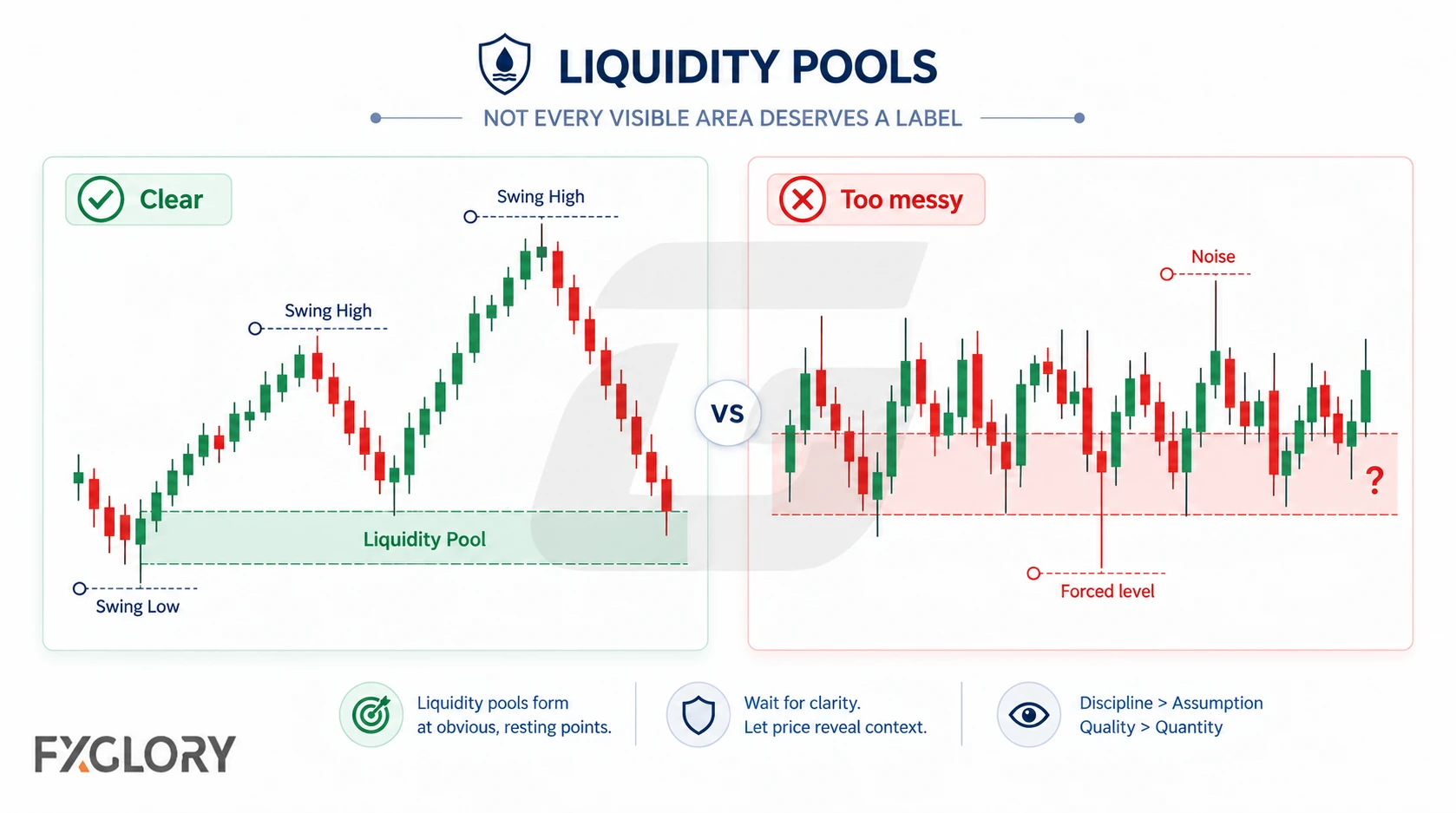
- Forced level: The zone requires repeated adjustment to make the idea fit.
- Messy range: Overlapping price action makes distinct highs, lows, or breaks difficult to separate.
- Low-timeframe noise: The zone appears meaningful only on a very small timeframe while the broader structure is unclear.
- Event-driven volatility: Rapid movement around scheduled or unexpected news makes the chart interaction difficult to interpret.
- No informative reaction: Price passes through the area without producing a clear change in behavior.
Common Mistakes With Forex Liquidity Pools
- Assuming price must reach a marked zone: A suspected liquidity area can remain untouched.
- Labeling every high or low: A useful zone should have a clear chart reason rather than being added to every swing point.
- Assuming every sweep will reverse: Price can trade through the level and continue.
- Mixing different meanings of liquidity: Chart-based zones, order-book depth, broker liquidity, and DeFi pools are separate concepts.
- Using the zone without context: Structure, direction, timeframe, and invalidation still determine whether the observation is useful.
Example: Liquidity Pool on Gold
Suppose gold forms several visible highs near the same price area on the timeframe being studied. A trader using liquidity terminology may mark the area above those highs as possible buy-side liquidity.
If price later trades above the highs, the next observation is what price does after the break. A quick rejection would produce a different scenario from sustained trading above the level and continued upward movement.
The review can then return to the same framework used earlier: Is the level clear? Where does it sit in the broader structure? What is the prevailing direction? Which timeframe is being used? What behavior would invalidate the original idea?