
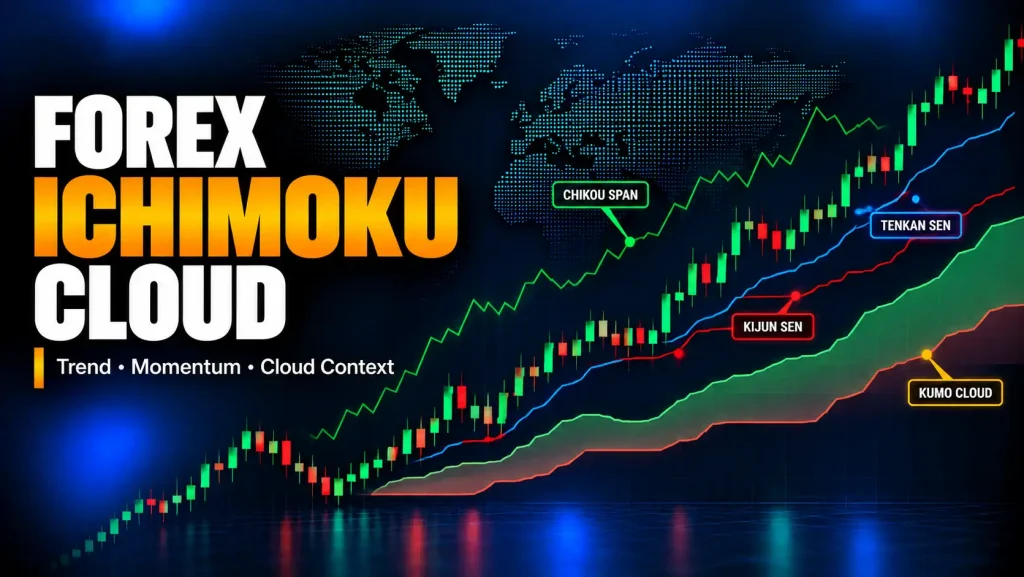
What Is Ichimoku in Forex?
Ichimoku in forex is a multi-line technical indicator used to review trend context, momentum, cloud zones, and possible signal conflict on a currency-pair chart.
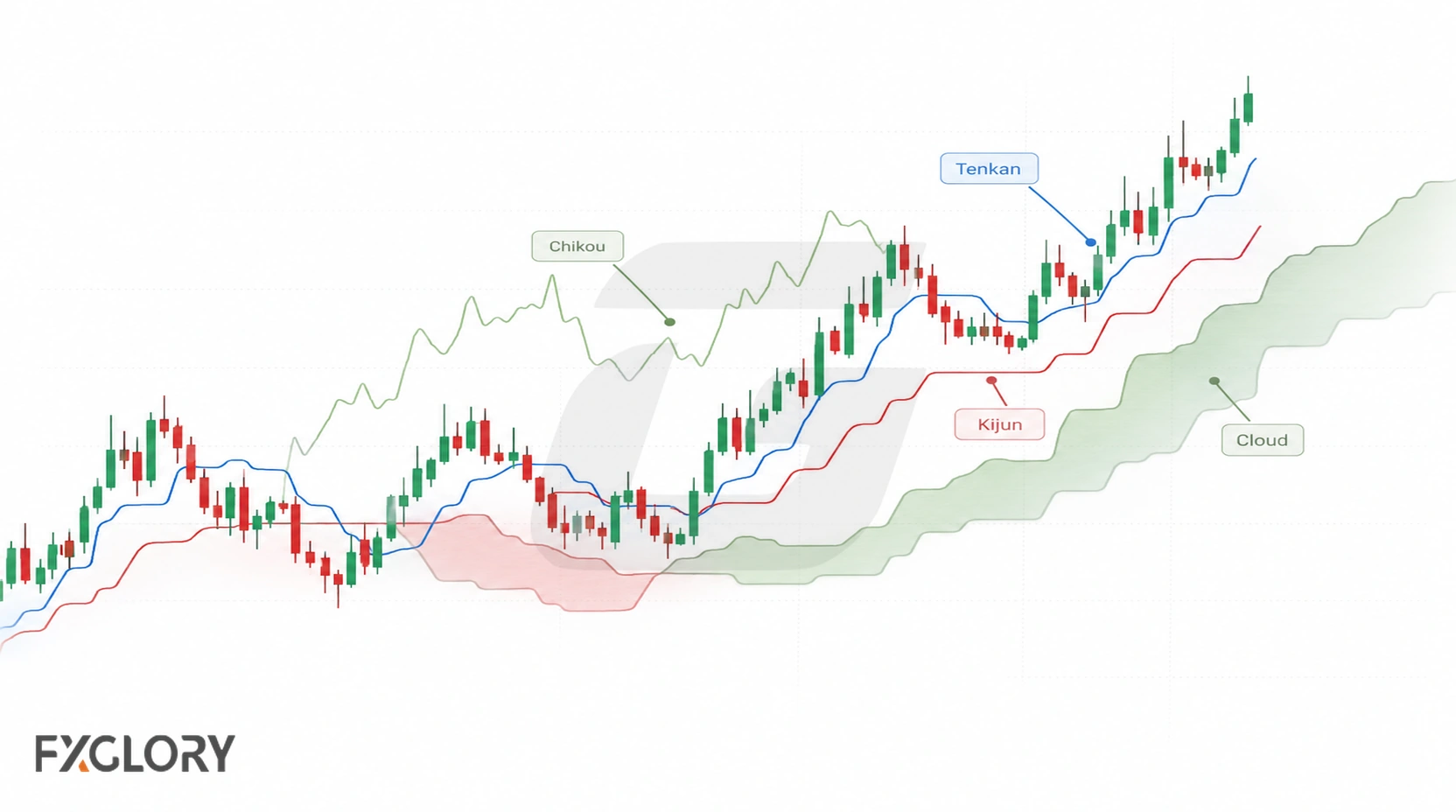
The full name is Ichimoku Kinko Hyo, often translated as a one-glance equilibrium chart. In practical chart reading, the indicator places several lines and a cloud on the chart so the trader can review context quickly.
Ichimoku should not be treated as a one-click trading signal. It can help organize a chart, but it does not tell a trader where to enter, where to exit, or how much to risk by itself.
Ichimoku combines several related calculations so traders can compare trend direction, price balance, and conflicting signals on the same chart. For a broader explanation of trend direction, see forex trend.
This guide focuses on Ichimoku as one of the more advanced forex technical indicators. For the broader framework, start with the full technical-analysis roadmap.
The Main Parts of Ichimoku
Ichimoku can look crowded at first because several lines appear on the same chart. A beginner should learn the role of each part before reading any signal.
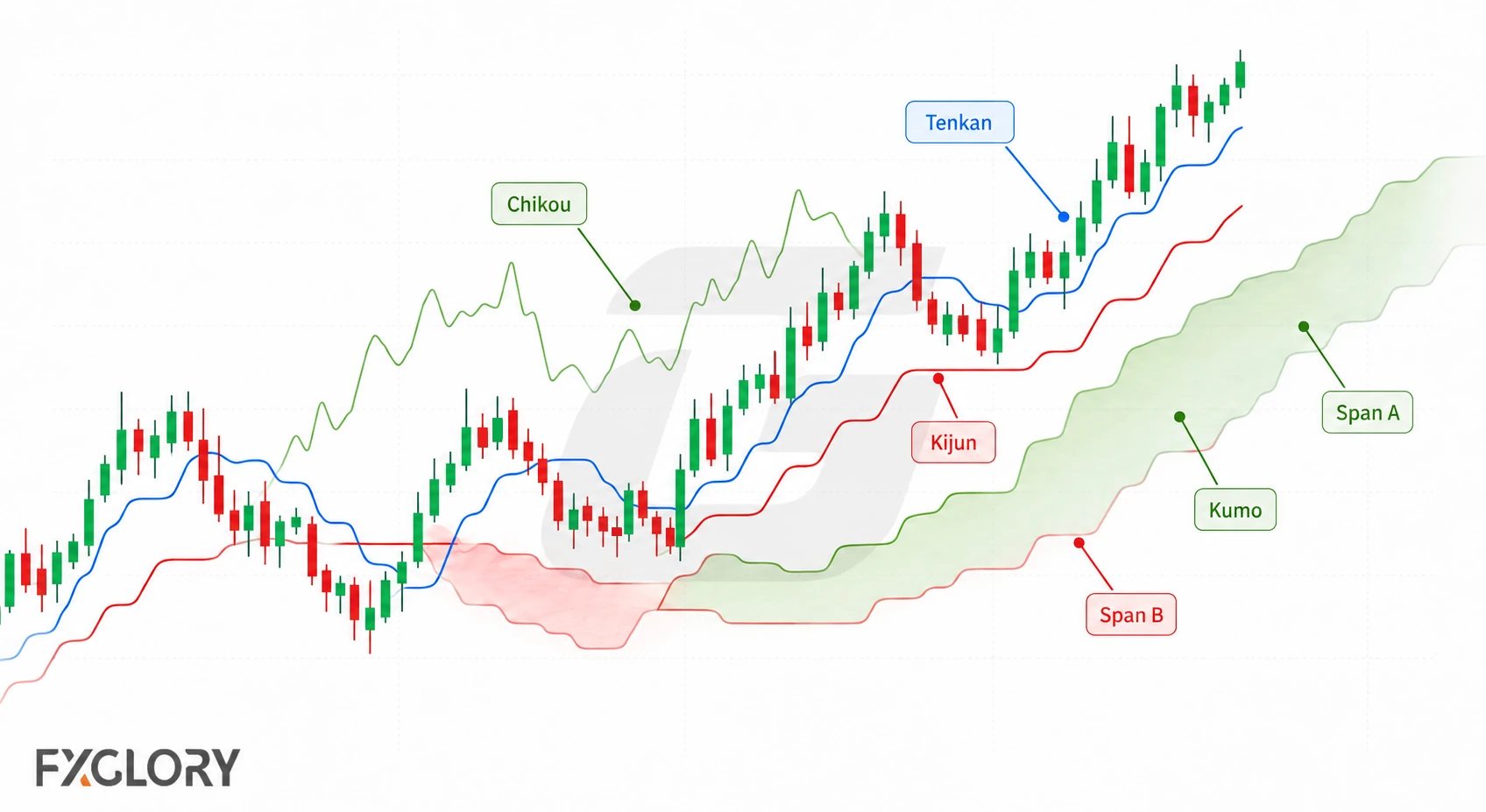
| Ichimoku Part | Standard Calculation | Plot Position | Plain-English Role |
|---|---|---|---|
| Tenkan Sen | (9-period high + 9-period low) / 2 | Current chart position | Short-term balance line |
| Kijun Sen | (26-period high + 26-period low) / 2 | Current chart position | Medium-term base line |
| Senkou Span A | (Tenkan Sen + Kijun Sen) / 2 | Plotted 26 periods forward | One boundary of the cloud |
| Senkou Span B | (52-period high + 52-period low) / 2 | Plotted 26 periods forward | The other boundary of the cloud |
| Kumo cloud | Area between Senkou Span A and Senkou Span B | Forward-projected zone | Trend and balance context |
| Chikou Span | Current close | Plotted 26 periods backward | Lagging comparison with earlier price structure |
The common Ichimoku settings are 9, 26, and 52 periods. Tenkan and Kijun are high-low range midpoints, not moving averages of closing prices. Platforms may allow custom settings, so comparisons should use the same configuration.
The cloud is the most visible part of Ichimoku, but the reading is weak if the surrounding lines are ignored.
A cleaner Ichimoku reading starts by checking whether price, cloud, Tenkan, Kijun, Chikou, and timeframe agree or conflict.
Before adding Ichimoku to a chart, the basic chart interface should already be clear. For that foundation, use the chart-interface basics.
How Traders Read the Ichimoku Cloud
The Kumo is the forward-projected zone formed by Senkou Span A and Senkou Span B. Traders often use it to review broad context rather than one exact price level.
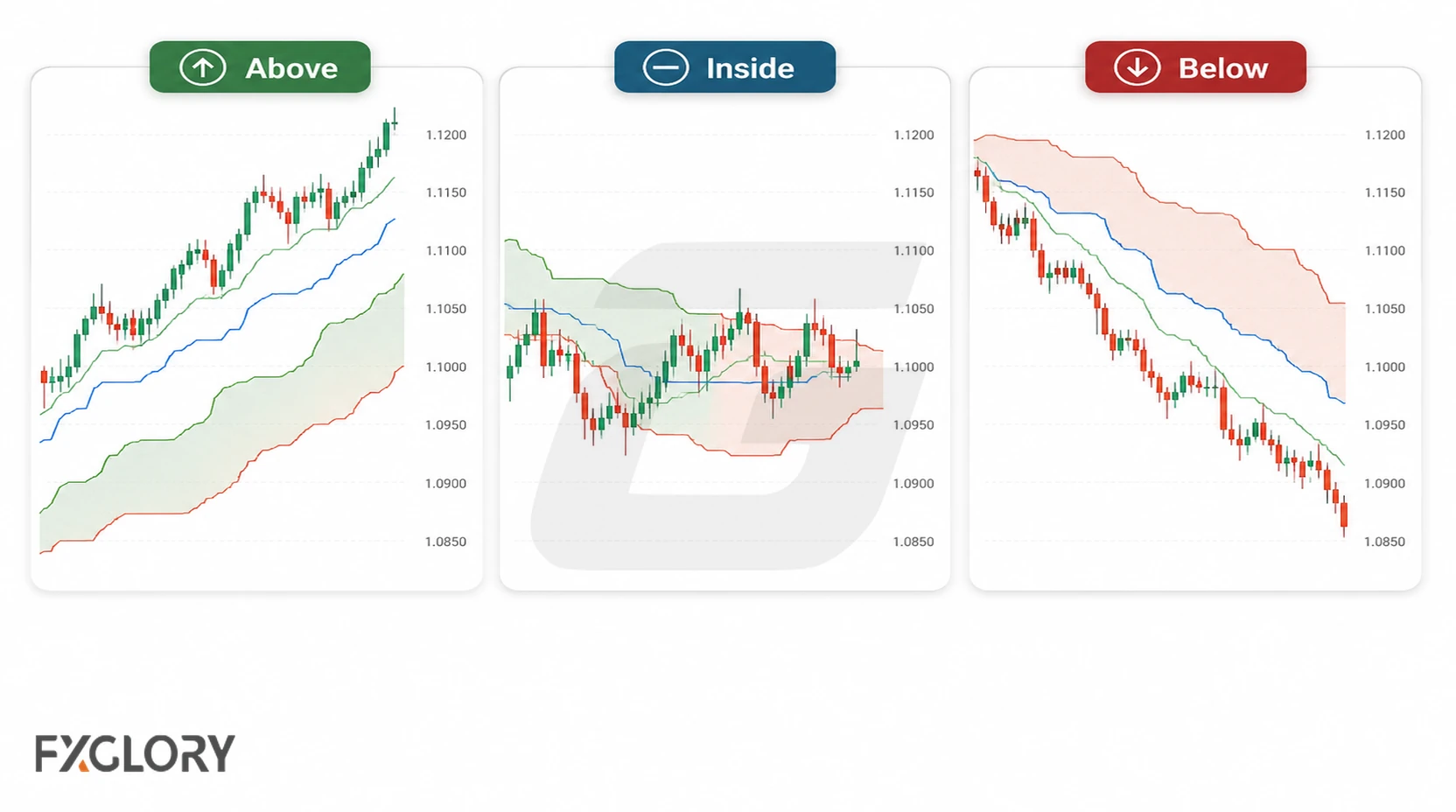
| Price Position | Common Reading | Main Risk |
|---|---|---|
| Price above the cloud | Bullish context may be present | The move may already be stretched |
| Price below the cloud | Bearish context may be present | The move may already be late |
| Price inside the cloud | Context may be unclear or transitional | Signals can be weaker or noisy |
| Thick cloud | A wider zone of uncertainty or possible reaction may exist | It is not an exact price line |
| Flat cloud area | Balance or hesitation may be visible | False confidence can develop around the flat area |
A cloud reading should be treated as context. Price above the cloud does not guarantee continuation. Price below the cloud does not guarantee further decline. Price inside the cloud often means the chart needs more caution.
Tenkan Sen and Kijun Sen in Forex
Tenkan Sen and Kijun Sen are usually read together because they compare faster and slower balance on the chart.
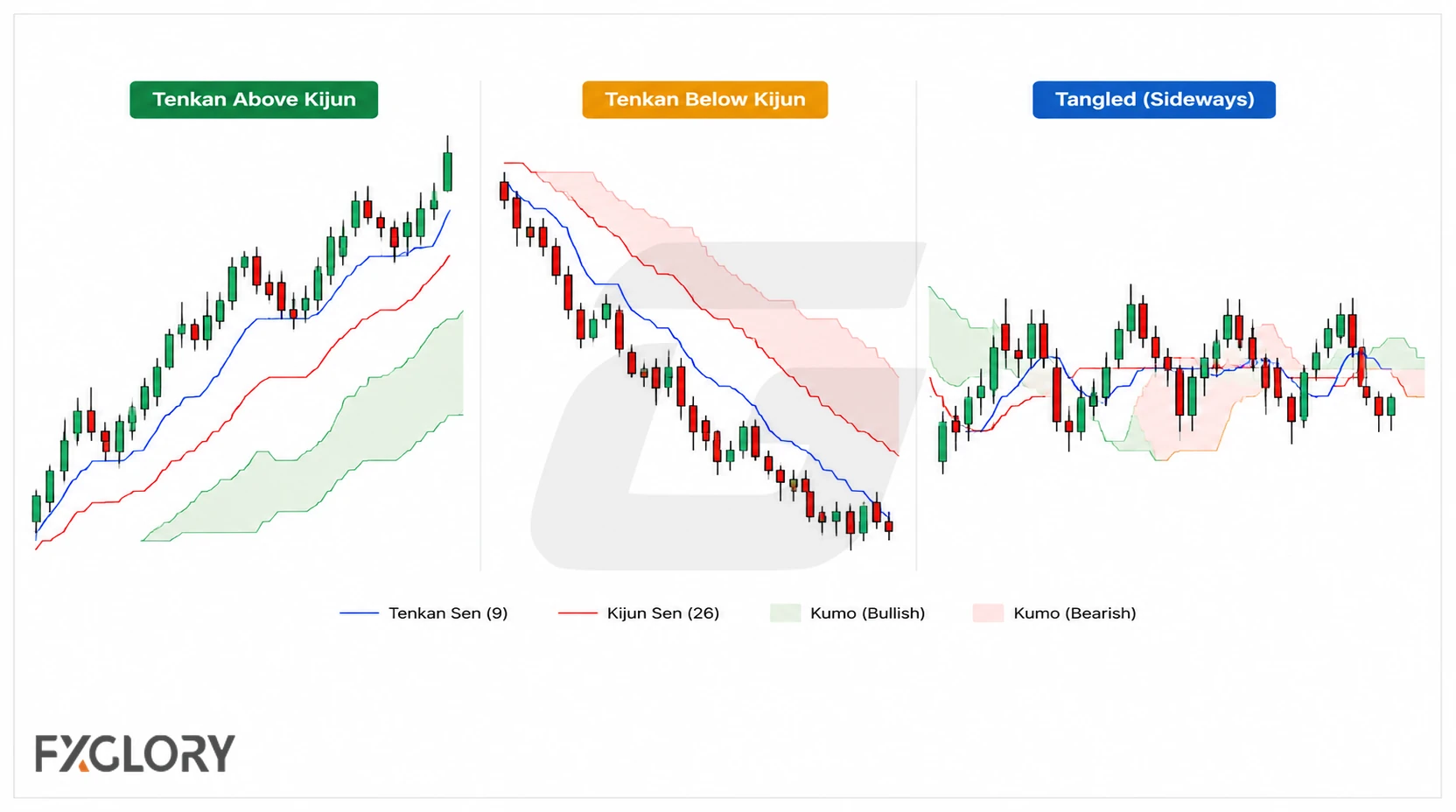
- Tenkan Sen: A faster line that reacts to shorter-term price balance.
- Kijun Sen: A slower base line that can show broader balance.
- Tenkan above Kijun: Some traders read this as supportive of bullish context, depending on the cloud and timeframe.
- Tenkan below Kijun: Some traders read this as supportive of bearish context, depending on the cloud and timeframe.
- Tangled lines: When the lines cross back and forth, the chart may be choppy or unclear.
A Tenkan/Kijun cross is not a complete trade plan. The location of price, the cloud, the timeframe, and the broader chart condition still matter.
Chikou Span and Lagging Context
Chikou Span is a lagging line used to compare current price context with earlier chart movement. Beginners often ignore it or misread it because it appears behind current price.
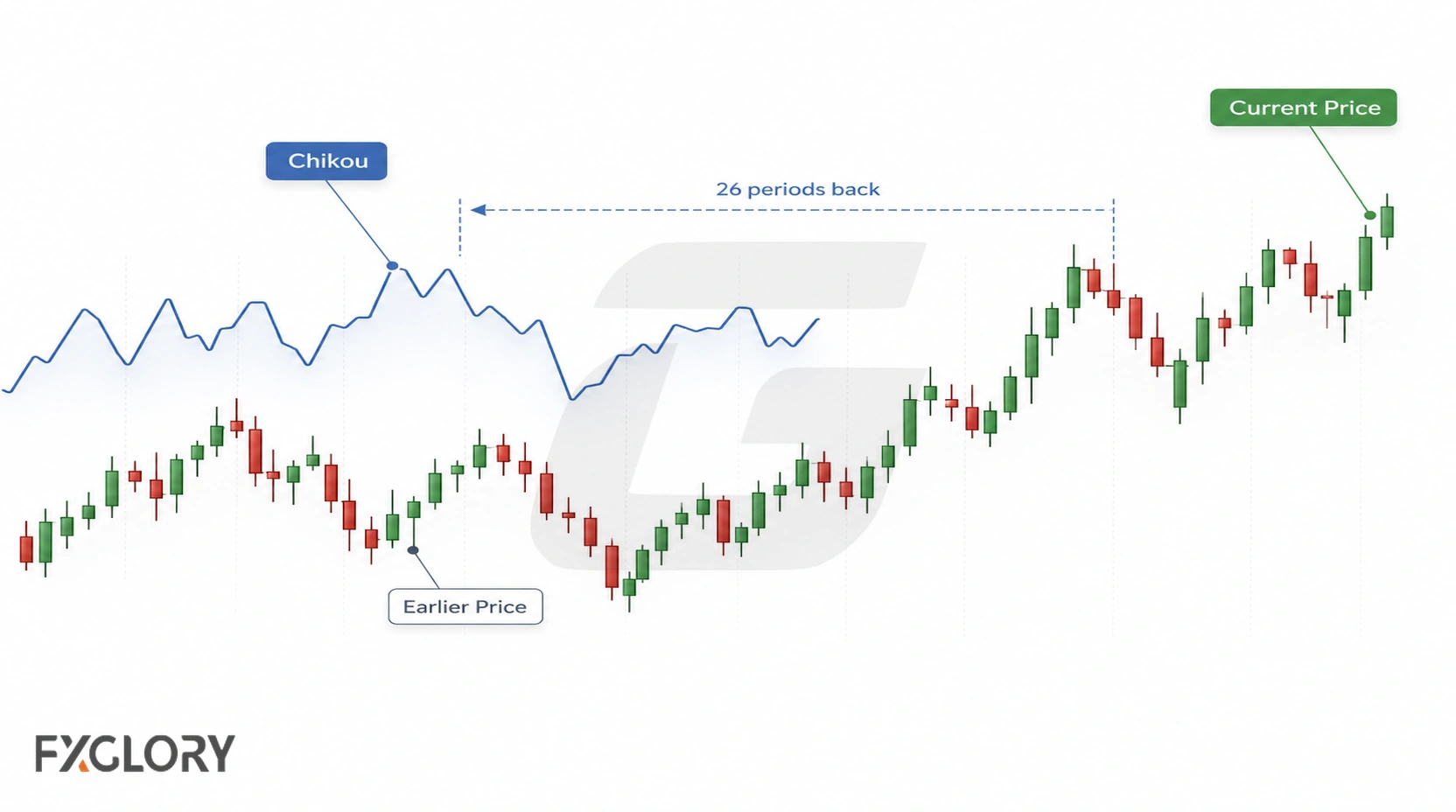
A trader may use Chikou Span to check whether earlier price areas are interfering with the current reading. This should still be treated as supporting context, not confirmation by itself.
Forex chart feeds, sessions, and candle closes can vary by broker or platform. Because of that, Ichimoku readings may not look identical across every chart.
Ichimoku Signals vs Ichimoku Context
Ichimoku can produce many possible readings, but a reading is not the same as a trade. Beginners should separate signal language from chart context.
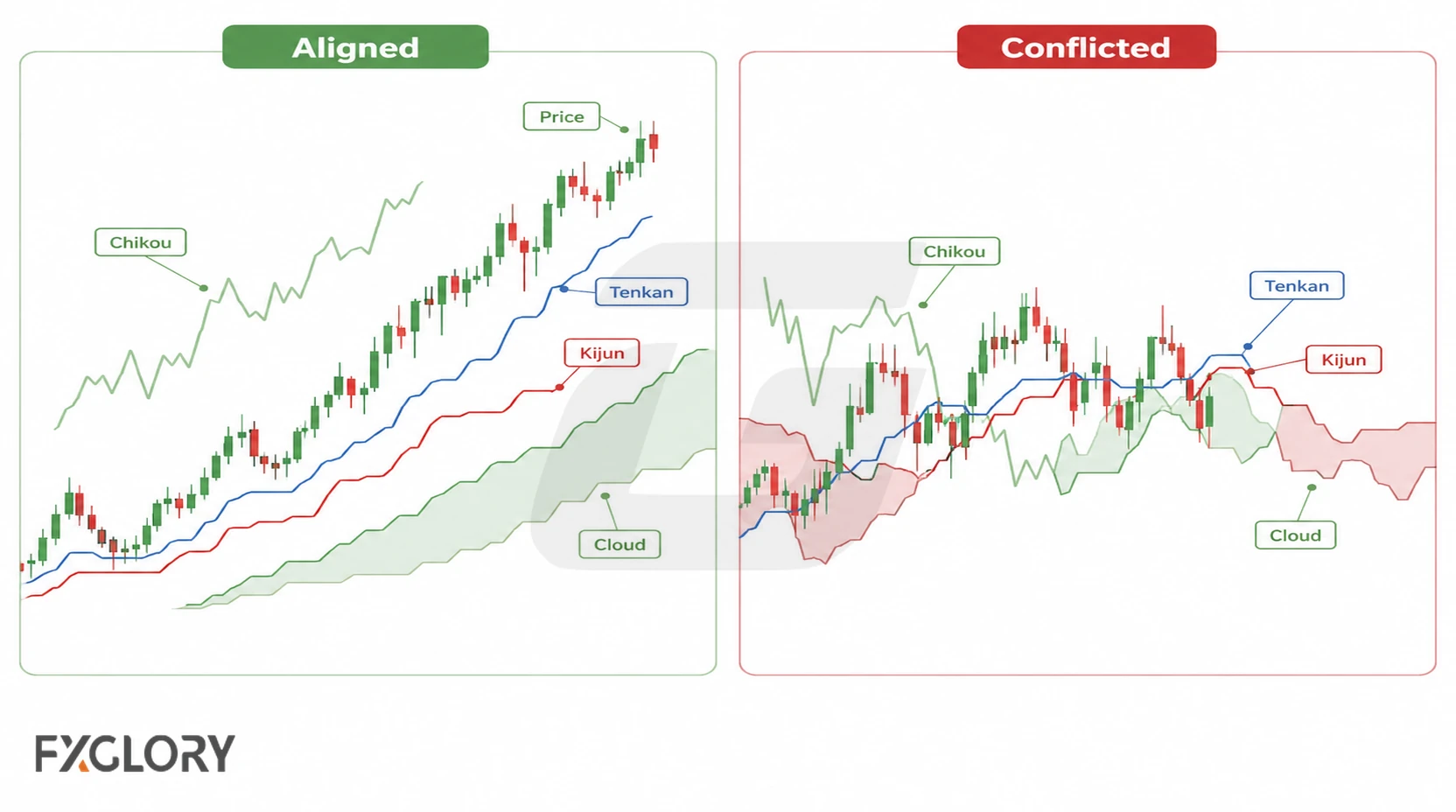
| Reading | What It May Suggest | Why It Is Not Enough Alone |
|---|---|---|
| Price above cloud | Bullish context may be present | The move may be stretched or near resistance |
| Price below cloud | Bearish context may be present | The move may be late or near support |
| Tenkan/Kijun cross | Momentum balance may be changing | Crosses can whipsaw in ranges |
| Price inside cloud | Context may be uncertain | Signals inside the cloud can be weaker |
| Chikou conflict | Earlier price context may be blocking a clean read | The trader still needs current chart confirmation |
Ichimoku is more useful when its parts agree with a clear chart condition. When the cloud, lines, price location, and timeframe disagree, the indicator may be showing confusion rather than opportunity.
Ichimoku and Timeframes
Ichimoku readings depend on the timeframe being studied. A currency pair may look clear on one timeframe and unclear on another.
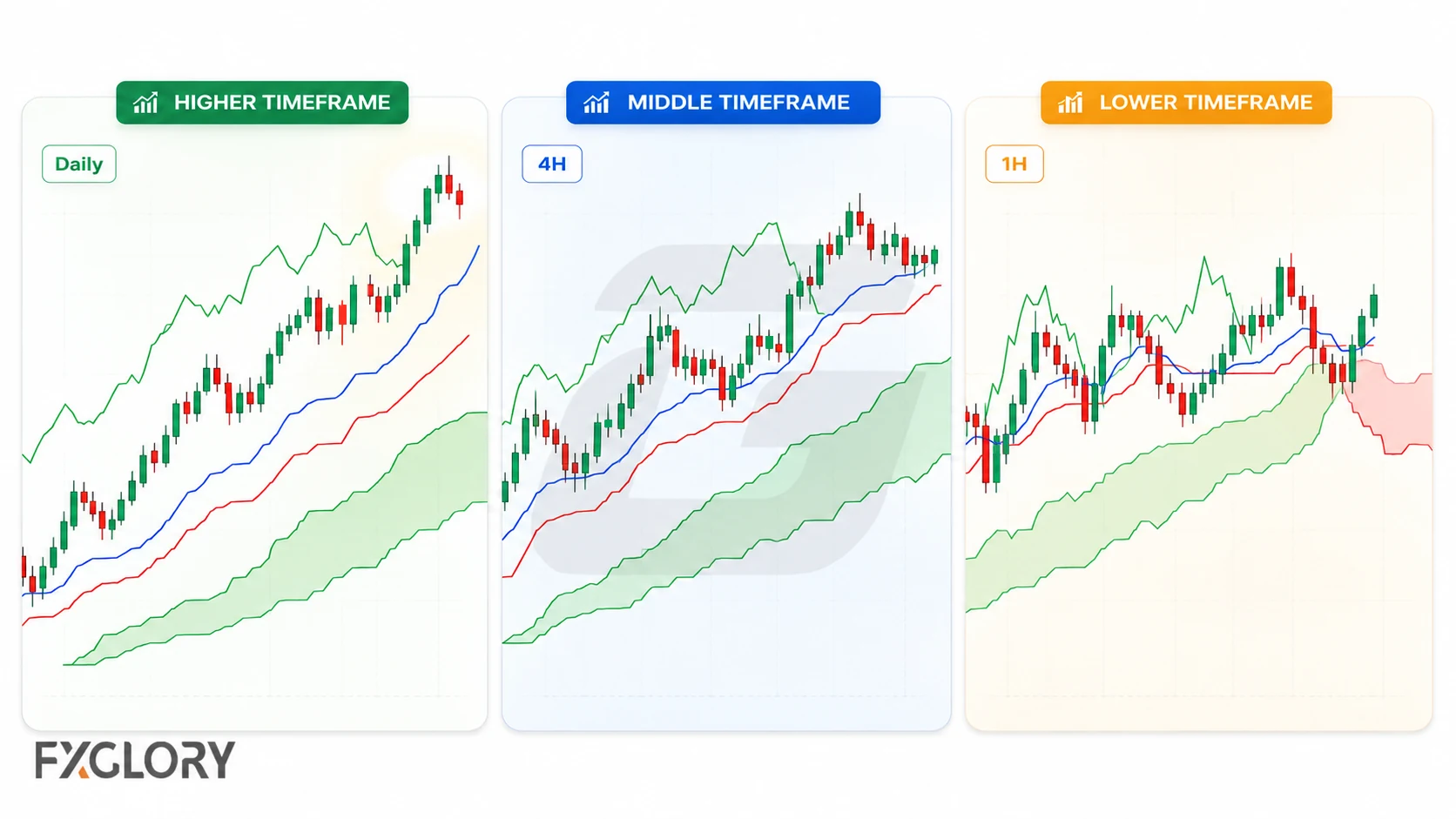
- Higher timeframe: May help review broader trend context.
- Middle timeframe: May show how current movement fits inside the broader condition.
- Lower timeframe: May show more detail, but can also create more noise.
- Conflicting timeframes: A lower-timeframe cloud reading may disagree with the broader chart condition.
This is why the same Ichimoku reading can mean something different on a 1-hour chart than on a daily chart.
When Ichimoku Is Not Clear Enough
Ichimoku is not always easy to read. Some chart conditions make the cloud and lines less useful.
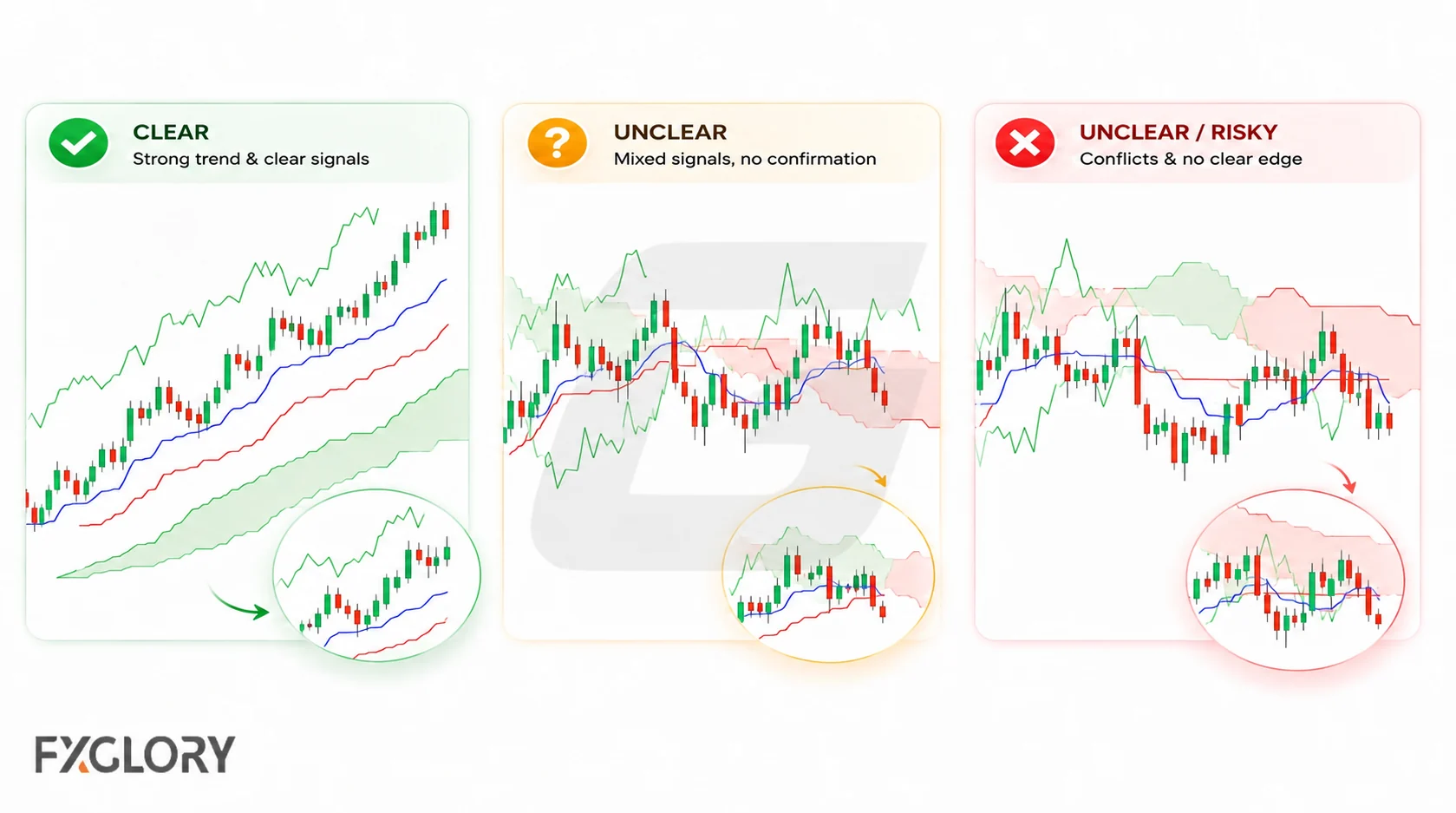
- Price inside the cloud: The market may be transitional or unclear.
- Tangled Tenkan and Kijun: Repeated crosses can signal noise rather than a clean context.
- Flat or overlapping cloud: The chart may be balanced, slow, or uncertain.
- Choppy range: Ichimoku readings can whipsaw when price lacks direction.
- News-driven spike: A sudden move can distort the indicator reading.
- Timeframe conflict: One timeframe may look bullish while another looks bearish or range-bound.
Common Mistakes With Ichimoku Forex
Ichimoku mistakes often come from treating one line or one cross as if it explains the whole chart.
- Using Ichimoku as a standalone signal: The indicator still needs chart context and risk control.
- Trading every Tenkan/Kijun cross: Crosses can fail, especially inside ranges or inside the cloud.
- Ignoring price location: A cross above, below, or inside the cloud can have different context.
- Ignoring timeframe: A short-term signal can conflict with a higher-timeframe chart.
- Reading the cloud as an exact level: The cloud is a zone, not a precise price guarantee.
- Ignoring spread and liquidity: Execution conditions still matter even when the indicator looks clean.
- No invalidation: The trader cannot explain where the Ichimoku idea fails.
Example: Reading Ichimoku on EUR/USD
Suppose EUR/USD is shown on a 1-hour chart with Ichimoku applied. Price is above the cloud, and Tenkan Sen is above Kijun Sen.
A beginner may describe that as bullish Ichimoku context on that timeframe. The reading does not mean EUR/USD must keep rising. The trader still needs to check whether price is stretched, whether the cloud is clear or flat, whether Chikou Span conflicts with prior price movement, and whether the higher timeframe agrees.
If price moves back into the cloud or Tenkan and Kijun begin crossing repeatedly, the reading becomes less clear. Unstable spread, volatility, or news conditions can weaken it further.
A Safer Way to Read Ichimoku in Forex
A practical Ichimoku workflow is to choose the timeframe, compare price with the cloud, check Tenkan and Kijun alignment, review Chikou for conflict with earlier price structure, and then define what would invalidate the scenario. When those elements disagree, the chart may be better treated as unclear rather than forced into a bullish or bearish label.