
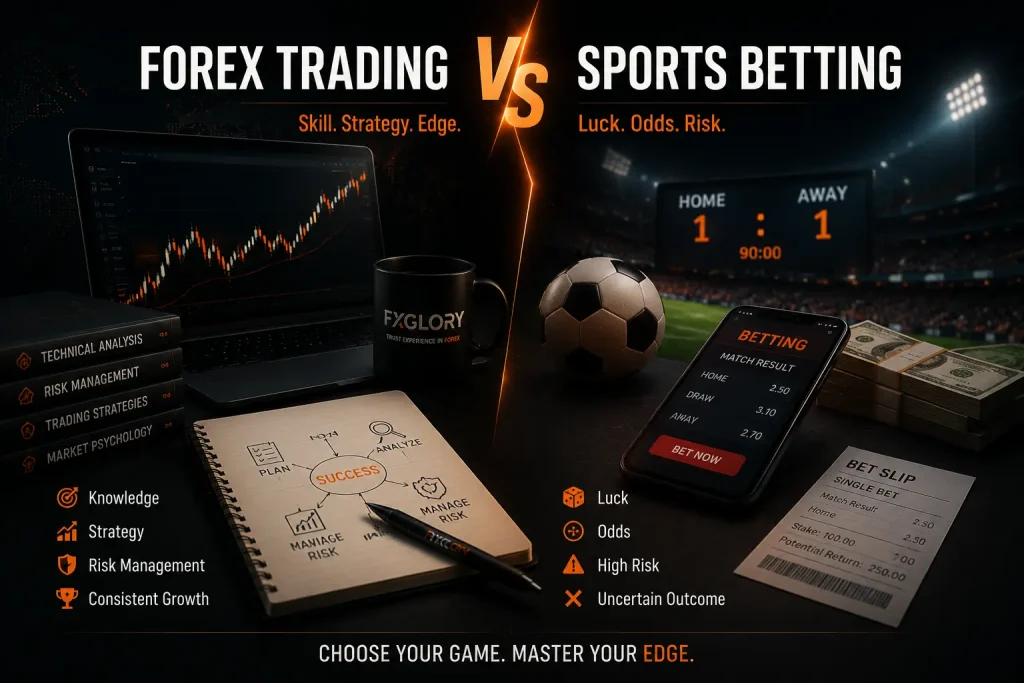
Forex Trading vs Sports Betting: The Direct Answer
Forex trading and sports betting both involve uncertainty and the possibility of losing money, but they are not the same activity. Forex trading involves taking exposure to currency price movement in a financial market. Sports betting involves wagering on a sports outcome or event condition under odds and settlement rules.
Neither activity is automatically “better” simply because its structure is different. Forex gives a trader more ways to define and manage market exposure—such as position sizing, stop logic, exits, exposure limits, and trade review—but those tools do not remove market risk or guarantee a profitable result.
For the broader question of whether trading behavior itself can become gambling-like, read when forex starts to look like gambling.
What Is The Difference Between Forex Trading And Sports Betting?
The main difference is the structure of the risk. A forex trade creates market exposure to a currency pair whose price can change continuously. A sports bet is a wager whose payout and settlement depend on the terms of a sports event market.
| Factor | Forex Trading | Sports Betting |
|---|---|---|
| Core activity | Buy or sell currency exposure based on a trading idea. | Place a wager on a sports outcome or event condition. |
| Pricing | Currency pairs have bid and ask prices that can change continuously with market activity. | Odds define wager pricing and payout terms under the betting market's rules. |
| What can be lost | Losses reduce account equity. Margin supports an open leveraged position but is not the same as a maximum-loss amount. | The financial result depends on the stake and the wager's settlement terms. |
| Leverage and margin | Leverage can allow larger notional exposure relative to the capital or margin supporting the position. | Sports wagers do not use forex-style margin and leveraged currency exposure. |
| Position management | A trader can usually close or adjust an open position while the market and platform permit execution. | Many wagers settle when the event condition is resolved; some platforms may offer separate cash-out features. |
| Costs and friction | Spread, slippage, swap or financing, commissions where applicable, and execution conditions can affect the result. | Odds margin, fees, or platform terms can affect the economics of the wager. |
| Decision review | A journal can evaluate setup quality, risk, execution, and rule-following in addition to profit or loss. | Review focuses on the wager, pricing, result, and decision process under the betting rules used. |
These differences describe how the activities work; they do not make forex risk-free. A poorly sized or highly leveraged forex position can lose money quickly even when the original analysis was reasonable.
What Forex Trading And Sports Betting Have In Common
The strongest overlap is behavioral rather than structural. In both activities, money is put at risk before the outcome is known, and fast feedback can influence the next decision.
- Uncertainty: Neither activity guarantees the result.
- Probability: Decisions may be based on likelihood, but probability is not certainty.
- Emotional pressure: Wins and losses can affect confidence, fear, and urgency.
- Loss-chasing: A previous loss can push the next decision beyond the original risk rules.
- Overconfidence: A recent win can encourage larger or less selective risk-taking.
This is why process matters. See forex trading psychology for a deeper look at fear, greed, FOMO, revenge trading, and tilt.
Odds, Pricing And Edge
Sportsbook odds and forex prices are not interchangeable. Odds price a wager and its payout terms. Forex prices are bid and ask quotations for currency pairs and can change continuously as market participants trade.
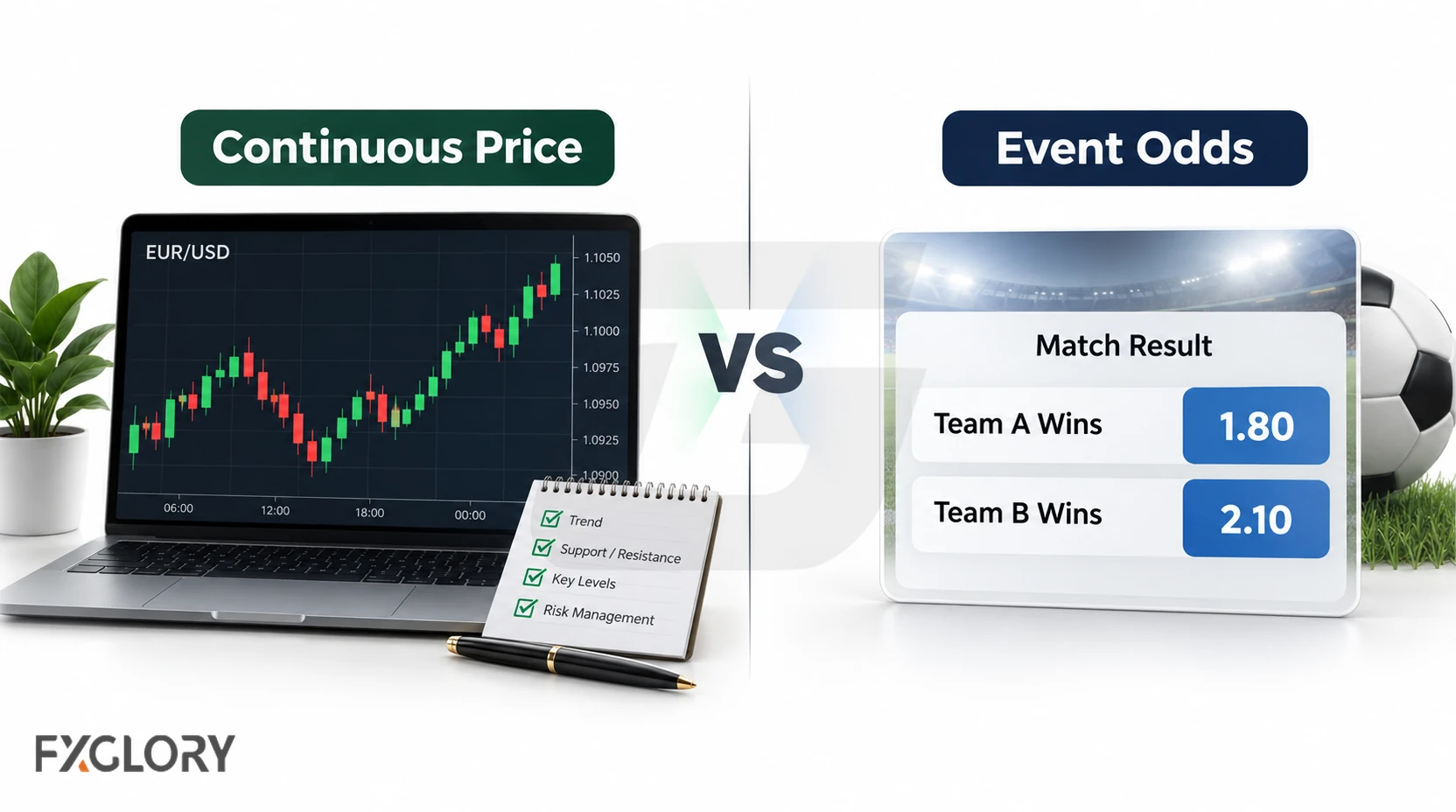
A forex trader may use the word “edge” to describe a tested advantage in a repeatable setup. That claim should be supported by a meaningful sample, consistent execution, cost awareness, and defined risk rules. One winning trade does not prove an edge, and one losing trade does not disprove one.
Risk Control, Leverage And Margin
Risk-control tools can define or reduce intended exposure, but they cannot remove uncertainty. Position size should be considered together with the stop distance, account equity, and total exposure across open positions. A stop can define an intended exit, but slippage, gaps, and fast conditions can produce a different execution price.
Leverage does not magnify the market's price movement. It changes how much notional market exposure can be controlled relative to the capital or margin supporting the position. If a trader takes larger exposure relative to account equity, the same market price move can have a larger effect on the account's profit or loss.
Margin is the amount required to open or maintain a leveraged position under the account's conditions. It is not the same thing as trade risk or maximum possible loss.
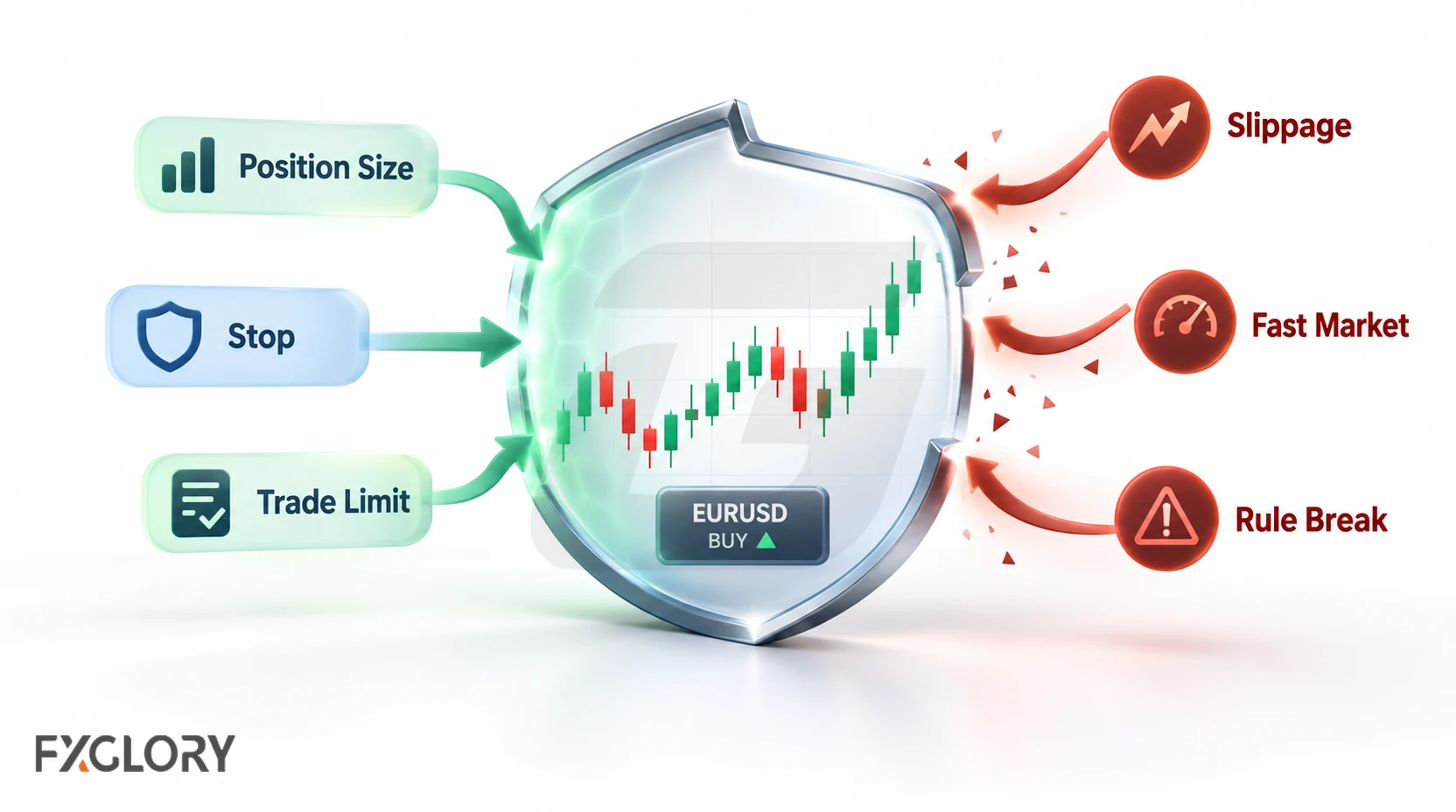
| Risk-Control Tool | What It Helps Define | What It Does Not Guarantee |
|---|---|---|
| Position size + stop distance | The intended monetary risk if the planned stop is executed near its level. | The exact loss in every market condition. |
| Stop logic | Where the trade idea is considered invalid. | Execution at an exact price during gaps, slippage, or fast markets. |
| Exposure limit | How much total currency risk is allowed across open positions. | That correlated positions will behave independently. |
| Margin check | The margin required to support the planned exposure. | That the exposure is appropriate for the account. |
| Trade or session limit | A boundary against repeated emotional entries. | Protection if the trader ignores the rule. |
Use risk limits before a trade, a written trading plan, and a journal that separates planned decisions from emotional ones.
When Forex Trading Starts To Look Like Betting
Forex becomes betting-like when the trader removes the process but keeps the financial risk. The chart, platform, or technical language does not make a decision structured if the entry is driven by hope, excitement, or a need to recover a loss.
| Behavior | Why It Is A Problem | Better Control |
|---|---|---|
| Entering without a defined setup | The decision cannot be reviewed against a repeatable rule. | Require a written setup before entry. |
| Chasing a previous loss | The last result begins to control the next amount of risk. | Use a session stop or cooldown rule. |
| Increasing lot size emotionally | Exposure is no longer based on the original risk plan. | Set size from account risk and stop distance before entry. |
| Ignoring or moving invalidation rules | The planned risk boundary disappears. | Define invalidation before the trade opens. |
| Copying signals blindly | The trader may not understand the position's exposure or exit logic. | Take only trades whose setup and risk can be explained. |
| Trading for excitement or relief | Entertainment or emotion replaces the trading process. | Use no-trade conditions and session limits. |
Loss-chasing can appear as revenge trading, FOMO-driven entries, overtrading, or trading tilt.
Loss-Chasing, FOMO And Tilt
Fast feedback can make the previous result feel more important than the next setup. After a loss, a trader may re-enter immediately, increase position size, or open another correlated pair to recover the session. After a win, the same feedback can create overconfidence and looser entry standards.
A useful review question is not simply “Did the trade win?” but “Was the setup valid, was the size planned, was the exit logic defined, and did the decision follow the trading plan?” That separates process quality from a single outcome.
Legal, Religious And Personal Suitability Questions
Whether forex trading and sports betting are treated similarly under law, religion, tax rules, or personal values depends on the reader's jurisdiction, beliefs, and circumstances. This article does not issue legal or religious rulings.
For an educational comparison, focus on the structure: what is being risked, how pricing or settlement works, what costs apply, how exposure can change, and what controls exist before money is committed. Those questions can be answered without assuming that the two activities are legally, morally, or personally equivalent.
Practical Risk Rules Before Any Forex Trade
A structured forex decision should be explainable before the position is opened. These checks are designed to keep the trade tied to a plan rather than to the previous win, loss, or emotion.
- Define the setup: State the reason for entry before placing the order.
- Define invalidation: Decide what market condition makes the idea wrong and where the planned exit belongs.
- Size from risk, not emotion: Set position size using account equity, stop distance, and the intended risk limit rather than increasing size after a win or loss.
- Check total exposure and margin: Review correlated positions and use the margin calculator before adding exposure.
- Account for trading costs: Review spread conditions and remember that slippage, swaps, commissions where applicable, and execution can affect the result.
- Use session boundaries: Set limits for trade count, loss, and rule breaks before the session begins.
- Review the process: Record whether the setup, sizing, execution, and exit followed the plan rather than judging quality only by profit or loss.
A demo account can be used to practice order workflow and risk rules before live capital is involved. Before live trading, also review FXGlory's Risk Disclosure.
Sources Used For Risk Context
The CFTC and NASAA warn that retail off-exchange forex trading is extremely risky and caution investors about high-return, low-risk, get-rich-quick, and pressure-based claims: CFTC/NASAA foreign exchange currency fraud alert.
The SEC's day-trading investor publication is not forex-specific, but it provides broader context on the risks of frequent speculative trading, including severe losses, stress, expenses, borrowed money, and margin: SEC day trading risk publication.
FXGlory's Risk Disclosure covers trading, leverage, order execution, one-click trading, stop-loss, platform, and related risks.
For gambling-harm context, the National Council on Problem Gambling explains how problem gambling can cause financial, family, or daily-life harm: NCPG problem gambling FAQ.