Current weekly forecast: This outlook covers 18–24 October 2026 and remains valid until 24 October 2026, unless its stated invalidation condition is triggered earlier.
Daily check — 22 October 2026: The latest completed D1 close was 1.97019 on 21 October 2026. It remains below the upper formal invalidation level 1.99039; the lower calibrated boundary 1.95154 is an extension/confirmation boundary. The authored weekly thesis remains valid.
In brief
EUR/NZD has a bearish weekly bias as negative momentum and falling daily moving-average slopes align, although mixed D1 closes and scheduled data leave room for pauses or countertrend price action.
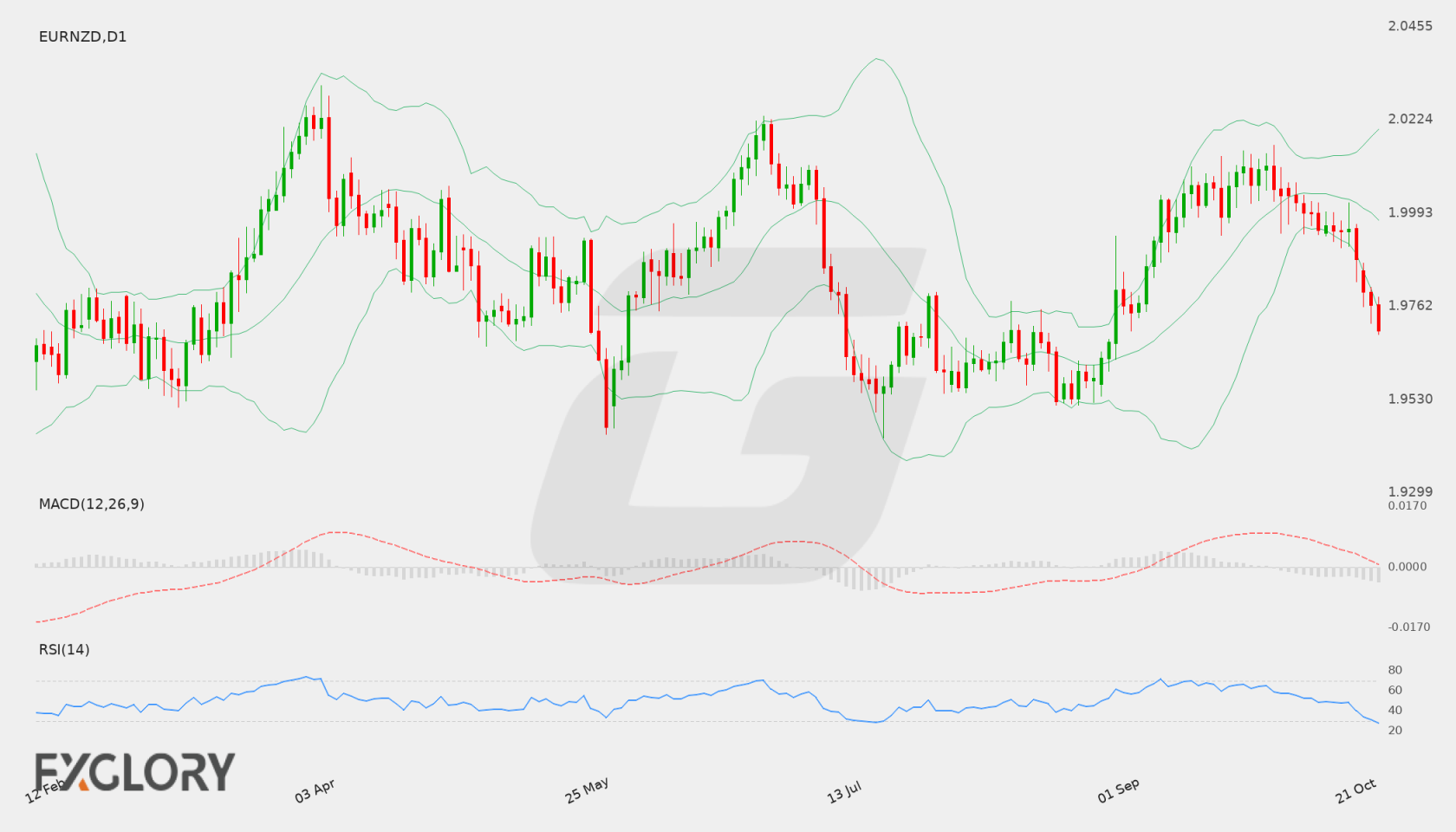
The D1 trend is bearish, and the reference close of 1.97976 sits below the supplied primary resistance at 1.99039 and the daily EMA20, EMA50 and SMA200. Negative MACD readings and an RSI of 33.54 reinforce downside pressure, while the mixed D1 close sequence argues against treating continuation as settled.
H4 is also bearish, with its close below the H4 EMA20 and EMA50 and its MACD histogram negative; this supports the daily direction tactically, but does not establish how quickly price may develop. The supplied support levels at 1.95154 and 1.9443 frame the downside reference area, while the NZD CPI and EUR PMI releases may introduce repricing risk during the week.
EUR/NZD D1 technical-analysis context for the weekly forecast. Chart data captured 22 October 2026.
The weekly bias is Bullish, supported by D1 structure and a rising EMA50 slope, but bearish H4 conditions and mixed momentum keep progress toward resistance conditional.
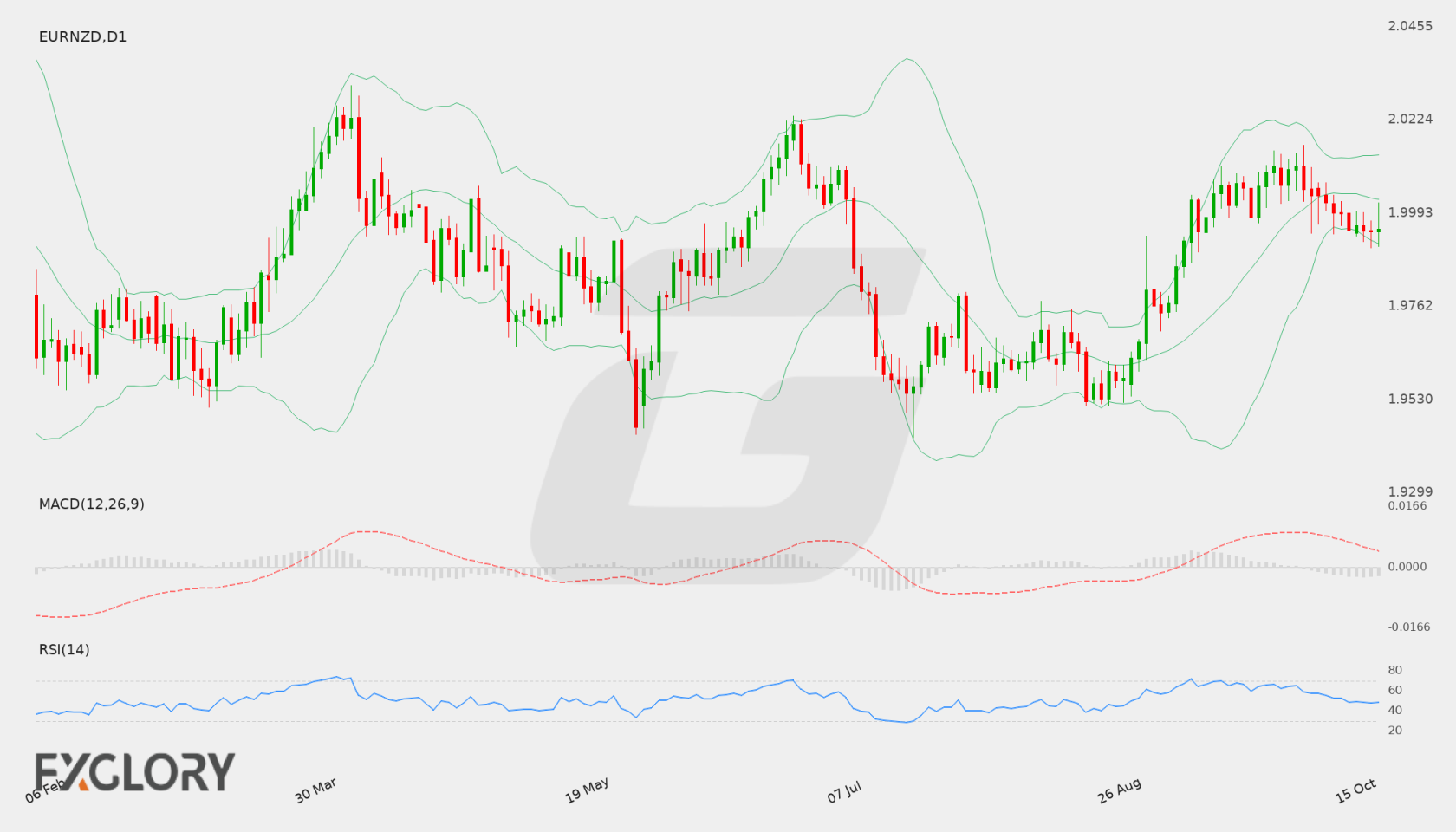
EUR/NZD retains a bullish D1 trend state, with the reference close at 1.99512 above the 1.98481 primary support and the 1.99044 EMA50. That backdrop is constructive, but the D1 sequence of consecutive lower closes shows that the recent price path has not yet aligned cleanly with the broader trend.
The next constructive development would be a completed D1 close above 2.00414, while H4 must contend with bearish tactical conditions and resistance at 1.99953. A sustained-looking directional narrative is therefore not assumed: the market can remain two-sided between the supplied structural levels while momentum is mixed.
EUR/NZD D1 technical-analysis context for the weekly forecast. Chart data captured 16 October 2026.
EUR/NZD fundamentals continue to be driven by comparative macroeconomic health and central bank expectations between the Eurozone and New Zealand. With no specific economic releases scheduled on the pair calendar, market valuation is largely shaped by general risk sentiment, trade activity, and ongoing interest rate dynamics. The New Zealand Dollar remains sensitive to global growth sentiment, while the Euro responds to overarching European monetary stability.
Price Action:
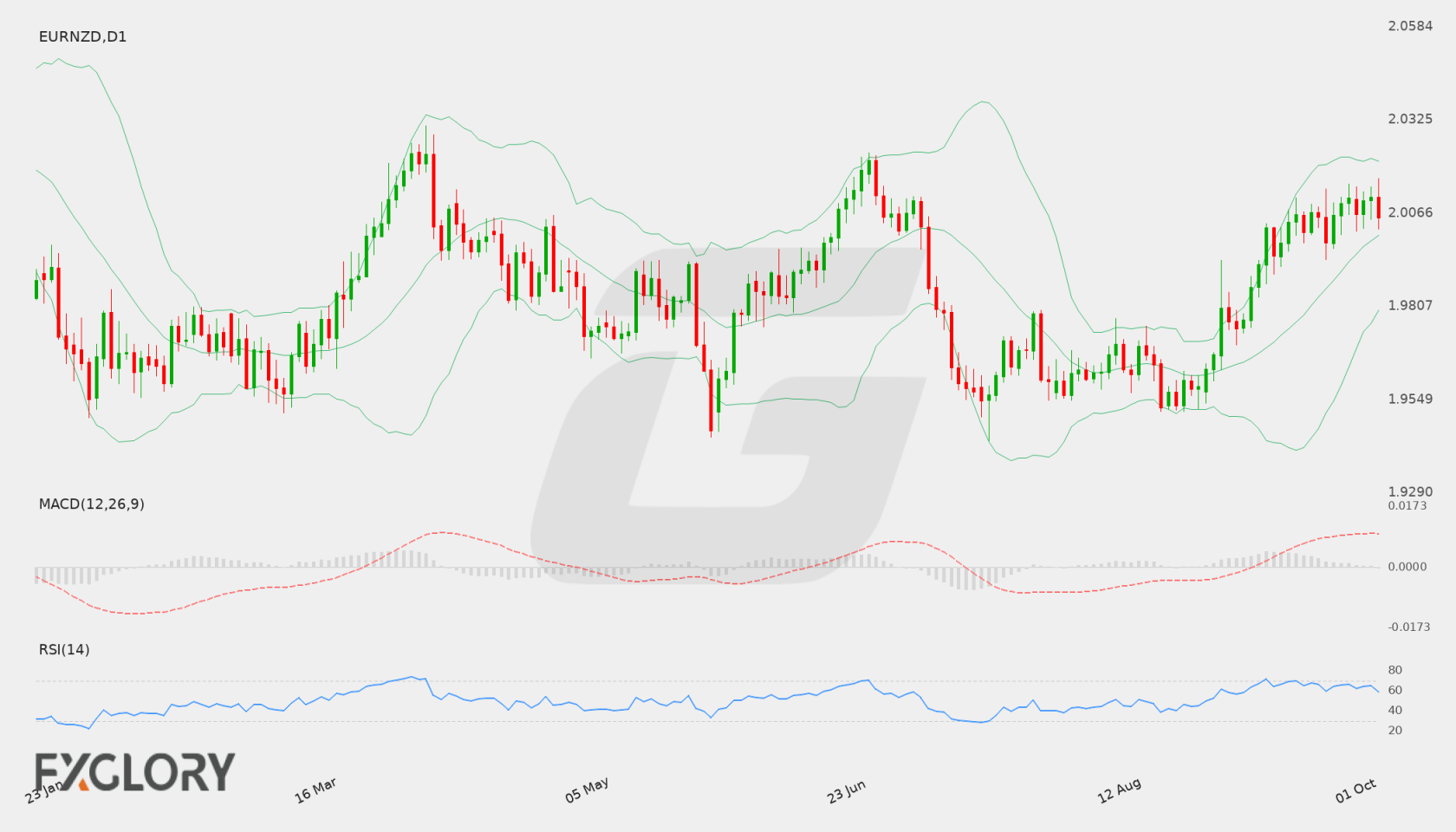
On the daily chart, EUR/NZD has established an upward trajectory after rebounding from lows below 1.9600 in prior sessions. The currency pair recently reached a high of 2.01611 before moderating slightly to close at 2.00534. This behavior shows persistent buying interest above the 2.0000 mark, though recent price action reflects consolidation directly beneath the latest swing high.
Key Technical Indicators:
Bollinger Bands: EUR/NZD is trading in the upper half of its Bollinger Bands, reflecting a constructive technical stance. The middle band sits at 2.00034, offering immediate baseline support, while the upper band is positioned at 2.02099 and the lower band is located at 1.97968. With the last close at 2.00534 holding above the middle band, volatility remains supportive of the prevailing upward bias.
RSI: The 14-day Relative Strength Index (RSI) for EUR/NZD is currently reading at 58.80. Positioning comfortably above the neutral 50 threshold indicates steady upside momentum without signaling overbought conditions. This provides adequate technical latitude for continued directional movement in either direction.
MACD: The daily MACD for EUR/NZD stands in positive territory at 0.00905. This positive alignment indicates that short-term momentum continues to outpace long-term averages. While the reading confirms ongoing bullish momentum, traders typically watch for any signs of line convergence that might signal momentum fatigue.
Support and Resistance:
Key technical levels for EUR/NZD define the current daily trading parameters. Immediate resistance is situated at 2.01611, which marks the latest peak on the chart. On the downside, primary technical support is established at 1.94349, with intermediate dynamic support provided by the 20-day moving average around 2.00034.
News to Watch for EURNZD This Week:
No specific events are available.
Generic High-Impact Releases: Major macroeconomic reports could shift broader market volatility and impact exchange rates.
Central Bank Comments: Statements from monetary policymakers can alter forward expectations for interest rate differentials.
Broader Risk Sentiment: Shifts in overall market risk appetite may influence capital flows between risk-correlated currencies and the Euro.
Weekly Outlook and Consideration:
The daily outlook for EUR/NZD (EURNZD) remains mildly bullish as the pair holds above the key 2.0000 psychological handle, closing at 2.00534. Technical support from the Bollinger middle band at 2.00034, combined with a positive MACD of 0.00905 and an RSI of 58.80, highlights ongoing buyer presence. A decisive break past the 2.01611 resistance could expose the upper Bollinger Band at 2.02099. Conversely, failure to maintain altitude above 2.00034 may shift attention toward lower levels, with primary structural support sitting down at 1.94349.
Disclaimer: The analysis provided for EUR/NZD is for informational purposes only and does not constitute investment advice. Traders are encouraged to perform their own analysis and research before making any trading decisions. Market conditions can change quickly, so staying informed with the latest data is essential.
The EUR/NZD currency pair continues to reflect macroeconomic trends across the Eurozone and New Zealand. Traders are monitoring upcoming Eurozone inflation data and broader risk sentiment, which frequently drives movement in commodity-linked currencies like the New Zealand Dollar relative to the Euro.
Price Action:
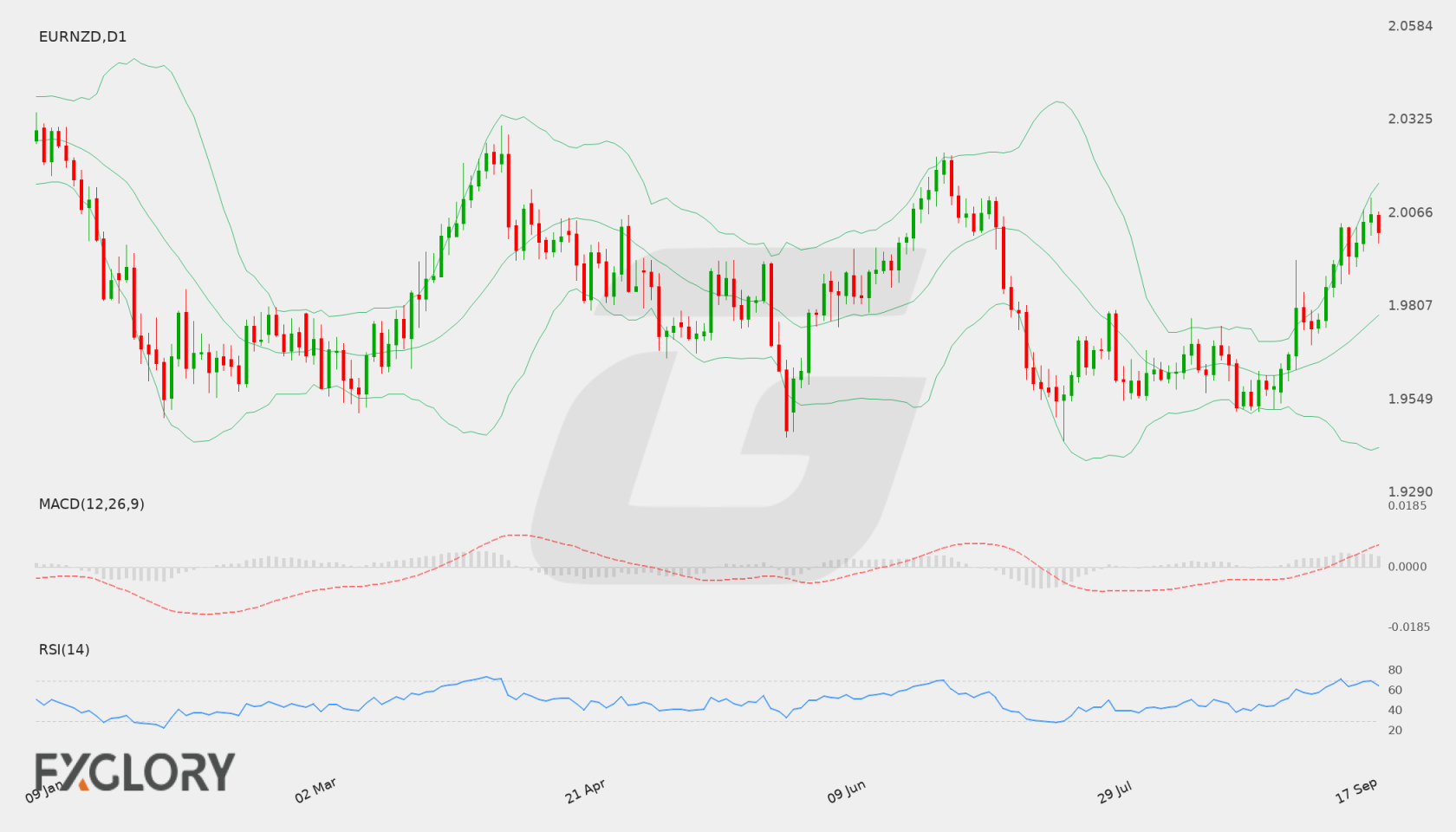
On the daily (D1) chart, EUR/NZD has exhibited a steady upward progression, climbing from recent swings near 1.95695 toward the 2.00619 level before settling at a close of 2.00138. The sequence of recent higher daily closes demonstrates active bullish sentiment across recent trading sessions.
Key Technical Indicators:
Bollinger Bands: The daily Bollinger Bands display an expanding channel for EURNZD. The middle band sits at 1.97817, while the upper band is at 2.01491 and the lower band is at 1.94144. Trading near 2.00138 positions price in the upper half of the band structure, reflecting persistent upward pressure.
RSI: The 14-period Relative Strength Index (RSI) currently sits at 64.92. This reading places the oscillator in comfortable bullish territory above the 50 centerline, while remaining below the overbought threshold of 70.
MACD: The MACD indicator for EUR/NZD shows a positive reading of 0.00985. The location of the signal line above zero indicates sustained positive momentum on the daily horizon, aligned with the recent recovery in price.
Support and Resistance:
Key daily technical levels for EURNZD highlight main technical boundaries. Resistance is mapped overhead at 2.02330, while solid historical support is established below at 1.94349.
News to Watch for EURNZD This Week:
German Prelim CPI m/m: Tracks preliminary German consumer inflation, which strongly impacts European monetary policy expectations.
CPI Flash Estimate y/y: Reflects headline inflation across the Eurozone and provides key direction for European yields.
The technical posture for EUR/NZD remains constructively biased following its advance to 2.00138. If the current upward trajectory continues, buyers may look toward testing the daily resistance near 2.02330. Should a pullback occur, initial dynamic support rests near the daily middle Bollinger Band at 1.97817, with major support established lower at 1.94349.
Disclaimer: The analysis provided for EUR/NZD is for informational purposes only and does not constitute investment advice. Traders are encouraged to perform their own analysis and research before making any trading decisions. Market conditions can change quickly, so staying informed with the latest data is essential.
EUR/NZD has experienced notable upward movement as traders assess relative monetary policy expectations and economic conditions between the Eurozone and New Zealand. Broad market risk sentiment and upcoming domestic data points from New Zealand remain key drivers that could impact the exchange rate’s trajectory in the coming sessions.
Price Action:
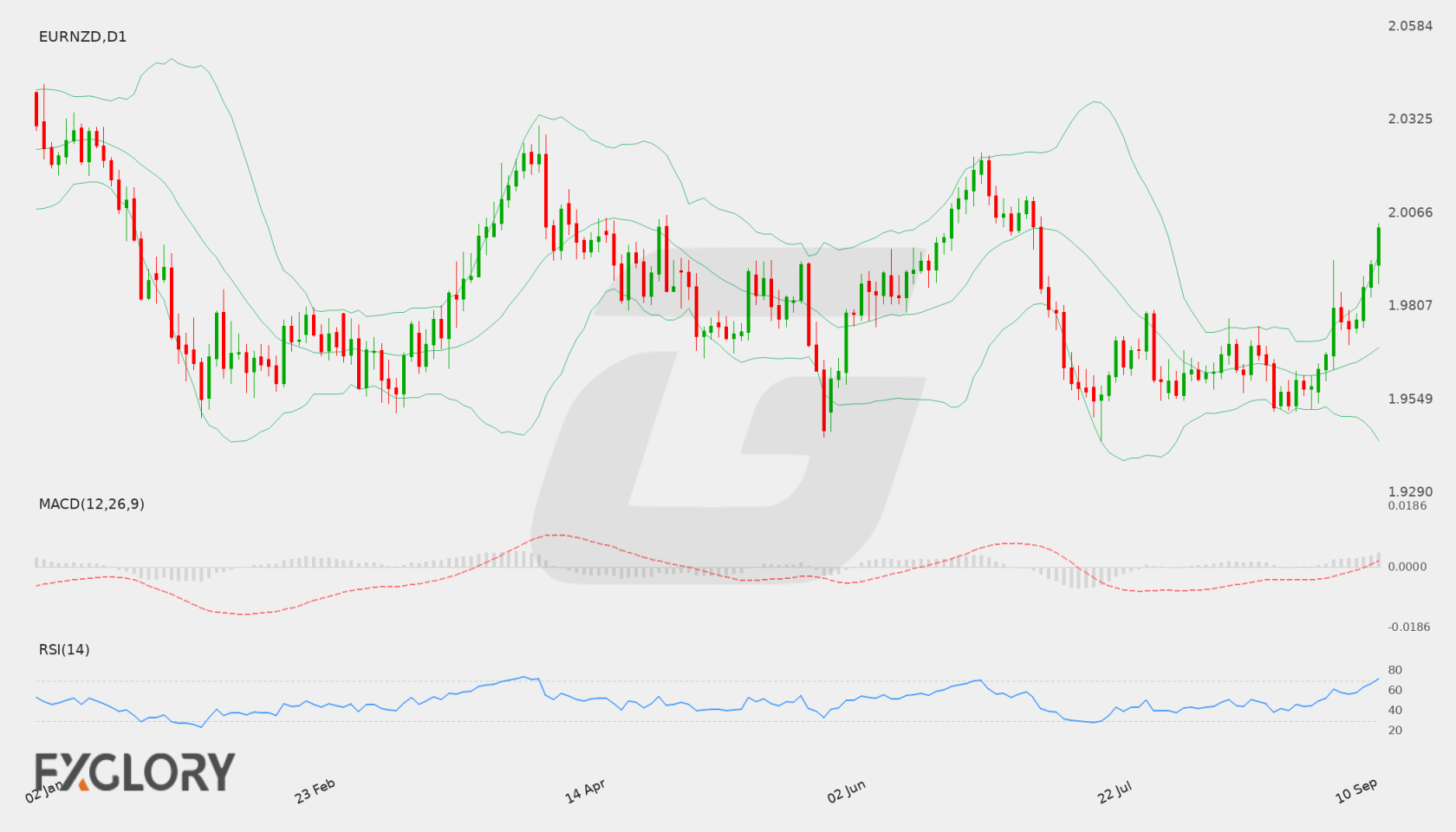
On the daily timeframe, EUR/NZD has established a solid upward trajectory, climbing from recent low closes near 1.95835 to close at 2.00250. The pair has comfortably cleared the key 2.0000 level, demonstrating persistent buying interest through higher daily highs and higher daily lows.
Key Technical Indicators:
Bollinger Bands: The daily Bollinger Bands feature a middle line at 1.96927, an upper band at 1.99513, and a lower band at 1.94341. With the current close at 2.00250 breaking above the upper envelope, price action indicates strong bullish momentum alongside potential overextension beyond normal volatility ranges.
RSI: The 14-day Relative Strength Index (RSI) registers at 71.60. Crossing above the 70 benchmark places EUR/NZD in overbought territory, pointing to robust buying pressure while highlighting the possibility of a pause or minor corrective pullback.
MACD: The MACD indicator on the daily timeframe stands at a positive 0.00615. The indicator continues to trade above its baseline, aligning with the ongoing bullish trend and indicating that buyers currently maintain directional control.
Support and Resistance:
Technically, EUR/NZD faces overhead resistance at 2.02330, which acts as the primary upside target for further gains. On the downside, primary support is identified at 1.94349, with intermediate dynamic support around the daily middle Bollinger Band at 1.96927.
News to Watch for EURNZD This Week:
GDP q/q: This quarterly economic growth indicator for New Zealand could influence central bank monetary policy expectations and drive price volatility in the New Zealand dollar.
Weekly Outlook and Consideration:
EUR/NZD enters the week with a firm bullish posture on the daily chart after closing at 2.00250. Positive MACD momentum and price action above the upper Bollinger Band support the ongoing uptrend toward resistance at 2.02330. Nevertheless, with the daily RSI in overbought territory at 71.60, a period of consolidation or a retracement toward support near 1.96927 remains possible before further directional moves unfold.
Disclaimer: The analysis provided for EUR/NZD is for informational purposes only and does not constitute investment advice. Traders are encouraged to perform their own analysis and research before making any trading decisions. Market conditions can change quickly, so staying informed with the latest data is essential.