Alligator Indicator in Forex
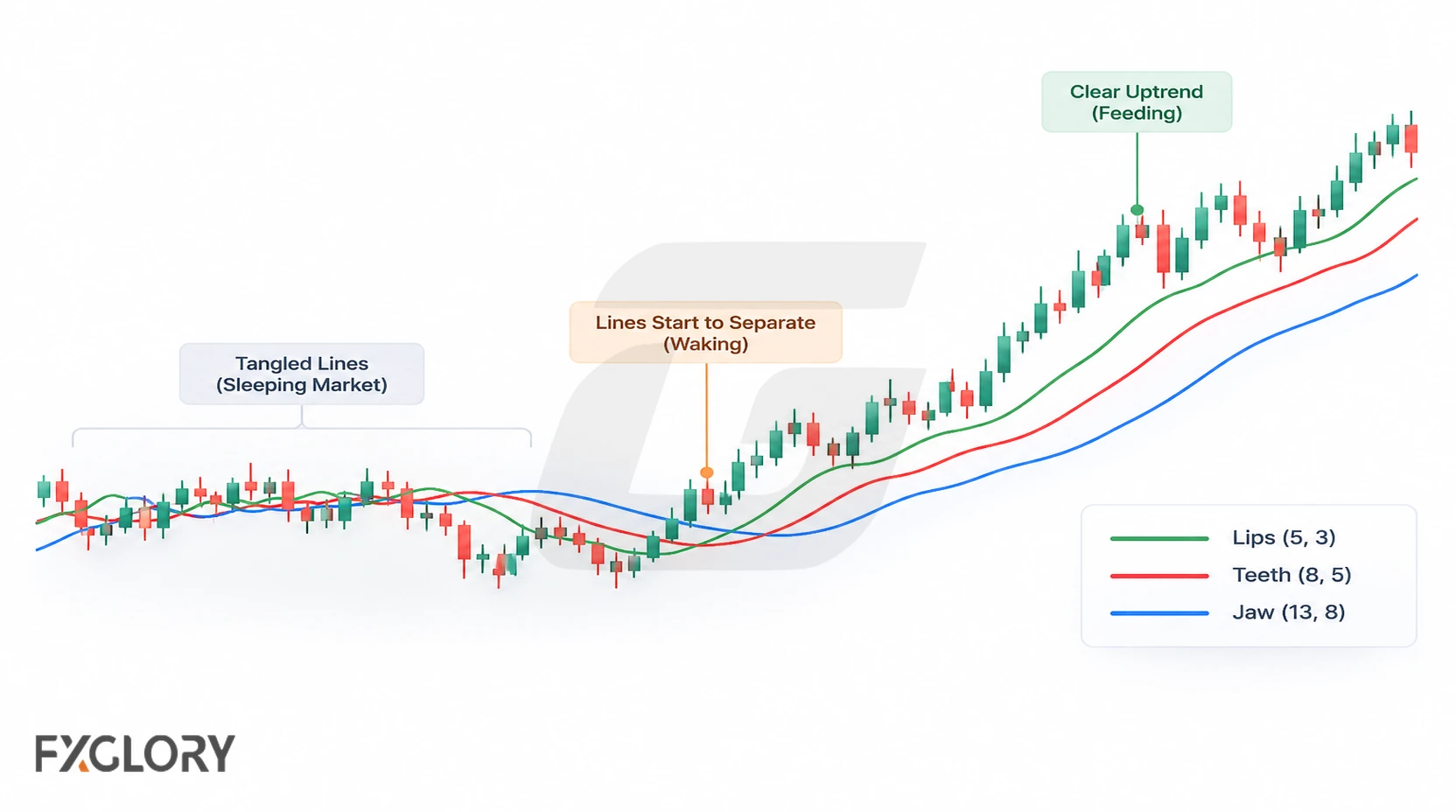
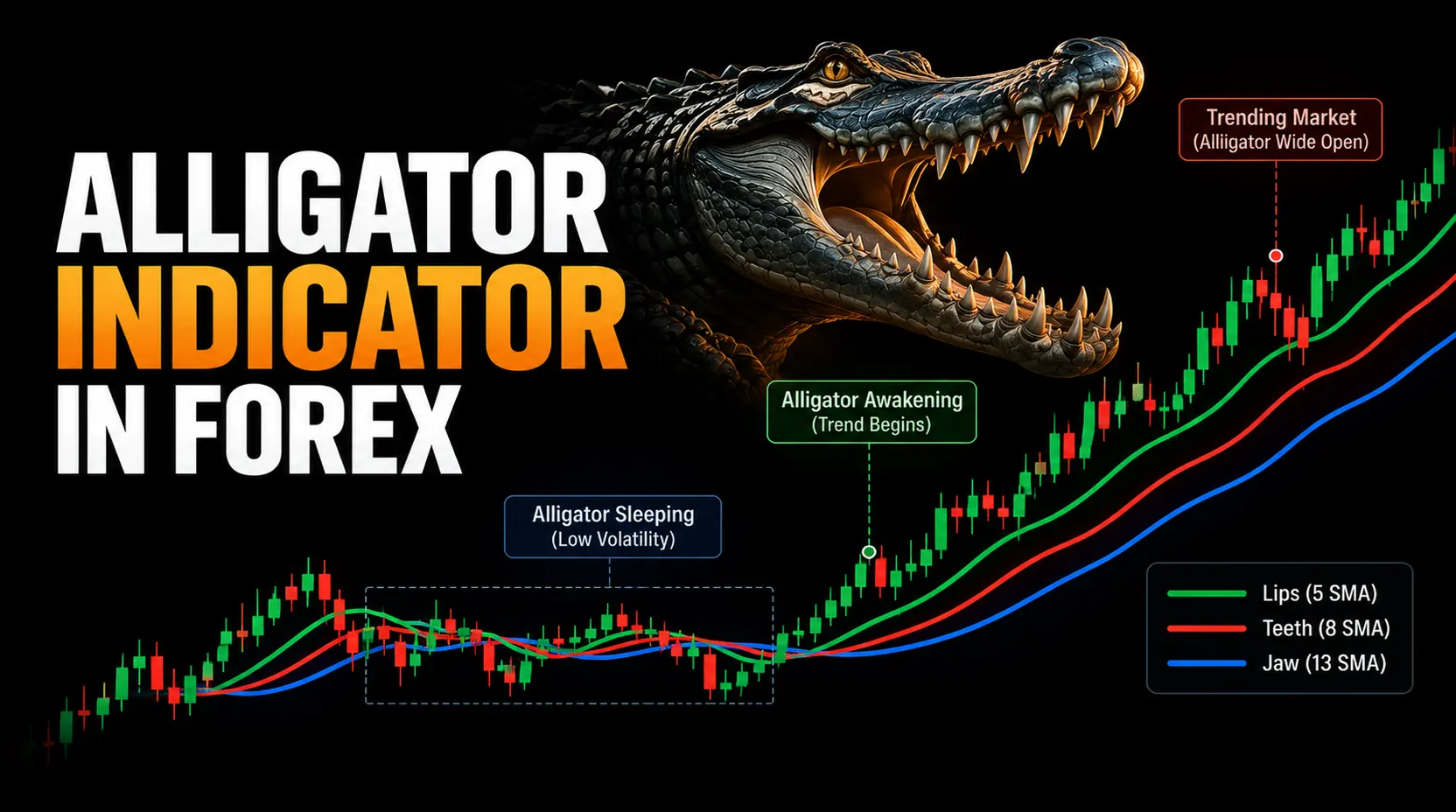
The Alligator uses three shifted smoothed moving averages — Jaw, Teeth, and Lips — to distinguish between trending and ranging markets. When the lines are intertwined the Alligator sleeps; when they diverge it eats. Knowing which state the market is in prevents trading in the noise.
Forex Technical Indicators · Updated May 2026
Key Takeaways
- The Alligator uses three shifted SMMAs: Jaw (13, shifted 8), Teeth (8, shifted 5), and Lips (5, shifted 3).
- Tangled lines mean the Alligator is sleeping — the market is ranging; avoid new directional trades.
- Bullish order is Lips above Teeth above Jaw; bearish is Jaw above Teeth above Lips.
- The Alligator is a trend-state filter, not a precise entry tool — pair it with price action or fractals for timing.
What Is the Alligator Indicator?
The Alligator indicator is a trend-identification tool developed by trader and market theorist Bill Williams and introduced in his 1995 book Trading Chaos. It uses three smoothed moving averages (SMMAs), each calculated on the median price (rather than the close) and shifted forward in time. Williams named the three lines after the anatomy of an alligator — Jaw, Teeth, and Lips — with the metaphor of whether the alligator is sleeping (lines tangled), awakening (lines beginning to separate), or eating (lines fully spread and trending).
The core insight is simple but powerful: markets trend only a minority of the time — Williams estimated roughly 15–30% of all price action. The remaining 70–85% is sideways consolidation that produces losing signals for most trend-following systems. The Alligator’s design explicitly addresses this problem: it tells you when not to trade (sleeping phase) as directly as it tells you when a trend is active (eating phase).
The indicator is built into MetaTrader 4, MetaTrader 5, and TradingView as a standard tool and requires no manual calculation. Its value is not in the mathematics — three moving averages are trivially simple — but in the interpretive framework of phases and line order that Williams built around it.
The Alligator functions as a trend-state filter. It answers the binary question: is this market trending right now? It does not provide a standalone entry trigger, an exit level, or a volatility measurement. Used alone, it is an incomplete strategy. Used as a condition that must be met before acting on any other signal, it is a valuable noise filter.
Jaw, Teeth, and Lips Explained
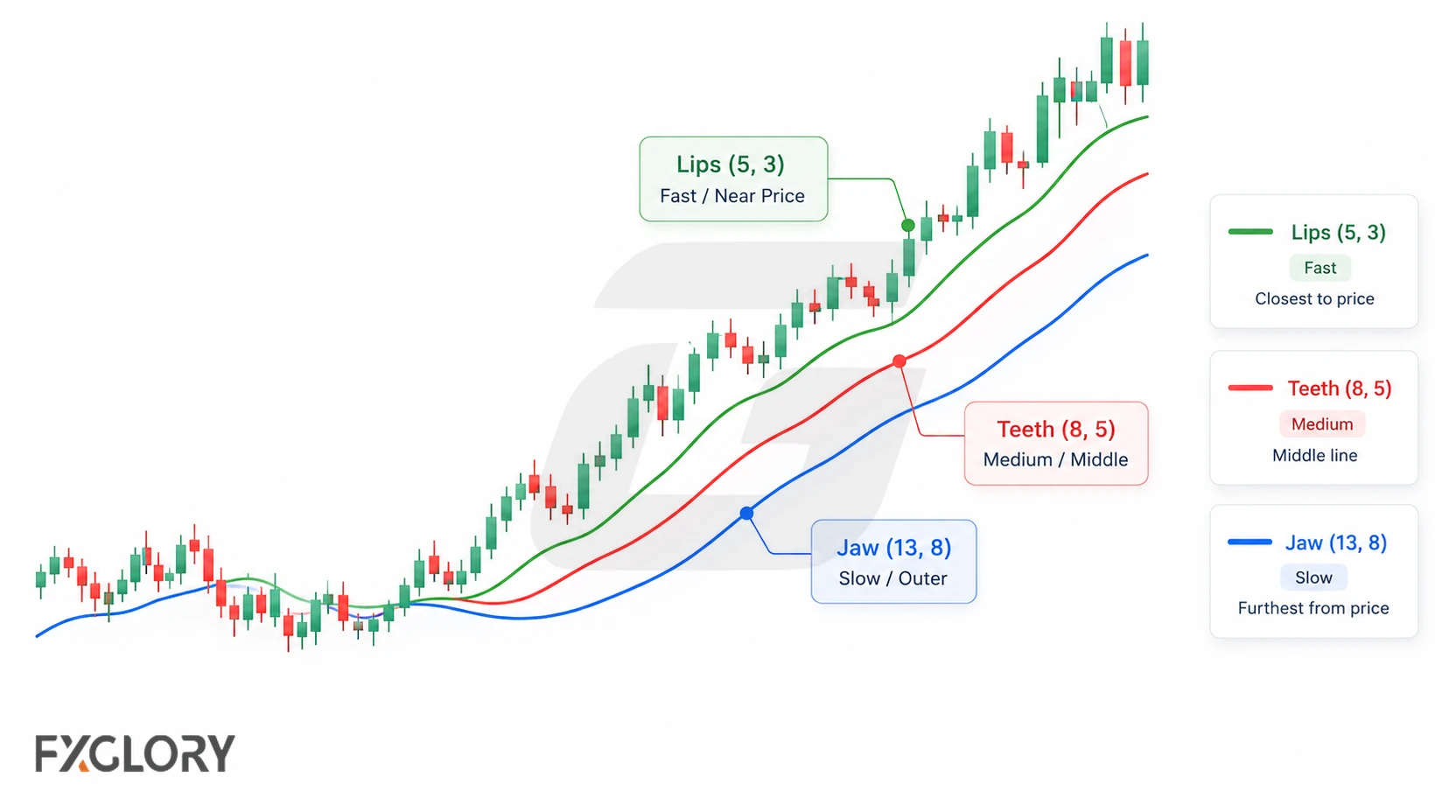
Each line has a specific lookback period and a specific shift forward. The combination of different lookback and shift values gives the three lines their characteristic behaviour — the Lips reacts quickly, the Jaw is slow and steady, and the Teeth sits between them.
The Alligator Jaw (Blue Line)
Formula: 13-period SMMA of median price ((high + low) ÷ 2), shifted 8 bars forward.
The Jaw is the slowest line. Its 13-period lookback smooths out most short-term price noise, and the 8-bar forward shift means it appears ahead of the current bar — visually as if the line is projecting forward. In an uptrend, the Jaw is the lowest of the three lines; in a downtrend, the highest. It represents the broadest equilibrium and acts as the most distant dynamic support (uptrend) or resistance (downtrend) reference. When price pulls back far enough to test the Jaw, the move is considered a significant retracement relative to the trend’s overall structure.
The Alligator Teeth (Red Line)
Formula: 8-period SMMA of median price, shifted 5 bars forward.
The Teeth sits between the Jaw and the Lips in both speed of reaction and position. In an uptrend, it is above the Jaw and below the Lips. The gap between Teeth and Jaw is a rough measure of medium-term momentum — if the gap is growing, the trend is accelerating; if it is narrowing, the trend is losing energy. Shallow pullbacks in a healthy trend typically find support at the Teeth before resuming.
The Alligator Lips (Green Line)
Formula: 5-period SMMA of median price, shifted 3 bars forward.
The Lips is the fastest line. It responds most quickly to new price data and is usually the first to change direction when a trend reversal begins. In an uptrend, it is the highest of the three lines. The angle of the Lips relative to the Teeth gives an early read on whether short-term momentum is consistent with the prevailing trend direction.
Why median price, not close?
Williams deliberately used the median price (high + low) ÷ 2 rather than the closing price for all three calculations. This reduces the influence of closing-price anomalies — stops being run just before the close, or news spikes that affect only the close — and keeps the lines centred on the true midpoint of each bar’s trading range.
Why shift the lines forward?
Shifting the lines forward in time was Williams’ method of acknowledging that moving averages are inherently lagging. By projecting them forward, the indicator visually compensates for the lag, making the lines appear “ahead” of price rather than behind. The practical effect is that the spread between the current price and the future-projected lines gives a sense of how extended price is relative to its equilibrium.
Alligator Indicator Settings
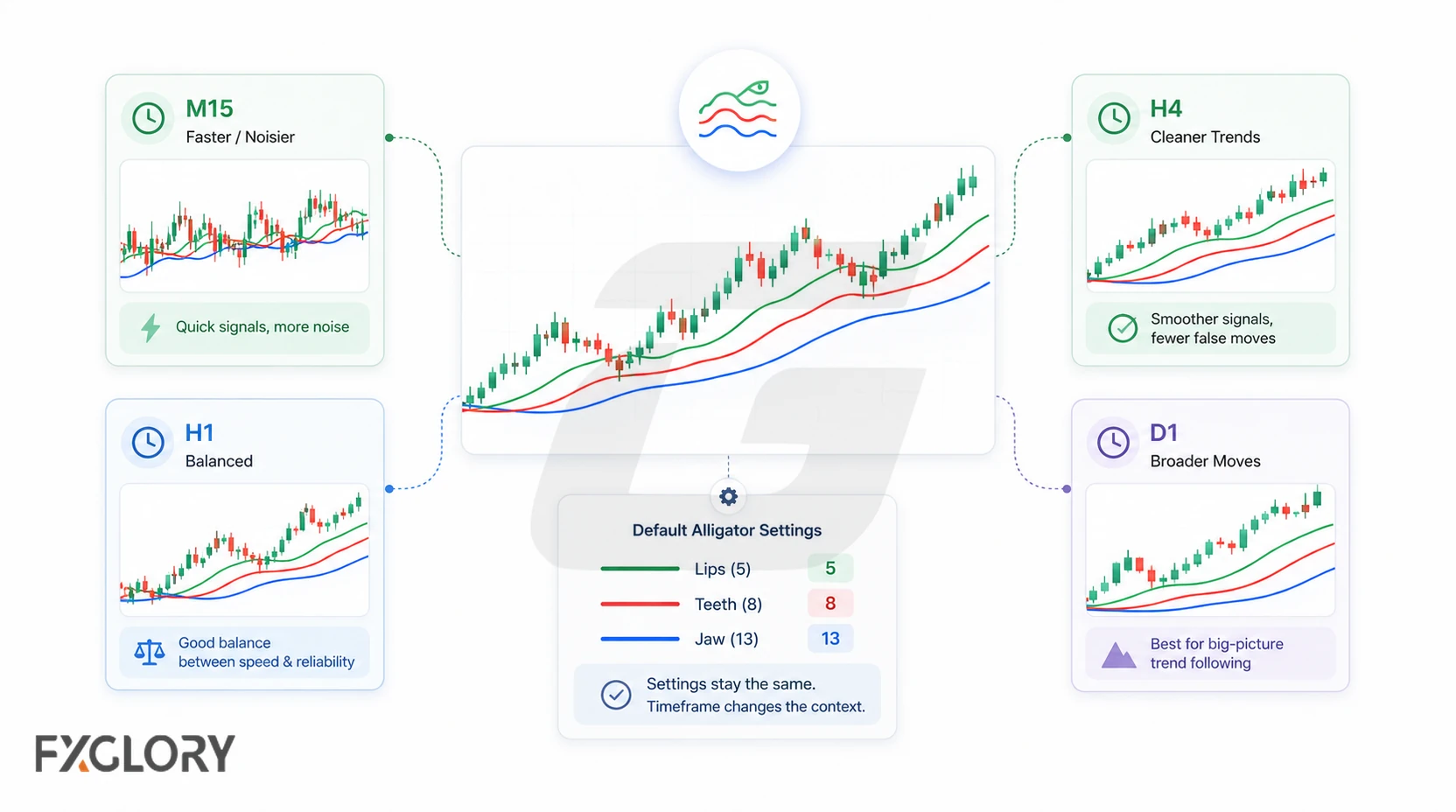
The default Alligator settings are 13/8 (Jaw), 8/5 (Teeth), 5/3 (Lips) — the first number is the SMMA lookback period, the second is the forward shift. These are the values Williams published and the defaults in all major platforms.
| Line | Period / Shift (default) | Faster alternative | Slower alternative | Trade-off |
|---|---|---|---|---|
| Jaw (blue) | 13-period SMMA, shift 8 | 8 / 5 | 21 / 13 | Faster: more signals, more noise. Slower: fewer, cleaner signals but more lag. |
| Teeth (red) | 8-period SMMA, shift 5 | 5 / 3 | 13 / 8 | Maintaining the ratio between lines is more important than the absolute values. |
| Lips (green) | 5-period SMMA, shift 3 | 3 / 2 | 8 / 5 | Faster Lips produces more TK-style crossovers but also more false signals in ranges. |
The default 13/8/5 Jaw, 8/5/3 Teeth, 5/3/2 Lips settings follow a near-Fibonacci progression. Williams designed them this way intentionally. The ratios are part of the system’s structure. Adjusting any one line in isolation destroys the proportional relationship — if you widen the Jaw without widening the Teeth and Lips accordingly, the phase system loses its calibration.
On H4 and daily charts, the default settings produce the clearest phase transitions. On M15 and lower, the lines tangle and untangle so frequently that the sleeping/eating distinction becomes meaningless. Most practitioners who use the Alligator below H1 increase all periods proportionally — but at that point it is no longer the Williams Alligator in its designed form.
The Four Alligator Phases
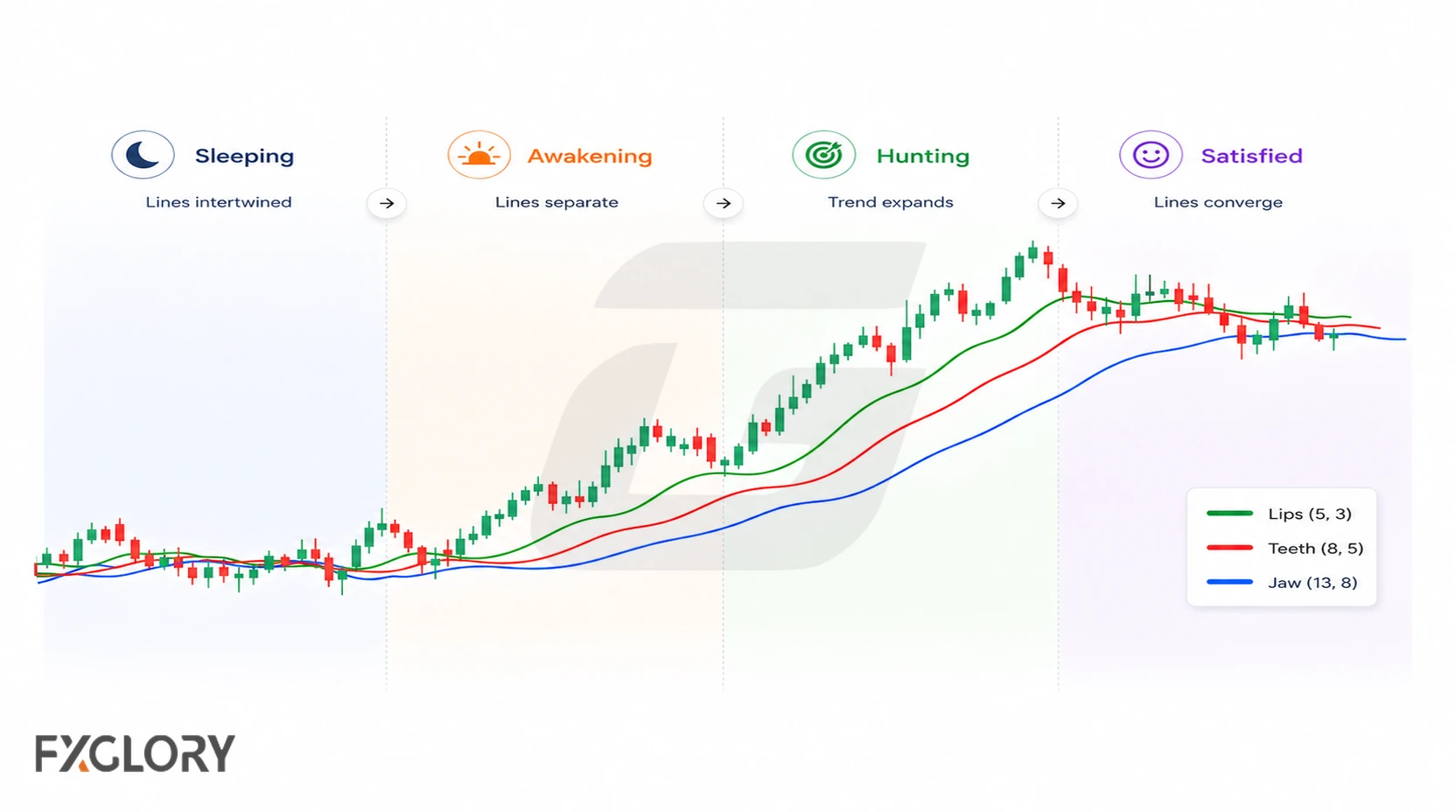
Williams organised the Alligator’s behaviour into four named phases. The phases are the analytical heart of the system — understanding them is more important than any specific entry rule because they define when the indicator has any signal value at all.
Sleeping Alligator
The three lines are intertwined, crossing each other repeatedly with no clear separation. Price is consolidating — the market has no directional commitment. This is the phase where most trend-following systems generate losing signals. Williams’ explicit guidance: when the Alligator sleeps, do not trade.
The longer the sleeping phase, the more pent-up energy in the market. An extended consolidation followed by a sharp breakout typically produces one of the cleaner Awakening → Eating transitions, because the move has room to develop before the lines tangle again.
Awakening Alligator
The lines begin to separate. The Lips is typically the first to move away from the other two. The Teeth follows, and finally the Jaw. This is the warning phase — a trend may be developing. Williams’ approach was to use fractals (his separate indicator) as the entry trigger during the Awakening phase, rather than acting immediately on the separation alone. The risk is that the Awakening can fail and collapse back into a new sleeping phase. Reduced position size or waiting for confirmed line order is appropriate here.
Eating Alligator
The lines are clearly separated and in the correct order — Lips above Teeth above Jaw in an uptrend, or Jaw above Teeth above Lips in a downtrend. Price is above all three lines (uptrend) or below all three (downtrend). This is the phase where the Alligator produces its highest-quality signals. Full trend-following positions are appropriate when the eating phase is confirmed.
The gap between the lines is a live measurement of trend strength. Increasing gap = acceleration. Stable gap = steady trend. Narrowing gap = the trend is losing momentum (watch for Sated phase).
Sated Alligator
The lines begin to converge. The gaps between Lips, Teeth, and Jaw are narrowing. The Alligator has “eaten enough.” This signals trend exhaustion — the move is losing energy and the market may be returning to a sleeping phase. Williams’ guidance: begin taking profits and tighten stop-losses when the Alligator becomes sated. The Sated phase does not guarantee a reversal — the trend may simply pause before the Alligator awakens again. But it is an explicit warning to stop adding to positions and start protecting gains.
Line Order Signals
The order of the three lines is the primary directional signal of the Alligator system. Once the lines are separated (eating phase), their stacking order determines whether the bias is bullish or bearish.
Bullish line order
Lips above Teeth above Jaw, all spreading upward, price above all three lines. This is the confirmed bullish eating phase. Short-term momentum (Lips) is strongest, medium-term momentum (Teeth) confirms, and the broad trend direction (Jaw) supports. Price trading above all three lines adds further confirmation. The wider the gaps between lines, the stronger the trend.
Bearish line order
Jaw above Teeth above Lips, all spreading downward, price below all three lines. The exact mirror of the bullish order. The broadest structure (Jaw) is now highest, indicating the dominant equilibrium is bearish, with shorter-term momentum (Lips) confirming by sitting lowest. Price below all three lines adds directional confirmation.
Price crossing individual lines
Price crossing the Lips is a minor signal — the Lips is the most reactive line and crosses are frequent. Price crossing the Teeth is more significant; the 8-period SMMA is more stable. Price crossing the Jaw is the most structurally significant event — the 13-period SMMA represents the broadest equilibrium and a definitive break of it often signals a major trend change. Jaw crosses should be assessed in the context of the overall line order, not in isolation.
Alligator Trading Setups
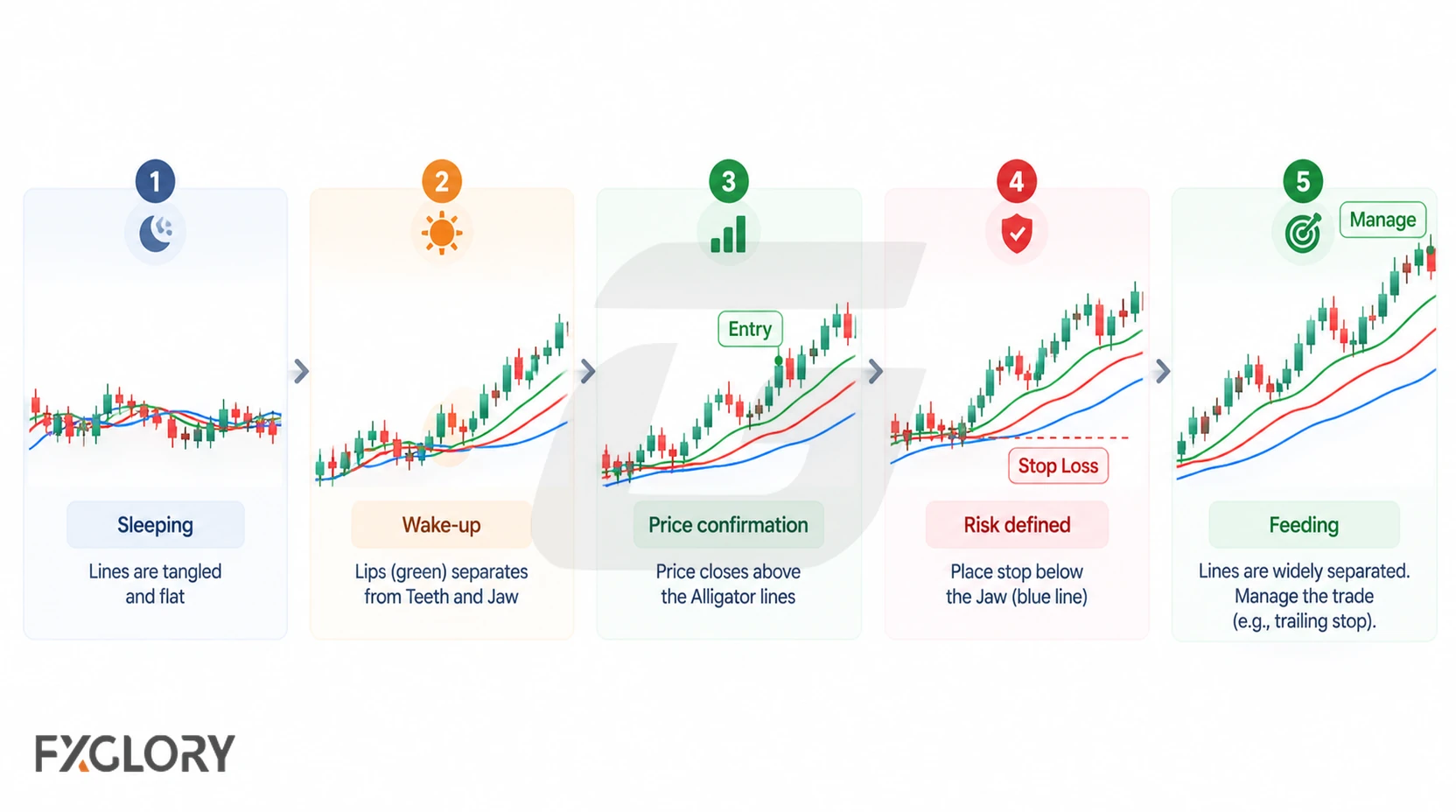
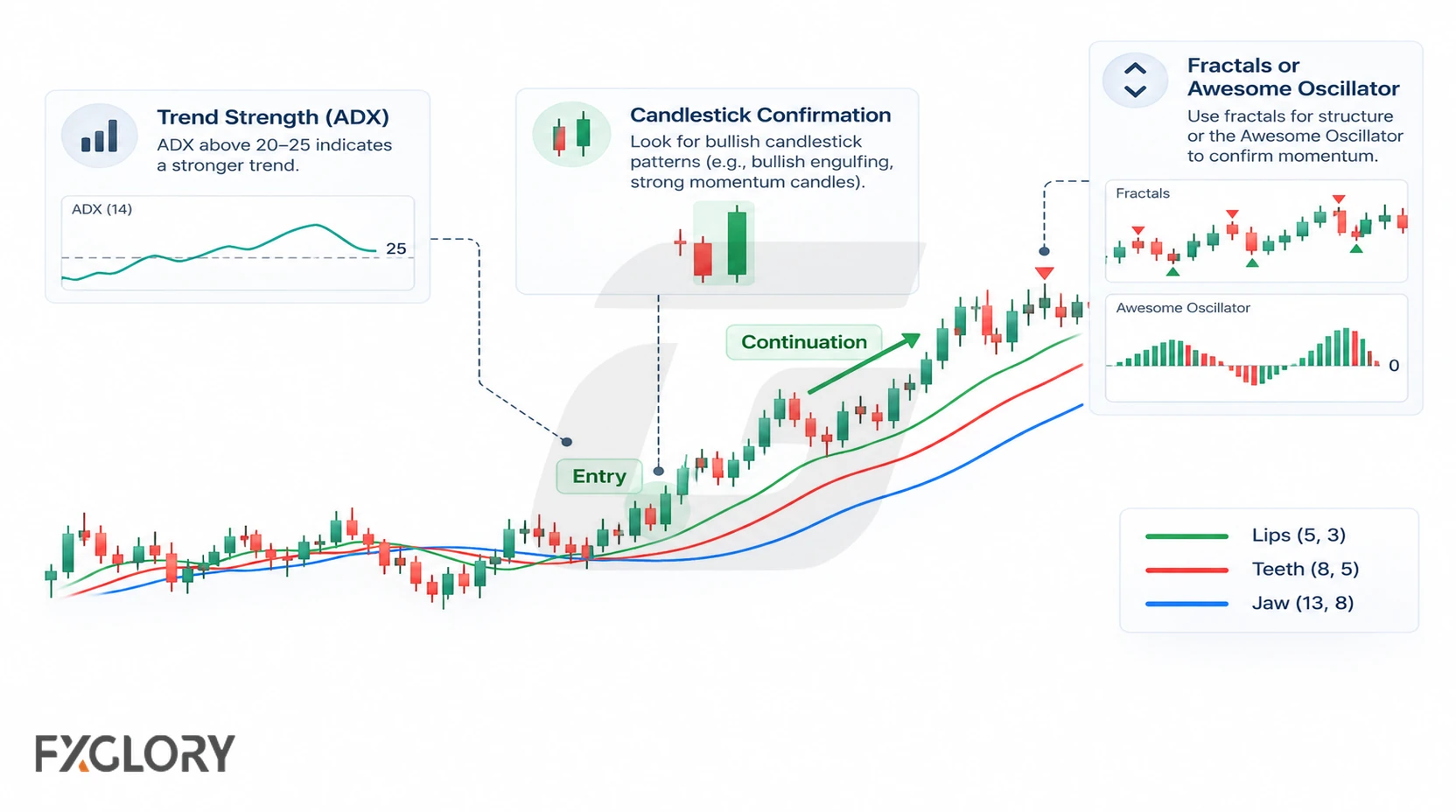
The Alligator is primarily a condition indicator — it tells you whether conditions are right to trade, not exactly when to enter. Williams used his Fractal indicator as the entry trigger, but the Alligator’s phases and line order are compatible with any price-action based entry method.
Bullish Alligator Entry Checklist
- Alligator is Eating — lines separated, Lips above Teeth above Jaw
- Price is above all three lines — confirms bullish context
- Lips and Teeth both sloping upward — active momentum, not just line order
- Line gaps are stable or widening — trend accelerating or sustained, not sated
- Entry trigger fires — bullish fractal, pin bar, or break of a recent consolidation above the Teeth
- Stop-loss placed — below the Teeth or Jaw, sized using ATR for current volatility
The bearish checklist is symmetrical: Alligator eating (Jaw above Teeth above Lips), price below all three lines, lines sloping downward, entry trigger fires, stop above the Teeth or Jaw.
Pullback to Teeth — the core trade location
In a confirmed eating phase, price frequently pulls back to the Teeth line before continuing in trend direction. This represents a retest of medium-term equilibrium. A rejection at the Teeth — a bullish candle pattern holding above it in an uptrend — is one of the cleaner Alligator entry references. The Jaw, being slower and further away, acts as the ultimate support/resistance backstop. A deeper pullback to the Jaw is not necessarily a reversal signal but it does indicate the trend has weakened enough to test its broadest equilibrium.
Alligator vs MACD vs ADX
All three indicators can identify trending conditions, but from different analytical angles. They answer different questions in the trade decision process.
| Indicator | What it measures | What it does NOT provide | Primary use | Related guide |
|---|---|---|---|---|
| Alligator | Whether the market is trending vs ranging; trend direction via line order | Trend strength as a number; volatility; divergence signals | Trend-state filter; identifying when to be in or out of the market | This guide |
| MACD | Momentum direction and strength via two EMAs; momentum divergence | Whether market is ranging vs trending; support/resistance levels | Momentum confirmation and divergence; crossover timing signals | MACD in Forex |
| ADX | Trend strength as a 0–100 number (above 25 = trending; above 40 = strong) | Trend direction; support/resistance; entry timing | Confirming whether the Alligator’s “eating” phase reflects a genuinely strong trend | ADX Indicator |
| ATR | Volatility as a measurable pip value per period | Direction, trend state, or signal quality — purely a volatility measure | Sizing stop-losses relative to current market volatility at Alligator entries | ATR Indicator |
The Alligator and ADX are natural complements: the Alligator tells you whether a trend is present (via phase and line order); ADX tells you how strong it is (as a number). A combination of Alligator in eating phase + ADX above 25 is a stronger confirmation than either alone. Add the ATR to set the stop-loss distance and the combination covers trend state, strength, and risk calibration without adding redundant information.
Alligator Indicator Limitations
Not designed for ranging markets
The Alligator is a trend-following tool. When the market is ranging — as it is for the majority of any given session — the indicator produces its sleeping signal and yields no tradeable information. Some traders treat the extended sleeping phase as a setup for the eventual breakout, but the Alligator itself provides no signal about the direction the breakout will take. Direction must come from other analysis.
No quantified trend strength
The Alligator’s eating phase tells you a trend exists; it does not tell you how strong it is. Two eating phases can look identical on the chart while one is backed by ADX of 42 and the other is ADX of 26. Adding an ADX confirmation layer addresses this gap — use the Alligator for trend-state identification and ADX for strength verification.
Lagging by design
All three lines are smoothed moving averages shifted forward. They are inherently lagging. By the time the lines are clearly in eating order, a portion of the move has already occurred. This is a necessary feature of the system’s noise-filtering design — earlier entry during the awakening phase means less lag but more false signals. Traders must accept the lag trade-off or supplement the Alligator with a faster signal for timing.
Forward shifts distort visual assessment
Because the lines are projected forward, the visual distance between current price and the displayed line position is not the actual current distance — the lines shown ahead of the current bar represent where the indicator will be in the future, not where price is now relative to the line. Beginners frequently misread the chart by comparing current price to the forward-projected portion of the lines. Always read the Alligator values at the current bar only.
Poor on M15 and below
On short timeframes, the Alligator transitions between sleeping and eating so rapidly that the phase framework loses meaning. The indicator was designed for daily and swing-trading timeframes. On M1–M15, most practitioners find the lines produce noise rather than structure.
Common Mistakes with the Alligator Indicator
Alligator — Mistakes to avoid
- Trading during the sleeping phase. This is the single most common and costly error. The sleeping Alligator is an explicit “do not trade” signal — not a neutral signal. Entering during line-tangling produces losing trades precisely because that is the market state where moving-average crossovers have no predictive value.
- Using the Alligator as a standalone entry system. The Alligator defines market state. It does not specify exact entries. Adding a price-action trigger — a fractal, a rejection candle, a consolidation breakout — substantially improves entry timing and risk-reward compared to entering purely on line order.
- Misreading the forward-projected lines. The lines are shifted into the future. The portion of each line ahead of the current bar is not a current value — it is where the indicator will be in future periods. Compare current price only to the indicator values at the current bar.
- Adjusting only one line’s period. The three lines are designed as a proportional system. Changing the Jaw to 20 without proportionally adjusting the Teeth and Lips destroys the phase-detection calibration. Adjust all three together or use the defaults.
- Treating the awakening phase as confirmed entry. The awakening phase (lines beginning to separate) indicates a possible trend developing, not a confirmed one. It fails back into a sleeping phase frequently. Wait for confirmed eating-phase line order before committing full position size.
- Ignoring the sated phase as an exit signal. When the lines begin converging after an extended eating phase, it is an advance warning. Many traders who hold through the full sated phase give back a significant portion of unrealised profit. The sated phase should trigger at minimum a stop-loss tighten or partial profit-taking.
Frequently Asked Questions About the Alligator Indicator
What is the Alligator indicator in forex?
The Alligator indicator, developed by Bill Williams, uses three shifted smoothed moving averages — Jaw (13-period SMMA, shifted 8), Teeth (8-period SMMA, shifted 5), and Lips (5-period SMMA, shifted 3) — all calculated on median price. When the three lines are tangled, the Alligator is “sleeping” and the market is ranging. When lines separate and order themselves (Lips above Teeth above Jaw in an uptrend), the Alligator is “eating” and a trend is active. The indicator’s primary purpose is to distinguish trending from ranging conditions — telling traders when to trade directionally and when to stand aside.
What do the Alligator Jaw, Teeth, and Lips mean?
Each line represents a different equilibrium timeframe. The Jaw (blue, 13-period SMMA shifted 8 bars) is the slowest, representing broad trend direction. The Teeth (red, 8-period SMMA shifted 5 bars) is the middle line. The Lips (green, 5-period SMMA shifted 3 bars) is the fastest, reacting most quickly to price change. In a bullish trend, the correct stacking order is Lips above Teeth above Jaw, with price above all three. In a bearish trend, Jaw above Teeth above Lips, with price below all three. When all three lines are tangled, no directional order exists and the indicator signals no-trade conditions.
What are the best Alligator indicator settings?
The default settings — Jaw: 13/8, Teeth: 8/5, Lips: 5/3 — are the values Bill Williams published and are the correct starting point for H4 and daily charts. The three periods (13, 8, 5) follow a near-Fibonacci progression, and the relationship between the lines is part of the system’s design. Adjusting one line without adjusting the others proportionally disrupts the phase-detection logic. For slower, cleaner signals on weekly charts, some practitioners use 21/13, 13/8, 8/5 as a scaled-up version maintaining the same ratios. Below H1, the default settings produce too many transitions to be analytically useful.
What does it mean when the Alligator is sleeping or eating?
Williams described four phases using the alligator metaphor. Sleeping: lines are intertwined, the market is consolidating — stand aside. Awakening: lines begin separating, a trend may be developing — watch and prepare but use reduced size. Eating: lines are clearly separated in correct order (Lips above Teeth above Jaw for bull, Jaw above Teeth above Lips for bear) — trend is active and directional trading is appropriate. Sated: lines begin converging after an eating phase — the trend is exhausting, take profits and tighten stops. The longer the sleeping phase, the more energy typically stored for the subsequent eating phase.
How do you trade with the Alligator indicator?
The Alligator defines market state, not specific entry points. The general approach: wait for the eating phase with lines in correct bullish or bearish order. Then use a secondary trigger — Williams used his Fractal indicator; many traders use candlestick patterns, consolidation breakouts, or a Kijun-sen test from Ichimoku. For longs in a bullish eating phase, entries on pullbacks to the Teeth line tend to offer better risk-reward than chasing price away from all three lines. Stop-losses belong below the Jaw (or below the Teeth for tighter risk) and should be sized using the ATR indicator to match current market volatility. Exit when the sated phase begins (lines converging) or at a pre-defined target.
What are the main limitations of the Alligator indicator?
Four key limitations: first, the Alligator provides no signal during ranging markets (sleeping phase) — it tells you to stand aside but gives no directional edge for the eventual breakout. Second, it does not quantify trend strength — two eating phases can differ greatly in strength; use ADX alongside to measure this. Third, all three lines are lagging by design, so a portion of the move is always “paid” before the eating phase is confirmed. Fourth, the forward-shifted lines can be visually confusing — the projected portion ahead of the current bar shows future indicator values, not current ones. The Alligator works best as one component in a broader system, not as a standalone trading strategy.
Related Technical Analysis Guides
Practice the Alligator on a Free Demo Account
Apply Alligator indicator analysis risk-free on a FXGlory demo account. Identify sleeping and eating phases, test line-order entries, and practice with ATR-sized stops on live market data — without risking real capital.
Open a Free Demo Account