
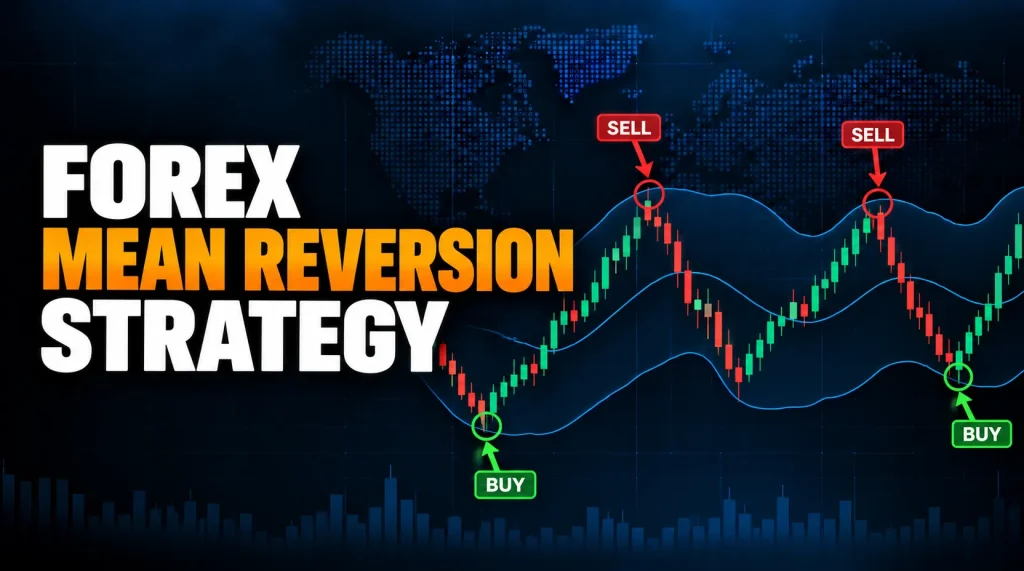
What Is A Forex Mean Reversion Strategy?
The defining feature of a forex mean reversion strategy is an explicit return objective: a previously selected price or spread reference, such as a moving average, Bollinger middle band, range midpoint, session average, or average spread between related currency instruments. The mean describes a level or relationship; its existence alone does not establish that deviations are likely to reverse.
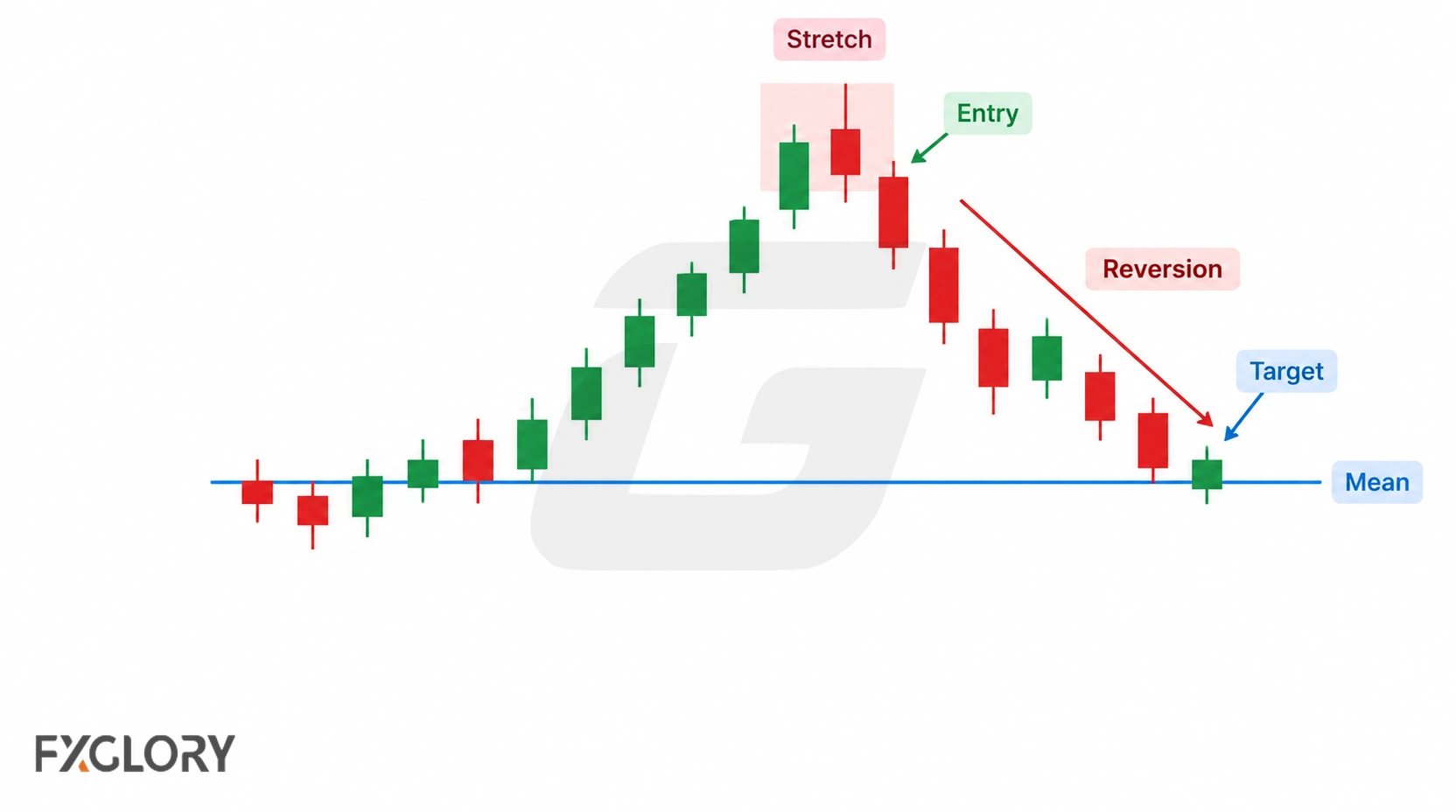
Traders may investigate whether a deviation has tended to reverse in similar historical conditions, then assess the current market regime before considering entry. For contrast, counter-trend rules can describe a trade against the active move without a specific mean-return objective.
Mean Reversion vs Counter Trend vs Range Trading vs Trend Following
Mean reversion overlaps with counter-trend trading and range trading, but it has a different job. It asks whether price may return toward a specific reference point, not only whether price may react against the current move.
| Topic | Main Question | Role In A Mean Reversion Plan | Main Risk |
|---|---|---|---|
| Mean reversion strategy | Can price return toward a defined reference point? | Focuses on mean, deviation, target, and invalidation | The mean shifts while price keeps trending |
| Counter trend strategy | Can price react against the active move? | Useful only if the reaction has a defined mean target | Fighting strong movement without a true reference point |
| Range trading | Is price rotating between boundaries? | Can use the range midpoint as the mean | Range breaks and rotation logic fails |
| Trend following | Is price continuing away from the mean? | Acts as the main danger filter | Fading a trend that is expanding |
| Indicator strategy | Do tools define deviation or confirmation? | Indicators can define the mean or measure stretch | Using indicators without market-condition filters |
Use range trading rules when the mean is the center of a visible range. Use momentum checks when price may be moving away from the mean for a valid reason.
What Counts As The Mean In Forex?
The appropriate reference depends on what is measured: a single price series, a session range, or a relationship between instruments. Each has different update rules and different ways it can cease to be useful.
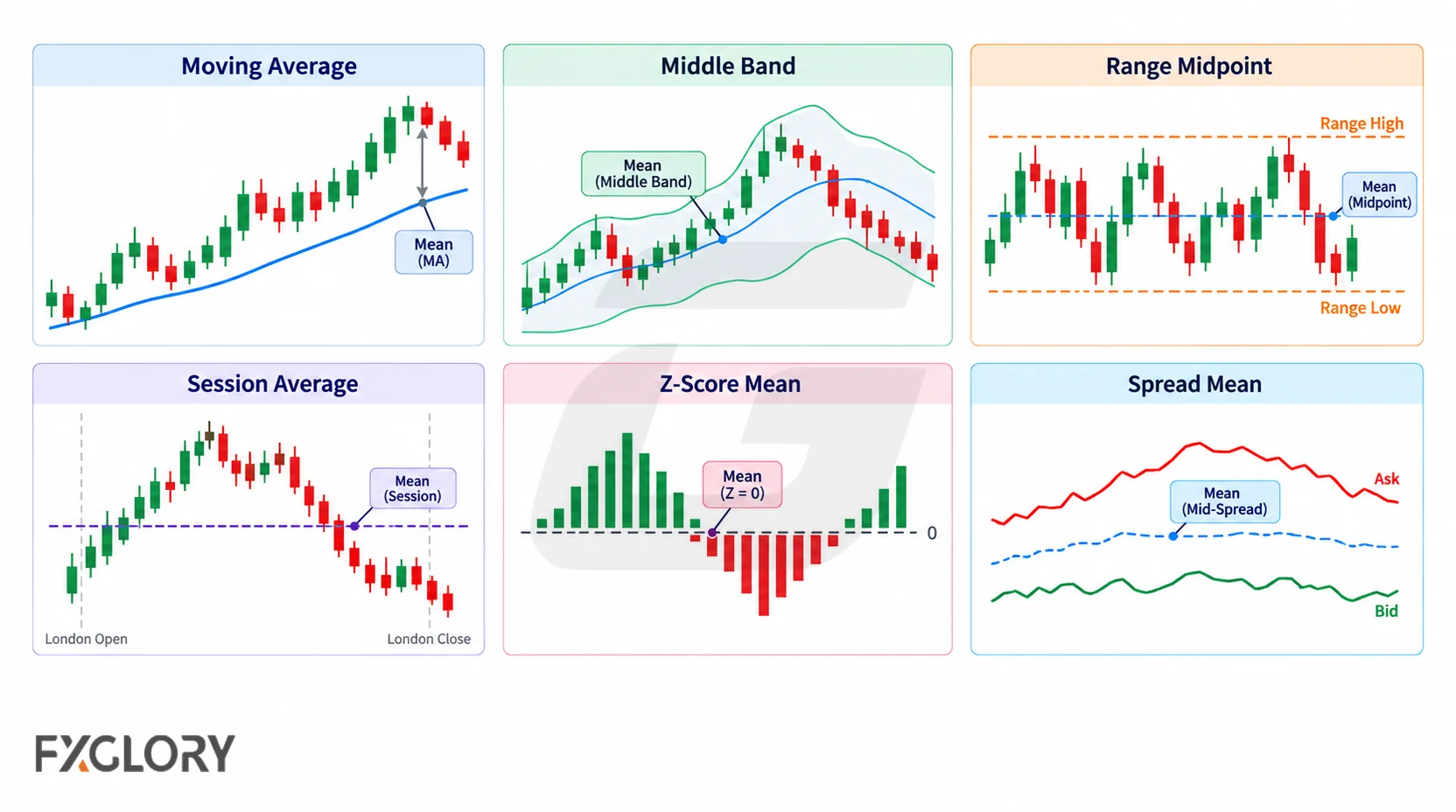
| Mean Type | What It Represents | Weak Use |
|---|---|---|
| Simple or exponential moving average | A rolling average of price over a chosen period | Changing the period after entry to justify the trade |
| Bollinger middle band | A moving average inside a volatility band structure | Assuming every outer-band touch must return to the middle band |
| Range midpoint | The center of a sideways price range | Using midpoint logic after the range has broken |
| Prior session or day average | A reference from recent trading activity | Ignoring current-session news or volatility changes |
| Statistical mean used for a z-score | A statistical average used to measure standard-deviation distance | Ignoring whether the distribution or regime has changed |
| Pair spread mean | Average relationship between related instruments or pairs | Assuming correlation will hold without testing |
| Currency basket average | Relative average across a group of currencies or pairs | Ignoring swap, rebalancing, and duplicated exposure |
The reference point should match the setup. A short intraday trade, a daily range trade, and a currency-basket trade should not use the same mean unless that reference has been tested for that setup type.
When Mean Reversion Has A Reason To Work
Mean reversion can appear when price stretches away from a reference point and then returns as short-term pressure fades. This can happen inside ranges, after volatility spikes, near range edges, around Bollinger extremes, or when related currency relationships temporarily move away from their usual spread.
The mean should not be treated as a magnet. It is only a reference point. Price can return to it, ignore it, or move the mean itself if market conditions change.
| Supportive Condition | Why It Helps | What Still Needs Confirmation |
|---|---|---|
| Range or rotation | Price has recently respected boundaries and midpoint behavior | Range must still be valid |
| Volatility spike that fades | Price may have moved too far too quickly | Momentum must stop expanding |
| Outer-band rejection | Price may be stretched relative to recent volatility | Band-walk risk must be checked |
| Oscillator stretch near structure | RSI or Stoch RSI may show extension | Price still needs structure or confirmation |
| Spread deviation | Related instruments may have moved apart | Relationship must be tested and costs included |
Why Mean Reversion Fails In Trends
Mean reversion fails when price is not stretched temporarily but repricing into a new trend or regime. In that case, the mean may follow price instead of pulling price back.
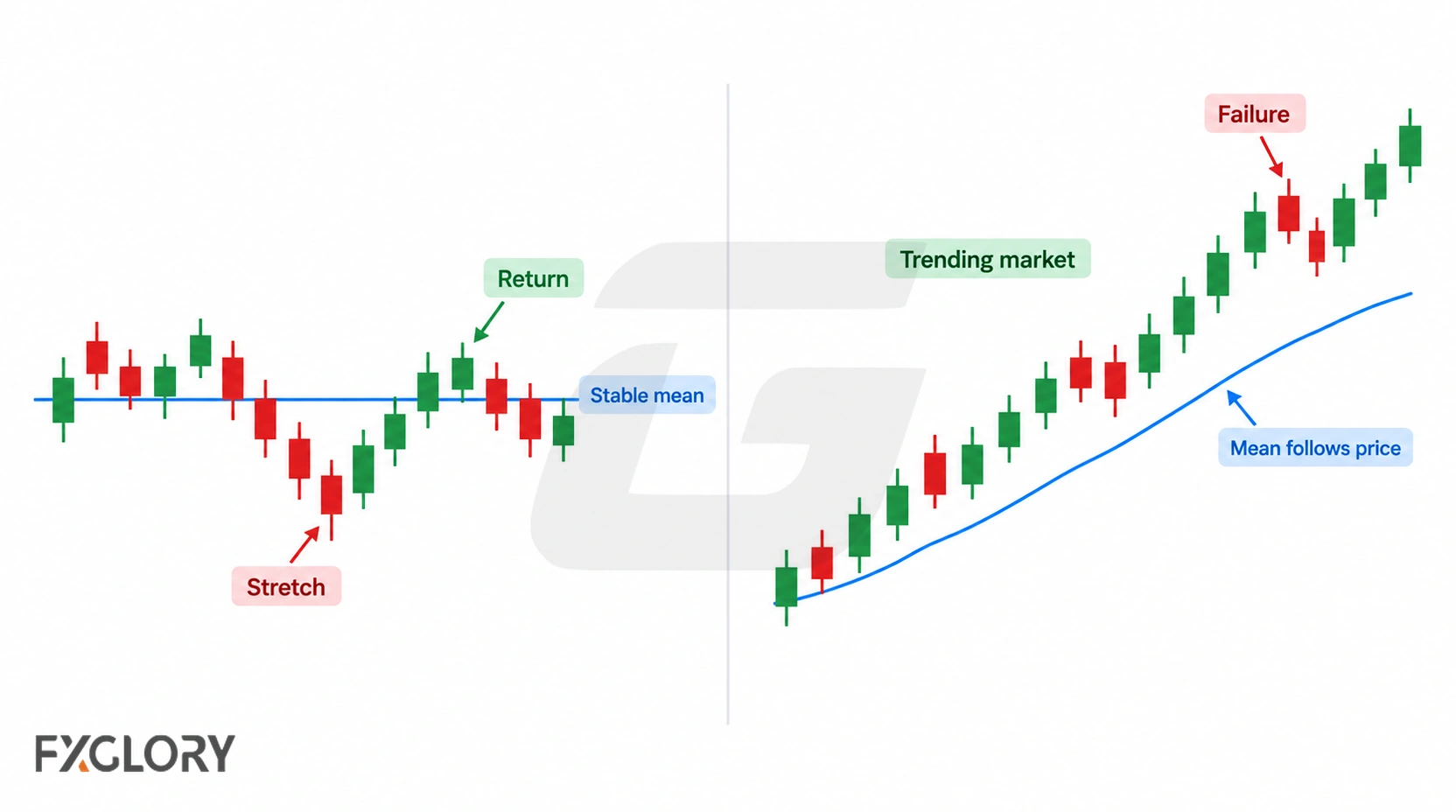
| Failure Condition | What It Means | Decision |
|---|---|---|
| Moving average slope expands | The mean is moving with the trend | Avoid fading only because price is away from the average |
| ADX or trend strength rises | Directional pressure may be increasing | Skip mean reversion until pressure fades |
| Bollinger Bands expand with price | Volatility and direction are expanding together | Do not fade the band-walk automatically |
| Breakout holds beyond a range | The old range mean may no longer matter | Cancel midpoint-return logic |
| News changes the market | The prior mean may be stale | Reassess instead of averaging into the old reference |
Use breakout continuation logic when price accepts outside the range instead of returning to the mean.
Timeframes For Forex Mean Reversion
The timeframe changes the mean, the stop distance, the holding time, and the cost profile. A setup built on a five-minute session average should not be judged the same way as a daily basket relationship.
| Timeframe Type | Possible Mean | Useful When | Main Risk |
|---|---|---|---|
| Intraday | Session average, short moving average, Bollinger middle band, range midpoint | Price rotates during active sessions without breakout acceptance | Spread, slippage, and news can consume short targets |
| H1 or H4 | Range midpoint, moving average, prior structure, volatility reference | Price respects a wider rotation or fades after a volatility spike | Holding time and swap may matter more |
| Daily | Daily moving average, multi-day range center, ATR-adjusted reference | Price stretches across several sessions and trend filters weaken | Mean may shift after macro news or trend expansion |
| Pairs or basket | Spread mean, basket average, currency-relative mean | Relationship has been tested and costs are acceptable | Correlation, stationarity, swap, and rebalancing can fail |
Use the setup timeframe to identify the failed-return level and a higher timeframe to assess whether the move belongs to a larger trend.
Forex Mean Reversion Without Indicators
Mean reversion can be reviewed without indicators if the reference point is still clear. A no-indicator setup should not mean a no-rule setup.
| No-Indicator Reference | How It Can Work | Weak Use |
|---|---|---|
| Range midpoint | Price rejects a range edge and targets the center | Using the midpoint after range breakout acceptance |
| Prior session average | Price stretches away from recent session value and re-enters structure | Ignoring news or session change |
| Failed breakout return | Price breaks out, fails, and returns toward prior structure | Calling a wick a failed breakout before acceptance |
| Support and resistance rotation | Price rotates between known internal levels | Fading trend expansion without confirmation |
| Price re-entry | Price leaves a structure, then returns inside it | Entering before the re-entry is confirmed |
For example, a completed close back inside an established range offers different evidence from a wick briefly crossing its boundary. Define which observation counts as re-entry before reviewing results.
Forex Mean Reversion Rule Sequence
A forex mean reversion strategy should follow a fixed order. Starting with an oversold or overbought reading before defining the mean can create weak entries against a market that is trending for a reason.
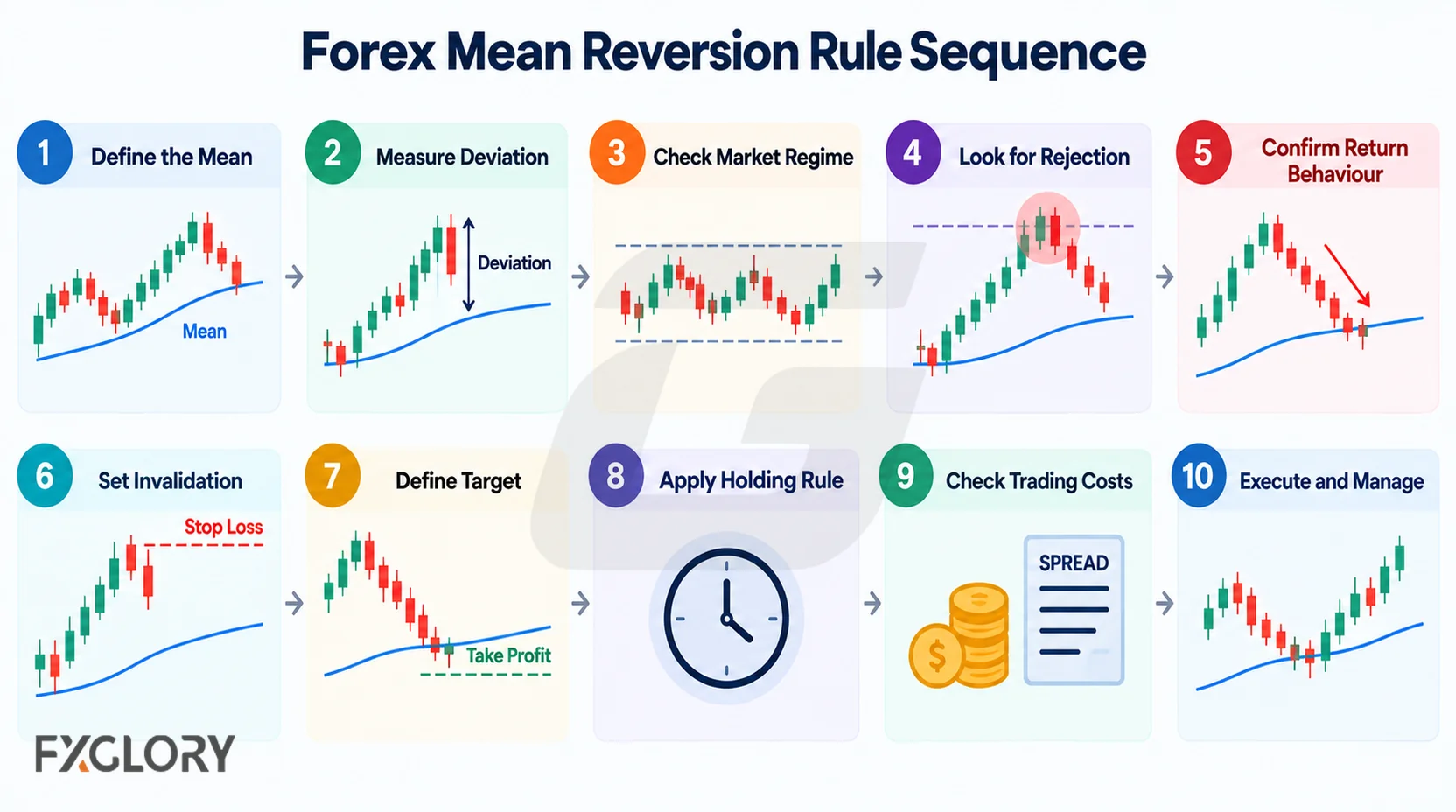
- Define the mean: moving average, Bollinger middle band, range midpoint, session average, statistical reference for a z-score, spread mean, or basket average.
- Measure deviation: distance from the mean, band position, ATR stretch, z-score, or spread deviation.
- Check market condition: range, rotation, fading volatility, or trend expansion.
- Reject trend expansion: skip if momentum, ADX, moving average slope, or breakout acceptance shows the mean is shifting.
- Wait for confirmation: rejection, re-entry inside a band or range, failed continuation, oscillator turn with price action, or retest behavior.
- Define invalidation: identify the price, spread, or regime condition that negates the return hypothesis; then evaluate stop distance and position size separately.
- Plan the target: usually the defined mean first, not the opposite extreme.
- Set a holding rule: define whether the trade exits at the mean, a time limit, a volatility change, or a cancellation point.
- Check trading costs: spread, slippage, swap, transaction cost, rebalancing cost, and holding time.
- Approve risk and execution: calculate position size from the planned stop and permitted account risk; assess margin, order execution, and any correlated exposure.
For the distinction between stop placement, account-risk sizing, and correlated exposure, consult forex risk-management rules.
Mean Reversion Setups And When To Use Them
Bollinger-band returns, range-midpoint trades, and z-score spread setups rely on different measurements. Their thresholds and historical results should be evaluated separately rather than transferred from one setup type to another.
| Setup Type | Use When | Main Risk | Rule To Check Before Entry |
|---|---|---|---|
| Moving average return | Price stretches from a chosen average and pressure fades | Average slopes strongly and price keeps trending | how indicators support the setup |
| Bollinger middle-band return | Price rejects an outer band and targets the middle band | Price walks the band in a strong trend | how Bollinger Bands define the middle-band target |
| RSI or Stoch RSI stretch | Oscillator stretch appears near structure and price confirms | Overbought or oversold readings persist | how oscillator signals should be confirmed |
| Range midpoint return | Price rejects range edge and targets midpoint | Range breaks before price returns | range boundary rules |
| ATR or volatility spike return | Price moves unusually far and volatility begins to normalize | High volatility becomes trend expansion | momentum check |
| Z-score deviation | Price or spread moves a defined number of deviations from its mean | Statistical relationship changes | how indicators define deviation and confirmation |
| Pairs or basket mean reversion | Related currency relationships move away from their average | Correlation, swap, and rebalancing costs weaken the idea | how risk rules limit exposure |
How To Define The Mean
The mean should match the timeframe, pair, and setup type. A mean chosen only because price has already moved against the trader is not a valid reference.
| Decision | What To Define | Bad Practice |
|---|---|---|
| Reference period | How many candles, sessions, or observations create the mean? | Changing the lookback after entry |
| Mean type | Moving average, midpoint, band middle, statistical mean for z-score calculation, or spread average | Mixing several means until one supports the trade |
| Timeframe | Whether the mean belongs to M15, H1, H4, daily, or another chart | Entering on one timeframe and defending with another |
| Market condition | Range, rotation, trend, breakout, or regime shift | Using range logic in a breakout |
| Target | The first level where price would complete the return-to-mean idea | Holding beyond the mean without a new reason |
The reference point should make the trade easier to reject. If price does not have enough room to return to that level after spread and slippage, the setup should be skipped.
How To Measure Deviation
Deviation measures how far price, a spread, or a currency relationship has moved away from the mean. The deviation threshold should be chosen before entry and tested by setup type.
| Deviation Method | What It Measures | Risk |
|---|---|---|
| Distance from moving average | How far price is from a rolling average | Distance can grow in a trend |
| Bollinger Band position | Price location relative to volatility bands | Outer-band touches can continue |
| ATR stretch | Whether the move is large compared with recent range | ATR can rise during trend expansion |
| RSI or Stoch RSI stretch | Momentum or oscillator extension | Oscillator extremes can persist |
| Z-score | Standard-deviation distance from a mean | Relationship may not be stable |
| Spread deviation | Distance between related instruments or currency baskets | Correlation can break or reprice |
For example, an ATR-based distance and a z-score use different denominators; a threshold calibrated in one measure should not be transferred to the other without testing.
Range And Trend Filters
Mean reversion usually needs a filter that separates range behavior from trend expansion. Without a filter, the trader may fade the strongest part of a trend only because price is far from the average.
| Filter | Mean Reversion Friendly | Warning Sign |
|---|---|---|
| ADX or trend strength | Weak or falling trend strength | Rising trend strength |
| Moving average slope | Flat or gently rotating average | Strong slope in one direction |
| Bollinger bandwidth | Stable or narrowing volatility after extension | Band expansion with price continuation |
| ATR behavior | Volatility spike begins to fade | ATR rises while price keeps trending |
| Support and resistance | Price respects range boundaries | Price accepts outside the range |
| News context | No event is changing the reference point | Major event reprices the pair |
Use support and resistance context when the mean is based on range structure or midpoint behavior.
Entry Rules: Touch, Re-Entry, Confirmation, Or Retest
A mean reversion entry should show that price may be returning toward the reference point. Touching an outer band, moving average distance, or oscillator extreme is not enough.
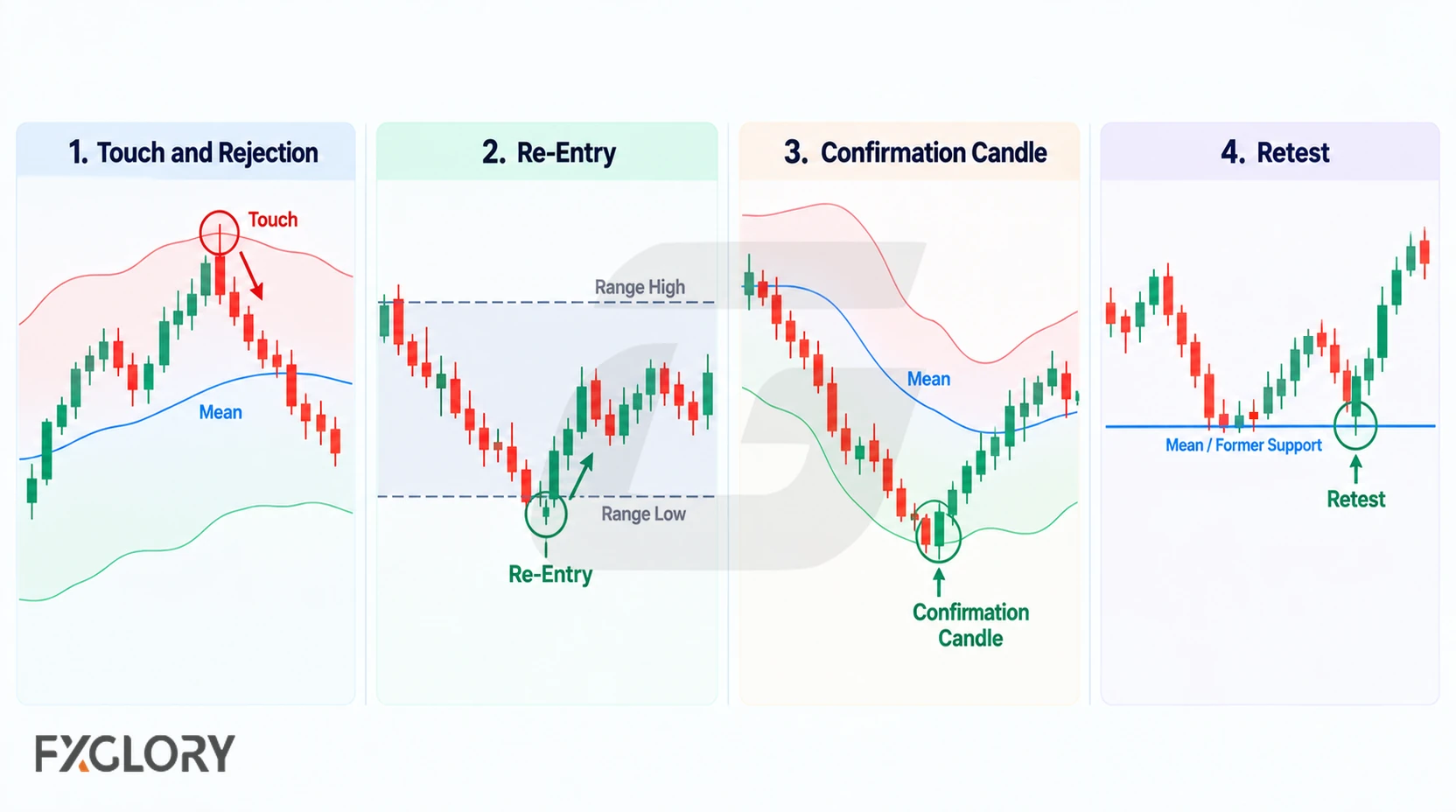
| Entry Type | How It Works | Use When | Main Risk |
|---|---|---|---|
| Touch plus rejection | Price reaches an extreme and rejects it | Range edge or band extreme | Rejection becomes only a pause |
| Re-entry inside band or range | Price moves back inside after stretching outside | Bollinger or range mean reversion | Re-entry fails and breakout resumes |
| Confirmation candle | Completed candle supports return behavior | Level or band reaction | Entry may be late if target is close |
| Retest entry | Broken minor structure holds from the other side | Controlled timing after extreme | Old direction resumes |
| Z-score threshold plus price confirmation | Statistical deviation aligns with price behavior | Advanced deviation setups | Threshold is treated as automatic entry |
The entry should leave enough room between the entry price and the defined mean after spread and slippage.
Mean Reversion Trade Management Stack
A mean reversion trade should be managed around the reference point, not around hope that price will travel beyond it. The stack below keeps the trade focused on the return-to-mean idea.
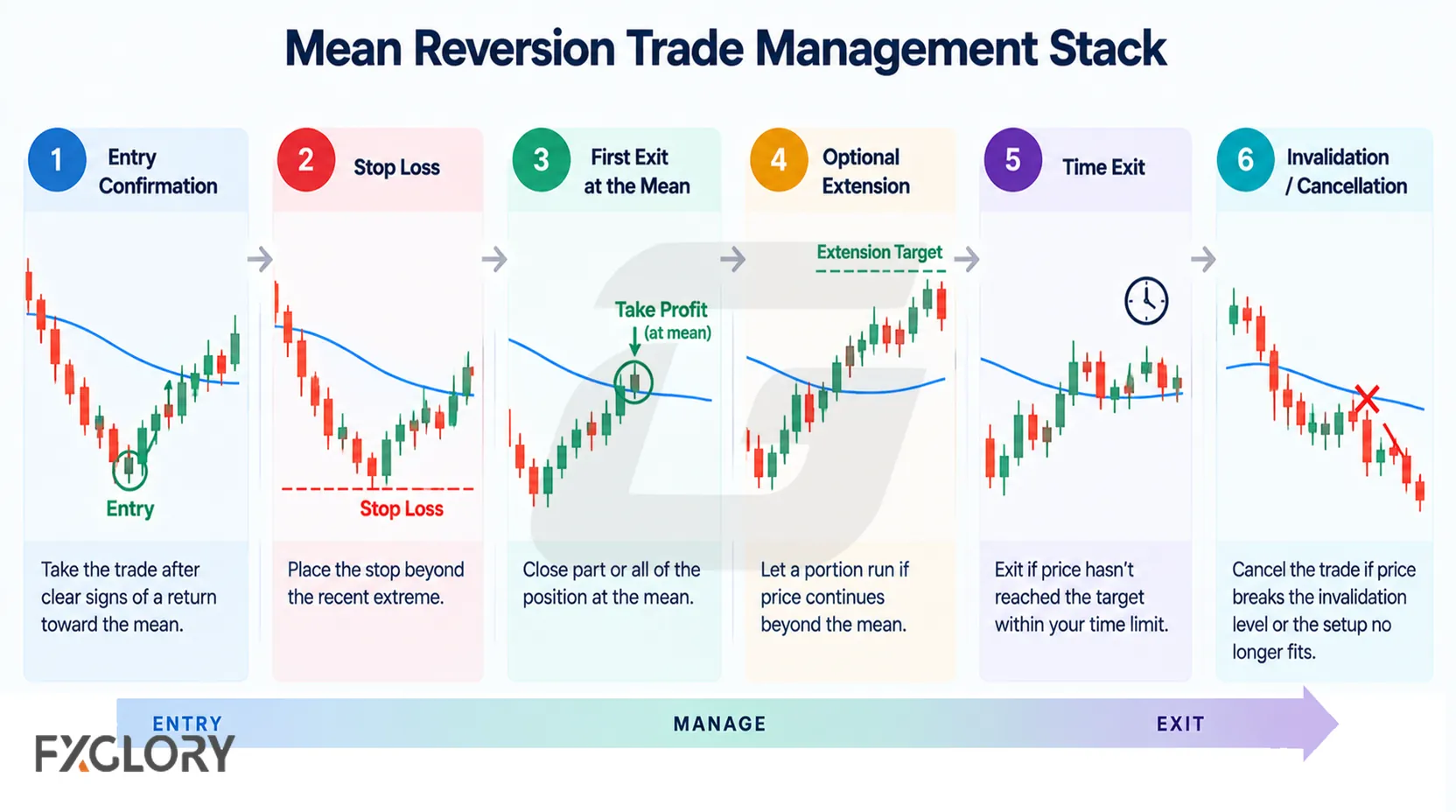
| Management Step | Rule To Define Before Entry | Failure Warning |
|---|---|---|
| Entry confirmation | Close back inside a band or range, rejection candle, retest, or spread behavior | Entering only because price touched an extreme |
| Stop placement | Beyond the swing extreme, failed-break level, band extreme, or ATR-adjusted invalidation | Stop is placed at the mean or inside normal noise |
| First exit | Scale or exit at the defined mean | Holding past the mean without a new rule |
| Optional second exit | Opposite band, range boundary, or next level only if momentum and structure support it | Turning mean reversion into a reversal hope |
| Time-based exit | Exit if price does not revert within the tested holding window | Letting a stalled trade drift into swap or trend risk |
| Cancellation | Exit if trend strength expands, breakout accepts, news shifts the mean, or spread relationship breaks | Averaging into a stale mean |
Specify whether the target is fixed at entry or tracks a recalculated mean during the holding period. These are different exit methods; changing between them after entry makes results difficult to compare.
Stop Placement And Invalidation
A mean reversion stop should be placed where the return-to-mean idea is wrong. It should not be placed only because a smaller stop makes the position size look easier.
| Setup Type | Possible Invalidation Area | Bad Stop Logic |
|---|---|---|
| Range midpoint return | Beyond the rejected range boundary or failed-break extreme | Stop inside normal range noise |
| Bollinger return | Beyond the reaction extreme if structure supports it | Stop based only on band distance |
| Moving average return | Beyond the impulse extreme or failed continuation point | Stop ignores trend expansion |
| Z-score setup | Beyond a maximum deviation, time limit, or structure invalidation | No maximum loss because the spread should revert eventually |
| Pairs or basket setup | Beyond a tested spread deviation, relationship break, or exposure limit | Assuming correlation must return immediately |
Use the FXGlory margin calculator after the stop distance is known, and review leverage conditions before increasing exposure.
Target Rules: Mean First, Opposite Band Later Only If Confirmed
The first target in a mean reversion setup is usually the defined mean. Holding for the opposite band, opposite range boundary, or a larger reversal needs a separate rule.
| Target Type | When It Fits | Risk |
|---|---|---|
| Moving average | Price stretches from a chosen average and begins to return | Average may move away from price |
| Bollinger middle band | Outer-band rejection or re-entry setup | Trend may resume before middle band |
| Range midpoint | Range edge reaction | Midpoint may be too close after spread |
| Spread mean | Pairs or basket relationship normalizes | Spread may not fully revert |
| Time-based exit | Price does not return within expected holding time | Trade drifts into swap or trend risk |
| Opposite band or boundary | Only if new rules support continuation beyond the mean | Turning a mean target into a reversal hope |
If the mean is too close after trading costs, the setup may not offer enough target room. If the target is far beyond the mean, the trade may no longer be a mean reversion setup.
Z-Score And Standard Deviation In Forex Mean Reversion
Z-score and standard deviation can help measure how far price or a spread has moved from its average. They are useful for making deviation more consistent, but they do not prove that price must return.
| Concept | Meaning | Risk To Control |
|---|---|---|
| Standard deviation | Measures typical variation around a mean | Variation can change during volatility shifts |
| Z-score | Shows how many deviations price or spread is from its mean | A high z-score can become higher in a trend |
| Entry threshold | Defines how stretched the market must be before review | Threshold can be curve-fitted |
| Exit threshold | Defines where reversion is considered complete | Exit may be too late if costs are high |
| Half-life idea | Reviews how quickly a relationship has historically reverted | Historical speed may not continue |
For observation x, reference mean μ, and estimated standard deviation σ, the z-score is z = (x − μ) / σ when σ is greater than zero. A large absolute value measures unusual distance relative to the sample; it does not itself prove stationarity or a future return.
Single-Pair vs Basket Mean Reversion
Single-pair and basket mean reversion should not be treated as the same method. A single-pair setup reads one chart. A basket setup compares several currency relationships and may require rebalancing.
| Type | Mean Reference | Decision Focus | Risk |
|---|---|---|---|
| Single-pair mean reversion | Moving average, band middle, range midpoint, session average | Does this pair have room to return toward its reference? | Trend expansion, news, spread, slippage, stale range |
| Pair spread mean reversion | Average relationship between two related instruments | Is the spread stretched and still stable? | Relationship breakdown, hedge-ratio error, swap, costs |
| Currency basket mean reversion | Currency-relative average across several pairs or contracts | Which currency is far from the basket average? | Duplicated exposure, rebalancing, carry, leverage, correlation |
| Portfolio-style mean reversion | Multiple relative-value relationships | How much exposure should each deviation receive? | Leverage growth and transaction cost |
Basket mean reversion needs exposure limits before entry. A larger deviation should not automatically mean a larger position unless the sizing method is tested and capped.
Pairs, Basket, And Currency-Relative Mean Reversion
Advanced forex mean reversion may compare related currency pairs, spreads, or baskets. The idea is to review whether one relationship has moved away from its average and may return toward it. This is more complex than a single-pair chart setup.
| Advanced Type | What It Compares | Risk To Control |
|---|---|---|
| Pairs or spread mean reversion | Relationship between two related instruments or currency pairs | Correlation can break or reprice |
| Currency basket mean reversion | One currency against a group or average | Exposure may duplicate the same currency leg |
| Relative value setup | Overvalued and undervalued relationships by a chosen model | Model assumptions may fail |
| Periodic rebalancing | Positions are adjusted on a schedule or threshold | Spread, slippage, swap, and turnover costs can build |
| Carry and swap impact | Holding cost or credit affects the setup | Return-to-mean logic can be weakened by rollover costs |
Pairs and basket mean reversion should be tested separately from single-pair mean reversion because the risks are different: correlation, swap, rebalancing, transaction costs, and exposure concentration.
Cointegration, Stationarity, And Relationship Breakdown
Pairs mean reversion needs more than two charts that look related. The relationship should be tested and reviewed because correlation can weaken, hedge ratios can change, and a spread can stop behaving around its old mean.
| Concept | Why It Matters | Risk To Control |
|---|---|---|
| Cointegration | Tests whether a combination of related series has shown a stable long-run relationship | A relationship that only looks correlated may not revert |
| Stationarity | Checks whether the spread behaves around a stable mean | A non-stationary spread can drift without returning |
| Hedge ratio | Defines how much of each leg is used in the spread | Wrong ratios can create hidden directional exposure |
| Half-life | Reviews how quickly a relationship has historically reverted | Old reversion speed may not continue |
| Relationship breakdown | Occurs when macro, policy, liquidity, or regime changes alter the spread | The old mean becomes stale |
A pairs setup should have a relationship-break rule. If the spread stops behaving around its tested mean, the trade should not be defended by adding exposure.
Swap, Spread, Slippage, Transaction Cost, And Rebalancing Risk
Mean reversion setups can look better on a chart than they behave after costs. Short targets, frequent entries, rebalancing, and overnight holding can weaken or remove the setup.
| Cost Or Risk | Why It Matters | Decision It Should Change |
|---|---|---|
| Spread | Mean targets can be small | Skip if spread consumes too much of the move |
| Slippage | Fast reversion or news movement can change fills | Avoid entries after sudden spikes without a plan |
| Swap | Mean reversion may take longer than expected | Review holding cost before entry |
| Rebalancing cost | Pairs or basket setups may require repeated adjustments | Include turnover cost before testing live |
| Correlation exposure | Several trades may repeat the same currency risk | Limit duplicated exposure |
| Leverage and margin | Averaging or baskets can increase exposure quickly | Resize or skip if margin pressure becomes excessive |
| News and regime shift | The old mean can become stale | Cancel or reassess the setup |
Review FXGlory spreads when mean targets are short. Check the economic calendar before trading mean reversion setups near major data releases, because event-driven moves can shift the reference point before price returns.
High Win Rate And Large Loss Trap
Mean reversion setups can produce frequent small reactions in calm ranges. The danger is that one trend expansion can erase many small wins if stop distance, position size, and maximum loss are not fixed before entry.
| Assumption | Risk | Control Rule |
|---|---|---|
| Price usually returns to the mean | Sometimes the mean shifts instead | Use trend and regime filters |
| High win rate means the setup is safe | Average loss can be much larger than average win | Review average win, average loss, and worst trend loss |
| A wider stop gives price time to revert | Loss can grow without clear invalidation | Use a maximum loss and time limit |
| Averaging improves the mean entry | Exposure grows while price trends away | Do not add unless the plan is tested and capped |
| Backtest worked in one range | Trend regimes may behave differently | Test by pair, timeframe, session, and regime |
Judge the setup by full risk, not by how often price touched the mean in a calm sample.
Curve-Fitting And Out-Of-Sample Testing
Mean reversion rules can look strong when thresholds are chosen after reviewing old results. A Bollinger setting, RSI level, ATR filter, z-score threshold, or holding period can fit past data and still fail under new market conditions.
| Testing Issue | Why It Matters | Control Rule |
|---|---|---|
| Curve-fitted thresholds | Old data may reward a setting that has no durable edge | Test nearby settings and avoid fragile rules |
| Out-of-sample failure | Rules may fail on data not used to choose them | Separate development data from review data |
| Regime dependency | Range samples may not represent trending markets | Review range, trend, news, and volatility regimes separately |
| Cost omission | Short targets may disappear after spread and slippage | Include realistic trading costs |
| Lookahead bias | Rules may use information not available at entry | Log only decisions available before entry |
Compare nearby parameter values and chronologically later holdout periods. A narrow performance peak that disappears after a small adjustment is weak evidence of a robust rule.
Backtesting Notes For Forex Mean Reversion Strategy
This numerical review uses one hypothetical educational rule model: a daily Bollinger Band re-entry setup that targets the 20-day simple moving average. It does not test every type of forex mean reversion, basket mean reversion, z-score spread reversion, range midpoint rotation, RSI reversal, or discretionary return-to-mean setup.
The model reviews EURUSD, GBPUSD, USDJPY, AUDUSD, USDCAD, and USDCHF on daily candles using public yfinance OHLC data where available. The reference mean is the 20-day SMA, and the deviation trigger is a prior daily close outside a 20-day, 2.0-standard-deviation Bollinger Band.
| Rule Area | Educational Model Rule |
|---|---|
| Mean | 20-day simple moving average used as the Bollinger middle band |
| Deviation | Previous daily close outside a 20-day, 2.0-standard-deviation Bollinger Band |
| Long confirmation | Daily close re-enters above the lower band while remaining below the 20-day SMA |
| Short confirmation | Daily close re-enters below the upper band while remaining above the 20-day SMA |
| Entry | Next daily open after the confirmation candle |
| Range filter | ADX(14) less than or equal to 25 |
| Volatility filter | Bollinger Band width at or below its prior 252-day 70th percentile |
| Weekly trend filter | Absolute weekly EMA(50) slope over 5 completed weeks divided by weekly ATR(14) less than or equal to 1.0 |
| Stop | Beyond the two-candle stretch/re-entry extreme with a 0.25 ATR(14) buffer |
| Target | Fixed 20-day SMA value from the confirmation candle |
| Minimum target room | At least 0.35 ATR(14) and at least 5 pips before costs |
| Maximum holding review | 20 daily candles after entry |
The review records trade count, win rate, average win in R, average loss in R, expectancy in R, profit factor, maximum drawdown in R, worst losing streak, average holding period, pair-level behavior, exit reasons, and spread/slippage sensitivity.
| Cost Input | Assumptions Used |
|---|---|
| Spread | 0.5, 1.5, and 3.0 pips |
| Slippage | 0.1, 0.5, and 1.0 pips per side |
| Baseline comparison | 1.5-pip spread and 0.5-pip slippage per side |
| Swap and rollover | Not included |
Educational Sensitivity-Test Results
The local Python run completed on 2026-06-29 and reviewed the requested data window from 2016-06-29 through 2026-06-29, with warmup data from 2015-02-15 for indicator calculation. Under the baseline assumption of 1.5-pip spread and 0.5-pip slippage per side, the model produced 389 trades, a 39.59% win rate, -0.0426R expectancy, 0.9332 profit factor, -56.4832R maximum drawdown, and -16.5556R total net R.
| Metric | Baseline Output |
|---|---|
| Number of trades | 389 |
| Win rate | 39.59% |
| Average win | 1.5023R |
| Average loss | -1.0549R |
| Expectancy | -0.0426R |
| Profit factor | 0.9332 |
| Maximum drawdown | -56.4832R |
| Worst losing streak | 11 |
| Average holding period | 4.08 daily candles |
| Median holding period | 3.00 daily candles |
| Total net R | -16.5556R |
The pair-level output was mixed. EURUSD, USDJPY, and USDCHF were positive under the baseline assumptions, while AUDUSD, GBPUSD, and USDCAD were negative. The combined baseline expectancy remained negative.
| Pair | Trades | Win Rate | Average Win | Average Loss | Expectancy | Profit Factor | Max Drawdown | Worst Losing Streak | Total Net R |
|---|---|---|---|---|---|---|---|---|---|
| AUDUSD | 64 | 40.62% | 1.0252R | -1.0724R | -0.2203R | 0.6541 | -21.3529R | 8 | -14.0960R |
| EURUSD | 69 | 42.03% | 1.5074R | -1.0328R | 0.0348R | 1.0581 | -19.5226R | 9 | 2.4004R |
| GBPUSD | 70 | 40.00% | 0.9626R | -1.0326R | -0.2346R | 0.6214 | -16.8547R | 4 | -16.4187R |
| USDCAD | 61 | 36.07% | 1.2561R | -1.0732R | -0.2331R | 0.6602 | -24.7093R | 7 | -14.2215R |
| USDCHF | 70 | 40.00% | 2.4628R | -1.0700R | 0.3431R | 1.5345 | -14.1303R | 12 | 24.0187R |
| USDJPY | 55 | 38.18% | 1.7830R | -1.0494R | 0.0320R | 1.0494 | -13.8526R | 7 | 1.7615R |
Exit counts were 150 mean-target exits, 232 stop-loss exits, and 7 time exits.
| Exit Reason | Trades |
|---|---|
| mean target | 150 |
| stop loss | 232 |
| time exit | 7 |
The cost sensitivity review stayed negative across the tested spread and slippage grid. The least costly assumption was closest to breakeven at -0.0042R expectancy, while the highest tested cost assumption declined to -0.0959R expectancy.
| Spread Pips | Slippage Pips Per Side | Trades | Expectancy | Profit Factor | Max Drawdown | Total Net R |
|---|---|---|---|---|---|---|
| 0.5 | 0.1 | 389 | -0.0042R | 0.9932 | -47.0406R | -1.6152R |
| 0.5 | 0.5 | 389 | -0.0212R | 0.9659 | -50.2632R | -8.2554R |
| 0.5 | 1.0 | 389 | -0.0426R | 0.9332 | -56.4832R | -16.5556R |
| 1.5 | 0.1 | 389 | -0.0255R | 0.9592 | -51.0688R | -9.9154R |
| 1.5 | 0.5 | 389 | -0.0426R | 0.9332 | -56.4832R | -16.5556R |
| 1.5 | 1.0 | 389 | -0.0639R | 0.9021 | -63.2723R | -24.8558R |
| 3.0 | 0.1 | 389 | -0.0575R | 0.9113 | -61.2320R | -22.3657R |
| 3.0 | 0.5 | 389 | -0.0746R | 0.8871 | -66.7348R | -29.0059R |
| 3.0 | 1.0 | 389 | -0.0959R | 0.8580 | -73.7393R | -37.3061R |
Forex Mean Reversion Strategy Example Flow
This hypothetical EUR/USD range example illustrates the arithmetic of a possible return-to-midpoint setup. The prices are invented for teaching; they are not observed trades and are unrelated to the historical Bollinger backtest above. All quoted prices below are illustrative midprices, before trading costs.
| Element | Hypothetical Observation Or Rule | What It Shows |
|---|---|---|
| Reference and range | Range low 1.0960, range high 1.1040, midpoint 1.1000 | The intended return level is chosen from the range before entry. |
| Deviation and confirmation | Price briefly reaches 1.0958, then a completed candle closes back inside the range at 1.0966 | A defined re-entry condition, not the low alone, is used to identify the candidate. |
| Illustrative entry | 1.0970 after the completed re-entry candle | Entry is below the midpoint, leaving 30 pips of gross target distance. |
| Structural stop | 1.0950, below the failed-break extreme | Planned gross stop distance is 20 pips; position sizing is a separate calculation. |
| Initial target | 1.1000 range midpoint | Gross planned reward is 30 pips, versus 20 pips gross risk. |
| Illustrative cost allowance | 1.5 pips of spread plus 0.5 pip slippage on each side: 2.5 pips in total | This round-trip allowance is applied once to the midprice-based illustration; actual executable quotes and costs may differ. |
| Net comparison | 27.5 pips potential net reward versus 22.5 pips potential net stop loss; reward/risk approximately 1.22 | The 30-to-20 gross comparison becomes less favorable after assumed costs, before any gap or financing cost. |
| Time and cancellation | Choose a time limit and a rule for sustained trading below the range before acting | A target or stop may not be reached promptly, and a failed return may require an exit. |
The same calculation can be mirrored for a short setup near an upper range boundary. The numbers illustrate a trade plan, not a demonstrated strategy edge or an expected fill; additional testing would be needed to establish whether this particular pattern has historically offered positive expectancy.
No-Trade Conditions
A weak candidate should be rejected before entry when its defining reference, market conditions, costs, or risk controls are inadequate. These no-trade conditions combine the practical diagnostic checks for price, indicator-based, and pairs or basket setups.
- Skip if the mean is not defined before entry.
- Skip if trend strength is expanding away from the mean.
- Skip if price has accepted outside the range or breakout area.
- Skip if the setup depends only on RSI, Stoch RSI, Bollinger touch, or z-score threshold.
- Skip if news can shift the reference point or widen spreads.
- Skip if the first mean target is too close after spread and slippage.
- Skip if swap or holding time makes the setup unsuitable.
- Skip if the stop must be placed randomly because structure is unclear.
- Skip if the plan depends on adding to a losing trade without maximum exposure rules.
- Skip if multiple trades duplicate the same currency or basket exposure.
- Skip if a pairs relationship is not tested or has stopped behaving around its old spread mean.
- Skip if the rule only works on one optimized setting and fails nearby settings.
- Skip if the trader is entering only because price looks too far from an average.
Testing And Review Checklist
Forex mean reversion strategies should be tested by setup type. A moving-average return, Bollinger middle-band return, RSI stretch, range midpoint return, z-score spread setup, and basket mean reversion should not be mixed into one result unless the rules are identical.
- Choose the setup type: moving average return, Bollinger middle-band return, RSI or Stoch RSI stretch, range midpoint, ATR spike, z-score deviation, pair spread, or currency basket.
- Define the mean: reference period, mean type, timeframe, pair group, and target point.
- Define deviation: distance from average, band position, ATR stretch, oscillator threshold, z-score, or spread deviation.
- Classify market condition: range, rotation, fading volatility, trend expansion, breakout, or news regime.
- Write the confirmation rule: rejection, re-entry, retest, failed continuation, oscillator turn with price action, or spread behavior.
- Write invalidation: the price, spread, structure, time limit, or regime change that cancels the setup.
- Measure stop and target: compare stop distance with the defined mean target after spread and slippage.
- Record trading costs: spread, slippage, swap, rollover, rebalancing cost, and holding time.
- Record exposure rules: no averaging, or tested add levels with maximum total risk if the strategy explicitly allows scaling.
- Separate samples: review in-sample and out-of-sample behavior, and check whether nearby thresholds still work.
- Record skipped setups: trend expansion, stale mean, indicator-only signal, no cost room, poor target room, relationship breakdown, and news distortion should be reviewed too.
- Assess sample adequacy: report the number and independence of observations, uncertainty around expectancy, coverage of market regimes, and stability on later holdout data; no fixed trade count by itself establishes reliability.
- Record mistake tags: undefined mean, faded trend, averaged loser, held past time limit, ignored swap, ignored spread, changed mean after entry, curve-fitted threshold, or no exit rule.