

What Is A Forex Reversal Strategy?
A forex reversal strategy is a rule-based method for reviewing whether a currency pair may be changing direction. It does not try to guess the exact top or bottom. It waits for evidence that the prior move is weakening and that price is starting to accept a new direction.
Reversal evidence can come from a major support or resistance level, a failed breakout, a rejection candle, a double top or bottom, a head and shoulders pattern, a 1-2-3 structure shift, momentum divergence, a Sushi Roll-style multi-candle pattern, or a failed attempt to continue the trend. None of these is enough alone. The setup also needs invalidation, stop placement, target room, and risk controls.
A reversal plan should keep the decision process separate from the tools used to support it. Candle patterns, support and resistance, momentum, and trend analysis can help confirm the idea, but the trade still needs a clear turning-point case, invalidation, stop placement, and target room. Use price action strategy for broader candle and structure reading, and use support and resistance rules when the setup depends mainly on levels.
Reversal Strategy vs Retracement vs Trend Trading
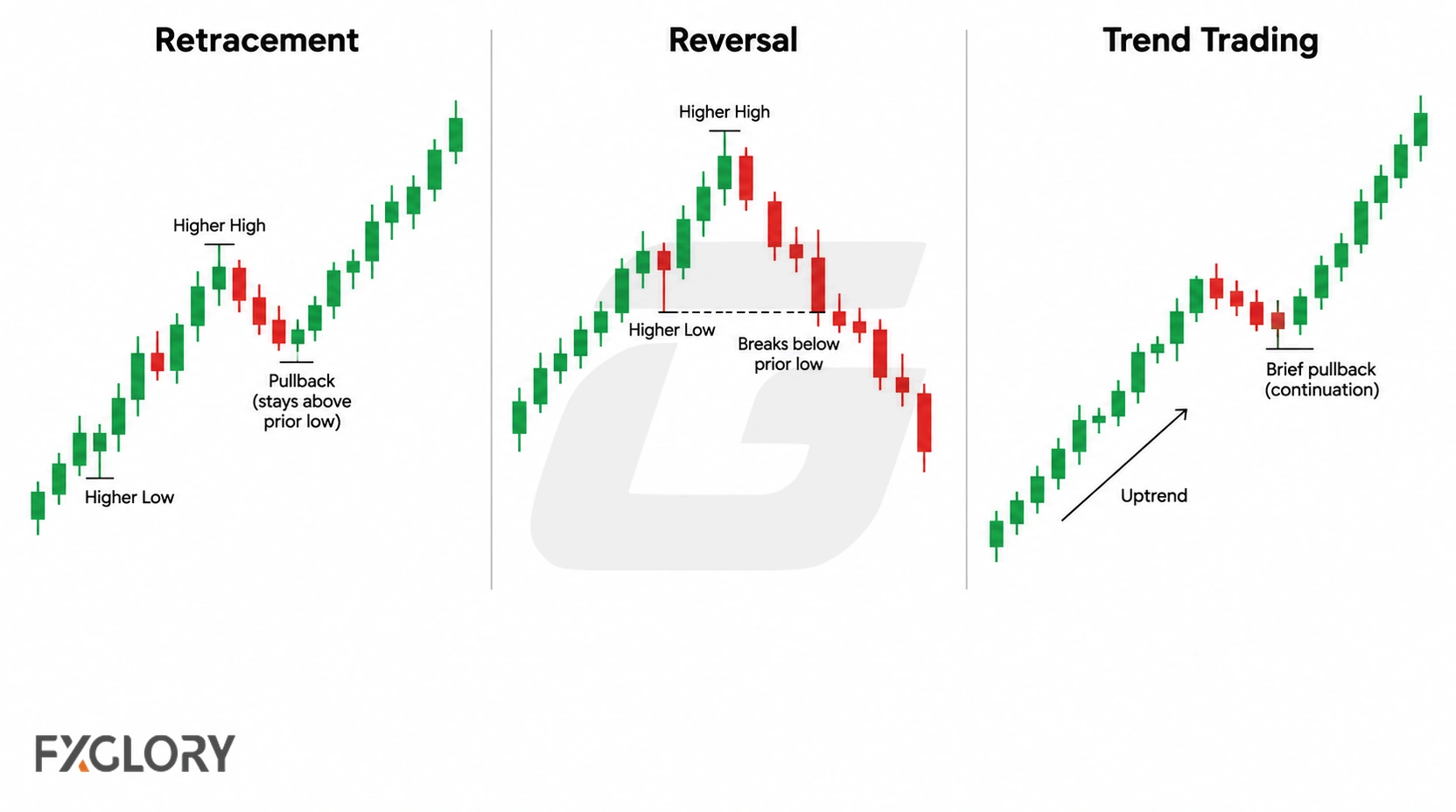
A reversal should not be confused with a retracement. A retracement in forex is a temporary move against the current trend. A reversal needs stronger evidence that the prior direction is losing control and that a new structure may be forming.
| Topic | Main Question | Role In A Reversal Plan | Main Risk |
|---|---|---|---|
| Reversal strategy | Is the move changing direction with confirmation? | Focuses on exhaustion, failed continuation, structure shift, and invalidation | Calling the turn too early |
| Retracement | Is price only pulling back inside the current trend? | Reviewed as a warning before assuming a full reversal | Confusing a pullback with a trend change |
| Trend trading | Is price continuing in the existing direction? | Used as context before fighting the trend | Shorting strength or buying weakness too early |
| Momentum strategy | Is directional pressure continuing or fading? | Used to separate exhaustion from confirmed reversal pressure | Treating faded momentum as a reversal by itself |
| Candlestick strategy | Does a candle pattern support the idea? | Used only after level and structure are checked | Trading a candle pattern without context |
A trend can retrace many times before it reverses. A reversal trader should first ask whether the move is only correcting or whether the prior structure has actually failed.
Reversal vs Retracement Checklist
Most failed reversal trades begin as a simple retracement that the trader calls a full trend change too early. Use a checklist before treating a pullback as a reversal.
| Question | Retracement Clue | Reversal Clue |
|---|---|---|
| Higher-timeframe trend | Main trend remains intact | Trend structure begins to fail |
| Price location | Pullback forms inside the existing move | Price reacts from a major support, resistance, range edge, or failed breakout zone |
| Swing structure | Higher highs and higher lows, or lower highs and lower lows, still hold | Prior swing sequence breaks and retest behavior changes |
| Momentum | Momentum pauses but does not reverse structure | Momentum fades, failed continuation appears, and price confirms a shift |
| Confirmation | No completed reversal signal appears | Completed candle, false break, structure break, or retest supports the change |
| Invalidation | Trade idea has no clear point where it is wrong | Setup has a specific level or swing that cancels the reversal idea |
If the answer is mostly retracement clues, the better decision is usually to wait, trade with the trend, or skip the reversal attempt.
Why Reversal Trading Is Hard
Reversal trading is difficult because the best-looking reversal often appears against recent price pressure. A market that has already moved far can continue farther. An oversold market can stay weak, and an overbought market can keep rising if the trend has not broken.
The hard part is waiting until the market proves the old direction is failing without entering so late that the stop becomes unusable.
| Common Reversal Mistake | Why It Fails | Better Rule |
|---|---|---|
| Buying only because price dropped far | A strong downtrend can keep making lower lows | Wait for support reaction, failed continuation, or structure shift |
| Selling only because RSI is high | Momentum can stay strong in a trend | Use RSI only with level, structure, and invalidation |
| Placing blind orders at levels | Levels can break without reversal | Wait for confirmation at or around the level |
| Entering before the candle closes | The reversal candle can change before confirmation | Define whether completed-candle confirmation is required |
| Using a tiny stop against a strong trend | Normal volatility can hit the stop before the setup is invalid | Place the stop where the reversal idea is actually wrong |
Reversal With The Trend vs Counter-Trend Reversal
Not every reversal trade is a fight against the main trend. Some reversal signals happen when a pullback ends and price turns back into the higher-timeframe direction. Those setups are different from trying to catch the end of a full trend.
| Reversal Type | What It Means | Example Context | Main Risk |
|---|---|---|---|
| Counter-trend reversal | Trader expects the larger move to change direction | Major resistance after an extended uptrend | Trend keeps going and stops early entries |
| Pullback reversal with trend | Trader expects a correction to end and main trend to resume | Daily uptrend, 4H pullback, support rejection | Pullback becomes a real reversal against the trend |
| Failed breakout reversal | Price breaks a level, fails, and accepts back inside | False break above resistance or below support | Failure signal appears before confirmation |
| Range-edge reversal | Price reacts from range support or resistance | Sideways market with visible boundaries | Range breaks during news or session expansion |
With-trend reversal setups usually deserve priority over counter-trend reversal attempts when the higher-timeframe trend is intact, the pullback moves into a planned value area, a completed reversal signal forms at that level, and there is target room back toward the trend direction.
Counter-trend reversals need stricter confirmation, smaller exposure, or fewer attempts because the old trend can keep going. Use trend context before deciding whether a reversal is fighting the main move or only reversing a pullback.
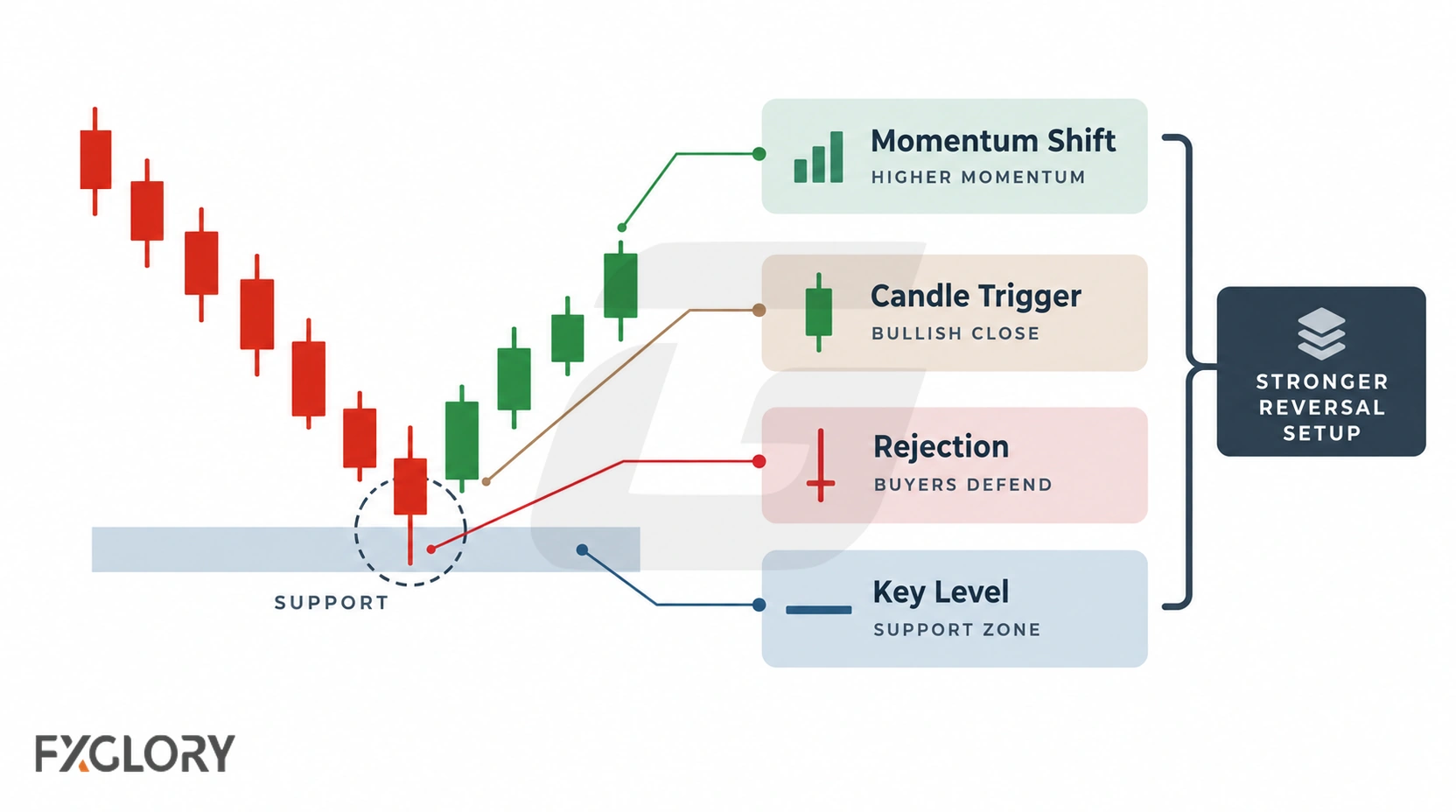
The Reversal Confirmation Stack
Confirmation can support a candidate reversal, but it does not establish a trade-ready setup on its own. Define the price level or structure that invalidates the idea, then assess stop distance, target room, and acceptable risk separately. Confirmation cannot prove that the new direction will continue.
| Stack Step | What To Look For | Why It Matters |
|---|---|---|
| 1. Level | Daily or 4H support, resistance, range edge, swing point, or failed breakout zone | Gives the reversal a location instead of a random candle |
| 2. Exhaustion or failed continuation | Weak follow-through, failed high or low, rejection, or inability to hold a breakout | Shows the old direction may be losing control |
| 3. Structure break | Prior swing sequence changes or the old trendline/structure fails | Separates reversal evidence from simple retracement |
| 4. Retest or trigger | Broken structure holds, false break confirms, or completed candle supports entry | Improves timing and defines invalidation |
| 5. Invalidation | Clear price or structure level that cancels the idea | Prevents guessing and random stop placement |
A reversal with only one piece of evidence is fragile. A reversal with location, failure, structure shift, trigger, and invalidation is easier to test.
Forex Reversal Rule Sequence
A forex reversal strategy should follow a fixed sequence. Starting with a pattern or divergence before checking the level and trend context can create weak counter-trend entries.
- Start with higher-timeframe context: review daily or 4H trend, support, resistance, range, and major swing points.
- Mark the reversal area: support, resistance, range edge, prior swing, failed breakout zone, or higher-timeframe level.
- Check whether the current move is extended: review whether price is late, stretched, or running into a major obstacle.
- Look for failed continuation: price tries to continue the prior move but cannot hold the new high, low, or breakout area.
- Wait for confirmation: rejection candle, false break, structure shift, retest, divergence plus price confirmation, or completed pattern.
- Define invalidation: write the price or structure that proves the reversal idea wrong.
- Measure stop and target: compare stop distance with target room after spread and slippage.
- Check conditions: news, spread, slippage, swap, margin, leverage, and holding time.
- Write the exit plan: target level, structure break, momentum fade, failed retest, or cancellation point.
Use risk rules based on the reversal stop before testing any setup live.
Higher-Timeframe Level First
Most reversal setups need a location. A reversal signal in the middle of unclear price action is weaker than a signal at a visible daily or 4H level. The level does not guarantee a reversal, but it gives the trader a reason to watch for one.
| Reversal Location | Why It Matters | Weak Use |
|---|---|---|
| Daily support or resistance | Can attract larger reactions and define target areas | Placing blind orders before confirmation |
| 4H swing high or low | Can show where recent structure may fail | Using a minor swing against strong daily trend |
| Range boundary | Can support range-edge reversal logic | Fading every touch when the range is breaking |
| Failed breakout zone | Can show trapped breakout pressure | Calling a false break before price accepts back inside |
| Prior trendline or channel area | Can help locate structure change | Forcing lines to fit the reversal idea |
Use multiple time frame role separation when a daily level, 4H setup, and lower-timeframe entry need different jobs.
Daily/H4 Reversal System Checklist
Some traders look for daily or H4 reversal systems because those timeframes can reduce lower-timeframe noise. A daily/H4 reversal setup still needs patience and confirmation; it should not become a blind indicator match.
| Checklist Item | What To Confirm | Skip If |
|---|---|---|
| Daily context | Price is near a daily level, extended move, range edge, or major swing area | The setup appears in the middle of unclear structure |
| H4 setup | H4 shows failed continuation, rejection, structure shift, or false break | H4 trend still strongly follows the old direction |
| Optional H1 refinement | H1 improves timing below a valid daily/H4 idea | H1 creates a trade that daily/H4 do not support |
| Indicator or candle agreement | RSI, MACD, candle pattern, or moving average supports price evidence | The indicator is the only reason for entry |
| Stop placement | Stop is beyond the failed high/low, level, or invalidating swing | Stop is placed randomly to make the trade smaller |
| Exit plan | Target, trail, partial exit, or cancellation point is written before entry | The trader only hopes the reversal becomes a full trend change |
Daily/H4 systems should be tested separately from intraday reversal setups. The holding time, stop size, swap exposure, and review rhythm are different.
Exhaustion, Failed Continuation, And Structure Shift
Exhaustion alone is not a reversal. A trend can slow down, pause, or pull back before continuing. A stronger reversal case appears when exhaustion is followed by failed continuation and a structure shift.
| Evidence | What It May Show | Why It Is Not Enough Alone |
|---|---|---|
| Exhaustion | Move is stretched, candles shrink, or wicks appear | Price can consolidate before continuing |
| Failed continuation | Price tries to make a new high or low but cannot hold it | Failure must be confirmed by close or structure behavior |
| Structure shift | Price breaks the pattern of higher highs/lows or lower highs/lows | One minor break can be noise without context |
| Retest after shift | Broken structure holds from the other side | Retest can fail if momentum returns to the old trend |
| Momentum divergence | Indicator pressure disagrees with price progress | Divergence can persist before price turns |
A reversal plan is strongest when several pieces agree: location, exhaustion, failed continuation, structure shift, and invalidation.
Reversal Confirmation Methods
| Confirmation Method | Useful Role | Weak Use |
|---|---|---|
| Support or resistance rejection | Shows reaction at a planned level | Trading every touch of the level |
| False breakout or fakey | Shows failure beyond a level and acceptance back inside | Entering before price confirms the failure |
| Pin bar or rejection candle | Shows failed pressure beyond a level | Using a wick away from meaningful structure |
| Engulfing candle | Shows a possible control shift after a move | Entering after a large candle directly into the next obstacle |
| Inside bar break | Shows compression and possible expansion after a level reaction | Using inside bars in messy price action |
| 1-2-3 structure shift | Shows possible end of prior swing structure | Forcing structure labels after the move |
| RSI or MACD divergence | Shows momentum disagreement | Treating divergence as a reversal by itself |
Use completed candle logic when the reversal depends on pin bars, engulfing candles, inside bars, or multi-candle structures.
False Breakout Reversal And Spring/Upthrust Logic
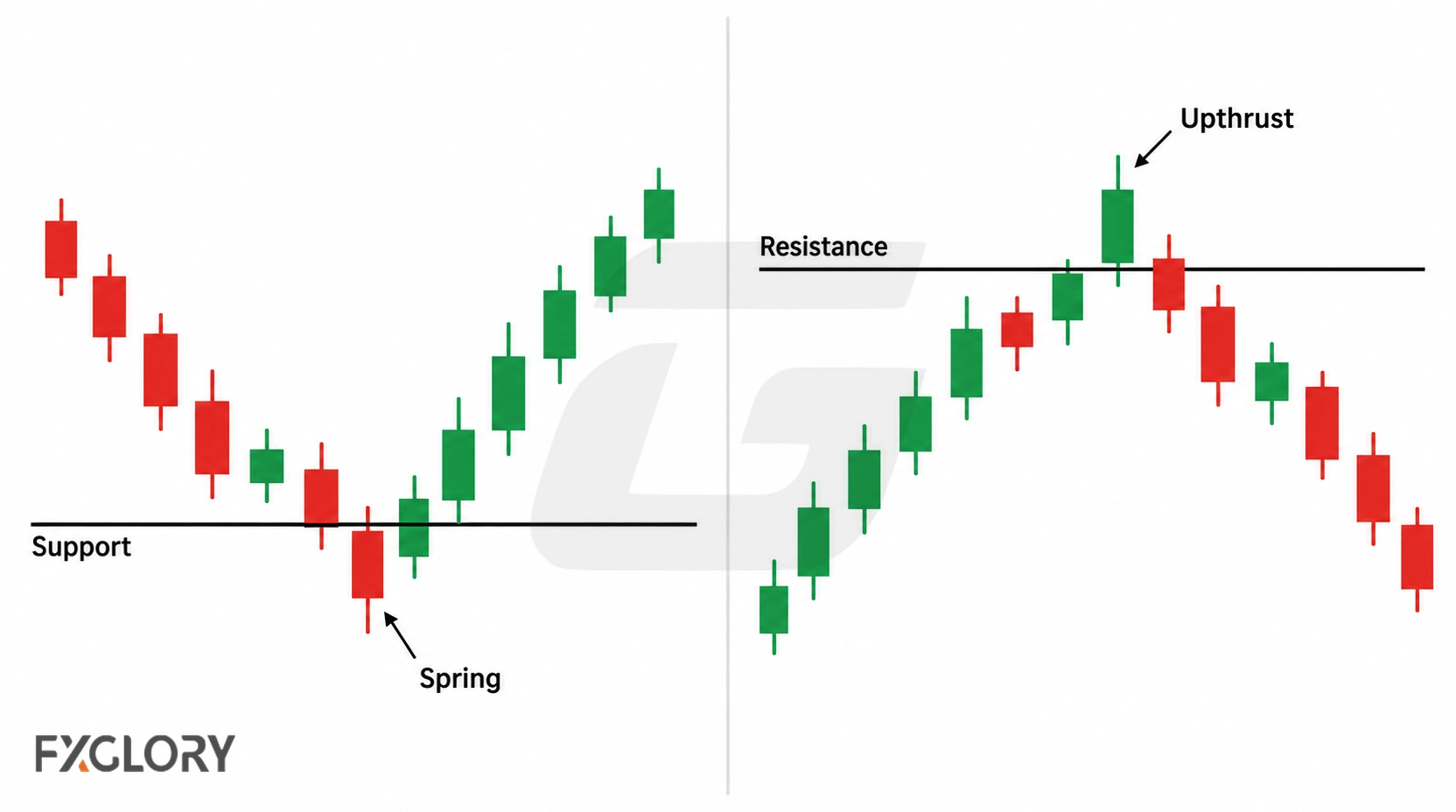
A false breakout reversal happens when price breaks through a level, cannot hold beyond it, and accepts back inside the prior structure. In range logic, a failed break below support is often described as spring-style behavior, while a failed break above resistance is often described as upthrust-style behavior.
| False-Break Type | What Happens | Confirmation Needed | Weak Use |
|---|---|---|---|
| Spring-style failed break | Price breaks below support, then returns back inside the range | Acceptance back above the broken support area | Buying the first dip below support before failure is confirmed |
| Upthrust-style failed break | Price breaks above resistance, then returns back inside the range | Acceptance back below the broken resistance area | Selling the first move above resistance before failure is confirmed |
| Failed trendline break | Price breaks a line but cannot continue beyond it | Close and retest behavior confirm failure | Forcing trendlines to create a reversal idea |
| Failed breakout retest | Retest does not hold the broken side of the level | Price accepts back into the old structure | Calling a normal retest a failed breakout too early |
A spring or upthrust idea is not a signal by itself. It needs acceptance back inside the prior structure, invalidation beyond the failed extreme, and enough target room toward the other side of the range or next level.
Price Action Reversal Signals
Price action reversal signals work best when they form at a planned level and give a clear invalidation point. A pin bar, inside bar, engulfing candle, or false break is weak if it forms in the middle of unclear structure.
- Do not trade a pin bar if the wick is not rejecting a meaningful area.
- Do not trade an engulfing candle if it closes directly into the next support or resistance level.
- Do not trade an inside bar breakout if the mother-bar range is messy or too wide for the account risk.
- Do not trade a false breakout before price has accepted back inside the prior structure.
- Do not enter a reversal only because a candle looks dramatic after a large move.
Use reversal evidence from price action when candle behavior and structure are the main tools.
Chart Patterns And Structure Reversals
Reversal patterns can help identify possible changes in price structure, but recognizing a pattern is not the same as confirming it or planning a trade. A trade-ready setup requires a defined entry trigger, structural invalidation, stop, and realistic target.
| Pattern Or Structure | What It May Show | Risk To Control |
|---|---|---|
| Double top | Repeated failure near resistance | Entering before neckline or structure confirmation |
| Double bottom | Repeated failure near support | Buying before the market stops accepting lower prices |
| Head and shoulders | Possible weakening of an uptrend | Forcing the pattern before the neckline matters |
| Inverse head and shoulders | Possible weakening of a downtrend | Ignoring resistance directly above the pattern |
| 1-2-3 reversal | Possible shift from old swing structure to new structure | Labeling swings after the move has already happened |
| Sushi Roll-style multi-candle reversal | Possible shift from narrow price action to wider reversal movement | Treating a pattern as valid without level or risk context |
Sushi Roll Pattern: Optional Evidence, Not A Strategy Alone
A commonly described Sushi Roll reversal uses ten consecutive price bars divided into two groups of five. The first five have a relatively narrow combined high-low range; the second five form a combined range with both a higher high and a lower low than the first group. Variations may use other group lengths. This range structure identifies a candidate pattern, not confirmation of a sustained direction change or a trade-ready setup.
| Sushi Roll Element | What To Review | Risk Rule |
|---|---|---|
| Narrow range | The first five bars have a relatively narrow combined high-low range in the commonly described version | Do not assume compression must reverse |
| Wider reversal range | The following five bars as a group make both a higher high and lower low than the first group | Wait for completed structure if the rules require confirmation |
| Trigger | Break beyond the pattern range or a retest after the break | Do not enter if the break is directly into the next obstacle |
| Invalidation | Often beyond the opposite side of the reversal structure | Stop should match structure, not a random small distance |
| Context | Best reviewed near a meaningful level or after exhaustion | Pattern alone is not enough |
A Sushi Roll setup should be treated as optional reversal evidence, not as a standalone signal or automatic entry system.
RSI, MACD, And Divergence In Reversal Trading
Divergence can warn that momentum is weakening, but it does not guarantee a reversal. A market can keep trending while RSI or MACD diverges. Divergence becomes more useful when it appears at a major level and price also shows failed continuation or structure shift.
| Indicator Evidence | What It May Suggest | Why It Is Not Enough |
|---|---|---|
| RSI divergence | Price makes a new extreme while RSI does not confirm | Trend can continue despite divergence |
| MACD divergence | Momentum weakens while price still pushes | Entry timing can still be too early |
| Moving average break | Price may be shifting away from trend structure | One break can be a retracement, not a reversal |
| Momentum loss | Candle bodies shrink or follow-through fades | Loss of momentum can become consolidation |
Use momentum exhaustion rules when the reversal idea depends on fading pressure or divergence.
Forex Reversal Strategy Example Flow
The following example shows a decision sequence only. It is not a trading signal or a recommendation to trade a specific pair.
| Step | Example Flow | Decision |
|---|---|---|
| Context | Price approaches a daily resistance area after an extended move | Watch for reversal evidence; do not enter blindly |
| Exhaustion | Candles show weaker follow-through or rejection near the level | Wait for failed continuation or structure shift |
| Failed continuation | Price attempts a new high but cannot hold above the level | Review whether the failure is confirmed by close or structure |
| Structure shift | Price breaks a short-term higher-low structure | Define invalidation above the failed high or relevant structure |
| Entry method | Retest, confirmation candle, or break of structure is used | Skip if entry is too far from invalidation |
| Risk check | Spread, slippage, news, margin, leverage, and target room are reviewed | Resize, wait, or skip if conditions weaken the plan |
| Exit plan | Target is planned near the next support or structure area | Do not hold only because the reversal feels strong |
The same workflow can be reversed for bullish setups near support. Direction changes; confirmation, invalidation, and risk control do not.
Entry Rules: Confirmation, Retest, Or Structure Break
A reversal entry should reduce uncertainty. It should not be an emotional response to a dramatic candle or a belief that price has gone too far.
| Entry Type | How It Works | Best Use | Main Risk |
|---|---|---|---|
| Confirmation candle | Entry after a completed rejection, engulfing, or false-break candle | Level-based reversal | Entering after the candle has already moved too far |
| Retest entry | Entry after broken structure holds from the other side | Structure-shift reversal | Retest fails and trend resumes |
| Break of structure | Entry after price breaks the prior swing pattern | Trend reversal confirmation | Minor break becomes only a pullback |
| Pattern completion | Entry after neckline, trigger, or pattern condition confirms | Double top, head and shoulders, 1-2-3 setup | Pattern is forced before confirmation |
| Divergence plus price action | Entry when divergence aligns with level and structure shift | Momentum-loss reversal | Divergence appears too early |
The entry should be close enough to invalidation to keep risk controlled. If the stop must be placed far away because price has already reversed sharply, the setup may be too late.
Stop Placement And Invalidation
Stop placement in reversal trading should be based on the point where the reversal idea is wrong. A tight stop may feel safer, but it can be weaker if it sits inside normal volatility.
| Setup Type | Possible Invalidation Area | Bad Stop Logic |
|---|---|---|
| Resistance rejection | Beyond the failed high or rejection area | Stop placed randomly inside the wick |
| Support rejection | Beyond the failed low or support area | Stop too tight under the entry candle |
| False breakout | Beyond the false-break extreme if structure supports it | Stop placed where normal retest movement can hit it |
| Double top or bottom | Beyond the second top or bottom, depending on structure | Stop based only on a fixed small distance |
| 1-2-3 reversal | Beyond the swing that invalidates the new structure | Stop ignores the structure shift |
Use the FXGlory margin calculator after the stop distance is known, and review leverage conditions before increasing exposure.
Exit Rules And Target Planning
A reversal setup should have an exit plan before entry. The first target is often near the next support or resistance area, prior swing point, range midpoint, neckline projection, or structure zone. The target must leave enough room after spread and slippage.
- Use nearby support or resistance as the first realistic target area.
- Do not assume a full trend reversal when the first structure target is close.
- Reduce or exit if price reaches the target and momentum fades.
- Cancel continuation expectations if price accepts back into the old trend structure.
- Review the trade at written management points instead of reacting to every small fluctuation.
What To Do When Reversals Keep Failing In A Trend
The market does not owe the trader a reversal. If the trend keeps going, the reversal idea must be cancelled instead of defended. Reversal trading can create several small losses when a strong trend keeps rejecting early counter-trend attempts.
| Trend Continuation Evidence | What It Means | Decision |
|---|---|---|
| Price accepts beyond the reversal level | The level did not hold | Cancel the reversal idea |
| Pullback stays shallow | Trend pressure remains strong | Avoid counter-trend entries |
| Structure keeps making higher highs or lower lows | No confirmed shift yet | Wait for failed continuation or structure break |
| Divergence persists without price confirmation | Momentum warning is early or incomplete | Do not enter on divergence alone |
| Breakout holds after retest | False-break idea failed | Route analysis back to breakout or trend continuation |
If reversal setups keep failing, reduce counter-trend attempts and focus on pullback reversals that align with the higher-timeframe trend. Use breakout continuation logic when the market accepts beyond the level instead of reversing from it.
News, Spread, Slippage, Swap, Margin, And Leverage Checks
Reversal strategies can be sensitive to execution conditions because they often form near volatile turning points, failed breaks, or high-impact events. A setup that looks valid on the chart may become weak after spread, slippage, news, or leverage exposure is included.
| Condition | Why It Matters For Reversals | Decision It Should Change |
|---|---|---|
| Spread | Can reduce target room, especially near volatile turning points | Skip if spread consumes too much of the planned move |
| Slippage | Fast reversal candles can change entry, stop, and exit quality | Avoid entering after sudden spikes without a plan |
| News | Event moves can create false reversals or violent continuation | Delay, reduce risk, or skip if event rules are not defined |
| Swap | Reversal trades may stay open longer than planned | Review holding cost before entry |
| Margin | Wider reversal stops can increase exposure | Resize or skip if exposure is too large |
| Leverage | Losses can accelerate when trying to fight a strong trend | Reduce size or skip if margin pressure becomes excessive |
| Counter-trend exposure | Old trend pressure may keep returning | Use stricter confirmation or smaller exposure than with-trend pullback reversals |
A reversal signal near major news is not clean technical evidence. Review FXGlory spreads when reversal targets are close or volatility is high. Check the economic calendar before trading reversal setups near major data releases, because event-driven moves can break levels, widen spreads, or trigger slippage before the technical setup has time to develop.
What Makes A Reversal Setup Weak?
A weak reversal setup usually fails before entry. The trader may see a candle, pattern, or divergence, but the surrounding context does not support the reversal.
- No higher-timeframe level: the reversal signal appears in the middle of unclear price action.
- Only exhaustion: price slows down but does not shift structure.
- Strong trend still intact: the market keeps making higher highs or lower lows.
- Divergence only: RSI or MACD disagrees with price, but price has not confirmed the turn.
- Blind level entry: the trade is opened only because price touched support or resistance.
- Pattern forcing: the trader labels a double top, head and shoulders, Sushi Roll, or 1-2-3 reversal after the move.
- Poor target room: the next support or resistance area is too close after spread and slippage.
- No invalidation: the trader cannot define where the reversal idea is wrong.
- News distortion: the reversal appears during unstable event-driven movement.
No-Trade Conditions
Most possible tops and bottoms should be ignored because they are only pauses, retracements, or unconfirmed reactions inside the existing trend.
- Skip if price is trending strongly and no structure shift has appeared.
- Skip if the setup is only based on overbought or oversold indicator readings.
- Skip if divergence appears without price confirmation.
- Skip if the reversal signal forms away from a meaningful level.
- Skip if the candle or pattern has not completed and the strategy requires confirmation.
- Skip if the entry is far from invalidation after a large reversal candle.
- Skip if the next target area is too close after spread and slippage.
- Skip if high-impact news can distort the level or candle confirmation.
- Skip if the stop must be placed randomly because structure is unclear.
- Skip if the trader is entering only because they want to catch the exact top or bottom.
Backtesting Notes For Forex Reversal Strategy
This numerical review uses one hypothetical educational rule model: a daily false-break reversal at a prior 60-day high or low, with an ADX trend-strength filter, completed-candle acceptance back inside the prior structure, ATR-based stop placement, a 1.5R target comparison, a failure exit, and spread/slippage sensitivity. It does not test divergence reversals, pin bars, engulfing candles, double tops, double bottoms, head-and-shoulders patterns, Sushi Roll patterns, or pullback reversals into trend.
The model reviews EURUSD, GBPUSD, USDJPY, AUDUSD, USDCAD, and USDCHF on daily candles using public yfinance OHLC data where available. The reversal level is defined before the signal using the highest high or lowest low of the previous 60 completed daily candles.
| Rule Area | Educational Model Rule |
|---|---|
| Reversal type | Daily false-break reversal at a prior 60-day high or low |
| Bullish reversal level | Lowest low of the previous 60 completed daily candles |
| Bearish reversal level | Highest high of the previous 60 completed daily candles |
| False-break distance | Signal candle must break the level by at least 0.10 ATR(14) and no more than 1.25 ATR(14) |
| Bullish confirmation | Signal candle closes back above support, at least 0.05 ATR(14) inside the prior range, and above its open |
| Bearish confirmation | Signal candle closes back below resistance, at least 0.05 ATR(14) inside the prior range, and below its open |
| Trend-strength filter | ADX(14) no more than 35 |
| Entry | Next daily open after the completed false-break signal candle |
| Stop | Beyond the signal candle extreme with a 0.25 ATR(14) buffer |
| Target comparison | Fixed 1.5R target from entry |
| Failure exit | Exit at daily close if price closes back through the failed-break level after entry |
| Maximum holding review | 20 daily candles after entry |
The review records trade count, win rate, average win in R, average loss in R, expectancy in R, profit factor, maximum drawdown in R, worst losing streak, average holding period, pair-level behavior, direction-level behavior, exit reasons, and spread/slippage sensitivity.
| Cost Input | Assumptions Used |
|---|---|
| Spread | 0.5, 1.5, and 3.0 pips |
| Slippage | 0.1, 0.5, and 1.0 pips per side |
| Baseline comparison | 1.5-pip spread and 0.5-pip slippage per side |
| Swap and rollover | Not included |
Educational Sensitivity-Test Results
The hypothetical backtest covered the requested period from 2016-06-29 to 2026-06-29, with warmup data starting on 2015-02-15 for indicator calculation. The baseline cost assumption used a 1.5-pip spread and 0.5-pip slippage per side. The baseline result was negative, with expectancy of -0.2127R and total net result of -52.5444R.
| Metric | Baseline Result |
|---|---|
| Number of trades | 247 |
| Win rate | 27.13% |
| Average win | 1.3616R |
| Average loss | -0.7987R |
| Expectancy | -0.2127R |
| Profit factor | 0.6345 |
| Maximum drawdown | -56.1974R |
| Worst losing streak | 15 |
| Average holding period | 2.29 daily candles |
| Median holding period | 1.0 daily candles |
| Total net result | -52.5444R |
| Pair | Trades | Win Rate | Expectancy | Profit Factor | Max Drawdown | Total Net R |
|---|---|---|---|---|---|---|
| AUDUSD | 50 | 24.00% | -0.3031R | 0.5079 | -15.5711R | -15.157R |
| EURUSD | 35 | 34.29% | 0.0086R | 1.0177 | -5.563R | 0.3005R |
| GBPUSD | 65 | 30.77% | -0.178R | 0.7018 | -14.5209R | -11.5676R |
| USDCAD | 31 | 16.13% | -0.3031R | 0.439 | -12.3429R | -9.3969R |
| USDCHF | 32 | 28.12% | -0.2475R | 0.6053 | -11.4653R | -7.9204R |
| USDJPY | 34 | 26.47% | -0.2589R | 0.5681 | -11.0237R | -8.8029R |
| Direction | Trades | Win Rate | Expectancy | Profit Factor | Max Drawdown | Total Net R |
|---|---|---|---|---|---|---|
| Long | 140 | 25.71% | -0.2221R | 0.6001 | -31.2775R | -31.091R |
| Short | 107 | 28.97% | -0.2005R | 0.6751 | -26.5857R | -21.4534R |
| Spread (pips) | Slippage Per Side (pips) | Expectancy | Profit Factor | Max Drawdown | Total Net R |
|---|---|---|---|---|---|
| 0.5 | 0.1 | -0.1534R | 0.7137 | -42.4385R | -37.8974R |
| 0.5 | 0.5 | -0.1798R | 0.6768 | -48.5536R | -44.4072R |
| 0.5 | 1.0 | -0.2127R | 0.6345 | -56.1974R | -52.5444R |
| 1.5 | 0.1 | -0.1864R | 0.668 | -50.0823R | -46.0346R |
| 1.5 | 0.5 | -0.2127R | 0.6345 | -56.1974R | -52.5444R |
| 1.5 | 1.0 | -0.2457R | 0.596 | -63.8412R | -60.6817R |
| 3.0 | 0.1 | -0.2358R | 0.6072 | -61.548R | -58.2405R |
| 3.0 | 0.5 | -0.2621R | 0.578 | -67.6631R | -64.7503R |
| 3.0 | 1.0 | -0.2951R | 0.5441 | -75.3996R | -72.8876R |
| Exit Reason | Count |
|---|---|
| failed break level lost | 61 |
| stop first same bar | 17 |
| stop loss | 102 |
| target 1 5r | 63 |
| time exit | 4 |
Testing And Review Checklist
Forex reversal strategies should be tested by setup type. A false breakout reversal, support rejection, double bottom, divergence reversal, 1-2-3 reversal, Sushi Roll-style setup, and pullback reversal into trend should not be mixed into one result unless the rules are identical.
- Choose the reversal type: counter-trend reversal, pullback reversal with trend, false breakout, level rejection, pattern reversal, or divergence-supported reversal.
- Define the level: daily support, daily resistance, 4H swing, range edge, breakout level, or trendline area.
- Classify the move: retracement, exhaustion, failed continuation, structure shift, or unclear.
- Write the confirmation rule: completed candle, false-break close, retest hold, neckline break, 1-2-3 shift, Sushi Roll confirmation, or divergence plus price action.
- Write invalidation: the price or structure that cancels the reversal idea.
- Measure stop and target: compare stop distance with target room after spread and slippage.
- Record trading conditions: news, spread, slippage, swap, margin, leverage, and holding time.
- Separate reversal type in review: counter-trend reversals and with-trend pullback reversals should not be judged together unless the rules are identical.
- Record skipped setups: early entries, strong trend continuation, no level, divergence-only signals, poor target room, and news distortion should be reviewed too.
- Review enough examples: collect at least 30 to 50 examples per reversal type before drawing conclusions, without treating past samples as proof of future performance.
- Record mistake tags: predicted top, caught falling knife, confused retracement with reversal, ignored trend, traded divergence alone, stop too tight, or no exit rule.