
What Is A Break And Retest Strategy In Forex?
A break and retest strategy in forex is a price-action method where price breaks a support, resistance, trendline, range boundary, session range, or structure level, then returns to test that broken area before continuation is considered.
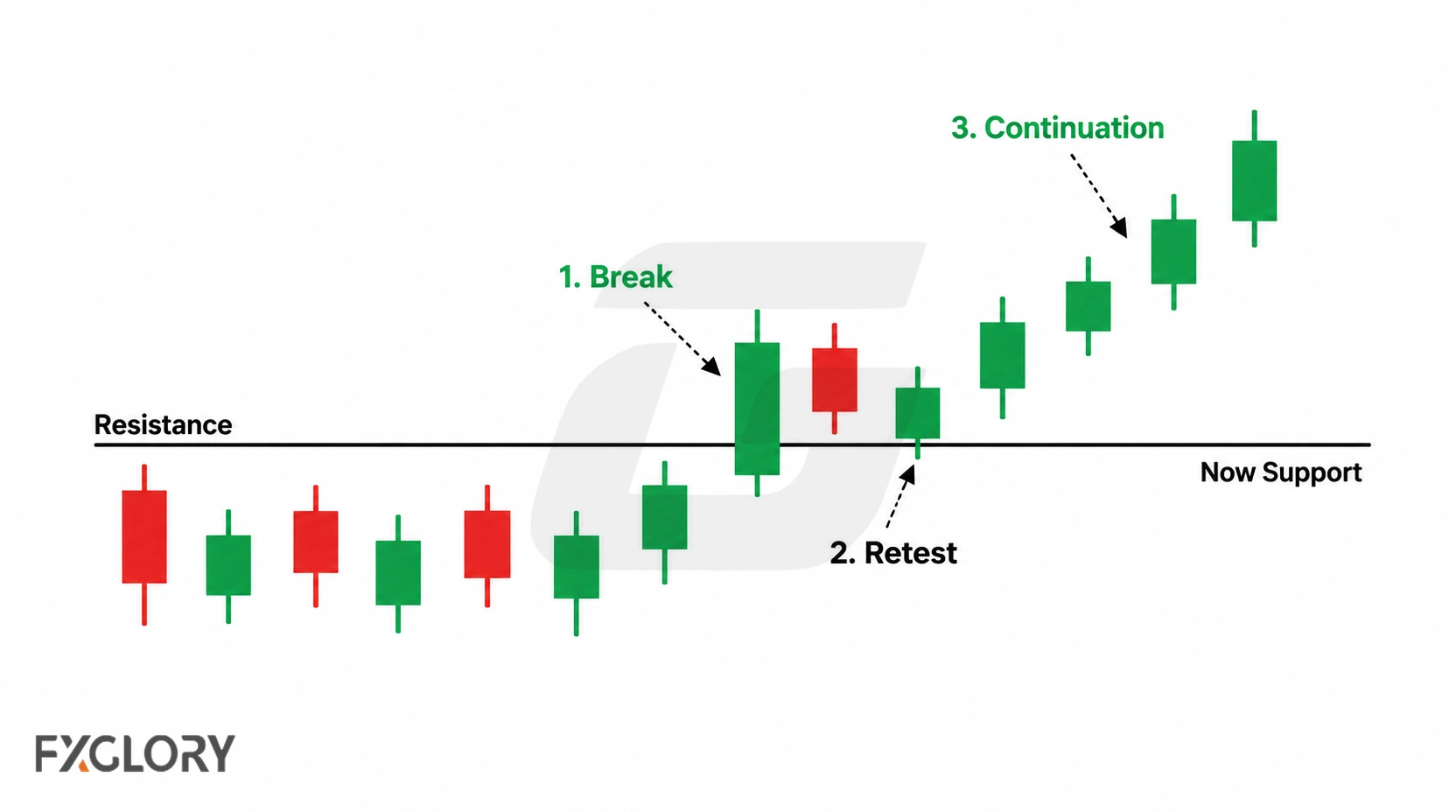
The retest matters because a breakout alone can be too early or too emotional. Price may break a level and keep moving, but it may also reverse quickly and turn into a fakeout. Waiting for a retest gives the trader a chance to see whether the broken level is accepted by the market or rejected back into the old structure.
For breakout types beyond retest entries, use the wider forex breakout strategy guide. The break and retest method is useful only when the return to the broken level gives clearer entry, stop, and invalidation rules.
Breakout vs Retest vs Break And Retest
Breakout, retest, and break and retest are often used together, but they are not identical. Separating them helps prevent late entries and emotional rule changes.
| Term | Meaning | Main Risk |
|---|---|---|
| Breakout | Price moves beyond a support, resistance, range, trendline, or structure level | The break may fail quickly and return into the old area |
| Retest | Price returns to the broken level after the breakout | The retest may be shallow, messy, too deep, or never happen |
| Break and retest | The trader waits for the break, the return, and confirmation before entry | The trader may enter too early or treat every return as confirmation |
| Failed retest | Price cannot hold the new side of the broken level | The setup may become a fakeout or reversal instead of continuation |
A clean break and retest setup has three separate decisions: whether the original break is meaningful, whether the return respects the broken area, and whether the entry has clear invalidation.
Benefits And Limits Of Break And Retest Trading
A retest can give the trader a better-defined location than chasing the first breakout candle. It can also create missed trades, late entries, and false confidence if every return to a level is treated as confirmation.
| Potential Benefit | Practical Meaning | Limit To Control |
|---|---|---|
| Clearer entry area | The broken level gives a reference point for the entry decision | The level may not hold after the return |
| More defined invalidation | The retest can show where the setup is wrong | The stop may still be too wide for the account risk limit |
| Reduced chase behavior | The trader waits for price to come back instead of entering far from the level | The retest may never happen |
| Better fakeout filtering | A failed retest can warn that the breakout is not accepted | A deep retest can be hard to separate from a true failure |
| Useful across several structures | The method can apply to levels, trendlines, ranges, and swing structure | Each structure type must be tested separately |
How Role Reversal Works
Role reversal is the core idea behind many break and retest setups. In a bullish setup, old resistance may become new support after price breaks above it. In a bearish setup, old support may become new resistance after price breaks below it.
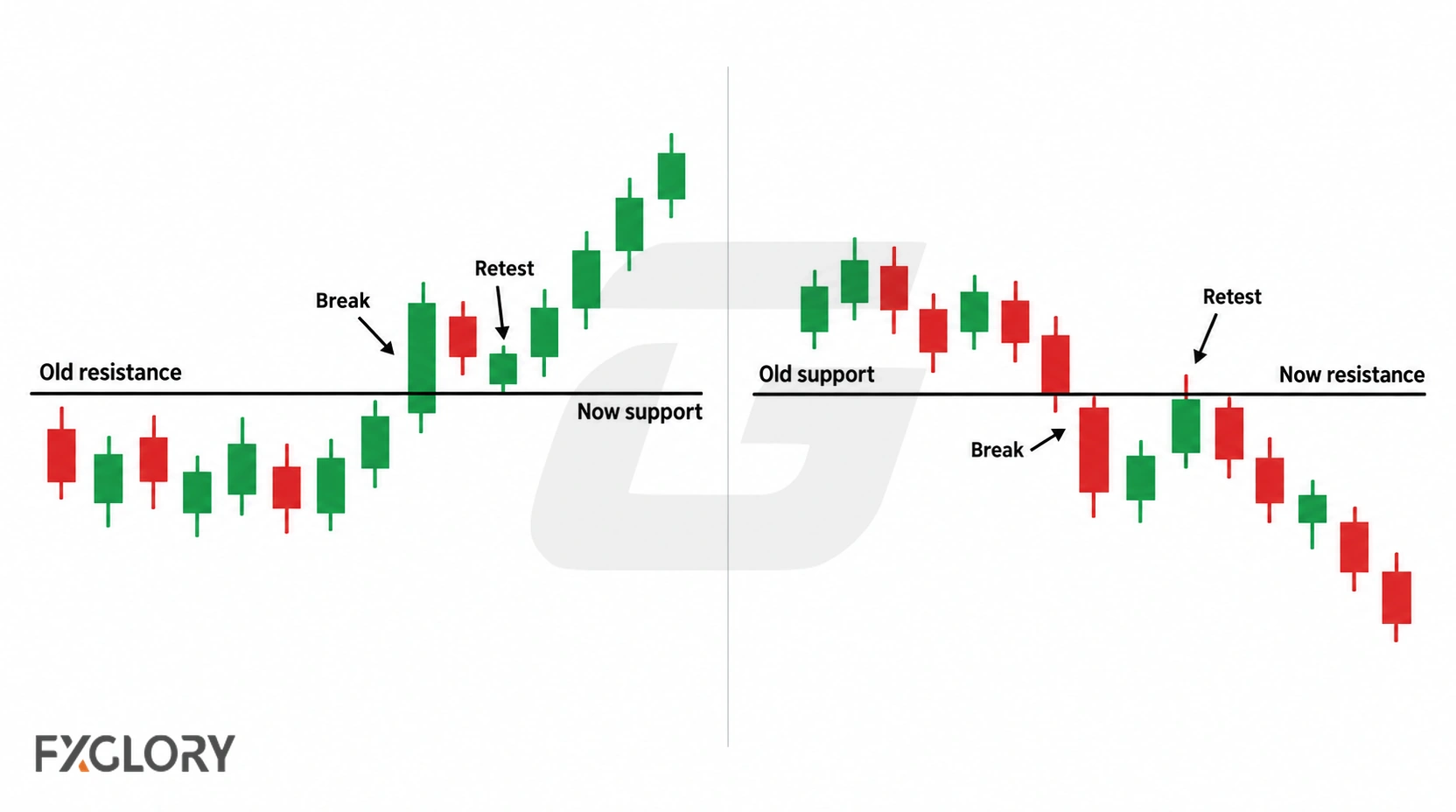
The level does not flip role just because price crossed it. The trader needs evidence that price has accepted the new side of the level. That evidence may come from rejection, a close that holds, a controlled retest, a failed move back into the old range, or a lower-timeframe structure shift that supports the continuation idea.
Use role reversal around broken support or resistance when the setup depends mainly on horizontal levels.
Break And Retest Rule Sequence
A break and retest setup should follow a fixed order. Starting with the retest candle before judging the level can lead to forced trades.
- Mark the level: identify support, resistance, trendline, range boundary, session range, or structure area before the break happens.
- Wait for a clean break: price should move beyond the level with enough clarity to separate a break from a small probe.
- Wait for the return: price should come back toward the broken level instead of being chased far away from it.
- Judge the retest quality: check whether the retest is clean, shallow, deep, messy, missed, or failed.
- Wait for confirmation: use rejection, close behavior, a structure shift, or a failed return into the old zone.
- Define invalidation: decide where the retest idea is wrong before entry.
- Check target room: the next support, resistance, swing, or range target should leave room after spread and slippage.
- Size the position: position size should be based on the stop distance and risk limit, not on confidence after the retest.
For the wider entry and exit sequence, use entry, stop, target, and invalidation rules.
Retest Decision Zone
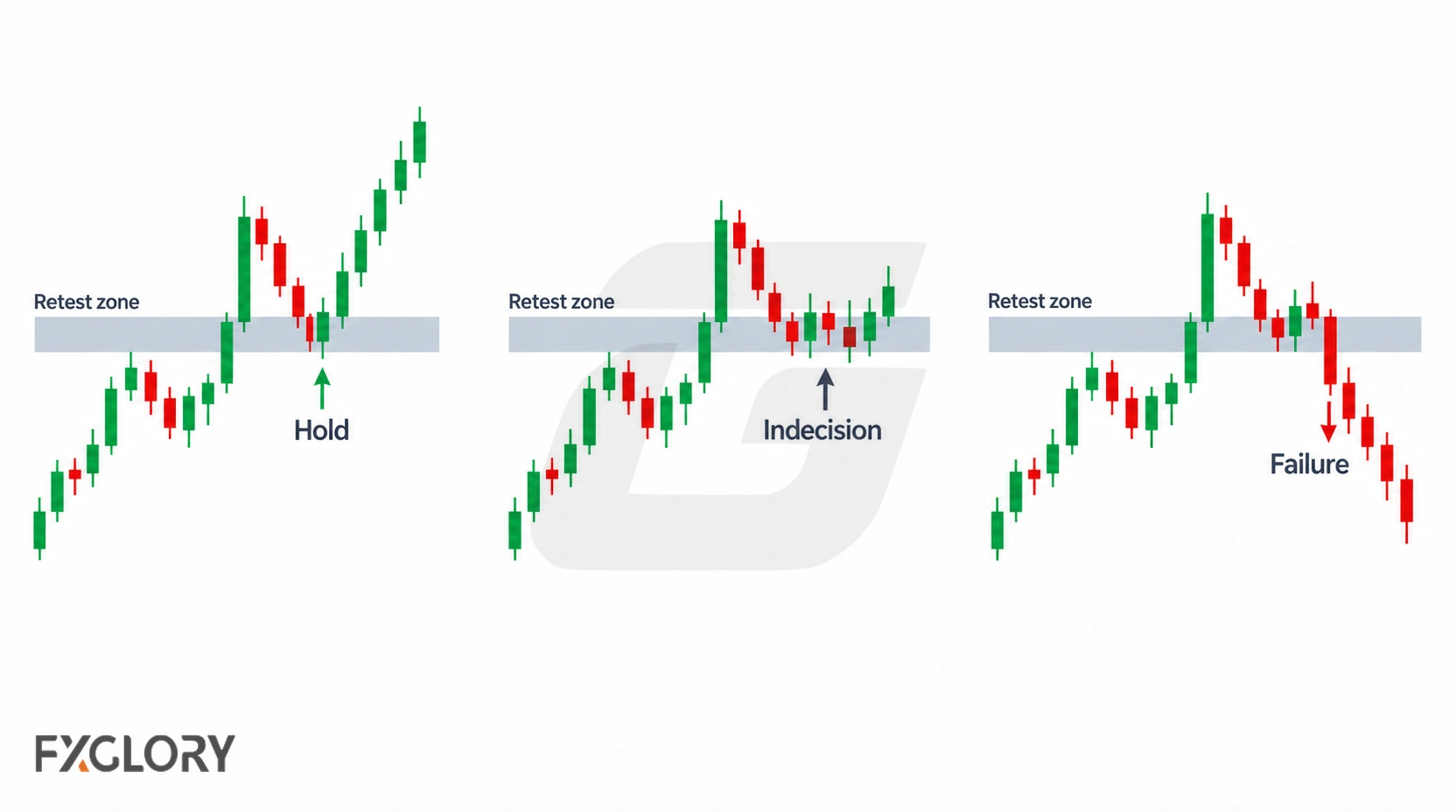
The retest decision zone is the area where the trader decides whether the broken level is being respected, rejected, or reclaimed by the old structure. It is not a single perfect line. In forex, spread, wick behavior, and short-term volatility can make the retest behave like a small zone rather than an exact touch.
| Zone Behavior | What It Suggests | Decision |
|---|---|---|
| Price returns to the zone and rejects it | The broken level may be respected | Review entry only if stop and target are clear |
| Price pauses but gives no direction | The retest is undecided | Wait; do not enter only because price reached the zone |
| Price overlaps the zone repeatedly | The level may be messy or weak | Skip unless structure becomes clear again |
| Price accepts back inside the old range | The breakout may have failed | Cancel the continuation setup |
| Price never returns to the zone | No retest has formed | Avoid chasing unless another written strategy applies |
Types Of Break And Retest Setups
Break and retest setups can appear around different structures. The logic is similar, but the level type changes the way confirmation and invalidation should be judged.
| Setup Type | How It Forms | What To Confirm | Main Risk |
|---|---|---|---|
| Support and resistance retest | Price breaks a horizontal level and returns to it | Old resistance holds as support, or old support holds as resistance | The level was weak or too obvious, creating a fakeout |
| Trendline break and retest | Price breaks a trendline and returns to test it from the other side | The trendline area rejects price after the break | The trendline is drawn loosely or adjusted after the move |
| Break of structure retest | Price breaks a prior swing high or low and returns to the structure area | The retest supports the new directional structure | A small lower-timeframe break conflicts with higher-timeframe context |
| Range or box retest | Price breaks a range boundary and returns to the edge | The old range edge holds after the break | Price returns into the range and traps breakout entries |
| Session range retest | Price breaks a planned session range and retests the boundary | The retest holds during active market conditions | Session volatility creates a quick fakeout |
Use price-action confirmation at the retest when the setup depends on candle behavior, rejection, failed continuation, or structure shift.
Trendline Break And Retest
A trendline break and retest uses a diagonal structure instead of a horizontal level. The trendline should be drawn from clear swing points before the break happens. If the line is adjusted after price moves, the setup becomes subjective.
In an uptrend, a bearish trendline break and retest may form when price breaks below the rising trendline and then returns to test it from underneath. In a downtrend, a bullish version may form when price breaks above a falling trendline and then returns to test it from above.
- Do not use a trendline retest if the line has only been drawn after the break.
- Do not force a diagonal line through messy price action.
- Do not ignore nearby horizontal support or resistance.
- Do not enter on the retest unless the stop and invalidation are clear.
A trendline retest is stronger when horizontal structure, swing behavior, or higher-timeframe context also supports the level. Use trend context before treating a trendline break as a structure change.
Break Of Structure Retest
A break of structure retest focuses on swing behavior. Price breaks a prior swing high or swing low, then returns to the structure area to test whether the new direction is being accepted.
A bullish break of structure may form when price breaks a prior swing high and later retests the broken swing area. A bearish version may form when price breaks a prior swing low and later retests the broken area from below.
The key risk is timeframe conflict. A lower-timeframe break of structure may look clean while the higher timeframe remains inside a range or near a major obstacle. The trader should decide which timeframe controls the trade idea before entry.
Use multiple time frame analysis when the break, retest, and entry do not belong to the same chart.
Clean Retest vs Weak Retest vs Failed Retest
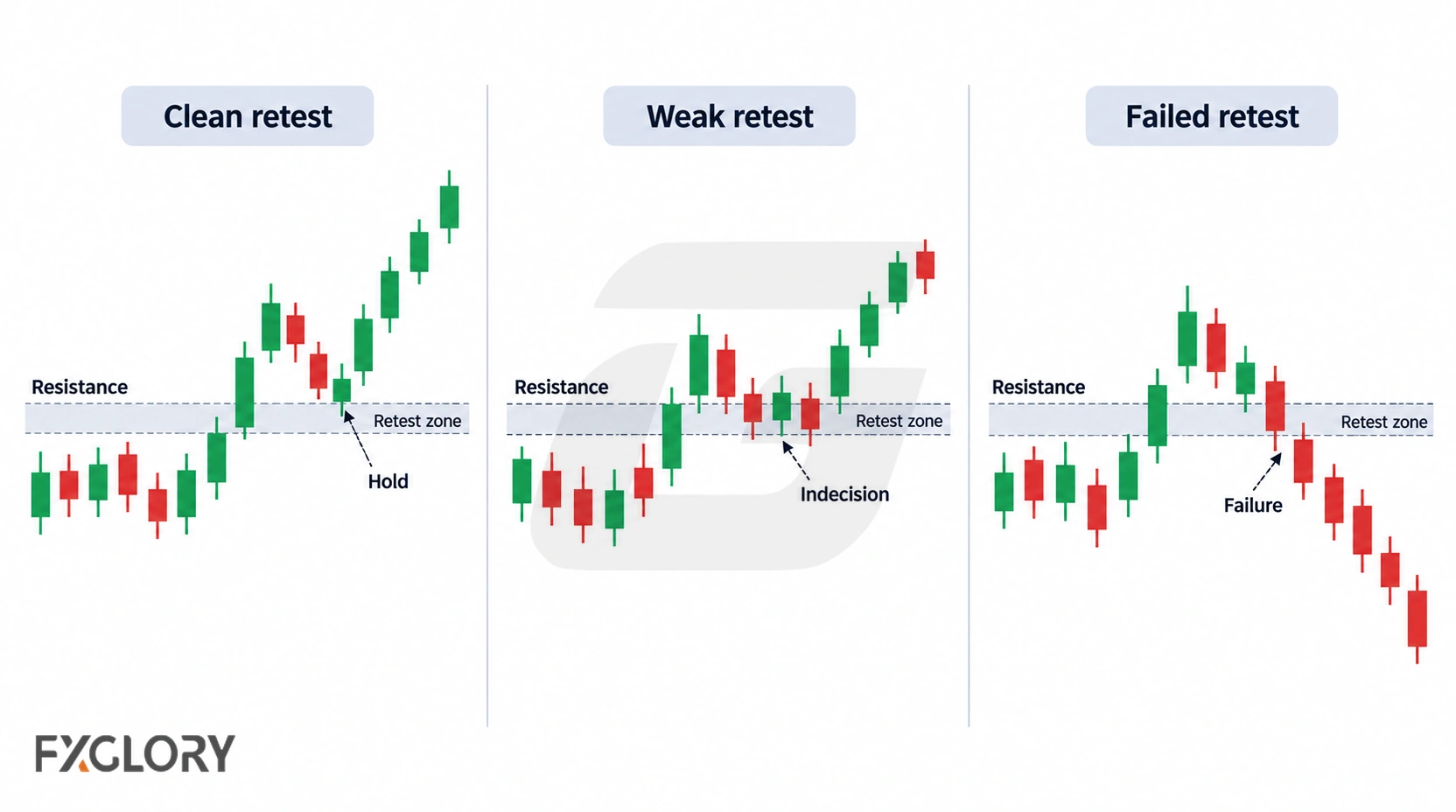
The quality of the retest is often more important than the breakout itself. A trader should not treat every return to a broken level as a valid entry.
| Retest Type | What It Looks Like | Possible Decision |
|---|---|---|
| Clean retest | Price returns to the broken area, rejects it, and holds the new side | Review entry only if invalidation and target room are clear |
| Shallow retest | Price returns near the level but does not fully touch it | Wait for confirmation; avoid chasing if stop logic is unclear |
| Deep retest | Price pushes beyond the level but then recovers the new side | Check whether it is a sweep or a true failure |
| Messy retest | Price overlaps the level repeatedly without clear rejection | Skip unless structure becomes clear again |
| No retest | Price breaks and continues without returning | Avoid chasing unless a separate strategy allows continuation entry |
| Failed retest | Price returns through the broken level and accepts the old range again | Cancel the continuation setup; reassess for fakeout conditions |
Retest Confirmation Methods
Retest confirmation is the evidence that the broken level is still relevant after price returns to it. Confirmation should support the setup; it should not replace stop placement or risk control.
| Confirmation Type | What It Shows | Weak Version |
|---|---|---|
| Rejection wick | Price tested the level and failed to hold beyond it | A long wick that appears away from the broken area |
| Close beyond the level | Price holds the new side after the retest | A close with poor target room before the next obstacle |
| Engulfing or strong candle | Momentum returns after the retest | A large candle that enters too late after the move |
| Lower-timeframe structure shift | Short-term price behavior supports continuation | A tiny shift that conflicts with higher-timeframe structure |
| Fibonacci, moving average, or pivot support | A secondary tool aligns with the retest zone | The tool becomes the reason for entry instead of the broken level |
Fibonacci, moving averages, or pivots can support the zone only when the broken level remains the main reason for the trade. If the level is weak, a secondary tool should not be used to force the setup.
Volume-style confirmation should be handled carefully in spot forex because there is no single centralized exchange volume feed. Platform or tick volume may provide context, but it should not be treated as complete market volume or as proof that the retest must hold.
Bullish And Bearish Example Flow
The following examples show the decision sequence only. They are not trading signals or recommendations.
| Example Step | Bullish Retest Flow | Bearish Retest Flow |
|---|---|---|
| Level | EUR/USD is capped by a clear resistance area | GBP/USD is supported by a clear support area |
| Break | Price closes above resistance | Price closes below support |
| Return | Price pulls back toward the broken resistance | Price pulls back toward the broken support |
| Retest decision | The old resistance area holds as support | The old support area holds as resistance |
| Invalidation | Price accepts back below the retest area | Price accepts back above the retest area |
| Target review | Next resistance must leave enough room after spread | Next support must leave enough room after spread |
On more volatile instruments such as gold, the same logic may need wider invalidation and stricter position sizing because wick movement and stop distance can be larger. The level, not the instrument name, should define whether the setup is valid.
Entry, Stop, Target, And Partial Exit Rules
The entry should come after the retest gives enough information to define invalidation. A trader should not enter only because price touched the broken level.
| Rule | Bullish Break And Retest Example | Bearish Break And Retest Example |
|---|---|---|
| Entry | Price breaks resistance, retests it as support, and confirms rejection | Price breaks support, retests it as resistance, and confirms rejection |
| Invalidation | Price accepts back below the broken resistance area | Price accepts back above the broken support area |
| Stop | Below the retest structure, wick, or level zone | Above the retest structure, wick, or level zone |
| Target | Next resistance, prior swing high, measured range, or continuation level | Next support, prior swing low, measured range, or continuation level |
| Partial exit | Optional reduction near first obstacle if the plan allows it | Optional reduction near first obstacle if the plan allows it |
A partial exit or first target should be planned before entry. If the first obstacle is too close, the setup may not offer enough room after spread and slippage. Position size should be calculated after the retest stop distance is known. Use position size after the retest stop is known before live testing.
Timeframe, Session, Spread, And News Checks
Break and retest setups can appear on many timeframes. Higher timeframes may show cleaner levels, while lower timeframes can offer earlier entries but more noise. The trader should decide which chart defines the level and which chart defines the entry.
- Timeframe: the level should be clear on the chart used for decision-making.
- Higher-timeframe context: the retest should not conflict with a stronger nearby level.
- Session: the pair should have enough activity for the setup type.
- Spread: the planned target should still make sense after spread cost.
- Slippage: fast movement can change entry, stop, and target quality.
- News: scheduled events can turn a clean retest into a fast fakeout.
- Margin: position size should fit the account after the stop distance is known.
Review spread conditions before low-timeframe retests, use the FXGlory margin calculator before adding live exposure, and check scheduled-event risk around retests when the setup forms near important data releases.
Common Break And Retest Mistakes
Most break and retest mistakes come from treating the retest as permission instead of evidence. The return to the level is only useful if it helps define the trade and control risk.
- Chasing the breakout: entering far from the level before the retest happens.
- Buying or selling the touch: entering because price touched the broken level without confirmation.
- Redrawing the level after price moves: changing support, resistance, or trendline placement to fit the outcome.
- Calling every pullback a retest: using the label even when the original level was not clear before the break.
- Forcing weak levels: drawing support, resistance, or trendlines after the move has already happened.
- Ignoring failed retests: holding a continuation idea after price accepts back inside the old range.
- Using stops that are too tight: placing the stop where normal retest noise can trigger it.
- Using stops that are too wide: making the trade too large for the account risk limit.
- Ignoring spread: accepting a setup where the first target is too close after cost.
- Changing the plan after entry: turning a failed continuation trade into a reversal idea without written rules.
No-Trade Conditions
A break and retest strategy needs strong skip rules. Many broken levels do not deserve a trade.
- Skip if the original level is unclear or drawn after the breakout.
- Skip if the breakout is only a small probe through the level.
- Skip if the retest is messy and price overlaps the level repeatedly.
- Skip if price returns too deep and accepts back inside the old structure.
- Skip if the stop has no logical invalidation point.
- Skip if the first target is too close after spread and slippage.
- Skip if a news event can distort the retest.
- Skip if higher-timeframe structure conflicts with the setup.
- Skip if the trade is being taken only because the breakout was missed.
Backtesting Notes For Break And Retest Strategy Forex
This numerical review uses one hypothetical educational rule model: a daily horizontal level break-and-retest setup using a prior 50-day high or low, ATR-based breakout distance, a 10-candle retest window, retest candle confirmation, a 2R target comparison, a level-failure exit, and spread/slippage sensitivity. It does not test every type of trendline retest, session range retest, break-of-structure retest, box retest, or discretionary price-action confirmation.
The model reviews EURUSD, GBPUSD, USDJPY, AUDUSD, USDCAD, and USDCHF on daily candles using public yfinance OHLC data where available. The broken level is defined before the signal using the highest high or lowest low of the previous 50 completed daily candles.
| Rule Area | Educational Model Rule |
|---|---|
| Structure type | Horizontal 50-day support or resistance level |
| Long breakout level | Highest high of the previous 50 completed daily candles |
| Short breakout level | Lowest low of the previous 50 completed daily candles |
| Clean break filter | Breakout close must be at least 0.10 ATR(14) beyond the level and no more than 1.25 ATR(14) beyond it |
| Retest window | Retest must occur within 10 daily candles after the breakout candle |
| Retest zone | 0.15 ATR(14) around the broken level |
| Long confirmation | Retest candle trades into the zone, closes above the broken level, and closes above its open |
| Short confirmation | Retest candle trades into the zone, closes below the broken level, and closes below its open |
| Entry | Next daily open after the retest confirmation candle |
| Stop | Beyond the retest candle extreme with a 0.25 ATR(14) buffer |
| Target comparison | Fixed 2R target from entry |
| Failure exit | Exit at daily close if price closes back through the broken level after entry |
| Maximum holding review | 25 daily candles after entry |
The review records trade count, win rate, average win in R, average loss in R, expectancy in R, profit factor, maximum drawdown in R, worst losing streak, average holding period, pair-level behavior, direction-level behavior, exit reasons, and spread/slippage sensitivity.
| Cost Input | Assumptions Used |
|---|---|
| Spread | 0.5, 1.5, and 3.0 pips |
| Slippage | 0.1, 0.5, and 1.0 pips per side |
| Baseline comparison | 1.5-pip spread and 0.5-pip slippage per side |
| Swap and rollover | Not included |
Educational Sensitivity-Test Results
The supplied Python output completed a hypothetical educational backtest for the daily 50-day level break-retest model from 2016-06-29 to 2026-06-29. Under the baseline cost assumption of 1.5-pip spread and 0.5-pip slippage per side, the baseline result was negative. These figures are for studying risk behavior and rule sensitivity, not for proving future live-trading performance.
| Metric | Baseline Result |
|---|---|
| Number of trades | 98 |
| Win rate | 18.37% |
| Average win | 1.6132R |
| Average loss | -0.8470R |
| Expectancy | -0.3951R |
| Profit factor | 0.4285 |
| Maximum drawdown | -37.7186R |
| Worst losing streak | 15 |
| Average holding period | 2.97 daily candles |
| Median holding period | 1.00 daily candles |
| Total net result | -38.7201R |
Pair-Level Baseline Results
| Pair | Trades | Win Rate | Expectancy | Profit Factor | Max Drawdown | Total Net Result |
|---|---|---|---|---|---|---|
| AUDUSD | 21 | 14.29% | -0.5792R | 0.2452 | -11.1795R | -12.1628R |
| EURUSD | 15 | 20.00% | -0.5245R | 0.3504 | -8.1247R | -7.8677R |
| GBPUSD | 22 | 13.64% | -0.4311R | 0.3821 | -10.3943R | -9.4833R |
| USDCAD | 14 | 28.57% | -0.1008R | 0.8412 | -4.3162R | -1.4119R |
| USDCHF | 10 | 20.00% | -0.2467R | 0.5882 | -3.0424R | -2.4674R |
| USDJPY | 16 | 18.75% | -0.3329R | 0.4275 | -4.8869R | -5.3270R |
Direction-Level Baseline Results
| Direction | Trades | Win Rate | Expectancy | Profit Factor | Max Drawdown | Total Net Result |
|---|---|---|---|---|---|---|
| Long | 54 | 20.37% | -0.3415R | 0.4866 | -22.2521R | -18.4412R |
| Short | 44 | 15.91% | -0.4609R | 0.3630 | -20.1634R | -20.2788R |
Spread And Slippage Sensitivity
| Spread Pips | Slippage Pips Per Side | Trades | Win Rate | Expectancy | Profit Factor | Max Drawdown | Total Net Result |
|---|---|---|---|---|---|---|---|
| 0.5 | 0.1 | 98 | 19.39% | -0.3378R | 0.4772 | -32.1948R | -33.1040R |
| 0.5 | 0.5 | 98 | 19.39% | -0.3633R | 0.4547 | -34.6498R | -35.6000R |
| 0.5 | 1.0 | 98 | 18.37% | -0.3951R | 0.4285 | -37.7186R | -38.7201R |
| 1.5 | 0.1 | 98 | 19.39% | -0.3696R | 0.4493 | -35.2636R | -36.2240R |
| 1.5 | 0.5 | 98 | 18.37% | -0.3951R | 0.4285 | -37.7186R | -38.7201R |
| 1.5 | 1.0 | 98 | 18.37% | -0.4269R | 0.4044 | -40.7874R | -41.8401R |
| 3.0 | 0.1 | 98 | 18.37% | -0.4174R | 0.4115 | -39.8667R | -40.9041R |
| 3.0 | 0.5 | 98 | 17.35% | -0.4429R | 0.3931 | -42.3282R | -43.4002R |
| 3.0 | 1.0 | 98 | 17.35% | -0.4747R | 0.3717 | -45.4302R | -46.5202R |
Exit Reason Counts
| Exit Reason | Count |
|---|---|
| level failure close | 22 |
| stop first same bar | 4 |
| stop loss | 54 |
| target 2r | 15 |
| time exit | 3 |
Testing And Review Checklist
Break and retest strategies should be tested by setup type. Test each retest type separately because a horizontal level retest does not behave the same as a trendline or swing-structure retest.
- Choose the structure: support and resistance, trendline, range boundary, session range, or break of structure.
- Define the break: decide what counts as a clean break before reviewing examples.
- Classify the retest: clean, shallow, deep, messy, no retest, or failed retest.
- Write the confirmation: rejection, close, candle behavior, structure shift, or failed return.
- Write invalidation: the price or structure that cancels the retest idea.
- Record costs: spread, slippage, holding cost, and target room.
- Record no-trades: missed retests, messy retests, and failed retests should be reviewed too.
- Record mistake tags: chased breakout, late entry, weak level, redrawn level, poor target room, ignored news, or emotional rule change.
- Review enough examples: collect at least 30 to 50 examples per retest type before drawing conclusions, without treating past samples as proof of future results.
- Review execution: entry timing, stop placement, partial exits, emotional errors, and rule changes.