

What Is A Forex Correlation Strategy?
A forex correlation strategy is a method for reviewing how two or more currency pairs have moved in relation to each other. The trader uses that relationship to check exposure, confirm a view, avoid duplicate risk, review hedging logic, or decide that a trade should be skipped.
Correlation does not say that one pair must follow another. It only describes how pairs have behaved over a selected period. A correlation reading should be checked with the timeframe, current market condition, trade direction, position size, cost, margin, and exit rule before it affects a decision.
For example, two positions on pairs that have often moved together may behave like a larger version of the same idea. Two positions on pairs that have often moved in opposite directions may partially cancel each other, but they can also create hedge cost, exit complexity, and false confidence if the relationship changes.
Correlation Is Not A Signal By Itself
A correlation reading can describe a relationship between pairs, but it does not decide whether either pair should be traded. A strong positive or negative correlation can still appear in a weak setup, during unstable news conditions, or inside a market where spread and slippage make the idea unusable.
Correlation should be reviewed after the trader already knows what is being tested: duplicate exposure, confirmation, hedge logic, diversification, or divergence. If the purpose is unclear, the correlation reading can become a reason to force a trade.
| Correlation Use | Useful Question | Weak Use |
|---|---|---|
| Exposure review | Do these trades add similar currency risk? | Trader opens several pairs without seeing that they depend on the same currency move. |
| Confirmation | Does a related pair support the same market condition? | Trader treats confirmation as permission to increase size. |
| Hedging review | Does the second pair reduce a defined exposure? | Trader assumes the hedge works because two pairs once moved opposite each other. |
| Diversification | Are these positions genuinely different? | Trader thinks different pair names automatically mean diversified risk. |
| Divergence review | Has a usual relationship weakened or changed? | Trader trades convergence without a trigger, cost review, or invalidation rule. |
Correlation Does Not Explain Cause
A forex correlation reading shows that two pairs moved together, moved apart, or moved in opposite directions during the measured period. It does not prove why that relationship happened. The cause may be shared USD exposure, a central-bank theme, commodity prices, risk sentiment, session flow, or a temporary event.
This distinction matters because a trader can see a high coefficient and still misunderstand the trade. If the relationship exists because both pairs are reacting to the same USD move, the account may already be concentrated in one currency theme. If the relationship exists because of a short-lived news event, the reading may fade after the event is digested.
| Correlation Reading | Possible Cause | Risk If Ignored |
|---|---|---|
| Two USD-quoted pairs rise together | Broad USD weakness may be driving both pairs | Trader treats duplicated dollar exposure as diversification |
| A commodity-linked currency pair follows a commodity move | Commodity sensitivity, risk sentiment, or local data may be involved | Trader assumes the link is permanent |
| Pairs move together only during one session | Session liquidity or a short-term order-flow theme may be active | Trader applies an intraday relationship to a longer holding plan |
| A usually correlated pair disconnects | Local news, central-bank repricing, or a changing macro theme may be present | Trader expects automatic convergence without a valid trigger |
Positive And Negative Forex Correlation
Positive correlation means two currency pairs have tended to move in the same direction over the selected period. Negative correlation means they have tended to move in opposite directions over the selected period.
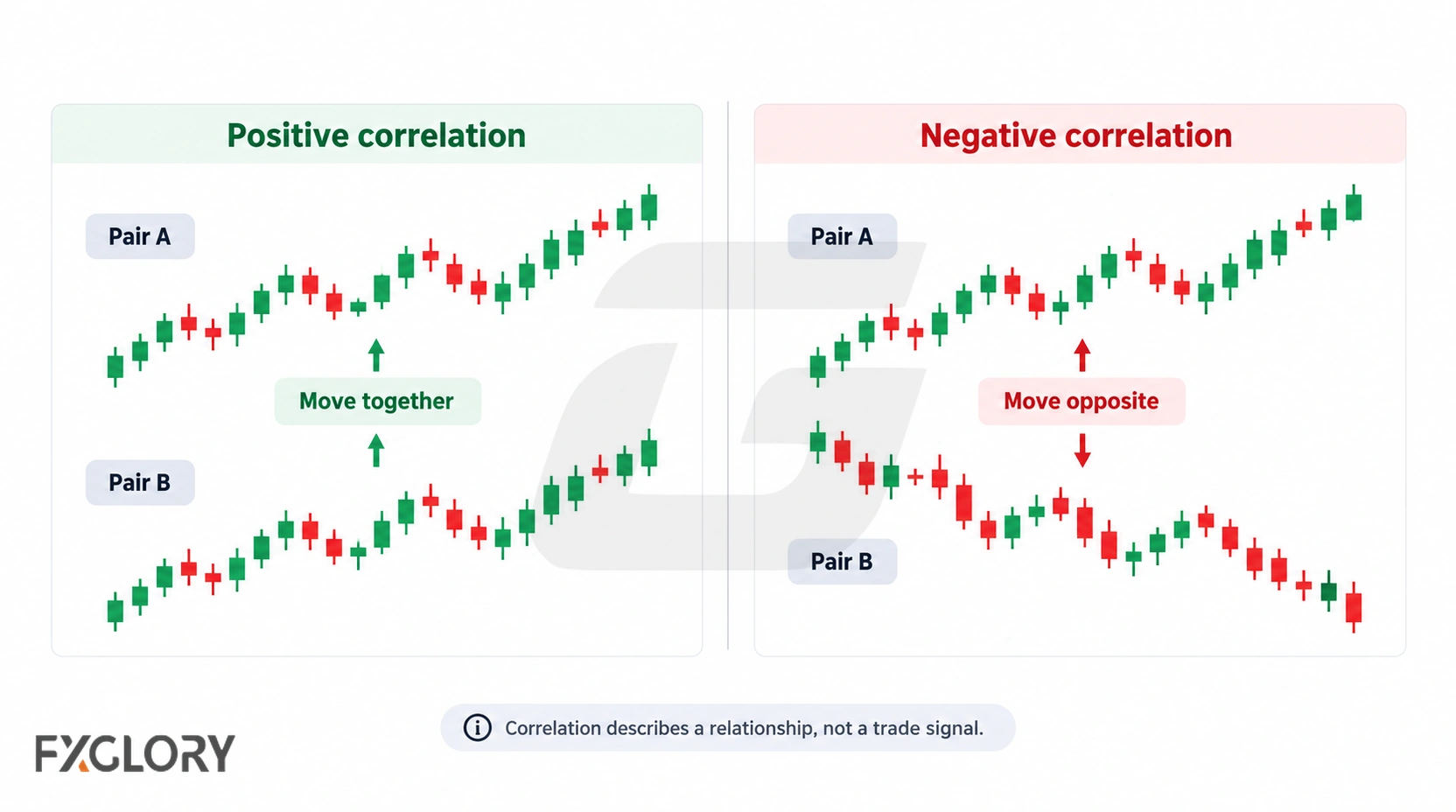
The direction of the trade matters. A positive correlation between two pairs does not create the same exposure in every order direction. Buying both positively correlated pairs can add similar directional risk. Buying one and selling the other can partially offset or distort the exposure.
| Correlation Type | Basic Meaning | Exposure Question |
|---|---|---|
| Positive correlation | Pairs have tended to move in the same direction. | Would two trades increase the same market idea? |
| Negative correlation | Pairs have tended to move in opposite directions. | Would one trade offset or conflict with the other? |
| Weak or unstable correlation | The relationship is inconsistent or low. | Is the relationship too weak to support the decision? |
| Changing correlation | The relationship differs across timeframes or market phases. | Is the old reading still relevant? |
Pair Direction And Currency Exposure
Correlation only becomes useful after the trader translates each position into currency exposure. A forex pair has a base currency and a quote currency. Buying a pair means buying the base currency and selling the quote currency. Selling a pair means selling the base currency and buying the quote currency.
This is why two correlated pairs can create different exposure depending on trade direction. A trader who buys EUR/USD and buys GBP/USD may be adding two USD-short ideas. A trader who buys EUR/USD and sells GBP/USD is not using the same exposure profile, even if the two pairs have often moved together.
| Position | Currency Exposure Created | Correlation Review |
|---|---|---|
| Buy EUR/USD | Long EUR and short USD | Check whether another trade also depends on USD weakness |
| Sell EUR/USD | Short EUR and long USD | Check whether another trade also depends on USD strength |
| Buy GBP/USD while already long EUR/USD | Adds another USD-short exposure | May duplicate a broad dollar view if the pairs are positively correlated |
| Buy EUR/USD while already long USD/CHF | Creates opposing USD exposure through different pair structures | May offset, distort, or complicate the account exposure |
How To Read A Correlation Coefficient
Correlation is often shown as a coefficient between -1 and +1, or as a percentage between -100% and +100%. A value near +1 means the pairs have moved very closely in the same direction during the measured period. A value near -1 means the pairs have moved very closely in opposite directions. For a commonly used Pearson correlation coefficient, a value near zero indicates little measured linear co-movement in the sample. It does not prove the pairs are independent or that no other relationship exists.
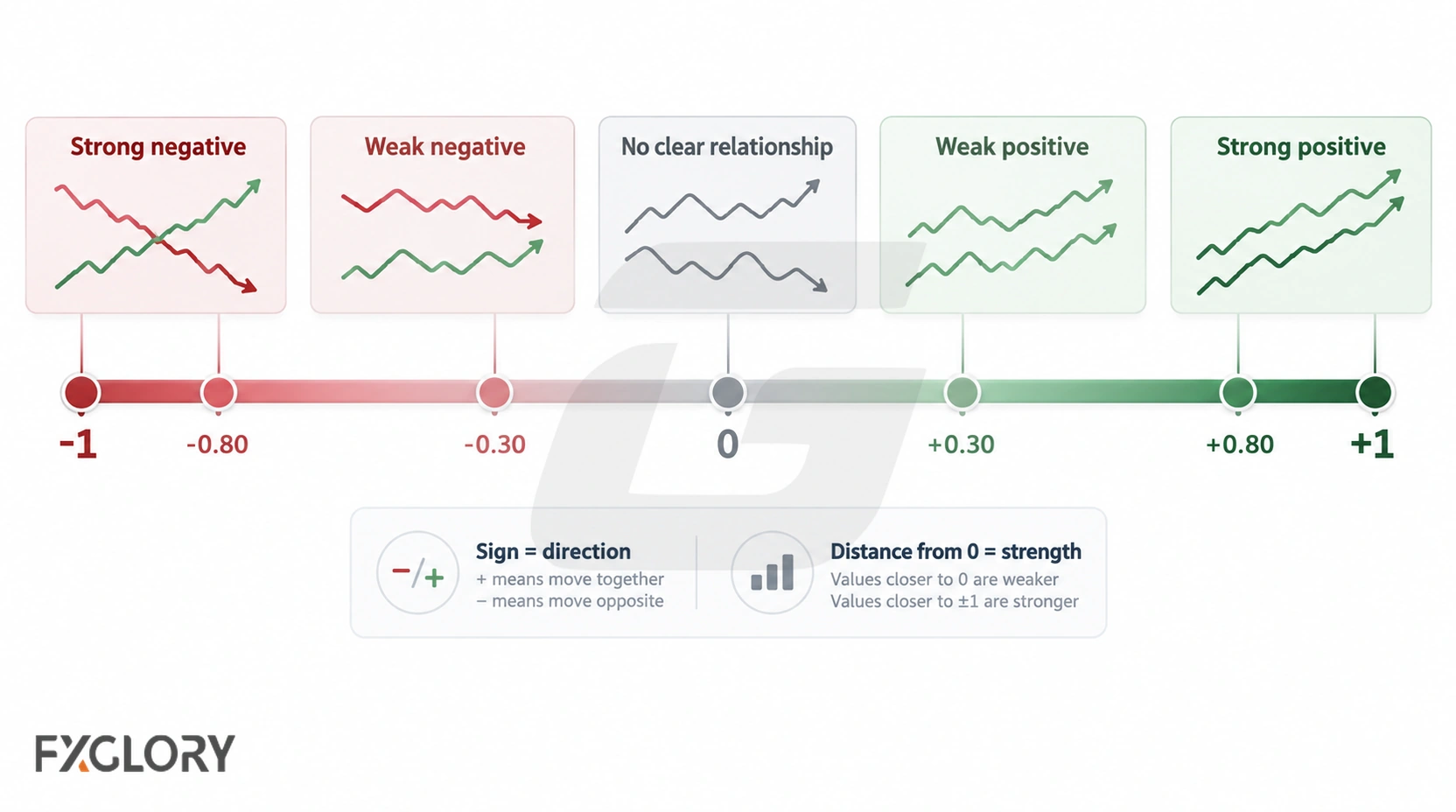
Some traders treat readings around +0.70 or -0.70 as stronger correlation zones. That threshold should be written before review starts, not chosen after the trade idea appears.
| Reading | Meaning | Risk Review |
|---|---|---|
| +0.80 or +80% | Strong positive relationship over the measured period | Similar-direction trades may duplicate exposure. |
| +0.30 or +30% | Weak positive relationship | The relationship may not be strong enough to support a strategy rule. |
| 0 or near zero | Little measured linear co-movement for Pearson correlation; other relationships may exist. | Pair names alone should not be treated as connected. |
| -0.30 or -30% | Weak negative relationship | Hedge or offset logic may be unreliable. |
| -0.80 or -80% | Strong negative relationship over the measured period | Opposite exposure may reduce or reshape risk, but not remove it. |
How To Read A Correlation Table
A correlation table or matrix compares multiple pairs over a selected timeframe. The reading is only useful if the trader knows which pair is being compared, which timeframe is used, how recent the sample is, and what action the reading is supposed to support.
The sample window also matters. A five-minute reading, one-hour reading, daily reading, weekly reading, and monthly reading can tell different stories. A short sample may react quickly but can be noisy. A long sample may smooth noise but can miss a recent regime change. The trader should choose the window before looking for confirmation.
Before a correlation table affects a trade, check whether it is being used for exposure control, confirmation, hedging, diversification, or divergence review. The same coefficient can lead to a different decision depending on position direction and existing exposure.
| Table Item | What To Check | Why It Matters |
|---|---|---|
| Pair 1 and pair 2 | The exact currency pairs being compared | Different pairs can share the same base, quote, or macro driver. |
| Timeframe | Intraday, daily, weekly, or another period | Correlation can change across timeframes. |
| Coefficient | Positive, negative, strong, weak, or unstable | The strength and direction decide how much weight the reading deserves. |
| Trade direction | Buy, sell, or no position on each pair | The same correlation can increase or reduce risk depending on direction. |
| Current market condition | Trend, range, news, risk sentiment, or liquidity condition | Market shifts can weaken old relationships. |
| Existing positions | Current exposure before adding another trade | Correlation should be reviewed at account level, not pair-by-pair only. |
Why Timeframe Matters
Forex correlation depends on the period being measured. Two pairs may look strongly related on a daily chart but disconnect during a short session, a central-bank event, or a sudden risk-sentiment move. The opposite can also happen: intraday pairs may move together during one session while the longer-term relationship remains weak.
The timeframe used for correlation should match the decision being reviewed. A short-term entry should not rely only on a long historical relationship, and a long-term exposure review should not be built only from a few intraday candles.
Correlation should also be refreshed when market conditions change. A central-bank surprise, commodity shock, major risk-off move, or local political event can weaken a relationship that looked stable in older data.
| Timeframe Issue | Possible Problem | Better Rule |
|---|---|---|
| Intraday correlation | Session flow or news can dominate the reading. | Use it only for short-term exposure review. |
| Daily correlation | May miss fast breaks in the relationship. | Check whether recent events changed the pair behavior. |
| Weekly or monthly correlation | Useful for broader exposure but slow to react. | Combine it with current market condition before adding risk. |
| Mixed-timeframe decision | Trader confirms a short-term trade with an unrelated long-term sample. | Define the correlation timeframe before reviewing the trade. |
For a wider process that separates higher-timeframe context from trade timing, use the trading-system framework for setup, trigger, invalidation, and review rules.
Common Forex Correlation Examples
Common pair examples can help explain correlation, but they should not be treated as fixed rules. EUR/USD and GBP/USD may often show positive correlation because both include USD as the quote currency and can react to broad dollar movement. EUR/USD and USD/CHF may often show negative correlation because USD sits on opposite sides of the pair structure and CHF can behave differently during risk events.
AUD/USD and NZD/USD may sometimes move together because both can be affected by regional, commodity, and risk-sentiment themes. USD/CAD can be affected by Canadian dollar behavior and oil-related context, while AUD/USD can sometimes reflect risk sentiment and commodity sensitivity. These relationships can weaken, strengthen, or reverse when local data, central banks, commodity prices, or broader risk conditions change.
| Example Relationship | Possible Reason Traders Review It | Caution |
|---|---|---|
| EUR/USD and GBP/USD | Both can respond to broad USD movement. | Eurozone and U.K. drivers can separate the pairs. |
| EUR/USD and USD/CHF | Often reviewed as a negative-correlation example. | CHF behavior can change during risk or central-bank events. |
| AUD/USD and NZD/USD | Both may react to regional or risk-sentiment themes. | Australia and New Zealand data can diverge. |
| USD/CAD and oil context | CAD can be sensitive to energy-market developments. | Oil is not the only driver of USD/CAD. |
| AUD/USD and gold or risk sentiment | AUD can be reviewed around commodity and risk themes. | Commodity links are not stable trading rules. |
For pair selection and available forex instruments, review the FXGlory currency-pairs market list.
How Correlation Changes Account Exposure
The most important use of correlation is not finding a pair that “moves like” another pair. The more important use is understanding what exposure the account already has before another trade is added.
Two trades on positively correlated pairs can create similar exposure even if the pair names are different. A trader who buys two strongly positive-correlated pairs may be taking one larger idea, not two independent ideas. A trader who buys one pair and sells another pair with a strong positive relationship may partially offset or confuse the exposure.
| Position Mix | Correlation Context | Possible Exposure Issue |
|---|---|---|
| Buy pair A and buy pair B | Strong positive correlation | Exposure may be duplicated. |
| Buy pair A and sell pair B | Strong positive correlation | Positions may partially conflict or cancel each other. |
| Buy pair A and buy pair B | Strong negative correlation | Positions may offset part of each other. |
| Buy pair A and sell pair B | Strong negative correlation | Exposure may become more concentrated than expected. |
| Several pairs share one currency | Mixed correlation readings | The account may be dominated by one currency theme. |
For account-level risk, use the risk-management process for size, drawdown, margin, and no-trade limits.
A Simple Correlation Exposure Example
Assume a trader already has a long EUR/USD position and is considering a long GBP/USD position. If both pairs are showing a strong positive correlation over the trader's chosen timeframe, the second trade may not be a separate idea. It may add another position that depends partly on USD weakness.
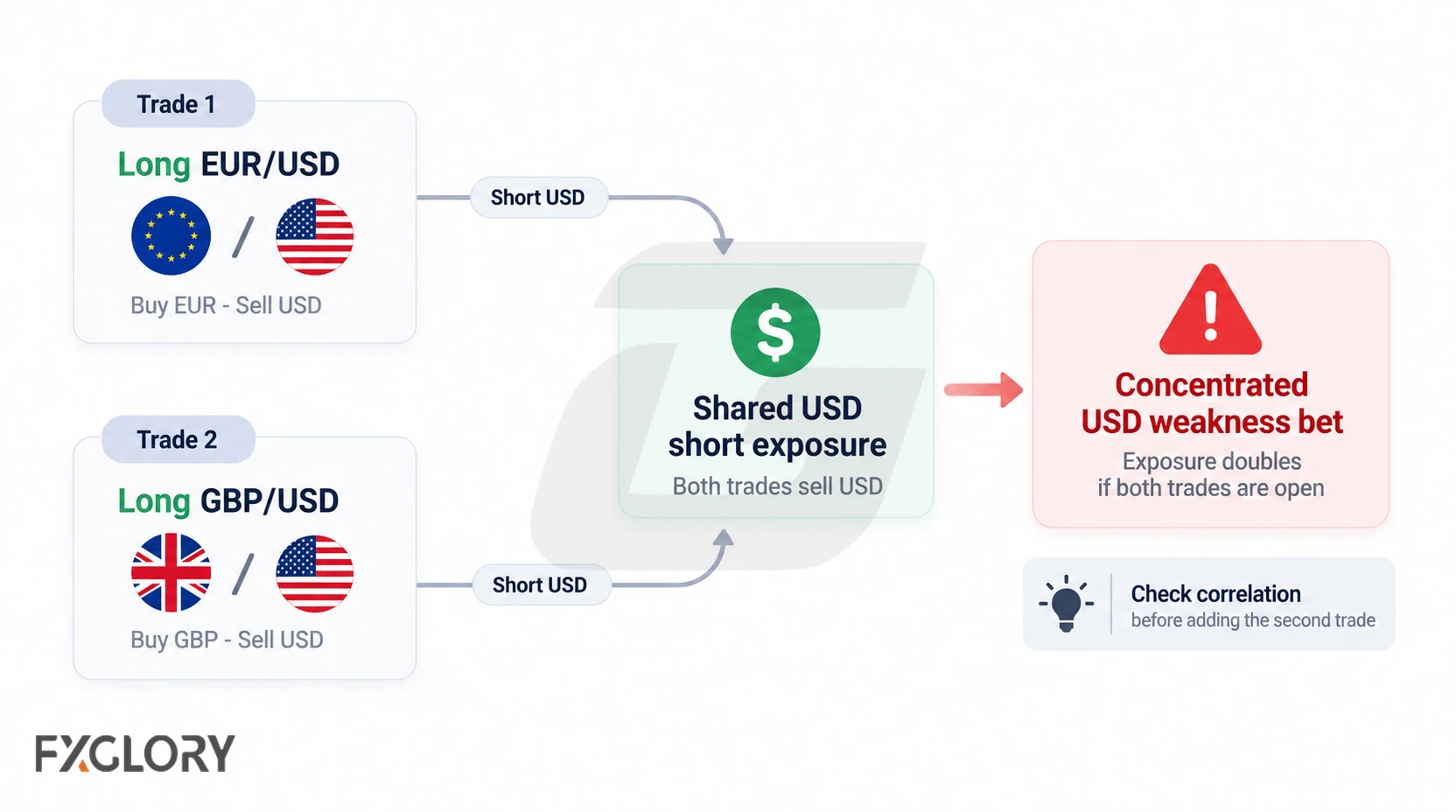
The review should happen before entry. The trader should check whether the account already has enough exposure to that theme, whether position size should be reduced, whether one pair gives a cleaner setup than the other, and whether the second trade only creates a larger version of the first risk.
| Review Step | Question | Possible Decision |
|---|---|---|
| Existing position | What currencies is the account already long and short? | Long EUR and short USD through EUR/USD |
| New idea | Does the new pair share the same driver? | Long GBP/USD may also depend on USD weakness |
| Correlation check | Is the relationship strong on the relevant timeframe? | Strong positive correlation may indicate duplicated exposure |
| Risk adjustment | Does the second trade require lower size, no entry, or replacing the first trade? | Reduce size, choose one cleaner setup, or skip |
| Exit review | What cancels the exposure idea? | Exit if USD strength invalidates both setups or if one pair breaks structure |
Using Correlation For Confirmation
Correlation can be used as a confirmation check, but confirmation does not make a trade safe. A trader may review whether a related pair is showing similar strength, weakness, breakout behavior, support or resistance reaction, or trend continuation. If the related pair does not support the idea, the trader may reduce confidence or skip the trade.
Confirmation should not become duplication. Opening two full-size trades because both pairs support the same view can increase exposure instead of improving the setup.
| Confirmation Use | Useful Review | Risk |
|---|---|---|
| Trend support | A related pair supports the same broad direction. | Trader adds correlated exposure without reducing size. |
| Level reaction | A related pair also reacts near support or resistance. | Trader ignores that both positions can fail together. |
| Breakout check | A related pair confirms or rejects market participation. | Trader chases a late move after both pairs have already extended. |
| No-confirmation rule | The setup is skipped when related pairs disagree. | Trader keeps searching until one pair supports the desired trade. |
After correlation supports a review, trade execution still needs an entry, invalidation, target, and cancellation rule. Use the entry-and-exit framework for trigger and exit planning.
Using Correlation For Hedging
Correlation can support hedge planning when a trader wants to reduce or reshape exposure with another pair. A negatively correlated pair may be reviewed as a possible offset, while a positively correlated pair can also be used in a different direction depending on the position mix.
The hedge still needs its own size, cost, remaining-exposure review, margin check, and exit rule. A correlation-based hedge can fail if the relationship weakens, the cost is too high, or both pairs react to the same event in an unexpected way.
For hedge structure, direct same-pair hedge reality, partial hedges, cross-pair hedges, and hedge exit rules, use the forex hedging strategy guide.
Correlation And Diversification
Diversification in forex is not the same as opening several pair names. If the positions depend on the same currency, same risk theme, same central-bank expectation, or same commodity driver, the account may still be concentrated.
A correlation review can help traders avoid false diversification. The goal is not to collect many pairs. The goal is to understand whether the added position genuinely changes the risk profile or only increases the same exposure.
| Situation | Looks Diversified? | Correlation Review |
|---|---|---|
| Multiple USD-linked positions | Several pair names | Account may be mainly exposed to one USD theme. |
| Several commodity-sensitive pairs | Different currencies | Commodity or risk sentiment may still dominate. |
| Pairs with low historical correlation | Possibly more diversified | Check whether current events have changed the relationship. |
| Pairs with opposite correlation | May reduce directional exposure | Check whether cost and margin justify the offset. |
Correlation Divergence Review
Correlation divergence happens when pairs that usually move together start separating, or pairs that usually move opposite each other stop behaving that way. A divergence may mean one pair is leading, one pair is lagging, or the relationship itself has changed.
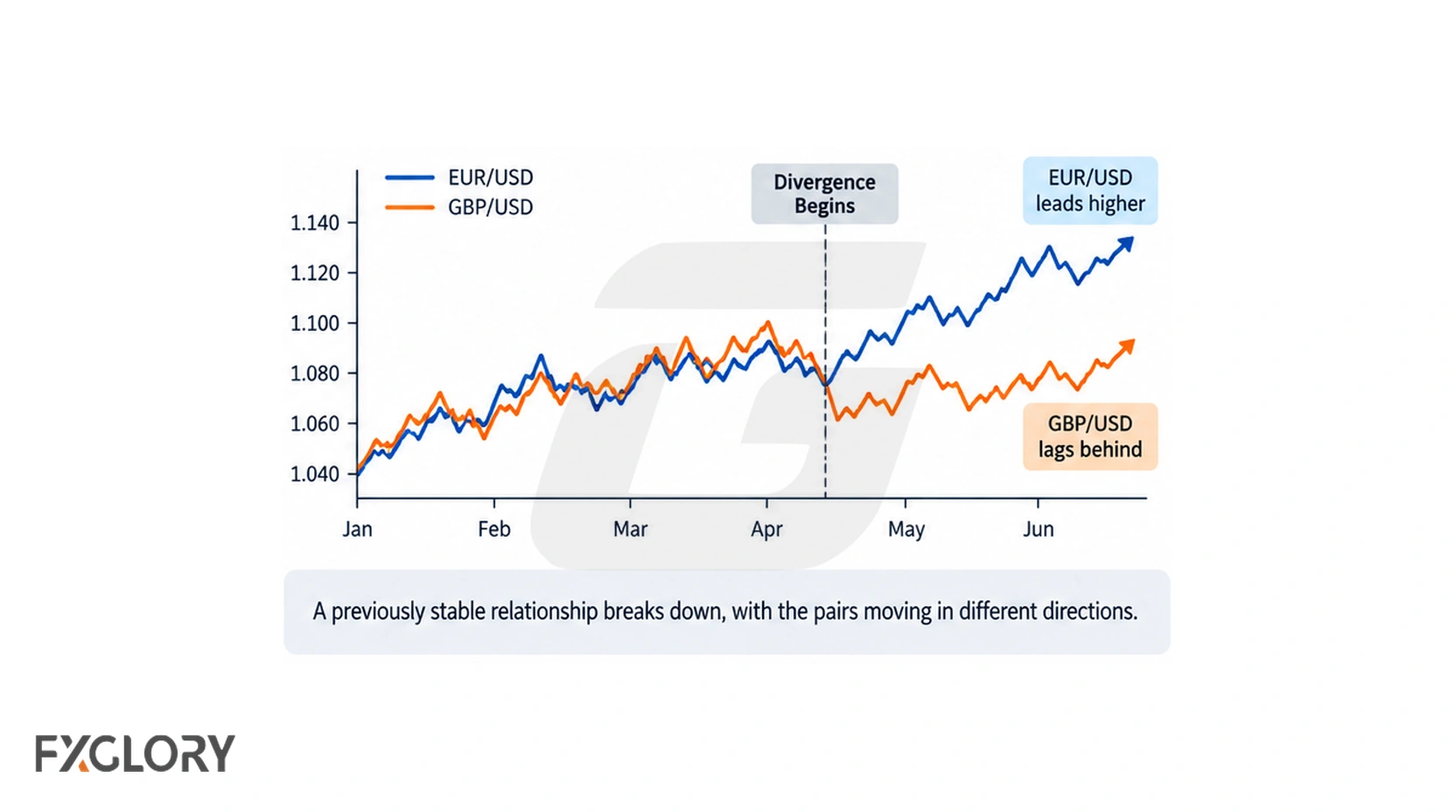
Divergence should not be treated as an automatic convergence trade. The trader still needs market context, a trigger, invalidation, target room, cost review, and a reason the relationship should matter in current conditions.
| Divergence Question | Why It Matters | Weak Use |
|---|---|---|
| Is the relationship normally strong? | Weak historical relationships may not matter. | Trader forces a divergence between unrelated pairs. |
| Has news changed the relationship? | Old correlation may no longer apply. | Trader expects reversion while the macro driver has changed. |
| Which pair is leading? | Leadership may show where pressure is strongest. | Trader assumes the lagging pair must catch up. |
| Is there a tradable trigger? | Divergence alone does not define entry or stop. | Trader enters before price gives a usable setup. |
When a divergence idea is based on price discrepancies instead of relationship review, compare it with the forex arbitrage guide for execution and cost risks.
Costs, Margin, And Leverage Checks
Correlation strategies often involve more than one pair. That means the trader should review the cost and account effect of the full position group, not only the chart logic.
Two correlated entries can create two spreads, two possible slippage points, higher margin use, more exposure under leverage, and more decisions during fast movement. A hedge or diversification idea can also become expensive if the expected benefit is small compared with the trading cost.
| Check | Question | Why It Matters |
|---|---|---|
| Spread | Are multiple entries adding unnecessary cost? | Correlation ideas can be damaged by stacked spreads. |
| Slippage | Can both pairs be executed near the planned prices? | Fast movement can distort the intended relationship. |
| Margin | Does the full group fit free margin and stop distance? | Several positions can strain the account together. |
| Leverage | Does correlated exposure increase loss speed? | Correlation does not reduce leverage risk. |
| Swap | Will overnight holding add cost on one or more legs? | Longer-held correlated positions may carry rollover cost. |
Before adding multiple correlated positions, review spread conditions that affect trade cost, use the margin calculator to estimate margin requirements, and check leverage conditions before increasing exposure.
Forex Correlation Decision Sequence
A correlation strategy should follow the same order each time. If the trader starts with a desired trade and searches for a correlation reading afterward, the review becomes biased.
| Step | Decision | Continue Only If |
|---|---|---|
| 1. Purpose | Exposure review, confirmation, hedge, diversification, or divergence | The reason for using correlation is clear. |
| 2. Pairs | The exact pair relationship is selected | The pairs are relevant to the account exposure. |
| 3. Timeframe | The correlation period is chosen before review | The timeframe matches the trade decision. |
| 4. Coefficient | The relationship is positive, negative, strong, weak, or unstable | The threshold was not chosen after seeing the result. |
| 5. Market condition | Trend, range, event risk, session, or macro condition is reviewed | Current conditions do not make the reading stale. |
| 6. Trade direction | Buy/sell direction is checked for each pair | The resulting exposure is understood. |
| 7. Cost and margin | Spread, slippage, swap, leverage, and margin are reviewed | The full group fits the account plan. |
| 8. Trigger and invalidation | Entry and failure rules are written | Correlation is not the only reason for entry. |
| 9. Exit or review rule | The condition for reducing, closing, or reassessing is defined | The position group will not be held after the reason disappears. |
| 10. No-trade rule | Skip conditions are written before risk is added | The trader is not forcing the correlation idea. |
When Correlation Strategies Fail
Correlation strategies often fail when traders treat historical relationships as future instructions. A relationship that looked strong in the table can weaken when central-bank expectations change, one currency receives local news, commodity prices shift, or risk sentiment changes.
| Failure Reason | What Happens | Better Rule |
|---|---|---|
| Old correlation data | The relationship no longer reflects current conditions. | Use recent data and compare it with market context. |
| Wrong timeframe | The sample does not match the trade horizon. | Use correlation readings that match the decision. |
| Duplicate exposure | Several trades behave like one large position. | Review account exposure before adding another pair. |
| False diversification | Different pair names still share the same risk driver. | Check currency, macro, and commodity overlap. |
| Correlation break | A usual relationship weakens or reverses. | Use exit or reassessment rules when the relationship changes. |
| Over-sizing after confirmation | Trader adds size because another pair agrees. | Confirmation should not override risk limits. |
| Hedge cost ignored | The offsetting trade adds cost and margin pressure. | Calculate remaining exposure and total cost before hedging. |
No-Trade Conditions
A correlation setup should be skipped when the relationship cannot support a clear decision or when the account risk becomes harder to control.
- Skip when the correlation data is stale or does not match the trade timeframe.
- Skip when the pair relationship is weak but the trader is treating it as strong.
- Skip when the trade duplicates existing exposure without a size adjustment.
- Skip when the trader cannot explain the remaining exposure after adding the position.
- Skip when spread, slippage, swap, margin, or leverage conditions make the group too costly or unstable.
- Skip when news, central-bank events, or commodity shocks can change the relationship quickly.
- Skip when the trade has no entry trigger, invalidation point, or exit rule outside the correlation reading.
- Skip when the position is being added only because another correlated pair already moved.
Testing And Review Before Live Trading
A forex correlation strategy should be reviewed on historical examples or demo conditions before real funds are used. The purpose is to test whether the same pair relationship, timeframe, coefficient threshold, exposure calculation, entry rule, exit rule, and no-trade rule can be followed repeatedly.
- Record the pair relationship and the reason it was reviewed.
- Record the timeframe and correlation coefficient before the trade decision.
- Record whether the correlation was positive, negative, strong, weak, or changing.
- Record all existing positions affected by the same currency or macro theme.
- Record trade direction on each pair and the exposure that remains after the position is added.
- Record spread, slippage, margin, leverage exposure, and swap if positions are held overnight.
- Record the entry trigger, invalidation point, exit rule, and no-trade rule.
- Record whether correlation strengthened, weakened, reversed, or stopped mattering during the trade.
- Review whether the decision followed the plan, not only whether the trade made or lost money.
Backtesting Notes For Forex Correlation Strategy
This hypothetical educational model uses one daily correlation rule: rolling 60-day return correlation, a stable confirmation-pair requirement, a completed-candle breakout candidate, correlated-exposure filtering, ATR-based stop placement, a 1.5R target comparison, range-failure and correlation-failure exits, and spread/slippage sensitivity. It does not test hedging, divergence reversion, pair trading, statistical arbitrage, multi-leg baskets, discretionary correlation-table review, or every possible correlated-pair relationship.
The model reviews EURUSD, GBPUSD, USDJPY, AUDUSD, USDCAD, and USDCHF on daily candles using public yfinance OHLC data where available. The confirmation pair is selected from the other reviewed pairs using the highest stable absolute rolling correlation available before the simulated entry.
Reproducibility detail: The recorded model specifies daily log returns, 60 completed observations for the main correlation, and comparison with the 60-day reading from 10 daily candles earlier. The supplied research summary does not name the coefficient estimator or describe how dates and missing return observations were aligned across pairs. Those implementation details should be checked against the archived Python script and trade log before attempting to reproduce the results; they should not be inferred from this summary.
| Rule Area | Educational Model Rule |
|---|---|
| Strategy type | Daily rolling-correlation confirmation with correlated-exposure filter |
| Correlation input | Daily log returns |
| Main correlation window | 60 completed daily return observations ending on the signal candle |
| Stability check | 60-day correlation from 10 daily candles earlier |
| Confirmation-pair threshold | Current absolute correlation at least 0.65, prior absolute correlation at least 0.50, and same correlation sign |
| Candidate setup | 20-day completed-candle range breakout with range width between 1.00 and 5.00 ATR(14) |
| Long candidate | Completed daily close 0.10 to 1.00 ATR(14) above the 20-day range high, with close in the upper 40% of the candle range |
| Short candidate | Completed daily close 0.10 to 1.00 ATR(14) below the 20-day range low, with close in the lower 40% of the candle range |
| Positive-correlation confirmation | Confirmation pair must move in the same required direction by at least 0.10 ATR(14) and close on the correct side of EMA(20) |
| Negative-correlation confirmation | Confirmation pair must move in the opposite required direction by at least 0.10 ATR(14) and close on the correct side of EMA(20) |
| Exposure filter | No overlapping same-pair trade and no overlapping accepted trade with at least 0.70 absolute rolling correlation that creates duplicated movement exposure |
| Entry | Next daily open after the completed signal candle |
| Stop | Beyond the signal candle extreme with a 0.25 ATR(14) buffer |
| Target comparison | Fixed 1.5R target from entry |
| Failure exits | Range-failure close or correlation-failure close after 5 holding candles |
| Maximum holding review | 20 daily candles after entry |
The review records candidate count, accepted trades, rejected candidates, rejection reasons, trade count, win rate, average win in R, average loss in R, expectancy in R, profit factor, maximum drawdown in R, worst losing streak, average holding period, pair-level behavior, direction-level behavior, correlation-sign behavior, confirmation-pair behavior, exit reasons, and spread/slippage sensitivity.
| Cost Input | Assumptions Used |
|---|---|
| Spread | 0.5, 1.5, and 3.0 pips |
| Slippage | 0.1, 0.5, and 1.0 pips per side |
| Baseline comparison | 1.5-pip spread and 0.5-pip slippage per side |
| Swap and rollover | Not included |
Educational Sensitivity-Test Results
The hypothetical educational backtest used public yfinance daily OHLC data from 2016-06-30 through 2026-06-30, with warmup data for indicators and rolling-correlation calculations. The baseline cost assumption was a 1.5-pip spread and 0.5-pip slippage per side. Swap and rollover were not included.
| Metric | Baseline Result |
|---|---|
| Candidate count | 80 |
| Accepted trades | 65 |
| Rejected candidates | 15 |
| Acceptance rate | 81.25% |
| Number of trades | 65 |
| Win rate | 13.85% |
| Average win | 1.3892R |
| Average loss | -0.6886R |
| Expectancy | -0.4009R |
| Profit factor | 0.3242 |
| Maximum drawdown | -27.6915R |
| Worst losing streak | 17 |
| Average holding period | 1.43 daily candles |
| Median holding period | 1.0 daily candles |
| Total net result | -26.0569R |
| Rejection Reason | Count |
|---|---|
| correlated movement exposure overlap | 13 |
| same pair overlap | 2 |
| Pair | Trades | Win Rate | Expectancy | Profit Factor | Max Drawdown | Total Net |
|---|---|---|---|---|---|---|
| EURUSD | 20 | 20.0% | -0.1642R | 0.6203 | -4.9818R | -3.2841R |
| GBPUSD | 6 | 0.0% | -0.8525R | 0.0 | -4.0881R | -5.1152R |
| USDJPY | 8 | 0.0% | -0.6702R | 0.0 | -5.3415R | -5.3613R |
| AUDUSD | 11 | 27.27% | -0.0932R | 0.8058 | -2.6771R | -1.0251R |
| USDCAD | 7 | 14.29% | -0.4056R | 0.3398 | -2.7738R | -2.8395R |
| USDCHF | 13 | 7.69% | -0.6486R | 0.1442 | -7.2883R | -8.4318R |
| Direction | Trades | Win Rate | Expectancy | Profit Factor | Max Drawdown | Total Net |
|---|---|---|---|---|---|---|
| long | 35 | 14.29% | -0.4375R | 0.3102 | -16.9435R | -15.3114R |
| short | 30 | 13.33% | -0.3582R | 0.3433 | -12.1218R | -10.7456R |
| Correlation Sign | Trades | Win Rate | Expectancy | Profit Factor | Max Drawdown | Total Net |
|---|---|---|---|---|---|---|
| negative | 38 | 13.16% | -0.4259R | 0.305 | -17.8368R | -16.1824R |
| positive | 27 | 14.81% | -0.3657R | 0.3536 | -11.2759R | -9.8745R |
| Confirmation Pair | Trades | Win Rate | Expectancy | Profit Factor | Max Drawdown | Total Net |
|---|---|---|---|---|---|---|
| AUDUSD | 8 | 12.5% | -0.3646R | 0.3338 | -3.2836R | -2.9169R |
| EURUSD | 20 | 0.0% | -0.8069R | 0.0 | -14.9948R | -16.1383R |
| GBPUSD | 11 | 27.27% | -0.0454R | 0.8885 | -2.4118R | -0.4992R |
| USDCAD | 5 | 20.0% | 0.0014R | 1.0049 | -1.353R | 0.0068R |
| USDCHF | 20 | 15.0% | -0.3965R | 0.3482 | -9.6085R | -7.9306R |
| USDJPY | 1 | 100.0% | 1.4212R | Infinity | 0.0R | 1.4212R |
Confirmation-pair interpretation: The six rows group the 65 accepted trades by which pair supplied confirmation, not by which pair was traded. USDJPY accounts for the single trade missing from a sum of the other five rows. Its 100% win rate and infinite profit factor follow from one winning trade with no recorded losing trade in that subgroup, not from demonstrated repeatability. The five USDCAD-confirmed trades produced only +0.0068R net; these small positive subgroups should not be confused with the negative results for all six traded-pair groups.
| Exit Reason | Count |
|---|---|
| range failure close | 24 |
| stop first same bar | 4 |
| stop loss | 28 |
| target 1 5r | 9 |
| Spread | Slippage Per Side | Trades | Expectancy | Profit Factor | Max Drawdown | Total Net |
|---|---|---|---|---|---|---|
| 0.5 pips | 0.1 pips | 65 | -0.3424R | 0.3731 | -24.168R | -22.2589R |
| 0.5 pips | 0.5 pips | 65 | -0.3684R | 0.3501 | -25.734R | -23.9469R |
| 0.5 pips | 1.0 pips | 65 | -0.4009R | 0.3242 | -27.6915R | -26.0569R |
| 1.5 pips | 0.1 pips | 65 | -0.3749R | 0.3448 | -26.1255R | -24.3689R |
| 1.5 pips | 0.5 pips | 65 | -0.4009R | 0.3242 | -27.6915R | -26.0569R |
| 1.5 pips | 1.0 pips | 65 | -0.4333R | 0.3006 | -29.649R | -28.167R |
| 3.0 pips | 0.1 pips | 65 | -0.4236R | 0.3075 | -29.0618R | -27.534R |
| 3.0 pips | 0.5 pips | 65 | -0.4496R | 0.2895 | -30.6278R | -29.222R |
| 3.0 pips | 1.0 pips | 65 | -0.482R | 0.2686 | -32.5853R | -31.332R |
What The Educational Backtest Shows
The baseline result was negative under the 1.5-pip spread and 0.5-pip slippage-per-side assumption: 65 trades, 13.85% win rate, -0.4009R expectancy, and -26.0569R total net result. This is a correlation-confirmation and exposure-filter observation from one hypothetical rule model, not proof of future live-trading performance.
The exposure filter rejected 15 candidates, including 13 correlated movement-exposure overlaps and 2 same-pair overlaps. The accepted set still had negative expectancy, so correlation confirmation did not remove breakout risk, cost risk, or relationship-change risk in this model.
All six traded-pair baseline groups were negative. The separate confirmation-pair grouping includes small positive totals for five USDCAD-confirmed trades and one USDJPY-confirmed trade, but neither subgroup establishes a reliable advantage. Both positive- and negative-correlation confirmation groups had negative aggregate results, as did every tested spread and slippage scenario.