
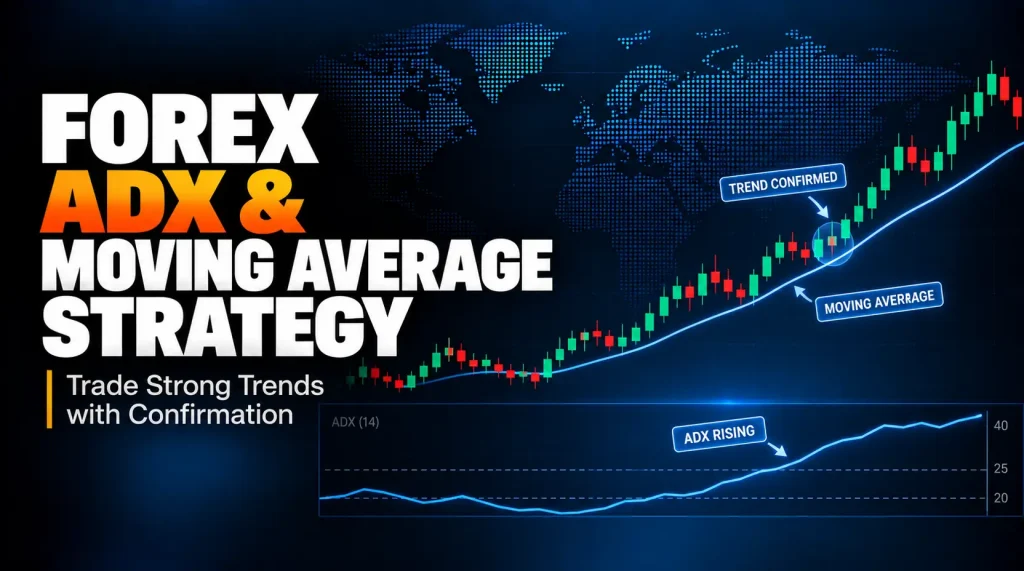
What Is An ADX And Moving Average Strategy?
An ADX and moving average strategy combines two different indicator roles. A moving average can help review trend direction, slope, price position, crossover behavior, or dynamic context. ADX helps review whether trend strength is worth attention.
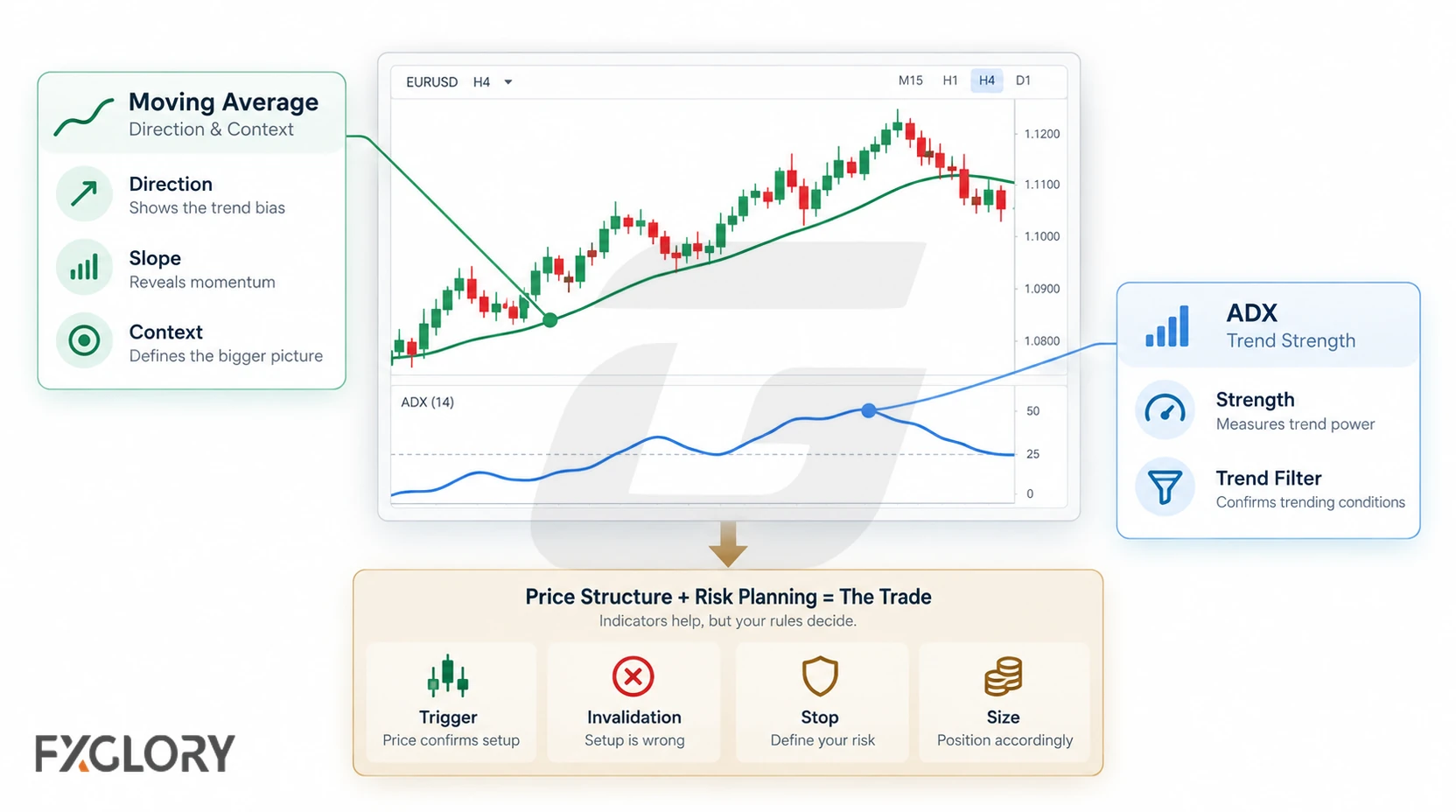
EMA, SMA, and other moving-average types can all be tested with ADX, but the role should stay the same: the average provides direction, slope, price-position, or crossover context, while ADX reviews trend strength. This page uses “moving average” as the broader category so EMA, SMA, and crossover variations do not need separate thin pages.
The combination is useful only when the roles stay separate. A moving average should not be treated as a complete trade signal, and ADX should not be used as direction by itself. Price structure still has to define the trade area, trigger, invalidation, stop distance, position size, exit logic, and review rule.
This page is not a general moving-average guide or a general ADX guide. It focuses only on how moving averages and ADX can work together inside one rule-based setup. For the broader pairing framework, use forex indicator combinations. For the parent indicator-strategy framework, use forex indicator strategies. For the broader moving-average strategy framework, use moving average forex strategy.
For ADX-specific rules, review ADX as a trend-strength filter. For indicator mechanics, use the dedicated ADX Forex guide and Forex Moving Average guide.
Moving Average + ADX Signal vs Full Strategy
The common mistake is to treat a moving-average crossover and ADX above a reference area as a complete trade reason. A crossover may show that average price behavior has changed. ADX may show that trend strength is present. Those readings are only conditions to review.
| Reading | What It May Suggest | What Still Needs To Be Checked | Main Risk |
|---|---|---|---|
| Price above moving average + rising ADX | Direction and trend strength may be aligned | Price structure, trigger, invalidation, and stop distance | Price may already be far from the risk area |
| Moving average crossover + ADX above 25 | A trend shift may be worth reviewing | Breakout, retest, slope, spread, and position size | The crossover may be late |
| Moving average crossover + low ADX | The crossover may be happening inside weak or range-like conditions | Support, resistance, range context, and skipped-trade rule | Choppy markets can create repeated crossovers |
| Price far from moving average + high ADX | Trend strength may be visible after a strong move | Pullback quality and distance to invalidation | The entry may chase an extended move |
| Flat moving average + low ADX | Trend-following conditions may be weak | Range plan, breakout watch, or no-trade rule | The strategy may force trades in unclear conditions |
When two indicator readings need to become a full trade plan, use the forex trading setups framework instead of adding another indicator.
ADX And Moving Average Role Matrix
The strongest reason to combine ADX and moving averages is not that both indicators create a signal at the same time. The useful part is the relationship between moving-average context and trend strength.
| Condition | Possible Market Reading | Strategy Use | Skip Or Reduce Risk When |
|---|---|---|---|
| Price above MA + high or rising ADX | Bullish direction context may align with trend strength | Review continuation only if price structure and risk are manageable | Price is extended or invalidation is too far away |
| Price below MA + high or rising ADX | Bearish direction context may align with trend strength | Review continuation only if the setup has clear structure | The move is late or the stop distance is unclear |
| Price above MA + low ADX | Direction context may exist but trend strength may be weak | Wait for stronger structure or use a separate range plan | The strategy requires trend strength |
| Price below MA + low ADX | Bearish direction context may exist, but trend strength may be weak | Wait for clearer structure or use a separate range plan | The setup depends only on price sitting below the average |
| MA crossover + low ADX | Crossover may be happening inside chop | Treat as a caution or no-trade condition | Price keeps crossing back and forth around the average |
| MA crossover + rising ADX | Trend strength may be developing after a shift | Wait for price confirmation, retest, or manageable invalidation | ADX confirms only after price is far from the entry area |
Moving Average First Or ADX First?
ADX and moving averages can be reviewed in either order, but the question should be clear. A moving average is usually used for direction or context. ADX is usually used to judge whether trend strength deserves attention.
| Starting Point | Question | Tool | Decision |
|---|---|---|---|
| Direction first | Is price above, below, or crossing the moving average? | Moving average and price structure | Review bullish, bearish, or unclear context |
| Strength first | Is trend strength present or weak? | ADX | Choose trend-following, range, breakout, or no-trade context |
| Slope first | Is the moving average rising, falling, or flat? | Moving average slope | Check whether the average supports the trade idea |
| Trade planning | Where is the idea wrong? | Price structure | Define invalidation before position size |
| Exposure check | Does the trade fit after spread and margin? | Spread, stop distance, margin | Accept, reduce, delay, or skip the setup |
ADX And Moving Average Strategy Types
A single moving average can be used for price-position, slope, or pullback context. Two moving averages can be used for crossover or fast-versus-slow average context. ADX does not make either version a complete strategy; it only helps review whether trend strength supports the condition.
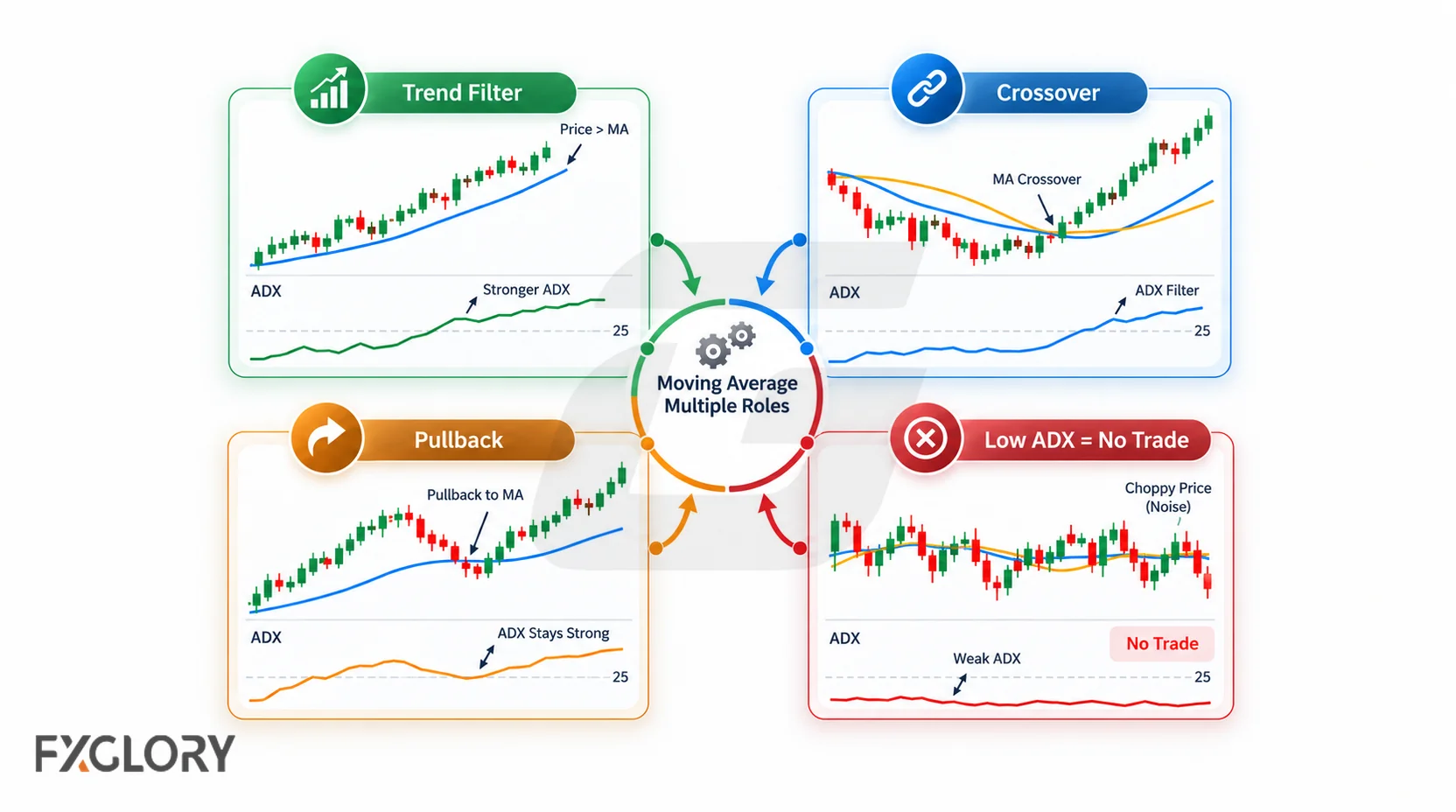
The examples below are role snapshots, not complete standalone systems. A full moving average crossover strategy, EMA forex strategy, or ADX EMA strategy would need narrower rules for market condition, trigger, invalidation, stop distance, exit, and review.
This page uses crossover examples only to explain the ADX filter. It does not replace a dedicated moving-average crossover strategy page, where crossover types, trend regimes, retests, exits, and false-cross filters would need deeper treatment.
Moving Average Trend Filter + ADX Strength Confirmation
This setup uses the moving average to review direction or trend context, then uses ADX to check whether trend strength supports further review. The moving average should not replace the price structure behind the trade.
- Context: Price has a visible directional structure.
- Moving average role: Direction, slope, or price-position context.
- ADX role: Trend-strength filter.
- Trigger: Price confirms continuation from a defined area.
- Invalidation: Price breaks the structure behind the trend idea.
- Skip rule: Skip if ADX confirms only after price is far from the risk area.
Moving Average Crossover + ADX Filter
A moving average crossover can show that average price behavior has shifted. ADX can help review whether trend strength is developing. The crossover still needs price confirmation because crossovers can repeat in sideways conditions.
- Context: Price is shifting from range, pullback, or compression into possible direction.
- Moving average role: Crossover or trend-shift warning.
- ADX role: Trend-strength filter after the shift begins.
- Trigger: Price breaks, holds, or retests a structure in a manageable way.
- Invalidation: Price returns through the structure or crossover zone and removes the trade idea.
- Skip rule: Skip if the crossover happens while ADX is weak and price is chopping around the averages.
Moving Average Pullback + ADX Trend-Strength Review
This setup uses a moving average as a pullback reference inside a trend. ADX reviews whether the trend-strength context still deserves attention. The pullback still needs price confirmation rather than a touch of the average alone.
When a moving average is used as a pullback reference, treat it as a dynamic area, not an exact price. Review support and resistance in forex when the setup depends on a moving average acting like a shifting reaction zone.
- Context: Price trends and pulls back toward a moving average or nearby structure.
- Moving average role: Dynamic context or pullback reference.
- ADX role: Trend-strength review.
- Trigger: Price resumes from the pullback area with clear invalidation.
- Invalidation: Price breaks the pullback structure or trend idea.
- Skip rule: Skip if the moving average touch has no price reaction or the target is too small after spread.
Moving Average Slope + ADX Continuation Filter
Moving-average slope can help review whether the average is rising, falling, or flat. ADX can then help review whether trend strength supports the directional context. A flat moving average with weak ADX usually needs extra caution.
- Context: Price shows direction, but the trader needs a filter for strength.
- Moving average role: Slope and context review.
- ADX role: Strength confirmation or caution.
- Trigger: Price confirms continuation from a defined area.
- Invalidation: Price breaks the structure that supported continuation.
- Skip rule: Skip if the moving average is flat and price has no clean directional structure.
Low ADX + Moving Average Crossover No-Trade Filter
Low ADX can help reject moving-average crossovers that happen inside weak or choppy conditions. This is useful because the best decision may be to avoid the setup instead of adding more indicators.
- Context: Price crosses around moving averages without clean structure.
- Moving average role: Shows repeated crossover noise.
- ADX role: Weak trend-strength warning.
- Trigger: No trend trade until price structure and trend strength improve.
- Invalidation: A different range plan may exist, but it is not a trend-following setup.
- Skip rule: Skip when crossovers repeat and the loss scenario is unclear.
Advanced Variation: Moving Average On ADX
Some traders add a moving average directly to the ADX line to smooth ADX behavior or review ADX changes. This is an advanced variation and should not replace normal chart structure. If used, it should be tested separately from a standard price moving average plus ADX setup.
- Context: The trader is studying smoothed ADX behavior rather than only price trend context.
- Moving average role: Smooths or reviews ADX movement.
- ADX role: Provides the underlying trend-strength line.
- Skip rule: Skip if the added average makes the signal harder to explain or test.
Testing ADX And Moving Average Settings
Common moving-average references include 20, 50, 100, and 200-period averages. Common crossover pairs include faster and slower averages such as 9/21 or 20/50. ADX 20 or 25 areas are often used as trend-strength reference zones. These are testing references, not universal settings.
| Reference | Strategy Use | Main Risk |
|---|---|---|
| 20-period MA | Shorter-term trend or pullback context | Can create more noise on lower timeframes |
| 50-period MA | Medium-term trend or dynamic context | Can lag during fast turns |
| 100 or 200-period MA | Broader trend context | May react slowly and create wide distance from entry |
| 9/21 crossover | Faster crossover testing reference | Can whipsaw in sideways conditions |
| 20/50 crossover | Slower crossover testing reference | May confirm after price has already moved |
| ADX 14 | Common baseline for trend-strength review | Not automatically suitable for every pair or timeframe |
| ADX 20 or 25 area | Trend-strength reference zone | Can be misread as an automatic trade filter |
Settings should be chosen before testing and kept consistent long enough to review clean examples, failed examples, skipped setups, and different currency-pair behavior.
ADX And Moving Average Multi-Timeframe Workflow
The combination can be reviewed across more than one timeframe, but each timeframe should have a separate job. The higher timeframe should define whether the market is trending, ranging, crossing, extended, or unclear. The trading timeframe should show the ADX and moving-average setup. The entry timeframe should only refine the trigger and invalidation.
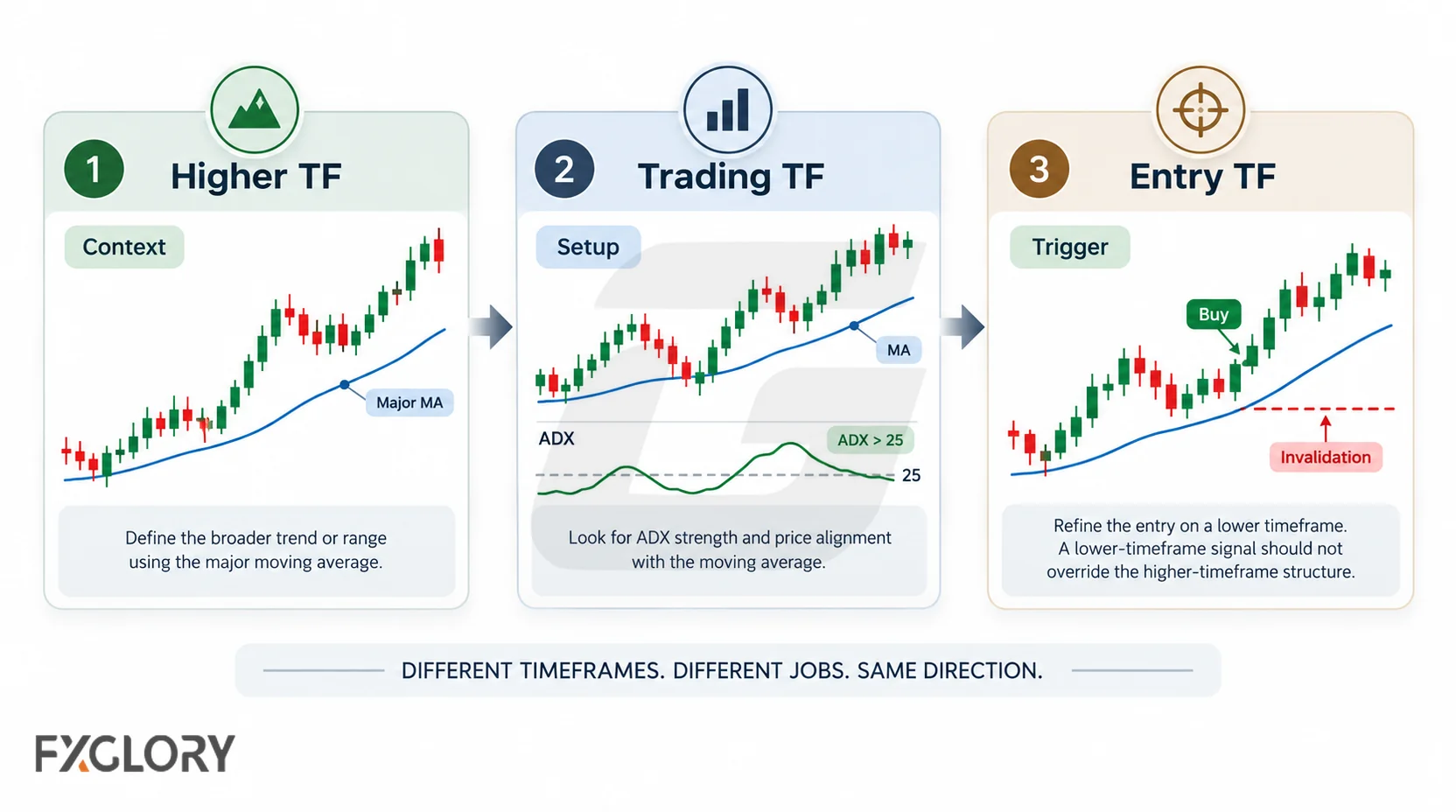
| Timeframe Role | What To Check | Skip If |
|---|---|---|
| Higher timeframe | Trend, range, major moving average, major level, or broader ADX condition | The lower-timeframe signal fights the broader structure |
| Trading timeframe | Price position vs MA, MA slope, crossover, ADX level or slope, and +DI/−DI behavior | The signal appears in unclear price action or risk is not manageable |
| Entry timeframe | Price trigger, rejection, retest, structure shift, or invalidation | The entry timeframe creates noise instead of clearer risk |
Short-Term And Platform Workflow Notes
Lower-timeframe ADX and moving-average setups can create repeated signals because moving averages can cross often and ADX can confirm late. Platform alerts and scripts can help monitor conditions, but they should not replace written trade rules.
| Short-Term Or Platform Issue | Why It Matters | What To Check |
|---|---|---|
| Spread sensitivity | Small targets can be reduced by trading cost | Check whether the target still makes sense after spread |
| Crossover noise | Fast averages can cross repeatedly in choppy markets | Require price structure before accepting the signal |
| Late ADX confirmation | ADX may confirm after price has already moved | Check whether invalidation is still manageable |
| Price far from MA | The signal may appear after an extended move | Check whether a pullback gives a better risk area |
| Alerts and scripts | They can highlight conditions but not decide the trade | Use alerts only to review written rules |
Before testing short-term rules, review FXGlory spreads. When stop distance and position size need to be checked together, use the FXGlory margin calculator. Review FXGlory trading platforms when the strategy depends on charting tools, moving-average settings, ADX settings, alerts, order placement, or trade-management workflow.
Worked Example: One Moving Average Crossover, Four Decisions
Assume a currency pair makes a bullish moving-average crossover while ADX starts rising. That does not automatically create a buy setup. The same reading can lead to different decisions depending on chart condition and risk.
| Observation | Possible Meaning | Next Check | Skip If |
|---|---|---|---|
| Price breaks structure and ADX rises after the crossover | Trend strength may be developing after a shift | Check retest, +DI/−DI behavior, and stop distance | The breakout is only a spike |
| Crossover appears while ADX remains low | The signal may be range noise | Check support and resistance instead of forcing trend logic | The strategy requires trend strength |
| ADX confirms after price is far above the MA | Trend strength may be visible late | Check whether a pullback gives a better risk area | Price is already far from invalidation |
| Moving average is flat and price crosses repeatedly | Trend direction may be unclear | Wait for cleaner structure or no-trade condition | The trade reason depends only on the crossover |
When ADX And Moving Average Strategies Fail
ADX and moving average strategies often fail when the two indicators are treated as a shortcut instead of a decision process. The most common problem is not the combination itself; it is using lagging tools without price structure and risk control.
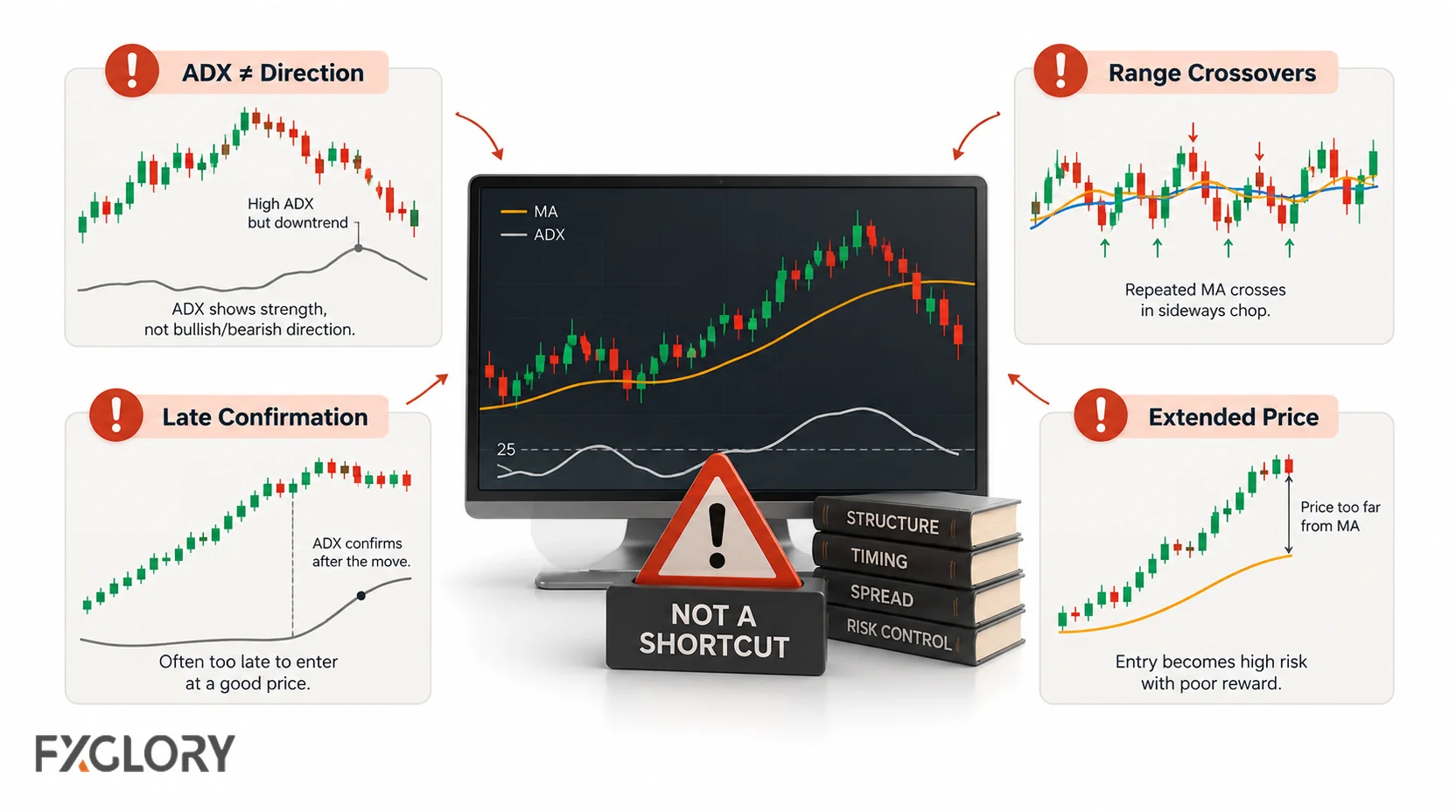
- ADX used as direction: ADX measures strength, not bullish or bearish direction.
- Moving average used as a complete signal: Price crossing an average does not define a full trade plan.
- Crossover in a range: Moving averages cross repeatedly while price stays sideways.
- Late ADX confirmation: ADX confirms strength only after price has moved away from the risk area.
- Price too far from the average: The signal appears after the move is extended.
- No price structure: The signal is used without support, resistance, trend, or range context.
- Settings changed too often: Moving-average periods or ADX settings are adjusted after each result.
- Spread problem: A short-term setup has too little room after trading cost.
- Risk ignored: The signal looks clean, but stop distance, position size, or margin exposure does not fit.
Testing An ADX And Moving Average Strategy
An ADX and moving average strategy should be tested as a full rule set, not as a pair of agreeing signals. Testing should include clean trends, weak ranges, crossover whipsaws, late ADX signals, price extension, pullbacks, failed breakouts, short-term signals, volatile periods, and skipped setups.
- What market condition does the strategy need?
- Is the moving average being used for direction, slope, price position, crossover, pullback, or no-trade filtering?
- Is ADX being used for trend strength, breakout filtering, range filtering, or weak-condition rejection?
- What price structure confirms the setup?
- Where is the idea invalid?
- Does the target still make sense after spread?
- Does stop distance fit position size and margin exposure?
- Are moving-average and ADX settings kept consistent during the test?
- Are crossover whipsaws, late signals, extended entries, and skipped setups recorded?
- Does the result change across selected currency pairs or timeframes?
Review available currency pairs before applying the same ADX and moving average method everywhere. Review forex trend behavior when the strategy depends on direction, and review support and resistance in forex when the strategy depends on a breakout, range, crossover area, or retest.
ADX And Moving Average Strategy Checklist
Before using an ADX and moving average strategy, answer these questions.
- Is the market trending, ranging, crossing, extended, or unclear?
- What job does the moving average have in this setup?
- What job does ADX have in this setup?
- Do +DI and −DI agree with price structure?
- Is price near a meaningful chart area?
- Does price structure confirm or reject the idea?
- Where is the trade idea invalid?
- Are the indicator settings fixed for testing?
- Does the setup still make sense after spread?
- Does stop distance fit position size and margin?
- What condition makes the combination a no-trade?
An ADX and moving average strategy is useful only when the tools keep separate roles. A moving average can help review direction or trend context; ADX can help review trend strength; the chart still has to define the trade area and the point where the idea is wrong.
ADX + Moving Average Setup-Role Test Notes
This hypothetical educational ADX + Moving Average setup-role test reviewed ADX and moving-average setup roles: MA trend filter with ADX strength, MA crossover with ADX filter, MA pullback with ADX trend review, MA slope with ADX continuation, and low-ADX crossover rejection. Moving averages are used for direction, slope, pullback, crossover, or no-trade context. ADX is used for trend-strength review. The test does not prove that ADX and moving averages are profitable or that one setup role is universally best.
The model reviewed EURUSD, GBPUSD, USDJPY, AUDUSD, USDCAD, and USDCHF using public yfinance 15-minute OHLC data where available. The 1H candles are resampled from the same 15-minute data so that context and setup timing have defined roles.
| Setup Role | Educational Model Rule |
|---|---|
| MA trend filter + ADX strength | Reviews trend direction from EMA(20)/EMA(50), then checks ADX strength and +DI/-DI pressure. |
| MA crossover + ADX filter | Reviews recent EMA(20)/EMA(50) crosses only when ADX and directional pressure support the shift. |
| MA pullback + ADX trend review | Reviews 15M pullbacks near EMA(20) when 1H trend and ADX context agree. |
| MA slope + ADX continuation | Reviews structure breaks when EMA(50) slope and ADX strength agree with direction. |
| Low-ADX crossover rejection | Counts moving-average crosses rejected because ADX is weak or not rising; this is a no-trade filter count. |
| Rule Area | Educational Model Rule |
|---|---|
| Fast moving average | EMA(20) |
| Slow moving average | EMA(50) |
| ADX | 14-period ADX used as a trend-strength filter. |
| +DI / -DI | 14-period directional-pressure review. |
| Context chart | 1H EMA and ADX context. |
| Setup chart | 15M EMA, ADX, +DI/-DI, and price structure. |
| Session grouping | London morning, London/New York overlap, early New York afternoon, and a separately reported rollover/off-hours group. |
| Entry | Next 15M open after the completed setup candle. |
| Stop | Setup candle extreme with a 0.25 ATR(14) buffer. |
| Target comparison | Fixed 1.3R target from entry. |
| Invalidation exit | Setup-specific invalidation based on moving average, structure, or setup-candle failure. |
| Same-day exit | Forced close at the last available 15M close at or before 20:45 UTC. |
| Cost Input | Assumptions Used |
|---|---|
| Spread | 0.5, 1.5, and 3.0 pips |
| Slippage | 0.1, 0.5, and 1.0 pips per side |
| Baseline comparison | 1.5-pip spread and 0.5-pip slippage per side |
| Swap and rollover | Not included because trades are forced flat before the same-day cutoff |
The review records setup candidates, accepted trades, rejected candidates, low-ADX crossover rejections, rejection reasons, trade count, win rate, average win in R, average loss in R, expectancy in R, profit factor, maximum drawdown in R, worst losing streak, holding time, same-day cutoff exits, setup-role behavior, session-level behavior, pair-level behavior, direction-level behavior, exit reasons, and spread/slippage sensitivity.
Educational ADX + Moving Average Setup-Role Test Results
The completed educational ADX + Moving Average setup-role test produced a negative baseline result after the 1.5-pip spread and 0.5-pip slippage-per-side assumption. The model recorded 3,952 setup candidates, 1,916 trades before the overlap filter, and 1,080 accepted baseline trades. It also counted 1,349 low-ADX crossover rejections as no-trade filter events.
| Metric | Result | What It Means |
|---|---|---|
| Setup candidates | 3,952 | Rules found possible ADX and moving-average setup conditions before trade filters. |
| Trades before overlap filter | 1,916 | Setups that passed the rule model before same-pair/setup-role overlap control. |
| Accepted trades | 1,080 | Trades included in the baseline result after filters. |
| Rejected candidates | 2,872 | Rejected for operating-window, risk-gate, or overlap reasons. |
| Low-ADX crossover rejections | 1,349 | Moving-average crosses counted as no-trade conditions because ADX was weak or not rising. |
| Baseline win rate | 39.44% | Win rate after 1.5-pip spread and 0.5-pip slippage per side. |
| Baseline expectancy | -0.3393R | Average net R result per accepted trade under baseline costs. |
| Total baseline result | -366.4424R | Total net R across all accepted baseline trades. |
| Profit factor | 0.5197 | Gross profit divided by gross loss under baseline costs. |
| Maximum drawdown | -387.3346R | Worst cumulative R drawdown in the baseline sequence. |
All four traded ADX and moving-average setup roles were negative under the baseline cost assumption. The least-negative baseline role was MA trend filter + ADX strength at -0.2728R expectancy. The weakest baseline role was MA pullback + ADX trend review at -0.4312R expectancy.
| Setup Role | Trades | Win Rate | Expectancy | Total Net Result | Profit Factor | Invalidation Exit Rate |
|---|---|---|---|---|---|---|
| MA trend filter + ADX strength | 397 | 44.08% | -0.2728R | -108.2823R | 0.6013 | 1.51% |
| MA crossover + ADX filter | 139 | 41.01% | -0.3250R | -45.1744R | 0.5498 | 5.04% |
| MA pullback + ADX trend review | 291 | 38.83% | -0.4312R | -125.4836R | 0.4446 | 3.09% |
| MA slope + ADX continuation | 253 | 32.02% | -0.3459R | -87.5020R | 0.4698 | 41.90% |
The cost sensitivity check stayed negative across the selected low, baseline, and high cost assumptions. Lower trading cost reduced the loss, while higher spread and slippage made the same rule model weaker.
| Spread | Slippage | Trades | Weighted Win Rate | Weighted Expectancy | Total Net Result |
|---|---|---|---|---|---|
| 0.5 pips | 0.1 pips per side | 1,080 | 39.82% | -0.1151R | -124.3536R |
| 1.5 pips | 0.5 pips per side | 1,080 | 39.45% | -0.3393R | -366.4423R |
| 3.0 pips | 1.0 pips per side | 1,080 | 38.70% | -0.6506R | -702.6768R |
| Review Area | Segment | Expectancy | Total Net Result |
|---|---|---|---|
| Least-negative setup role | MA trend filter + ADX strength | -0.2728R | -108.2823R |
| Weakest setup role | MA pullback + ADX trend review | -0.4312R | -125.4836R |
| Least-negative session | London morning | -0.3243R | -143.0334R |
| Weakest session | Rollover/off-hours | -0.4840R | -4.8401R |
| Least-negative pair | GBPUSD | -0.2548R | -49.1850R |
| Weakest pair | USDJPY | -0.4844R | -60.0610R |
| Least-negative direction | short | -0.2662R | -140.3062R |
| Weakest direction | long | -0.4089R | -226.1362R |
What This ADX + Moving Average Setup-Role Test Shows
In this educational model, the ADX and moving-average rule set was negative at the baseline cost assumption, with -0.3393R expectancy and -366.4424R total net result across 1,080 trades. The result was also cost-sensitive: the selected lower-cost case still showed -0.1151R expectancy, while the selected higher-cost case fell to -0.6506R expectancy.
The least-negative baseline setup role was MA trend filter + ADX strength at -0.2728R expectancy and -108.2823R total net result. The weakest baseline setup role was MA pullback + ADX trend review at -0.4312R expectancy and -125.4836R total net result. This does not identify a universally best ADX and moving-average method; it shows how these simplified setup roles behaved under one rule model.
The educational use of the test is to review cost sensitivity, low-ADX crossover rejection, crossover whipsaws, ADX confirmation timing, +DI/-DI directional-pressure filters, invalidation exits, session behavior, and whether moving averages and ADX are being used as separate role filters rather than automatic trade commands.
Use the result as a review prompt, not as a live-trading conclusion. Test one pair, one session window, one moving-average role, one ADX rule, one low-ADX rejection rule, and one cost assumption before comparing ADX + moving-average routines.