
What Is Forex Trading Volume?
Forex trading volume describes market activity during a period, but the exact meaning depends on the data source. In spot forex, a volume reading may refer to broker-side tick activity, while other sources report exchange-traded futures volume or institutional turnover.
A retail trading platform therefore does not usually show total global spot forex volume. Before interpreting a volume figure, traders should identify what is being measured and where the data comes from.
For broader vocabulary, traders can review basic forex market terms such as liquidity and spread.
Why Forex Volume Is Different From Stock Volume
Many stocks trade on centralized exchanges that can report the number of shares traded on that venue. Spot forex is an over-the-counter market spread across banks, brokers, liquidity providers, electronic venues, and other participants.
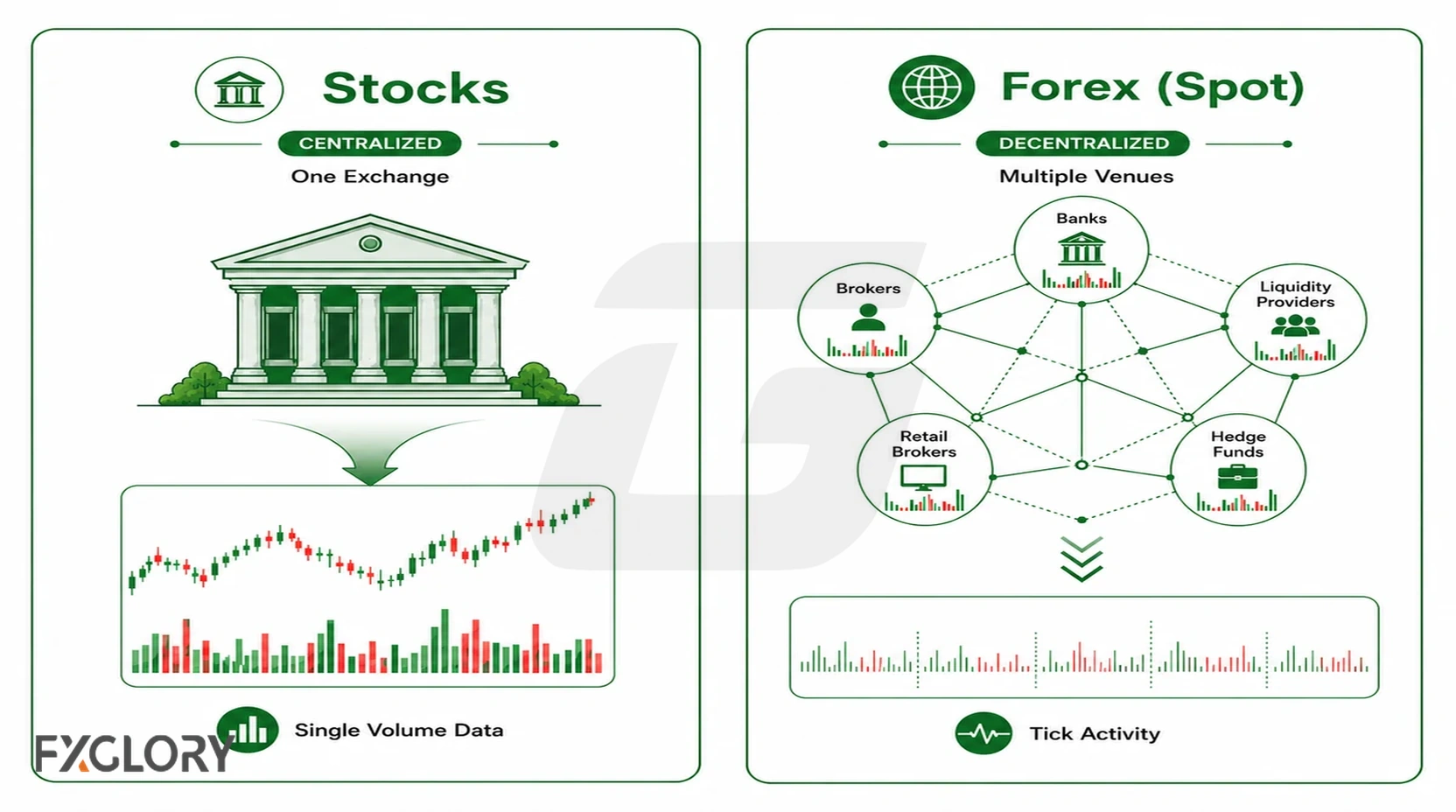
Because no single exchange records every spot FX transaction, there is no complete real-time market-wide volume figure on a normal retail forex chart. This is why forex traders encounter several different kinds of volume data instead of one universal number.
Global Forex Daily Trading Volume
Final BIS analysis of the 2025 Triennial Survey reported average global over-the-counter foreign exchange turnover of about 9.5 trillion U.S. dollars per day in April 2025.
This figure measures institutional turnover across spot and derivative instruments, including spot transactions, outright forwards, FX swaps, options, and other products. It describes the size of the broader OTC FX market rather than the activity of one currency pair on one retail platform.
The U.S. dollar was on one side of about 89% of FX trades in the 2025 survey, showing its central role in global currency-market turnover.
Main Forex Volume Sources
Different volume sources answer different questions. Traders should compare them only after checking what each source measures.
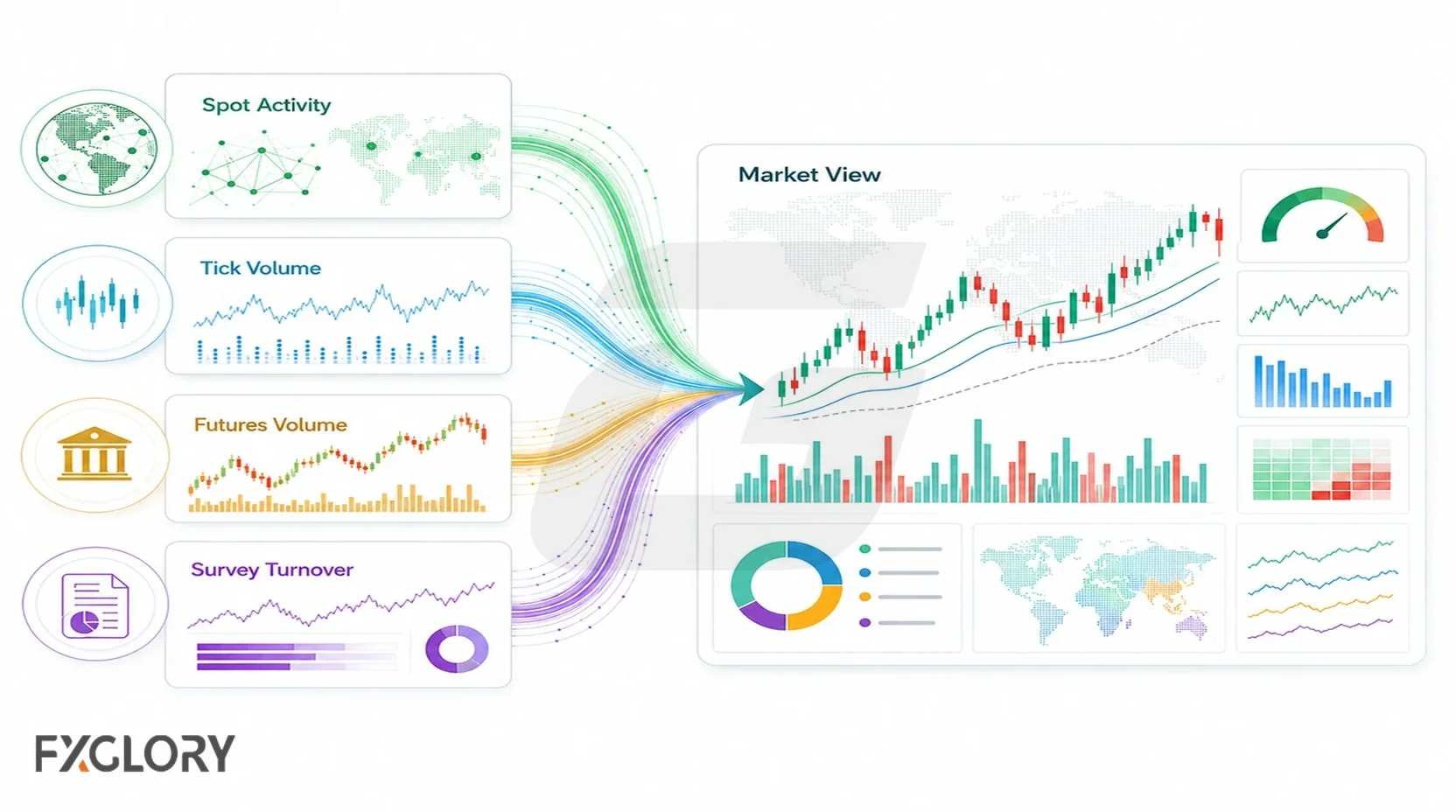
- Tick volume: Counts price updates during a period from a broker or data feed.
- FX futures volume: Counts contracts traded on a centralized futures exchange.
- Options volume and open interest: Describe activity and outstanding positions in exchange-traded or reported derivatives markets.
- Institutional survey turnover: Aggregates reported OTC FX activity from participating dealers or institutions over a survey period.
CME data, New York Fed Foreign Exchange Committee surveys, and BIS surveys are all useful, but they cover different parts of the FX market. For example, the New York Fed Foreign Exchange Committee reported $1,303.2 billion in average daily total OTC FX volume in its October 2025 North American survey. That regional survey should not be read as total global forex volume.
What Tick Volume Means in Forex
Tick volume counts how many times price updates during a selected period. More updates produce a higher tick-volume reading; fewer updates produce a lower reading.
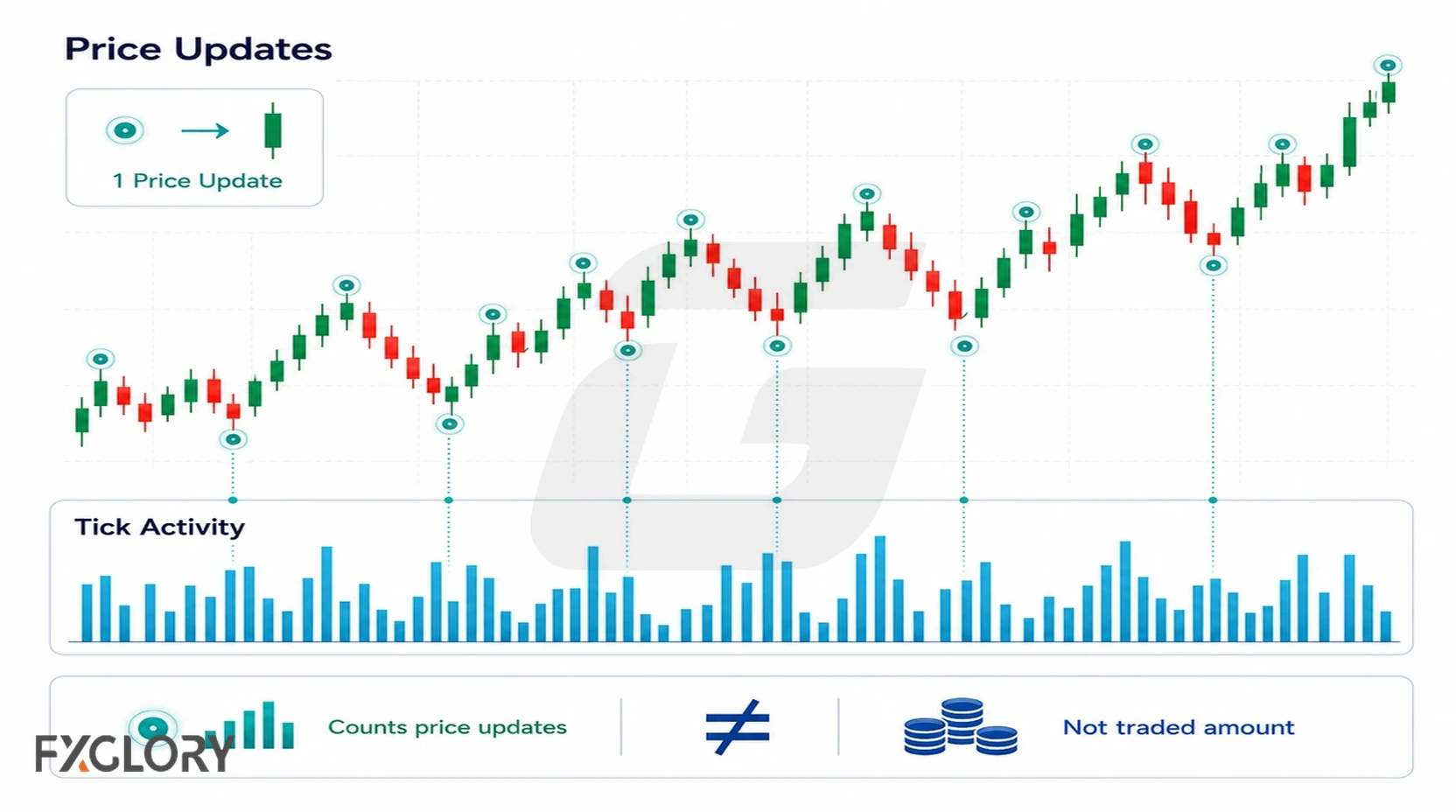
Because tick volume comes from a specific broker or data feed, readings can differ between platforms. It is generally more useful when compared with recent readings from the same source rather than treated as a universal market total.
Rising tick activity can show that a pair is becoming more active, but it does not tell traders whether price will rise or fall. The reading still needs price, spread, volatility, and market-context interpretation.
Traders who want the technical-indicator side can review tick volume as a broker-side activity measure.
How to Interpret Forex Volume
Volume is most useful as context. A trader can use it to compare current activity with recent conditions and then interpret that change alongside price behavior.
- Breakouts: A change in activity can add context to a break of support, resistance, or a range boundary, but it does not guarantee continuation.
- Trends: Rising or falling activity can help describe participation during a move, while price structure determines whether the trend remains intact.
- Ranges: A sudden change in activity near a range boundary may deserve attention, but false breaks are still possible.
- Liquidity and execution: Activity should be read with spread behavior and market conditions because high activity can also occur during unstable news-driven periods.
Forex activity can also vary by trading session, currency pair, scheduled news, holidays, and broader market conditions. Session timing is therefore context rather than a fixed rule about when volume must be high or low.
For related market conditions, traders can compare spread behavior during changing liquidity with volume and volatility during active market conditions.
Traders interested in chart-based tools can review volume indicators used to interpret market activity.
Common Mistakes With Forex Trading Volume
- Mixing different data sources: Tick volume, futures volume, and institutional survey turnover measure different things.
- Treating tick volume as total global volume: Tick volume reflects price updates from a specific feed.
- Using volume as a directional signal: High activity can accompany both rising and falling markets.
- Ignoring spreads and volatility: High activity does not guarantee smooth execution or stable trading conditions.
- Comparing broker feeds directly: Different data providers can produce different tick-volume readings.
- Assuming futures volume equals spot volume: Futures data comes from centralized contracts and does not represent the entire decentralized spot FX market.
Final Thoughts on Forex Trading Volume
The key to understanding forex volume is identifying the source. Tick volume describes price-update activity from a feed, futures volume describes exchange-traded contracts, and institutional surveys estimate broader OTC turnover.
Used this way, volume can add context to price behavior and market conditions without being mistaken for a prediction of direction or a complete measure of global spot forex activity.