Forex Trading Volume: What Volume Means in Forex

Forex trading volume shows market activity, but spot forex does not have one centralized volume feed. Traders need to understand the difference between global turnover, broker tick volume, futures volume, and session liquidity before using volume in analysis.
 
Written byHenry Green
Published
Last updated

Key Takeaways

  • Forex trading volume describes market activity, but spot forex volume is different from stock-market volume because forex is decentralized.
  • Global forex turnover is measured through institutional surveys, while retail platforms often show broker-side tick volume or activity data.
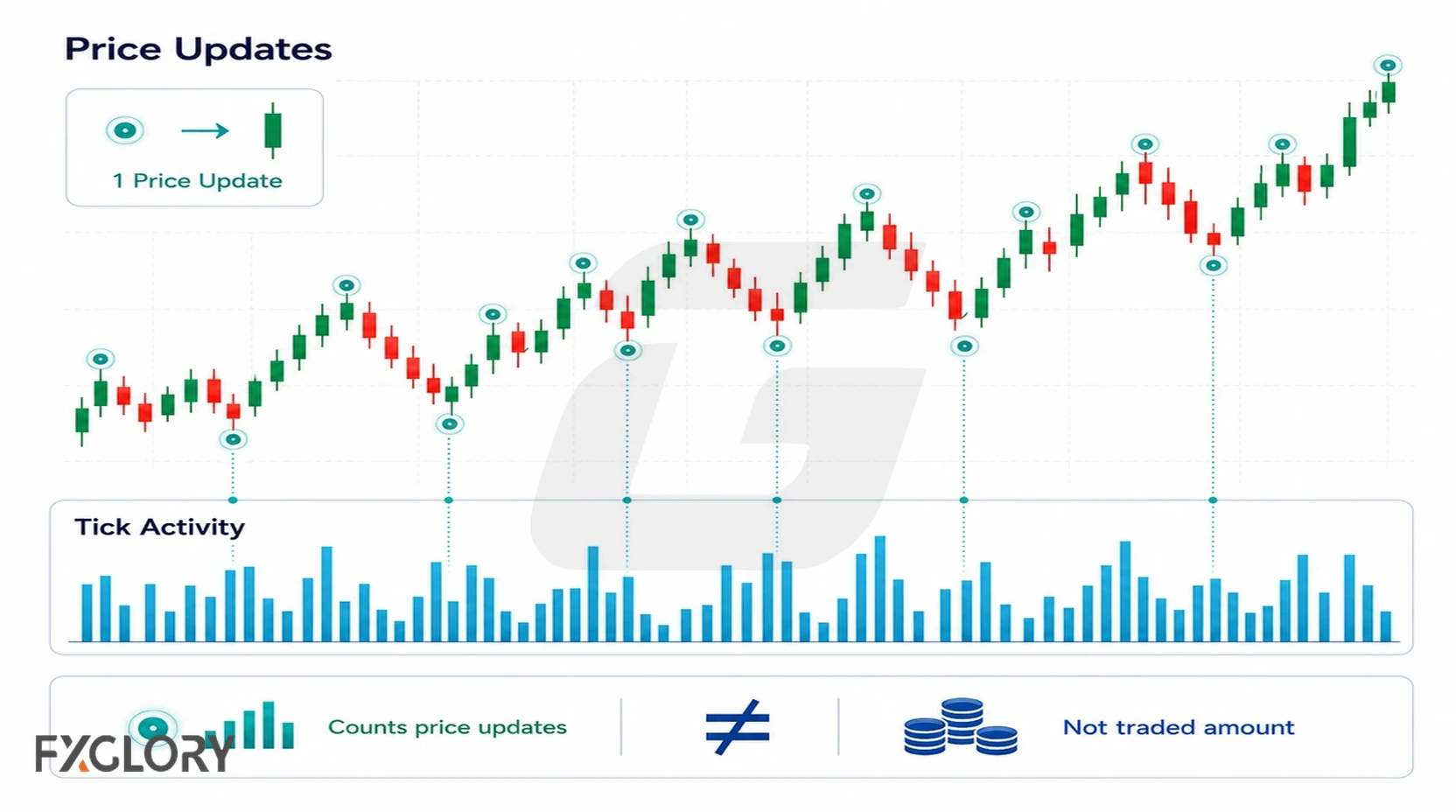
  • Tick volume counts price updates or ticks, not the total number of currency units traded across the whole forex market.
  • Futures volume and open interest can provide exchange-traded FX context, but they are not the same as total spot forex volume.
  • Volume can help traders understand liquidity, spreads, volatility, and session activity, but it should not be treated as a standalone trading signal.
Risk note: Forex trading involves risk of loss. Volume can help describe market activity, but it cannot predict direction, guarantee liquidity, prevent slippage, or replace risk control.

What Is Forex Trading Volume?

Forex trading volume describes activity in the currency market. In simple terms, it asks how much trading activity is taking place during a period.

In forex, the word volume can mean different things depending on the source. It may refer to global institutional turnover, exchange-traded FX futures volume, broker-side tick volume, or platform activity data. These are related, but they are not the same measurement.

This is why forex volume needs careful wording. A trader looking at a retail chart is usually not seeing total global spot forex volume. The chart may show tick volume or activity from a specific broker or data provider.

For broader vocabulary, traders can review basic forex market terms such as liquidity and spread.

Plain-English idea: Forex volume means market activity, but the source of that activity data matters.

Why Forex Volume Is Different From Stock Volume

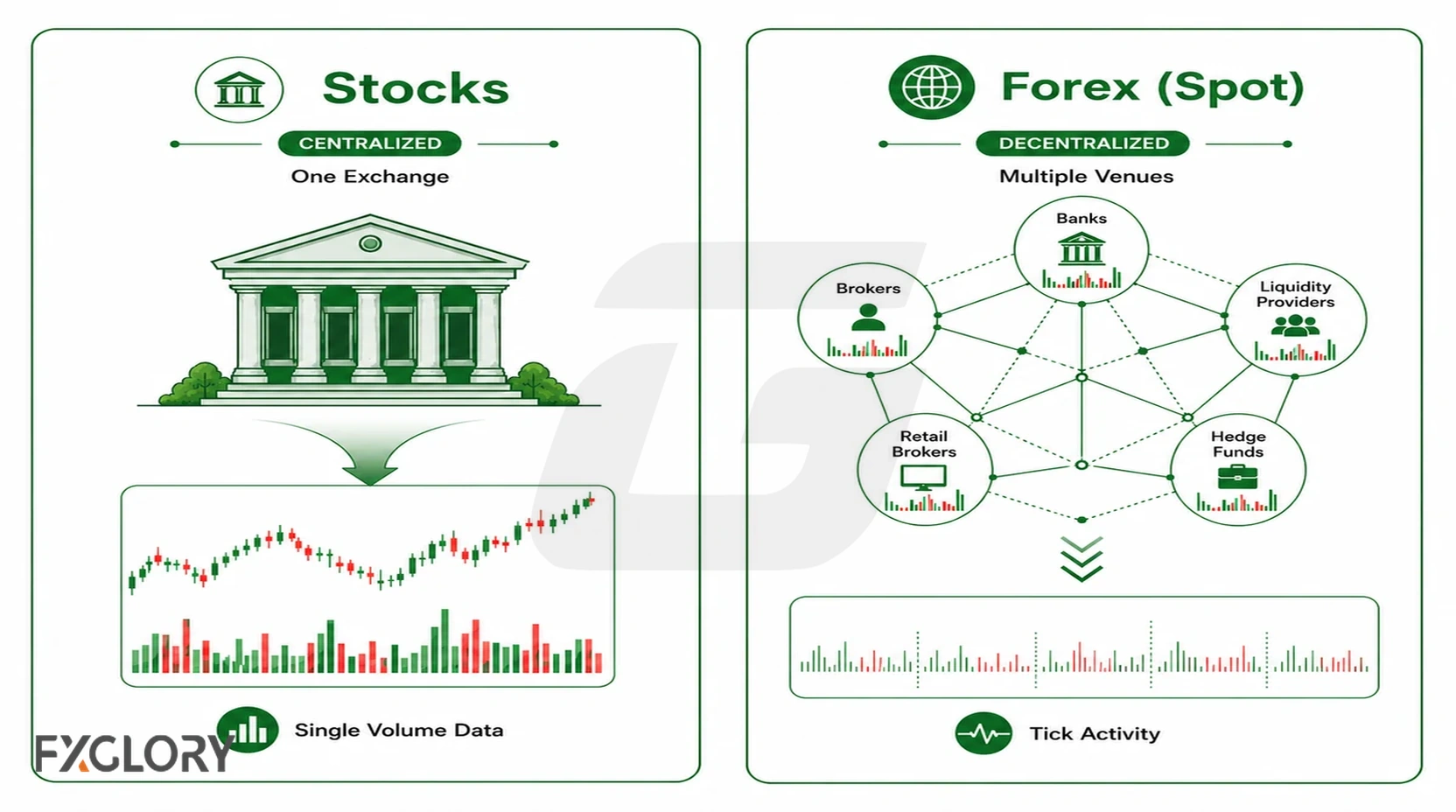
Stock volume is usually easier to understand because many stocks trade on centralized exchanges. If a stock trades on a central exchange, the exchange can report how many shares changed hands during a period.

Spot forex is different. It is a decentralized over-the-counter market. Trading takes place through banks, brokers, liquidity providers, electronic venues, and institutional networks rather than one single exchange that records every spot FX trade.

Because of that structure, there is no single complete real-time volume number for the entire spot forex market on a normal retail trading chart. A platform may show activity from its own feed, but that does not equal total global currency trading volume.

  • Stocks: Often have centralized exchange volume.
  • Spot forex: Has decentralized market activity across many venues and participants.
  • Retail forex charts: Often show tick volume or broker-side activity, not full global spot volume.
  • FX futures: Have exchange volume because futures trade on centralized exchanges.

Global Forex Daily Trading Volume

The forex market is one of the largest financial markets in the world. The BIS 2025 Triennial Survey reported that global over-the-counter foreign exchange turnover reached about 9.6 trillion U.S. dollars per day in April 2025.

That figure is useful because it shows the size of the institutional FX market. It should not be confused with the volume number on a retail chart. BIS turnover data is survey-based institutional market data, not a live signal for one currency pair on one platform.

Global turnover also includes different FX instruments, such as spot transactions, forwards, FX swaps, options, and other over-the-counter activity. A trader studying EUR/USD on a short-term chart is looking at a much narrower slice of the market.

The U.S. dollar remains central to global FX volume. In the BIS 2025 survey, the dollar was on one side of about 89% of all FX trades, and the top traded currency pairs were heavily USD-centered. This helps explain why major USD pairs often receive more attention when traders discuss liquidity and market activity.

Data rule: Global forex turnover numbers describe market size. They do not tell a retail trader where the next candle will go.

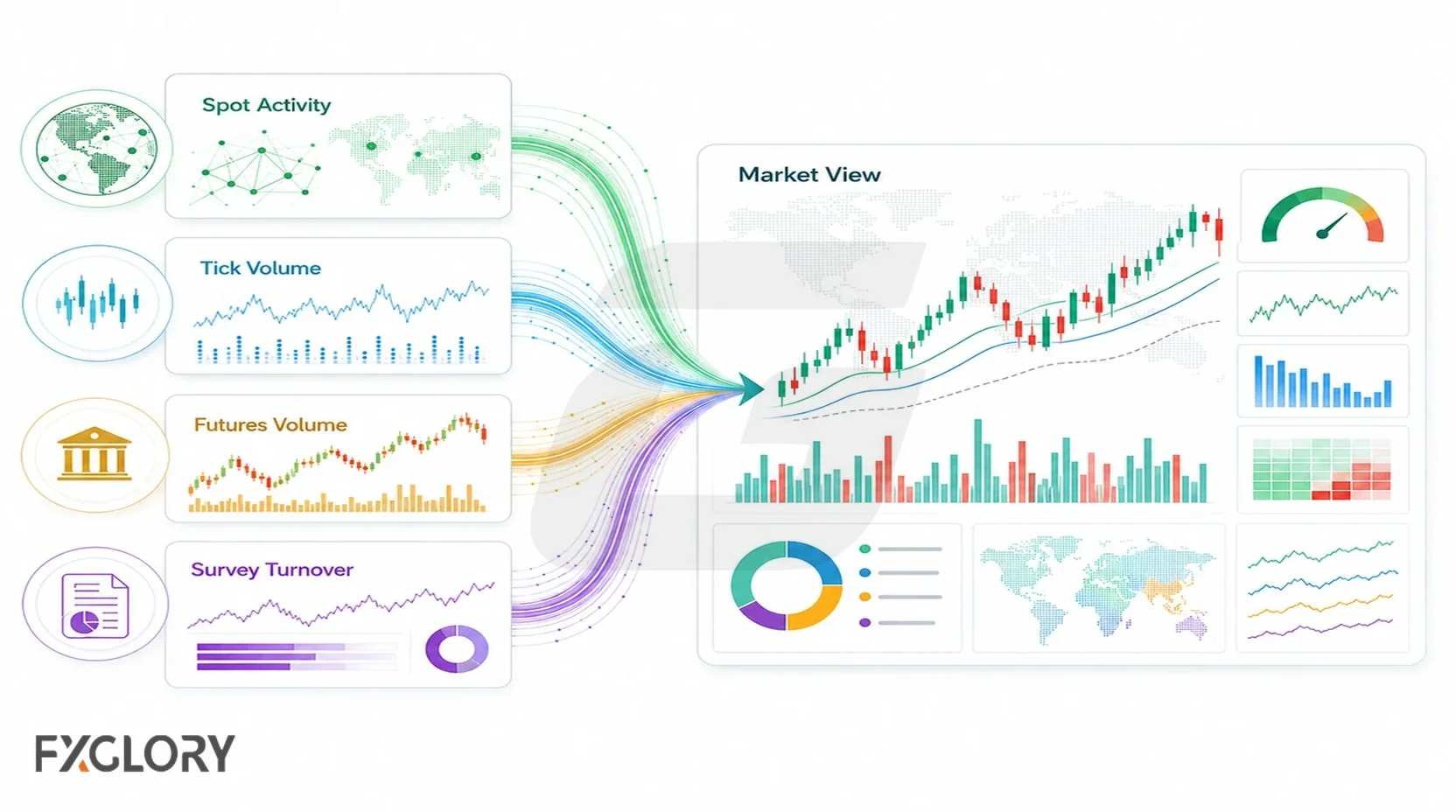
Spot Forex Volume vs Futures Volume vs Survey Volume

Different volume sources answer different questions. Before using a volume number, identify where it comes from.

  • Spot forex volume: Decentralized activity in the spot currency market. Retail traders usually do not see one complete global spot volume feed.
  • Tick volume: The number of price updates in a period from a broker or data feed.
  • FX futures volume: The number of exchange-traded futures contracts traded on a centralized venue.
  • Options volume and open interest: Exchange-traded or reported derivatives activity that can add context, but is not the same as spot forex volume.
  • Survey volume: Institutional turnover collected from reporting dealers or market committees over a survey period.

For example, CME FX futures and options data can show exchange-traded currency activity. New York Fed Foreign Exchange Committee surveys can show North American over-the-counter FX activity from reporting institutions. BIS surveys provide a broader global view. These are valuable references, but each measures a different part of the FX market.

For regional context, the New York Fed Foreign Exchange Committee reported $1,303.2 billion in average daily volume across total OTC FX instruments in its October 2025 North American survey. That figure reflects participating reporting institutions and should not be read as total global forex volume.

Source rule: Do not compare broker tick volume, CME futures volume, New York Fed survey volume, and BIS turnover as if they are the same type of data.

What Tick Volume Means in Forex

Tick volume counts how many times price updates during a selected period. If price updates frequently, tick volume rises. If price updates less often, tick volume falls.

Tick volume does not measure the total number of currency units traded globally. Instead, it can act as a broker-side activity measure. Traders often use it because spot forex lacks one centralized exchange volume feed.

Tick volume can still be useful if read carefully. Rising tick activity may show that a pair is becoming more active. Falling tick activity may show quieter conditions. The reading should be compared with price behavior, spread, session timing, and volatility.

Live currency ranking or platform-volume pages can be useful for observation, but traders should check what the page is measuring before comparing pairs. A ranking based on one data provider is not the same as total global spot forex volume.

Traders who want the technical-indicator side can review tick volume as a broker-side activity measure.

  • Tick volume is not total market volume: It counts price updates from a feed.
  • Tick volume can vary by broker: Different feeds may show different activity.
  • Tick volume needs comparison: It is usually more useful compared with its own recent history.
  • Tick volume does not confirm direction alone: Activity can rise during both bullish and bearish movement.

Why Forex Volume Matters

Volume matters because activity can affect how a market behaves. More activity may be linked with stronger participation, faster movement, or better liquidity in some conditions. Higher activity can also occur during unstable news-driven movement, so volume should be read with spread, volatility, and execution conditions.

Volume can help traders ask practical questions:

  • Is the pair active right now? More activity can make price movement easier to observe.
  • Is a move happening during a liquid session? Session timing can affect movement quality.
  • Is a breakout happening with activity or in a quiet period? The answer can change how traders read the move.
  • Are spreads changing? Spread behavior can affect execution and cost.
  • Is volatility expanding? Active conditions can connect with wider ranges and faster movement.

Volume should not be read alone. A high-activity candle can appear during a clean trend, a news spike, a false breakout, or a fast reversal. Price context still matters.

Volume, Liquidity, Spreads, and Volatility

Forex volume connects closely with liquidity, spreads, and volatility. Liquidity describes how easily orders can be matched in the market. Spreads describe the difference between bid and ask prices. Volatility describes how much price moves.

During active liquid periods, major pairs may often show tighter pricing and smoother order flow than during thin or uncertain conditions. During low-liquidity periods, spreads may widen and price may move unevenly. During news events, volume and volatility may rise, but execution can still become difficult.

This is why traders should compare volume with spread behavior during changing liquidity and volume and volatility during active market conditions.

  • Higher activity is not always safer: News-driven movement can be fast and unstable.
  • Low activity can change execution conditions: Spreads may widen or price may move unevenly.
  • Liquidity differs by pair: Major pairs and exotic pairs can behave differently.
  • Volume does not remove slippage: Fast movement can still affect execution.

Forex Volume by Trading Session

Forex activity changes throughout the trading day because major financial centers open and close at different times. The Asian, London, and New York sessions can show different levels of liquidity, volatility, and participation.

Many traders pay attention to the London session, the New York session, and the London-New York overlap because activity in major currency pairs often increases when large financial centers are open at the same time. This does not mean every trade should happen during those hours. It only means session timing can change the market environment.

  • Asian session: May be quieter for some pairs but more active for JPY, AUD, NZD, and regional themes.
  • London session: Often brings stronger activity in European pairs and broader FX participation.
  • New York session: Can be active for USD pairs, especially around U.S. data and market overlap.
  • London-New York overlap: Often watched because two major centers are active together.
Session rule: Session activity can change average conditions, but news, holidays, central-bank events, and risk sentiment can override normal patterns.

How Traders Use Volume in Forex Analysis

Traders use forex volume carefully because the data source matters. A volume reading can add context, but it should not be treated as a complete signal.

Breakout Context

If price breaks a level during rising tick activity, traders may treat the move differently from a quiet break during low activity. This does not guarantee continuation. It only adds context around participation.

Trend Context

Rising activity during a trend may show stronger participation, while falling activity during a move may show weaker participation. Price structure still decides whether the trend remains intact.

Range Context

Low activity inside a range may show quiet conditions. A sudden increase in activity near the edge of the range may deserve attention, but false breaks can still happen.

Indicator Context

Volume indicators can organize activity data into chart tools. That topic belongs in the technical-indicator cluster. Traders can review volume indicators used to interpret market activity for OBV, MFI, A/D, tick volume, and related tools.

Analysis rule: Volume can support a trading idea, but it should not replace price action, invalidation, position sizing, or risk control.

Common Mistakes With Forex Trading Volume

The biggest mistake is treating every volume source as if it measures the same thing. Broker tick volume, exchange futures volume, institutional survey turnover, and live ranking pages each describe different parts of the market.

  • Confusing tick volume with total global volume: Tick volume is feed-specific activity, not worldwide spot forex turnover.
  • Using volume as a standalone signal: Activity does not decide direction by itself.
  • Ignoring the session: The same volume reading may mean different things during active and quiet sessions.
  • Ignoring spread: A move with high activity can still have difficult execution if spreads widen.
  • Comparing different feeds blindly: Volume readings can differ across platforms and brokers.
  • Assuming futures volume equals spot volume: Futures data is exchange-traded and useful, but it is not the whole spot FX market.
  • Treating ranking pages as global truth: A live ranking may reflect one provider, method, or platform, not the entire forex market.
  • Ignoring news events: Volume and volatility can rise sharply around scheduled data or unexpected headlines.

When Volume Is Less Useful

Volume is less useful when the trader does not know the source of the data, when the market is distorted by news, when spreads are unstable, or when the trader is using tick activity as if it were centralized exchange volume.

  • Do not use forex volume as a standalone trading system.
  • Do not assume high volume guarantees a clean trend.
  • Do not assume low volume means no risk.
  • Do not compare volume sources without checking what each source measures.

Final Thoughts on Forex Trading Volume

Forex trading volume is useful only when the source is understood. Global turnover shows the size of the market. Futures volume shows exchange-traded FX activity. Tick volume shows price-update activity from a broker or data feed. Regional surveys show institutional activity from reporting participants. These are connected ideas, but they are not the same number.

A safer way to use volume is to treat it as market context. It can help traders think about liquidity, session activity, spread behavior, volatility, and participation.

Volume does not predict direction or remove risk. It becomes more useful when combined with price structure, session timing, spread awareness, volatility, invalidation, and risk control.

Frequently Asked Questions

What is forex trading volume?

Forex trading volume describes market activity in currency trading. In spot forex, traders usually cannot see one centralized total volume feed, so volume may refer to global turnover data, broker tick volume, futures volume, or survey-based institutional activity.

Why is forex volume different from stock volume?

Stock volume is usually measured on a centralized exchange. Spot forex is decentralized and traded through banks, brokers, liquidity providers, and electronic networks, so there is no single exchange volume number for the whole spot forex market.

How much volume is traded in forex daily?

The BIS 2025 Triennial Survey reported global OTC foreign exchange turnover of about 9.6 trillion U.S. dollars per day in April 2025. This is institutional market turnover, not a retail platform volume reading.

What is tick volume in forex?

Tick volume counts how often price updates during a period. It is often used as a proxy for market activity in retail forex platforms, but it does not show total global trading volume.

Is tick volume the same as real volume?

No. Tick volume measures price-update activity from a broker or data feed. Real exchange volume measures traded contracts or units on a centralized venue. Spot forex does not have one centralized exchange volume feed.

Can forex volume show liquidity?

Volume and activity can help describe liquidity conditions, but they should be read with spread, volatility, trading session, news, and price behavior. Higher activity does not automatically mean better trade conditions.

What is the highest-volume forex session?

Activity is often higher when major financial centers overlap, especially during the London and New York overlap. Actual activity can still vary by currency pair, news, and market conditions.

Can volume confirm a breakout in forex?

Volume or tick activity may add context to a breakout, but it should not be treated as guaranteed confirmation. Spot forex volume data is fragmented, so price structure, liquidity, spread, and invalidation still matter.

What is the difference between forex trading volume and forex volume indicators?

Forex trading volume is the broader concept of market activity and liquidity. Forex volume indicators are technical tools that try to interpret activity or tick volume on a chart.

Should traders use volume alone in forex?

No. Volume should not be used alone. It is better used with price action, session context, volatility, spread, support and resistance, and risk control.

Related Contents

Forex Trading TermsReview basic forex market terms such as liquidity, spread, volume, pip, margin, and order types.
What Is Volatility in Forex?Learn how market movement changes during active, quiet, or news-driven conditions.
SpreadsReview how spreads relate to trading costs and changing market liquidity.
Forex Volume IndicatorsStudy technical indicators that use volume, tick activity, or money-flow style calculations.

Practice Reading Volume Context on Demo

Use an FXGlory demo account to observe market activity, compare session behavior, and test trading decisions before using real funds.

Open a Demo Account