
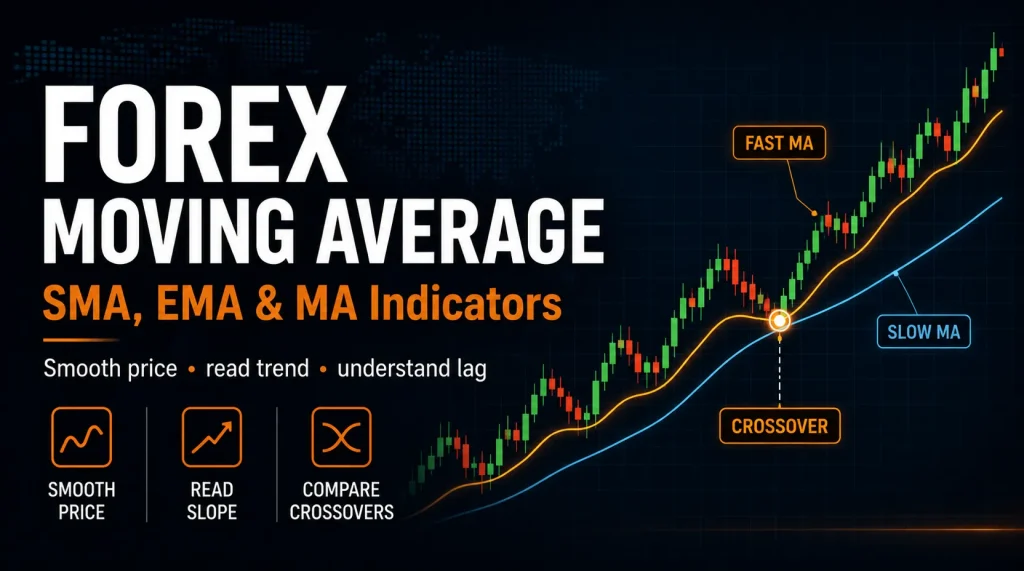
What Is a Moving Average in Forex?
A moving average (MA) is a chart indicator that calculates a rolling average from selected past price data and plots the result as a line. Its purpose is to reduce short-term price variation so direction and changes in direction are easier to inspect.
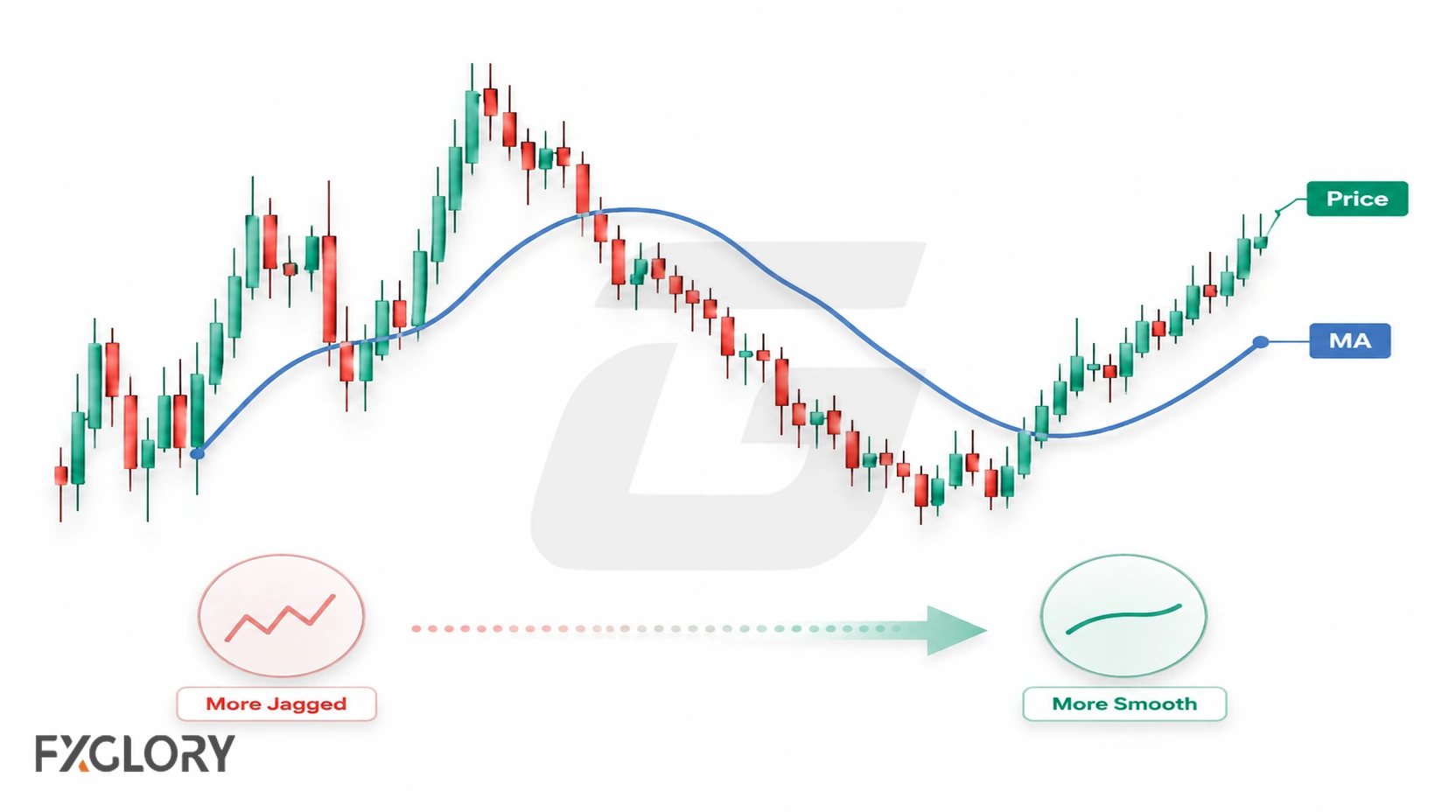
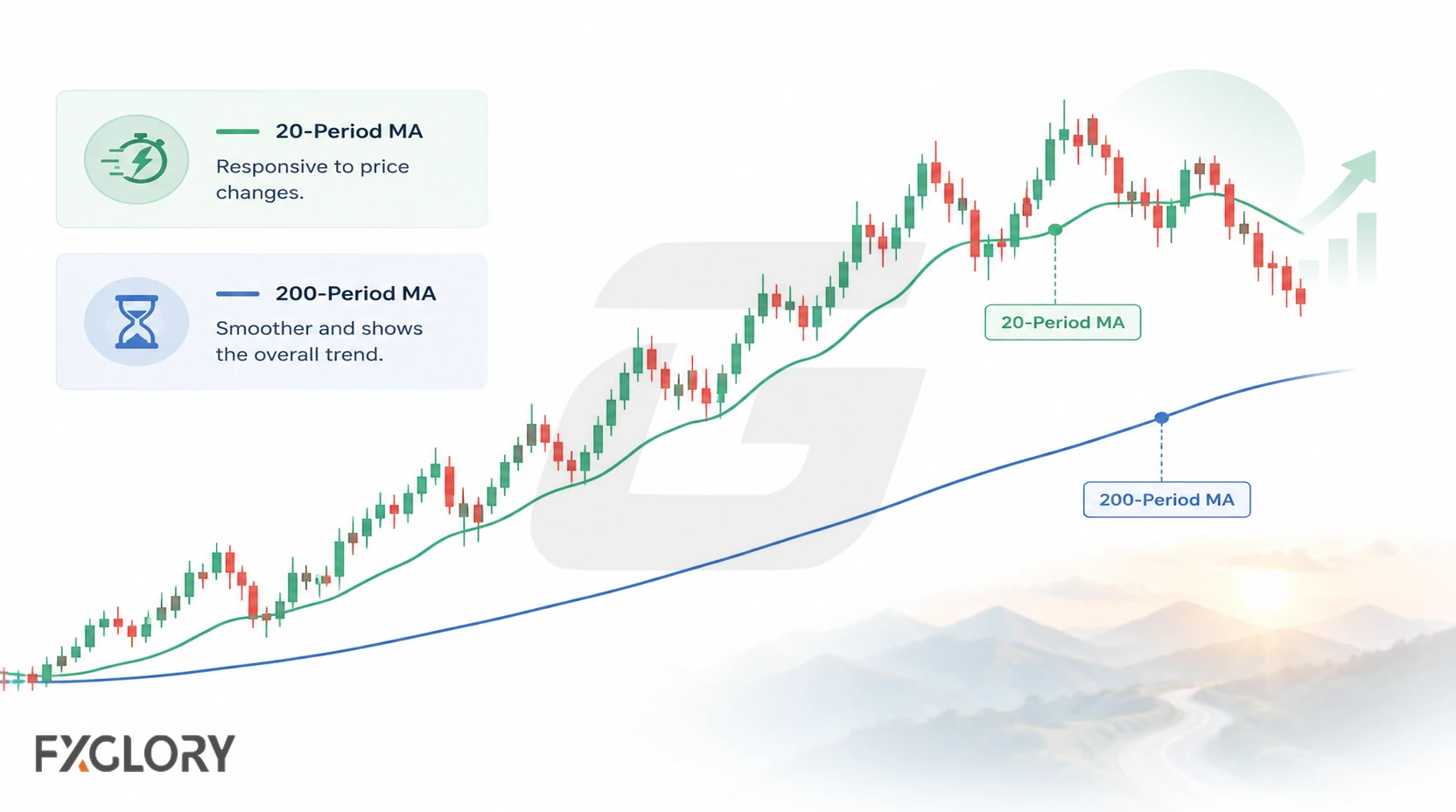
The selected period determines how much price history enters the calculation. A 20-period MA uses fewer candles than a 200-period MA, so it usually responds faster and stays closer to recent price.
Because the calculation is based on historical data, an MA is a lagging indicator. It can describe current chart context, but it does not forecast the next candle.
This page focuses on how moving-average lines work and how to read them. For the broader indicator framework, see forex technical indicators.
How Moving Averages Are Calculated
A moving average uses a selected price source, period length, calculation method, and chart timeframe. The value updates as new candles enter the calculation.
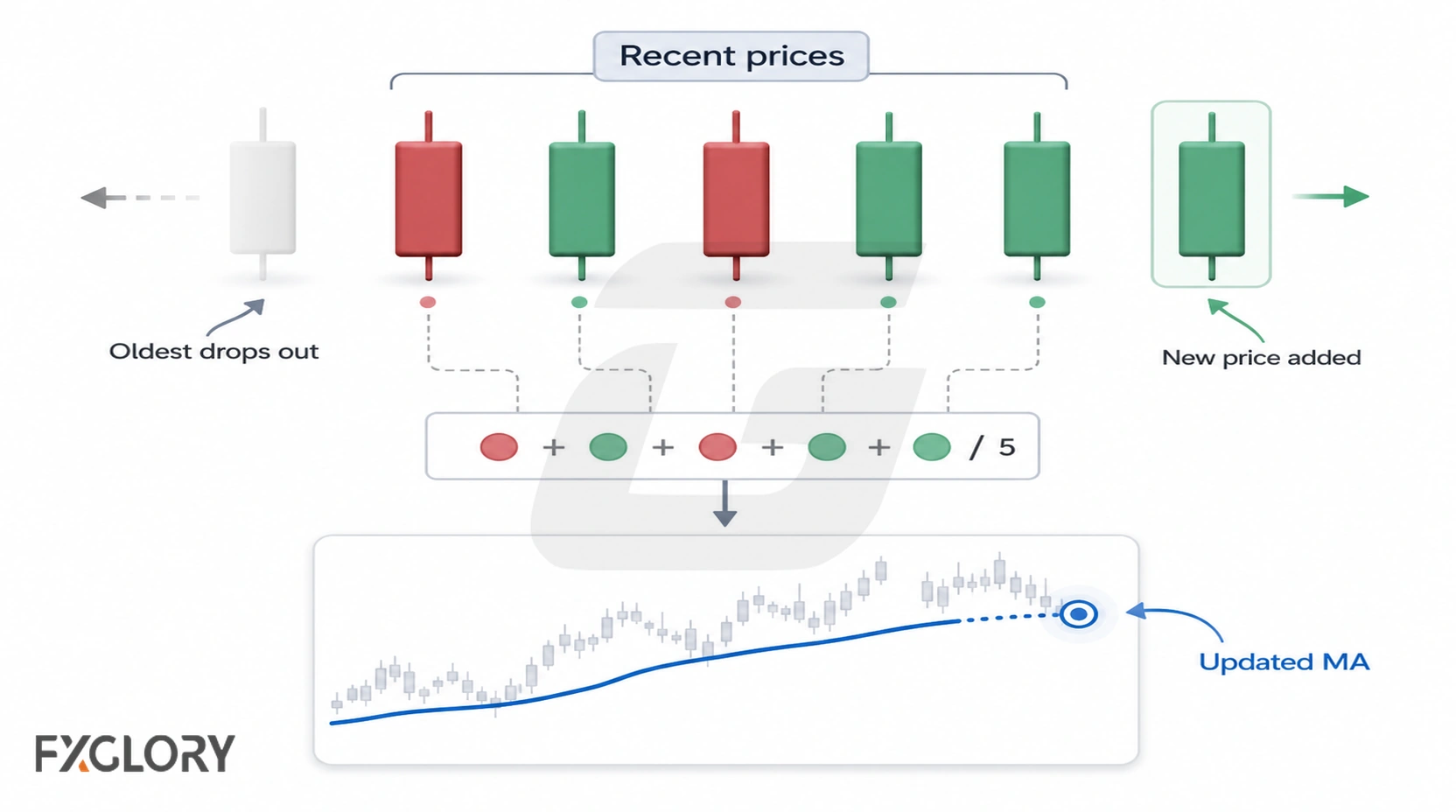
For a simple moving average, each selected price has equal weight. A 5-period SMA adds the five selected prices and divides the total by five. On the next candle, the oldest value drops out and the newest value enters.
| Input | What It Controls | Why It Matters |
|---|---|---|
| Price source | The data used in the calculation, often close price | Changing the source can change the plotted line |
| Period length | The number of candles included | Shorter and longer settings respond at different speeds |
| Calculation type | SMA, EMA, WMA, SMMA, VWMA, or another method | Different weighting methods change sensitivity |
| Timeframe | The chart interval where the MA is applied | A 20-period MA on a 5-minute chart is not the same calculation window as a 20-period MA on a daily chart |
These settings explain why two traders can look at the same currency pair and still see different moving-average lines.
SMA vs EMA vs Other Moving Averages
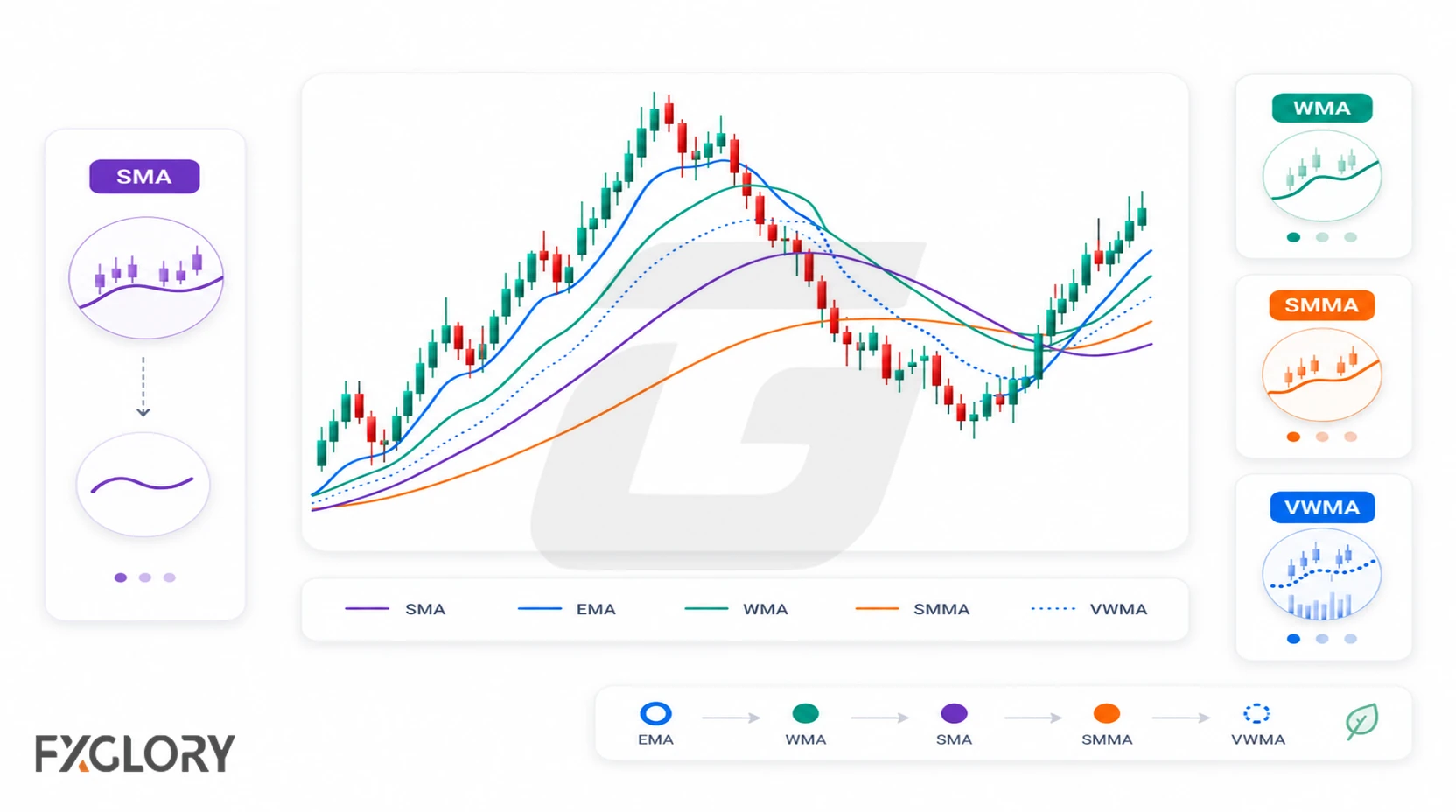
The main difference between moving-average types is how they weight the data inside the selected period. For beginners, the most useful comparison is usually SMA versus EMA.
| Moving Average Type | Calculation Behavior | Typical Trade-off |
|---|---|---|
| SMA | Gives equal weight to each selected price | Smoother response, with more delay after recent price changes |
| EMA | Gives more weight to recent prices | Faster response, with greater sensitivity to short-term movement |
| WMA | Weights prices differently across the selected period | Sensitivity depends on the weighting method |
| SMMA | Applies heavier smoothing across price data | Can react more slowly to new movement |
| VWMA | Includes volume in the calculation where volume data is available | The result depends on the available volume source |
Faster does not mean better. The useful choice depends on what the trader wants the line to describe and how much short-term movement should affect it.
Short vs Long Moving Average Periods
The MA period controls how many candles are included. Short settings emphasize recent movement, while long settings smooth a larger amount of price history.
| Setting | Typical Behavior | What to Watch |
|---|---|---|
| Short period | Responds faster and stays closer to recent price | More sensitivity to small moves and more frequent crosses |
| Long period | Produces a smoother, slower-moving line | More delay when price direction changes |
| Multiple MAs | Compares averages with different response speeds | Additional lines can help comparison but can also clutter the chart |
Common examples include 10, 20, 50, 100, and 200 periods, but those values are conventions rather than rules. The same period behaves differently when the chart timeframe or market condition changes.
How to Use a Moving Average in Forex Chart Analysis
Use an MA by reading several features together rather than treating one crossing or one price position as a complete signal.
| MA Reading | What It Describes | Key Limitation |
|---|---|---|
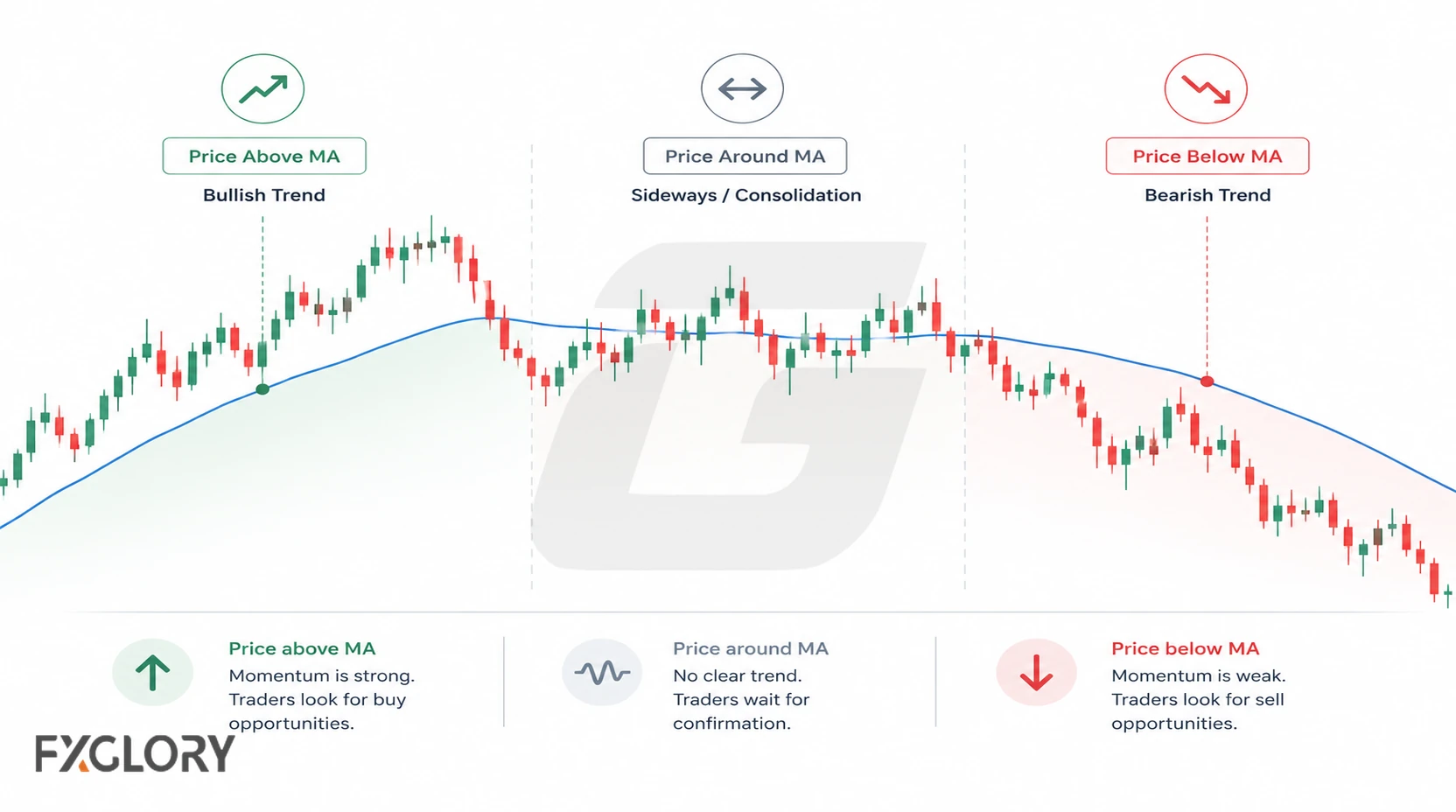
| Slope | Whether the average is rising, falling, or flattening | The change appears after price has already moved |
| Price above or below MA | Where current price sits relative to the selected average | Price can move back through the line |
| Distance from price | Whether price is close to or far from the average | Distance alone does not show whether price will continue or reverse |
| Fast and slow MA relationship | Whether the faster average is above or below the slower one | Both lines are based on past data |
| Moving average crossover | When one MA moves from one side of another MA to the other | The crossover can arrive late or repeat in a range |
A crossover records a change in the relationship between two averages. It is most useful as context to investigate, not as proof that a new trend has begun.
Moving Averages as Dynamic Reference Lines
Because an MA updates with each new candle, some traders use it as a changing reference line and watch whether price slows, crosses, rejects, or moves away near the line.
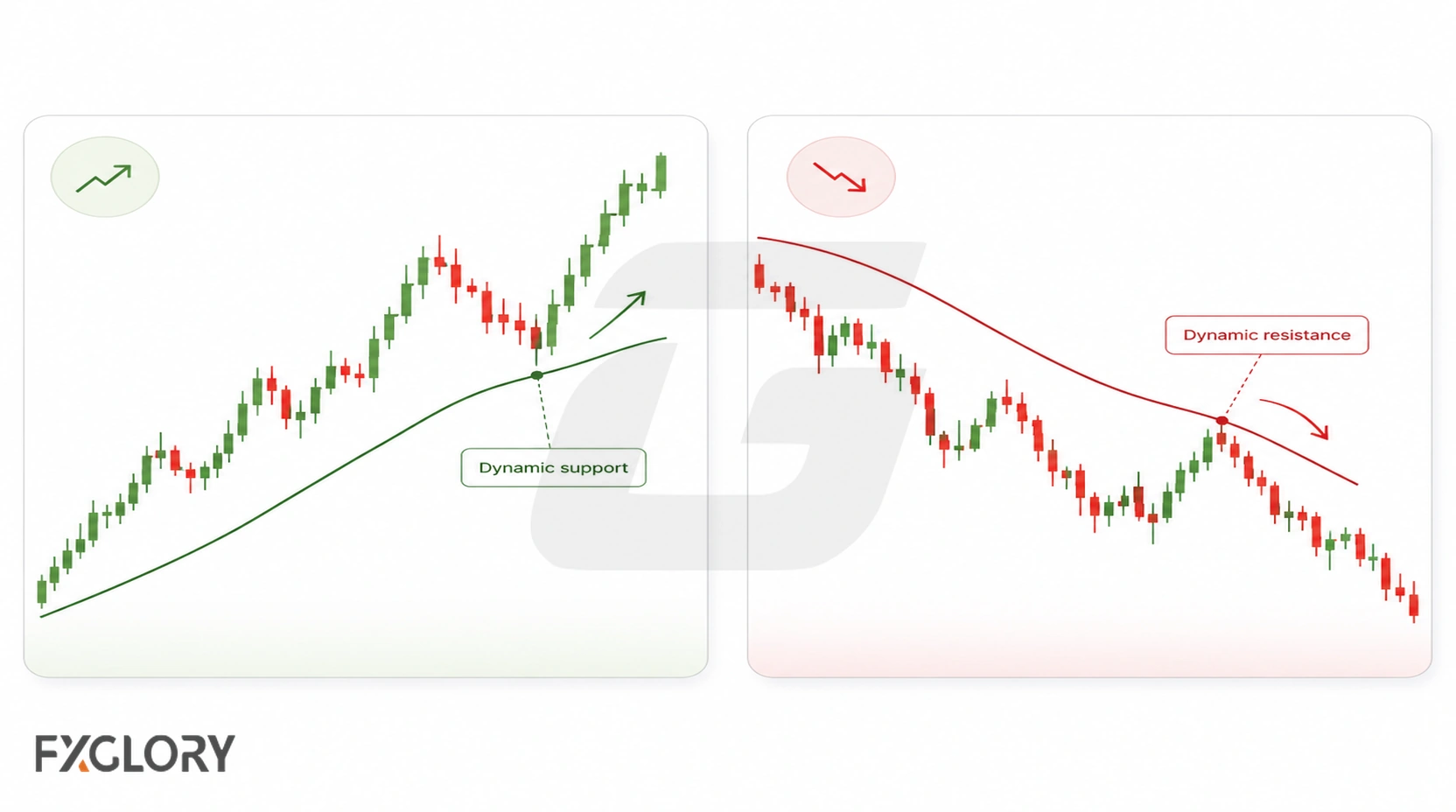
An MA is not historical support or resistance by itself. Treat any reaction near the line as observed price behavior rather than something the indicator forces price to do.
Moving Averages, Trend, and Price Action
A moving average is one way to summarize price behavior, but trend and price action describe different parts of the chart-reading process.
| Concept | Primary Role | Relationship to an MA |
|---|---|---|
| Price action | Raw candle and swing behavior | Shows the movement that the MA later smooths |
| Trend | Broader direction context | MA slope and price position can support a trend reading |
| Moving average | Rolling average of selected past price data | Provides a smoothed reference for chart context |
| MACD | A separate momentum indicator built from moving-average relationships | Uses moving averages but should not be treated as the same indicator |
For candle and swing behavior, review price action in forex. For broader direction context, see forex trend.
When a Moving Average Is Not Clear Enough
An MA reading becomes less useful when the chart does not support a consistent interpretation.
- Sideways movement: Price repeatedly crosses the MA while the line stays flat or changes slope frequently.
- Timeframe conflict: The MA reading on one timeframe does not match the broader chart condition being reviewed.
- News-driven movement: Sudden price movement can quickly make a recent indicator reading outdated.
- Mixed MA relationships: Several averages point in different directions or cross repeatedly, leaving no clear directional context.
When slope, price position, and MA relationships keep changing, the useful conclusion may simply be that the moving average is inconclusive in that condition.
Common Mistakes With Forex Moving Averages
Most moving-average mistakes come from asking the indicator to provide certainty that its calculation cannot provide.
- Treating crossovers as automatic signals: A crossover can fail, arrive late, or repeat when price is ranging.
- Treating price position as a guarantee: Price above an MA can move back below it, and price below an MA can move back above it.
- Assuming one setting is always best: No single MA type or period fits every pair, timeframe, and market condition.
- Changing settings after every poor reading: Repeatedly adjusting the period can make it difficult to judge whether the method is consistent.
- Overloading the chart: Too many MA lines can make the relationships harder to interpret rather than clearer.
- Ignoring execution and risk: Spread, volatility, liquidity, position size, and account risk still matter even when an MA reading looks clean.
- No invalidation: The trader cannot explain what price behavior would make the MA-based interpretation no longer valid.
Example: Moving Averages on NZD/USD
Suppose NZD/USD is being reviewed on one timeframe with a 20-period MA and a 50-period MA.
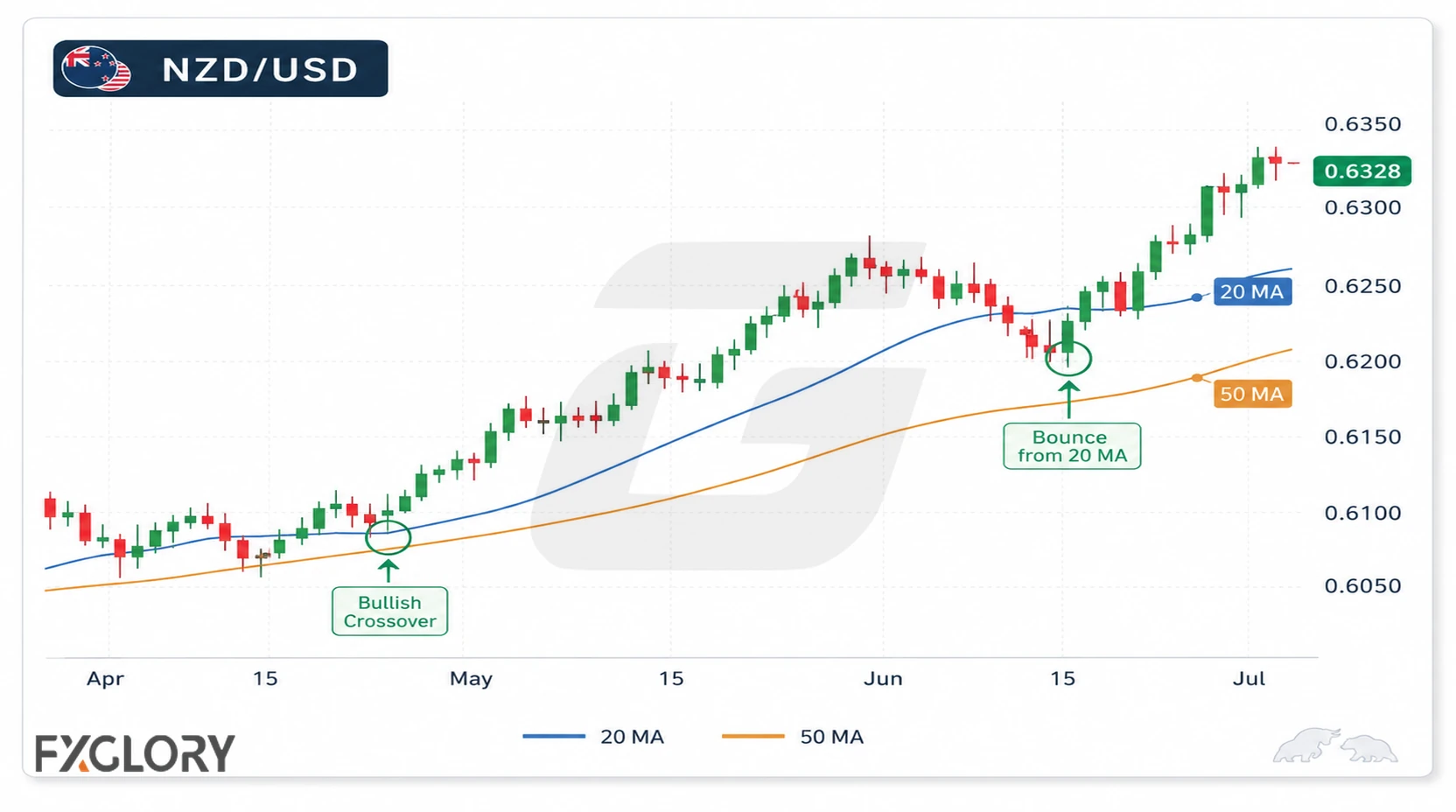
If both averages are rising and price stays mostly above them, that supports an upward moving-average context for that timeframe. If the faster MA crosses the slower MA, the relationship between the two averages has changed, but the crossover alone does not confirm continuation.
If both lines flatten and price moves back and forth through them, the MA evidence becomes less decisive. In that case, the chart is showing why market condition matters more than the presence of a crossover by itself.
A structured review can check the timeframe, MA type and periods, slope, price position, relationship between the averages, and the price behavior that would invalidate the interpretation. Spread, volatility, liquidity, position size, and account risk remain separate considerations.
How to Read Forex Moving Averages More Clearly
Start with the timeframe, price source, MA type, and period. Then read slope, price position, and any fast-versus-slow relationship together instead of relying on one feature in isolation.
If the line is flat, price keeps crossing it, or multiple averages give conflicting information, treat the MA reading as inconclusive rather than forcing a directional interpretation.