
What Is a Forex Trend?
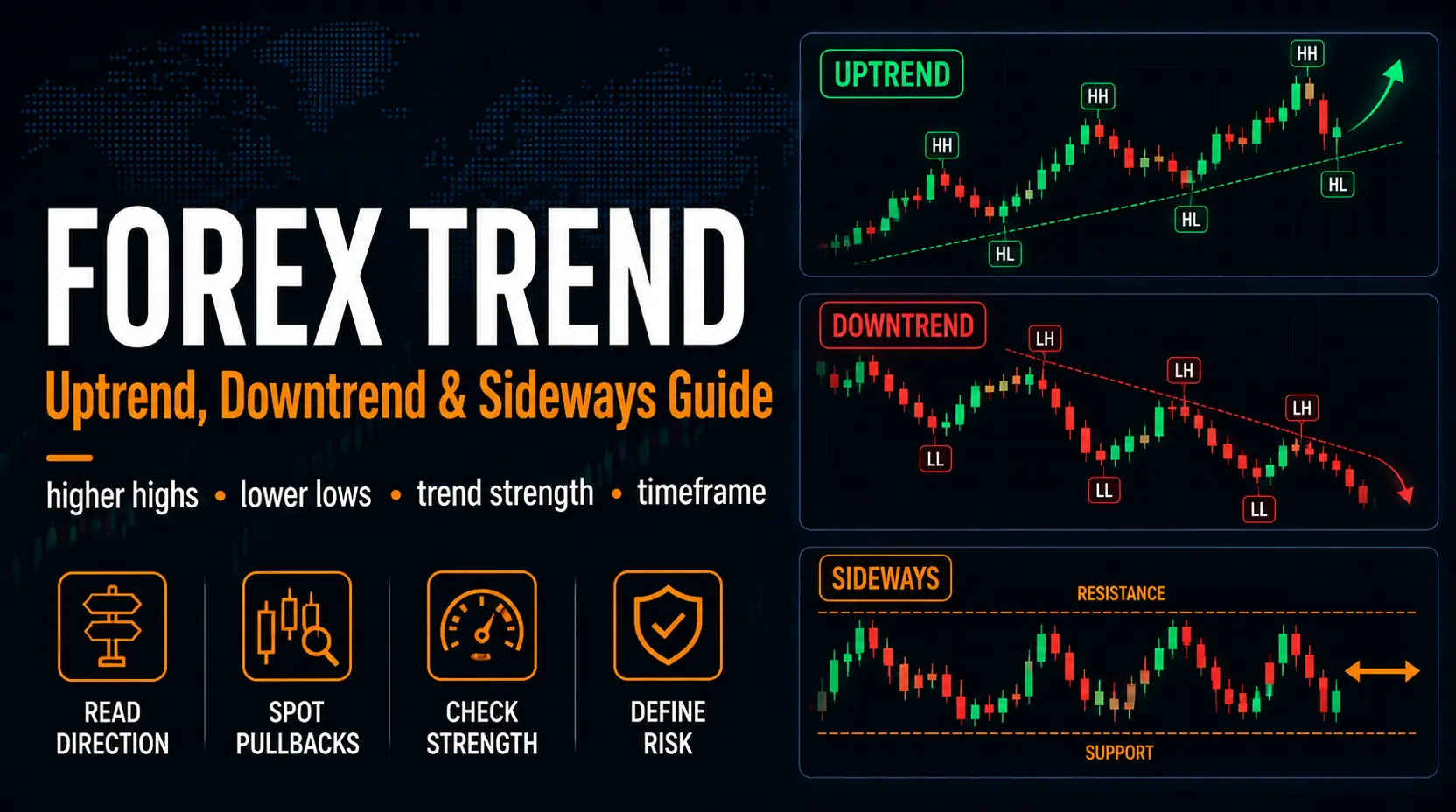
A forex trend is the general direction a currency pair is moving on a selected timeframe. Traders usually describe a trend as upward, downward, sideways, or unclear.
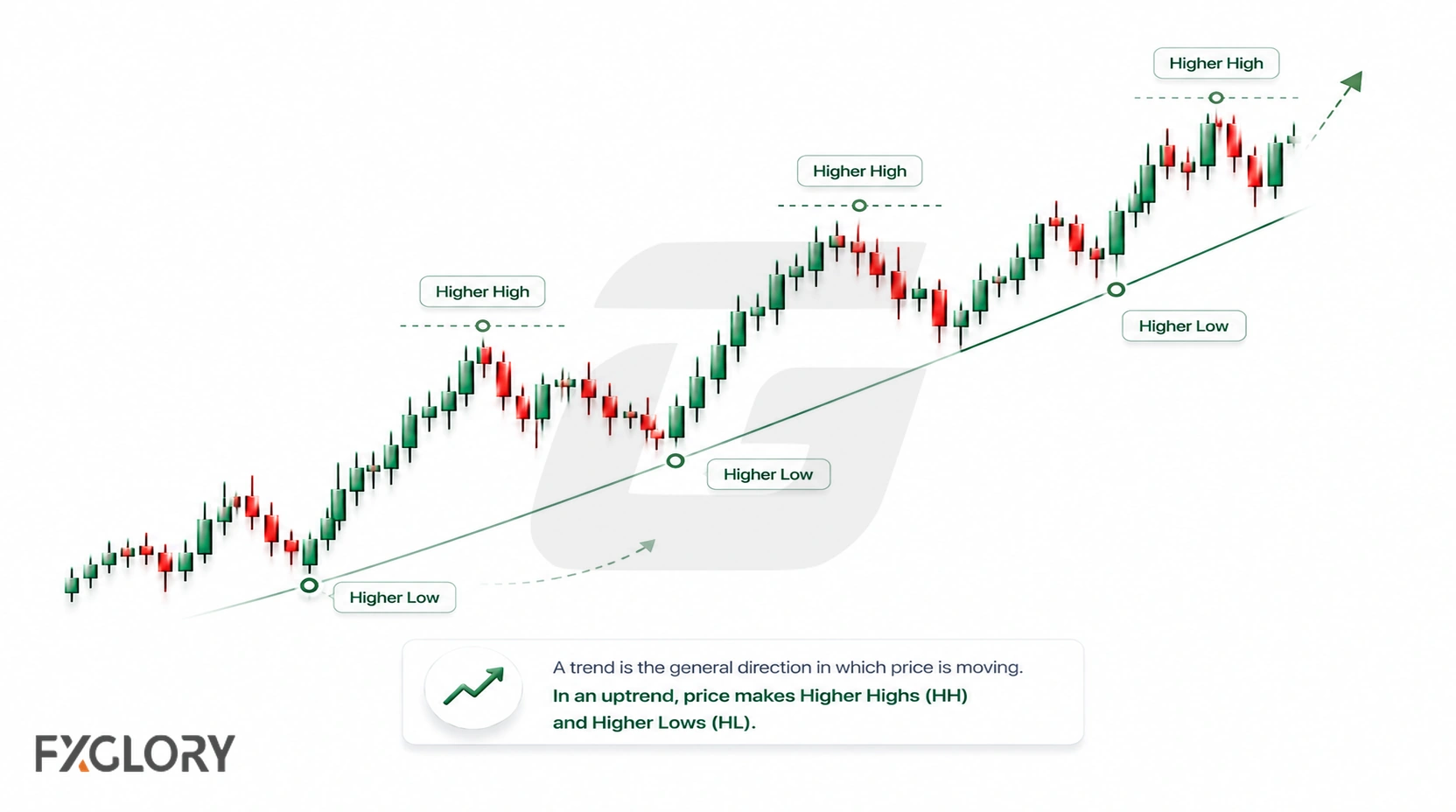
A trend gives the chart a directional label before any setup is considered. It does not tell a trader where to enter, where to exit, or how much to risk by itself. A trend can continue, weaken, reverse, or turn into a range.
This guide focuses on trends as part of forex technical analysis. For the broader chart-reading framework, start with the full technical-analysis roadmap.
Uptrend, Downtrend, and Sideways Market
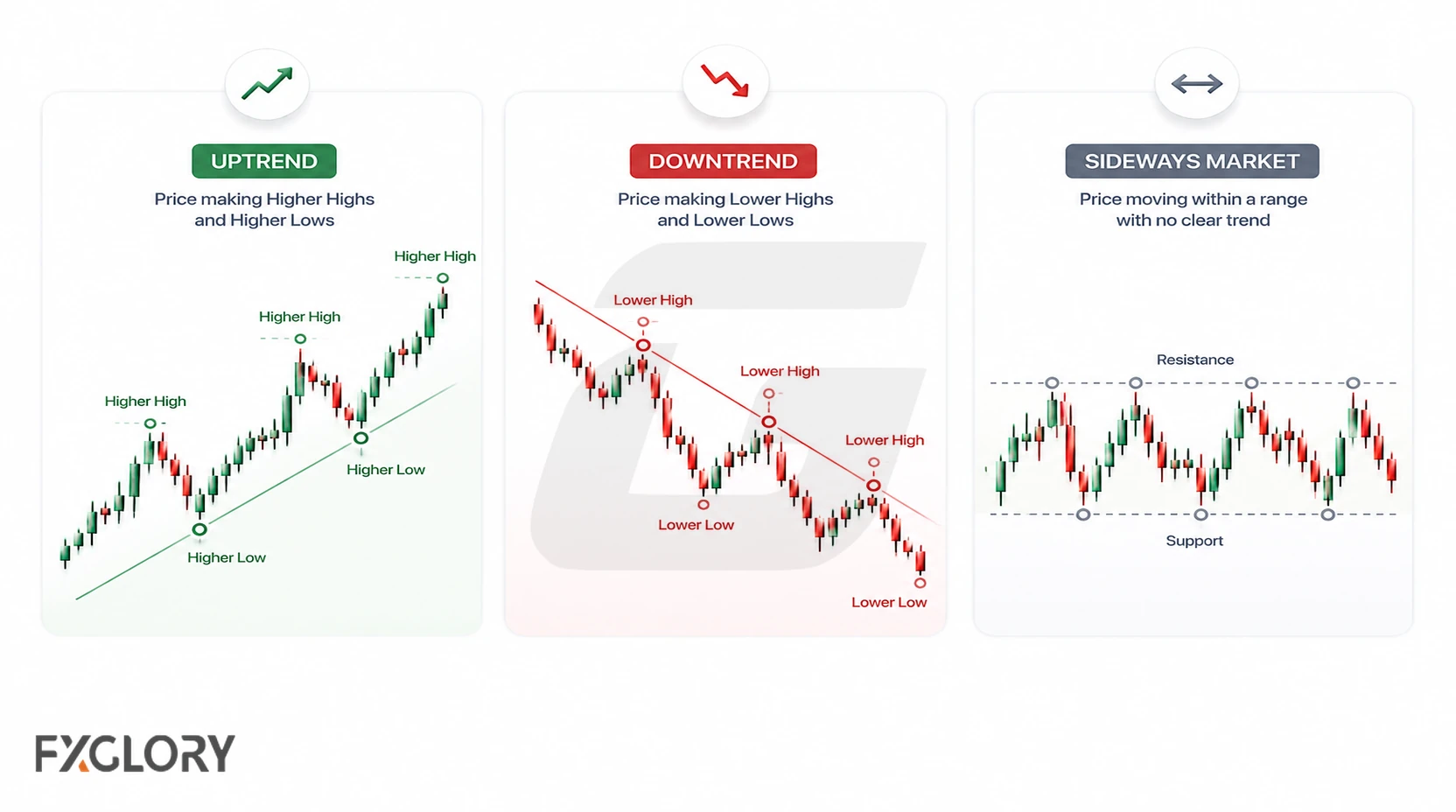
Forex trends are usually grouped into upward, downward, sideways, and unclear conditions. These labels describe the current condition, not the next candle.
| Trend Type | What It Looks Like | What It Does Not Mean |
|---|---|---|
| Uptrend | Price generally forms higher highs and higher lows | It does not mean every pullback is a buy |
| Downtrend | Price generally forms lower highs and lower lows | It does not mean every rally is a sell |
| Sideways market | Price moves between similar highs and lows | It does not mean the chart is useless |
| Unclear trend | Price overlaps, whipsaws, or lacks clean direction | It does not need to be forced into a trend label |
No clear trend is also useful information. It can tell the trader that directional assumptions may be weak.
Forex Trend vs Market Structure and Price Action
A forex trend is connected to market structure and price action, but these ideas are not the same. Trend describes broad direction. Market structure explains the swing-by-swing evidence behind that direction.
- Trend: Describes the general direction of price on a selected timeframe.
- Market structure: Shows the swing-by-swing arrangement behind a trend, range, transition, or unclear condition. Use the swing-by-swing structure view when the trend depends on highs and lows.
- Price action: Shows how price moves inside the trend. Use the movement inside the trend to review current behavior.
- Support and resistance: Helps identify areas where a trend may pause, react, break, or fail. For that context, review the reaction zones around a trend.
This page uses trend as direction context. It does not replace market-structure analysis, price-action reading, or risk management.
Trend Direction vs Trend Strength
Trend direction and trend strength are not the same. Direction describes where price has been moving. Strength describes how clean, persistent, or vulnerable that movement appears.
| Concept | Question It Answers | Main Risk |
|---|---|---|
| Trend direction | Is price moving up, down, sideways, or unclear? | Direction can change after the trader labels it |
| Trend strength | Is the move clean, steady, weak, choppy, or stretched? | A trend can weaken before it clearly reverses |
| Trend invalidation | What price behavior would make the trend idea wrong? | Without invalidation, the label can become hope |
A currency pair can still be moving upward while the move is weakening. It can also pause inside a downtrend without creating a confirmed reversal.
Pullback, Weakness, Reversal, and Range Transition
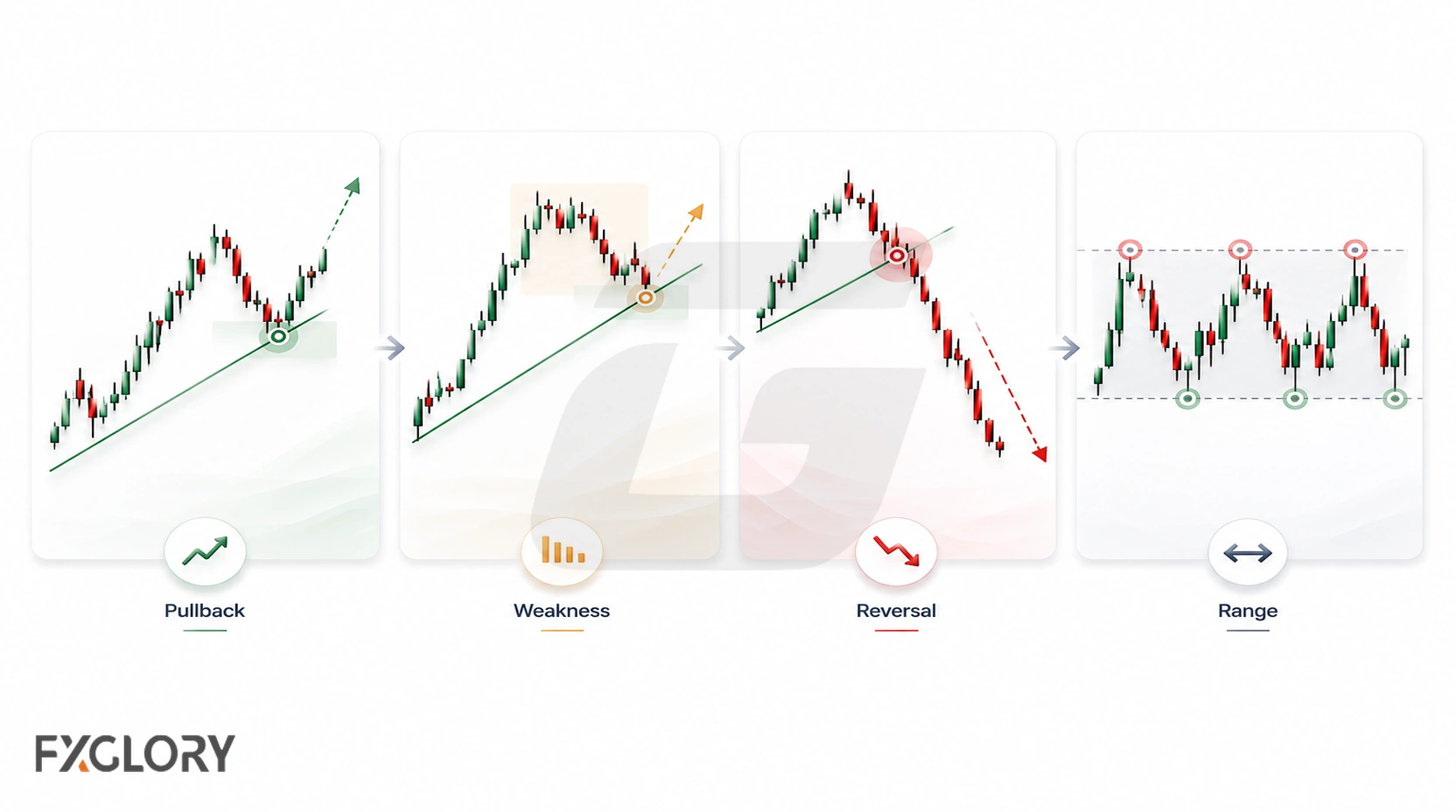
A trend does not end every time price moves against it. Beginners often confuse normal pullbacks, early weakness, reversals, and range transitions.
| Condition | What It Means | Main Risk |
|---|---|---|
| Pullback | A temporary move against the trend | The pullback can deepen or change character |
| Trend weakness | The trend loses clean progress or becomes less persistent | Weakness is not always a reversal |
| Reversal | The prior direction starts changing | Reversals are often clearer after more evidence appears |
| Range transition | The trend stops making clean progress and price begins overlapping | Trend tools may fail in sideways conditions |
This distinction helps prevent a trader from calling every pullback a reversal or every weak move a continuation.
How Traders Identify Forex Trends
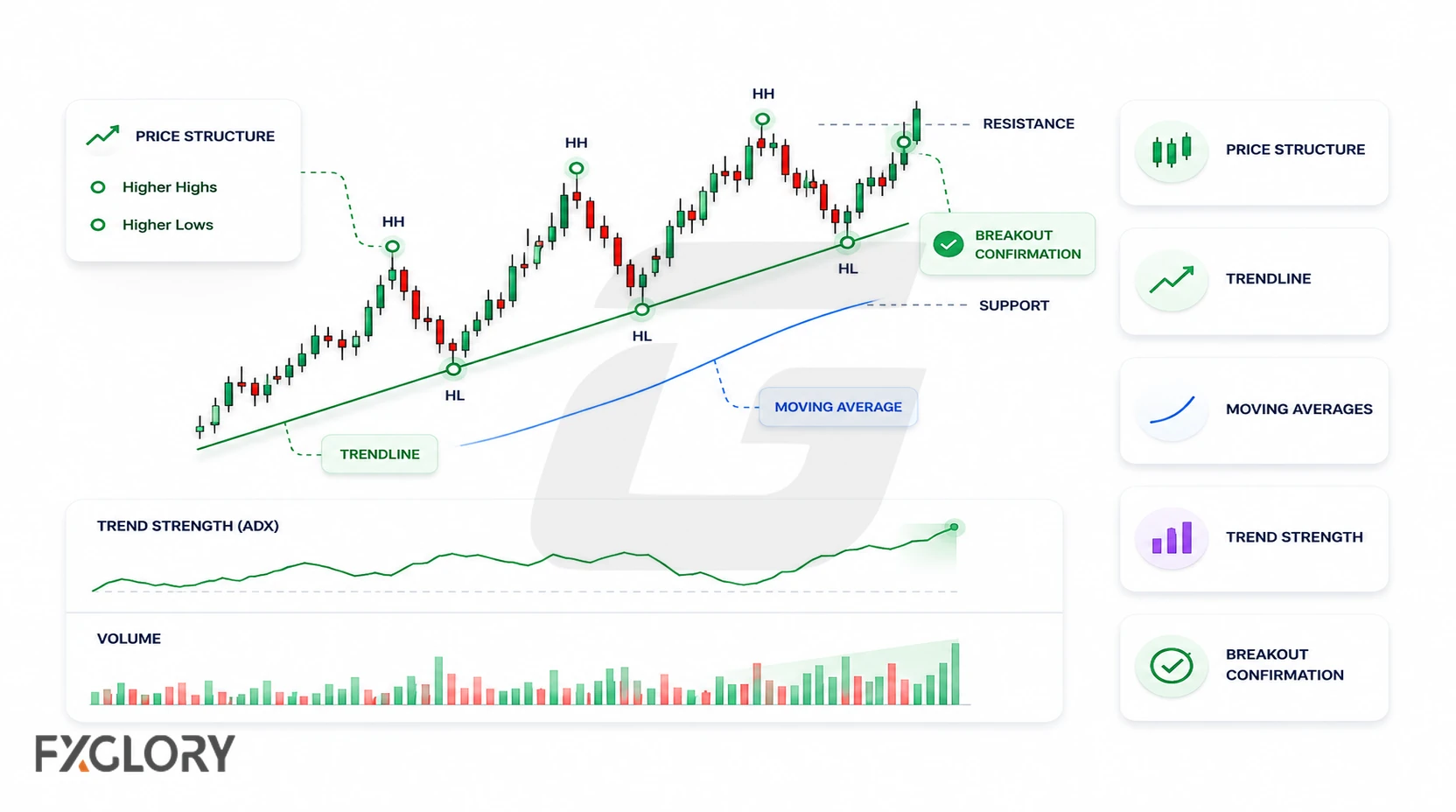
Traders may use several tools to identify trend direction. Each tool gives context, not certainty.
| Tool | How It Helps | Beginner Risk |
|---|---|---|
| Swing behavior | Shows whether price is building directional progress or losing it | Minor movement can be confused with the main trend |
| Trend lines | Connects visible highs or lows to show directional pressure | Forced trend lines can create false confidence |
| Moving averages | Smooths price movement to show possible direction | A moving average can lag or whipsaw in ranges |
| Channels | Shows movement inside a broad rising, falling, or sideways path | Channels can break or become too subjective |
| Live market screens | Shows current performance or direction across pairs | Live rankings change and do not replace chart context |
A tool is only useful when the trader can explain what it shows and where the trend idea fails.
Trend Trading vs Reading a Trend
Reading a trend means identifying the direction and condition of price. Trend trading is a trading approach that uses that trend context to build possible trade scenarios.
The two should not be confused. A trend can help a trader describe the chart, but it does not create a complete trade plan by itself.
- Trend reading: Describes direction, strength, timeframe, and invalidation.
- Trend trading: Uses that context to plan a possible trade, if risk and conditions allow.
- Risk control: Still needed because a trend can fail, reverse, or become choppy.
Why Forex Trends Depend on Timeframe
Trend direction depends on the timeframe being studied. A currency pair may look bullish on a short-term chart while still moving sideways or downward on a higher timeframe.
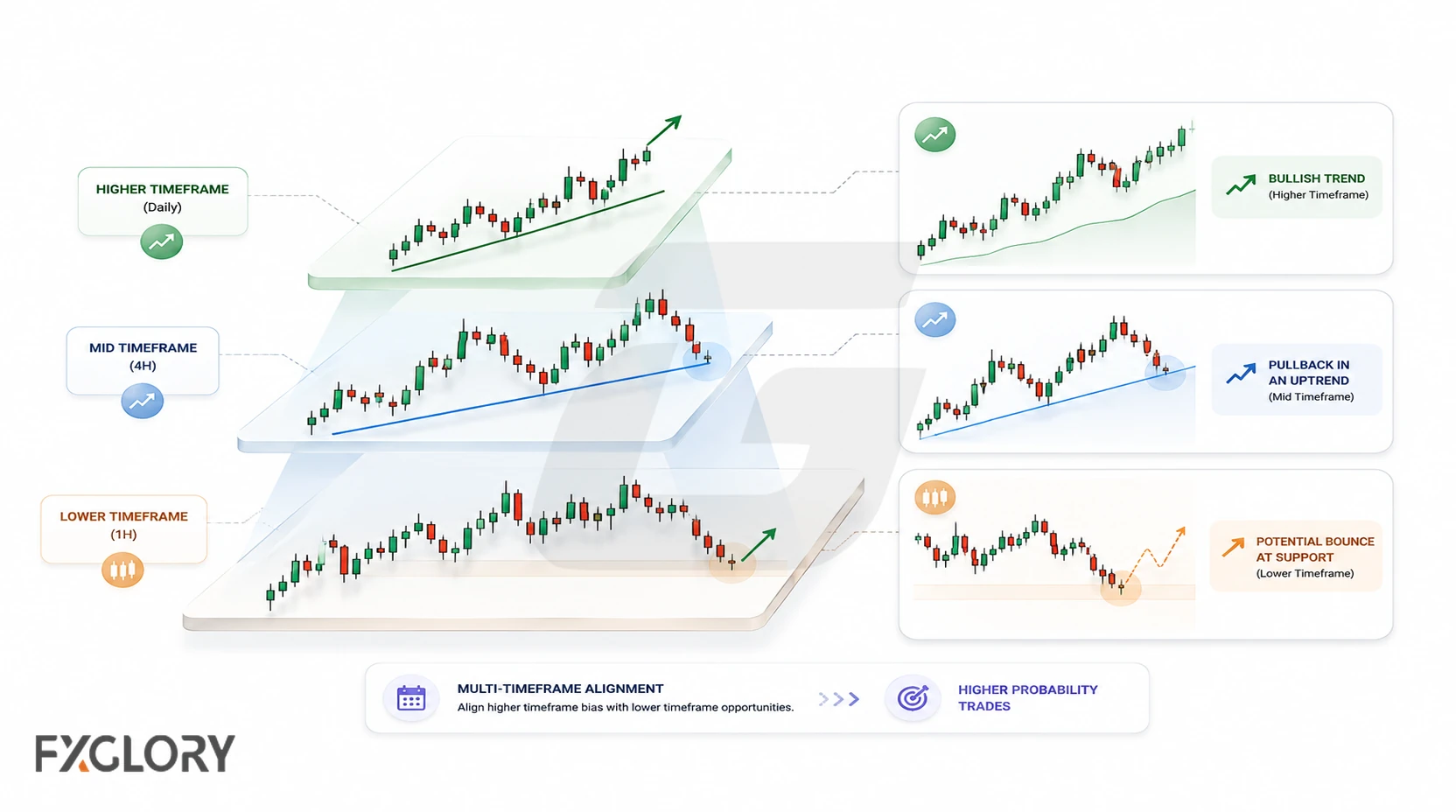
- Higher timeframe: Helps describe the broader trend or range.
- Middle timeframe: May show the current movement inside that broader condition.
- Lower timeframe: Shows more detail, but can also show more noise.
- Conflicting timeframes: A short-term trend may disagree with the larger chart context.
A trend label without a timeframe is incomplete. The trader should be able to say which pair, which timeframe, and which chart condition is being described.
Current Forex Trends vs Trend Concepts
Current forex trends can change throughout the trading day. Market maps, currency screens, and live charts may show which pairs are moving strongly at that moment, but those readings are temporary.
Trend concepts are the reusable part: direction, strength, timeframe, and invalidation. A live ranking can show movement now, but it does not explain whether the move is clean, late, risky, or close to invalidation.
When a Forex Trend Is Not Clear Enough
A trend is not always clean. Some charts are too choppy, fast, or conflicted to support a clear trend read.
- Overlapping movement: Price keeps moving back and forth without clear direction.
- Weak swing points: Highs and lows are too small or inconsistent to define a trend.
- Forced trend lines: The trader draws lines to fit a preferred idea instead of visible structure.
- Range conditions: Price keeps returning to similar highs and lows instead of trending.
- News spikes: A sharp move may look like a trend but can fade after the event.
- Timeframe conflict: The trend appears on one timeframe but disagrees with a higher timeframe.
- No invalidation: The trader cannot explain where the trend idea is wrong.
Common Mistakes With Forex Trends
Forex-trend mistakes often come from treating direction as if it were a complete trading plan.
- Calling every move a trend: A short price burst is not always a trend.
- Ignoring timeframe: A lower-timeframe trend can be noise inside a higher-timeframe range.
- Entering late: A trend can be stretched by the time it becomes obvious.
- Assuming pullbacks are safe: A pullback can continue, deepen, or become a reversal.
- Forcing trend lines: A line that only works after heavy adjustment may not be useful.
- Ignoring spread and liquidity: Execution conditions still matter even when direction looks clear.
- No invalidation: The trader cannot explain where the trend idea fails.
Example: Reading a Forex Trend on EUR/USD
Suppose EUR/USD is moving mostly upward on the timeframe being studied. A beginner may describe that as an uptrend on that timeframe.
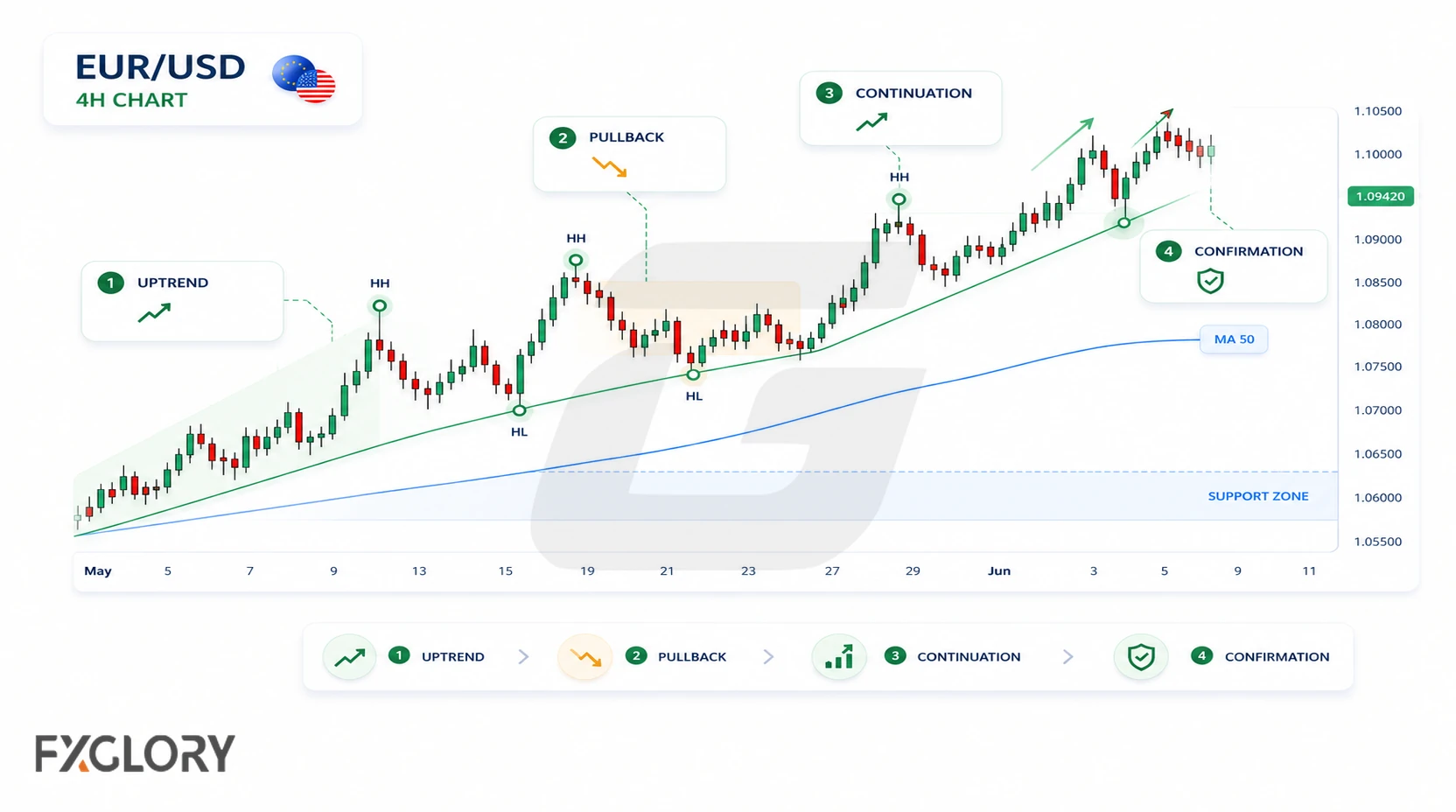
The label does not mean EUR/USD must keep rising. The trader still needs to check whether the move is clean or choppy, whether the higher timeframe agrees, whether price is near a reaction zone, and where the trend idea becomes invalid.
If price stops making clean upward progress and begins overlapping, the trend may be weakening or transitioning into a range. If price clearly changes direction, the chart may need to be reviewed again.
A Safer Way to Read Forex Trends
A forex trend is useful only when the pair, timeframe, direction, strength, and invalidation point are clear.
Trend reading becomes more useful when the trader separates direction from strength. A trend should be checked against swing structure, price behavior, timeframe context, reaction zones, invalidation, and risk.
The important beginner lesson is that a trend is context, not a command. The trader should be able to explain the pair, timeframe, direction, strength, invalidation point, and risk before using real money.