

Quick Answer: Can You Make Money Trading Forex?
That distinction is important because “making money” can mean several different things: closing one trade at a profit, being net profitable over time, withdrawing regular income, or building substantial wealth. Those outcomes should not be treated as interchangeable.
For a trading method to be viable, it needs a repeatable edge, controlled risk, realistic position sizing, and enough trade history to evaluate how it behaves through both winning and losing periods.
Realistic Forex Trading Expectations and Retail Loss Data
Forex offers the possibility of gains and the possibility of losses. Leverage, trading costs, execution, market volatility, and trader behavior can all change the final result, so profitability should be evaluated from net results rather than from screenshots, isolated trades, or advertised returns.
Retail loss data provides useful context. In one CFTC educational warning referenced by this article, roughly one-third of customers at registered OTC forex dealers made a profit while about two-thirds lost money after costs and expenses. That figure should not be treated as a universal forex success rate: percentages can vary by dealer, period, jurisdiction, account type, and market conditions.
The practical lesson is narrower: retail losses are common enough that a beginner should not assume profitability before testing a process and measuring results after costs.
Making Money vs Profitability vs Income vs Wealth
The phrase “make money trading forex” covers several different questions. Separating them makes expectations easier to evaluate.
| Question | What it measures | What must be evaluated |
|---|---|---|
| Can one trade make money? | Whether one position closes with a positive net result. | Price movement, position size, and trading costs. |
| Is a method profitable? | Whether many trades produce a positive net result over time. | Expectancy, costs, losses, drawdowns, and consistency. |
| Can trading provide income? | Whether profits can support recurring withdrawals. | Capital, variability of returns, withdrawals, and losing periods. |
| Can trading build substantial wealth? | Whether capital can grow to a much larger amount over time. | Starting capital, compounded net returns, withdrawals, losses, and time. |
A trader can therefore answer “yes” to the first question without having evidence for the other three. Long-term results require a much larger sample than a single winning position.
How Forex Profit and Loss Work
Forex traders try to profit from changes in currency-pair prices. A trader may buy a pair if they expect it to rise or sell a pair if they expect it to fall.
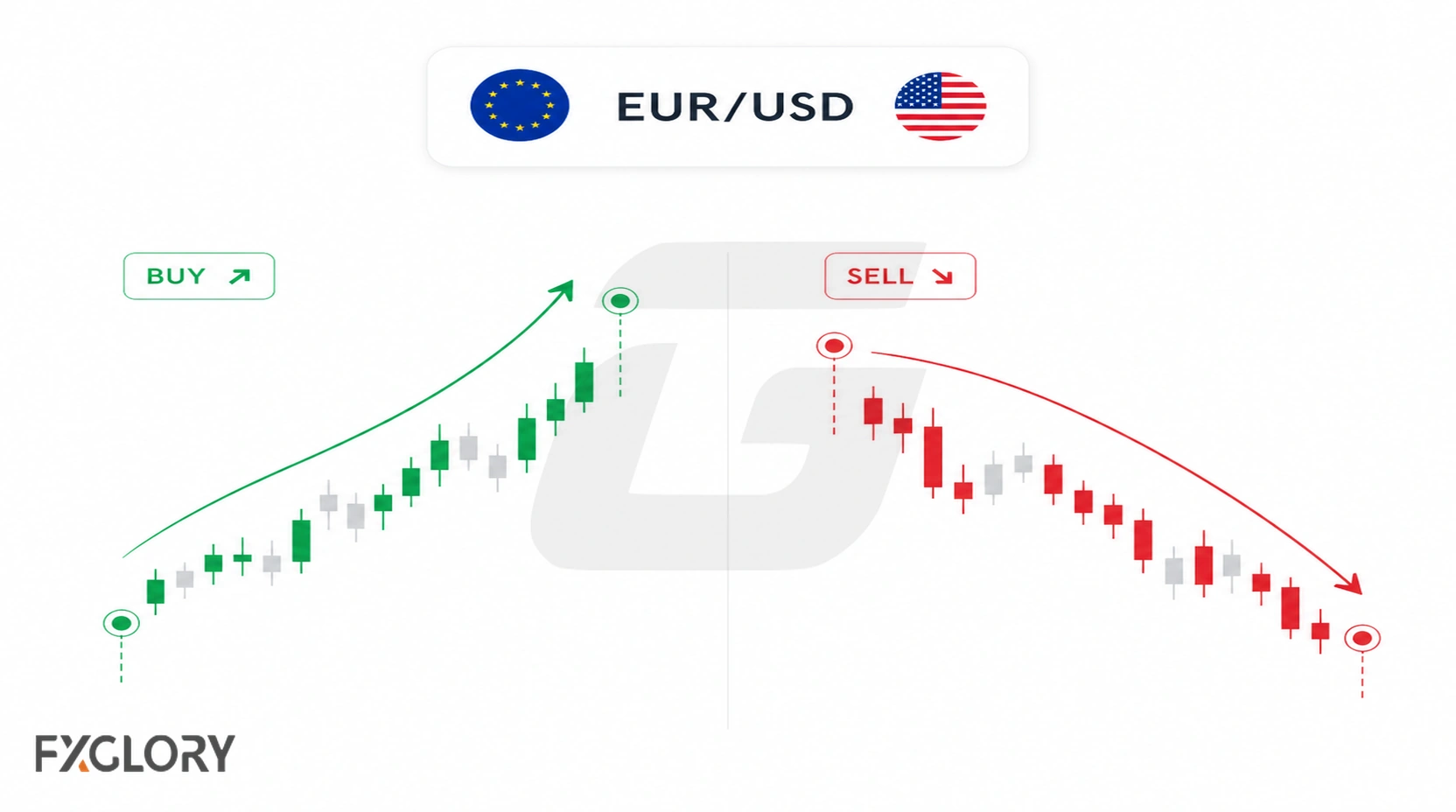
How Do Traders Try to Earn Money From Forex?
A buy position benefits from an upward move in the pair, while a sell position benefits from a downward move. Direction alone does not determine the final cash result because position size, spread, slippage, swaps, account currency, commissions if applicable, and trade management also matter.
| Trade | Pair move | Directional effect | What still affects the result |
|---|---|---|---|
| Buy EUR/USD | Up | Favorable | Lot size, costs, and execution. |
| Buy EUR/USD | Down | Unfavorable | Lot size, stop placement, and execution. |
| Sell EUR/USD | Down | Favorable | Lot size, costs, and execution. |
| Sell EUR/USD | Up | Unfavorable | Lot size, stop placement, and execution. |
Gross Result vs Net Result
Gross result is the price-movement result before trading costs. Net result is what remains after spread, slippage, swaps, commissions if applicable, and other execution effects.
A trader can be correct about direction but still earn less than expected if spread widens, slippage occurs, or position sizing creates more exposure than intended.
Before evaluating profit, beginners should understand pips, lot size, bid and ask price, and leverage.
Why Beginners Often Lose Money in Forex
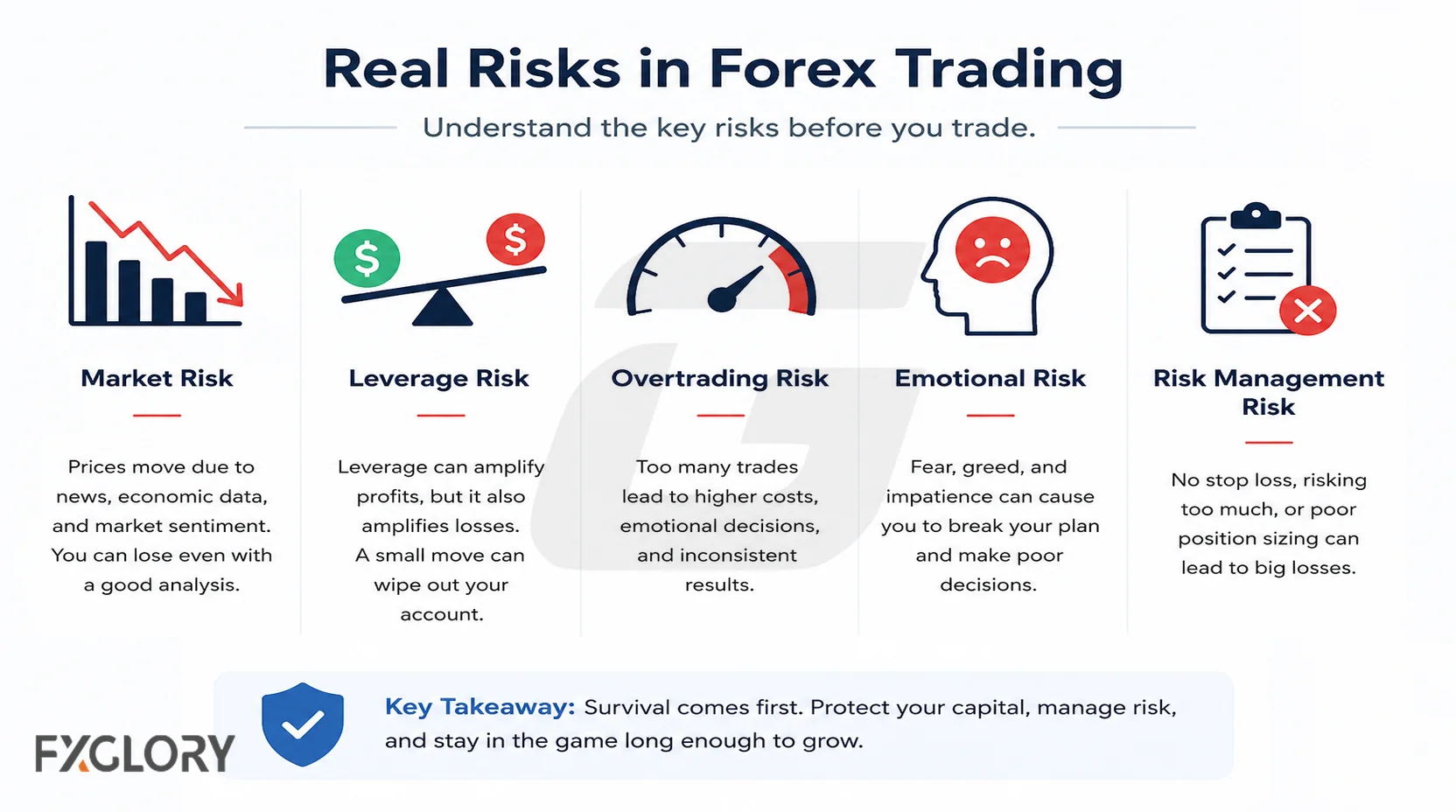
Beginner losses usually come from several factors working together rather than one single mistake. A strategy may be untested, risk may be too large, costs may be underestimated, and emotional decisions may override the original plan.
An edge is a repeatable reason a method may produce positive expectancy after costs. Without evidence of an edge, individual wins can occur without showing that the process is profitable.
- Oversized positions: A normal price move can create a disproportionately large account loss.
- Excessive leverage: Greater market exposure magnifies the account impact of both favorable and unfavorable moves.
- Unclear or untested rules: Entries and exits change from trade to trade instead of following a defined process.
- Ignoring costs: Spread, slippage, swaps, and commissions if applicable reduce net results.
- Changing stops emotionally: Planned risk expands after the trade is already losing.
- Revenge trading: Position size or trade frequency increases after losses.
- Income pressure: The need to make a specific amount can encourage trades that do not meet the strategy’s rules.
- Following unverified claims: Screenshots, signal sellers, or lifestyle marketing replace independent testing.
Can Forex Make You Rich, a Millionaire, or Provide a Living?
These questions are mainly questions about capital, net return, withdrawals, losses, and time. There is no single forex return that converts automatically into wealth or a full-time income.
Building Wealth With Forex
If an account grows after costs and losses, its value can compound. But the path depends heavily on starting capital and on the sequence of returns. A larger target from a small starting balance requires a much larger cumulative gain than the same target from a large starting balance.
Using more leverage can accelerate account changes in either direction, so increasing exposure to reach a wealth target faster also increases the potential size of losses.
Trading Forex for a Living
Trading income is different from a salary because returns can vary from month to month. A trader relying on withdrawals needs enough capital and sufficiently stable net results to cover withdrawals without making the account unable to withstand drawdowns or losing periods.
That means the relevant question is not only “how much can I make?” but also “how variable are the results, how large are the drawdowns, and how much capital remains after withdrawals?”
Small Forex Account Math: What Percentage Changes Mean in Cash
Account size changes the cash value of a percentage gain or loss. The table below is arithmetic only; it is not a return target, forecast, or recommended performance level.
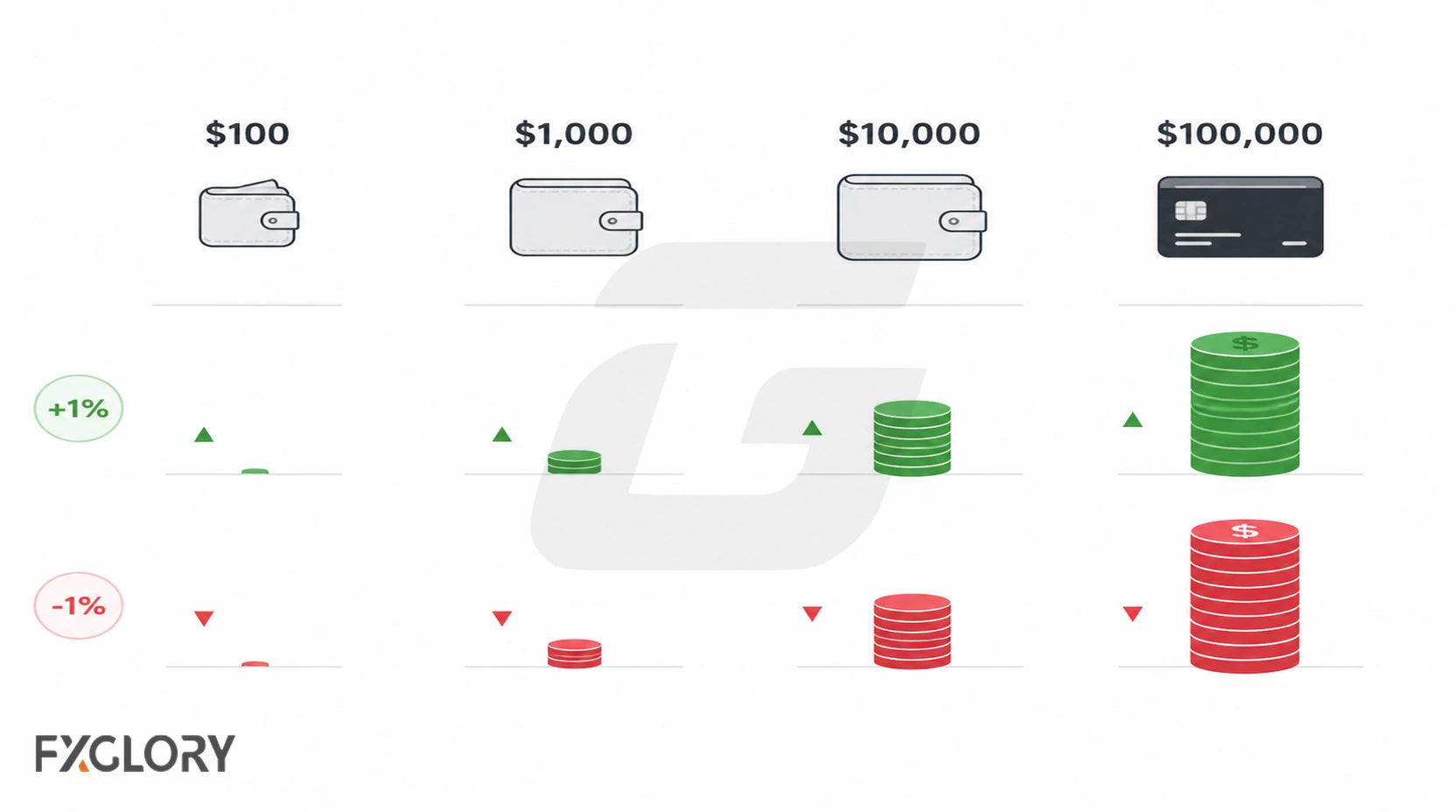
| Account size | 1% account change | 5% account change | What the arithmetic shows |
|---|---|---|---|
| $100 | +$1 or -$1 | +$5 or -$5 | Each 1% equals $1. |
| $1,000 | +$10 or -$10 | +$50 or -$50 | Each 1% equals $10. |
| $10,000 | +$100 or -$100 | +$500 or -$500 | Each 1% equals $100. |
| $100,000 | +$1,000 or -$1,000 | +$5,000 or -$5,000 | Each 1% equals $1,000. |
If a trader wants a specific cash withdrawal from a smaller balance, the required percentage return is higher. Chasing that percentage by increasing lot size or leverage also increases the size of potential losses, so cash-income goals should not determine position size.
Risk, Costs and Profitability Math
Long-term profitability depends on the relationship between wins, losses, costs, and position sizing rather than on directional accuracy alone.
Trading Expectancy
Expectancy helps show why win rate alone is not enough. For example, if a trader wins 60% of trades with an average win of $10 and loses 40% with an average loss of $20, expectancy is 0.60 × $10 - 0.40 × $20 = -$2 per trade before additional costs.
Drawdown
Drawdown is the decline from a previous account peak to a lower value. A strategy can have profitable periods and still experience drawdowns, so any evaluation should consider both return and the losses required to achieve it.
Leverage, Spread and Lot Size
- Leverage: Increases market exposure relative to deposited funds.
- Spread: The difference between buy and sell prices and part of the trading cost.
- Lot size: Determines position size and therefore the cash impact of each pip.
- Slippage: The difference that can occur between an expected price and the executed price.
- Margin: Funds required to open or maintain a leveraged position.
Risk-first rule: Position size should be based on the amount the plan allows the trader to lose if the trade is invalidated, not on a desired cash profit.
For deeper learning, see what is lot size in forex, what is leverage in forex trading, and bid and ask price in forex.
Red Flags: Forex Hype, Scams and Guaranteed Returns
Claims about easy income or rapid wealth should be evaluated separately from the mechanics of trading. Marketing can show profitable examples without showing losing trades, costs, drawdowns, or whether the results are repeatable.
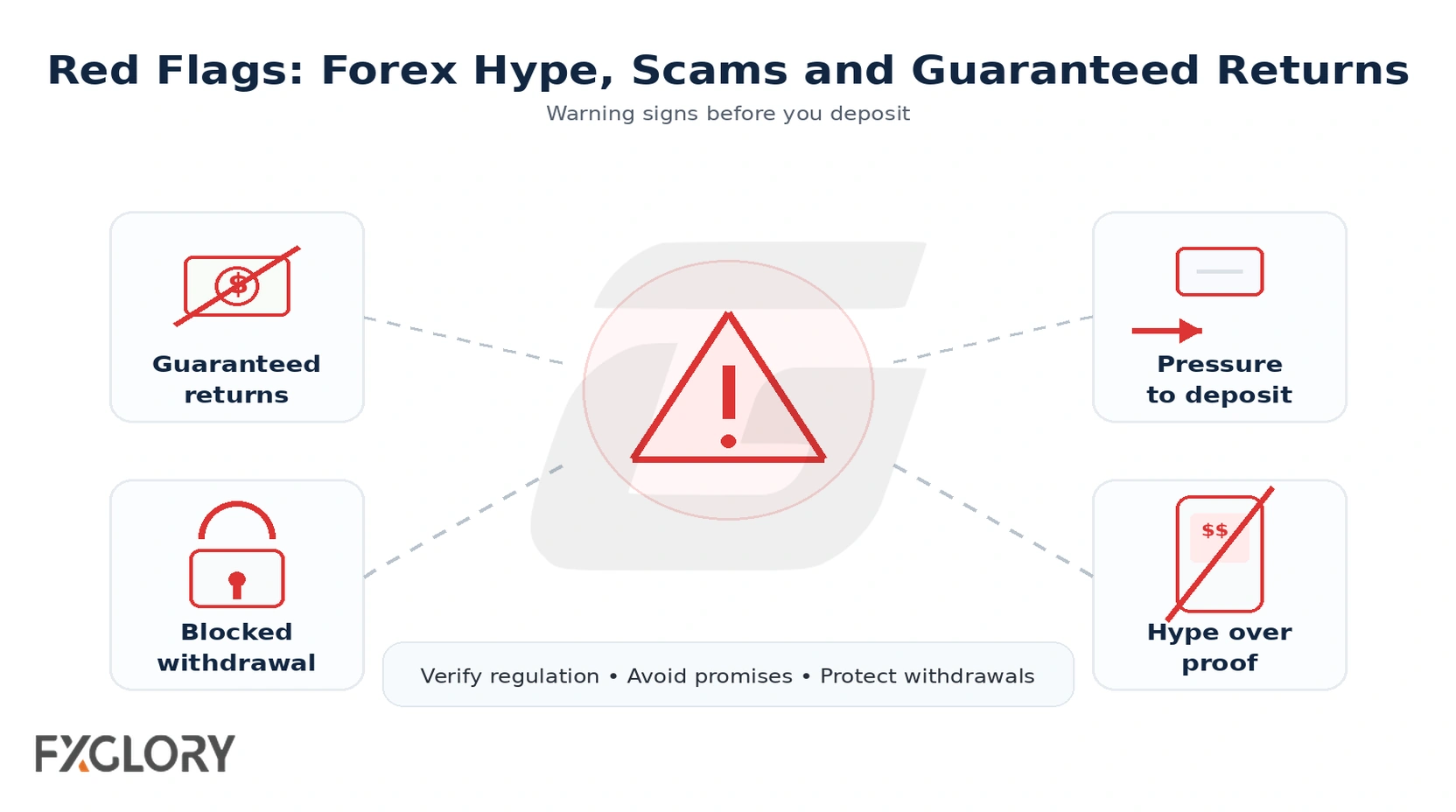
- Guaranteed-return claims: Market outcomes cannot be guaranteed.
- Fixed daily-profit promises: Markets do not produce a fixed return on demand.
- Pressure to deposit quickly: Urgency can discourage proper risk review.
- Luxury lifestyle marketing: Cars, watches, and screenshots do not establish a repeatable trading record.
- Unverifiable performance: Selected screenshots can omit losses, deposits, withdrawals, or full account history.
- Claims that leverage is risk-free: Larger exposure increases the potential account impact of adverse price movement.
- Unclear business identity or withdrawal terms: Missing information about who holds the funds, how withdrawals work, or what terms apply is a warning sign.
- Conflicted promotions: Consider whether a promoter is paid when users register, deposit, subscribe, or trade.
A Beginner Learning Path: Learn, Test, Review, Then Scale
A beginner needs evidence about process before increasing exposure. The purpose of early practice is to learn order mechanics, define rules, and collect enough trades to evaluate recurring strengths and mistakes.
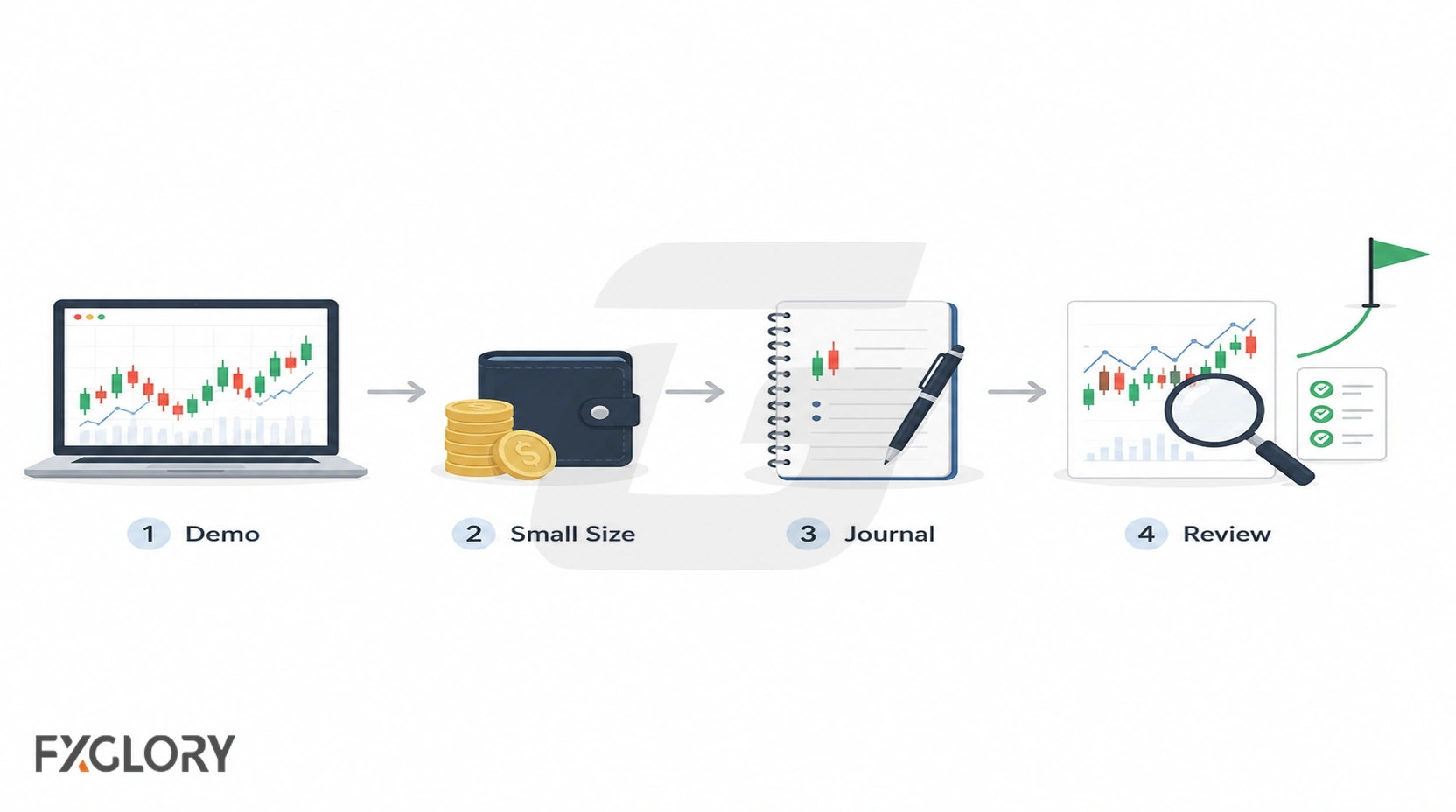
| Step | Beginner action |
|---|---|
| Learn | Understand pairs, pips, lots, spread, leverage, and margin. |
| Practice | Use demo trading to learn order placement and platform controls. |
| Plan | Write rules for entries, exits, position size, invalidation, and review. |
| Test | Record enough trades to examine expectancy, costs, mistakes, and drawdowns. |
| Start small | If moving live, use risk capital and position sizes that keep individual losses within the written plan. |
| Review | Journal trades to identify repeated errors and whether rules were followed. |
| Scale deliberately | Increase exposure only when the decision is supported by the process and risk plan. |
Demo trading can teach platform use and rule execution, but it does not reproduce every aspect of live trading. Real-money decisions can involve different emotions, and live execution can include changing spreads and slippage.
For a practical next step, start with forex basics for beginners or use the forex trading plan template to turn a strategy idea into written rules.
Common Beginner Mistakes When Trying to Make Money With Forex
- Setting a cash target before defining risk: Desired income starts driving position size.
- Trading too large for the account: A small number of losses can create a large drawdown.
- Using leverage without understanding exposure: The account impact of a price move becomes larger than expected.
- Ignoring costs: Gross trading results are mistaken for net results.
- Changing rules during a losing trade: Planned invalidation is replaced by hope.
- Increasing activity after losses: Revenge trading turns one loss into a sequence of unplanned decisions.
- Believing selected profit screenshots: A partial record does not show expectancy or drawdown.
- Not recording trades: Without a journal, it is difficult to separate strategy problems from execution mistakes.
- Trading essential funds: Financial pressure can make it harder to follow a risk plan.
What to Remember About Forex Profitability
The most useful way to evaluate forex is through net results, not isolated wins or promised returns. Measure the method across enough trades to observe average wins, average losses, costs, drawdowns, and whether the rules were actually followed.
Account size determines the cash value of percentage changes, while leverage changes exposure rather than creating an edge. A larger desired income therefore does not justify taking larger uncontrolled risk.