

What Is A Forex Box Strategy?
A forex box strategy is a rule-based method that marks a price area where the market is contained between an upper boundary and a lower boundary. The upper boundary acts like resistance while the lower boundary acts like support. The trader then watches whether price rejects the boundaries, breaks out, retests the edge, or fails back inside the box.
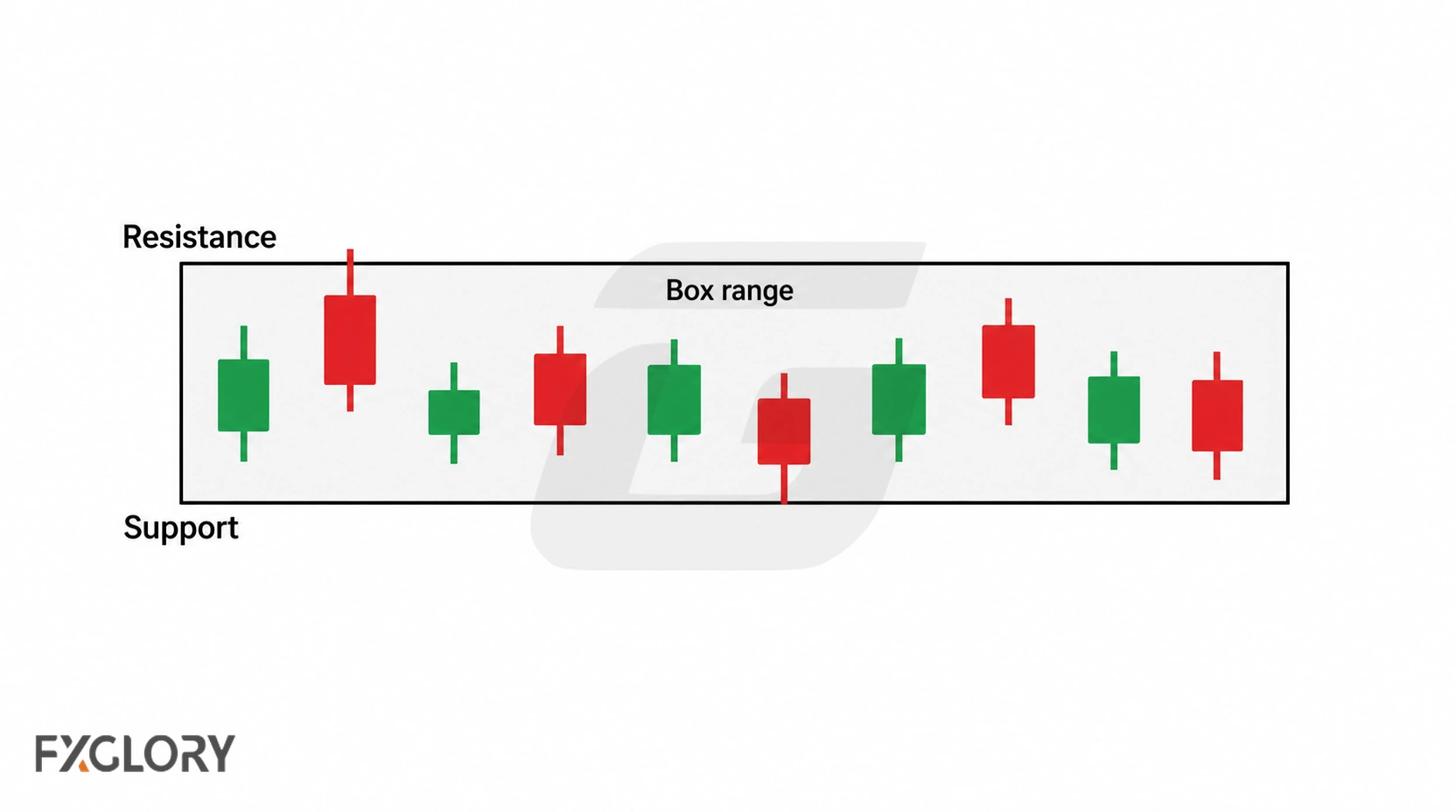
The box can be drawn around consolidation, a planned session range, a fixed number of candles, a Darvas-style momentum pause, or a sideways market. A box is tradable only when its boundaries define a specific decision: reject, break, retest, fail, or skip.
A box is not a signal by itself. Price can stay inside the box, break and continue, break and retest, or break and fail. The strategy begins only when the trader has written rules for each possible outcome.
Box Strategy vs Range Trading vs Breakout Trading
A forex box strategy can overlap with range trading and breakout trading, but it should not be confused with either one. The box is the structure. The trade plan decides what to do with that structure.
| Method | Main Question | Typical Decision | Main Risk |
|---|---|---|---|
| Box strategy | Is price contained between a clear top and bottom? | Trade inside, wait for breakout, wait for retest, trade failure, or skip | The trader treats the box as a signal instead of a decision structure |
| Range trading | Is price rotating between support and resistance? | Review rejection near the lower or upper boundary | The range fails and turns into a breakout |
| Breakout trading | Has price left the box with enough strength? | Review close, continuation, retest, or failure | The break is a fakeout or lacks target room |
| Break and retest | Does the broken box edge hold after price returns? | Review entry only if the retest confirms the new side | The retest is messy, deep, or failed |
Use inside-the-box range logic when price keeps rotating between boundaries. Use box breakout rules when price leaves the structure and the plan depends on continuation.
Box Decision Flow
A box strategy should give the trader a repeatable decision path. The same box should not be used for range entries, breakout entries, and failed-break entries unless each scenario has its own rule.
- Draw the box: mark the upper and lower boundary before choosing a trade direction.
- Classify the box: decide whether it is a range box, consolidation box, session box, 10-candle box, or Darvas-style momentum box.
- Choose one plan: inside-box range trade, box breakout, break-and-retest, failed-break setup, or no trade.
- Define invalidation: decide what price action cancels the setup before entry.
- Check box width: the box should leave enough room for stop, spread, slippage, and target planning.
- Check timing: session behavior and scheduled news should not distort the box boundary.
- Execute only if the plan remains valid: do not switch from range logic to breakout logic after entry without a written rule.
How To Draw A Valid Forex Box
A valid forex box should be drawn before the trade idea is chosen. If the box is adjusted after price moves, the strategy becomes subjective and difficult to review.
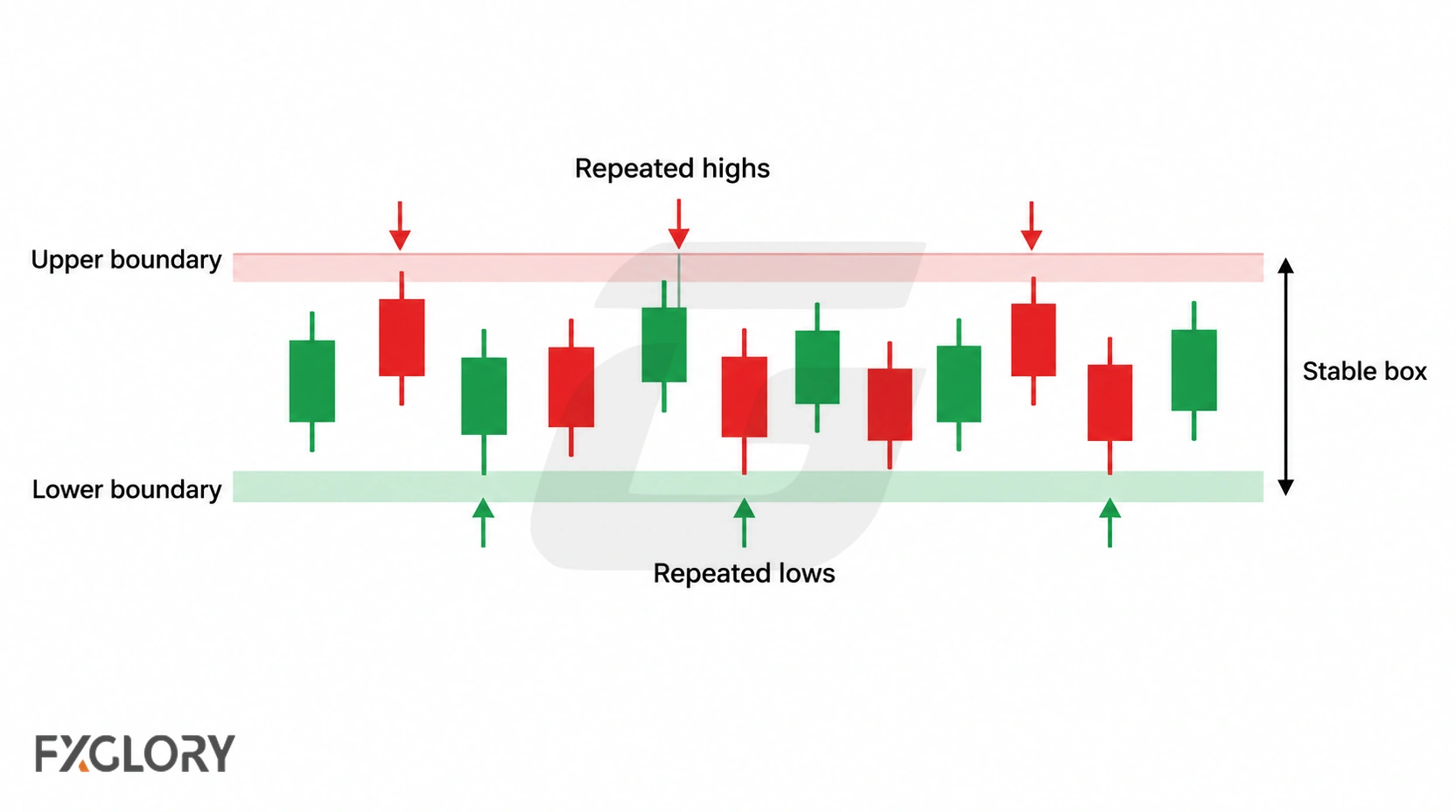
- Find containment: price should show repeated reaction between an upper area and a lower area.
- Use zones, not perfect lines: forex candles may pierce a level before returning inside the box.
- Check width: the box should be wide enough for realistic stop and target planning after spread.
- Check time spent inside: a box formed from only a few random candles may not show real consolidation.
- Check market context: decide whether the box is a range, pause inside a trend, session range, or pre-breakout compression.
- Mark invalidation: know what makes the box idea fail before any order is considered.
Use box top and box bottom rules when the setup depends on support, resistance, rejection, breakout, or retest behavior.
Main Forex Box Strategy Types
Not every forex box should be traded the same way. A consolidation box, range box, Darvas-style box, session box, and fixed-candle box can create different decisions.
| Box Type | How It Forms | Possible Use | Main Risk |
|---|---|---|---|
| Consolidation box | Price compresses between a clear high and low | Wait for breakout, retest, or failed break | False breakout before real direction appears |
| Range box | Price rotates between support and resistance | Review rejection near edges | Entering near the middle or trading after the range fails |
| Breakout box | Price leaves the box boundary | Review close outside, continuation, or retest | Breakout fails and price returns inside |
| 10-candle box | Box is drawn around the high and low of the last 10 candles | Simple structure test for short-term consolidation | The number of candles becomes the reason for entry |
| Darvas-style box | Price forms a box after a strong move or momentum phase | Review continuation above or below the box | Stock-style volume logic is copied into forex without adjustment |
| Session box | Box is drawn around a planned session range | Review session breakout, range hold, or failed break | Session volatility creates whipsaws and poor fills |
The box type should be selected before the entry rule. Mixing range entries, breakout entries, and failed-break entries after the trade has started can turn a simple structure into an unmanaged position.
Original Darvas Box Theory vs Forex Adaptation
Darvas Box Theory was originally developed around stock momentum, new highs, box formation, volume confirmation, stop updates, and continuation. Forex traders should not copy that framework directly. Spot forex does not have one centralized exchange volume feed, and leveraged forex positions can react differently to spread, session liquidity, slippage, and margin pressure.
| Original Darvas Element | Stock-Market Logic | Forex Adaptation | What Not To Copy Blindly |
|---|---|---|---|
| New highs | Darvas focused on stocks showing strong upward momentum | Forex can trend both ways, so boxes can form after bullish or bearish movement | Do not treat a new high as a buy signal without structure and risk rules |
| Volume confirmation | Exchange volume helped confirm stock participation | Spot forex has no centralized volume feed; platform or tick volume is only context | Do not treat local platform volume as complete market proof |
| Box breakout | A break above the box could signal continuation in the stock | A forex box breakout must account for spread, session, false breaks, and next levels | Do not enter only because price pierced the box edge |
| Stop below box | The lower box boundary could guide stop placement | Stop placement should also consider volatility, box width, and account risk | Do not use a wide box if the stop size breaks risk limits |
| Pyramiding | Darvas-style logic could add exposure as new boxes formed | In forex, adding positions is an advanced exposure decision | Do not add to a trade unless total exposure, margin, and invalidation are capped |
A Darvas-style forex box should be treated as a momentum-structure framework, not a historical performance claim. The box must define where the idea is wrong before any breakout, trailing stop, or scale-in rule is considered.
10-Candle Forex Box: Entry, Stop, Re-Boxing, And Failure Rules
The 10-candle forex box strategy draws the box around the high and low of the last 10 candles. The method is easy to repeat, but the candle count is only a drawing rule. It does not prove that a breakout, rejection, or continuation has a better chance of working.
| Decision | Rule To Define Before Testing | Weak Version |
|---|---|---|
| Entry | Decide whether entry needs a wick break, candle close, retest, or continuation candle | Entering every small pierce of the box |
| Stop | Place the stop where the box idea is invalid, such as back inside the box or beyond the opposite edge | Using a random fixed stop that ignores box width |
| Target | Use box height, next support or resistance, or measured movement only if room remains after spread | Targeting the same distance on every pair and timeframe |
| Re-boxing | Draw a new box only after price forms a new clear consolidation with fresh boundaries | Redrawing the box immediately after a losing trade |
| Failure | Cancel the setup if price breaks out, returns inside, and accepts the old range again | Holding the breakout idea after the box has failed |
- Do not trade the box only because 10 candles have formed.
- Do not accept a box that is too narrow for spread and stop placement.
- Do not accept a box that is so wide that risk becomes too large.
- Do not change the candle count after seeing the outcome.
- Do not draw a new box until price creates new boundaries that can be tested.
When testing a 10-candle box, record the timeframe, pair, session, box width, spread, breakout direction, retest behavior, failure behavior, and re-boxing rule. The rule should be judged by repeatability and risk control, not by isolated examples.
Box Range Trading Rules
Box range trading reviews trades inside the box while price remains contained. The basic idea is to watch for reaction near the lower boundary or upper boundary, then judge whether there is enough room back toward the middle or the opposite edge.
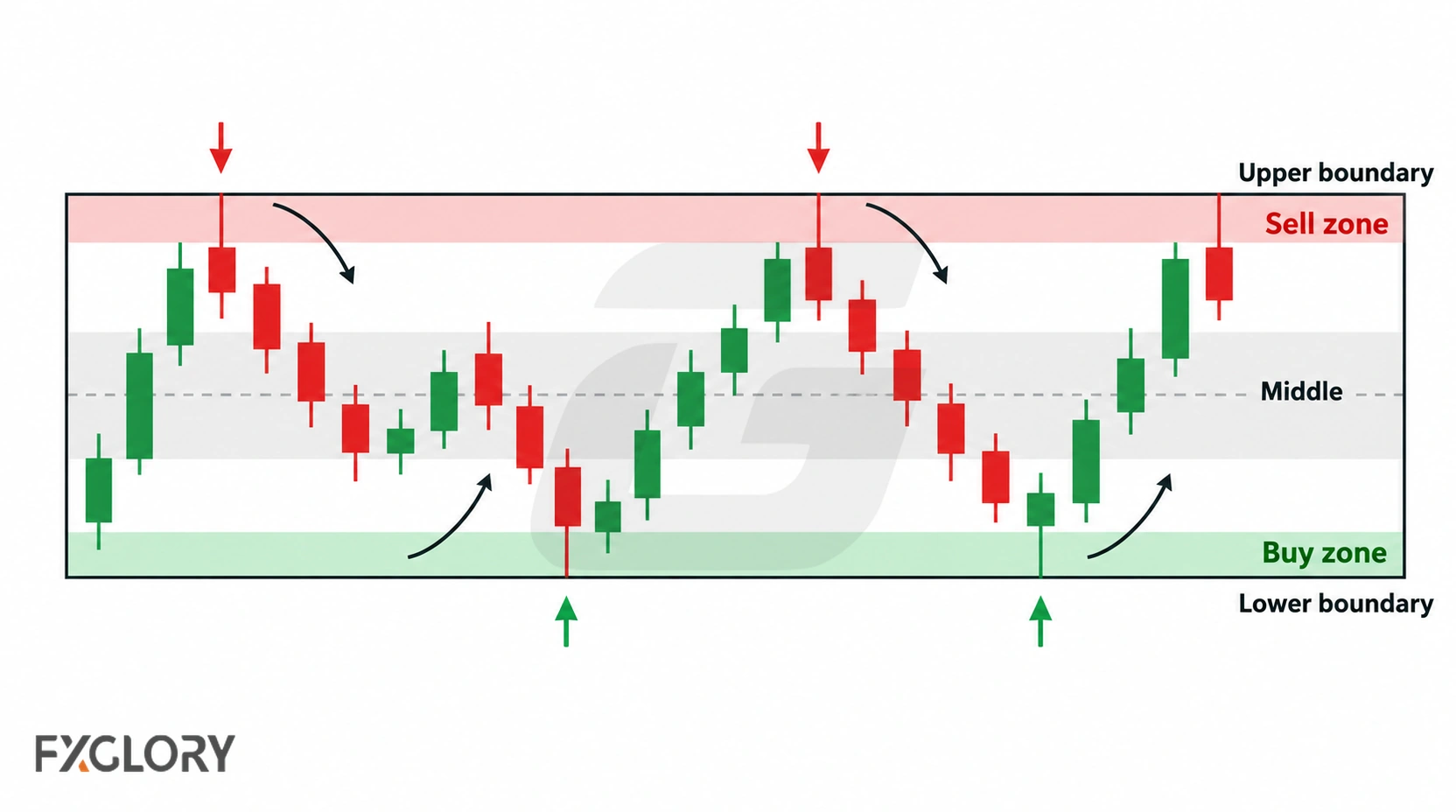
The middle of the box is usually the weakest area for range decisions because price has less room to either boundary. A box range setup should begin near an edge, not in the middle.
| Range Decision | What To Check | Skip If |
|---|---|---|
| Buy near box bottom | Price rejects the lower boundary and target room remains | Price closes below the box or news risk is near |
| Sell near box top | Price rejects the upper boundary and target room remains | Price closes above the box or breakout momentum is strong |
| Trade toward midpoint | Only if the range is wide enough and structure supports it | Spread removes too much of the target |
| Trade across the box | Only if the box is clean and volatility is stable | Price overlaps heavily and boundaries are unclear |
For the wider sideways-market framework, use the forex range trading strategy.
Forex Box Breakout Rules
A forex box breakout happens when price moves beyond the upper or lower boundary. A break through the box does not automatically create a trade. The breakout must be judged by close behavior, target room, retest possibility, session activity, and false-break risk.
- Define the box before the break: do not redraw the boundary after the candle moves.
- Decide what counts as a break: a wick, close, full candle, or retest can create different signals.
- Check the first obstacle: the next support or resistance should leave enough room after spread.
- Watch for a return: a box breakout often needs a retest or follow-through rule.
- Cancel weak breaks: if price returns inside the box and accepts the old range, the breakout idea is no longer valid.
Use the forex breakout strategy when the setup depends mainly on continuation outside the box.
Box Retest And Failed Breakout Rules
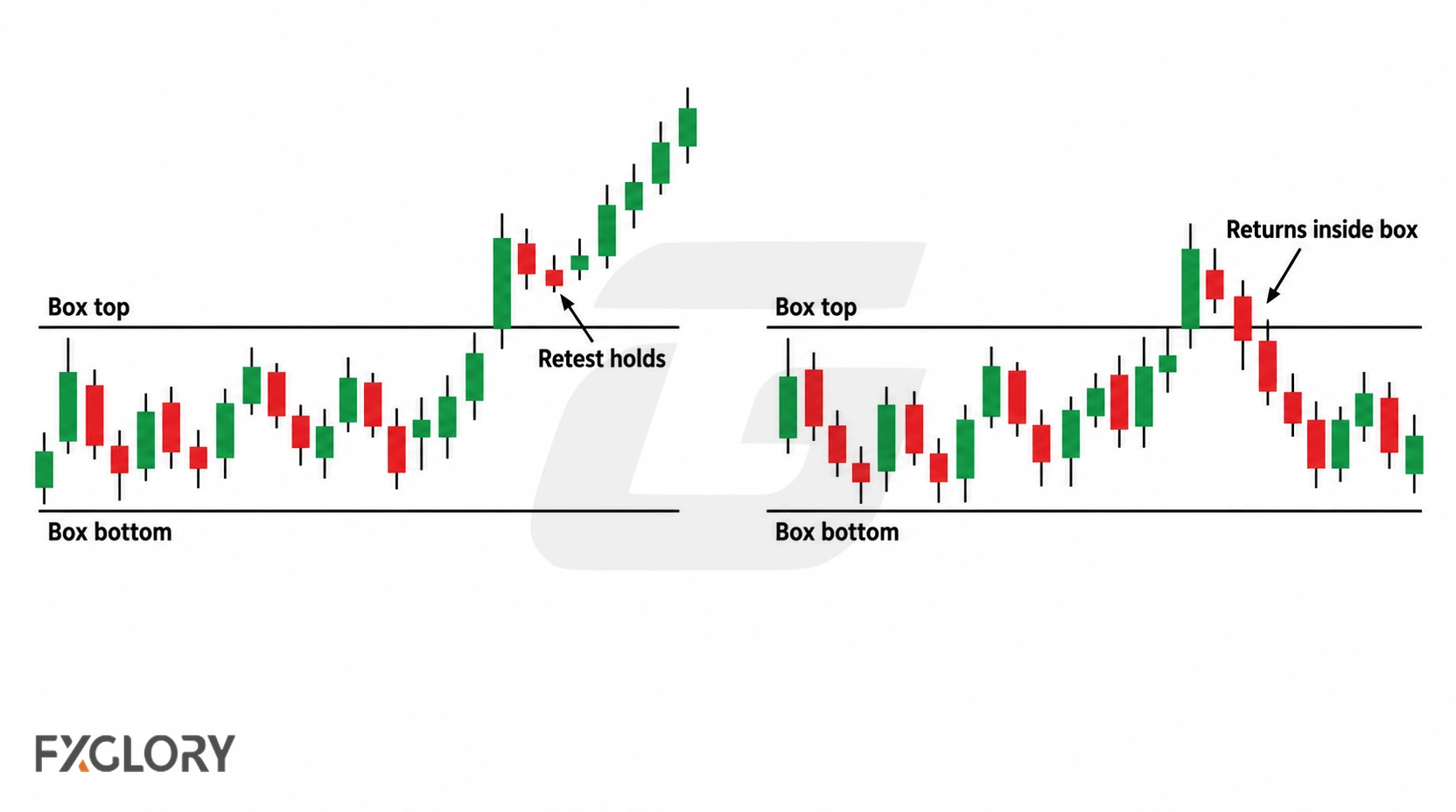
After price leaves the box, it may return to test the broken edge. In a bullish breakout, the old box top may act as support. In a bearish breakout, the old box bottom may act as resistance. The retest is useful only if it clarifies invalidation and target room.
| After The Break | What It Means | Decision |
|---|---|---|
| Clean retest of the edge | Price returns to the broken boundary and holds the new side | Review only if confirmation and stop logic are clear |
| No retest | Price breaks and continues without returning | Avoid chasing unless another written strategy allows it |
| Deep retest | Price pushes through the edge and recovers | Check whether it is a liquidity sweep or true failure |
| Failed breakout | Price breaks the box but returns and holds inside it | Cancel the continuation setup |
| Repeated edge overlap | Price crosses the boundary many times | Skip until the structure becomes clean again |
Use the return to the broken box edge guide when the setup depends on the retest after a breakout.
Stops, Targets, Trailing Stops, And Pyramiding
Box width helps determine whether the stop and target are practical before a position is sized. A narrow box may not leave enough target room after spread. A wide box can require a greater stop distance, which generally calls for a smaller position at the same planned account-risk budget; available margin is a separate constraint.
| Rule | Range Box Example | Breakout Box Example |
|---|---|---|
| Entry | Reaction near box edge | Close outside the box, retest, or continuation confirmation |
| Stop | Beyond the box edge or rejection structure | Back inside the box or beyond retest structure |
| Target | Midpoint, opposite edge, or nearby level | Measured box height, next support or resistance, or swing level |
| Trailing stop | Usually less useful inside a tight range | May follow new swings or new boxes only if rules allow |
| Pyramiding | Usually avoided inside a box | Only considered if a new valid box forms and total exposure remains capped |
Pyramiding is an advanced exposure decision, not a default Darvas rule to copy into forex. Adding to a breakout can compound losses quickly in leveraged trading if the new entry, stop, margin, and total exposure are not controlled. Use stop distance, position size, and false-break risk before testing any scale-in rule.
Box Filters: ATR, Spread, Session, News, Volume, And Margin
A filter earns its place only if it changes the box decision: accept, wait, resize, or skip. Filters should not be used to justify a weak box after the boundaries have already failed.
| Filter | What It Actually Decides | Weak Use |
|---|---|---|
| ATR | Whether the box width and stop distance fit current volatility | Using the same box width in every volatility condition |
| Spread | Whether the target remains realistic after cost | Trading narrow boxes where spread consumes too much room |
| Session | Whether the pair has enough activity for the box plan | Trading breakouts during dead liquidity or random spikes |
| News | Whether a scheduled event can distort the box boundary | Assuming a clean box will hold during high-impact releases |
| Platform or tick volume | Whether local activity supports context | Treating it as complete spot forex market volume |
| Margin | Whether the selected position size fits available margin, after stop-based loss risk is checked separately | Confusing enough margin to open a trade with acceptable potential loss |
Review FXGlory spreads when the box is narrow or the target is small. Calculate position size from the planned stop distance and account-risk allowance, then use the FXGlory margin calculator to check the margin requirement for that size. Chart drawing, alerts, and order placement should also be checked through the available trading platforms.
When A Forex Box Should Be Skipped
If no condition can cancel the box setup, the rules are incomplete. A box strategy should reject unclear structures before they become trades.
- Skip if the box boundaries are not clear before entry.
- Skip if the box is redrawn after price moves.
- Skip if the box is too narrow for spread, stop, and target planning.
- Skip if the box is too wide for acceptable account risk.
- Skip if price is chopping through both boundaries repeatedly.
- Skip if the middle of the box is the only available entry area.
- Skip if a breakout candle closes directly into the next support or resistance area.
- Skip if a scheduled news event can distort the boundary.
- Skip if the trader cannot define whether the plan is range, breakout, retest, failed-break, or no-trade logic.
Backtesting Notes For Forex Box Strategy
This numerical review uses one hypothetical educational rule model: a daily 10-candle box breakout-and-retest setup with an ATR-based box-width filter, a retest confirmation rule, a box-height target, a box-failure exit, and spread/slippage sensitivity. It does not test every type of range box, Darvas-style box, session box, failed-break box, inside-box range setup, or discretionary box breakout.
The model reviewed EURUSD, GBPUSD, USDJPY, AUDUSD, USDCAD, and USDCHF on daily candles using public yfinance OHLC data where available. The requested backtest review window was 29 June 2016 through 29 June 2026. The research record shows downloaded daily data for all six pairs from 3 September 2015 through 29 June 2026, including earlier warmup observations for indicator calculations; the warmup period is not an additional tested decade. The box is drawn from the highest high and lowest low of the previous 10 completed daily candles.
| Rule Area | Educational Model Rule |
|---|---|
| Box type | Daily 10-candle breakout-and-retest box |
| Box high | Highest high of the previous 10 completed daily candles |
| Box low | Lowest low of the previous 10 completed daily candles |
| Valid box width | At least 0.70 ATR(14) and no more than 3.00 ATR(14) |
| Long breakout | Daily close at least 0.10 ATR(14) above the box high, but no more than 1.00 ATR(14) beyond it |
| Short breakout | Daily close at least 0.10 ATR(14) below the box low, but no more than 1.00 ATR(14) beyond it |
| Retest window | Retest must occur within 5 daily candles after the breakout candle |
| Long retest | Retest candle touches or moves below the old box high and closes back above it |
| Short retest | Retest candle touches or moves above the old box low and closes back below it |
| Entry | Next daily open after the retest confirmation candle |
| Stop | Beyond the retest candle extreme with a 0.25 ATR(14) buffer |
| Target | One original box height projected from the broken boundary |
| Failure exit | Exit at daily close if price closes back inside the old box after entry |
| Maximum holding review | 20 daily candles after entry |
The review records trade count, win rate, average win in R, average loss in R, expectancy in R, profit factor, maximum drawdown in R, worst losing streak, average holding period, pair-level behavior, direction-level behavior, exit reasons, and spread/slippage sensitivity.
Reproducibility detail: The published rule summary defines ATR(14), daily-candle retests, stop-first handling if stop and target are touched in one candle, and a 20-candle maximum hold. It does not identify the ATR smoothing convention, every missing-bar or daily-timestamp alignment choice, or the precise priority of competing exit conditions. Those implementation details require the original backtest code and trade log; they cannot be inferred from these aggregate results.
| Cost Input | Assumptions Used |
|---|---|
| Spread | 0.5, 1.5, and 3.0 pips |
| Slippage | 0.1, 0.5, and 1.0 pips per side |
| Baseline comparison | 1.5-pip spread and 0.5-pip slippage per side |
| Swap and rollover | Not included |
Overnight-cost limitation: Accepted trades were held for an average of 2.36 daily candles in the baseline results. Swap or rollover charges and credits were not modelled, so the reported net R does not include those potential holding effects. Actual financing depends on the pair, position direction, holding dates and trading terms.
Educational Sensitivity-Test Results
The hypothetical backtest used the baseline assumption of a 1.5-pip spread and 0.5-pip slippage per side. The baseline result was negative: expectancy was -0.5314R, profit factor was 0.2155, and total net result was -104.1607R. These figures are for studying the behavior of this rule model in historical data, not for projecting future live-trading performance.
| Metric | Baseline Result |
|---|---|
| Trades | 196 |
| Win rate | 10.20% |
| Average win | 1.4303R |
| Average loss | -0.7544R |
| Expectancy | -0.5314R |
| Profit factor | 0.2155 |
| Maximum drawdown | -104.0642R |
| Worst losing streak | 29 |
| Average holding period | 2.36 daily candles |
| Median holding period | 1 daily candles |
| Total net result | -104.1607R |
Pair-Level Results
| Pair | Trades | Win Rate | Expectancy | Profit Factor | Max Drawdown | Total Net Result |
|---|---|---|---|---|---|---|
| AUDUSD | 40 | 10.00% | -0.5875R | 0.1515 | -22.4629R | -23.5002R |
| EURUSD | 32 | 9.38% | -0.207R | 0.6008 | -8.1564R | -6.6232R |
| GBPUSD | 31 | 9.68% | -0.589R | 0.1094 | -18.1627R | -18.2593R |
| USDCAD | 42 | 19.05% | -0.3715R | 0.3996 | -18.3586R | -15.6034R |
| USDCHF | 27 | 3.70% | -0.7813R | 0.0642 | -20.0627R | -21.0942R |
| USDJPY | 24 | 4.17% | -0.795R | 0.0188 | -18.0495R | -19.0805R |
Direction-Level Results
| Direction | Trades | Win Rate | Expectancy | Profit Factor | Max Drawdown | Total Net Result |
|---|---|---|---|---|---|---|
| Long | 98 | 10.20% | -0.5563R | 0.2341 | -54.0085R | -54.5219R |
| Short | 98 | 10.20% | -0.5065R | 0.1939 | -49.5422R | -49.6388R |
Exit Reason Counts
| Exit Reason | Count |
|---|---|
| box failure close | 71 |
| box height target | 15 |
| stop first same bar | 2 |
| stop loss | 106 |
| time exit | 2 |
The 196 baseline trades include 108 stop-related exits (106 stop-loss and 2 stop-first same-bar), 71 box-failure closes, 15 box-height target exits, and 2 time exits. Stops and box failures accounted for most recorded exits. These are classifications of how positions closed, not independent proof that every trade in a category produced the same R outcome.
Spread And Slippage Sensitivity
| Spread | Slippage Per Side | Trades | Expectancy | Profit Factor | Max Drawdown | Total Net Result |
|---|---|---|---|---|---|---|
| 0.5 pips | 0.1 pips | 196 | -0.4727R | 0.2419 | -92.5997R | -92.6512R |
| 0.5 pips | 0.5 pips | 196 | -0.4988R | 0.2291 | -97.695R | -97.7665R |
| 0.5 pips | 1 pips | 196 | -0.5314R | 0.2155 | -104.0642R | -104.1607R |
| 1.5 pips | 0.1 pips | 196 | -0.5053R | 0.2262 | -98.9688R | -99.0454R |
| 1.5 pips | 0.5 pips | 196 | -0.5314R | 0.2155 | -104.0642R | -104.1607R |
| 1.5 pips | 1 pips | 196 | -0.5641R | 0.2039 | -110.4333R | -110.5549R |
| 3 pips | 0.1 pips | 196 | -0.5543R | 0.2072 | -108.5226R | -108.6367R |
| 3 pips | 0.5 pips | 196 | -0.5804R | 0.1985 | -113.6179R | -113.752R |
| 3 pips | 1 pips | 196 | -0.613R | 0.1885 | -119.9871R | -120.1462R |
Testing And Review Checklist
Forex box strategies should be tested by box type. A Darvas-style momentum box, 10-candle box, session box, and range box should not be mixed into one result unless the rules are identical.
- Choose the box type: consolidation, range, breakout, Darvas-style, 10-candle, or session box.
- Define the boundary rule: decide how the box top and bottom are drawn before testing examples.
- Define the trade plan: range entry, breakout entry, retest entry, failed-break setup, or no trade.
- Record box width: compare the width with spread, stop distance, and target room.
- Classify the break: no break, clean break, retest, failed break, or messy overlap.
- Write invalidation: the price or structure that cancels the box idea.
- Record costs: spread, slippage, holding cost, and margin requirement.
- Record skipped boxes: unclear boxes, narrow boxes, wide boxes, and news-distorted boxes should be reviewed too.
- Review enough examples: collect and document examples for each box type across different pairs, dates, and market conditions. An initial batch may reveal practical issues, but no fixed example count proves a strategy is reliable or statistically robust.
- Record mistake tags: redrawn box, late breakout, middle entry, ignored spread, false break, overtrading, or emotional rule change.