
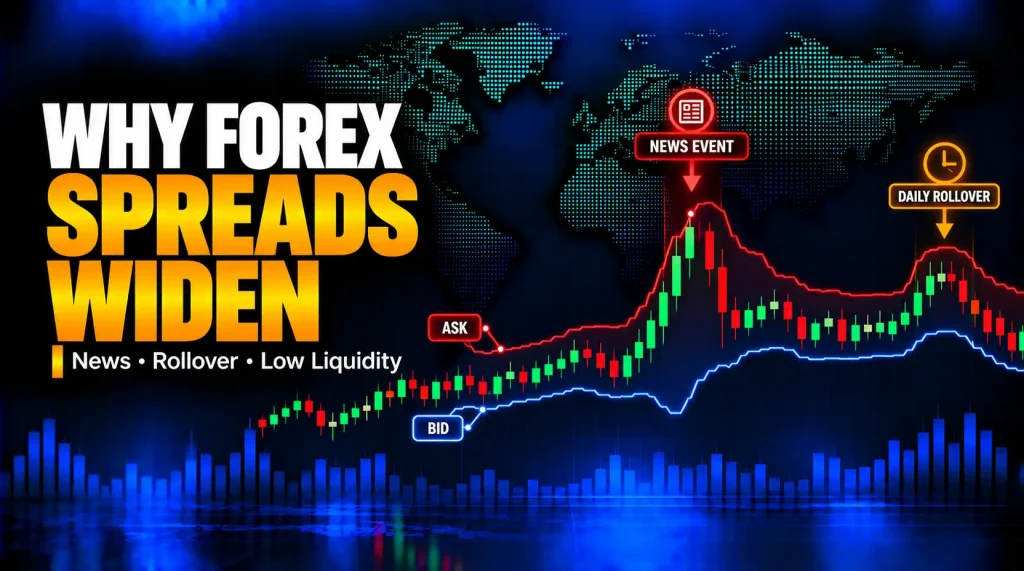
Why does the spread increase in forex? The difference between a currency pair's buying price (Ask) and selling price (Bid) can widen when liquidity thins, prices become more volatile, or liquidity providers and brokers adjust their quotes to reflect greater uncertainty. This often happens around important news, the daily market transition, the weekend reopening and quieter trading periods. A wider spread makes entering and immediately exiting a trade more expensive, even if the underlying price has barely moved.
This guide focuses on why spreads change, when the change may matter and how to investigate it. If you first need the definition of Bid and Ask, start with FXGlory's Bid and Ask Price in Forex lesson. The examples below use fictional EUR/USD quotes, not a record of FXGlory spreads or a promise about execution.
Why Does the Spread Increase in Forex?
The spread is Ask minus Bid. For EUR/USD quoted at Bid 1.08498 and Ask 1.08508, the difference is 0.00010, or 1.0 pip. One pip is 0.0001 for this pair. Traders buying at Ask and selling at Bid interact with different sides of the same quote.
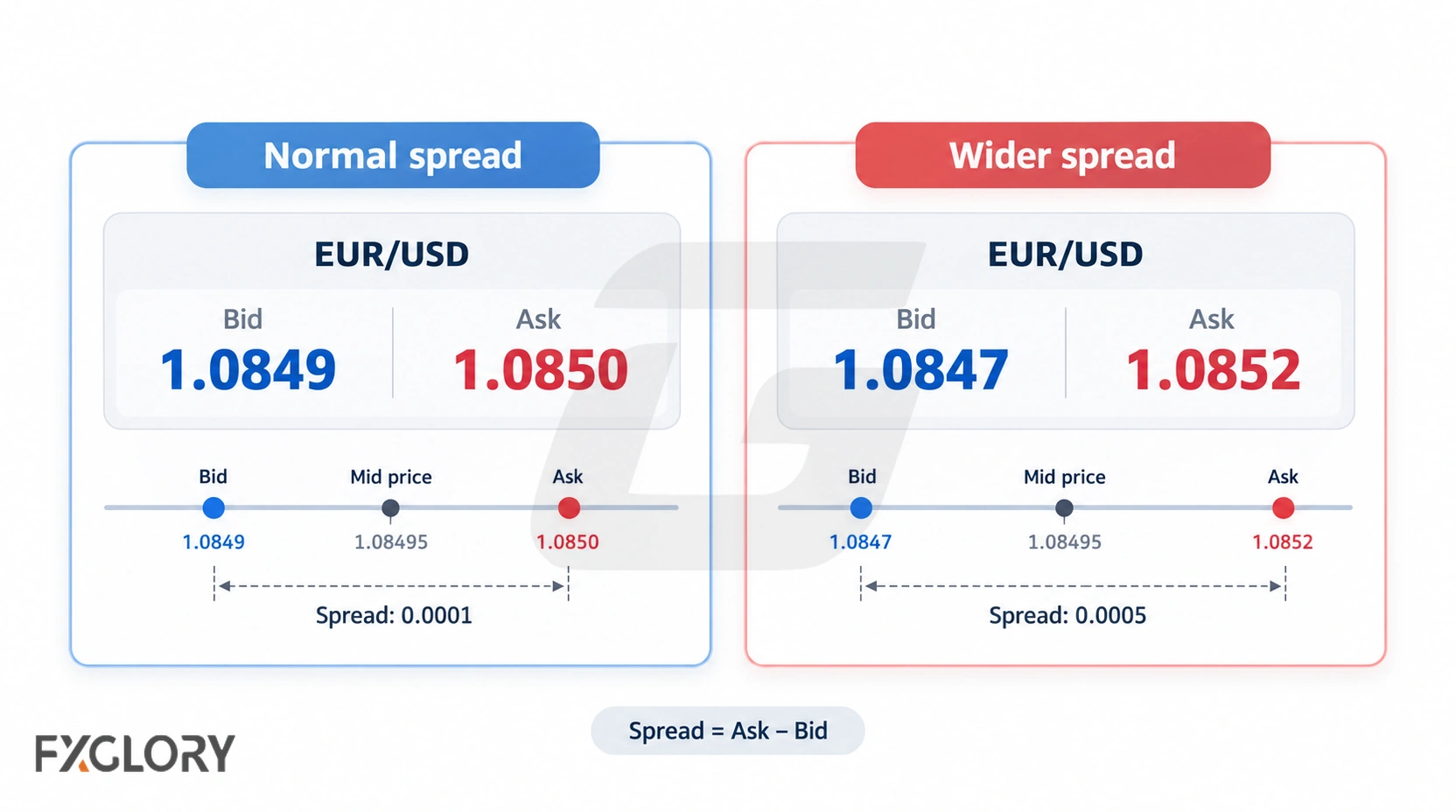
These prices are not necessarily fixed. Dealers and other quote providers may widen the gap when they face a greater risk of rapid price changes, have less depth available at nearby prices, or cannot obtain competitive quotes consistently. The broker's pricing and execution model also matters. The displayed spread is therefore a current quote condition, not a universal charge that stays constant for every pair or account.
A spread can widen because the Ask rises, the Bid falls, or both prices move apart. That distinction matters: a short position generally needs the Ask to buy back, while a long position generally needs the Bid to sell. Widening alone does not tell you which side moved or whether a specific open position has just incurred a realized loss.
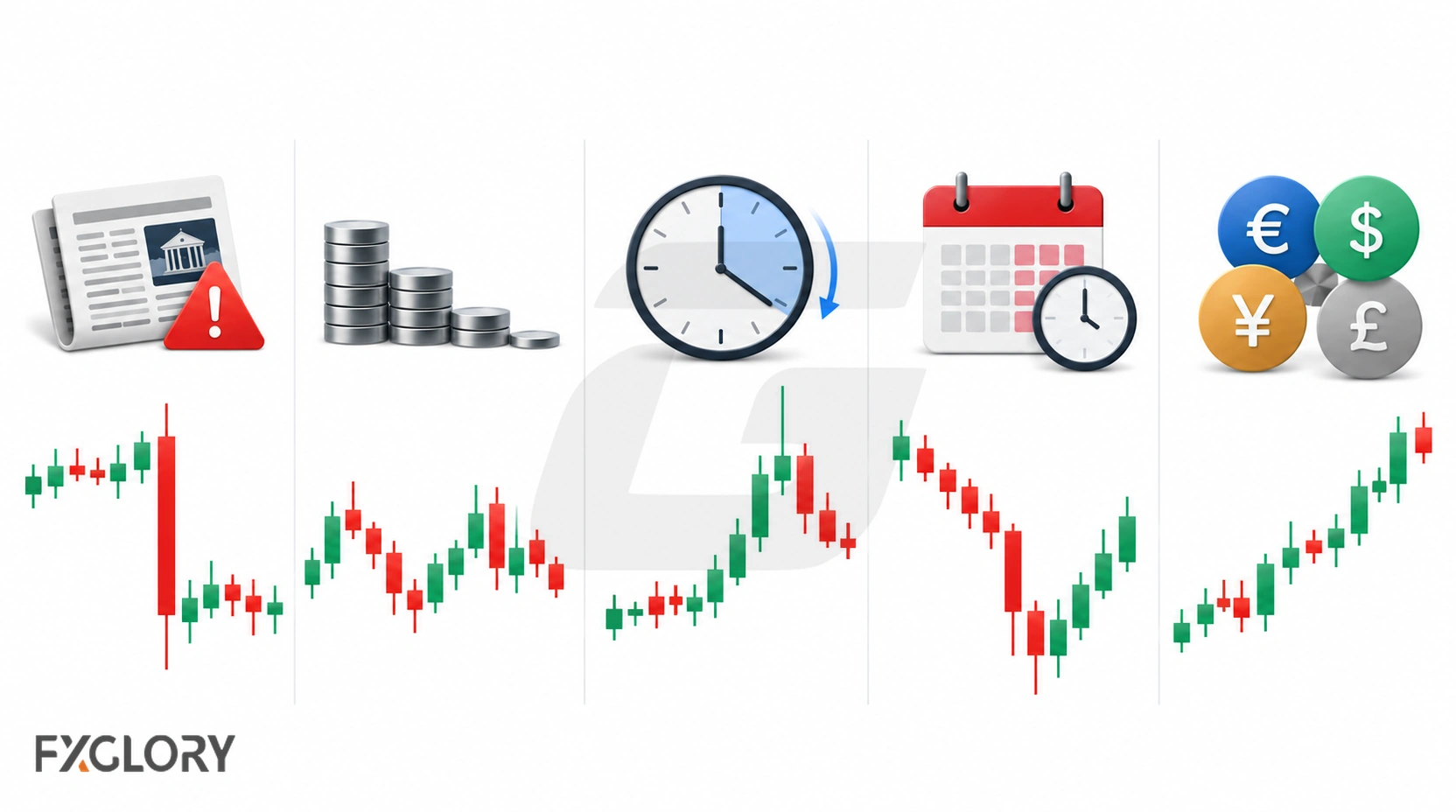
Five Common Causes of Wider Forex Spreads
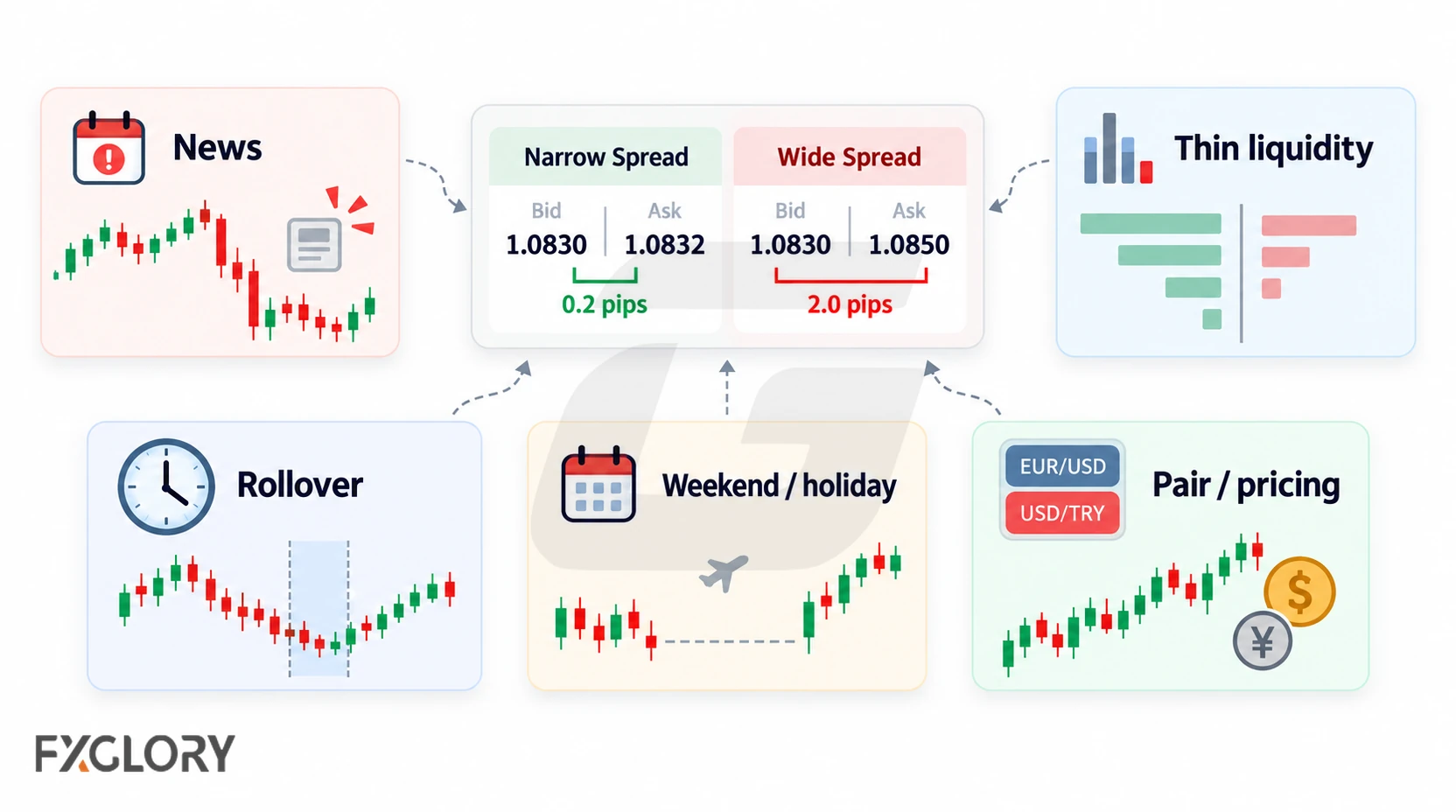
Several conditions can appear together. For example, an unexpected data release may make markets both more volatile and temporarily less liquid. The table describes typical mechanisms, not a timetable of guaranteed spread changes.
| Situation | Why quotes may widen | What to check |
|---|---|---|
| Major news or surprise events | Rapid repricing and uncertainty can reduce competitive quoting. | Event time, actual Bid/Ask quotes and execution history. |
| Thin market liquidity | Fewer available quotes or less depth at the best prices. | Trading session, currency pair and latest quote time. |
| Daily market transition | Some participants reset positions and quote availability can change. | New York time, broker server time and instrument schedule. |
| Weekend reopening or holidays | Price gaps and reduced participation can make early quotes uneven. | Market opening conditions and whether trading is available. |
| Pair and pricing conditions | Less-traded pairs, quote availability and account pricing rules differ. | Symbol specification, spread type and applicable commission. |
Volatility and liquidity are related but different
Volatility describes how quickly or far a price changes; liquidity concerns the ability to transact the desired size at available prices without a large price impact. A highly active market can still experience rapid, disorderly repricing. Conversely, a quiet period may have low volatility but too few competing quotes to maintain a tight spread. Learn more in FXGlory's What Is Liquidity in Forex? guide.
News timing creates a particularly important distinction: spreads may widen before a scheduled release if quote providers reduce risk, during a sharp response or after it while quotes normalize. The magnitude and duration are not predictable from the economic calendar alone. See the Forex News Trading Strategy lesson for the separate topic of evaluating event-driven setups and execution risk.
Why Forex Spreads May Widen Around 5 p.m. New York or 10 p.m.
A frequently discussed daily forex transition is 5:00 p.m. New York time. Around that point, some dealing and financing processes roll into a new trading day, and quote availability can become uneven. This is one reason traders sometimes observe sharply wider spreads even without a major economic announcement. It is not a rule that every broker, instrument or date has the same spread spike.
Searches mentioning 10 p.m. often refer to a clock in the United Kingdom. On most dates, 5 p.m. in New York corresponds to 10 p.m. in London; for short periods in spring and autumn, US and UK daylight-saving changes occur on different dates, so the corresponding London time can instead be 9 p.m.. In UTC, 5 p.m. New York is 21:00 during US daylight time and 22:00 during US standard time. Neither "5 p.m." nor "10 p.m." is meaningful without a time zone and date.
Reduced liquidity can also occur at other session handovers or around holidays. A spread that widens once at a specific hour does not prove that the same pattern will occur every day, and there is no guaranteed minute when quotes must return to a previous level.
How Much Can a Wider Spread Increase Trading Costs?
Consider an illustrative EUR/USD position of 10,000 EUR with a USD-denominated P/L. For EUR/USD, a 0.0001 price change is one pip, worth USD 1 per pip for that 10,000-EUR amount (10,000 × 0.0001). The two snapshots below represent alternative hypothetical market states, not an actual sequence of executed orders.
| Measure | Snapshot A | Snapshot B |
|---|---|---|
| EUR/USD Bid (sell price) | 1.08498 | 1.08498 |
| EUR/USD Ask (buy price) | 1.08508 | 1.08558 |
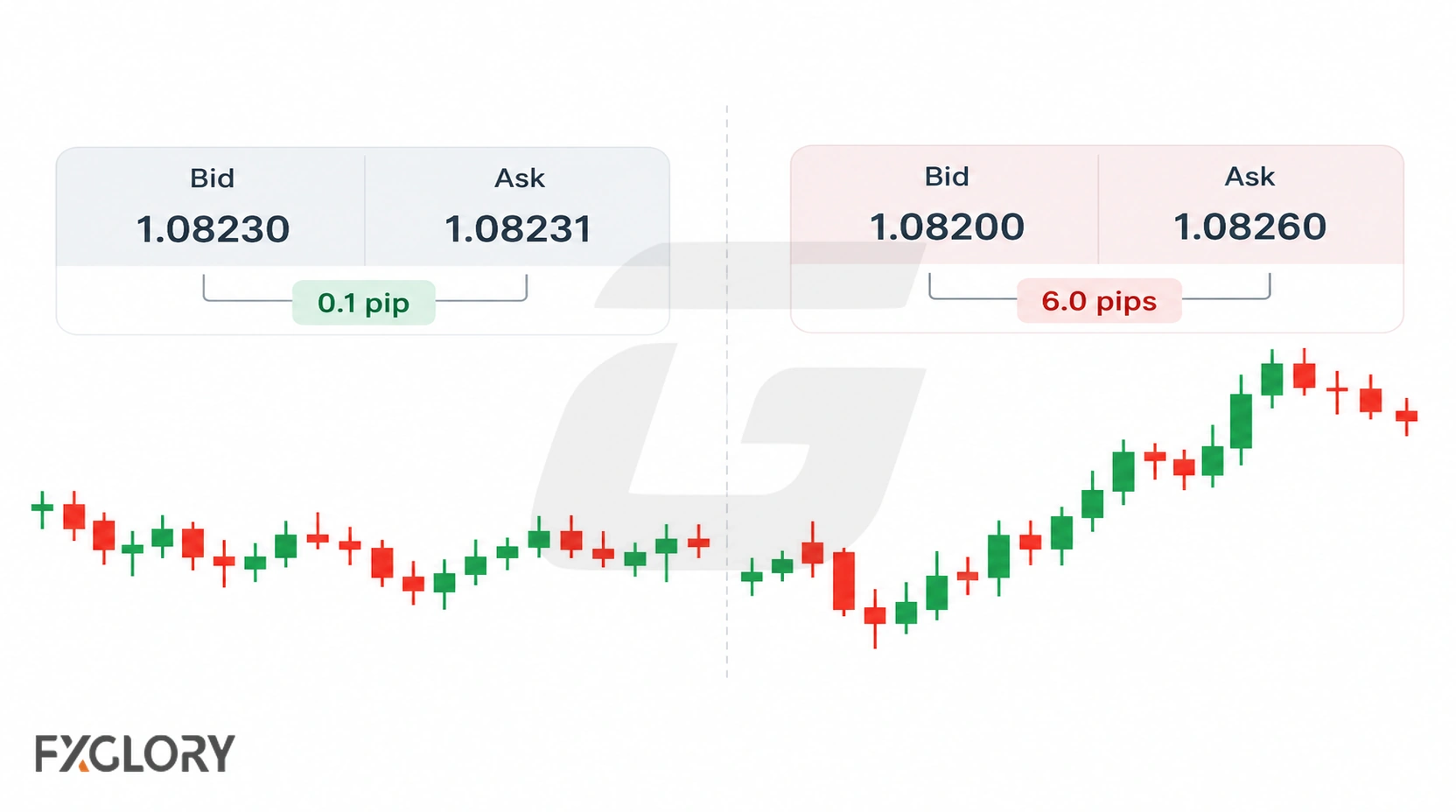
| Ask minus Bid | 0.00010 = 1.0 pip | 0.00060 = 6.0 pips |
| Illustrative gross round-trip P/L | −USD 1.00 | −USD 6.00 |
Calculation: For Snapshot A, (1.08498 − 1.08508) × 10,000 EUR = −USD 1.00. For Snapshot B, (1.08498 − 1.08558) × 10,000 EUR = −USD 6.00. The difference is USD 5.00 for the same assumed quantity. An immediate buy and sell at the displayed prices, with no other price change, is used only to isolate the spread effect.
This example excludes commissions, swaps, slippage, market impact and any conversion charges. It does not mean an existing trade automatically realizes another USD 5 loss when the spread increases: the mark-to-market impact depends on which side of the quote moves, the trade direction and when the exit occurs. Real fills are not guaranteed at either displayed snapshot.
Can a Spread Spike Trigger a Stop-Loss When the Chart Never Touched It?
It can, depending on the platform's quote and order rules. In common OTC forex conventions, a long position closes by selling at Bid and a short position closes by buying at Ask. MetaTrader 5's documented forex stop-loss logic checks the relevant quote side: Bid for the stop on a long position and Ask for the stop on a short position. A chart showing Bid candles alone can therefore hide the Ask movement relevant to a short trade's stop.
Hypothetical short-position stop example
Suppose a trader has an open short EUR/USD position with an illustrative stop-loss buy-to-close level of 1.08600. At one moment, Bid is 1.08540 and Ask is 1.08550, a 1.0-pip spread. The Ask is below the stop. Later, imagine Bid is still 1.08540 but Ask has widened to 1.08605, a 6.5-pip spread. The Ask has passed the 1.08600 stop level even though Bid has not changed.
On a system that evaluates this short-position stop against Ask, that second quote can trigger the stop although the Bid-only chart appears not to touch 1.08600. A trigger is not a guaranteed fill: the executed price may be different because of available liquidity, slippage, gaps or the broker's execution rules. These are invented prices for teaching the mechanics, not FXGlory tick data or proof of how a particular trade was handled.
When investigating a trade, compare the recorded Bid and Ask at the trigger time, the position direction, the specified stop, and the execution report. For MetaTrader charts, the Ask line may be available as a display option; historical Bid candles alone may still be insufficient to reconstruct the exact Ask tick at a past stop event.
Is Spread Widening the Same as Overnight Swap?
No. The spread is the difference between the currently quoted buying and selling prices; it affects the price at which an order can enter or exit. Swap (or overnight financing) is a separate adjustment associated with holding a position across a broker's applicable financing cutoff. Depending on the contract, direction and rates, a swap can be a debit or a credit.
Both may become noticeable around a daily rollover period, but a temporary wider Bid–Ask quote is not itself the swap fee. A trader may see one, both or neither depending on market conditions and account specifications. Read FXGlory's What Is Swap in Forex? for the financing calculation and its limitations. Do not infer FXGlory's current swap rate or rollover procedure from this general explanation.
What to Check When Your Forex Spread Is Unusually High
- Record the precise instrument and timestamp. Write down EUR/USD or the actual symbol, the date, your displayed local time, server time and time zone. A chart label alone may be ambiguous.
- Look at both live quote sides. Capture Bid and Ask from the relevant platform, not only the candle chart. Calculate Ask − Bid rather than guessing from the price movement.
- Check the units. On a five-decimal EUR/USD quote, 0.00001 is commonly one platform point and 0.00010 is one pip. A display of 60 such points corresponds to 6 pips, not 60 pips; verify the symbol's digits and contract settings.
- Identify the market context. Look for scheduled data releases, unusually rapid moves, the daily transition, a weekend reopening or a market holiday. Any one may be relevant, but it does not prove causation for a single quote.
- Inspect the symbol and account terms. Check whether the quoted spread is variable, what commission is charged separately and whether trading is available. Do not assume the same settings across accounts or instruments.
- If an order was affected, review the execution record. Compare trade direction, trigger side, requested stop, fills and timestamps. Ask support for quote and execution details where available.
In MetaTrader 5, the Market Watch interface documents current Bid, Ask and spread fields, although what a particular FXGlory account exposes and how its quotes are stored still needs direct verification. A screenshot of the current spread is useful context, but it is not a complete audit trail for an earlier trade.
Practical Risk Checklist: What a Wider Spread Changes
- Entry cost: A larger current Bid–Ask gap creates a greater immediate price disadvantage for an otherwise identical new round trip.
- Stop proximity: Assess the price side that can trigger the stop, not just the Bid or mid-price visible on a chart.
- Order execution: Fast markets and reduced depth can introduce slippage or rejected orders, so a displayed spread is not a complete estimate of realized costs.
- Time-based assumptions: News and rollover windows may change from one day or provider to another; previous patterns do not establish a guaranteed normal spread.
- Total costs: Evaluate spread, commission, applicable swap and potential currency conversion separately, without subtracting an already included expense twice.
Key lesson: An increased forex spread is primarily a change in available buy and sell quotes. It may arise from volatility, liquidity, the trading timetable or pricing conditions. Understanding both quote sides—and how they relate to orders—is more useful than assuming every spike is abnormal broker behavior. Use the instrument specification and actual order records when evaluating a real incident.