Forex Trading vs Sports Betting: Similarities, Differences & Risk Rules

Compare forex trading and sports betting without hype: risk, probability, odds, leverage, costs, emotional pressure, loss-chasing, and the point where trading starts to look gambling-like.
 
Written byHenry Green
Published
Last updated
Forex Trading vs Sports Betting

Key Takeaways

  • Forex trading and sports betting both involve uncertainty, risk, probability, emotional pressure, and the possibility of losing money.
  • They are not the same activity. Forex trading involves taking exposure to currency price movement in a financial market; sports betting involves wagering on sports outcomes under odds and settlement rules.
  • Forex trading has tools such as position sizing, stop logic, exits, journals, and risk limits, but those tools do not remove risk and only matter if the trader actually follows them.
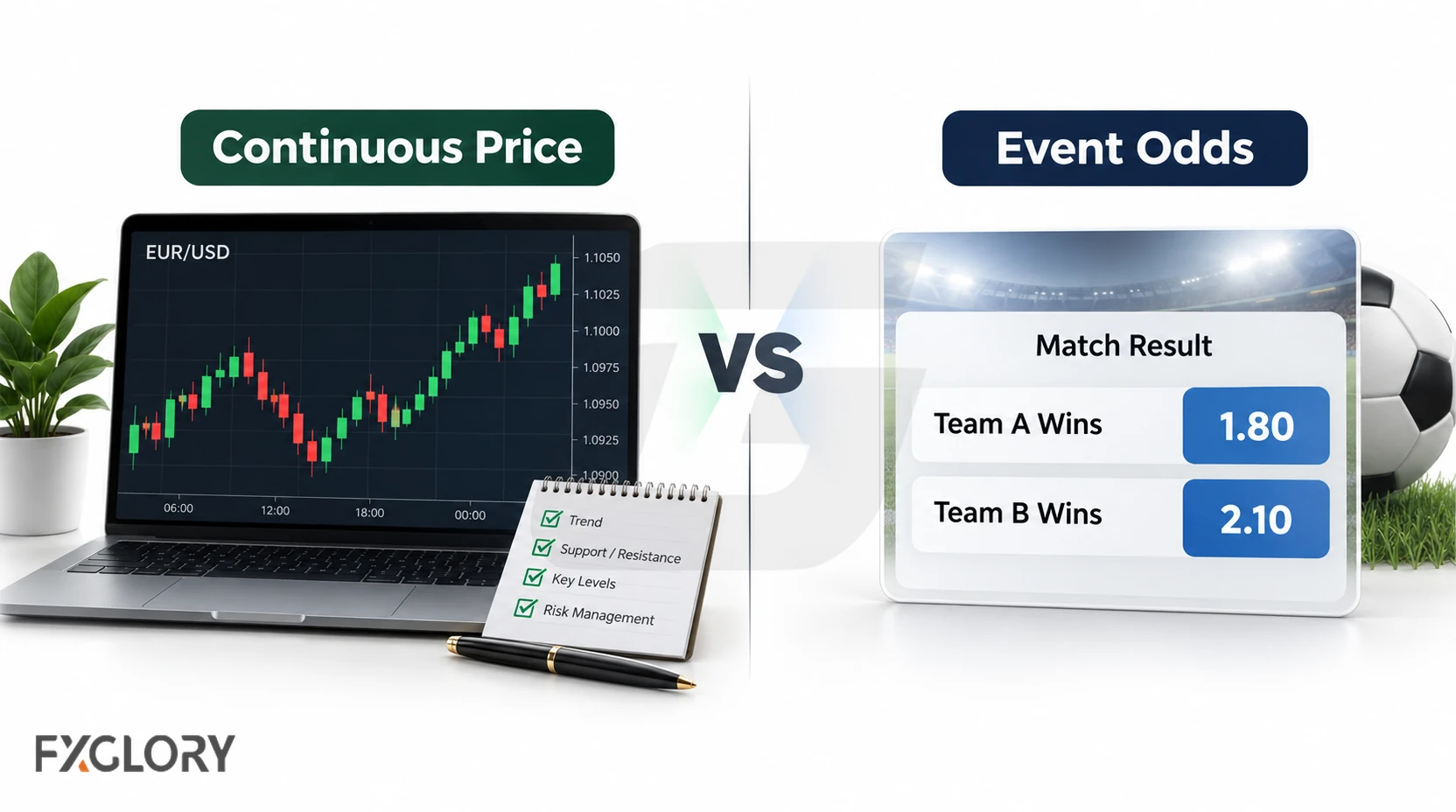
  • Sports betting odds and forex prices are not the same thing. Odds price a wager on an event outcome; forex prices move continuously as market participants trade currencies.
  • Forex can become gambling-like when a trader guesses, chases losses, oversizes, ignores stops, copies signals blindly, or keeps trading for excitement or relief.
  • This page does not recommend sports betting and does not provide legal, religious, mental-health, or personal financial advice. FXGlory does not provide sportsbook or sports betting services.

Forex Trading vs Sports Betting: The Direct Answer

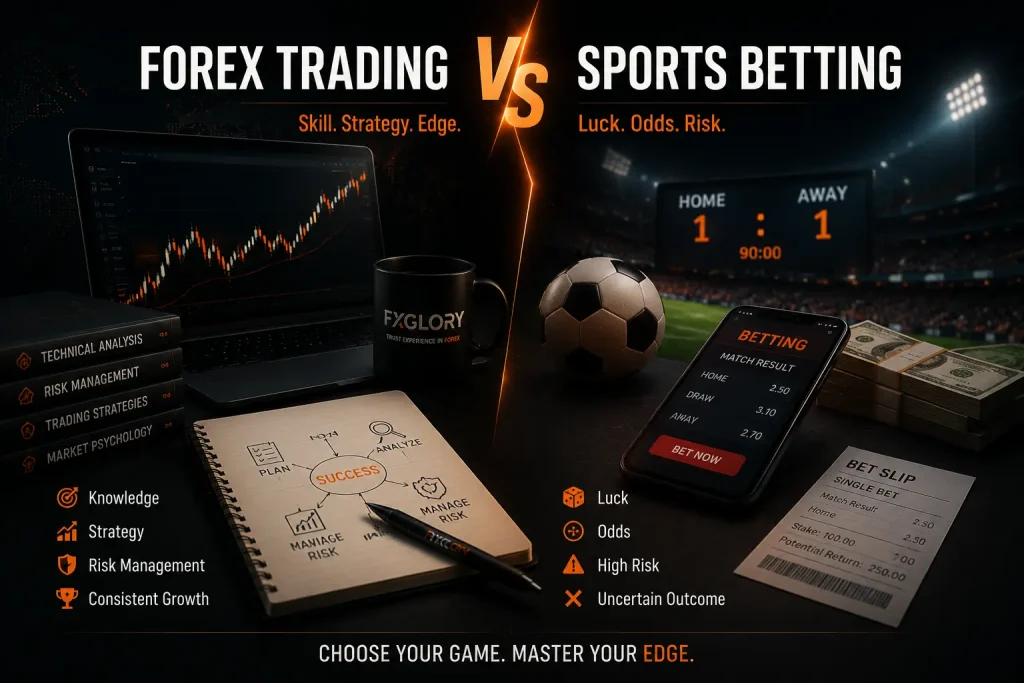
Forex trading and sports betting both involve uncertainty, risk, probability, emotional pressure, and the possibility of losing money. They are not the same activity. Forex trading is speculation on currency price movement in a financial market. Sports betting is wagering on sports outcomes under odds and settlement rules.

The useful comparison is not “which one is easy money?” Neither should be treated that way. Forex trading has tools such as position sizing, stop logic, exits, journals, and risk limits, but those tools do not remove risk and they only matter if the trader actually follows them. Forex becomes betting-like when the trader guesses, chases losses, oversizes, ignores stops, copies signals blindly, or keeps trading for excitement or relief.

Risk and scope note: This page is educational only. It does not recommend sports betting, does not provide sports betting advice, and does not provide legal, religious, mental-health, or personal financial advice. FXGlory does not provide sportsbook or sports betting services. Forex trading involves risk of loss, including leverage, margin, spread, slippage, execution, platform, news-event, and emotional decision-making risks.

For the broader question of whether forex itself is gambling, read when forex starts to look like gambling. This page focuses on the direct comparison with sports betting.

Are Forex Trading And Sports Betting In The Same Category?

They are in the same broad category of risky activities with uncertain outcomes. They are not the same product, market, or decision structure.

A sports bet is usually placed on a defined sports event or event condition. The outcome settles based on the rules of that wager. A forex trade takes exposure to currency price movement. The trader may open, close, resize, or manage a position depending on market and platform conditions, but that flexibility is not the same as safety.

QuestionForex TradingSports Betting
What is the activity?Taking exposure to currency price movement.Wagering on sports event outcomes or conditions.
What is at risk?Trading capital and margin exposure.The stake placed on the wager.
Is the outcome certain?No.No.
Can money be lost?Yes.Yes.
Can emotion damage decisions?Yes.Yes.
Is FXGlory a sportsbook?No.FXGlory does not offer sports betting.

Forex Trading vs Sports Betting: Direct Comparison

FactorForex TradingSports Betting
Core decisionBuy or sell currency exposure based on a trading idea.Place a wager on a sports outcome or event condition.
Pricing structurePrices move continuously through market activity.Odds are set or traded under betting-market rules.
Risk control toolsPosition sizing, stop logic, exits, trade limits, exposure limits, journals.Stake size, bet limits, bankroll rules, no-bet rules.
CostsSpreads, possible slippage, swaps, commissions where applicable, execution effects.Odds margin, fees, or platform terms depending on the betting venue.
LeverageCan increase market exposure relative to account size.Sports bets generally risk the stake, though betting structures vary.
Time structurePositions may be closed or managed before the trade idea fully plays out, subject to market/platform conditions.Many bets settle after the event or market condition is resolved.
Data usedCurrency pairs, macro data, technical levels, liquidity, volatility, sentiment, costs, risk rules.Teams, athletes, injuries, odds, form, weather, event context, market pricing.
Main behavioral dangerOverleverage, revenge trading, FOMO, overtrading, moving stops, ignoring risk.Chasing losses, increasing stakes, emotional wagering, betting for excitement.

What Forex Trading And Sports Betting Have In Common

The comparison exists because both activities can create similar behavior. The person risks money before knowing the outcome. Feedback can be fast. A win can create confidence. A loss can create pressure to recover. That pressure can lead to worse decisions.

  • Uncertainty: Neither activity gives a guaranteed outcome.
  • Risk of loss: Money can be lost even when the decision seems reasonable.
  • Probability thinking: Both involve judging likelihood, but probability is not certainty.
  • Emotional feedback: Wins and losses can affect the next decision.
  • Loss-chasing risk: A previous loss can push the person to risk more.
  • Overconfidence risk: A recent win can make the next decision less careful.
  • Excitement risk: Fast feedback can turn the activity into entertainment instead of a controlled process.

This behavioral overlap is why trading psychology matters. See the emotional pressure behind both activities for the broader psychology framework.

Key Differences That Matter

The biggest difference is not that one has risk and the other does not. Both have risk. The difference is how the risk is structured and how much the participant can define before entering.

DifferenceWhy It Matters
Market exposure vs event wagerForex trades involve exposure to changing currency prices. Sports bets depend on event-wager rules.
Exits and managementA forex trader may close or manage a position, but poor management can make risk worse.
Leverage and marginForex leverage can make exposure larger than the account balance would suggest.
Continuous pricingForex prices can change quickly before, during, and after news or liquidity shifts.
Trading costsSpreads, slippage, and swaps can affect trade outcomes, especially with repeated short-term trades.
Review processA trading journal can grade setup quality, risk, execution, and emotion, not only win or loss.
Rule controlA written plan can define when not to trade, how much to risk, and when the session must stop.

These differences do not prove that forex is safer. They show where a trader has control tools. A tool that is ignored does not protect the account.

Odds, Edge And Pricing

Sports betting odds and forex prices should not be treated as the same thing. Odds are attached to a wager on an event outcome. Forex prices reflect buying and selling activity in currency markets and can move continuously.

A forex trader may talk about “edge,” but an edge is not a feeling of confidence. It must be tested through a plan, sample size, risk control, and review. One profitable trade does not prove edge. One losing trade does not prove there is no edge.

Important distinction: Analysis can support a forex trade, but analysis does not guarantee the result. A well-planned trade can lose. A poorly planned trade can win. That is why process review matters.
TermIn Forex TradingIn Sports Betting
ProbabilityUsed to judge whether a setup is worth taking under risk rules.Used to judge the likelihood of a sports outcome or event condition.
Price or oddsCurrency pair price moves through market activity.Odds define wager pricing and payout structure.
EdgeRequires tested rules, execution control, cost awareness, and review.Depends on wager pricing, event analysis, and betting terms.
Bad processGuessing, oversizing, moving stops, revenge trading.Chasing, emotional staking, betting without a defined limit.

Risk Control Is Not Risk Removal

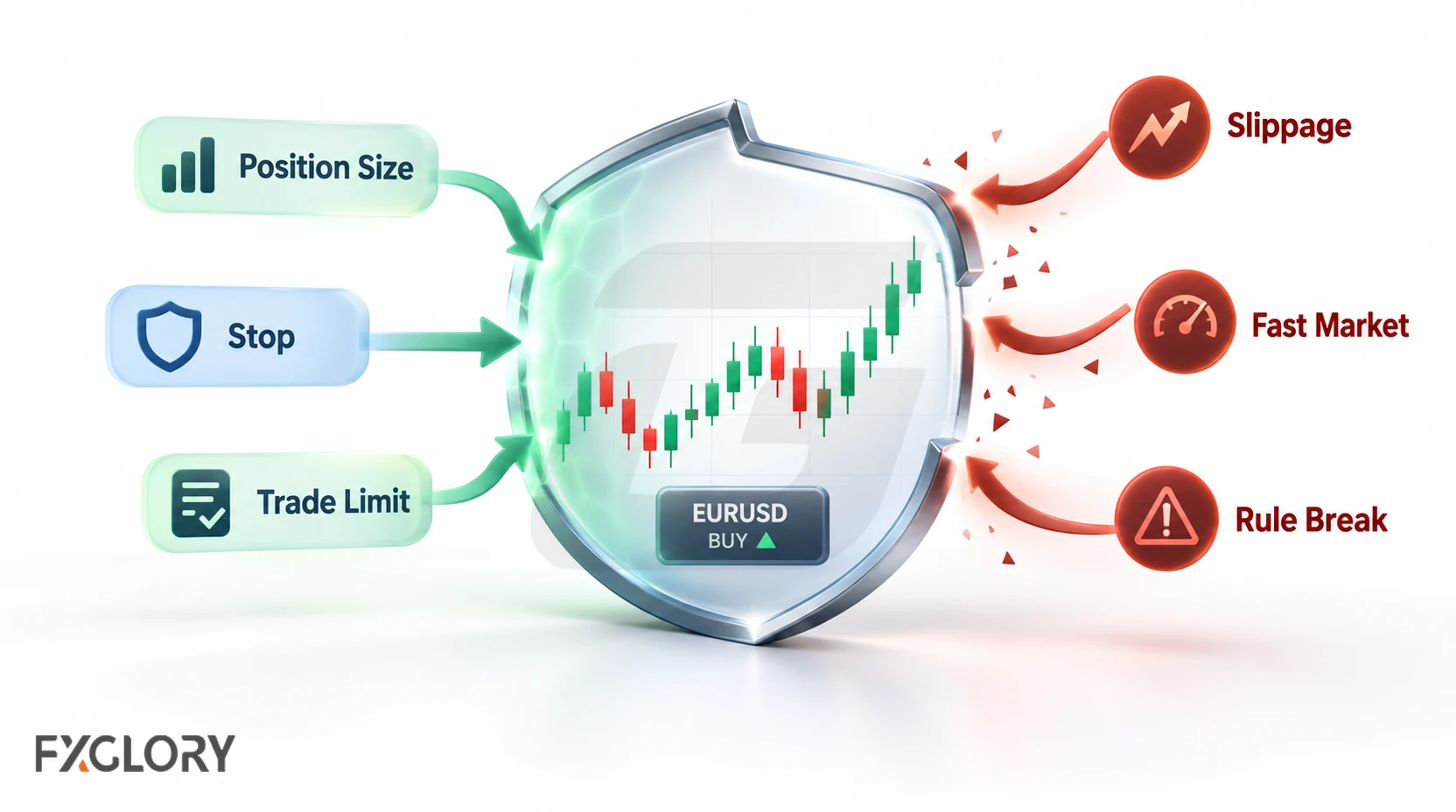
Forex trading has risk-control tools, but they do not remove risk. A stop loss can define the planned exit, but it cannot guarantee the exact exit price in every condition. Position sizing can limit planned exposure, but emotional resizing can break the rule. A trading plan can define what to do, but the trader still has to follow it.

Risk-Control ToolWhat It Can Help WithWhat It Cannot Promise
Position sizingPredefine how much account risk is planned.It cannot make a weak setup strong.
Stop logicDefine where the trade idea is invalidated.It cannot remove slippage or fast-market risk.
Trade limitReduce repeated emotional entries.It cannot help if the trader ignores it.
Margin checkShow required margin before adding exposure.It cannot make overleverage safe.
Journal reviewReveal whether the trade was planned or emotional.It cannot change a trade already taken.
No-trade ruleStop trading during poor emotional or market conditions.It cannot work if every condition is treated as an exception.

Use risk limits before any trade, a written plan before risk, and a review process that separates planned trades from emotional trades.

When Forex Trading Starts To Look Like Betting

Forex trading becomes betting-like when the trader removes the process and keeps only the risk. That can happen even if the chart is open and the language sounds technical.

Trading BehaviorWhy It Becomes Betting-LikeBetter Control
Entering without a setupThe decision depends on hope or guessing.Require a written setup checklist.
Chasing lossesThe previous loss controls the next risk.Use a cooldown or stop-for-day rule.
Increasing lot size emotionallyExposure is no longer planned.Use fixed size rules and margin checks.
Ignoring stop rulesRisk becomes undefined.Define invalidation before entry.
Copying signals blindlyThe trader does not understand the exposure.Trade only setups the trader can explain.
Trading for excitementEntertainment replaces process.Use no-trade rules and session limits.
Opening many related pairsSeveral trades may express the same currency risk.Review total exposure, not only pair names.
Continuing after broken rulesThe session loses its boundary.Stop when the first hard rule breaks.

The most dangerous overlap is loss-chasing. In forex, that often appears as when a loss controls the next trade, when urgency replaces the entry plan, when fast feedback turns into repeated trades, or when emotion lowers decision quality.

The Psychology Overlap: Fast Feedback, Chasing And Tilt

Both forex trading and sports betting can create fast emotional feedback. A win can feel like proof. A loss can feel like a problem that must be fixed immediately. That feedback loop is where risk control often fails.

In forex, the loop may look like this: a trader loses on GBP/USD, immediately opens another GBP/USD position, increases lot size, then opens a related pair to recover the session. The action looks like trading, but the driver is emotional recovery.

  • Revenge impulse: “I need to make it back.”
  • FOMO impulse: “The move is leaving without me.”
  • Tilt impulse: “I cannot stop after that result.”
  • Overconfidence impulse: “I am seeing everything clearly today.”
  • Boredom impulse: “I watched too long to do nothing.”
  • Relief impulse: “One more trade will make the session feel better.”
Control warning: If trading or betting feels compulsive, uncontrollable, or connected to serious financial or emotional harm, stop risking money and consider speaking with a qualified professional. This page is not mental-health treatment or personal financial advice.

Moral, Legal And Personal Suitability Questions

Some people search this topic because they want to know whether forex trading and sports betting belong in the same moral or religious category. This page does not answer religious law and does not give legal advice.

The safer comparison is structural: what is the activity, what is being risked, how is the outcome determined, what controls exist, and what behavior would make the activity harmful. Legal status, tax treatment, religious permissibility, and personal suitability depend on the reader's jurisdiction, beliefs, financial situation, and circumstances.

Scope note: This article compares risk and behavior. It does not tell a reader that either activity is morally acceptable, legally allowed, or personally suitable.

Practical Risk Rules Before Any Forex Trade

A trader who is comparing forex with betting should not start by asking which activity sounds easier. The better starting point is whether the trade can be explained, limited, and reviewed before money is at risk.

  1. Define the setup before entry: Do not enter because the market feels active.
  2. Know the invalidation point: Decide where the idea is wrong before the trade opens.
  3. Set position size before emotion appears: Do not increase lot size after a win or loss.
  4. Check margin before adding exposure: Use the margin calculator to estimate margin before increasing exposure.
  5. Know trading costs: Review trading-cost conditions before short-term or repeated trading.
  6. Use a session stop: Define a trade-count limit, loss limit, and rule-break stop.
  7. Review the reason after the trade: Record whether the trade was planned, emotional, rushed, copied, or recovery-driven.
  8. Practice workflow first: Use an order-workflow practice environment without live capital risk before live trading.

Then read FXGlory's disclosure on leverage, execution, one-click trading, stop-loss, and platform risks before deciding whether live trading fits your risk limits.

What Not To Conclude From This Comparison

A bad comparison can make forex sound safer than it is or make sports betting sound simpler than it is. Neither mistake helps the reader.

  • Do not conclude that forex is easy money: Forex trading can produce serious losses.
  • Do not conclude that analysis guarantees profit: A strong idea can still lose.
  • Do not conclude that stop losses remove risk: Stops can help define risk, but execution conditions still matter.
  • Do not conclude that sports betting is always 50/50: Odds and event pricing can be more complex than that.
  • Do not conclude that a lucky winning trade proves skill: Process and sample size matter.
  • Do not conclude that a trader is safe because they are not placing sports bets: Forex can still become gambling-like through behavior.

Sources Used For Risk Context

The CFTC and NASAA warn that retail off-exchange forex trading is extremely risky and caution investors against high-return, low-risk, get-rich-quick, and pressure-based claims: CFTC/NASAA foreign exchange currency fraud alert.

The SEC's day-trading investor publication is not forex-specific, but it supports the broader risk context for frequent speculative trading, including the risk of severe losses, stress, expenses, borrowed money, and margin: SEC day trading risk publication.

FXGlory's Risk Disclosure explains trading, leverage, order-execution, one-click trading, stop-loss, platform, and other risks that matter when comparing controlled trading with gambling-like behavior.

For gambling-harm context, the National Council on Problem Gambling explains that problem gambling can damage a person or family and disrupt daily life or career: NCPG problem gambling FAQ.

This page does not provide sports betting guidance, religious rulings, legal advice, mental-health guidance, trading signals, or any promise that forex trading is safer, better, or more profitable than sports betting.

Frequently Asked Questions

Is forex trading the same as sports betting?

No. Forex trading involves buying or selling currency exposure in a financial market, while sports betting involves wagering on sports outcomes. They are different activities, but both involve uncertainty, risk, probability, emotional pressure, and possible loss.

Is forex trading better than sports betting?

There is no safe blanket answer. Forex trading is not automatically better, safer, or more profitable. It has tools for analysis and risk control, but leverage, margin pressure, costs, slippage, and emotional trading can still create serious losses.

Should I choose forex trading or sports betting?

This article does not recommend either activity. Both involve risk and possible loss. A person should consider legality, personal beliefs, financial situation, risk tolerance, and whether they can follow strict rules before risking money.

Is forex trading safer than sports betting?

Not automatically. Forex trading may allow position sizing, exits, stop logic, and review, but those controls do not guarantee safety. A trader who ignores risk rules, uses excessive leverage, or chases losses can make forex highly risky.

Is sports betting always 50/50?

No. Sports betting odds are not always a simple 50/50. Odds can reflect market pricing, bookmaker margin, event probability, team conditions, injuries, weather, and public demand. This article does not provide sports betting strategy.

Does forex trading have odds like betting?

Forex trading does not use sportsbook odds. Currency prices move as market participants buy and sell currencies. A trader may think in probabilities, but the trade still faces spread, slippage, leverage, execution, and market-risk conditions.

Is the forex spread the same as sportsbook vig?

No. A forex spread is the difference between bid and ask prices in a currency pair. Sportsbook vig or margin is built into betting odds. Both are costs or pricing frictions, but they belong to different market structures.

Can forex trading become gambling-like?

Yes. Forex can become gambling-like when a trader enters without a plan, guesses, chases losses, increases lot size emotionally, ignores stop rules, copies signals blindly, or keeps trading for excitement, relief, or recovery.

What is the biggest similarity between forex trading and sports betting?

The biggest similarity is risk under uncertainty. In both activities, the outcome is not guaranteed, emotions can affect decisions, and money can be lost.

What is the biggest difference between forex trading and sports betting?

The biggest difference is the structure of the risk. Forex trading involves market exposure that can be managed with position size, exits, and risk rules. Sports betting involves a wager on an event outcome with odds and settlement rules.

Can analysis make forex trading risk-free?

No. Analysis can support a decision, but it cannot remove uncertainty, leverage risk, spread costs, slippage, news shocks, low-liquidity conditions, platform risk, or trader error.

Can stop losses make forex trading safer than betting?

Stop losses can help define risk, but they do not guarantee a fixed exit price in every market condition. Slippage, gaps, fast movement, and execution conditions still matter.

Is day trading similar to sports betting?

Frequent speculative trading and sports betting can feel similar when fast feedback, variable rewards, and loss-chasing drive decisions. The instruments are different, but the behavioral risks can overlap.

Is forex trading investing or betting?

Forex trading is market speculation on currency price movement. It can be approached with analysis, risk limits, and review, but it can also become betting-like if the trader relies on luck, emotional entries, and loss recovery.

Does FXGlory offer sports betting?

No. FXGlory does not provide sportsbook or sports betting services. This page is an educational comparison between forex trading and sports betting behavior, risk, and decision structure.

What makes forex trading different from football betting?

Football betting is a wager on a sports event or event condition. Forex trading involves taking exposure to currency price movement. Both can lose money, but the pricing, settlement, tools, risks, and decision process are different.

Can forex traders close trades before the final outcome?

A forex trader can usually close or adjust a position before the original trade idea fully plays out, depending on market and platform conditions. That flexibility is not the same as safety because exits can still be affected by spread, slippage, liquidity, and trader error.

Is early exit unique to forex trading?

Not completely. Some betting platforms may offer cash-out features, but that is still different from managing currency-market exposure. Forex exits also face spread, slippage, liquidity, execution, and trader-error risk.

Why do people compare forex trading with sports betting?

People compare them because both involve money at risk, uncertain outcomes, probability, emotion, and the temptation to chase losses. The comparison becomes useful when it helps identify poor trading behavior.

Is chasing losses in forex similar to chasing losses in betting?

Yes. In both cases, chasing losses means the previous loss starts controlling the next risk decision. In forex, this often appears as revenge trading, oversizing, immediate re-entry, or overtrading.

What is the role of leverage in the comparison?

Leverage is a forex-specific risk factor because it can increase market exposure relative to account size. Emotional leverage use can make trading losses accelerate faster than the trader expected.

Should beginners choose forex trading because it seems more skill-based?

No beginner should choose forex trading only because it sounds more skill-based. Skills, analysis, and risk rules take time to test, and they do not remove the possibility of loss.

Is sports betting more emotional than forex trading?

Not necessarily. Both can become emotional. Forex trading can create fear, greed, FOMO, revenge trading, tilt, and overtrading, especially when leverage, fast movement, or repeated entries are involved.

Can a trading plan stop forex from becoming gambling-like?

A trading plan can help, but only if the trader follows it. The plan should define setup rules, risk per trade, stop logic, maximum exposure, trade limits, no-trade conditions, and review rules.

What should I do if trading or betting feels compulsive?

Stop risking money and do not try to solve the feeling with another trade or wager. If the behavior feels compulsive, uncontrollable, or connected to serious financial or emotional harm, consider speaking with a qualified professional. This article is educational and is not mental-health, legal, religious, or financial advice.

Does this article give legal or religious advice about betting or trading?

No. This article compares structure, risk, and behavior. Legal, religious, tax, and personal suitability questions depend on the reader's jurisdiction, beliefs, and circumstances.

What is the safest conclusion from comparing forex and sports betting?

The safest conclusion is that both involve risk and possible loss. Forex trading should not be treated as easy money or entertainment betting. If a trader cannot define the setup, risk, exit, and reason for the trade, the decision is not controlled enough.

Related Contents

Is Forex Gambling?Go deeper into when forex trading starts to look like gambling and when it remains a structured trading process.
Forex Trading PsychologyReview the emotional pressure behind fear, greed, FOMO, revenge trading, tilt, and loss-chasing.
Revenge Trading in ForexStudy what happens when a previous loss controls the next forex trade.
FOMO Trading in ForexCompare sports-betting urgency with forex entries taken because a move feels like it is leaving without you.
Overtrading in ForexUnderstand when fast feedback and repeated clicking become trading beyond the plan.
Trading Tilt in ForexRecognize emotional overload before it turns into oversizing, revenge trades, or uncontrolled re-entry.
Forex Risk Management StrategySet risk limits before any trade, not after emotion starts influencing the position.
Forex Trading Plan TemplateUse written rules to separate planned trades from guesses, impulses, and recovery attempts.
Forex Trading JournalReview whether each trade was planned, emotional, oversized, or taken to recover a loss.
Margin CalculatorEstimate margin before increasing exposure or opening multiple positions.
SpreadsReview trading-cost conditions before short-term or repeated trading activity.
Risk DisclosureRead FXGlory's disclosure on trading, leverage, execution, one-click trading, stop-loss, and platform risks.
Open a Demo AccountPractice order workflow and risk rules without putting live capital at risk.

Review Risk Rules Before Live Trading

Create an FXGlory account to access FXGlory's trading environment and review platform workflow, account conditions, margin estimates, spread awareness, and your own trading rules before placing a real-money trade.

Create an FXGlory Account