
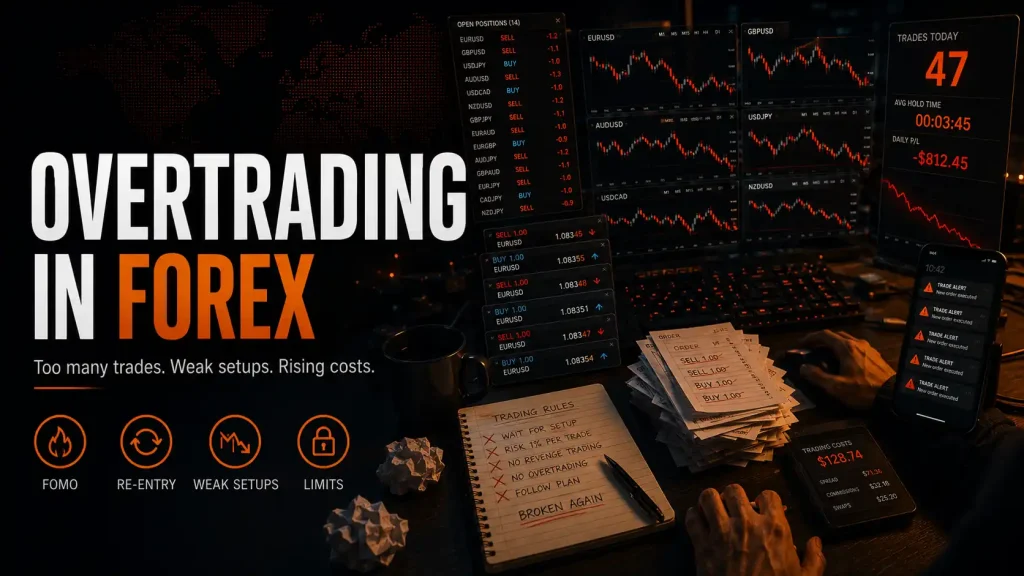
What Is Forex Overtrading?
Forex overtrading happens when trading activity moves beyond pre-defined limits for setup quality, trade count, position size, exposure, or session behavior. It is not simply “trading a lot.” A high-frequency strategy can still be controlled if each decision follows its rules, while a small number of impulsive or oversized trades can already be overtrading.
The practical response is not just to trade less. Define what qualifies as a trade, set limits before the session begins, and stop adding activity once a trade-count, risk, exposure, or rule-break threshold is reached.
This page supports the broader trading behavior and psychology guide by focusing on excessive or low-quality activity inside a trader's own process.
What Counts As Overtrading?
Overtrading can be measured across several dimensions, not by trade count alone. A useful review asks whether the trader exceeded the rules for activity, risk, exposure, or trade management.
| Area | Controlled Trading | Possible Overtrading |
|---|---|---|
| Trade frequency | Entries stay within the strategy and session plan. | The trader keeps adding trades after the planned limit or without qualifying setups. |
| Setup quality | Each entry meets the same defined criteria. | Later trades are accepted with weaker confirmation or looser standards. |
| Position size | Size follows the normal risk rule. | Size increases because of boredom, confidence, frustration, or recovery pressure. |
| Exposure | Combined currency exposure is reviewed before another position is added. | Several trades stack the same currency or market idea without an exposure check. |
| Trade management | Stops, targets, add-ons, and exits follow pre-defined rules. | The trader repeatedly changes an open position simply because watching it creates discomfort. |
This distinction matters because a scalper, day trader, swing trader, and position trader can all have different normal frequencies. The relevant question is whether the activity still belongs to the method being traded.
Overtrading vs Active Trading Or Scalping
Active trading and scalping are not automatically overtrading. A fast strategy can still be selective, risk-controlled, and rule-based.
| Active Trading Or Scalping | Overtrading |
|---|---|
| Uses defined setups before the session starts. | Takes weaker trades because movement itself feels like opportunity. |
| Has a risk budget and session boundaries. | Keeps trading after those boundaries have been reached. |
| Uses planned position sizing. | Changes size in response to recent wins, losses, or emotion. |
| Accepts periods with no trade. | Feels pressure to stay in the market. |
| Reviews performance by setup and execution quality. | Judges the session mainly by activity or the desire to recover a result. |
Different trader types naturally operate at different speeds. Use trade frequency by trader style to compare scalping, day trading, swing trading, and position trading.
Why Overtrading Happens In Forex
Overtrading often begins when activity starts to feel like control. Clicking can feel productive, constant chart monitoring can feel responsible, and another trade can feel like a solution to boredom, frustration, or a disappointing result.

- FOMO: A fast move makes waiting feel costly.
- Revenge trading: Another trade is used to try to recover a loss.
- Boredom: The trader treats inactivity as a problem that needs fixing.
- Overconfidence: Recent wins make weaker setups feel acceptable.
- Frustration: Recent losses lower the threshold for taking the next opportunity.
- Weak setup criteria: Vague rules make almost any market movement look tradable.
- Long screen time: Normal fluctuations begin to look more significant after extended monitoring.
- Social pressure: Other traders' activity creates pressure to participate.
The common feature is that the need to act becomes stronger than the filtering process that should decide whether a trade belongs in the plan.
Warning Signs Of Forex Overtrading
Overtrading usually becomes visible through changes from the trader's normal process rather than through one fixed number of trades.
- Trading after the session limit: New entries continue after the planned trade-count, time, or risk boundary has been reached.
- Lower setup standards: “Almost valid” starts replacing clearly defined criteria.
- Immediate re-entry: A new position appears before the previous trade has been reviewed.
- Jumping between pairs or timeframes: The trader keeps changing what they are watching because staying inactive feels uncomfortable.
- Emotion-driven size changes: Position size increases after wins, losses, boredom, or frustration.
- Stacked exposure: Several positions depend on the same currency move without a combined exposure check.
- Unplanned trade interference: Stops, targets, exits, or add-ons are changed repeatedly without a management rule.
- Compulsive platform checking: Screen time continues even when the plan has no valid setup.
- Discomfort with being flat: Having no open position starts to feel like a missed opportunity.
Overtrading vs FOMO, Revenge Trading, Tilt, Greed, And High-Frequency Trading
Overtrading can be caused by several emotions and behaviors, but it is not identical to them.
| Behavior | Main Trigger | Relationship To Overtrading |
|---|---|---|
| FOMO trading | Fear of missing a move | Can produce repeated late entries or weaker setups. |
| Revenge trading | A recent loss or lost profit | Can produce repeated recovery trades. |
| Tilt | Emotional overload after stress, surprise, fatigue, or frustration | Can weaken trade filtering and session discipline. |
| Greed or overconfidence | Wanting more after a strong result | Can push the trader past normal trade or risk limits. |
| High-frequency trading | Systematic, technology-driven rapid trading | High frequency by itself is not the same as emotional or discretionary overtrading. |
For the focused triggers, see FOMO trading in forex and revenge trading after a loss.
Why Forex Can Make Overtrading Worse
Forex does not make a trader overtrade, and leverage does not make market prices move more. The problem is that repeated decisions can quickly change account exposure, margin use, costs, and correlation across several currency pairs.

| Forex Factor | How Overtrading Can Affect It | What To Review |
|---|---|---|
| Leverage | Leverage can allow larger notional exposure with less margin. Repeated or larger positions can therefore increase the account impact of a given market move. | Review position size and combined notional exposure before adding another trade. |
| Margin | Additional positions can increase required margin and reduce free margin. Margin is a funding requirement, not the same as the trader's intended loss on a trade. | Check required margin separately from stop-based trade risk. |
| Spreads | More entries mean paying trading costs more often. | Include current spread conditions in the strategy's expected costs. |
| Slippage and execution | Rushed entries during fast conditions can execute at different prices than expected. | Avoid assuming every market order will fill at the displayed price. |
| Correlation | Several pairs can share the same currency exposure. | Review combined exposure by currency, not only the number of open tickets. |
| Swaps | Trades intended as short-term can remain open longer when decisions become disorganized. | Know applicable holding costs before leaving positions open. |
FXGlory's margin calculator can help estimate required margin before adding a position, and the spreads page can help review trading-cost conditions. These tools support planning; they do not determine whether another trade should be taken.
The Hidden Cost Of Overtrading
The cost of overtrading is not limited to losing positions. Repeated low-quality decisions can make a strategy harder to evaluate and can weaken execution even when some individual trades make money.
| Cost | How It Appears | Why It Matters |
|---|---|---|
| Repeated transaction cost | More entries create more spread and execution costs. | Costs can consume a larger share of expected returns as frequency rises. |
| Lower setup quality | Later trades no longer meet the same criteria as earlier ones. | The journal begins mixing strategy results with impulsive decisions, making the method harder to evaluate. |
| Decision fatigue | Selectivity declines after long periods of monitoring and repeated decisions. | Rule-breaking can become more likely later in the session. |
| Exposure concentration | Several positions respond to the same currency theme. | The account may carry more directional risk than the trade count suggests. |
| Review noise | A large number of inconsistent trades produces unclear performance data. | It becomes harder to identify whether the strategy or the execution process needs improvement. |
Session Brake: What To Do When You Are Already Overtrading
Once a session has moved beyond its rules, another market opinion is usually less useful than a clear interruption condition. The first task is to determine whether the plan still permits new risk.

| Trigger | Action | Reason |
|---|---|---|
| Daily risk limit reached | End new trading for the session. | The pre-defined loss boundary has already been reached. |
| Trade-count limit reached | Stop opening new positions. | The session has used its planned activity budget. |
| A key rule is broken | Step away and record the first rule break. | A broken process rule needs review before more risk is added. |
| The next trade cannot be explained clearly | Do not enter; record why the urge appeared. | Unclear reasons often indicate that filtering has weakened. |
| Position size was increased emotionally | Stop and review the risk decision. | Exposure control has already changed from the plan. |
| Pairs or timeframes keep changing | Return to the planned watchlist or end the session. | Repeated switching can become a way to manufacture another opportunity. |
| Being flat feels unacceptable | Do not add another trade simply to remain active. | The urge to participate is not a setup. |
Rules And Limits That Help Stop Overtrading
Overtrading controls are strongest when they are written before the session starts. They should cover activity, monetary risk, market selection, exposure, and the point at which trading ends.
| Control | Example Structure | What It Prevents |
|---|---|---|
| Trade-count limit | Set a maximum number of entries for the session or strategy. | Turning screen time into continuous trading. |
| Daily risk limit | Stop when the pre-defined session risk threshold is reached. | Loss-recovery loops and escalating exposure. |
| Watchlist limit | Trade only pairs selected before the session. | Moving across unrelated pairs simply because no current setup is available. |
| Correlation limit | Cap how much similar currency exposure can be open at once. | Several positions unintentionally becoming one concentrated view. |
| Timeframe rule | Use only the timeframes required by the method for entry decisions. | Changing charts until an already-desired trade appears easier to justify. |
| Cooldown rule | Pause after a win, loss, exit, or rule break when emotion is elevated. | Immediate re-entry and repeated decision loops. |
| Management rule | Define how stops, targets, partial exits, and add-ons may be changed. | Micromanaging open positions without a plan. |
| Session-end rule | Define the time or condition after which no new trade can be opened. | Extending the session because the trader still wants activity. |
Use the trading plan template to document trade and session limits. For monetary risk boundaries, pair it with the forex risk management guide. These rules can also be rehearsed with an FXGlory demo account before live capital is involved.
Pre-Entry Checklist To Avoid Overtrading
A checklist should test whether the next trade belongs in the plan, not whether a reason can be found to keep the session active.
- Setup: Does this trade meet the written entry criteria?
- Trade count: Is the session still inside its pre-defined activity limit?
- Watchlist: Is this pair one that was selected for today's plan?
- Position size: Is size consistent with the normal risk rule?
- Exposure: Does this trade add materially similar currency exposure to positions already open?
- Recent decision: Is the previous win, loss, exit, or missed move influencing this entry?
- No-trade option: Would skipping this order still be acceptable if the setup is not fully valid?
Journal Fields That Reveal Overtrading
A journal can show where trade quality begins to fall and which conditions are most often associated with excessive activity.
| Journal Field | What To Record | What It Reveals |
|---|---|---|
| Trade number in session | The sequence number of each entry. | Whether quality declines after a certain point. |
| Planned or unplanned | Whether the setup was identified before entry. | How much activity came from the trading plan versus impulse. |
| Setup grade | The strategy-specific quality classification used before entry. | Whether standards fell as the session continued. |
| Trigger | Plan, FOMO, revenge, boredom, overconfidence, frustration, or other cause. | Which state most often precedes excess activity. |
| Time since previous trade | Minutes between decisions. | Whether immediate re-entry is a repeated pattern. |
| Combined exposure | Relevant currency exposure already open when the trade was added. | Whether several positions were stacking the same idea. |
| Rule break | Trade count, risk, size, stop, watchlist, timeframe, or management rule. | Which control needs reinforcement. |
For a fuller review process, use the forex trading journal guide. A structured format is also available in the trading journal template.
What To Do After An Overtrading Day
An overtrading day should be reviewed as a process event, whether it finished positive or negative. A profitable result can still reinforce poor behavior if the trader repeatedly broke the plan.
- Identify the first rule break: Find where the session first moved outside the plan.
- Separate planned from unplanned trades: Do not evaluate every entry as if it came from the same strategy.
- Review sequence quality: Check whether later trades had weaker setups, larger size, or shorter decision gaps.
- Check exposure overlap: Identify whether multiple positions were effectively one currency view.
- Strengthen one control: Adjust a trade-count, watchlist, cooldown, or session-stop rule only when the review supports the change.
- Review after the session: Avoid rewriting the plan while still reacting to the day's result.
Sources Used For Risk Context
For broad forex risk context, the CFTC and NASAA warn that retail off-exchange forex trading is extremely risky and that traders should be cautious with high-return, low-risk, get-rich-quick, or pressure-based claims: CFTC/NASAA forex investor alert.
FXGlory's own Risk Disclosure explains trading, leverage, order-execution, one-click trading, stop-loss, and platform risks that can become more important when a trader keeps adding positions or changing decisions under pressure.
This page discusses forex overtrading as a behavioral and risk-control problem. It does not provide personal financial advice, mental-health guidance, trading signals, or a promise that any rule can prevent losses.