

What Is A Forex Martingale Strategy?
Martingale is a recovery-based position-sizing rule, not a way to forecast market direction. In a sequential closed-loss method, each failed trade is closed before a larger next trade is opened. In an open-basket averaging method, the losing positions are retained while larger same-direction trades are added. These versions should not share the same realised-loss, floating-loss, or margin calculation.
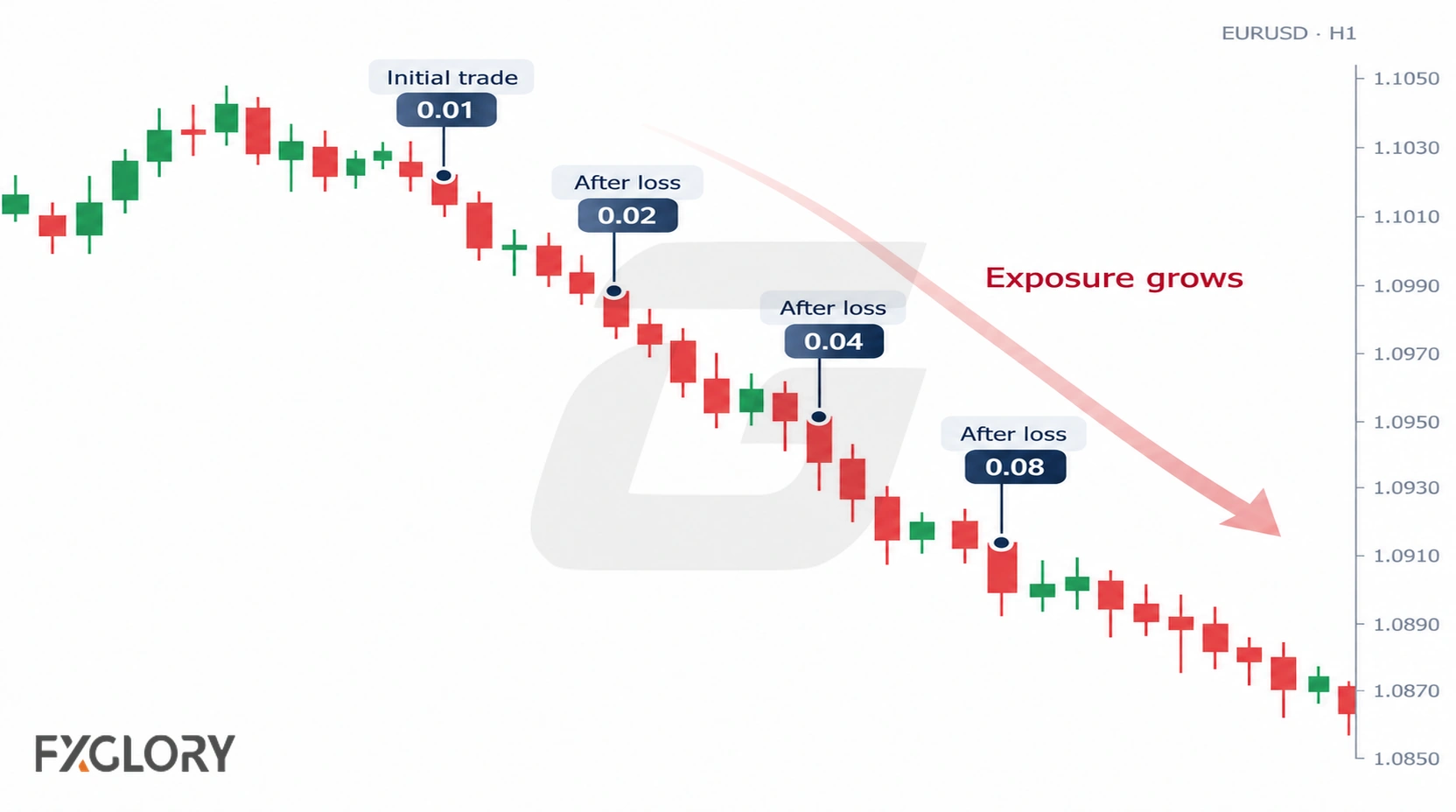
The classic version doubles the next stake after a realised loss. Other methods use a smaller multiplier or add positions at price intervals. In the sequential version the current open lot size is just the latest trade, while earlier losses are already realised; in the averaging version all retained orders contribute to current market exposure.
Martingale is not a market analysis method. It does not identify trend, range, support, resistance, momentum, or economic value. It only changes how position size behaves after losses. For that reason, it should never be treated as a complete forex trading system.
Why Martingale Looks Attractive
Martingale can report many small recovered cycles. In an averaging basket, a favorable price retracement may allow several open orders to close together near break-even or with a modest net gain. In a sequential system, a later win is instead compared with earlier realised losses. Either reporting style can appear stable when incomplete or severe losing sequences are overlooked.
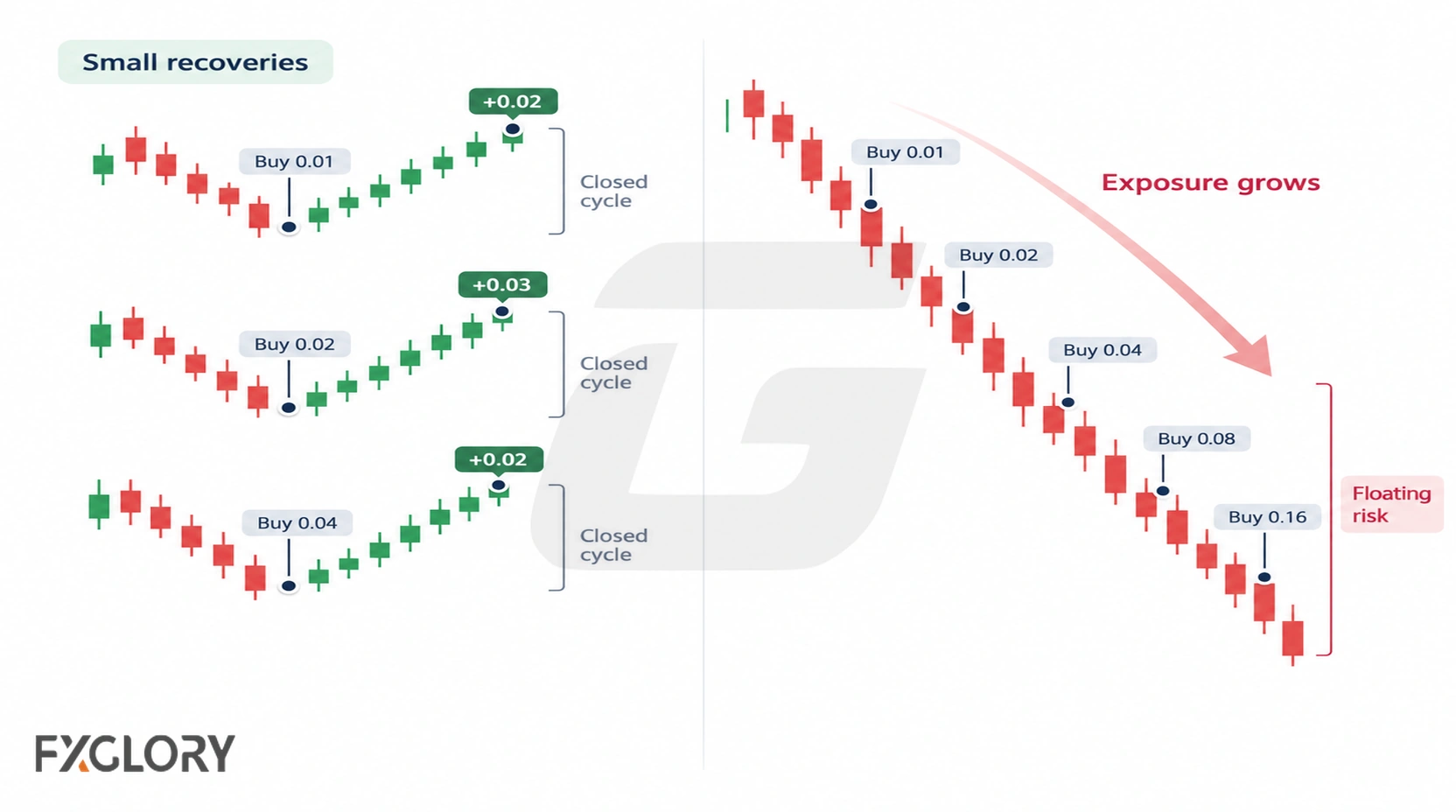
Closed-trade win frequency cannot show the full equity path. Record marked-to-market equity during unresolved baskets, and report realised losses during incomplete sequential recovery cycles. A long adverse move or a forced exit can outweigh many smaller successful cycles.
| Why It Looks Appealing | What Is Hidden |
|---|---|
| Many small baskets may recover | One extended losing sequence can erase earlier recoveries |
| Average entry moves closer to price | Total open volume and account exposure increase |
| Win rate can appear high | Loss size can be much larger than normal winners |
| The rules look simple | Margin, spread, swap, slippage, and trend risk are not simple |
Strict Martingale vs Modified Martingale
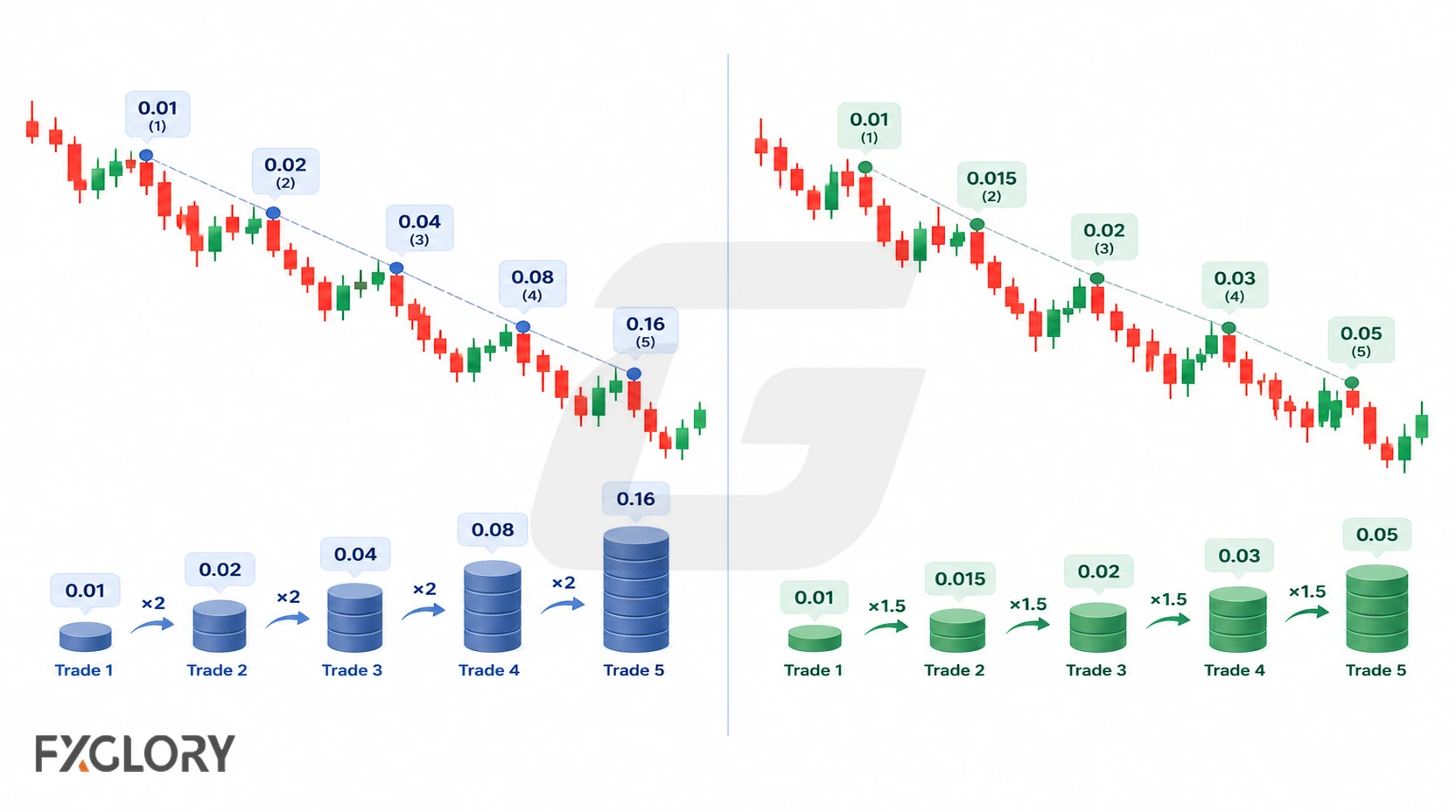
Strict Martingale commonly doubles the next stake; modified versions may use a smaller multiplier, capped levels, fixed spacing, or an equity stop. Doubling is not a guarantee of recovery. The familiar one-win recovery identity applies only to a simplified sequential model with equal per-unit gain and loss, no fees, and a winner paid at the planned amount. An averaging basket has different price-path and exposure mathematics.
| Version | What Changes | What Does Not Change |
|---|---|---|
| Strict Martingale | Size commonly doubles after each loss | Exposure can grow very quickly during a losing sequence |
| Reduced multiplier | Size may increase by a smaller factor | The account still adds risk after losses |
| Fixed maximum levels | The sequence stops after a written number of steps | The trader must accept the loss when that level is reached |
| Equity-stop version | The basket closes when account loss reaches a limit | The limit must be accepted instead of bypassed with another recovery trade |
Hypothetical sequential example: Four losing attempts of $10, $20, $40, and $80 realise $150 in losses. A subsequent $160 winner leaves a $10 net gain before costs. Under a 1.5 multiplier, losses of $10, $15, $22.50, and $33.75 total $81.25; a next win paying $50.625 leaves a net loss of $30.625 (approximately $30.63). The example assumes identical per-unit win/loss distances, so real spreads, slippage, and unequal outcomes can change either result.
How A Martingale Sequence Grows
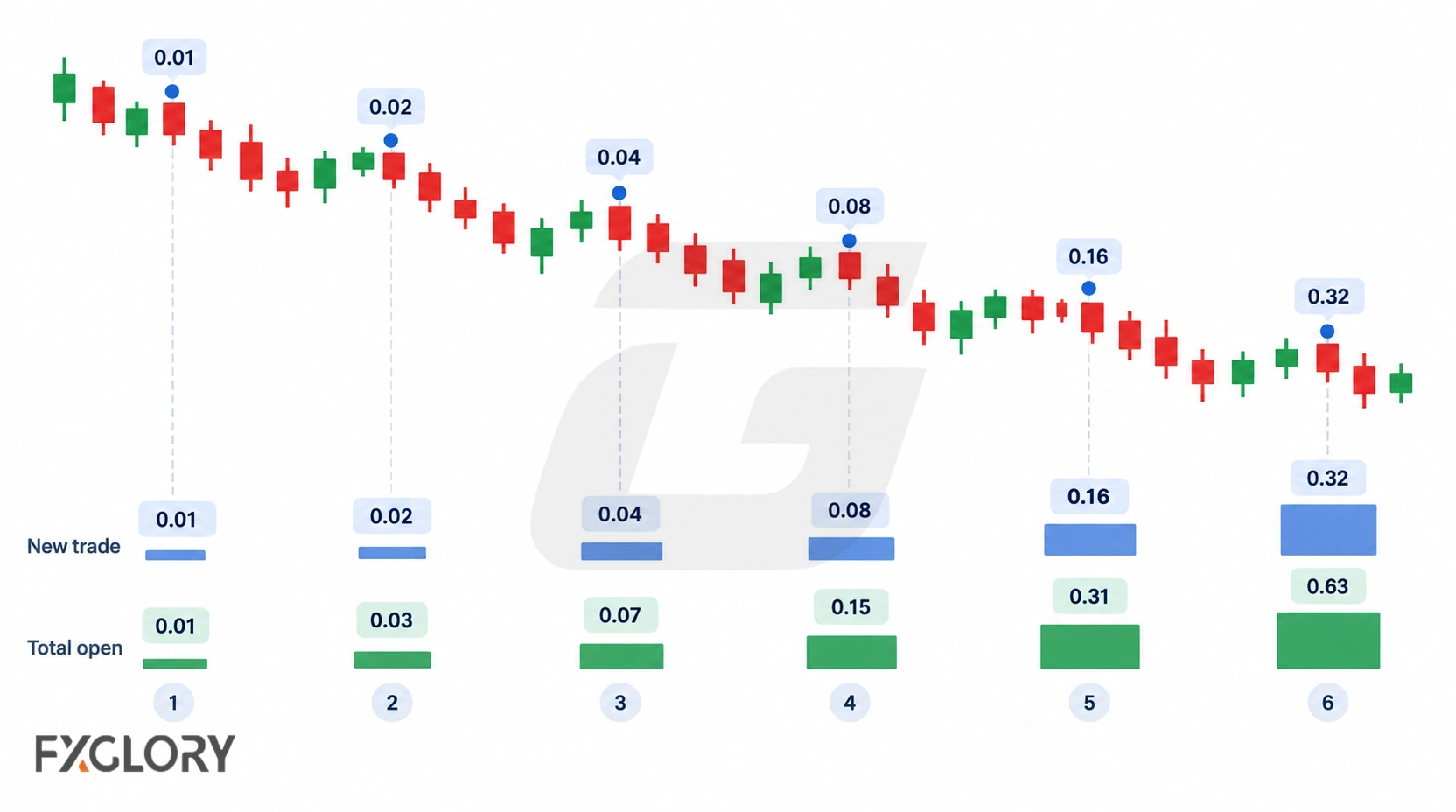
This hypothetical open-basket averaging example starts with 0.01 lots and doubles each added order while keeping all earlier positions open. The cumulative-volume column therefore does not describe a sequential method in which each loser is closed before the next order.
| Open-basket addition | Example New Lot Size | Total Open Lot Size If Positions Remain Open | What Changes |
|---|---|---|---|
| Initial trade | 0.01 | 0.01 | Small exposure begins |
| After 1 addition | 0.02 | 0.03 | The basket is already larger than the first trade |
| After 2 additions | 0.04 | 0.07 | Loss, spread cost, and margin pressure expand |
| After 3 additions | 0.08 | 0.15 | A small adverse move now affects a larger basket |
| After 4 additions | 0.16 | 0.31 | Margin use becomes a central risk check |
| After 5 additions | 0.32 | 0.63 | The sequence can become account-level risk |
For classic doubling, new volume at level n is the initial lot size × 2n. If all levels from 0 through n remain open, cumulative volume is the initial lot size × (2n+1 − 1). At the last row here, 0.63 lots remain open. In a closed-loss sequence, only the latest 0.32-lot order would be open, alongside previously realised losses.
Check both the planned maximum size and the prices where orders are added. Lot totals show exposure but do not by themselves determine maximum currency loss, margin use, or the price at which the broker may liquidate positions.
Average Entry Price vs Account Exposure
For an open basket of same-direction positions, the volume-weighted entry price is the sum of each entry price multiplied by its lot size, divided by total open lots. Adding larger positions at new prices can move that average toward the later entries. This does not apply to earlier trades already closed in a sequential method.
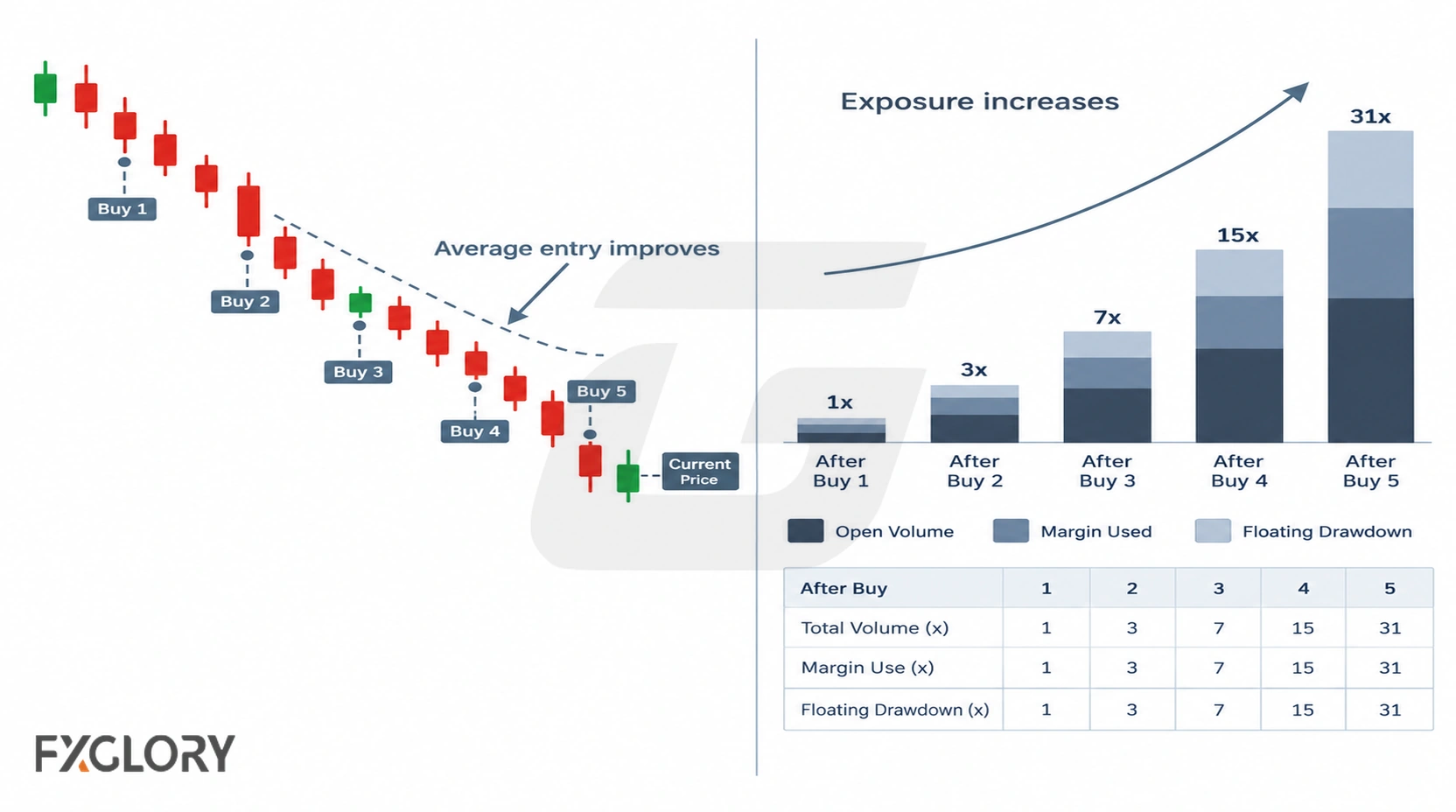
Average entry is a price measure; the account also depends on net volume and the full path of adverse prices. Hypothetical EUR/USD exposure: at 0.63 standard lots in a USD account, approximately $10 per pip per standard lot gives $6.30 per pip. An additional unfavorable 50-pip move changes floating P&L by approximately −$315, assuming all 0.63 lots remain open and before added costs. This is an incremental move from the current marked position, not the basket’s total lifetime loss or a historical result.
| Focus Area | What It Shows | What It Can Hide |
|---|---|---|
| Average entry | Where the basket may break even | How large the basket has become |
| Closed profit | Recovered sequences | Floating drawdown during recovery |
| Next recovery target | Distance to exit | Margin pressure if price does not return |
| Small initial lot | Conservative-looking start | Large later levels after repeated losses |
Recovery Target vs Maximum Loss
Martingale often targets a small recovery after a large sequence of risk. A trader may be trying to close the basket for a small gain, but the account is carrying several open positions while waiting for that gain to appear.
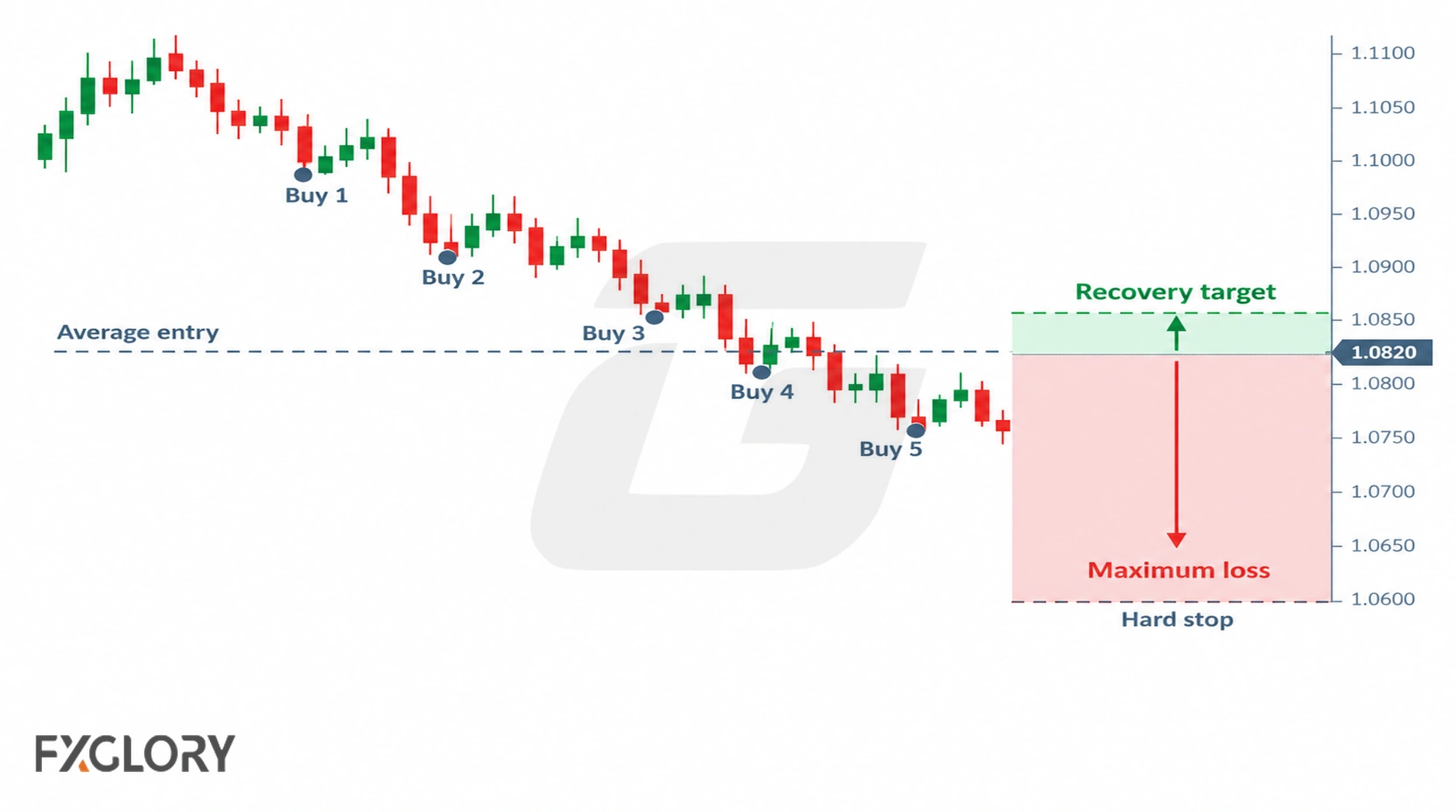
A small proposed basket exit gain should be compared with loss at a specified adverse-price or equity-exit condition, including existing floating P&L and costs. A level cap does not, by itself, establish the amount lost when a capped basket is finally closed.
| Question | Why It Matters |
|---|---|
| What is the intended recovery target? | Shows whether the basket is chasing a small gain after large exposure |
| What is the maximum accepted loss? | Prevents unlimited recovery logic from replacing risk control |
| What happens if the final level fails? | Forces the trader to define the ending before the sequence starts |
| Does the target still make sense after spread, slippage, and swap? | Checks whether the recovery is realistic after trading costs |
Why Martingale Is Dangerous In Forex
Martingale does not turn an adverse sequence into a favorable probability. The available account equity, permitted volume, tradable liquidity and broker execution rules set finite limits on both successive closed-loss attempts and averaging baskets.
In an open basket, increasing same-direction volume raises the monetary sensitivity to each subsequent pip of movement. In a closed-loss sequence, the next trade carries a larger single-trade stake on top of losses already realised. Both mechanisms can exhaust a finite account.
- Finite capital: The account can run out of usable margin before the expected reversal.
- Extended trends: A pair can keep moving in one direction longer than the recovery plan can survive.
- Spread and slippage: Later, larger orders can make trading costs more important.
- Swap: Recovery baskets held overnight can collect swap charges or credits depending on pair direction and conditions.
- News volatility: A fast candle can push the basket through multiple levels or beyond planned exits.
- Psychology: Rising size after losses can make the trader defend the basket instead of following the plan.
For position size, drawdown, stop distance, margin, and account-level rules, use the forex risk management strategy before any recovery method is tested.
Martingale And Margin Calls
For open baskets, additional positions may increase required margin while unfavorable price movement reduces account equity. Margin calls, stop-outs and liquidation depend on the broker’s account terms, instrument specifications, leverage, and the account’s changing equity; the number of lots alone cannot produce an exact margin requirement.
Stress-test equity and free margin at each planned entry price, the last allowable addition, and a further adverse move beyond the final level. In a sequential model, also test whether the account can fund the next stake after realised losses.
| Question | Why It Matters |
|---|---|
| How many levels are allowed? | Unlimited levels create undefined account risk |
| What is the largest planned lot size? | Later levels can dominate the whole sequence |
| What margin is needed at maximum exposure? | The account may fail before price returns |
| What is the hard stop or equity stop? | Without one, the loss has no written limit |
Use the margin calculator to review margin requirements before opening a live position, and check leverage conditions because leverage changes how much exposure an account can carry.
Positive Swap Does Not Fix Martingale
Some traders try to combine Martingale logic with positive swap or carry-style ideas. A swap credit may reduce part of the holding cost in some conditions, but it does not remove price risk, margin risk, spread cost, slippage, or the danger of an expanding recovery basket.
Swap can also change by symbol, account conditions, trade direction, rollover timing, and market conditions. If a Martingale basket stays open for several nights, the trader should review both positive and negative swap scenarios with the forex swap explanation and keep the carry-trade logic separate from recovery sizing.
Martingale vs Grid Trading
Grid trading and Martingale describe different design choices: where orders are placed and how much is traded after losses.
A grid defines where orders are placed across price levels. Martingale defines how size increases after losses. A trader can use a grid without Martingale sizing, and a trader can use Martingale sizing without a grid. When the two are combined, exposure can grow both through more levels and larger position sizes.
| Method | Main Function | Main Risk |
|---|---|---|
| Grid trading | Places orders at planned price intervals | Many open orders and floating drawdown if the market breaks the grid |
| Martingale | Increases size after losses | Exponential exposure growth after a losing sequence |
| Grid + Martingale | Adds levels and increases size | Basket risk can expand quickly if price trends one way |
For order-level structure, review what grid trading means in forex before comparing it with recovery sizing.
Martingale vs Hedging
Hedging attempts to offset or reshape currency exposure, whereas Martingale increases size after an adverse outcome. Combining these mechanisms does not make the resulting positions risk-free.
Some traders combine hedging and recovery logic, but that does not remove risk. A hedge can add spread, swap, margin requirements, and exit problems. A Martingale hedge-recovery system can become even harder to manage because the trader must solve both the hedge exit and the increasing-size problem.
For hedge structure, remaining exposure, costs, and exit rules, use the forex hedging strategy guide rather than treating every offset position as recovery protection.
Martingale vs Anti-Martingale
Anti-Martingale does the opposite of classic Martingale. Instead of increasing size after losses, it increases size after wins and reduces size after losses. The idea is to scale when the trader believes conditions are favorable and pull back when losses appear.
Anti-Martingale still needs predefined size caps and loss rules; a run of gains does not prove that the next trade will win. For deeper rules on this different sizing logic, see the anti-Martingale strategy guide.
| Approach | Size Increases After | Main Concern |
|---|---|---|
| Martingale | Losses | Exposure grows when the trader is already wrong or early |
| Anti-Martingale | Wins | Overconfidence can increase size late in a move |
Automation, Bots, And Martingale EAs
Where permitted, a Martingale EA can monitor quotes, calculate a predefined size multiplier and entry spacing, check level caps or margin thresholds, submit supported orders, and log actual fills. These functions depend on the platform and implementation; automation cannot guarantee a reversal, prevent spread widening, remove slippage, or create additional account equity.
Test disconnections, rejected or partial fills, failed equity-stop requests, incorrect quote timing, and differences between expected and executed order size. Recovery orders should not continue automatically after the configured cap or loss condition has been reached.
If a trader uses automation where permitted, trading platform workflow and VPS conditions can affect monitoring and connection stability, but they do not reduce Martingale exposure, margin risk, or market risk.
When Martingale Fails
Record the specific event that ends a recovery attempt: a prewritten size or level cap, a realised-loss ceiling, an equity-stop trigger, a broker stop-out, or a strategy invalidation. Sequential and open-basket versions reach these conditions differently.
| Failure Mode | What Happens |
|---|---|
| Strong trend | Each recovery level is added into the same adverse direction |
| News spike | Price can move beyond planned levels before orders are adjusted |
| Spread widening | Recovery targets become harder to reach after cost |
| Swap drag | Overnight baskets can accumulate holding cost |
| No hard stop | The sequence has no defined failure point |
| Too much leverage | Small price movement can create large account impact |
| Emotional override | The trader adds another level after the written limit is reached |
Spread cost becomes more important when later recovery trades are larger. Check spread conditions before assuming a small recovery target is realistic. If the basket stays open overnight, review swap in forex before carrying the sequence across rollover.
No-Trade Conditions
These are pre-entry rejection rules, distinct from the later research table and final checklist.
- Skip if there is no maximum number of recovery levels.
- Skip if the largest possible lot size is not known before the first entry.
- Skip if margin at maximum exposure has not been checked.
- Skip if the plan depends on price eventually returning with no written failure point.
- Skip if spread, slippage, and swap are ignored.
- Skip if a news event can push price beyond several planned levels.
- Skip if the trader cannot define where the basket must be closed.
- Skip if the strategy is being used to avoid accepting a planned loss.
Testing And Review Before Live Trading
For reproducible testing, label the method as sequential closed-loss or retained open-basket sizing, then document the original entry signal, multiplier, allowed order sizes, add-level spacing, basket or trade exit, margin policy, and transaction-cost assumptions. An unclosed losing basket at the end of the sample must not be counted as a successful or zero-loss cycle.
Report realised balance separately from marked-to-market equity, including intrabar drawdown where the data support it, the highest margin used, any margin-call or stop-out event, and how missing fills or gaps were modeled. Note whether historical candles provide enough resolution to simulate simultaneous price and margin changes; incomplete quote data should be identified as a limitation.
| Review Item | Why It Matters |
|---|---|
| Initial lot size | Controls how large later levels can become |
| Multiplier | Shows how quickly exposure grows |
| Maximum levels | Defines when recovery stops |
| Maximum floating drawdown and minimum equity | Shows intrasequence stress and any unresolved basket loss |
| Margin used, free margin, and broker exit | Shows whether a simulated stop-out occurs before the planned final level |
| Spread and slippage | Shows whether recovery targets remain realistic |
| Swap impact | Shows cost or credit during overnight holding |
| Exit reason and sample-end open exposure | Shows whether the plan was followed and avoids hiding unfinished losses |
Entry, basket exit, hard stop, equity stop, time stop, and cancellation rules should be written through an entry and exit rule framework before a recovery sequence is tested.
Martingale Strategy Checklist
This checklist summarises decisions needed before the first order; historical testing and outcome reporting belong in the previous section.
| Checklist Item | Question |
|---|---|
| Method and market reason | Is this a sequential or open-basket method, and why is this pair traded before recovery sizing? |
| Initial size | What is the smallest first position? |
| Multiplier | How does size change after each loss? |
| Maximum level | Where does the sequence stop adding exposure? |
| Maximum loss | What loss is accepted if the sequence fails? |
| Margin test | Can the account support the worst planned basket? |
| Cost check | Do spread, swap, and slippage still allow the basket plan? |
| Event filter | Is the sequence paused around high-risk news or unstable liquidity? |
| Exit rule | What closes the basket if recovery does not happen? |
| Review rule | What data proves the method followed the written plan? |
Check execution permissions, margin and stop-out terms through FXGlory trading account conditions. Do not infer live profitability from an incomplete simulated recovery sequence.