

What Is A Forex Straddle Strategy?
A forex straddle strategy is a volatility-based pending-order method. Instead of choosing a bullish or bearish direction first, the trader defines a price range and reviews whether a buy-stop order above the range and a sell-stop order below the range can be planned with acceptable risk.
The common idea is simple: if price breaks upward, the buy-stop order may trigger; if price breaks downward, the sell-stop order may trigger. The difficult part is that fast markets do not behave like diagrams. Spread can widen, price can jump through an order level, one order can fill worse than expected, and a first break can reverse quickly.
A forex straddle is therefore not a direction-free shortcut. It is a trade structure that needs a reason, event context, order distance, range quality, stop logic, target or trailing rule, opposite-order cancellation, spread check, margin review, and no-trade condition.
Forex Straddle vs Options Straddle
The word straddle is used differently across markets. In options markets, a straddle usually means buying or selling a call option and a put option with the same strike price and expiration date. That structure depends on option premium, strike, expiry, implied volatility, and option payoff rules.
In spot or CFD-style forex discussion, a straddle usually means something different. It often describes pending buy-stop and sell-stop orders placed around price, especially around news releases or expected volatility expansion. There is no options strike price in that forex-order version.
| Straddle Type | Common Structure | What It Depends On | FXGlory-Safe Reading |
|---|---|---|---|
| Options straddle | Call and put option at the same strike and expiry. | Premium, expiry, strike, implied volatility, and option settlement. | General market concept; not the focus of this forex pending-order guide. |
| Forex pending-order straddle | Buy stop above a range and sell stop below a range. | Range quality, spread, slippage, stop distance, trigger behavior, and cancellation rules. | The main structure reviewed in this article. |
| News straddle | Pending orders placed around a news-sensitive range or post-news range. | Event risk, liquidity, spread expansion, first spike, and whipsaw behavior. | Requires strict risk and no-trade rules. |
When Traders Use Forex Straddles
Forex straddles are usually reviewed when traders expect movement but do not want to decide direction before the move starts. This often happens before high-impact events, after quiet consolidation, or around a range that may break in either direction.
The setup is most often discussed around central-bank decisions, inflation reports, employment releases, GDP data, unexpected policy comments, or other events that may create fast price movement. It can also appear around a tight technical range where a trader expects volatility expansion but does not know which side will break.
That does not mean every event is suitable. A straddle setup can be weak when the range is too wide, the range is too tight after spread, liquidity is thin, the event is already priced in, or the expected move is not large enough to justify stop distance and execution risk.
- Common use: Reviewing movement around a planned event or range break.
- Weak use: Placing buy and sell stops only because the trader does not want to choose a direction.
- Required check: Confirm that spread, stop distance, and margin still fit the plan.
How A Forex News Straddle Works
A forex news straddle begins before the order tickets are opened. The trader first identifies the event, the affected currency, the pair under review, the price range, and the maximum risk that can be accepted if conditions change.
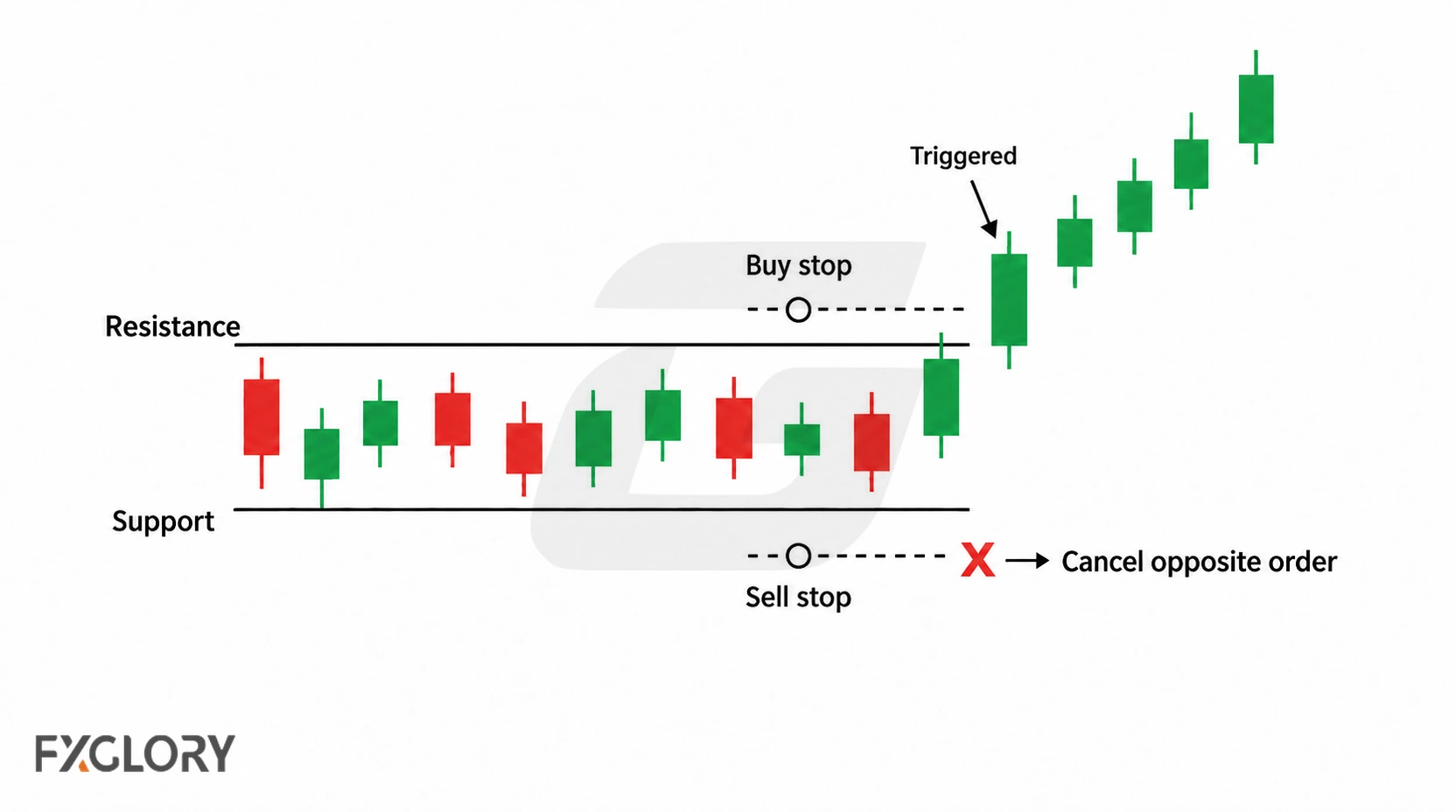
The simplest pending-order version places one buy-stop order above the chosen range and one sell-stop order below the range. If the buy stop fills, the plan should require confirming the fill, requesting cancellation of the remaining sell stop, and verifying its status; the same applies in reverse if the sell stop fills. Cancellation may not complete before a rapid second trigger.
| Step | Decision | Why It Matters |
|---|---|---|
| 1. Event or range | Choose the release, session, or technical range being reviewed. | The setup needs a reason beyond random volatility. |
| 2. Affected pair | Select a pair linked to the event or range structure. | The pair should fit the reason for expected movement. |
| 3. Range boundary | Mark the upper and lower boundary before orders are placed. | Orders should not be moved around after price starts jumping. |
| 4. Buy-stop level | Place the buy stop above the upper boundary only if spread and distance make sense. | The order should not sit inside normal noise. |
| 5. Sell-stop level | Place the sell stop below the lower boundary only if spread and distance make sense. | The order should not sit where routine movement can trigger it. |
| 6. Stop and target | Define risk, target, trail, or time exit before the trigger. | Fast markets leave little time for improvisation. |
| 7. Opposite-order rule | Confirm the first fill, cancel the remaining pending order, and verify its status. | A second order may execute before cancellation; a response must comply with account rules. |
Opposite-Order Cancellation Is Part Of The Setup
The untriggered order should not be treated as harmless just because one side has already filled. Unless the platform and account workflow clearly uses linked order handling, a buy-stop and sell-stop pair should not be assumed to cancel each other automatically. The trader needs a written rule for confirming the first fill and handling the second order. FXGlory may classify rapidly opened opposite positions, including certain forms of hedging, as scalping. Account-specific terms must be checked before using this structure; do not deliberately leave the opposite order active to create a rapid hedge.
| Order Issue | Why It Matters | Better Rule |
|---|---|---|
| Untriggered order remains active | Price can reverse and activate the second side. | After confirming the first fill, request cancellation and verify the remaining order is no longer active. |
| Fill confirmation delay | Fast movement can make the trader react before the first fill is clear. | Confirm order status before changing the remaining order. |
| Assumed OCO behavior | Not every order setup should be assumed to behave like a linked one-cancels-the-other order. | Check platform and account conditions before relying on automatic cancellation. |
| Second-side trigger | Both directions can become active before cancellation completes. | Check actual fills and exposure; use only account-permitted corrective procedures and contact support if the rules are unclear. |
Pre-News Straddle vs Post-News Straddle
A pre-news straddle places pending orders before the release. The goal is to catch the first expansion if price breaks beyond the planned range. This may provide an early trigger, but it faces the strongest spread, slippage, and whipsaw risk because the first seconds around news can be unstable.
Before considering either approach, check the current FXGlory User Agreement and the conditions of the specific account. FXGlory does not guarantee pending-order, stop-loss, or take-profit execution during important news. It also restricts certain high-volume trades using leverage above 1:100 around major news when intended to exploit market gaps. Do not assume that a news straddle is permitted, or that its orders will execute as displayed, merely because the platform accepts them.
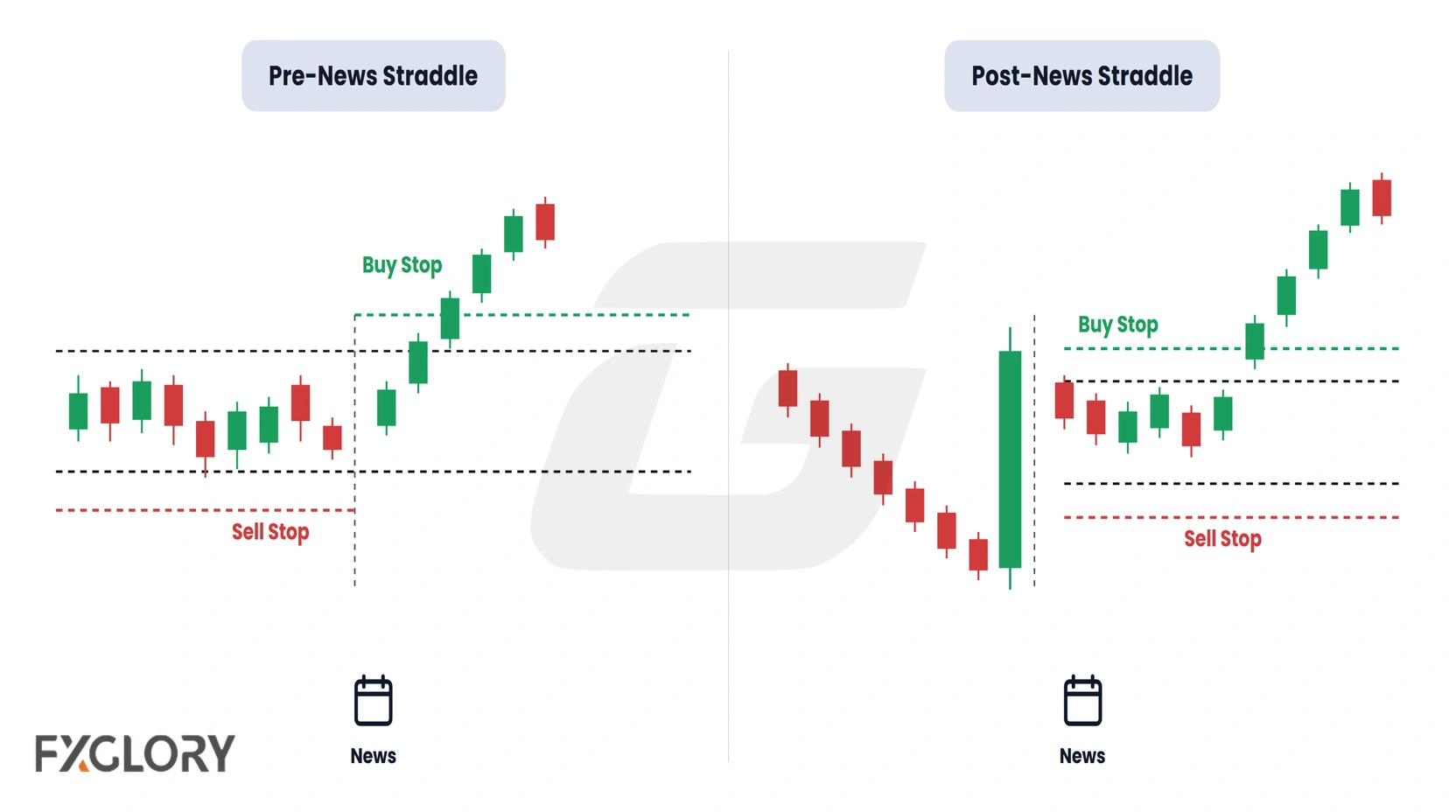
A post-news straddle waits until the first spike has already happened. The trader then reviews whether a new smaller range forms after the initial reaction. This may reduce some first-spike risk, but it can also miss the main move or create a late setup when the clean target room is already gone.
| Approach | Possible Advantage | Main Risk | Better Use |
|---|---|---|---|
| Pre-news straddle | Can participate if the first break continues. | Spread expansion, slippage, fake first move, and double-trigger risk. | Only where account terms permit the setup and spread, distance, stop, and cancellation rules are established before the release. |
| Post-news straddle | Avoids guessing the first spike and waits for a new range. | May be late, may have reduced target room, and may still face volatility. | Only when the new range is clear and the first reaction has not already consumed the move. |
| No straddle | Avoids unstable execution conditions. | May miss a move, but avoids forced trading. | Useful when spread, range, stop, or order logic is not clean. |
Order Distance And Range Placement
Order distance is one of the most important parts of a forex straddle strategy. If orders are placed too close to price, normal spread and noise can trigger them. If orders are too far away, the trade may trigger only after a large part of the move has already happened.
Straddle order levels should be based on the range being traded, recent volatility, spread behavior, nearby support or resistance, and whether there is enough room beyond the trigger. A random pip distance can make the setup impossible to review.
For range boundaries, traders can use support and resistance structure to avoid placing orders around arbitrary levels. For volatility expansion beyond a planned range, the breakout strategy guide explains why a line break still needs confirmation, room, invalidation, and false-breakout rules.
| Placement Issue | Weak Rule | Stronger Rule |
|---|---|---|
| Order distance | Use the same pip gap for every pair and event. | Adjust by range size, volatility, spread, and stop distance. |
| Upper level | Place the buy stop just above the current candle. | Place it beyond a defined upper boundary with room after cost. |
| Lower level | Place the sell stop just below the current candle. | Place it beyond a defined lower boundary with room after cost. |
| Spread allowance | Ignore spread because the event should be volatile. | Reject the setup if widened spread distorts the trigger or stop. |
| Range width | Use any range that appears before news. | Use only ranges that have clear boundaries and realistic stop placement. |
The Move Must Clear Costs After Trigger
An options straddle needs enough movement to overcome premium cost. A forex pending-order straddle has a different cost problem: after one side triggers, the move still needs enough room to absorb spread, possible slippage, stop distance, and any delayed fill. A trigger by itself is not useful if the remaining target room is already too small.
| Cost Or Distance Item | Why It Can Damage The Setup | Review Question |
|---|---|---|
| Spread | Wider spread can make a breakout trigger less meaningful. | Is the trigger still beyond real market noise? |
| Slippage | The fill may occur beyond the planned order level. | Does the trade still make sense after a worse fill? |
| Stop distance | Event stops can be wider than normal structure stops. | Does the position size still fit account risk? |
| Target room | The first spike may consume the clean part of the move. | Is there enough room left after entry costs? |
The Whipsaw Problem
Whipsaw risk is the main reason a forex straddle can look simple before the event and become difficult during execution. Price may break upward, trigger the buy stop, reverse sharply, threaten the stop, and then move toward the lower side of the range. The reverse sequence can also happen.
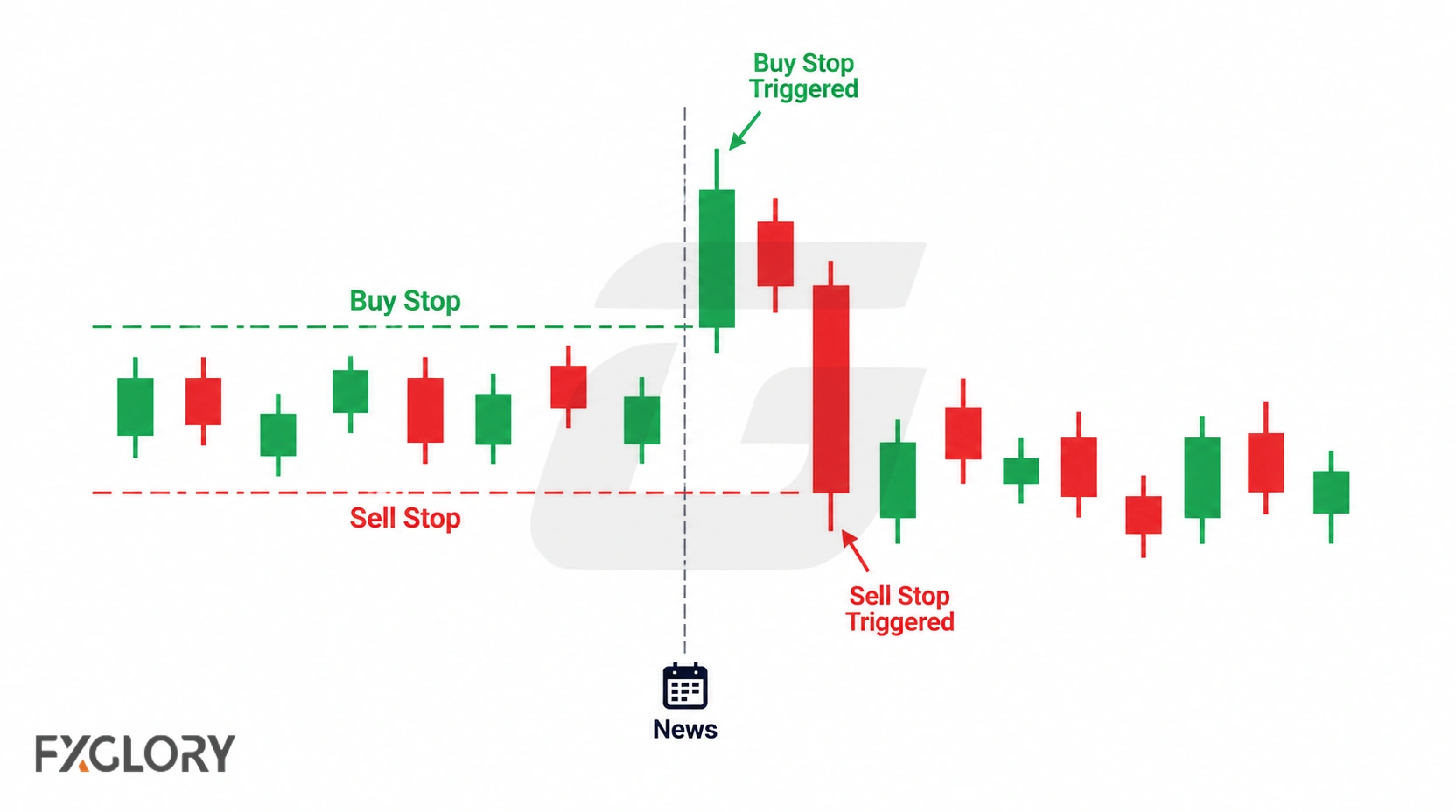
Whipsaws can occur alongside thin liquidity, mixed news, rapid repricing, and spread changes. Price movement alone cannot establish whether stops were deliberately targeted or which participants drove the reversal. For a straddle, the observable risk is a failed first break followed by renewed exposure to the other pending order.
| Whipsaw Scenario | What Can Happen | Required Rule |
|---|---|---|
| One-sided trigger then reversal | The first order fills, but price quickly returns inside the range. | Stop, time exit, or failed-break rule. |
| Both sides triggered unexpectedly | Price activates one order, reverses, and activates the other before cancellation completes. | Verify both executions and total exposure; follow only the corrective procedures permitted for the specific account. Do not assume rapid hedging is allowed. |
| Spread spike | The order triggers because execution conditions widened, not because structure broke cleanly. | Spread limit and no-trade rule. |
| Mixed data reaction | Headline direction reverses when traders read details or revisions. | Wait rule, post-news range rule, or skip rule. |
| Late chase | The trader re-enters after the planned setup has already failed. | One-attempt or no-re-entry rule. |
Spread, Slippage, Liquidity, And Execution Risk
News and volatility can change execution conditions. A setup that looks reasonable with normal spread may become poor when spread expands before or after an event. A small target can become unrealistic if the trigger price, stop price, and fill price are affected by fast movement.
For a straddle setup, trading cost is not a small detail. The plan can be damaged by spread on the triggered order, slippage at entry, slippage at stop, delayed order execution, and a price move that does not continue far enough after cost. In standard MetaTrader forex order handling, a buy stop triggers when the Ask reaches its level, while a sell stop triggers when the Bid reaches its level. Because a chart may display only Bid prices, a widening spread can activate a buy stop even when the displayed Bid has not reached that same level. Review FXGlory's spread information before treating a tight range as tradable.
| Execution Factor | Why It Matters In A Straddle | Control Question |
|---|---|---|
| Spread | Can widen around news and alter Ask/Bid trigger behavior. | Are the actual Ask and Bid trigger levels still consistent with the plan? |
| Slippage | Entry or stop can fill away from the planned level. | Can the account still accept the trade if the fill is worse? |
| Liquidity | Thin conditions can produce jumps, gaps, or unstable candles. | Is this a suitable time to use pending orders? |
| Order speed | Fast candles can move through order levels quickly. | Does the plan depend on a perfect fill? |
| Small targets | Costs can consume much of the expected move. | Is there enough target room after spread and slippage? |
Stops, Targets, And Cancellation Rules
A forex straddle needs stop, target, and cancellation rules before price reaches either order. These rules make the setup reviewable. Without them, the trader may be forced to decide under fast movement after one order has already triggered.
The stop may sit beyond the opposite side of the range, beyond a nearby level, or at a volatility-adjusted distance. The target may use a fixed level, a measured range, a trailing rule, a time stop, or a partial exit rule. The cancellation rule specifies how the remaining pending order is canceled after the first confirmed fill and how failed cancellation or an unexpected second fill is handled under the account terms.
The full trade-management logic belongs in an entry and exit plan. The entry and exit strategy guide is useful when defining trigger, invalidation, target, cancellation, and review rules before a pending-order setup is used.
| Rule | Question To Answer Before Entry | Weak Version |
|---|---|---|
| Stop rule | Where is the trade wrong after the trigger? | The stop is decided after price starts moving. |
| Target rule | Where is there realistic room after cost? | The target is copied from another event or pair. |
| Time rule | How long can the trade stay open if follow-through fails? | The position remains open because the trader hopes movement returns. |
| Opposite-order rule | What happens to the order that did not trigger first? | The second order is left active without a reason. |
| Re-entry rule | Can the trader try again after a failed break? | Re-entry happens emotionally after a stop-out. |
Forex Straddle vs Breakout Strategy
A forex straddle often uses breakout mechanics because the buy stop and sell stop sit outside a planned range. The difference is that a straddle is usually built around volatility uncertainty: the trader is preparing for movement in either direction before one side is chosen by price.
A breakout strategy can be directional from the start. A trader may plan a bullish breakout only, a bearish breakout only, a retest entry, or a continuation breakout in a wider trend. A straddle places potential triggers on both sides, which adds cancellation and whipsaw problems that a one-direction breakout plan may not have.
| Feature | Forex Straddle | Breakout Strategy |
|---|---|---|
| Direction before entry | Usually two-sided until one order triggers. | Can be one-sided or two-sided depending on the plan. |
| Main reason | Expected volatility or event movement. | Break beyond a planned level or structure. |
| Extra risk | Opposite-order management and double-trigger risk. | Fakeout, late entry, retest failure, or poor target room. |
| Key rule | Verify the first fill and cancel the remaining pending order under account rules. | Confirm the break and define invalidation. |
Forex Straddle vs Broader News Trading
A forex news trading strategy is broader than a straddle. A trader can choose to stand aside, wait for the first reaction, trade a confirmed continuation, fade a failed move, trade a post-news range, or reject the event entirely. A straddle is only one possible way to structure pending orders around expected movement.
This distinction matters because some events are not suitable for straddles. If the expected outcome is already priced in, if the release has multiple conflicting parts, if revisions are likely to change interpretation, or if spreads become unsuitable, a two-order setup may create more risk than clarity.
Margin And Pending-Order Exposure
A straddle setup should be reviewed with margin in mind. Even if only one side is expected to trigger first, fast movement can create unexpected exposure. The account still needs enough free margin for the triggered position, the stop distance, and any unusual execution conditions.
Before using pending orders around volatile conditions, use the margin calculator to review position size and margin exposure. Also review leverage conditions, because leverage can magnify losses when price moves quickly after an event.
Pending-order planning should also respect platform and account conditions. Review trading account conditions before assuming that every order workflow, distance, or execution behavior will fit the strategy.
| Margin Question | Why It Matters |
|---|---|
| What position size fits the stop distance? | A wide event stop can make a normal lot size unsuitable. |
| What happens if slippage worsens the entry? | The actual risk may differ from the planned level. |
| Can the account handle fast movement? | Volatile candles can pressure margin quickly. |
| Is the opposite order canceled correctly? | Unexpected second-side exposure can change total risk. |
| Are platform and account rules clear? | Order handling should not be assumed during fast conditions. |
Why Forex Straddle Strategies Fail
Forex straddles often fail because the trader sees the two-order structure but underestimates the execution and management burden. The plan may look balanced before the event, then become difficult when price moves fast, spreads widen, or the first trigger fails.
- Spread widening: The trigger distance becomes too small after costs change.
- Slippage: The entry or stop fills away from the planned level.
- False breakout: Price breaks one side of the range and quickly returns.
- Double trigger: Both buy and sell orders become active because the opposite order was not canceled or conditions reversed too quickly.
- Weak range: The order levels were based on a random zone rather than a clean structure.
- No follow-through: The triggered side does not move far enough after spread and slippage.
- Oversized position: The trader uses normal size even though the event stop is wider or execution risk is higher.
- Emotional re-entry: After a whipsaw or stop-out, the trader tries to recover without a written second-attempt rule.
Forex Straddle Decision Sequence
A forex straddle strategy should be decided before the market reaches the order levels. The sequence below keeps the setup reviewable and prevents the trader from building rules after price has already moved.
| Step | Decision | Continue Only If |
|---|---|---|
| 1. Reason | Event, volatility expectation, or range-break condition. | The setup has a clear reason beyond excitement around movement. |
| 2. Pair | Choose the affected currency pair. | The pair is linked to the event or range being reviewed. |
| 3. Range | Define upper and lower boundaries. | The range is visible before orders are placed. |
| 4. Spread check | Review whether spread makes order distance unsuitable. | Spread does not distort the trigger or stop logic. |
| 5. Order distance | Set buy-stop and sell-stop levels. | Levels are outside normal noise and still leave room. |
| 6. Stop and target | Define invalidation, target, trail, or time exit. | Risk and reward can be reviewed before entry. |
| 7. Cancellation | Plan confirmation of the first fill, cancellation of the remaining order, and response to an unexpected second fill. | The rule is written in advance and complies with the account conditions. |
| 8. Margin | Check account impact and position size. | The account can support the plan if conditions move quickly. |
| 9. No-trade rule | Define conditions that cancel the setup. | The trader knows when not to trade. |
No-Trade Conditions
Many straddle setups should be rejected before they reach the order stage. A no-trade rule protects the account from forced participation during unstable conditions.
- Skip the setup when spread has widened enough to distort the entry or stop.
- Skip the setup when the range is too messy, too wide for the account, or too narrow after spread.
- Skip the setup when the order distance is arbitrary rather than based on structure and volatility.
- Skip the setup when stop placement is unclear or too large for the planned position size.
- Skip the setup when the opposite-order cancellation and unexpected-fill procedure are unclear or would conflict with the account rules.
- Skip the setup when a mixed event, revision risk, or thin liquidity makes the first reaction unreliable.
- Skip the setup when the trader is using the strategy to avoid choosing a trade direction or waiting for confirmation.
Testing And Review Before Live Trading
A forex straddle strategy should be tested before real-fund use is considered. A trader should record not only whether one order made or lost money, but whether the planned range, spread, trigger, fill, stop, target, cancellation, and no-trade rules were followed.
Testing should include both quiet events and violent events. It should also separate theoretical chart entry from actual fill behavior. A chart may show price touching a level, but the account result depends on spread, order fill, slippage, stop execution, and how the opposite order was handled.
| Review Item | What To Record |
|---|---|
| Event or range reason | Why the straddle was planned. |
| Pre-order spread | Normal spread, widened spread, and spread near trigger. |
| Order distance | Distance from range boundary and reason for the distance. |
| Trigger behavior | Which order filled, fill price, and slippage. |
| Opposite order | Whether cancellation completed before any unintended second trigger and how resulting exposure was handled. |
| Stop and target | Whether the exit matched the written plan. |
| Whipsaw behavior | Whether price reversed after the first break. |
| Rule discipline | Whether the trader followed the no-trade, re-entry, and cancellation rules. |
The forex trading system guide can help organize straddle testing into repeatable rules instead of isolated event reactions. For account-level protection, compare the setup with risk-management rules for position size, leverage, margin, drawdown, and no-trade decisions.
Forex Straddle Strategy Checklist
The checklist below can be used before a forex straddle setup is reviewed. A missing item does not automatically make the setup impossible, but it should slow the decision down.
- The event, session, or range reason is clear before orders are placed.
- The affected currency pair is selected for a reason, not because it moved recently.
- The upper and lower range boundaries are marked before price reaches them.
- The buy-stop and sell-stop distances are based on range, volatility, spread, and stop logic.
- The stop, target, trailing, time-exit, and failed-break rules are written.
- The remaining pending order has a cancellation-and-verification rule, and any unexpected second fill can be addressed under the specific account terms.
- Spread, slippage, and liquidity risk are reviewed before the setup.
- Position size and margin are checked before orders are placed.
- The no-trade rule is strong enough to cancel the setup when conditions change.
- The setup has been tested in a demo environment before any real-fund use is considered.