
What Is Grid Trading In Forex?
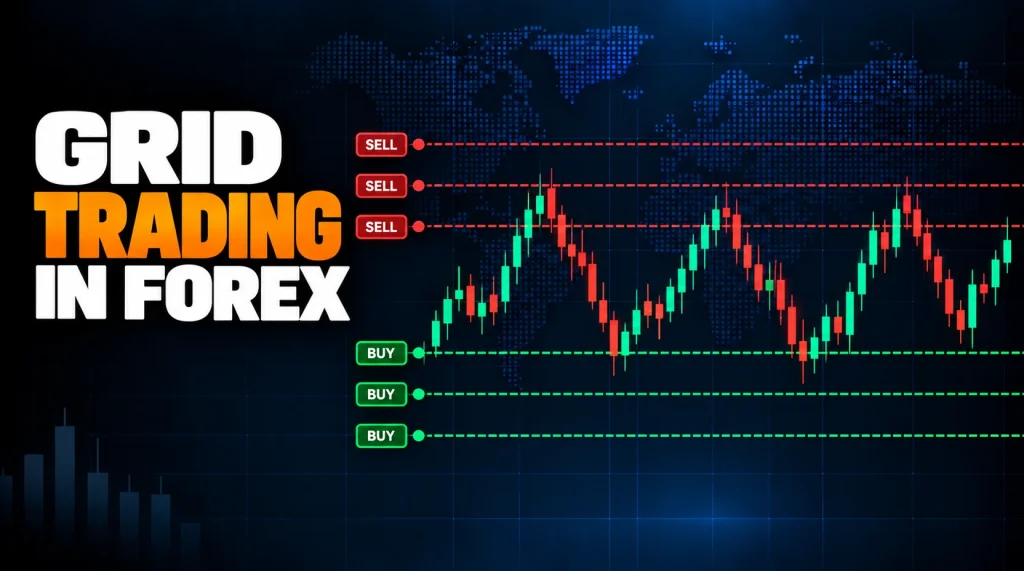
Grid trading in forex is an order-placement method where buy orders, sell orders, or both are placed at planned price intervals. The levels form a grid around a reference price, range, trend structure, support or resistance area, or another predefined zone.
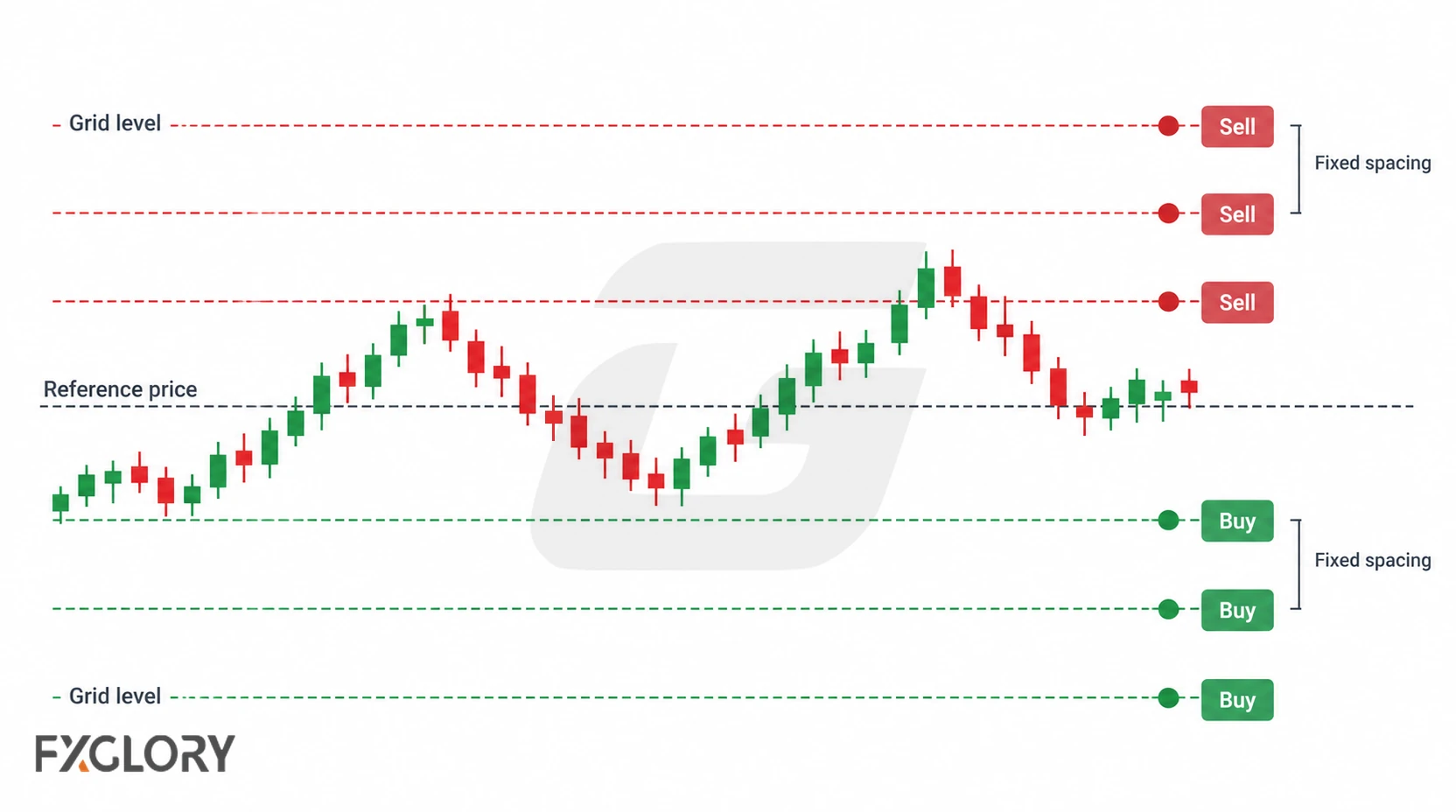
A grid can use equal spacing and equal lot size, or it can adjust spacing or size according to written rules. The central question is not how many levels the grid contains, but whether the market condition, maximum exposure, and exit logic are defined before orders begin to trigger.
Grid Trading Is Not A Complete Trading System
A grid answers where orders may be placed. It does not decide whether the market is suitable, how much total exposure is acceptable, where the idea becomes invalid, or when the grid should be disabled.
Those decisions belong to the wider trading system. For the broader rule set that connects market choice, setup condition, entry, exit, risk, and review, use the forex trading system framework.
| Grid Element | What It Decides | What It Does Not Decide Alone |
|---|---|---|
| Grid levels | Where orders may be placed | Whether the market condition is suitable |
| Grid spacing | Distance between planned order levels | Whether spread, volatility, and target room are acceptable |
| Lot size | Position size per level | Total exposure after several levels trigger |
| Take-profit rule | Where individual orders or baskets may close | How open losing exposure is controlled |
| Automation | How orders may be placed according to rules | Whether the market condition still fits the grid |
| Equity stop | When account-level risk forces an exit | Whether the grid should have been opened |
How Forex Grid Trading Works
A forex grid starts with a reference price or area. The trader then defines the grid interval, the number of levels, order direction, lot size, target rule, and the condition that cancels the grid.
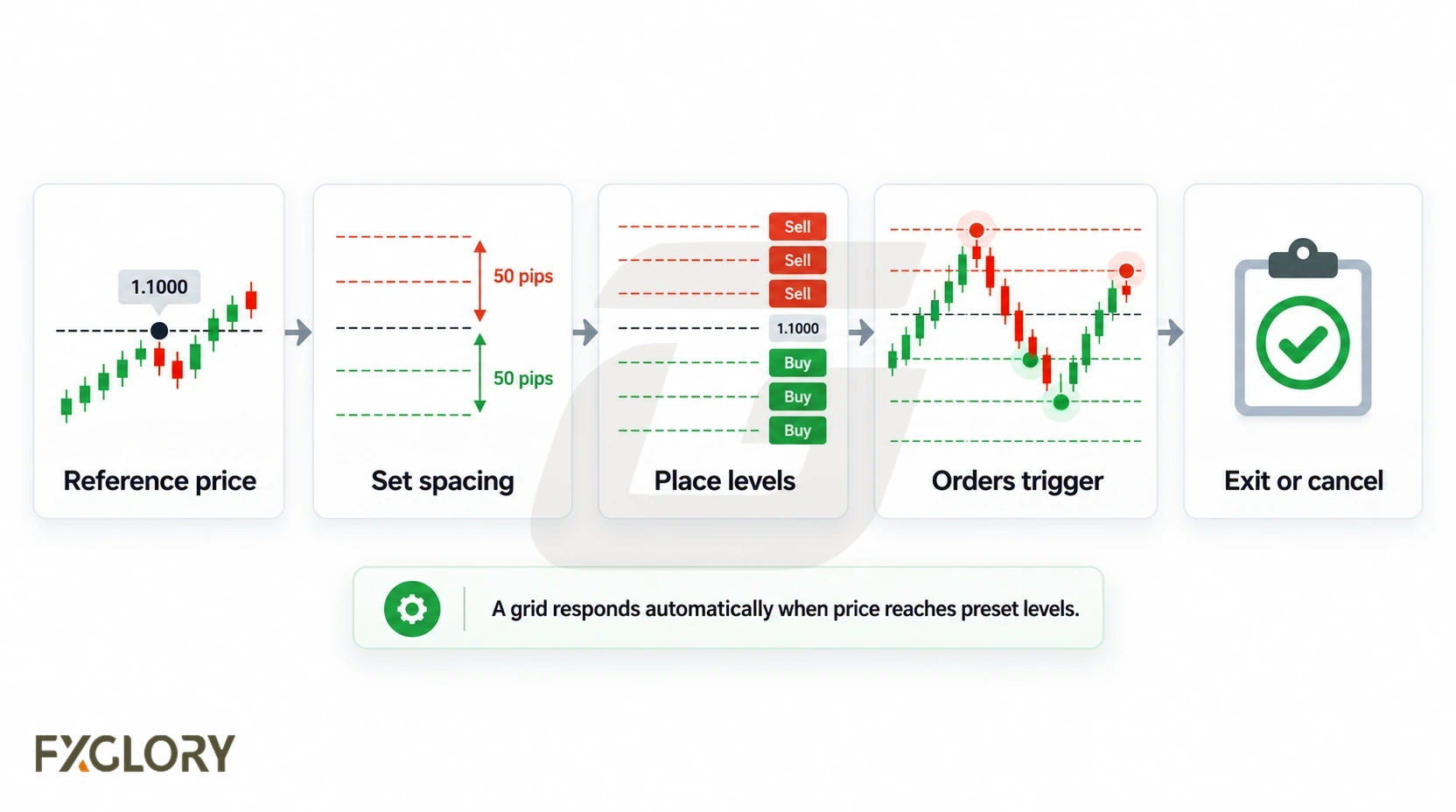
For example, a range grid may place buy orders lower in a defined range or sell orders higher in that range. A trend grid may add orders in the direction of a continuing move or on planned pullbacks. The same word “grid” can therefore describe different market assumptions.
The full result includes closed and open profit or loss, spread, slippage, swap if positions remain open overnight, margin use, and the exit rule for the entire grid.
| Grid Part | Practical Question | Weak Version |
|---|---|---|
| Reference price | What price or zone starts the grid review? | Starting because price simply looks active |
| Order direction | Buy grid, sell grid, mixed grid, range grid, or trend grid? | Placing both sides without defining the market condition |
| Grid interval | How far apart are the levels? | Using spacing too narrow for spread and normal noise |
| Number of levels | How many orders can trigger before the plan stops? | Allowing unlimited positions |
| Lot size | How much exposure is added at each level? | Increasing size without calculating full-grid exposure |
| Exit rule | Does each order close separately, or does the basket close together? | Closing small winners while leaving losing exposure unmanaged |
| Invalidation | When is the grid idea wrong? | Assuming price will return eventually |
Order Direction, Basket Logic, And Net Exposure
A forex grid should define direction before orders are placed. A buy grid, sell grid, two-sided grid, and trend-continuation grid do not create the same exposure.
The closing method also changes the risk. Some grids close each order separately after a small move. Others close a basket only when the combined position reaches a planned result. A per-order close can leave losing positions open, while a basket close can keep the whole grid active until the basket exit, time limit, or invalidation rule is reached.
| Grid Choice | What It Means | Main Risk To Review |
|---|---|---|
| Buy-limit range grid | Buy orders are placed below a reference area and usually expect rotation upward. | Price keeps falling after the range or support idea fails. |
| Sell-limit range grid | Sell orders are placed above a reference area and usually expect rotation downward. | Price keeps rising after the range or resistance idea fails. |
| Trend-continuation grid | Orders are added in the planned trend direction or during pullbacks. | The trend exhausts, reverses, or becomes choppy after exposure grows. |
| Two-sided grid | Orders may exist above and below the reference area. | Net exposure, spread cost, and exit logic become harder to track. |
| Basket close | The grid is managed as a combined position group. | The basket may not reach its target before the invalidation or risk limit is reached. |
Core Forex Grid Parameters
Grid parameters should be fixed before the first order opens. Spacing, level count, lot size, and exit logic all affect how quickly exposure can accumulate.
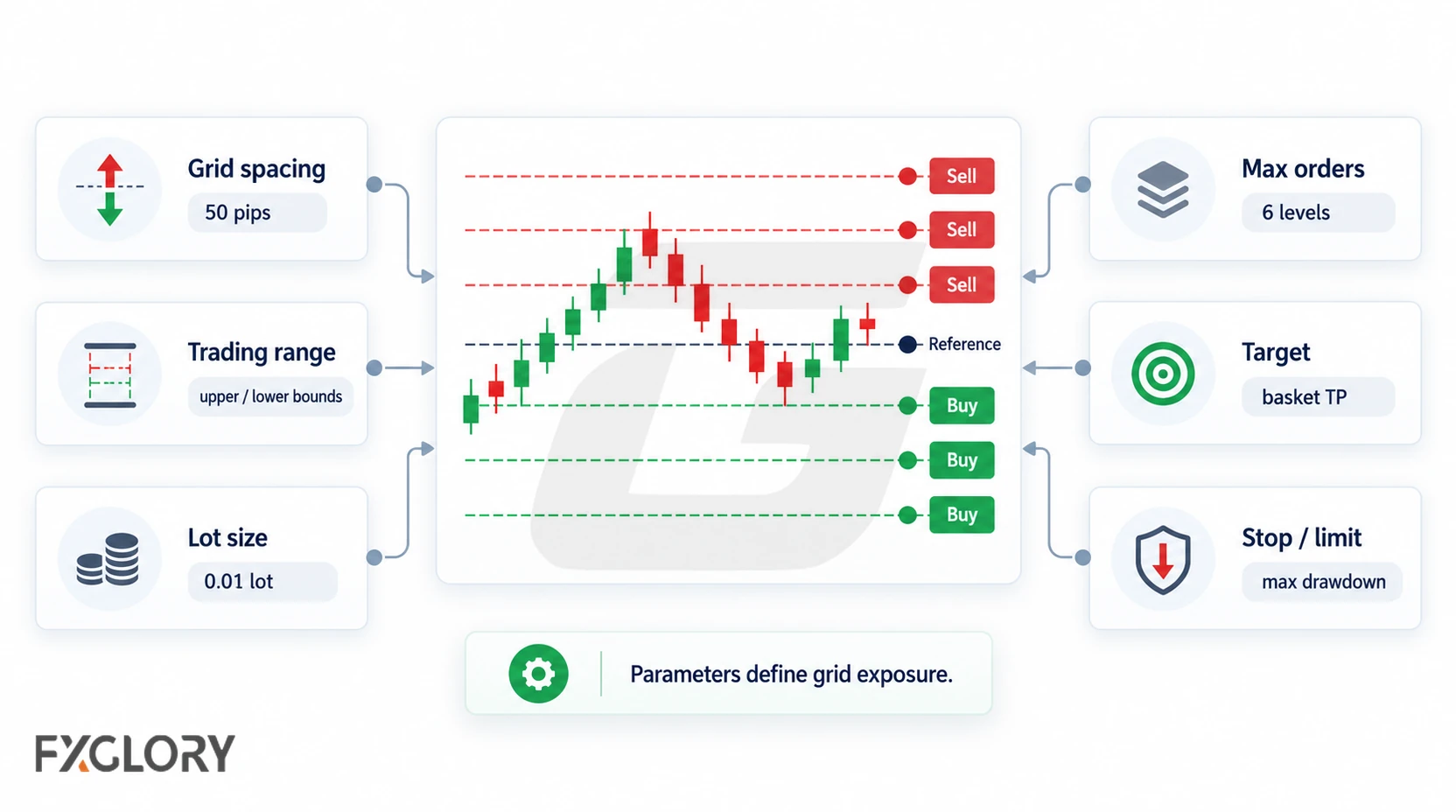
Spacing should be reviewed against spread, recent volatility, target distance, and the grid’s market assumption. Levels that are too close can be dominated by transaction cost and normal noise; levels that are too wide can leave more floating exposure before a planned close occurs.
| Parameter | What To Define | Risk If Missing |
|---|---|---|
| Market condition | Range, trend, compression, breakout risk, or no grid | The grid is used in the wrong market |
| Grid spacing | Fixed pips, volatility-based spacing, or structure-based spacing | Orders cluster too close together or too far from useful levels |
| Grid range | Upper and lower boundary or maximum distance from reference price | Exposure keeps growing after the original idea fails |
| Lot size | Equal, reduced, increased, or otherwise fixed before entry | Position size changes after drawdown begins |
| Maximum open orders | Hard limit on active positions | The account accumulates more exposure than planned |
| Target rule | Per-order target, basket target, level-to-level target, or time review | Small closed trades hide larger open risk |
| Stop or equity stop | Price stop, range-break stop, equity stop, time stop, or full-grid exit | The grid has no invalidation |
| Spread limit | Maximum spread or cost condition allowed | Dense grids become uneconomic |
| News pause | Events or windows where new grid orders are disabled | A news spike triggers levels under unstable conditions |
| Review schedule | When open exposure, margin, swap, and condition are checked | The grid stays active after the reason disappears |
Before using dense levels or several open orders, review current spread conditions.
Range Grid vs Trend Grid
A range grid and a trend grid rely on different assumptions.
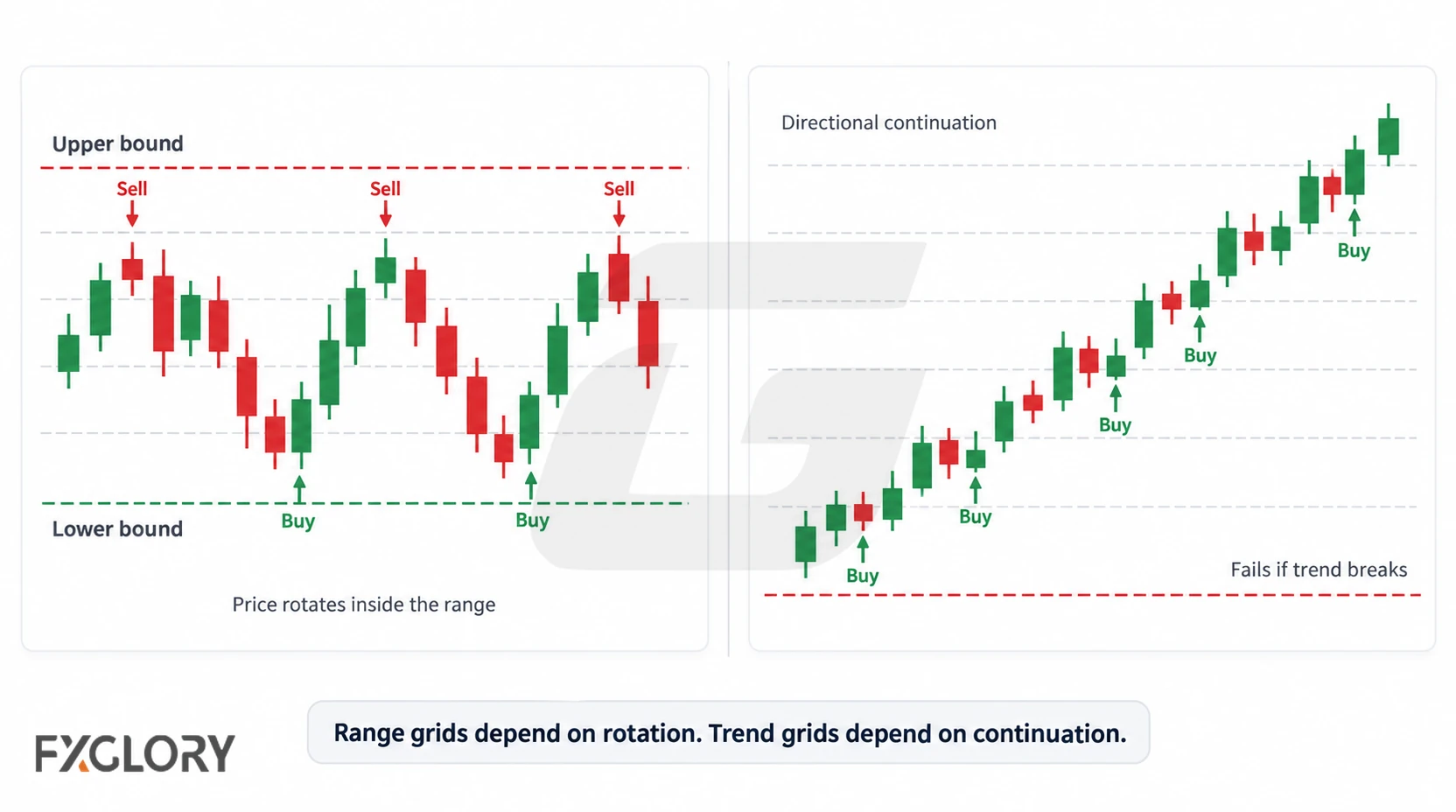
A range grid expects price to rotate inside a defined area. A trend grid expects directional structure to continue or resume after pullbacks. Each therefore needs a different invalidation rule.
| Grid Type | Market Assumption | Useful Checks | Failure Risk |
|---|---|---|---|
| Range grid | Price rotates between upper and lower areas | Range quality, support, resistance, spread, boundary invalidation | Range break leaves positions exposed |
| Trend grid | Price continues in a directional structure | Trend direction, pullback quality, continuation, trailing or exit rule | Trend reversal or exhaustion traps added positions |
| Mixed grid | Price movement can be handled from both sides | Maximum exposure, basket logic, net position, margin use | Both sides create more complex exposure and costs |
| No-condition grid | No clear market assumption | Usually not reviewable | Orders are placed because the grid exists, not because the market fits |
For more depth, use the dedicated range trading strategy, trend trading strategy, and support and resistance strategy pages.
Fixed, Dynamic, Arithmetic, And Geometric Grids
These labels describe how grid levels are spaced or adjusted. The important question is whether the adjustment rule is written and whether the resulting exposure can still be calculated.
| Grid Type | How It Works | Risk Review |
|---|---|---|
| Fixed grid | Uses the same distance between levels | Simple to review, but may not adapt when volatility changes |
| Dynamic grid | Adjusts levels based on volatility, structure, or new reference points | Can become inconsistent if adjustment rules are not written |
| Arithmetic grid | Adds equal price increments between levels | Equal spacing can be too dense or too wide for the pair |
| Geometric grid | Uses percentage-based spacing or proportional increments | Exposure still requires margin review |
| Volatility-based grid | Uses recent range, ATR-style distance, or similar volatility reference | Volatility can expand after orders are active |
| Structure-based grid | Uses support, resistance, swings, or range boundaries | Structure should be defined before price moves |
Grid Trading vs Martingale
Grid trading describes where orders are placed. Martingale describes increasing position size after losses. They can be combined, but they are not the same method.
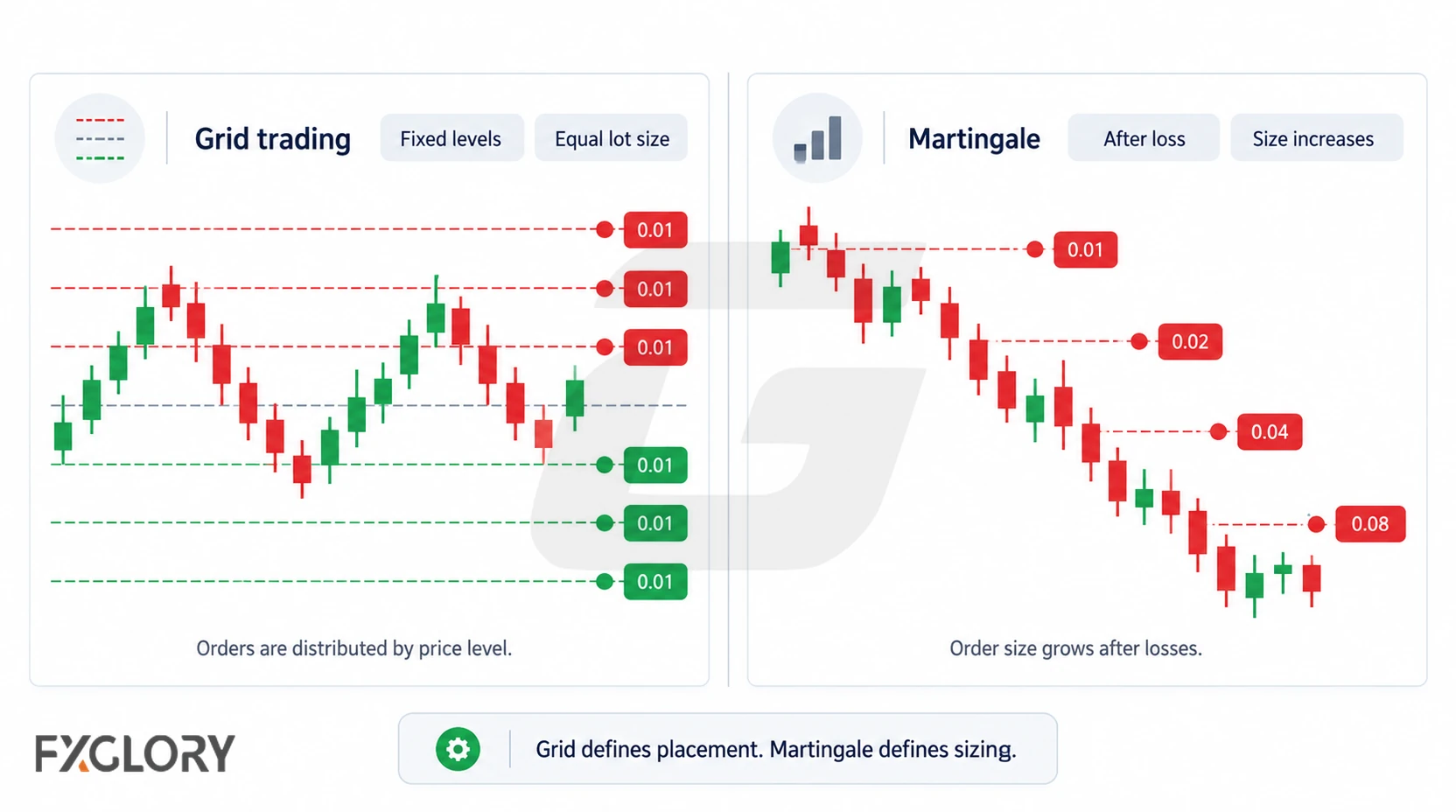
| Concept | Main Idea | Main Risk |
|---|---|---|
| Grid trading | Orders are placed at planned intervals | Several positions can remain open if price moves beyond the grid's assumed condition |
| Martingale sizing | Position size increases after losses | Drawdown and margin use can grow rapidly |
| Equal-size grid | Each level uses the same lot size | Cumulative exposure still grows across levels |
| Reduced-size grid | Later levels use smaller size | Lower exposure growth does not correct a failed market assumption |
| Martingale grid | Grid levels combine with increased sizing | Exposure can expand sharply if the expected reversal does not occur |
For the sizing method itself, see the dedicated Martingale strategy guide.
Grid Bots, EAs, And Automation
Automation can place planned grid orders with less manual delay, but it does not decide whether the market condition, spread, slippage, margin, or maximum exposure is acceptable.
A script or Expert Advisor should therefore have explicit rules for the market filter, grid limits, lot size, maximum open orders, spread limit, event pause, exit condition, and manual override.
| Automation Question | Why It Matters | Weak Version |
|---|---|---|
| Platform compatibility | Tools and order behavior depend on the platform and account setup. | Assuming any downloaded robot fits every environment. |
| Execution speed | Automated tools can place planned orders with less manual delay, but several grid levels may also trigger quickly. | Using speed as a substitute for risk control. |
| Backtest settings | Historical review should include spread, slippage, swap, and adverse trends. | Testing only periods where the grid worked. |
| Server or VPS use | A stable setup may reduce interruption risk for automated tools. | Assuming hosting stability removes market risk. |
| Manual override | The trader should know when the system is disabled or closed. | Letting automation continue after the grid condition fails. |
If automation is part of the plan, review the available trading platforms and VPS-service conditions before relying on any tool.
Floating Drawdown And The Closed-Win Illusion
A grid can close several small winners while other positions remain open at a larger unrealized loss. That means balance and equity may tell different stories.
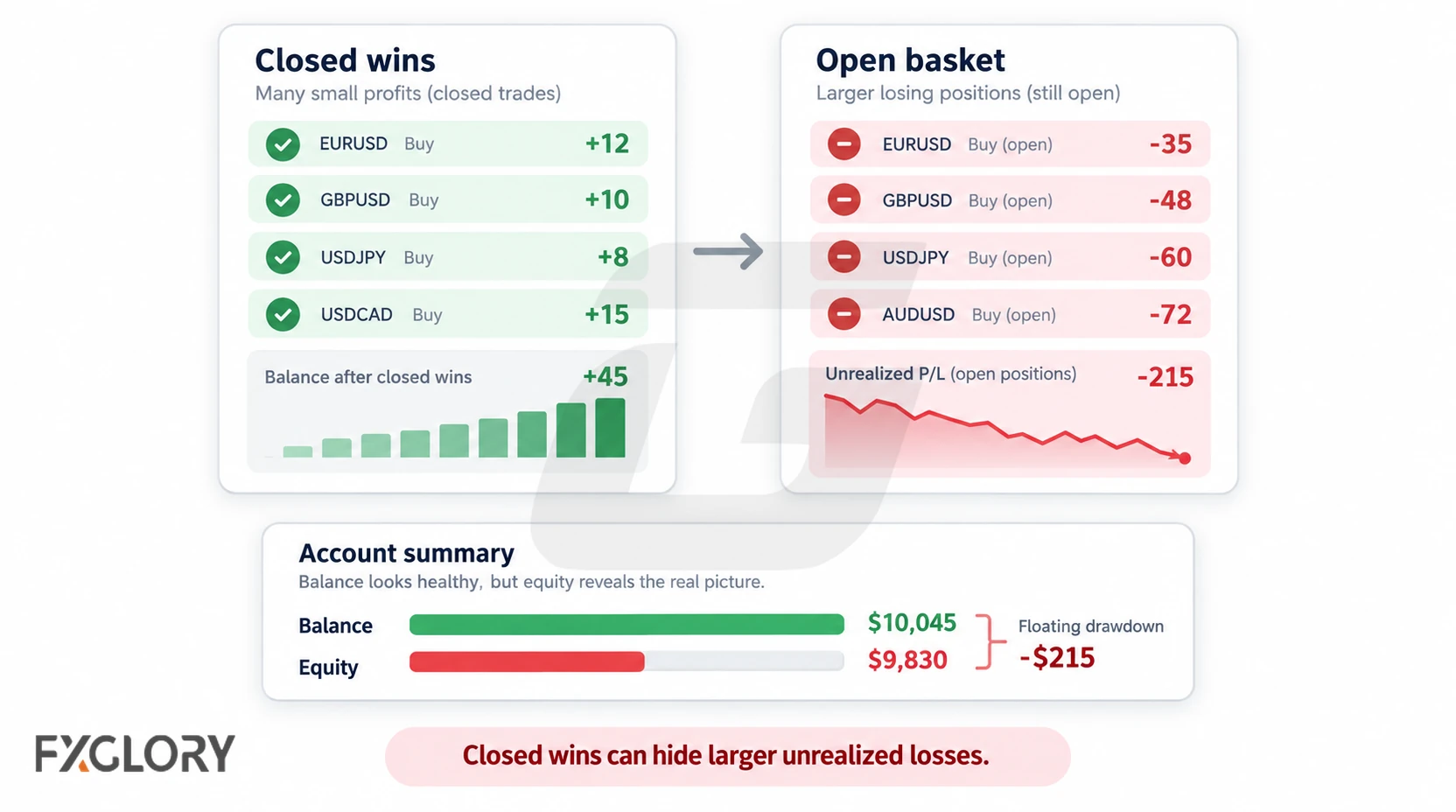
Review the grid by equity, margin level, maximum drawdown, maximum open exposure, and the full-grid exit rule rather than by closed win count alone.
| What Looks Good | What May Be Hidden | Better Review |
|---|---|---|
| Several small closed winners | Open losing positions remain active | Check equity, not only balance |
| High win count | One large grid failure can offset many small closes | Review maximum drawdown and full-cycle result |
| Basket close target | The basket may not reach target before invalidation | Define a full-grid stop or exit rule |
| No individual stop | Risk is shifted to account level | Use written invalidation and account limits |
| Backtest equity curve | Assumptions about spread, slippage, gaps, and execution | Stress-test costs and adverse price paths |
Margin, Leverage, And Multiple Open Positions
Because one grid can open several positions, margin should be reviewed for the maximum permitted number of levels and the lot size used at each level.
Leverage can make the first order appear inexpensive while later levels create much larger account exposure. Review the grid as a whole before activation. Use the margin calculator and leverage conditions when checking the planned exposure.
| Margin Question | Why It Matters | Weak Rule |
|---|---|---|
| How many orders can open? | Each level can add exposure | Only checking the first order |
| What is the total lot size if all planned levels trigger? | Full exposure may be much larger than the first entry | Adding levels until the account feels stressed |
| Where is the full-grid stop or equity stop? | The account needs a maximum loss boundary | No stop because price may return |
| What happens if spread widens? | Dense grids may trigger or close differently | Assuming normal spread during abnormal conditions |
| What if positions remain open overnight? | Swap can affect long holding periods | Ignoring rollover because each target is small |
| Can other open trades increase correlated exposure? | Grid exposure may overlap with existing positions | Reviewing the grid in isolation |
If positions may stay open overnight, review swap in forex separately from price P&L.
When Market Conditions Better Match the Grid Logic
A grid is easier to evaluate when the market condition matches the assumptions built into it.
A range grid is designed for rotation between boundaries. A trend grid is designed for directional continuation or pullback behavior. Neither condition guarantees a profitable result.
| Condition | Why It May Fit the Grid Logic | Still Required |
|---|---|---|
| Defined range | Price may rotate between planned areas | Boundary, spread, and breakout-risk rules |
| Defined trend | Directional grids may align with market structure | Trend-failure and pullback rules |
| Controlled volatility | Spacing can be planned more clearly | Volatility expansion plan |
| Liquid pair | Spread and execution may be easier to review | Cost checks and session awareness |
| No major event window | Reduces sudden spike risk | Calendar and liquidity review |
| Defined maximum exposure | Limits how far the grid can expand | Hard stop, equity stop, or full-grid exit |
Use the currency-pairs hub when reviewing instrument-specific spread, volatility, and session behavior.
When Forex Grid Trading Fails
Grid trading can fail when price leaves the condition the grid was designed for, when spacing or lot size is poorly defined, or when the grid has no hard limit on exposure.
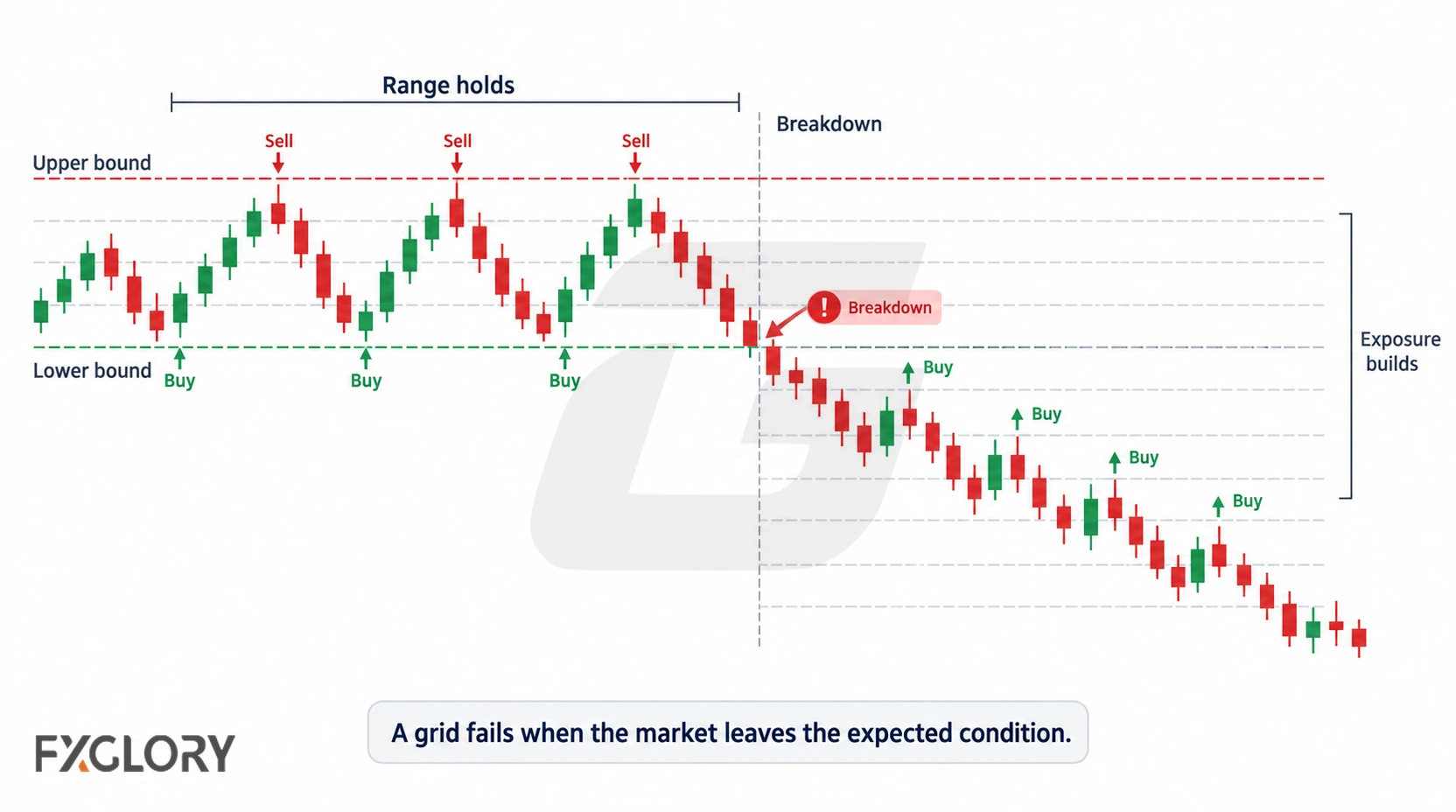
| Failure Cause | What Happens | Better Rule |
|---|---|---|
| Strong one-way trend against the grid | Orders keep opening as price moves away | Use range-break invalidation and max exposure |
| Grid spacing too tight | Spread and noise trigger many positions | Set spacing after cost and volatility review |
| Lot size too large | Several levels create account pressure | Size for the full grid, not the first order |
| No maximum orders | Exposure grows beyond the original plan | Set a hard open-order limit |
| No full-grid exit | Losing positions stay open after the idea fails | Use price, equity, time, or condition-based exit |
| Martingale sizing | Position size increases while the market moves against the grid | Separate grid placement from recovery sizing |
| Major news spike | Several levels may trigger quickly under wider spreads | Pause or avoid grid activity around event windows |
| Closed-win focus | Small winners distract from floating losses | Review equity, margin, drawdown, and full-cycle result |
Forex Grid Trading Decision Sequence
A grid should be designed in the same order each time so that the market condition and risk limits are defined before order levels.
| Step | Decision | Continue Only If |
|---|---|---|
| 1. Market condition | Is the market ranging, trending, breaking out, volatile, or unclear? | The condition matches the planned grid type |
| 2. Grid type | Range grid, trend grid, mixed grid, or no grid? | The grid logic fits the market condition |
| 3. Reference area | Where does the grid begin? | The reference is marked before orders are planned |
| 4. Spacing | How far apart are levels? | Spacing accounts for spread, volatility, and target room |
| 5. Levels | How many levels can trigger? | The maximum order count is fixed |
| 6. Lot size | What size is used at each level? | Full-grid exposure fits the account risk rule |
| 7. Exit design | Per-order target, basket target, time stop, equity stop, or condition stop? | The exit rule exists before entry |
| 8. Margin review | Can the account support the worst planned exposure? | Margin and leverage have been checked |
| 9. Event and cost check | Are spread, liquidity, swap, and event risk acceptable? | Conditions do not break the plan |
| 10. Cancel rule | When is the grid disabled or closed? | The rule is written before drawdown begins |
For trade-level triggers and exits, use the forex entry and exit strategy. For account-level drawdown and exposure limits, use the forex risk management strategy.
No-Trade Conditions
Multi-order methods need explicit no-trade conditions because one weak setup can create several positions.
| No-Trade Condition | Why It Matters | Action |
|---|---|---|
| Market condition is unclear | The grid does not know whether it is built for range or trend | Do not open the grid |
| Range boundaries are weak | A range grid can break quickly | Wait for clearer support and resistance |
| Trend is late or unstable | A trend grid can add near exhaustion | Skip the setup |
| Spread is too large for spacing | Costs can overwhelm small grid targets | Do not use dense levels |
| Major news or unstable liquidity is near | Fast movement may trigger several levels | Pause or cancel grid activation |
| Maximum exposure is unknown | The account risk cannot be judged | Do not start |
| No stop or equity limit exists | The grid has no invalidation | Do not start |
| Swap impact is ignored for overnight positions | Holding costs can change the result | Review rollover before holding |
| The plan depends on eventual reversal | Price can continue farther than expected | Reject the setup |
Testing And Review Before Live Trading
A grid should be reviewed on historical or demo data before live use so the same rules can be observed across different price paths, spreads, volatility, trends, ranges, news windows, and drawdown periods.
Record the full equity behavior rather than closed trades alone.
- Record the pair, session, spread, and market condition before the grid begins.
- Record the grid type, reference price, spacing, number of levels, lot size, and maximum open orders.
- Record the planned target rule, basket rule, time stop, equity stop, and full-grid exit rule.
- Record margin requirement before activation and margin use after each additional level.
- Record closed and floating P&L separately.
- Record maximum drawdown, maximum open exposure, and whether the grid reached the planned worst-case area.
- Record whether spread, slippage, swap, news volatility, or rule changes affected the result.