

What Is A Forex Pullback Strategy?
A forex pullback strategy is a trading method that looks for a temporary move against an existing trend before considering an entry in the trend direction. In an uptrend, the trader may wait for price to move lower into a planned area. In a downtrend, the trader may wait for price to move higher into a planned area.
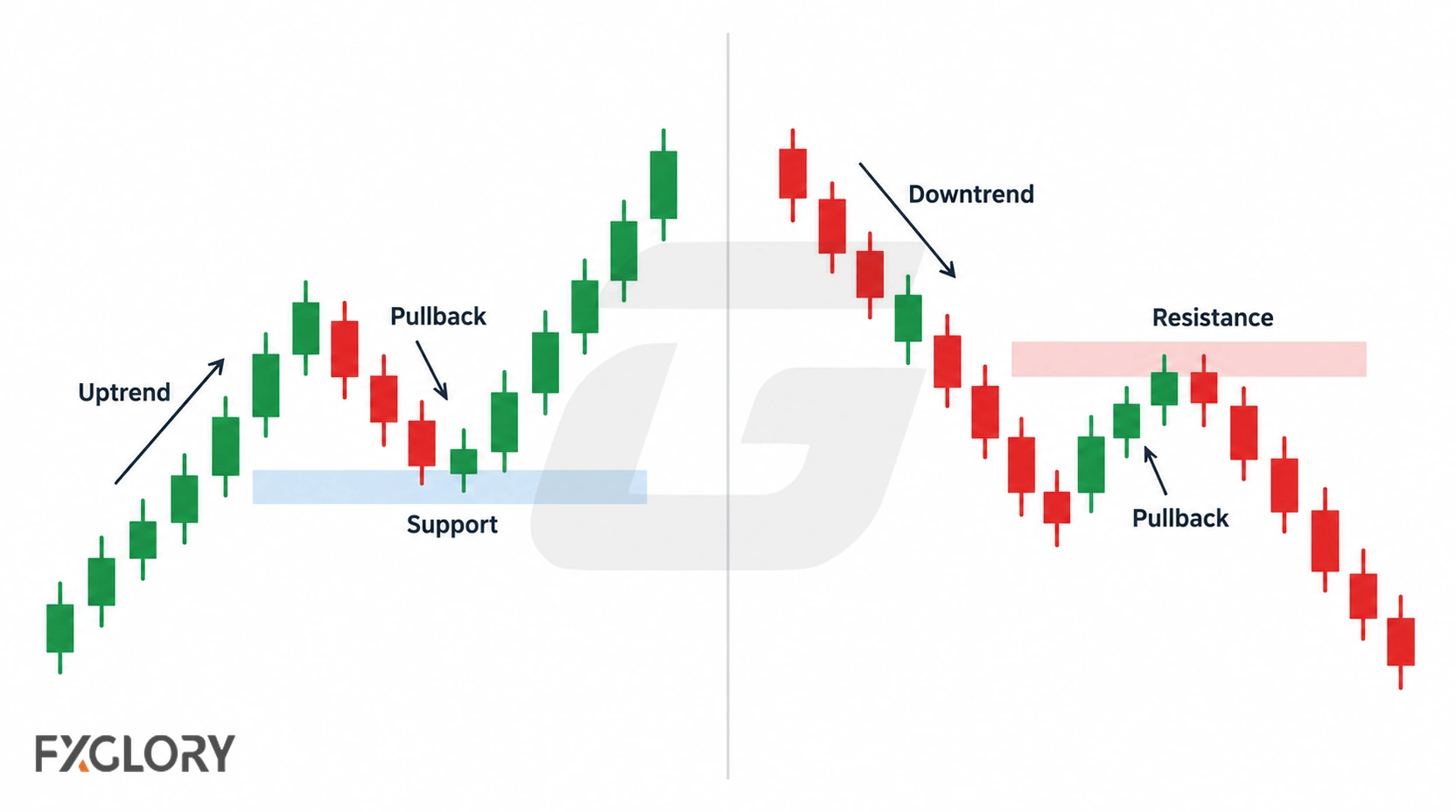
The pullback itself is only a setup condition. A trader still needs trend context, pullback location, confirmation, invalidation, stop placement, exit logic, spread check, position sizing, and a cancellation rule.
For the broader trend framework, start with the forex trend trading strategy guide. This page focuses only on pullback-specific decisions: when the pullback is still valid, when it may be a reversal, how to enter, where the trade is wrong, and when to skip.
Pullback vs Reversal
The most important pullback question is whether price is pausing inside the trend or breaking the structure that made the trend valid. A pullback moves against the trend temporarily. A reversal suggests the old trend may be failing.
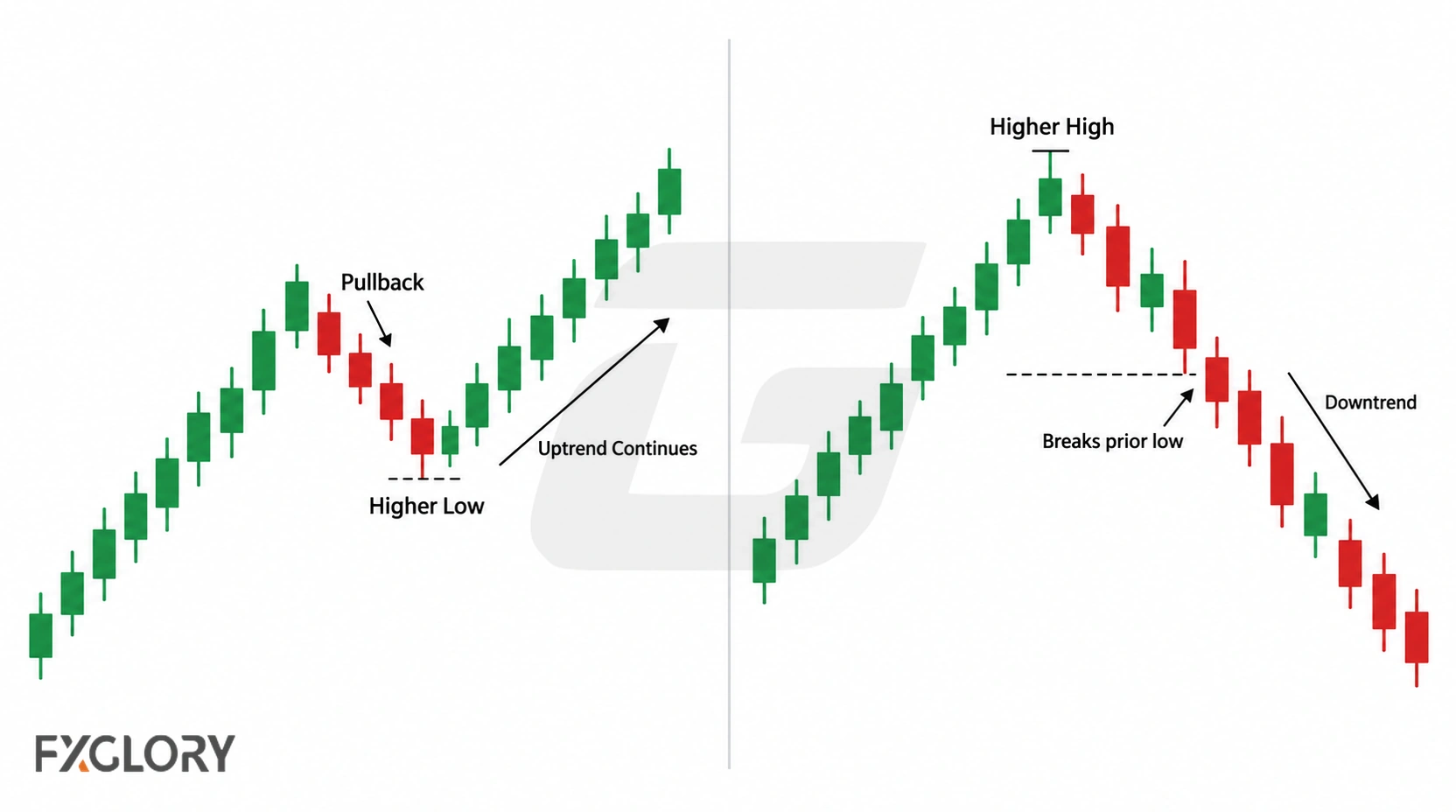
There is no perfect way to know in advance whether every pullback will resume or turn into a reversal. That is why the strategy needs invalidation rules before entry. In an uptrend, a pullback becomes weaker if it breaks the higher-low structure. In a downtrend, a rally becomes weaker if it breaks the lower-high structure.
| Condition | Pullback Clue | Reversal Warning |
|---|---|---|
| Uptrend structure | Price pulls back but higher-low structure remains intact | Price breaks the level that supported the higher-low sequence |
| Downtrend structure | Price rallies but lower-high structure remains intact | Price breaks the level that supported the lower-high sequence |
| Depth | Pullback reaches a planned area without damaging the trend | Pullback becomes too deep for the original stop or trend idea |
| Momentum | Counter-trend move slows near a planned area | Counter-trend move gains force and breaks structure |
| Time | Pullback remains controlled and fits the strategy window | Correction turns into a wider range or new opposite trend |
| Confirmation | Price reacts in the trend direction under a written rule | No reaction appears and price continues against the trend |
Pullback vs Pullback Trade
A pullback is a price movement. A pullback trade is a planned decision. This distinction keeps the trader from entering as soon as price moves against the trend.
| Item | What It Means | Why It Is Not Enough Alone |
|---|---|---|
| Pullback | Price moves against the existing trend | The move may become a reversal or a wider range |
| Pullback location | Price reaches a planned area such as support, resistance, moving average, trendline, channel, Fibonacci zone, or retest level | Location does not confirm that the trend will resume |
| Pullback trade | The trader has a trend context, entry trigger, stop, exit method, risk limit, and cancel rule | The plan can still be invalid if spread, volatility, or structure changes |
For the full entry-and-exit chain behind a pullback trade, use the entry and exit strategy guide. A pullback trigger should already have a stop, target or trailing method, time rule, and invalidation point.
How To Find A Valid Pullback
A valid pullback starts with trend quality. If the trend is unclear, flat, or already broken, the pullback setup has no strong foundation. The pullback should also reach a planned area before entry; entering in the middle of a correction often leaves unclear stop placement.
The trader should also check whether price still has room to move after spread and nearby obstacles. A technically clean pullback can still be weak if the target is too close or the stop is too wide for the account rules.
| Pullback-Quality Check | Better Version | Weak Version |
|---|---|---|
| Trend still intact | Trend structure remains valid before the entry | Structure breaks but the setup is still called a pullback |
| Planned location | Pullback reaches a support, resistance, moving average, trendline, channel, Fibonacci zone, or retest area | Entry happens because price has simply moved against the trend |
| Controlled depth | Pullback is deep enough to improve entry location but not so deep that it breaks the idea | Pullback is too shallow to define risk or too deep to keep trend confidence |
| Confirmation appears | Price reacts, rejects, closes, or resumes under a written rule | The trader enters before any reaction appears |
| Room remains | There is space before the next obstacle or target area | Entry happens directly into nearby support or resistance |
| Risk is measurable | Stop distance, position size, margin, and target logic are known before entry | Stop is chosen after the trade starts negative |
For trend-quality rules before the pullback appears, use the trend strategy page. For higher-timeframe trend context and lower-timeframe entry timing, use the multiple time frame analysis guide.
Simple vs Complex Pullbacks
Not every pullback has the same shape. A simple pullback may be a short, clean move against the trend. A complex pullback may develop as a multi-wave correction, small range, flag, channel, or sideways pause.
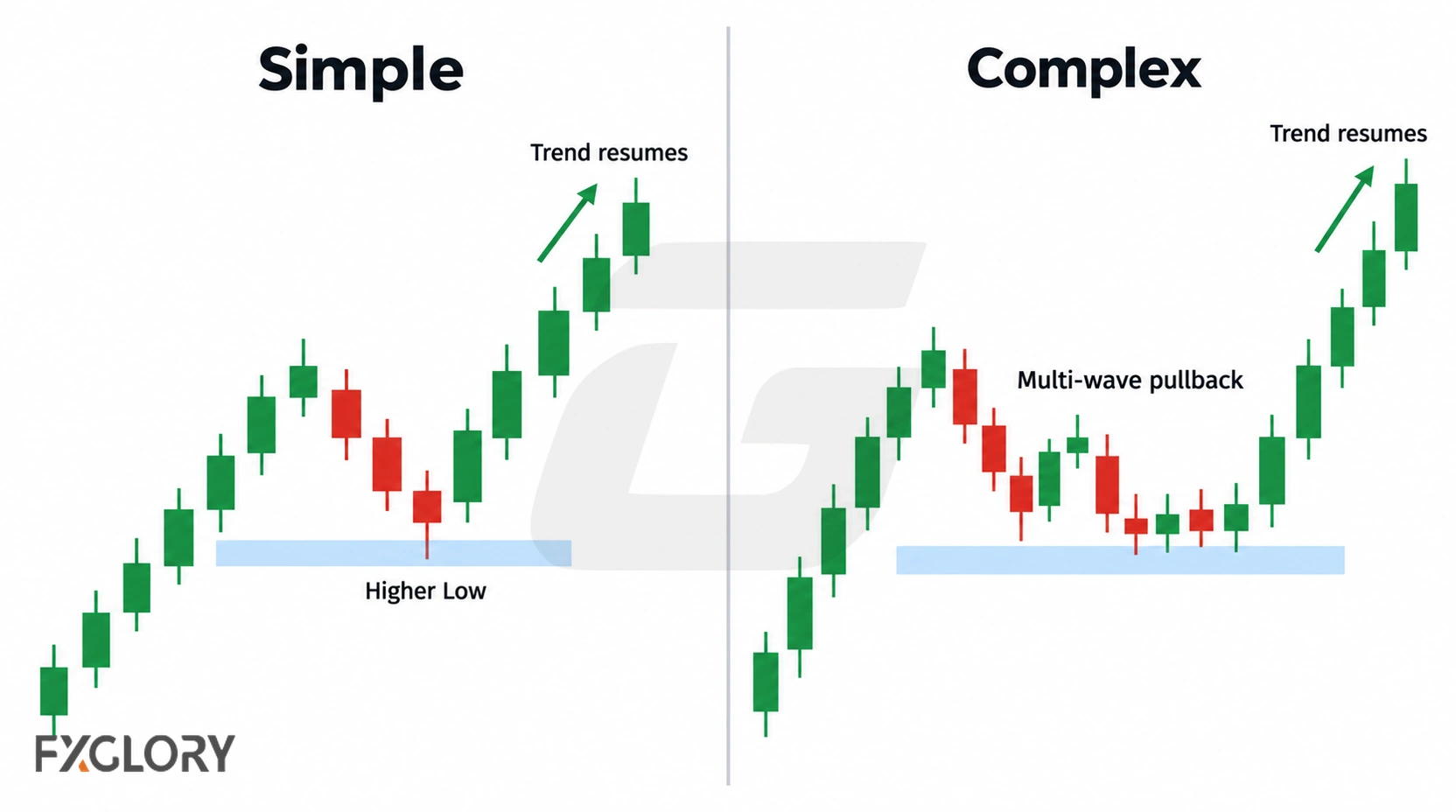
Complex pullbacks often require more patience because the first reaction may not be the final entry area. They can also become reversals if the structure that supports the trend breaks.
| Pullback Type | What It Looks Like | Possible Use | Main Risk |
|---|---|---|---|
| Simple pullback | One controlled counter-trend move into a planned area | Cleaner entry timing if confirmation appears | Trader enters before the pullback is complete |
| Complex pullback | Several waves, a small range, flag, channel, or messy correction | May give more time to define structure and invalidation | Correction becomes a reversal or range |
| Shallow pullback | Price barely moves against the trend before resuming | May show strong trend pressure | Stop may be hard to place clearly |
| Deep pullback | Price retraces far into the prior movement | May offer location if trend structure holds | Trend structure may already be damaged |
Forex Pullback Decision Sequence
A forex pullback strategy should follow the same order each time. If the trader begins with a small bounce and creates the trend reason afterward, the setup cannot be reviewed clearly.
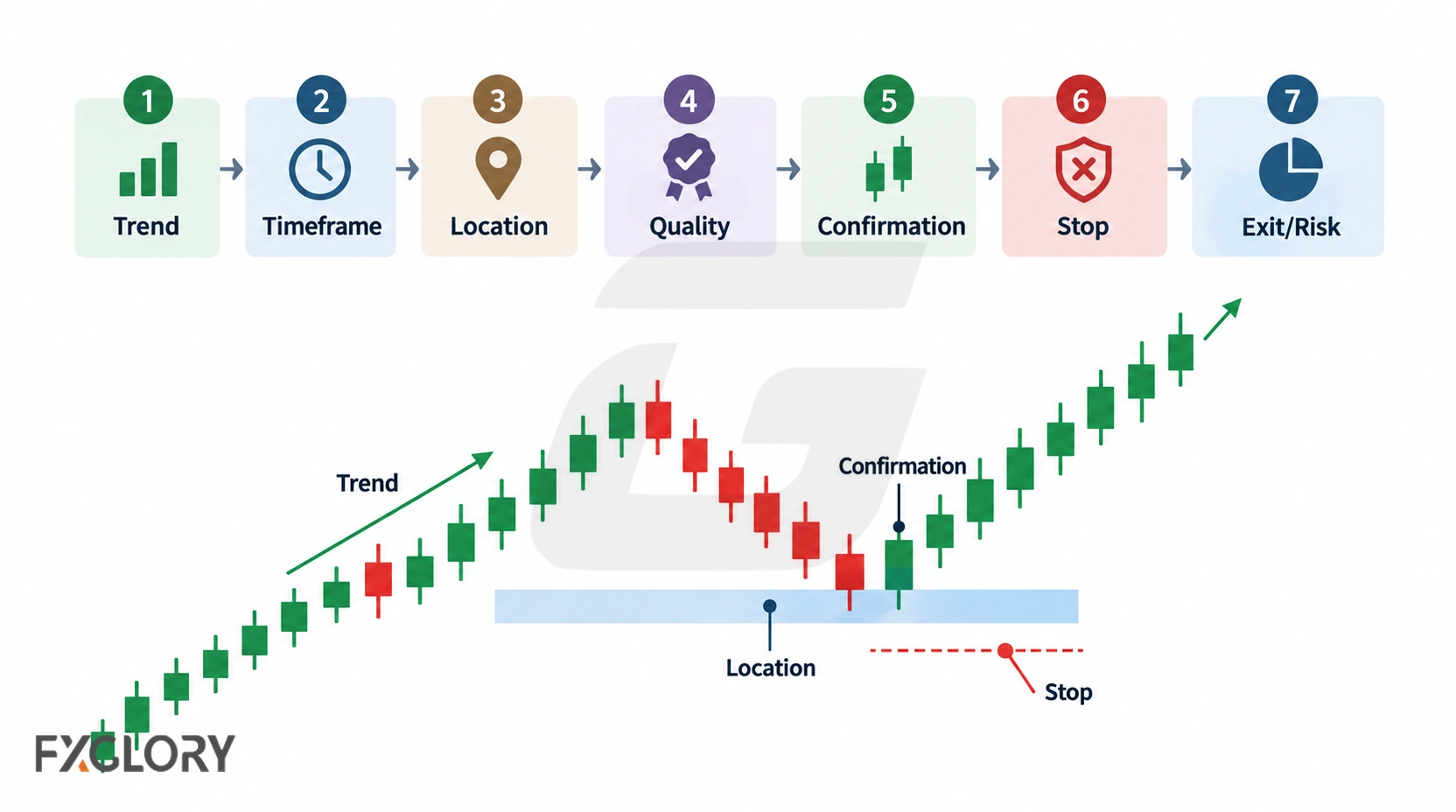
| Step | Decision | Continue Only If |
|---|---|---|
| 1. Trend context | The market is trending up, trending down, or unclear | The trend is visible before the pullback |
| 2. Timeframe role | Higher timeframe gives trend context and lower timeframe gives entry detail | The roles are defined before entry |
| 3. Pullback location | Price reaches a planned area such as structure, MA, trendline, channel, Fibonacci, or retest level | The location is not invented after price reacts |
| 4. Pullback quality | The pullback does not break the structure that supports the trend | The trend idea remains valid |
| 5. Confirmation | Price reacts, rejects, closes, or resumes according to the written trigger | The entry is not early, late, or forced |
| 6. Stop | The invalidation point is known before entry | The stop is based on structure or volatility |
| 7. Exit | The trade has a target, trailing rule, time rule, or invalidation exit | The exit is planned before stress appears |
| 8. Risk | Position size, margin, and daily risk fit the account rules | The trade does not break risk limits |
Support And Resistance Pullback Strategy
A support and resistance pullback strategy waits for price to return to a planned level before considering a trend entry. In an uptrend, the trader may watch whether prior support or a broken resistance area can hold. In a downtrend, the trader may watch whether prior resistance or a broken support area rejects price.
The level should be defined before price reaches it. If the trader draws the level only after the candle reacts, the setup becomes harder to review honestly.
| Level-Based Pullback | Better Version | Weak Version |
|---|---|---|
| Uptrend support pullback | Price pulls back to a planned support area and the trend structure remains intact | Support breaks but the trader still buys because price is lower |
| Downtrend resistance pullback | Price rallies to a planned resistance area and fails below trend structure | Resistance breaks but the trader still sells because the market was bearish earlier |
| Role reversal | Broken resistance is reviewed as possible support, or broken support as possible resistance | Every retest is treated as valid even when price returns inside the old structure |
| Target room | There is space between entry and the next obstacle | Trade enters directly into nearby support or resistance |
Moving Average Pullback Strategy
Moving averages can help traders review dynamic pullback areas, trend rhythm, and whether price is still respecting directional structure. A moving average does not make every touch tradable.
For moving-average-specific rules, use the moving average forex strategy guide. This page uses moving averages only as pullback-location tools.
| MA Pullback Use | Useful Role | Weak Use |
|---|---|---|
| 20-period or fast MA area | Reviews short-term pullback rhythm in active trends | Every touch becomes an entry |
| 50-period or medium MA area | Reviews deeper pullbacks or broader directional structure | Trend is assumed valid even when price is flat around the average |
| MA slope | Shows whether the average supports direction or has flattened | Flat average is treated as trend confirmation |
| MA reaction | Price reacts near the area and confirms under a written rule | Trader enters before price shows reaction |
| MA failure | Price breaks and holds beyond the average in a way that weakens the trend idea | Trader ignores failure because the original trend looked strong |
Fibonacci Pullback Strategy
Fibonacci retracement levels can help traders review possible pullback zones inside a trend. Common zones include 38.2%, 50%, 61.8%, and sometimes deeper retracement areas. These levels are not automatic entry signals.
A Fibonacci pullback needs the same controls as any other pullback: trend context, structure, confirmation, stop placement, target logic, and risk. A retracement level becomes more useful when it overlaps with structure, a moving average, a trendline, or a prior support or resistance area.
| Fibonacci Zone | Possible Meaning | Weak Use |
|---|---|---|
| Shallow retracement | May show strong trend pressure if structure remains intact | Stop is unclear because the pullback barely formed |
| Mid retracement | May give a more balanced entry area if confirmed | Level is traded without price reaction |
| Deep retracement | May offer location if trend structure still holds | Trend may already be damaged and the trader ignores it |
| Confluence area | Fibonacci overlaps with structure, MA, trendline, or support/resistance | Several weak tools are stacked to justify a poor setup |
Trendline And Channel Pullback Strategy
Trendlines and channels can help traders review whether a pullback is respecting a directional boundary. The line or channel should be drawn before the entry and should not be adjusted after price moves to make the setup look valid.
| Tool | Useful Pullback Role | Weak Use |
|---|---|---|
| Trendline pullback | Price pulls back toward a planned directional line and reacts under a written rule | Line is redrawn after every candle |
| Channel pullback | Price reacts near a channel boundary while trend structure remains intact | Channel boundary is adjusted after entry |
| Line break | A break may warn that the pullback is becoming a reversal or wider correction | Trader ignores the break because the entry was planned earlier |
| Multiple reactions | The line or channel respects meaningful prior reactions | Random touches are used to force a trendline |
Breakout-Retest Pullback Strategy
A breakout-retest pullback happens when price breaks a level and later returns to test the broken area. In an uptrend, broken resistance may be reviewed as possible support. In a downtrend, broken support may be reviewed as possible resistance.
The retest is not valid just because price returns to the level. The broken area must hold under the written rule. If price returns inside the prior structure, the breakout and pullback idea may already be weak.
For full breakout rules, including false breakouts and retest failure, use the forex breakout strategy guide.
| Breakout-Retest Part | Better Version | Weak Version |
|---|---|---|
| Broken level | The support or resistance level was defined before the breakout | The level is drawn after price has already moved |
| Retest behavior | Price returns to the broken area and reacts in the trend direction | Any touch of the area becomes a trade |
| Invalidation | Stop is placed where the retest idea is wrong | Stop is widened after the retest fails |
| Cancel rule | Trade is skipped if price returns inside the old structure | Trader enters because the breakout almost worked |
Entry Confirmation Methods
Entry confirmation should appear after trend context and pullback location are known. Confirmation is not a way to rescue a poor setup. It is a final check that price may be reacting in the planned direction.
| Confirmation Type | Possible Use | Weak Use |
|---|---|---|
| Candle close | Price closes back in the trend direction after reaching the pullback area | One candle is used without trend context |
| Rejection candle | Price rejects the pullback area and leaves a clear invalidation point | The wick is traded even though structure is broken |
| Engulfing or continuation candle | Price shows renewed pressure in the trend direction | Trader enters after the move is already extended |
| Micro break | Lower-timeframe structure breaks back in the trend direction | Lower timeframe is used against higher-timeframe context |
| Oscillator turn | Stochastic, RSI, or MACD supports pullback timing | Oscillator signal is used as the only reason for entry |
| Parabolic SAR or similar tool | Optional confluence for reaction or trailing review | Tool flip is treated as a standalone signal |
For trend-strength confirmation before pullback entries, use the ADX forex trading strategy page. For volatility and stop-distance realism, use the ATR forex strategy framework.
Forex Volume And Pullback Confirmation
Some pullback traders review volume or activity to judge whether a correction is losing pressure or whether trend participation may be returning. In spot forex, this needs careful handling because there is no single centralized exchange volume feed for the entire market.
Platform volume may be tick volume or broker-feed activity. It can be used as a participation clue, but it should not be treated as proof of total global forex volume. A pullback with lighter activity may support the trader's context only if trend structure still holds, the entry confirms, and risk remains measurable.
| Volume Question | Careful Interpretation | Weak Interpretation |
|---|---|---|
| Did activity weaken during the pullback? | It may suggest lower participation against the trend on the available feed | Assume the pullback must resume in the trend direction |
| Did activity return near confirmation? | It may support the reaction if structure and entry rules also agree | Treat volume as a standalone entry signal |
| Does platform volume conflict with price structure? | Price structure and invalidation should still control the trade decision | Ignore a broken trend because the volume clue looks favorable |
| Is the data tick or broker-feed volume? | Use it as a limited activity clue from the available source | Treat it as centralized global forex volume |
Stop, Target, And Exit Rules
A pullback trade should define stop, target, and exit logic before entry. If the stop appears only after the trade starts negative, the trader is reacting instead of following a strategy.
| Rule Area | Possible Pullback Rule | Weak Version |
|---|---|---|
| Stop in uptrend | Below the pullback low, failed support, trendline failure, or volatility invalidation | Stop is moved wider after price breaks the pullback |
| Stop in downtrend | Above the pullback high, failed resistance, trendline failure, or volatility invalidation | Stop is placed where the loss feels comfortable |
| Structure target | Prior swing high or low, next support or resistance, or trend structure area | Target is chosen without checking nearby obstacles |
| Partial exit | Part of the trade is closed near a planned structure area and the rest is managed by trail, time rule, or invalidation | Partial exit is used randomly because the trader is nervous |
| Trailing exit | ATR trail, structure trail, moving-average exit, or Chandelier-style exit | Trailing rule is changed whenever price pulls back |
| Time rule | Trade is reviewed or closed if it does not resume within the planned window | A stalled pullback trade becomes an unplanned hold |
| Invalidation exit | Exit when the trend or pullback reason disappears | Trader holds because the original trend looked strong |
When pullback management uses a volatility-based trail, review the ATR trailing stop forex strategy. For trend-following exit structure, use the Chandelier Exit forex strategy.
Short-term pullback targets can be sensitive to cost. Check the spread conditions that affect trade planning before accepting a small target. When stop distance, position size, leverage exposure, and margin need to be reviewed together, use the margin calculator before the order is placed.
Why Forex Pullback Strategies Fail
Pullback strategies often fail when the trader enters before the pullback is complete, ignores broken structure, or treats a reversal as if it is still a temporary correction. A pullback entry can look attractive because price is cheaper in an uptrend or higher in a downtrend, but price location is not enough.
| Failure Reason | What Happens | Better Rule |
|---|---|---|
| Early entry | Trader enters before price confirms reaction at the pullback area | Wait for a written confirmation rule |
| Reversal mistaken for pullback | Trend structure breaks before entry | Cancel the setup when invalidation appears |
| No trend context | Pullback is traded inside a sideways market | Define trend condition before looking for pullbacks |
| Pullback too deep | The correction damages the trend idea | Review whether the structure still supports the trade |
| No room after spread | Target is too close after trading cost | Skip if the target no longer makes sense |
| Stop is unclear | Trader cannot define where the idea is wrong | Do not enter without invalidation |
| Overtrading pullbacks | Every small counter-move becomes a setup | Limit trades to planned locations and sessions |
| Daily stop ignored | More attempts become recovery trades | Stop trading when the risk limit is reached |
Risk Rules And No-Trade Conditions
Pullback trades can look safer than breakout entries because price has moved back toward the trader's preferred area. That does not reduce the need for risk rules. A pullback setup should be rejected when the structure, cost, stop, or account risk does not support the trade.
| No-Trade Condition | Why It Matters | Action |
|---|---|---|
| Trend is unclear | The pullback may be forming inside a range, not inside a trend | Skip until directional structure is clear |
| Pullback breaks structure | The setup may be turning into a reversal | Cancel the trade idea |
| Entry is early | Price has not confirmed reaction at the pullback area | Wait for the written trigger |
| Entry is late | Price may already have resumed too far from the planned area | Wait for a new setup |
| Spread weakens the target | Trading cost can make a short-term target unrealistic | Skip if the target no longer makes sense |
| Stop is unclear | The trader cannot define where the pullback idea is wrong | Do not enter |
| News or volatility changes conditions | Spread, speed, and stop distance can change quickly | Follow the event-risk rule |
| Correlated exposure builds | Several positions may create the same directional risk | Reduce or avoid overlapping exposure |
| Daily stop reached | More pullback attempts can become recovery trades | Stop trading for the session |
| Recovery motive appears | The trade exists because the trader wants to recover a previous loss | Step away and review the plan |
For account-level risk rules, use the forex risk-management strategy page. For charting, stop workflow, and trade management tools, review FXGlory trading platforms.
Backtesting Notes For Forex Pullback Strategy
This hypothetical educational model uses one daily swing-pullback rule: an 8-candle directional impulse, a 5-candle pullback into the 38.2% to 61.8% retracement zone, structure protection at the 78.6% retracement level, completed daily candle confirmation, ATR-based stop placement, a 1.5R target comparison, a pullback-failure exit, and spread/slippage sensitivity. It does not test moving-average pullbacks, Fibonacci-only entries, trendline reactions, channel pullbacks, breakout-retest pullbacks, or discretionary support and resistance pullbacks.
The model reviewed EURUSD, GBPUSD, USDJPY, AUDUSD, USDCAD, and USDCHF on daily candles using public yfinance OHLC data where available. The impulse, pullback zone, confirmation candle, stop, target, and invalidation level are defined before the simulated entry.
| Rule Area | Educational Model Rule |
|---|---|
| Strategy type | Daily swing-impulse pullback continuation |
| Trend context | EMA(50), EMA(100), and EMA(50) slope must support the trade direction |
| Impulse window | 8 completed daily candles |
| Impulse requirement | Net close-to-close move of at least 1.75 ATR(14), with at least 6 of 8 close-to-close changes in the impulse direction |
| Pullback window | 5 completed daily candles after the impulse window |
| Pullback zone | 38.2% to 61.8% retracement of the impulse |
| Invalidation level | 78.6% retracement of the impulse |
| Long confirmation | Signal candle closes above its open, above the previous close, and above the 50% retracement level |
| Short confirmation | Signal candle closes below its open, below the previous close, and below the 50% retracement level |
| Entry | Next daily open after the completed signal candle |
| Stop | Beyond the pullback-window extreme with a 0.25 ATR(14) buffer |
| Target comparison | Fixed 1.5R target from entry |
| Pullback-failure exit | Exit at daily close if price closes beyond the 78.6% retracement invalidation level after entry |
| Maximum holding review | 20 daily candles after entry |
The review records trade count, win rate, average win in R, average loss in R, expectancy in R, profit factor, maximum drawdown in R, worst losing streak, average holding period, pair-level behavior, direction-level behavior, exit reasons, and spread/slippage sensitivity.
| Cost Input | Assumptions Used |
|---|---|
| Spread | 0.5, 1.5, and 3.0 pips |
| Slippage | 0.1, 0.5, and 1.0 pips per side |
| Baseline comparison | 1.5-pip spread and 0.5-pip slippage per side |
| Swap and rollover | Not included |
Educational Sensitivity-Test Results
The hypothetical backtest used public yfinance daily OHLC data from 2016-06-29 through 2026-06-29 where available. The baseline cost assumption used a 1.5-pip spread and 0.5-pip slippage per side. The baseline result was negative, with expectancy of -0.3802R and total net result of -9.8847R.
| Metric | Baseline Result |
|---|---|
| Number of trades | 26 |
| Win rate | 23.08% |
| Average win | 1.4548R |
| Average loss | -0.9307R |
| Expectancy | -0.3802R |
| Profit factor | 0.4689 |
| Maximum drawdown | -10.6935R |
| Worst losing streak | 8 |
| Average holding period | 7.46 daily candles |
| Median holding period | 6 daily candles |
| Total net result | -9.8847R |
| Pair | Trades | Win Rate | Expectancy | Profit Factor | Max Drawdown | Total Net R |
|---|---|---|---|---|---|---|
| EURUSD | 4 | 25.0% | -0.4078R | 0.4734 | -3.0977R | -1.6312R |
| GBPUSD | 6 | 16.67% | -0.5998R | 0.2919 | -2.5684R | -3.599R |
| USDJPY | 1 | 100.0% | 1.4593R | Infinity | 0.0R | 1.4593R |
| AUDUSD | 6 | 33.33% | -0.2359R | 0.6687 | -4.2729R | -1.4156R |
| USDCAD | 6 | 0.0% | -0.8179R | 0.0 | -3.8653R | -4.9072R |
| USDCHF | 3 | 33.33% | 0.0697R | 1.1668 | -1.2529R | 0.209R |
| Direction | Trades | Win Rate | Expectancy | Profit Factor | Max Drawdown | Total Net R |
|---|---|---|---|---|---|---|
| Long | 6 | 33.33% | -0.1996R | 0.708 | -3.0846R | -1.1975R |
| Short | 20 | 20.0% | -0.4344R | 0.4014 | -9.5441R | -8.6872R |
| Spread (pips) | Slippage Per Side (pips) | Expectancy | Profit Factor | Max Drawdown | Total Net R |
|---|---|---|---|---|---|
| 0.5 | 0.1 | -0.3511R | 0.4944 | -10.196R | -9.1276R |
| 0.5 | 0.5 | -0.364R | 0.4829 | -10.4097R | -9.4641R |
| 0.5 | 1.0 | -0.3802R | 0.4689 | -10.6935R | -9.8847R |
| 1.5 | 0.1 | -0.3672R | 0.4801 | -10.4631R | -9.5482R |
| 1.5 | 0.5 | -0.3802R | 0.4689 | -10.6935R | -9.8847R |
| 1.5 | 1.0 | -0.3964R | 0.4555 | -11.0377R | -10.3054R |
| 3.0 | 0.1 | -0.3915R | 0.4595 | -10.9345R | -10.1792R |
| 3.0 | 0.5 | -0.4045R | 0.4489 | -11.2098R | -10.5157R |
| 3.0 | 1.0 | -0.4206R | 0.4361 | -11.554R | -10.9364R |
| Exit Reason | Count |
|---|---|
| stop first same bar | 1 |
| stop loss | 16 |
| target 1.5R | 6 |
| time exit | 3 |
Testing And Review Before Live Trading
A forex pullback strategy should be reviewed on historical examples or demo conditions before it is used with real funds. The purpose is not to find perfect pullbacks. The purpose is to check whether the same trend definition, pullback location, confirmation, stop rule, exit method, and no-trade rules can be followed repeatedly.
Record both taken and skipped trades. Skipped trades matter because many pullback mistakes come from early entries, broken trend structure, unclear stops, and trades taken after the original trend reason has disappeared.
- Record whether the market was trending up, trending down, sideways, or unclear before the pullback.
- Record the timeframe used for trend context and the timeframe used for entry.
- Record the pullback location: support, resistance, moving average, Fibonacci, trendline, channel, or retest level.
- Record whether the pullback was simple, complex, shallow, or deep.
- Record whether the stop and exit method were known before entry.
- Record whether spread, margin, and position size were checked before entry.
- Record whether the trade exited by target, trail, structure break, time rule, or invalidation.
- Compare trades that followed the plan with trades that broke it.
Forex Pullback Strategy Checklist
Before a pullback becomes a trade, each item below should already be clear.
- Define whether the market is trending up, trending down, sideways, or unclear.
- Check higher-timeframe trend context before choosing the entry timeframe.
- Mark the planned pullback area before price reaches it.
- Check whether the pullback keeps trend structure intact.
- Identify whether the pullback is simple, complex, shallow, or deep.
- Wait for the written entry confirmation before entering.
- Define the invalidation point before entry.
- Choose position size only after stop distance is known.
- Choose the exit method before entry: target, structure break, trailing stop, time rule, or invalidation.
- Skip the trade if the pullback breaks the trend structure.
- Check spread, margin, leverage exposure, and correlated risk before entry.
- Stop trading when the daily loss, drawdown, or trade-count rule is reached.
- Review whether the trade followed the plan, not only whether it made or lost money.