

What Is A Forex Trend Trading Strategy?
A forex trend trading strategy is a method that looks for trades in the direction of a defined market trend. The trend may be upward, downward, or absent. The strategy starts by deciding whether the market condition supports trend trading before an entry is considered.

An uptrend generally forms higher highs and higher lows. A downtrend generally forms lower highs and lower lows. A sideways market does not give the same directional structure, so trend-following rules can produce repeated weak signals when price is moving without clear direction.
This page focuses on trend-specific decisions: how to identify trend direction, separate trend context from trade permission, use pullbacks or continuation breakouts, manage exits, and skip trades when the trend condition is not strong enough.
Trend Trading vs Trend Following
Trend trading is the broad idea of trading with directional price movement. Trend following is usually more rule-based: it waits for the trend to appear, follows while the rules remain valid, and exits when the trend condition weakens or reverses.
Trend following does not require predicting the exact start or end of the move. In many cases, the trader may miss the first part of the trend and still exit before or after the exact turning point. The goal is to follow a defined move under written rules, not to pick a perfect top or bottom.
| Concept | Meaning | Common Mistake |
|---|---|---|
| Trend trading | Trading in the direction of a defined market trend | Entering only because price has already moved |
| Trend following | Using rules to follow a directional move while it remains valid | Expecting the method to predict exact reversals |
| Countertrend trading | Trading against the current directional structure | Calling every pullback a reversal |
| Sideways market | Price moves without clear directional structure | Forcing trend entries during range conditions |
Trend vs Trend Trade
A trend is a market condition. A trend trade is a planned decision. This distinction keeps the trader from entering late just because the chart already shows direction.
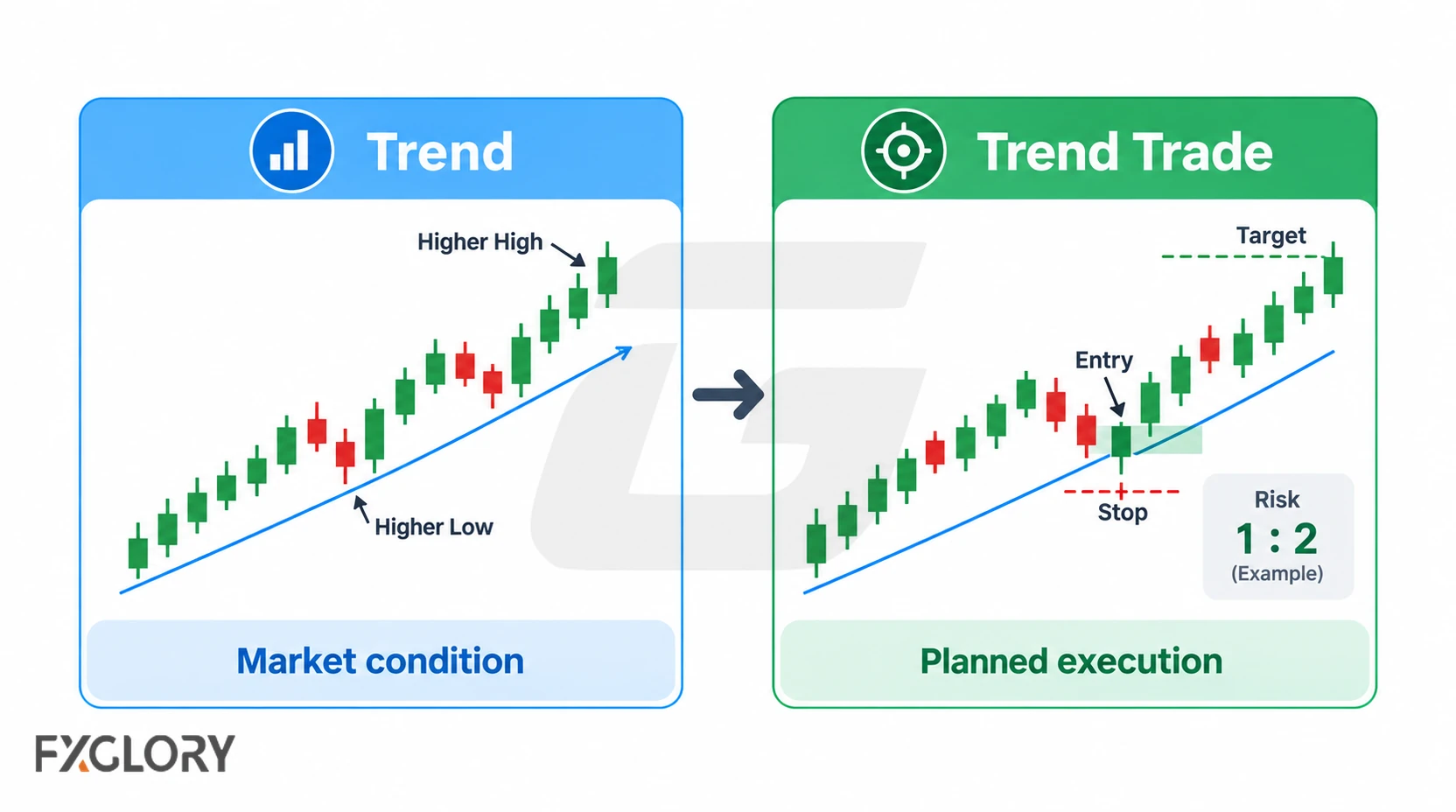
| Item | What It Means | Why It Is Not Enough Alone |
|---|---|---|
| Trend | Price shows directional structure such as higher highs and higher lows or lower highs and lower lows | The trend may already be extended, weak, or near an obstacle |
| Trend confirmation | Moving averages, ADX, momentum, trendline, channel, or higher timeframe supports direction | Confirmation can lag or appear after a late entry |
| Trend trade | The trader has an entry, stop, exit, risk limit, and cancel rule | The plan can still be invalid if spread, volatility, or structure changes |
For the complete entry-and-exit chain behind a trend trade, use the entry and exit strategy guide. A trend entry should already have a stop, target or trailing method, time rule, and invalidation point.
How To Identify A Forex Trend
Trend identification should happen before the entry. If the trader decides the market is trending only after a strong candle appears, the entry may already be late.
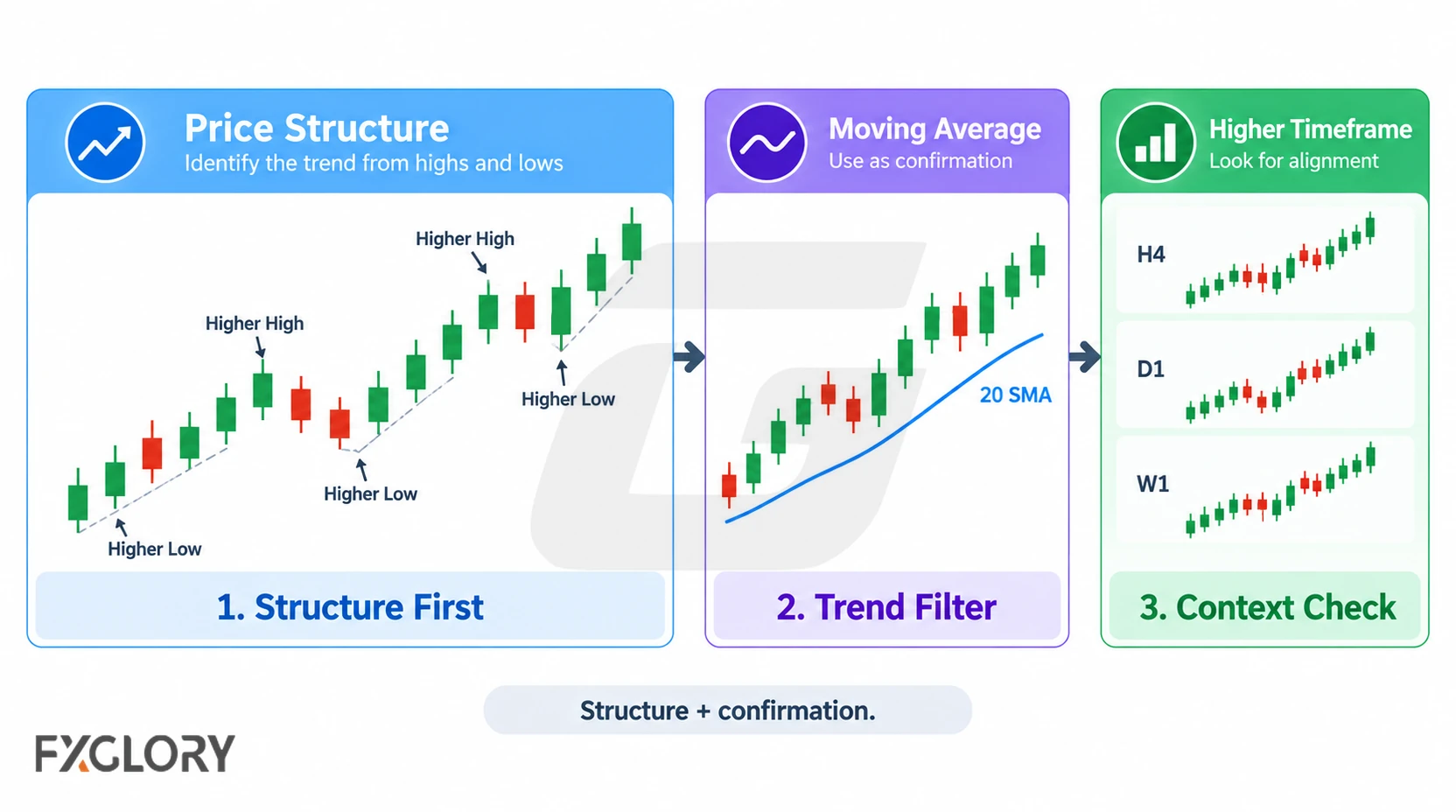
A useful trend read usually combines structure with one or two supporting tools. Too many tools can create duplicate signals, while no structure can leave the trader dependent on an indicator that may lag.
| Trend Check | What To Look For | Weak Version |
|---|---|---|
| Price structure | Higher highs and higher lows in an uptrend, or lower highs and lower lows in a downtrend | One strong candle is treated as a trend |
| Moving averages | Price position, slope, crossover, or pullback behavior around the average | Every moving-average touch becomes a trade |
| Trendlines or channels | Price respects a clear directional boundary or channel | The line is redrawn after every candle |
| ADX | Directional strength is reviewed before accepting a trend signal | ADX is used as a buy or sell signal by itself |
| Momentum | RSI, MACD, or Stochastic supports the trend condition or shows weakness | Momentum is used without structure or invalidation |
| Multiple timeframes | Higher timeframe gives context and lower timeframe gives entry detail | Timeframes conflict but the trade is forced anyway |
For more detail on how forex trends are identified, see the dedicated forex trend overview. For a deeper look at context and entry-timeframe alignment, use the multiple time frame analysis guide. The higher timeframe can help define trend context, while the entry timeframe should still provide a clear trigger and stop.
How To Judge Trend Quality
Trend quality should be reviewed before the entry. A market can be moving in one direction and still offer a poor trade if price is overextended, pullbacks are breaking structure, the next obstacle is too close, or the trend tools are flat and tangled.
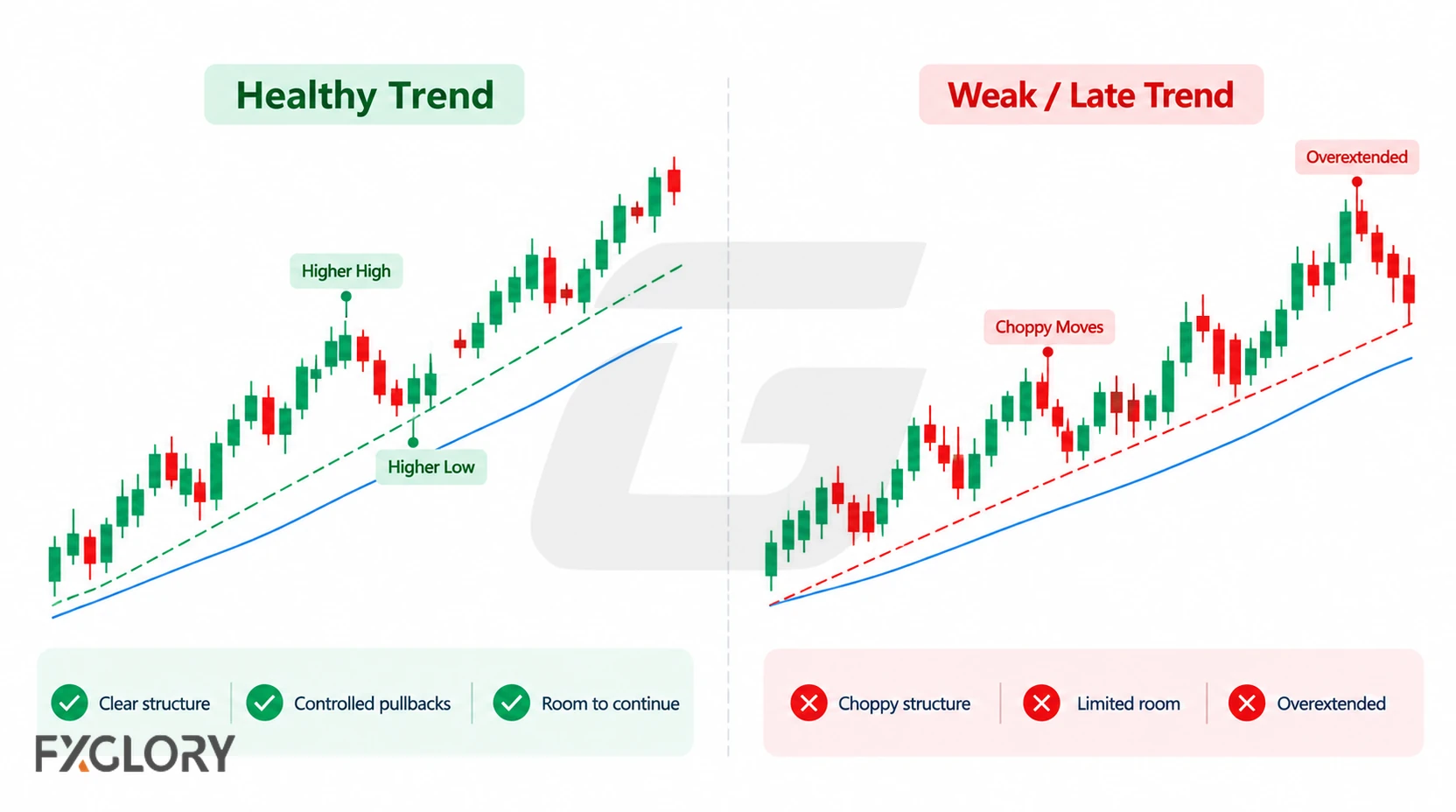
A better trend trade usually has clean structure, controlled corrections, enough room for the planned exit, and a stop that fits the account risk. If those pieces are missing, the visible trend may not be worth trading.
| Trend-Quality Check | Better Version | Weak Version |
|---|---|---|
| Structure is clean | Higher highs and higher lows, or lower highs and lower lows, are still intact | The trader calls one directional candle a trend |
| Pullbacks are controlled | Corrections do not destroy the structure that supports the trend | Pullback breaks structure but is still treated as a trend entry |
| Room remains | Price has space before the next major support, resistance, or structure obstacle | Entry happens directly into the next obstacle |
| Trend is not overextended | Entry is close enough to invalidation for the stop and target to make sense | Entry is far from structure after most of the move has already happened |
| Volatility is manageable | Stop distance, target logic, and trailing method still fit current movement | Volatility is too chaotic or too flat for the planned method |
| Timeframes do not conflict | Higher-timeframe context supports the trade or at least does not clearly oppose it | Lower-timeframe signal is forced against stronger context |
| Moving averages are not flat or tangled | Trend tools show direction, separation, or useful slope | Flat or tangled averages are treated as trend confirmation |
| Trendline or channel quality | Line or channel is drawn before entry and respects multiple meaningful reactions | Line or channel is redrawn after every candle until the setup looks valid |
Forex Trend Trading Decision Sequence
A trend strategy should follow the same order each time. If the trader starts with a moving candle and builds the trend reason afterward, the trade cannot be reviewed clearly.
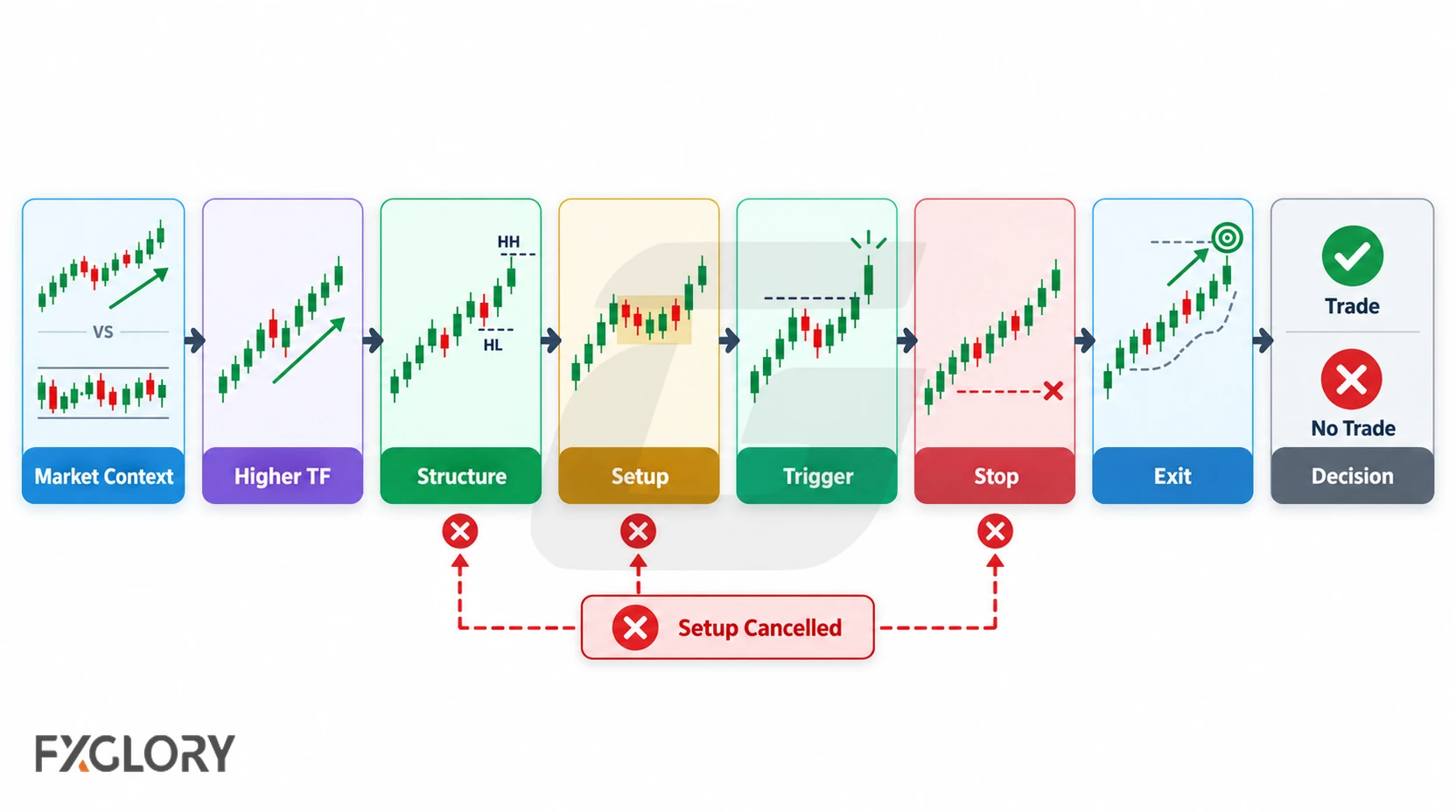
| Step | Decision | Continue Only If |
|---|---|---|
| 1. Market condition | The market is trending up, trending down, ranging, or unclear | The condition supports trend trading |
| 2. Timeframe role | Higher timeframe provides context and entry timeframe provides trigger | The roles are not mixed after entry |
| 3. Trend structure | Price structure, moving averages, trendline, channel, or ADX supports direction | The trend is visible before the setup |
| 4. Entry type | Pullback, continuation breakout, moving-average reaction, or structure retest is defined | The entry method is known before price moves |
| 5. Stop | The invalidation point is known before entry | The stop is based on structure or volatility |
| 6. Exit | The trade has a target, trailing rule, time rule, or invalidation exit | The exit is not invented after stress appears |
| 7. Risk | Position size, margin, and daily risk fit the account rules | The trade does not break risk limits |
| 8. Cancel rule | The trade is skipped if the trend weakens, entry is late, or structure breaks | The trader can avoid forcing a trend setup |
Pullback Trend Strategy
A pullback trend strategy waits for price to move against the trend temporarily without breaking the structure that made the trend valid. In an uptrend, the trader may watch for a controlled pullback before considering a long setup. In a downtrend, the trader may watch for a controlled rally before considering a short setup.
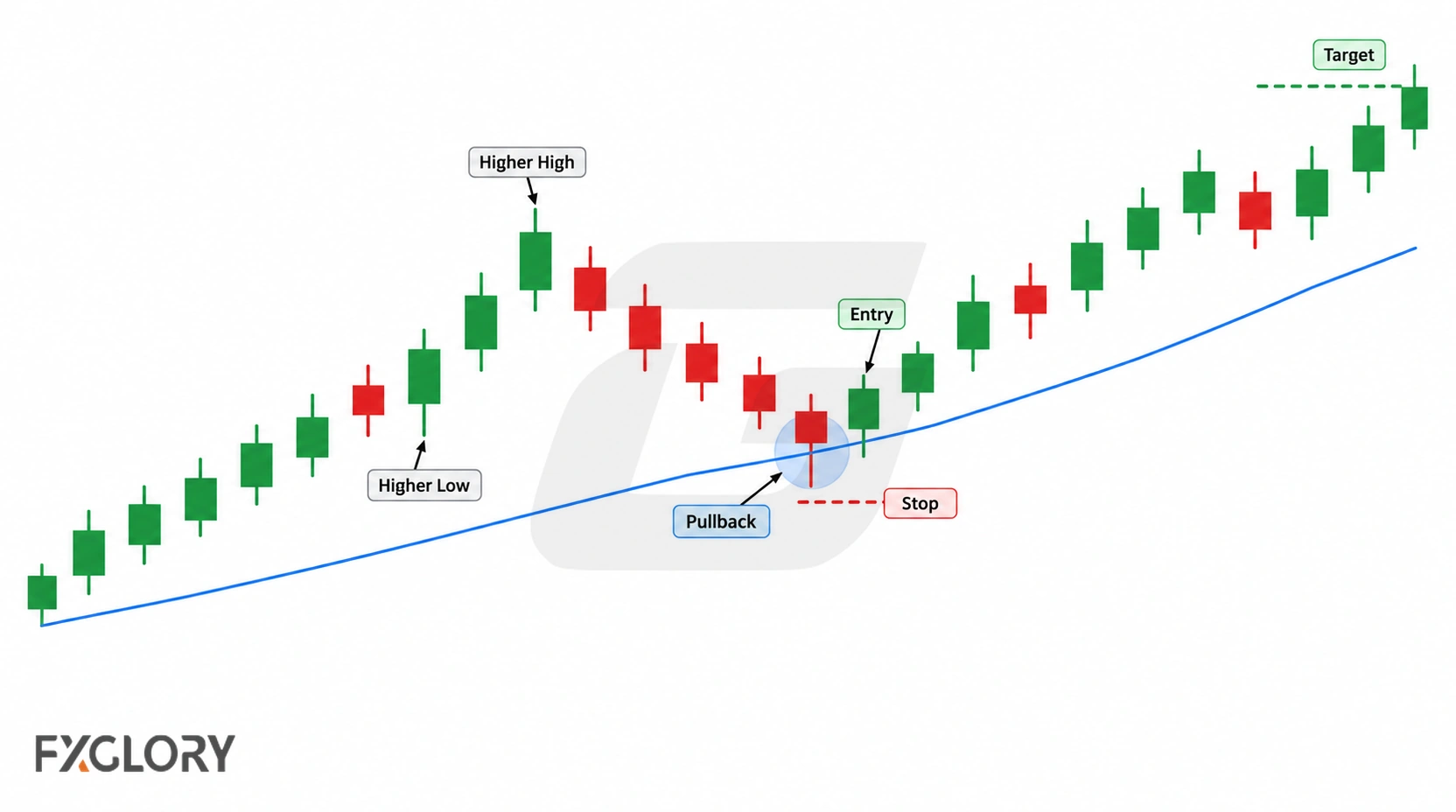
The pullback must not be treated as valid after the trend structure has failed. If an uptrend pullback breaks the higher-low structure, or a downtrend rally breaks the lower-high structure, the original trend idea may already be weak.
| Pullback Part | Better Version | Weak Version |
|---|---|---|
| Trend context | Trend direction is visible before the pullback | Pullback is traded without trend structure |
| Location | Pullback reaches a planned area such as structure, moving average, trendline, or channel | Entry happens in the middle of a messy correction |
| Confirmation | Price reacts, rejects, or resumes according to a written trigger | Every small bounce becomes an entry |
| Invalidation | Stop is placed where the pullback idea becomes wrong | Stop is moved wider after the pullback fails |
| Exit | Exit uses structure, trailing rule, time rule, or invalidation | Trader waits for a perfect trend top or bottom |
Hypothetical pullback calculation: Suppose EUR/USD has a planned long entry at 1.1000 and a stop at 1.0950. The 50-pip stop distance represents 1R for this illustration. A fixed 2R target would be 1.1100, or 100 pips above entry, before trading costs. These example prices are invented to explain the calculation; they are not historical observations or results from the educational backtest.
Breakout Continuation Trend Strategy
A trend can continue after price pauses in a flag, channel, triangle, rectangle, or consolidation area. A continuation breakout tries to enter when price breaks out in the direction of the existing trend.
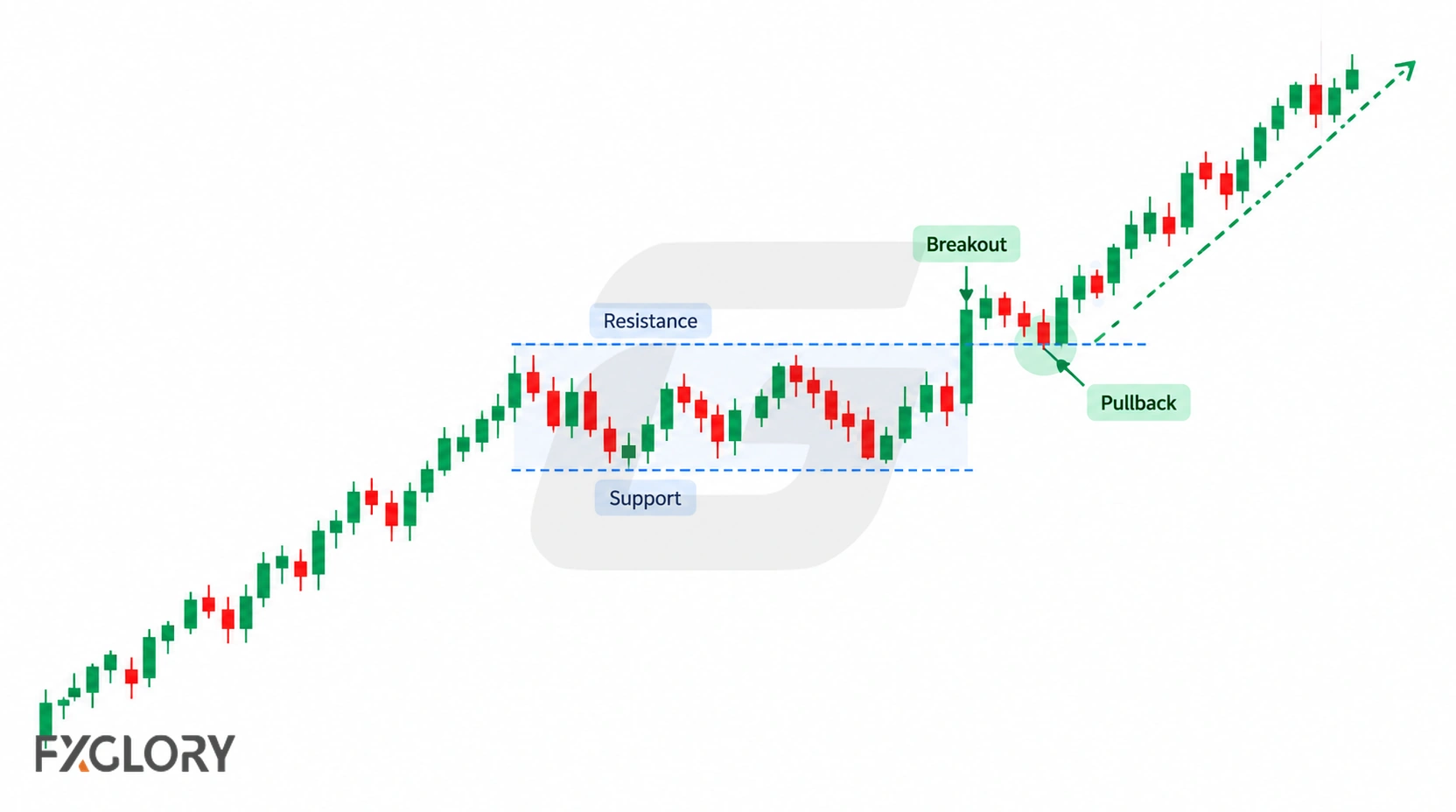
Breakout entries still need level quality, confirmation, false-break rules, stop placement, and target logic. For the full breakout framework, use the forex breakout strategy guide.
| Continuation Setup | Trend Role | Skip When |
|---|---|---|
| Flag or rectangle | Trend pauses before a possible continuation break | The range is unclear or the breakout is late |
| Triangle or wedge | Compression forms inside or near the trend | Break occurs into nearby support or resistance |
| Channel break | Price leaves a corrective channel in the trend direction | The channel boundary is redrawn after the break |
| Moving-average continuation | Price pulls back to a dynamic area and resumes trend direction | The average is flat and price is ranging |
| Retest after breakout | Broken area holds in the trend direction | The retest fails and price returns inside the structure |
Moving Averages in Trend Trading
Moving averages can help trend traders review direction, slope, pullbacks, crossovers, and dynamic structure. The moving average is a tool for reading trend behavior, not a complete strategy by itself.
For moving-average-specific rules, use the moving average forex strategy guide. This trend page uses moving averages only as one trend-reading method.
| Moving-Average Use | Useful Trend Role | Weak Use |
|---|---|---|
| Price above or below average | Reviews directional bias | Every cross is treated as a trade |
| Average slope | Shows whether direction is strengthening, flattening, or changing | Flat slope is ignored during ranges |
| MA pullback | Reviews whether price reacts near a dynamic area | Every touch becomes an entry without structure |
| MA crossover | Reviews possible trend shift or confirmation | Crossover confirms too late after price has extended |
| MA channel | Reviews pullback depth and trend rhythm | Channel is used after trend structure has already broken |
ADX, Momentum, and Volatility Filters
ADX and momentum indicators can help review whether a trend condition has strength or whether the move is weakening. They should not replace price structure, stop placement, or exit rules.
| Tool | Trend Role | Weak Use |
|---|---|---|
| ADX | Reviews directional strength or whether trend conditions may be improving | ADX is used as a standalone buy or sell signal |
| MACD | Reviews momentum shift, continuation, or weakening | Momentum confirms after the entry is late |
| RSI | Reviews momentum pressure, continuation, exhaustion, or divergence | Every overbought or oversold reading is treated as reversal |
| Stochastic | Reviews pullback timing in a trend context | Oscillator cross is traded against the trend without structure |
| ATR | Reviews volatility, stop distance, and movement size | ATR is used to justify oversized risk |
For trend-strength context, use the ADX forex trading strategy page. For volatility and stop-distance realism, use the ATR forex strategy framework.
Trend Exit Methods
Trend exits are central because a trend can continue longer than expected, reverse sharply, or turn sideways. A trend trader should know before entry whether the trade uses a fixed target, trailing method, structure exit, time rule, or invalidation exit.
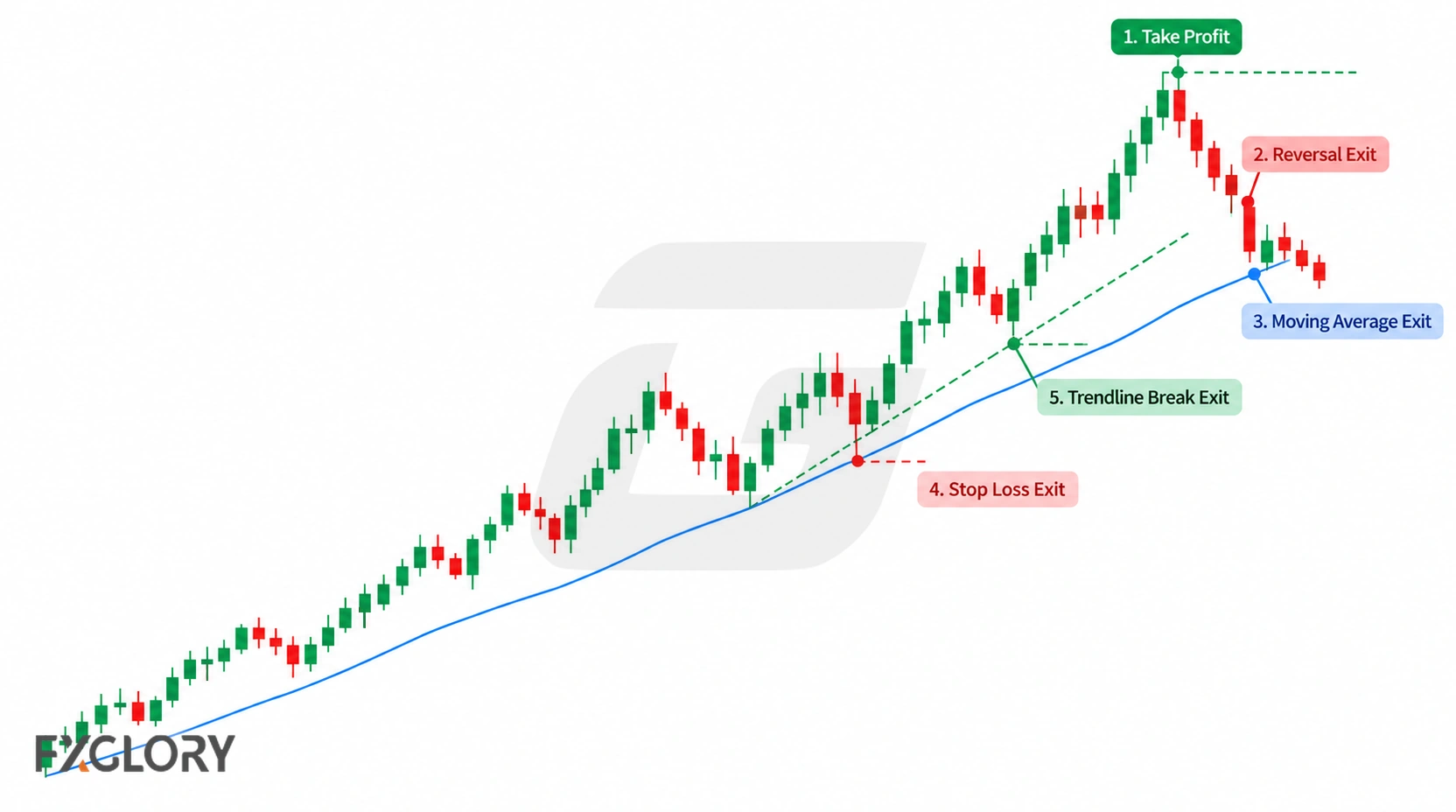
| Exit Method | How It Can Be Used | Weak Use |
|---|---|---|
| Structure exit | Exit when the trend structure breaks, such as a failed higher low or lower high | Trader ignores structure because the target has not been reached |
| Moving-average exit | Exit or review when price closes beyond a chosen average under written rules | Exit is triggered by every small touch of the average |
| ATR trailing stop | Trail the stop using volatility-based distance | ATR is changed after entry to avoid taking a loss |
| Chandelier-style exit | Trail using a volatility-based distance from recent high or low | Exit is widened whenever price pulls back |
| Partial exit | Close part of the trade at a planned area and manage the rest by rule | Partial exit is used to avoid following the original plan |
| Time exit | Close or review if the trend trade does not develop within the planned window | A stalled trade becomes an unplanned hold |
| Invalidation exit | Exit when the reason for the trend trade disappears | Trader holds because the trend looked strong earlier |
For volatility-based trailing, use the ATR trailing stop forex strategy. For a Chandelier-style trend exit, use the Chandelier Exit forex strategy.
Trend Trading Expectations: Whipsaws, Late Signals, And Larger Moves
A forex trend trading strategy should not be judged by one clean chart example. Trend methods can miss the first part of a move, exit before or after the exact turning point, and produce repeated failed signals when the market turns sideways.
Whipsaws are a real trend-trading problem. A moving average, breakout, or momentum signal may trigger in one direction and then quickly reverse when the market has no sustained direction. That does not mean the trader should widen stops or keep switching tools after every loss. It means the method needs clear no-trade rules, position sizing, and review over many examples.
| Expectation | What It Means | Risk If Ignored |
|---|---|---|
| Trend methods may enter late | Confirmation often appears after the trend has already started | Trader chases after most of the move has passed |
| Trend methods may exit imperfectly | The exit may happen before or after the exact top or bottom | Trader waits for perfection and ignores the exit rule |
| Sideways markets can whipsaw | Signals can repeat without sustained movement | Small losses or repeated re-entries build up |
| High win rate is not guaranteed | The strategy must be judged by risk, losses, exits, and sample review | Trader focuses on win rate while ignoring drawdown |
| Large moves are not predictable on demand | A trend strategy follows valid movement; it does not force it to appear | Trader holds weak trades because a large trend is expected |
When Forex Trend Trading Fails
Trend trading often fails when the trader treats any directional move as a trend. A real trend trade needs structure, location, stop logic, and an exit method. Without those, the trader may enter after the move is extended or hold after the trend has already weakened.
| Failure Reason | What Happens | Better Rule |
|---|---|---|
| Sideways market | Moving averages flatten and signals repeat without direction | Skip when trend structure is unclear |
| Late entry | Price has already moved toward the target area | Wait for a pullback, retest, or new setup |
| Pullback breaks structure | The trend idea weakens before entry | Cancel the setup instead of forcing it |
| False continuation breakout | Price breaks with the trend but returns inside the pattern | Use the breakout failure rule |
| No exit method | Trader gives back movement or exits randomly | Choose trailing, structure, target, time, or invalidation exit before entry |
| Overleverage | A single trend idea creates too much exposure | Set position size after stop distance and margin review |
| Moving the stop | Risk expands after the trade goes negative | Stop placement must be accepted before entry |
Risk Rules And No-Trade Conditions
Trend trading can create false confidence because the direction looks obvious after price has already moved. Risk rules should be written before the entry, not after the trend weakens.
| No-Trade Condition | Why It Matters | Action |
|---|---|---|
| Stop is unclear | The trader cannot define where the idea is wrong | Do not enter |
| Indicators conflict | The plan has no clear decision | Wait until roles align or skip |
| Spread or cost is unsuitable | Short-term trend targets may be weakened by cost | Skip if target no longer makes sense |
| Correlated exposure builds | Several positions may create the same directional risk | Reduce or avoid overlapping exposure |
| Daily stop reached | More trend attempts can become revenge trades | Stop trading for the session |
Short-term trend entries still need cost awareness. Check the spread conditions that affect trade planning before accepting a small target. When stop distance, position size, leverage exposure, and margin need to be reviewed together, use the margin calculator before the order is placed.
For account-level risk limits, use the forex risk-management strategy page. For platform workflow, review FXGlory trading platforms before relying on indicator layouts, trailing stops, or fast trade-management decisions.
Backtesting Notes For Forex Trend Trading Strategy
This numerical review uses one hypothetical educational rule model: a daily EMA trend-pullback setup with ADX trend-strength confirmation, completed daily candle confirmation, ATR-based stop placement, a 2R target comparison, a Chandelier-style trend exit, and spread/slippage sensitivity. It does not test continuation breakouts, trendline reactions, moving-average crossovers, discretionary structure trades, or multi-timeframe entry refinement.
The model reviews EURUSD, GBPUSD, USDJPY, AUDUSD, USDCAD, and USDCHF on daily candles using public yfinance OHLC data where available. Trend direction is defined with EMA(50), EMA(200), EMA(50) slope, and ADX(14).
| Rule Area | Educational Model Rule |
|---|---|
| Strategy type | Daily EMA trend-pullback continuation |
| Long trend context | Daily close above EMA(50), EMA(50) above EMA(200), and EMA(50) rising over 10 completed daily candles |
| Short trend context | Daily close below EMA(50), EMA(50) below EMA(200), and EMA(50) falling over 10 completed daily candles |
| ADX filter | ADX(14) at least 18 and no more than 45 |
| Pullback window | Previous 5 daily candles must include a pullback into the EMA(20) area without closing beyond EMA(50) against the trend |
| Long confirmation | Signal candle trades into the EMA(20) area, closes above EMA(20), closes above its open, and is not more than 0.75 ATR(14) above EMA(20) |
| Short confirmation | Signal candle trades into the EMA(20) area, closes below EMA(20), closes below its open, and is not more than 0.75 ATR(14) below EMA(20) |
| Entry | Next daily open after the completed signal candle |
| Stop | Beyond the pullback-window extreme with a 0.25 ATR(14) buffer |
| Target comparison | Fixed 2R target from entry |
| Trend exit | After at least 5 holding candles, a daily close through a Chandelier-style level based on 3 ATR(14) below the best high since entry for longs, or above the best low since entry for shorts |
| Maximum holding review | 40 daily candles after entry |
The review records trade count, win rate, average win in R, average loss in R, expectancy in R, profit factor, maximum drawdown in R, worst losing streak, average holding period, pair-level behavior, direction-level behavior, exit reasons, and spread/slippage sensitivity.
| Cost Input | Assumptions Used |
|---|---|
| Spread | 0.5, 1.5, and 3.0 pips |
| Slippage | 0.1, 0.5, and 1.0 pips per side |
| Baseline comparison | 1.5-pip spread and 0.5-pip slippage per side |
| Swap and rollover | Not included |
Educational Sensitivity-Test Results
The hypothetical backtest used public yfinance daily OHLC data from 2016-06-29 through 2026-06-29 where available. The baseline cost assumption used a 1.5-pip spread and 0.5-pip slippage per side. The baseline result was negative, with expectancy of -0.0322R and total net result of -6.2703R.
| Metric | Baseline Result |
|---|---|
| Number of trades | 195 |
| Win rate | 34.87% |
| Average win | 1.8524R |
| Average loss | -1.0412R |
| Expectancy | -0.0322R |
| Profit factor | 0.9526 |
| Maximum drawdown | -20.8746R |
| Worst losing streak | 10 |
| Average holding period | 6.37 daily candles |
| Median holding period | 3 daily candles |
| Total net result | -6.2703R |
| Pair | Trades | Win Rate | Expectancy | Profit Factor | Max Drawdown | Total Net R |
|---|---|---|---|---|---|---|
| AUDUSD | 32 | 43.75% | 0.1678R | 1.2825 | -7.4282R | 5.3706R |
| EURUSD | 30 | 36.67% | 0.0486R | 1.077 | -7.7589R | 1.4575R |
| GBPUSD | 53 | 43.4% | 0.2001R | 1.3332 | -7.9911R | 10.6028R |
| USDCAD | 25 | 24% | -0.2958R | 0.6141 | -6.4953R | -7.3947R |
| USDCHF | 26 | 23.08% | -0.3742R | 0.5419 | -11.5132R | -9.7289R |
| USDJPY | 29 | 27.59% | -0.2268R | 0.7021 | -11.7372R | -6.5777R |
| Direction | Trades | Win Rate | Expectancy | Profit Factor | Max Drawdown | Total Net R |
|---|---|---|---|---|---|---|
| Long | 94 | 40.43% | 0.1302R | 1.2085 | -9.8772R | 12.2404R |
| Short | 101 | 29.7% | -0.1833R | 0.7482 | -22.4824R | -18.5108R |
| Spread (pips) | Slippage Per Side (pips) | Expectancy | Profit Factor | Max Drawdown | Total Net R |
|---|---|---|---|---|---|
| 0.5 | 0.1 | 0.0086R | 1.0131 | -15.702R | 1.6676R |
| 0.5 | 0.5 | -0.0095R | 0.9856 | -17.7018R | -1.8604R |
| 0.5 | 1 | -0.0322R | 0.9526 | -20.8746R | -6.2703R |
| 1.5 | 0.1 | -0.0141R | 0.9789 | -18.216R | -2.7424R |
| 1.5 | 0.5 | -0.0322R | 0.9526 | -20.8746R | -6.2703R |
| 1.5 | 1 | -0.0548R | 0.921 | -24.1978R | -10.6803R |
| 3 | 0.1 | -0.048R | 0.9303 | -23.2008R | -9.3573R |
| 3 | 0.5 | -0.0661R | 0.9058 | -25.8594R | -12.8853R |
| 3 | 1 | -0.0887R | 0.8762 | -29.1826R | -17.2953R |
| Exit Reason | Count |
|---|---|
| chandelier trend exit | 6 |
| stop first same bar | 4 |
| stop loss | 119 |
| target 2r | 63 |
| time exit | 3 |
Testing And Review Before Live Trading
A forex trend trading strategy should be reviewed on historical examples or demo conditions before it is used with real funds. The purpose is not to find perfect trends. The purpose is to check whether the same trend definition, entry type, stop rule, exit method, and no-trade rules can be followed repeatedly.
Record both taken and skipped trades. Skipped trades matter because many trend-trading mistakes come from late entries, sideways conditions, broken pullback structure, and trades taken after the original reason has disappeared.
- Record whether the market was trending up, trending down, sideways, or unclear before entry.
- Record the timeframe used for trend context and the timeframe used for entry.
- Record whether the setup was pullback, continuation breakout, moving-average reaction, or structure retest.
- Record whether the stop and exit method were known before entry.
- Record whether spread, margin, and position size were checked before entry.
- Record whether the trade exited by target, trail, structure break, time rule, or invalidation.
- Compare trades that followed the plan with trades that broke it.
Forex Trend Trading Checklist
Before a trend setup becomes a trade, each item below should already be clear.
- Define whether the market is trending up, trending down, sideways, or unclear.
- Check higher-timeframe context before selecting the entry timeframe.
- Confirm that the trend structure is visible before the entry signal.
- Choose the entry type: pullback, continuation breakout, moving-average reaction, or retest.
- Define the invalidation point before entry.
- Choose position size only after stop distance is known.
- Choose the exit method before entry: target, structure break, trailing stop, time rule, or invalidation.
- Skip the trade if the pullback breaks the trend structure.
- Skip the trade if price is already extended and the stop no longer fits.
- Check spread, margin, leverage exposure, and correlated risk before entry.
- Stop trading when the daily loss, drawdown, or trade-count rule is reached.
- Review whether the trade followed the plan, not only whether it made or lost money.