

What Is A Forex Day Trading Strategy?
A forex day trading strategy is a same-day trading plan for currency pairs. It defines when the trader watches the market, which pair is being tested, which chart owns context, which chart owns the setup, what triggers entry, where the trade is wrong, how the trade is exited, and how the session is reviewed.
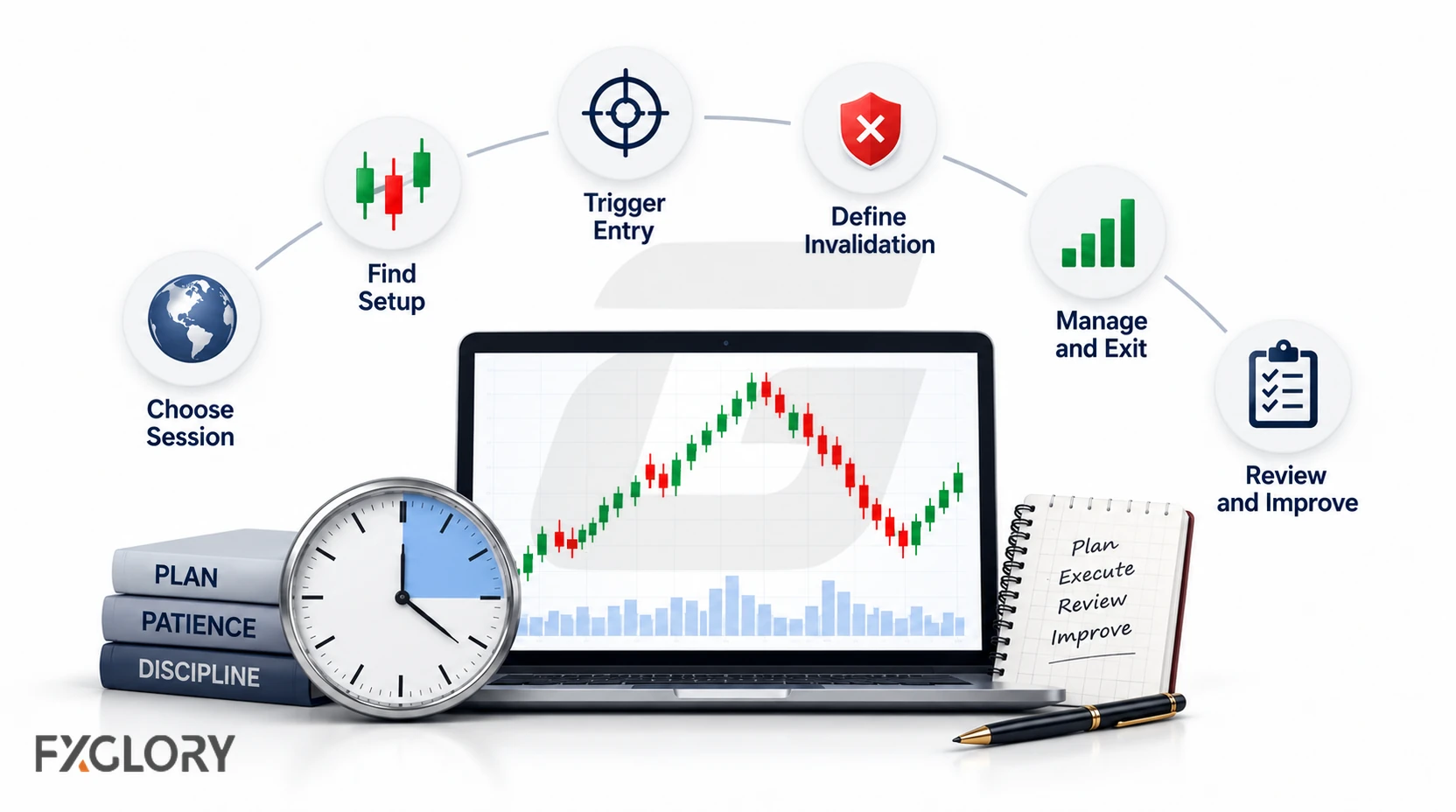
A day-trading strategy should be judged by whether its session, pair, setup, invalidation, and exit rules can be repeated under the same conditions. It should not depend on one universal signal or one indicator that is expected to work in every market condition.
The Forex Day Trading Workflow
A day trading plan becomes easier to test when each decision has an order. The strategy should not begin with a random candle or indicator reading. It should begin with the trading window and the market being watched.
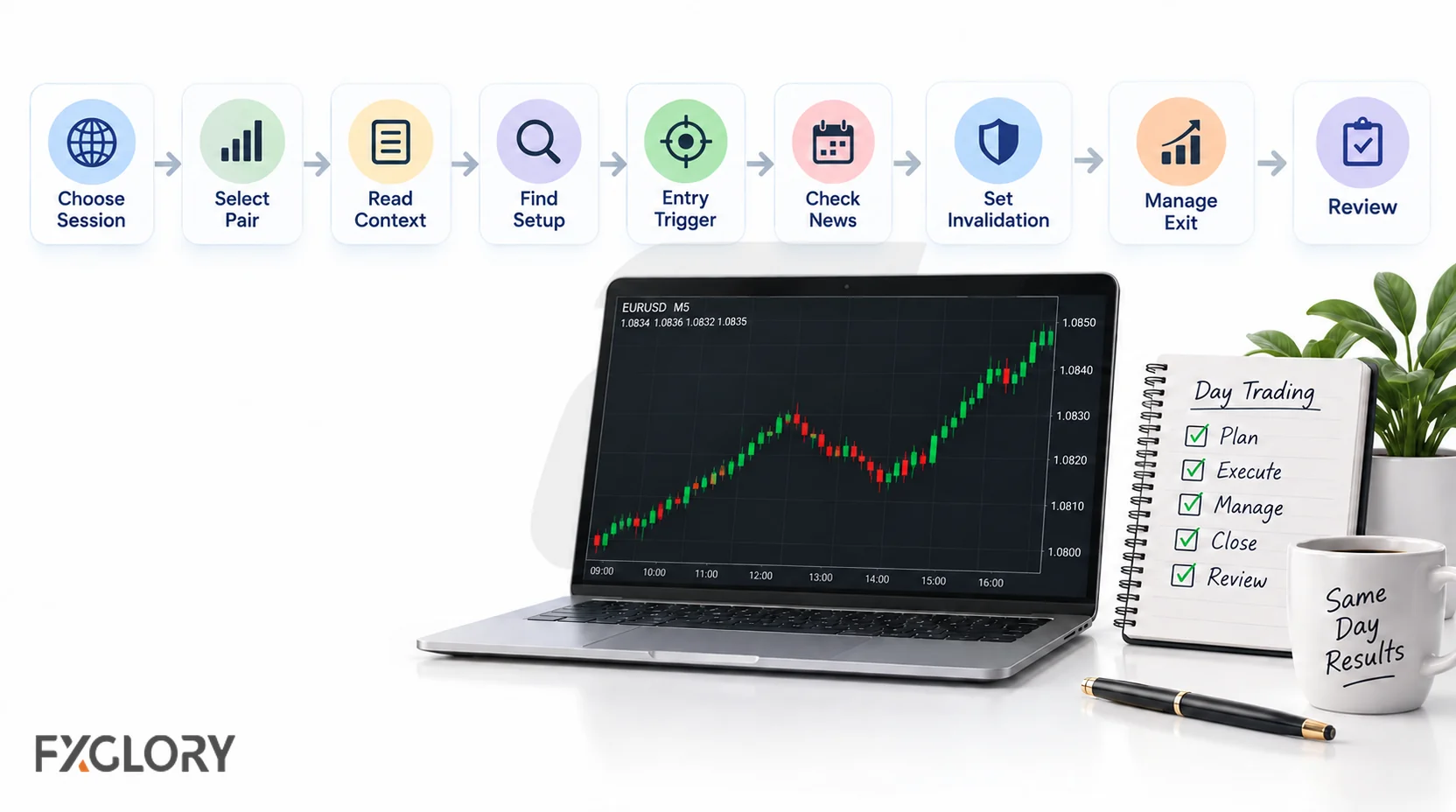
- Choose the session: Decide whether the plan will be tested during London, New York, the London/New York overlap, or another active window for the pair.
- Choose the pair: Focus on one or two currency pairs so the review does not mix too many market behaviors.
- Mark context: Use the higher intraday chart to define trend, range, nearby zones, and obstacles.
- Wait for the setup: Use the setup chart to decide whether a trade idea actually exists.
- Use a trigger: Use the lower chart only if it improves timing without changing the trade idea.
- Check cost and news: Confirm spread, upcoming events, and whether the expected move is still practical.
- Define invalidation: Know where the trade idea is wrong before entering.
- Set the exit rule: Decide before entry how the trade will be closed, including whether it must be closed before the session or day ends according to the written plan and platform/server-time awareness.
- Review the session: Record whether the trade followed the planned process or came from impulse.
If the plan needs a broader strategy structure, use the setup framework for trigger and invalidation rules before adding more chart filters.
Choose One Session And One Or Two Pairs
Forex day trading depends on the session being active enough for the selected pair. A trading setup that looks acceptable during a liquid period may behave differently during a quiet handoff or close to a major news release.
Start by matching the pair to the session. EUR/USD and GBP/USD are often watched during London and New York activity. USD/JPY may attract attention during Tokyo and later USD-driven periods. AUD and NZD pairs may show more Asia-Pacific behavior during Sydney or Tokyo hours. The pair still needs spread and news checks before entry.
Use the session and local-time guide to choose the trading window, then review the available currency pairs before selecting the market to test.
Use A Chart Routine Without Timeframe Hopping
A day trading strategy should define which chart owns each decision. A common structure is 1H for context, 15M for setup, and 5M only for entry refinement. The exact routine should be tested, but the chart order should not be changed after the trade is already open.
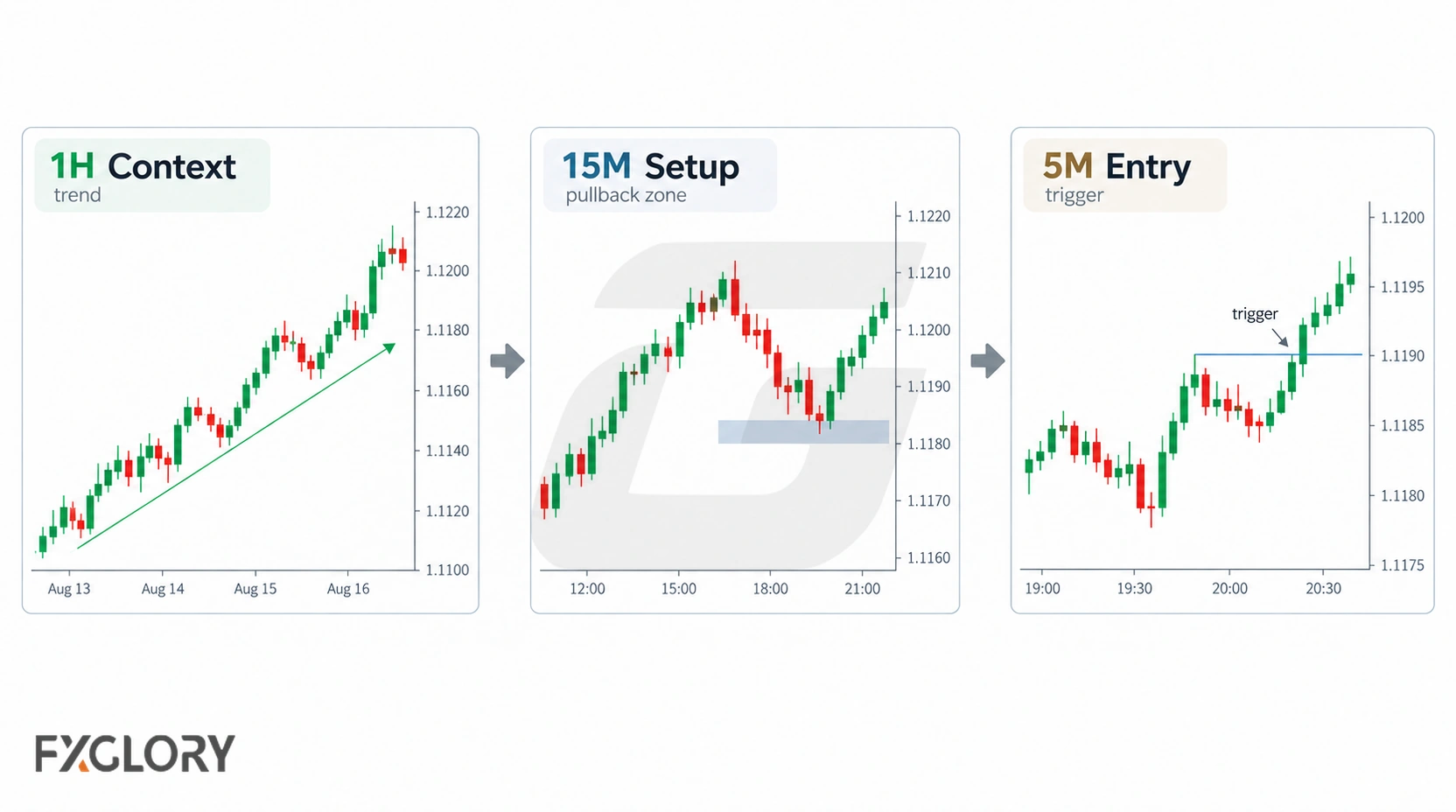
| Chart role | Common day trading chart | Decision it owns | Main mistake |
|---|---|---|---|
| Context chart | 1H or 4H | Trend, range, key zones, session bias | Using it as a direct entry signal |
| Setup chart | 15M or 30M | Trade idea, invalidation area, setup quality | Entering before the setup is clear |
| Trigger chart | 5M | Entry refinement only | Letting small candles create the trade |
| Review chart | The setup chart | Whether the plan was followed | Reviewing from hindsight on a different chart |
For the full intraday chart routine, use the 1H, 15M, and 5M day trading guide. If the strategy uses more than one chart, keep the context-to-trigger chart order fixed during the session.
A Simple Forex Day Trading Strategy Framework
A simple forex day trading strategy should have fewer moving parts, not fewer rules. The structure below can support trend, range, or breakout ideas without turning the plan into a random signal chase.
| Rule | Question to answer before entry | Skip condition |
|---|---|---|
| Session rule | Is this the planned trading window? | The trade appears outside the tested session |
| Pair rule | Is this one of the selected pairs? | The trader switches pairs because nothing happened yet |
| Context rule | Is price trending, ranging, or sitting near a key zone? | Context is unclear or directly conflicts with the setup |
| Setup rule | Is there a defined pattern, pullback, range reaction, or break-and-retest? | The setup cannot define invalidation |
| Trigger rule | Does the lower chart improve timing without changing the idea? | The lower chart is being used to invent a trade |
| Cost rule | Is the expected move still practical after spread? | The target is too small after costs |
| News rule | Is a major release about to affect the pair? | The trader has no news plan |
| End-of-day rule | Must the position be closed before the session or day ends? | The trader decides under pressure after entry |
| Review rule | Can the result be judged against the written plan? | The trade came from impulse or rule changes |
Example: One Simple Intraday Pullback Plan
This example shows how a day-trading plan can be structured without turning it into a promise or a fixed signal. It is a workflow template for testing, not a recommendation to enter every similar setup.
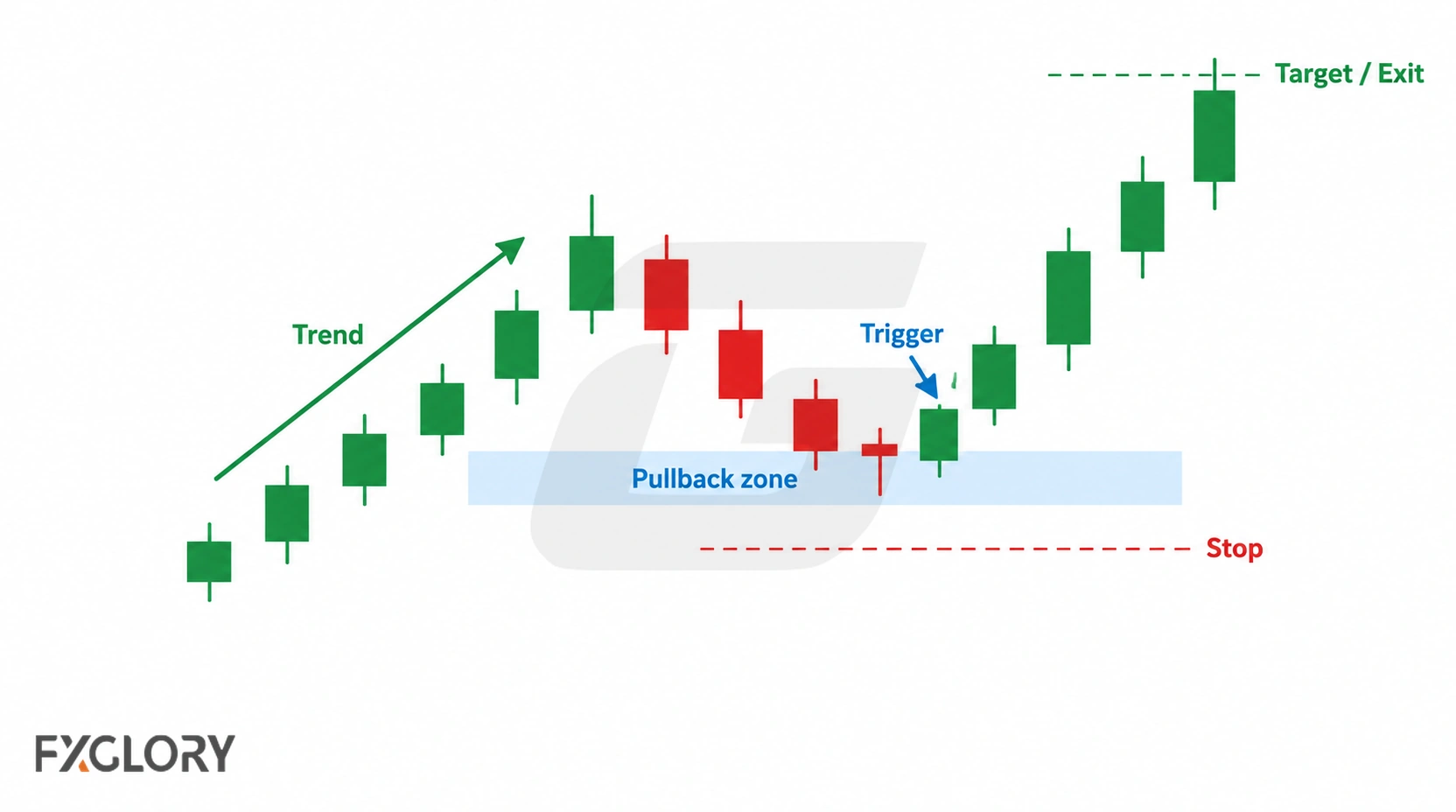
| Step | Example rule | Skip condition |
|---|---|---|
| Session | Trade only during the planned active session for the selected pair | The setup appears after the active window fades |
| Pair | Use one selected major pair during the test period | The trader switches to another pair because the first pair is quiet |
| Context | Use 1H to decide whether price is trending, ranging, or near a key zone | The 1H chart is unclear or price is moving into a major obstacle |
| Setup | Use 15M to wait for a pullback into a planned area with clear invalidation | The pullback has no defined invalidation area |
| Trigger | Use 5M only to refine timing after the 15M setup is valid | The 5M chart is being used to create a trade the 15M chart does not support |
| Cost and news | Check spread and scheduled news before entry | The expected move is too small after spread or news risk is immediate |
| Exit | Use the planned invalidation, target area, or time-based close rule | The trader holds because the session result feels uncomfortable |
| Review | Record whether the session, pair, context, setup, trigger, and exit rules were followed | The result cannot be explained from the written plan |
For example, suppose the 1H chart shows higher swing highs and higher swing lows. The trader can mark an earlier support area, then wait for a 15M pullback toward it instead of buying simply because price is rising. Only after a valid 15M setup develops would a 5M break above a nearby minor swing high be considered as an entry trigger. The pullback swing low offers a possible structural invalidation reference; the proposed entry-to-stop distance and room before the next 1H obstacle must then be checked against costs and planned account risk. This is an illustrative pullback workflow, not a trade drawn from the 15M breakout backtest below.
Forex Day Trading Strategy Types
The market condition decides which method is even allowed: trend plans need direction, range plans need boundaries, and breakout plans need a meaningful level. A trader should not force a breakout method into a range or a trend-pullback method into unclear price action.
| Strategy type | When it may fit | Failure filter |
|---|---|---|
| Trend pullback | Price has a clear intraday direction and pulls back toward a planned area | Skip when the trend is exhausted, unclear, or moving into a higher-timeframe obstacle |
| Break and retest | Price breaks a meaningful level and returns to test it without losing structure | Skip when the break happens during thin conditions or directly before major news |
| Range reaction | Price is contained between clear intraday boundaries | Skip when range edges are unclear or there is no room before the opposite side |
| News-filtered setups | The trader has planned whether scheduled data should be avoided or handled with specific rules | Skip when the trade is just a guess before or after the release |
| Moving-average filter | The average helps classify trend or location before a separate setup appears | Skip when the moving average replaces the setup, stop, or exit rule |
None of these methods creates permission to trade until session, spread, invalidation, and news checks are complete.
Where The 200 SMA Can Fit In Day Trading
The 200 simple moving average can be used as a trend or location filter inside a day trading plan. For example, a trader may use it to judge whether price is trading above or below a longer intraday average, or whether a pullback is approaching a widely watched area.
Inside this intraday plan, the 200 SMA is only a filter. It should not define the full strategy, entry, stop, or exit by itself. It is a lagging tool, so it can react slowly and may whipsaw when the market is sideways. A day trading plan still needs a session, pair, setup, trigger, invalidation, spread check, exit rule, and review process.
- Possible role: Trend filter or location filter.
- Not enough by itself: A cross, touch, or rejection still needs confirmation from the setup rules.
- Main caution: Sideways markets can make moving-average signals unclear.
Spread, Slippage, And News Filters
Day trading often works with smaller intraday moves than swing trading, so trading costs and execution conditions matter. A setup can look acceptable on the chart and still be weak if the expected move is too small after spread or if a scheduled release is about to distort conditions.
- Spread check: Is the expected move still practical after spread?
- Slippage check: Would a worse entry damage the trade idea?
- News check: Is a major release scheduled for the pair or related currency?
- Session check: Is the active window fading or becoming thin?
- Stop-distance check: Does the stop match the setup chart instead of a random number?
Use FXGlory spread information when evaluating short-target intraday plans. After determining a proposed stop distance and position size, use the margin calculator to check required margin; it does not calculate acceptable account risk at the stop.
Entry, Exit, And Daily Limit Rules
A day trading strategy needs a rule for entering, exiting, and stopping for the day. Without daily limits, a trader can turn one weak session into several forced trades.
| Rule type | What to define | Why it matters |
|---|---|---|
| Entry rule | The exact trigger after context and setup are valid | Prevents entering just because price moved quickly |
| Invalidation rule | The level or condition that proves the setup wrong | Prevents moving the stop after entry |
| Exit rule | Target area, time-based exit, or invalidation-based exit | Prevents holding a day trade without a plan |
| End-of-day rule | Whether positions must be closed before the session or trading day ends, using the written plan and platform/server-time awareness | Prevents changing a day trade into an unplanned overnight position |
| Daily loss rule | The point where trading stops for the session | Prevents revenge trading after losses |
| Daily trade-count rule | The maximum number of planned attempts | Prevents overtrading when conditions are unclear |
After identifying a structural stop, review position sizing and account risk: proposed lot size depends on stop distance, pip value, and the amount the plan permits at risk. Check margin separately. A valid chart setup can still be rejected because its size or planned loss does not fit account limits.
Same-Day Backtest Notes For Forex Day Trading Strategy
Educational rule model: 15-minute session-filtered breakout entries, ATR-based stop placement, fixed 1.3R target, whipsaw exits, spread/slippage assumptions, and a forced same-day exit. Scope excludes discretionary chart reading, news trading, scalping, and multiple-timeframe workflows.
The model reviewed EURUSD, GBPUSD, USDJPY, AUDUSD, USDCAD, and USDCHF using public yfinance 15-minute OHLC data where available. The stored download record reports first available timestamps of 7 April 2026 at 23:00 UTC and last available timestamps of 30 June 2026 at 08:15 UTC for each pair, with differing downloaded-bar counts. Its request was labeled 60d at 15m; that requested period is not a claim of 60 continuous calendar days of observations. These are recorded data-coverage boundaries, not the dates of the first and last accepted trades. The recorded source tickers were EURUSD=X, GBPUSD=X, USDJPY=X, AUDUSD=X, CAD=X (USDCAD), and CHF=X (USDCHF). Positions are not held overnight; any open trade is closed at the last available 15-minute close at or before 20:45 UTC on the entry date.
| Rule Area | Educational Model Rule |
|---|---|
| Strategy type | 15-minute same-day intraday breakout rule |
| Accepted signal windows | Fixed UTC windows: London morning 07:00–11:59, London/New York overlap 12:00–15:59, New York afternoon 16:00–19:30 |
| Rejected windows | Asia, rollover/off-hours, and signals too late for same-day exit |
| Direction filter | EMA(20) compared with EMA(50) |
| Range rule | Previous 12 completed 15-minute candles |
| Volatility filter | Range width between 0.75 and 4.00 ATR(14) |
| Long setup | Close 0.10 to 0.90 ATR(14) above the range high, with EMA(20) above EMA(50) and close in the upper 40% of the candle range |
| Short setup | Close 0.10 to 0.90 ATR(14) below the range low, with EMA(20) below EMA(50) and close in the lower 40% of the candle range |
| Entry | Next 15-minute open after the completed signal candle |
| Stop | Signal candle extreme with a 0.25 ATR(14) buffer |
| Target comparison | Fixed 1.3R target from entry |
| Whipsaw exit | Close back through the broken range boundary against the trade |
| Same-day exit | Forced close at the last available 15-minute close at or before 20:45 UTC |
| Overlap filter | One open trade per pair |
| Cost Input | Assumptions Used |
|---|---|
| Spread | 0.5, 1.5, and 3.0 pips |
| Slippage | 0.1, 0.5, and 1.0 pips per side |
| Baseline comparison | 1.5-pip spread and 0.5-pip slippage per side |
| Swap and rollover | Not included because trades are forced flat before the same-day cutoff |
The review records technical candidates, accepted trades, rejected candidates, rejection reasons, trade count, win rate, average win in R, average loss in R, expectancy in R, profit factor, maximum drawdown in R, worst losing streak, holding time, same-day cutoff exits, session-level behavior, pair-level behavior, direction-level behavior, exit reasons, and spread/slippage sensitivity.
Reproducibility details: The supplied research records the indicator periods, range thresholds, same-candle stop-first rule, session windows, and cost assumptions, but does not separately document the EMA/ATR initialization, ATR smoothing convention, treatment of missing 15-minute bars, whether downloaded bar timestamps denote opens or closes, the exact fill convention for close-triggered whipsaws, the priority of whipsaw versus other exits, or the arithmetic used to convert bid/ask costs and slippage into net R. These details must be checked against the preserved Python script and trade log before claiming an independently reproducible run; no unverified implementation rule has been assumed here.
Educational Same-Day Backtest Results
Baseline assumptions: 1.5-pip spread, 0.5-pip slippage per side, and no swap or rollover because positions are forced flat before the same-day cutoff. The baseline run was negative: -0.4516R expectancy and -206.3861R total net result across 457 trades.
| Metric | Baseline Result |
|---|---|
| Technical candidates | 1196 |
| Accepted trades | 457 |
| Rejected candidates | 739 |
| Win rate | 24.73% |
| Average win | 0.8958R |
| Average loss | -0.8942R |
| Expectancy | -0.4516R |
| Profit factor | 0.3291 |
| Maximum drawdown | -206.9632R |
| Worst losing streak | 16 |
| Average holding period | 67.81 minutes |
| Same-day cutoff exit rate | 5.03% |
| Session | Trades | Win Rate | Expectancy | Total Net Result | Max Drawdown | Cutoff Exit Rate |
|---|---|---|---|---|---|---|
| London/New York overlap | 177 | 24.86% | -0.4293R | -75.9914R | -76.2953R | 2.82% |
| London morning | 176 | 25.57% | -0.4412R | -77.6492R | -76.8703R | 0.00% |
| New York afternoon | 104 | 23.08% | -0.5072R | -52.7454R | -53.8288R | 17.31% |
| Pair | Trades | Win Rate | Expectancy | Total Net Result | Max Drawdown |
|---|---|---|---|---|---|
| AUDUSD | 55 | 32.73% | -0.4003R | -22.0180R | -21.1965R |
| EURUSD | 62 | 27.42% | -0.3990R | -24.7361R | -26.1234R |
| GBPUSD | 79 | 30.38% | -0.3999R | -31.5910R | -34.4862R |
| USDCAD | 92 | 25.00% | -0.3219R | -29.6148R | -30.7650R |
| USDCHF | 89 | 19.10% | -0.5869R | -52.2336R | -51.8357R |
| USDJPY | 80 | 17.50% | -0.5774R | -46.1926R | -45.7803R |
| Exit Reason | Trades |
|---|---|
| Same-day cutoff exit | 23 |
| Stop loss | 87 |
| 1.3R target | 100 |
| Whipsaw close back through range boundary | 247 |
| Session | Cost Scenario | Spread | Slippage Per Side | Expectancy | Total Net Result | Win Rate |
|---|---|---|---|---|---|---|
| London morning | Low-cost assumption | 0.5 | 0.1 | -0.2152R | -37.8808R | 25.57% |
| London morning | Baseline assumption | 1.5 | 0.5 | -0.4412R | -77.6492R | 25.57% |
| London morning | High-cost assumption | 3.0 | 1.0 | -0.7550R | -132.8832R | 25.57% |
| London/New York overlap | Low-cost assumption | 0.5 | 0.1 | -0.2371R | -41.9580R | 24.86% |
| London/New York overlap | Baseline assumption | 1.5 | 0.5 | -0.4293R | -75.9914R | 24.86% |
| London/New York overlap | High-cost assumption | 3.0 | 1.0 | -0.6964R | -123.2601R | 23.73% |
| New York afternoon | Low-cost assumption | 0.5 | 0.1 | -0.2728R | -28.3718R | 25.96% |
| New York afternoon | Baseline assumption | 1.5 | 0.5 | -0.5072R | -52.7454R | 23.08% |
| New York afternoon | High-cost assumption | 3.0 | 1.0 | -0.8327R | -86.5977R | 17.31% |
What This Same-Day Backtest Shows
Whipsaw exits accounted for 247 of the 457 accepted trades (54.05%), compared with 100 target exits and 87 protective-stop exits. This makes the close back through the range boundary an important feature to inspect in the trade log, not evidence that a different exit would necessarily have improved results. Under the baseline assumptions, all three accepted session groups and all six currency pairs had negative expectancy.
The same-day cutoff affected sessions differently: 18 of 104 New York afternoon trades (17.31%) exited at the cutoff, compared with five of 177 London/New York overlap trades (2.82%) and none of the 176 London morning trades. This describes time-to-cutoff exposure in the tested rules; it does not establish one session as superior. Even the selected low-cost sensitivity scenarios remained negative, so lower assumed costs reduced losses without reversing the observed result. The model avoided planned overnight holding but did not eliminate intraday losses or execution uncertainty.
Forex Day Trading Mistakes To Avoid
- Averaging down without a plan: Adding to a losing position can increase risk when the original setup has already failed.
- Trading news as a guess: Major releases can move price quickly and create execution risk.
- Switching strategies mid-session: A trader cannot review a plan that changes after every trade.
- Entering after the active window fades: The setup may appear when participation is already dropping.
- Using the 5M chart to invent trades: The lower chart should refine timing, not create the whole idea.
- Ignoring spread on small targets: A short-target plan can become impractical after costs.
- Moving stops after entry: Invalidation belongs to the setup, not to the trader's discomfort.
- Turning a day trade into an overnight position: Holding past the planned exit window changes the risk profile.
- Testing too many pairs at once: The review becomes unclear when several markets and sessions are mixed together.
One-Session Practice Plan
A forex day trading strategy should be tested one session at a time before live trading. Choose one pair, one session, one chart routine, one setup type, and one review process. Do not change all of them during the same test.
- Before the session: Choose the pair, session, key news events, context chart, setup chart, and end-of-day rule.
- During the session: Wait for the planned setup instead of reacting to every candle.
- Before entry: Check spread, stop distance, invalidation, and whether the active window still fits the plan.
- After exit: Record whether the trade followed the session, pair, context, setup, trigger, exit, and review rules.
- After several sessions: Review whether losses came from pair choice, timing, setup quality, costs, news, exit behavior, or rule-breaking.
Use the demo account information to practice one forex day trading strategy before applying it to live trading conditions. Review FXGlory trading platforms when building a workspace for session monitoring, chart review, and trade planning.