

What Is The Best Time Frame For Day Trading Forex?
The best time frame for day trading forex is usually not one chart. A practical routine uses a higher chart for context, a middle chart for the setup, and a lower chart only when it helps refine the entry.
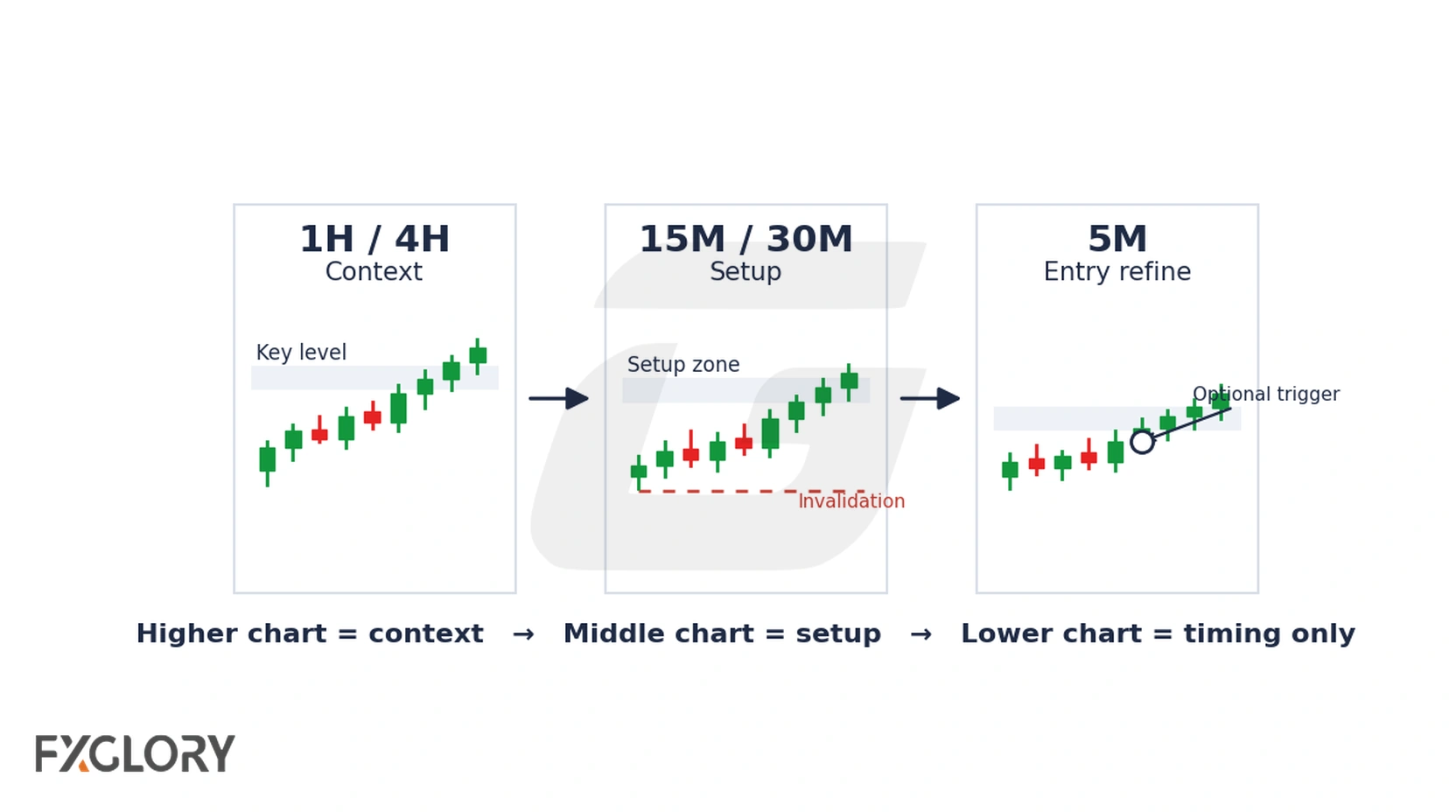
A common structure is 4H or 1H for market context, 15M or 30M for the intraday setup, and 5M for entry refinement. A slower structure can use Daily for major levels, 1H for intraday direction, and 30M for execution planning. The useful choice depends on how long the trader can monitor the market, how active the session is, how wide the stop needs to be, and whether the expected move is still reasonable after spread.
For broader chart selection across trading styles, start with the broader forex timeframe selection guide. This page stays focused on intraday day-trading routines.
Why Many Day Traders Separate Chart Roles
One chart can show detail, but it may not show enough context for an intraday decision. A 5-minute chart may show a clean candle reaction while the 1-hour chart shows price entering a major resistance area. A 1-hour chart may show direction but not enough entry detail. Day trading becomes easier to review when chart roles are separated before the trade is considered.
| Chart role | Question it answers | Common day-trading choices |
|---|---|---|
| Context chart | Where is price trading from, and what larger structure matters? | 4H, 1H, sometimes Daily |
| Setup chart | Is there an intraday setup with clear invalidation? | 30M, 15M |
| Trigger chart | Is there a cleaner entry signal without changing the setup? | 5M, sometimes 1M for very experienced traders with strict rules |
A clean trading setup framework keeps those roles separate: context first, setup second, trigger third, invalidation before entry, and review after the trade.
Forex Day-Trading Timeframe Map
Each intraday chart changes how much noise, structure, and decision pressure the trader has to handle. Faster charts are not automatically better; they simply compress the decision process.
| Time frame | Best day-trading role | Useful when | Main caution |
|---|---|---|---|
| 4H | Broad intraday context | The trader needs trend, range, or key-zone direction before checking lower charts | It can be too broad for precise intraday entries |
| 1H | Main context chart | The trader wants direction, structure, and session bias without using a very slow chart | It can hide lower-timeframe entry detail |
| 30M | Slower setup chart | The trader wants fewer, cleaner intraday decisions than 15M | It may give fewer setups during one session |
| 15M | Main setup chart | The trader wants intraday structure, pullbacks, breaks, and invalidation areas | It can still be noisy during thin or choppy periods |
| 5M | Entry refinement chart | The higher chart already shows a valid setup and the trader wants a tighter trigger | It can encourage overtrading and weak entries |
| 1M | Very fast trigger chart | The trader has strict rules, fast execution discipline, and cost awareness | It often behaves more like scalping than structured day trading |
The 1H-15M-5M Day-Trading Routine
The 1H-15M-5M routine is useful because each chart has a clear job. The 1H chart gives the intraday context. The 15M chart defines the setup. The 5M chart is optional and should only refine entry timing.
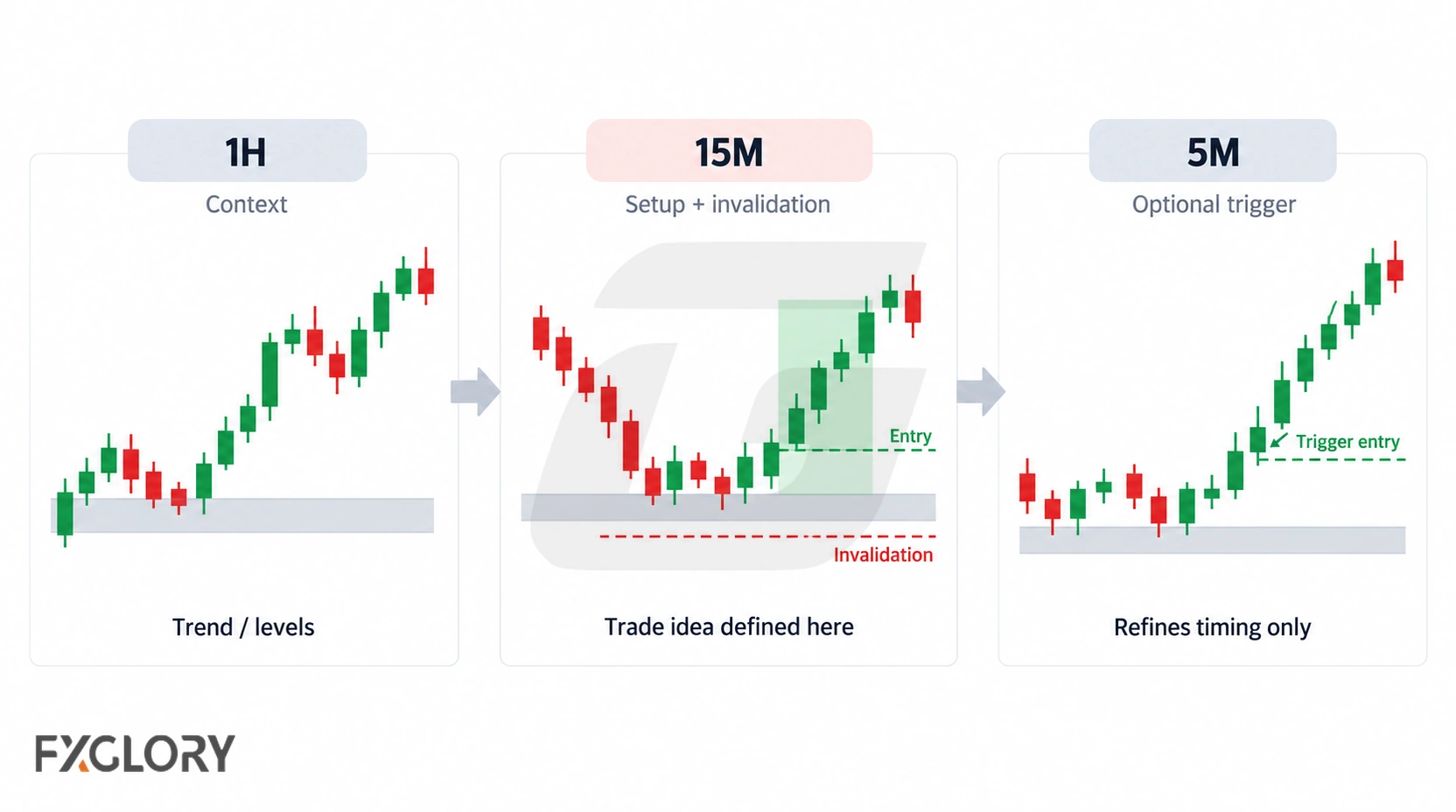
- Use 1H for context: Mark trend direction, range boundaries, recent swing points, and nearby support or resistance.
- Use 15M for the setup: Look for the actual intraday structure, such as a pullback, break and retest, range reaction, or continuation pattern.
- Use 5M for the trigger only: Entering from 5M should make the timing clearer, not change the trade idea.
- Place invalidation from the setup: The stop logic should come from the 15M structure, not from a random smaller candle after entry.
- Review after the session: Record whether the trade followed the planned chart order or came from a lower-chart impulse.
The Daily-1H-30M Routine
A slower intraday routine can start from the daily chart, especially when the trader wants major support, resistance, and broader trend context before choosing intraday direction. In that structure, the daily chart is not used for entry. It is used to understand where the day-trading idea sits inside larger market structure.
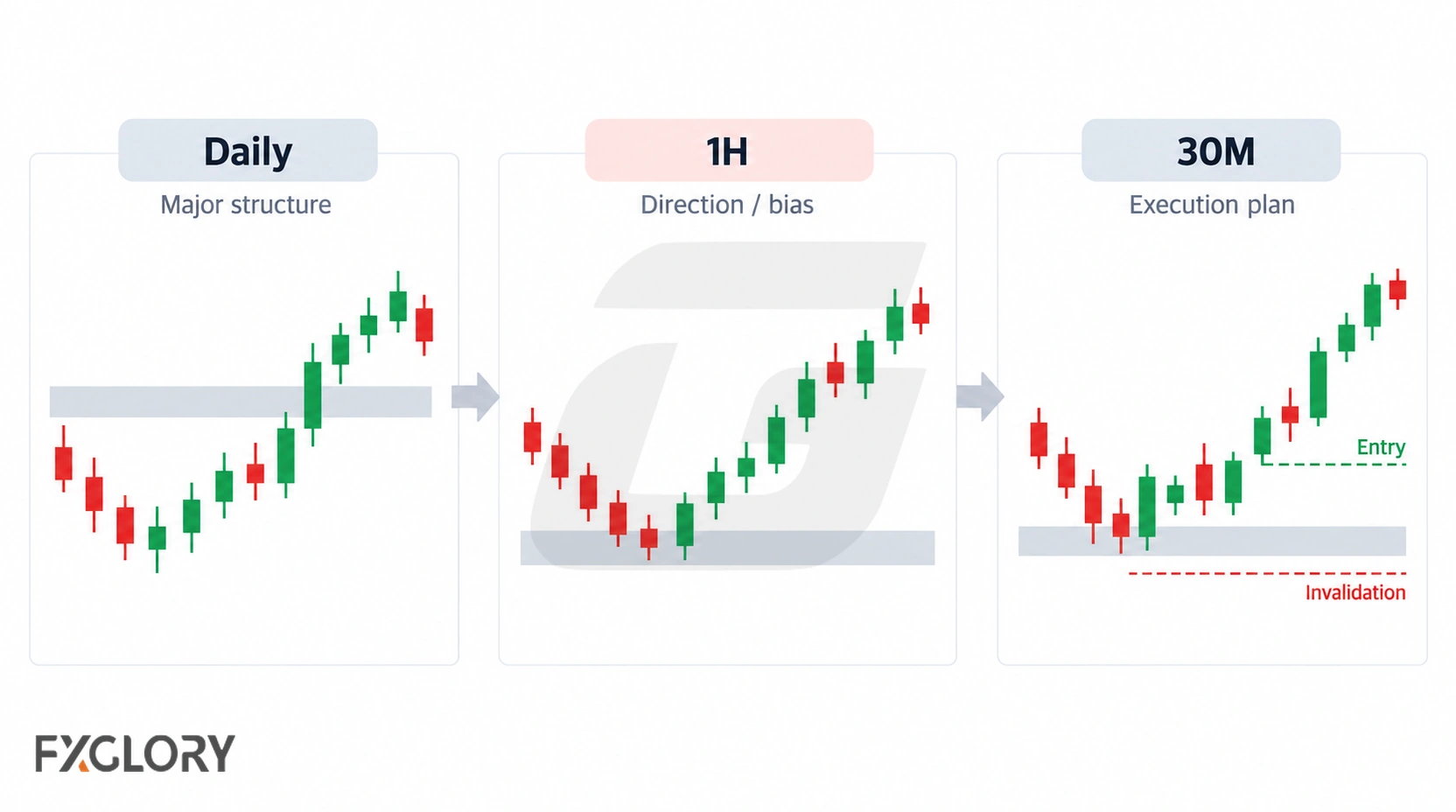
The 1H chart then helps narrow the intraday bias, and the 30M chart can be used to plan entries with fewer signals than the 15M or 5M charts. This routine can be useful for traders who do not want every small 5-minute fluctuation to affect their decision-making.
5-Minute Vs 15-Minute Chart For Forex Day Trading
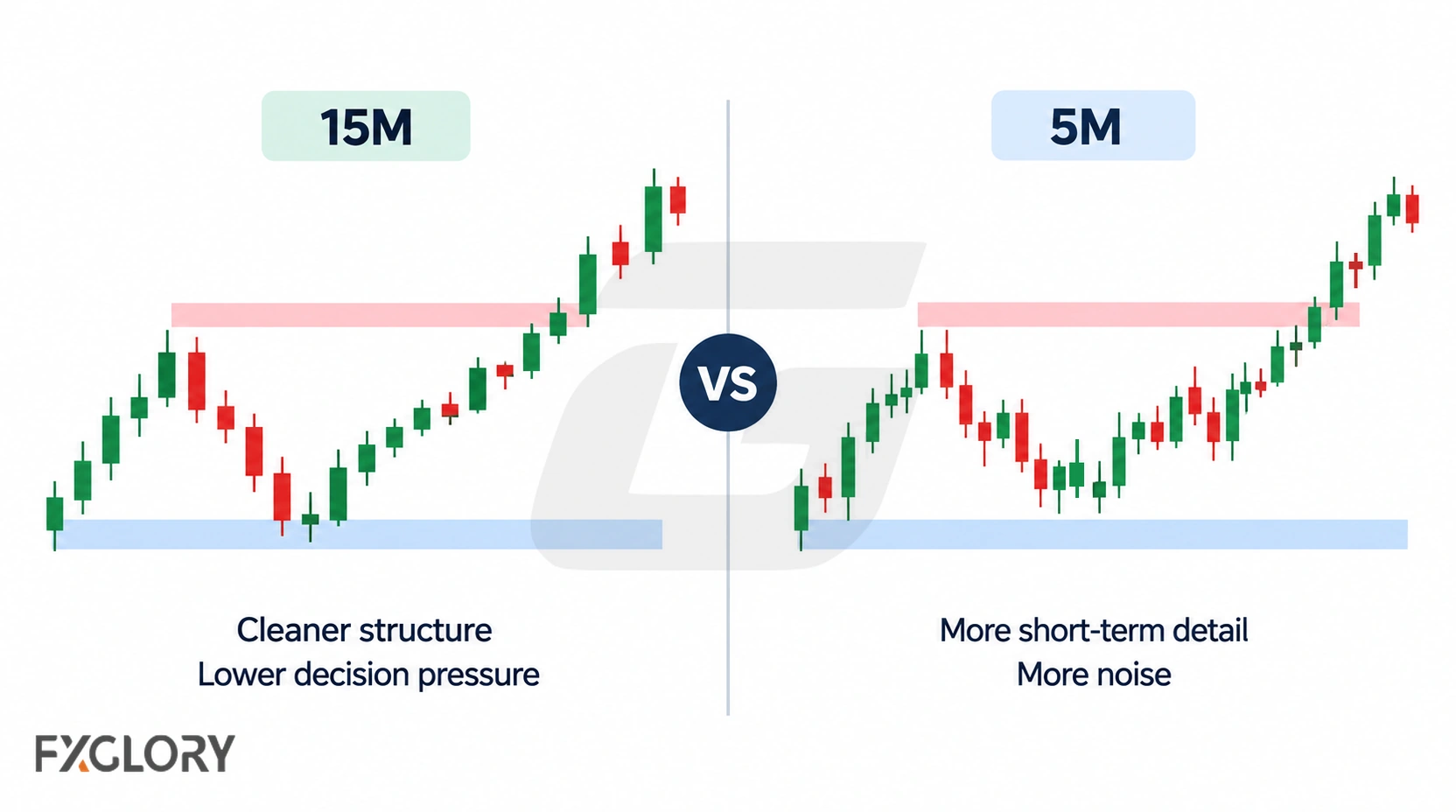
The 15-minute chart usually gives clearer intraday structure. It can show whether price is pulling back, breaking a range, rejecting a level, or forming a continuation pattern without forcing a decision every few candles. The 5-minute chart gives more detail, but that detail can become noise when the higher setup is weak.
| Question | 15M chart | 5M chart |
|---|---|---|
| Signal frequency | Lower | Higher |
| Structure clarity | Usually cleaner | More detailed but noisier |
| Decision pressure | Moderate | Higher |
| Spread sensitivity | Important | More important |
| Best role | Setup and invalidation | Entry refinement after setup confirmation |
A practical rule is to let the 15M chart decide whether there is a setup and let the 5M chart decide only whether the timing is acceptable. If the 15M chart is unclear, the 5M chart should not be used to force a trade.
When The 1-Minute Chart Becomes Too Fast
The 1-minute chart can show very precise movement, but it also magnifies noise, hesitation, and emotional decisions. For many day traders, it begins to behave more like a scalping chart than a structured day-trading chart.
- Do not use 1M when the 15M setup is unclear.
- Do not use 1M during a quiet session just to find more trades.
- Do not use 1M when the spread is large compared with the expected move.
- Do not use 1M to move the stop after entry.
- Do not use 1M if it causes repeated entries without a written reason.
For day trading, treat 1M as an optional trigger chart only after the higher-chart setup is already valid.
How Trading Sessions Affect Day-Trading Timeframes
A chart time frame is not the same thing as a trading session. A time frame is the candle interval. A session is the part of the trading day when certain markets and participants are active.
The same 5M or 15M chart can behave differently during a quiet period, an active overlap, or a news event. For many major currency pairs, the London/New York overlap is often watched because activity and liquidity can increase, but daylight-saving changes, news releases, and pair selection still matter.
Before testing a day-trading routine, choose the market and the session together. Use the currency-pair pages to review available forex markets, then test whether the selected pair gives clear enough movement during the trader's available hours.
Spread, Slippage, Stop Distance, And Margin Checks
Day-trading timeframes should be checked against trading costs and risk distance. A 5M entry might look precise, but if the expected move is small, the spread can take a larger share of the trade idea. A 30M setup may need a wider stop, which changes position size and margin planning.
- Spread check: Is the expected move large enough after the spread is considered?
- Stop-distance check: Is invalidation based on chart structure rather than a random tight stop?
- Margin check: Does the position size fit the wider intraday structure?
- Session check: Is the market active enough for the selected timeframe?
- News check: Could scheduled events overpower the chart setup?
Use FXGlory spread information when testing short intraday plans, and use the margin calculator before comparing stop distances across 5M, 15M, 30M, and 1H routines.
Common Day-Trading Timeframe Mistakes
- Starting from 5M without context: The trader reacts to movement before knowing where price is trading from.
- Using 1H for direction but ignoring it after entry: The plan says one thing, but the trade is managed from noise.
- Changing charts after a loss begins: The trader searches for a smaller chart that makes the trade feel valid.
- Treating 5M and 15M as competitors: They can have different jobs instead of one being permanently better.
- Trading quiet sessions with fast-chart expectations: A low-activity period can make short charts look choppy and misleading.
- Ignoring spread on small targets: The chart may show movement, but the cost structure may not support the plan.
- Testing too many routines at once: The trader cannot tell whether the problem is the timeframe, session, setup, or discipline.
One-Session Practice Plan
A day-trading timeframe routine should be tested one session at a time before live trading. Choose one pair, one session, one context chart, one setup chart, and one optional trigger chart. Do not change the chart order during the session.
- Before the session: Mark 1H or 4H context and write the levels that would matter.
- During the session: Use 15M or 30M to wait for the setup; use 5M only if the setup is already valid.
- Before entry: Check spread, stop distance, upcoming news, and invalidation.
- After exit: Record whether the trade followed the planned chart order.
- After several sessions: Review whether losses came from poor context, weak setup, bad timing, cost sensitivity, or rule-breaking.
Use the demo account information to practice one day-trading timeframe routine before applying it to live trading conditions. A platform workspace should make the routine easier to follow, so review FXGlory trading platforms before building a multi-chart day-trading layout.
Intraday Workflow Test Notes For Best Time Frame For Day Trading Forex
This hypothetical educational model tests one intraday workflow: 1H context, 15M setup, and 5M trigger. It records session behavior, cost sensitivity, whipsaw exits, holding time, and pair-level results. It does not identify one universal best day-trading timeframe.
The model reviewed EURUSD, GBPUSD, USDJPY, AUDUSD, USDCAD, and USDCHF using public yfinance 5-minute OHLC data where available. The script resamples the 5-minute candles into 15-minute and 1-hour candles so each chart has a defined role.
| Workflow Area | Educational Model Rule |
|---|---|
| Context chart | 1H EMA(20), EMA(50), and EMA(20) slope define long or short context |
| Setup chart | 15M EMA(20) pullback-and-confirmation candle defines setup direction and stop structure |
| Trigger chart | 5M break of the previous 6-candle trigger range refines entry timing only |
| Long context | 1H close above EMA(50), EMA(20) above EMA(50), and EMA(20) slope positive |
| Short context | 1H close below EMA(50), EMA(20) below EMA(50), and EMA(20) slope negative |
| 15M long setup | Pullback into EMA(20), bullish close, upper 40% close location, and no more than 0.75 ATR(14) above EMA(20) |
| 15M short setup | Pullback into EMA(20), bearish close, lower 40% close location, and no more than 0.75 ATR(14) below EMA(20) |
| 5M trigger | Break of the previous 6-candle 5M trigger range by at least 0.05 ATR(14), aligned with setup direction |
| Entry | Next 5M open after the completed trigger candle |
| Stop | 15M setup candle extreme with a 0.20 ATR(14) buffer |
| Target comparison | Fixed 1.2R target from entry |
| Whipsaw exit | 5M close back through the 15M setup candle extreme against the trade |
| Maximum holding review | 24 five-minute candles after entry |
| Session Group | UTC Window Used In The Test |
|---|---|
| Asia | 00:00-06:59 UTC |
| London morning | 07:00-11:59 UTC |
| London/New York overlap | 12:00-15:59 UTC |
| New York afternoon | 16:00-20:59 UTC |
| Rollover/off-hours | 21:00-23:59 UTC |
The review records setup candidates, triggered trades, accepted trades, rejected candidates, rejection reasons, trade count, win rate, average win in R, average loss in R, expectancy in R, profit factor, maximum drawdown in R, worst losing streak, holding time, session-level behavior, pair-level behavior, direction-level behavior, whipsaw exits, exit reasons, and spread/slippage sensitivity.
| Cost Input | Assumptions Used |
|---|---|
| Spread | 0.5, 1.5, and 3.0 pips |
| Slippage | 0.1, 0.5, and 1.0 pips per side |
| Baseline comparison | 1.5-pip spread and 0.5-pip slippage per side |
| Swap and rollover | Not included |
Educational Intraday Workflow Test Results
The completed run produced 2,198 15M setup candidates, 841 triggered trades before overlap filtering, and 640 accepted trades after the same-pair overlap filter. The baseline assumption used a 1.5-pip spread and 0.5-pip slippage per side. The baseline result was negative.
| Metric | Baseline Result |
|---|---|
| Accepted trades | 640 |
| Win rate | 37.03% |
| Average win | 0.6514R |
| Average loss | -1.0135R |
| Expectancy | -0.3969R |
| Profit factor | 0.378 |
| Maximum drawdown | -256.669R |
| Worst losing streak | 11 |
| Average holding period | 79.42 minutes |
| Total net result | -254.0399R |
| Whipsaw exit rate | 6.56% |
Session-Level Baseline Results
| Session | Trades | Win Rate | Expectancy | Profit Factor | Total Net Result | Whipsaw Exit Rate |
|---|---|---|---|---|---|---|
| Asia | 217 | 39.17% | -0.4059R | 0.382 | -88.0763R | 7.37% |
| London morning | 138 | 36.23% | -0.4069R | 0.3802 | -56.1491R | 5.8% |
| London/New York overlap | 111 | 43.24% | -0.1566R | 0.6808 | -17.3831R | 3.6% |
| New York afternoon | 117 | 27.35% | -0.5742R | 0.2144 | -67.1809R | 6.84% |
| Rollover/off-hours | 57 | 38.6% | -0.443R | 0.2857 | -25.2505R | 10.53% |
Pair-Level Baseline Results
| Pair | Trades | Win Rate | Expectancy | Profit Factor | Total Net Result | Whipsaw Exit Rate |
|---|---|---|---|---|---|---|
| AUDUSD | 110 | 35.45% | -0.57R | 0.2861 | -62.7028R | 15.45% |
| EURUSD | 79 | 40.51% | -0.3433R | 0.4459 | -27.123R | 0.0% |
| GBPUSD | 96 | 45.83% | -0.2698R | 0.5551 | -25.9003R | 12.5% |
| USDCAD | 140 | 32.86% | -0.3591R | 0.3637 | -50.275R | 0.71% |
| USDCHF | 99 | 34.34% | -0.4081R | 0.3268 | -40.4012R | 6.06% |
| USDJPY | 116 | 36.21% | -0.4107R | 0.3599 | -47.6377R | 5.17% |
Spread And Slippage Sensitivity
| Spread | Slippage Per Side | Trades | Weighted Expectancy | Total Net Result |
|---|---|---|---|---|
| 0.5 | 0.1 | 640 | -0.1589R | -101.7276R |
| 0.5 | 0.5 | 640 | -0.2647R | -169.4219R |
| 0.5 | 1.0 | 640 | -0.3969R | -254.0399R |
| 1.5 | 0.1 | 640 | -0.2912R | -186.3455R |
| 1.5 | 0.5 | 640 | -0.3969R | -254.0399R |
| 1.5 | 1.0 | 640 | -0.5292R | -338.6579R |
| 3.0 | 0.1 | 640 | -0.4895R | -313.2725R |
| 3.0 | 0.5 | 640 | -0.5953R | -380.9671R |
| 3.0 | 1.0 | 640 | -0.7275R | -465.5850R |
What This Intraday Workflow Test Shows
The workflow generated many 15M setup candidates, but most did not become accepted trades after the 5M trigger and overlap rules. The accepted baseline sample remained negative across every session and every pair.
The London/New York overlap was the least negative baseline session, with -0.1566R expectancy and a 3.6% whipsaw exit rate. New York afternoon had the weakest baseline session result, with -0.5742R expectancy and a 16-trade worst losing streak. The lowest-cost sensitivity setting still remained negative at -0.1589R weighted expectancy, while the highest-cost setting declined to -0.7275R weighted expectancy.
For this educational model, the 5M trigger did not offset the combined effect of stop losses, time exits, and cost assumptions. The result supports using session selection, spread checks, and strict skip rules when studying fast intraday workflows.
Use the result as a review prompt, not as a live-trading conclusion. Test one pair, one session group, one 1H-15M-5M routine, and one cost assumption before comparing intraday timeframe combinations.