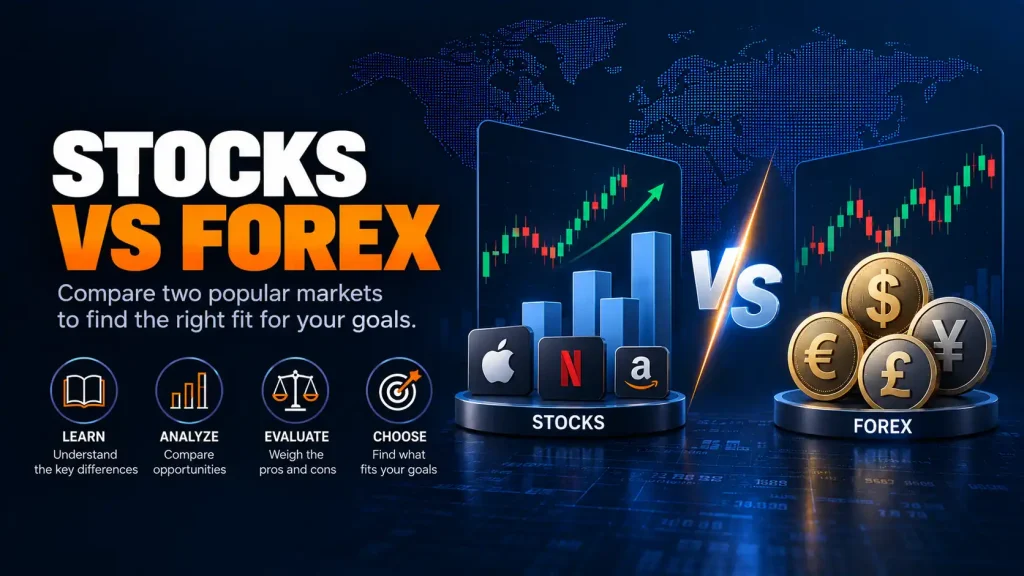
Stocks vs Forex: Key Differences, Pros and Cons

Compare stocks vs forex trading, including what you trade, market hours, liquidity, volatility, leverage, costs, ownership, day trading and which market may fit you.
 
Written byHenry Green
Published
Last updated

Key Take Aways

  • The main difference between stocks and forex is what you trade. Stocks are shares of companies, while forex trades currency pairs.
  • Stocks may suit traders or investors who want company ownership, dividends, company analysis, sector exposure or long-term investing options.
  • Forex may suit active traders who understand currency pairs, leverage, macro events, major-pair liquidity, spread, swap and long or short trading.
  • Forex is not automatically better than stocks. Stocks are not automatically better than forex. The better choice depends on goals, time horizon, risk tolerance, capital, schedule and product understanding.
  • Day trading is a trading style, not a market. A trader can day trade stocks, day trade forex, swing trade either market or invest in stocks long term.
  • Forex often offers longer weekday access and major-pair liquidity, but those features can also increase overtrading, leverage risk and emotional pressure.
  • Stock trading can mean buying shares directly or speculating through ETFs, CFDs, options or other stock-based products, depending on broker, account type and product structure.
  • Beginners should avoid choosing either market because of hype, high leverage, quick-income expectations or social-media pressure.
Risk note: Forex and stock trading both involve risk and can result in losses. Forex can involve leverage, spread, slippage, swap, liquidity changes and broker conditions. Stocks can involve company risk, market drawdowns, gap risk, liquidity differences and margin risk. This page is educational content, not financial advice.

Quick Answer: Stocks vs Forex

15-second answer: The main difference between stocks and forex is what you trade. Stocks are shares of companies, while forex trades currency pairs. Stocks may suit investors or traders who want company ownership, dividends and long-term exposure. Forex may suit active traders who want currency-pair trading, longer weekday hours, major-pair liquidity and long or short flexibility. Neither market is automatically better.

Stocks and forex are different markets for different goals. The right choice depends on what you want to trade, how long you plan to hold positions, how much risk you can accept, what costs you understand and whether your schedule fits the market.

The rule to remember:

Choose the market whose risks, structure and time commitment you understand best.

Stocks vs Forex at a Glance

A side-by-side comparison makes the difference clearer.

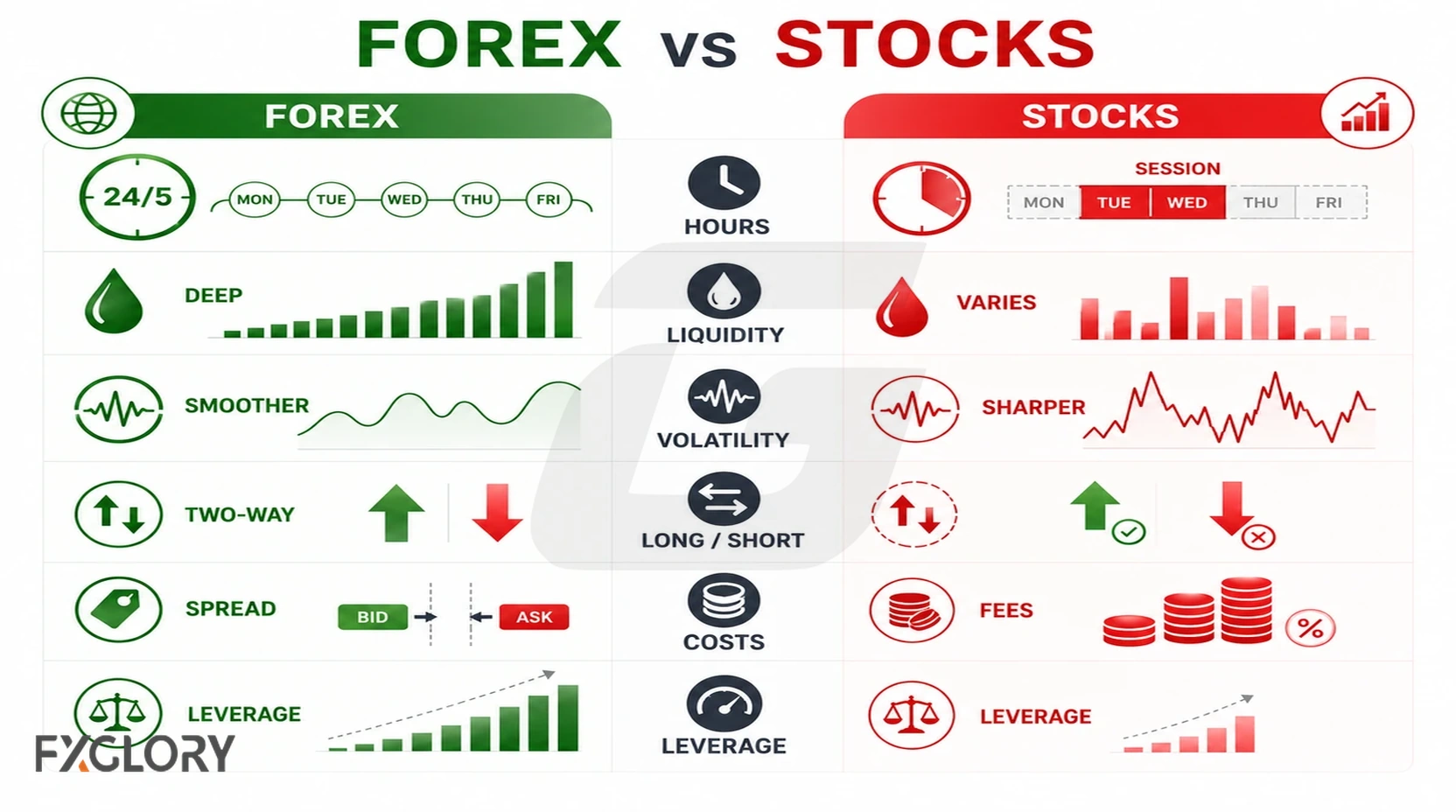
FeatureForexStocksWhat It Means
InstrumentCurrency pairs, such as EUR/USD.Shares of companies, ETFs, or stock-based derivative products, depending on broker and account type.Forex compares currencies. Stocks and stock-based products create company, sector or index exposure.
OwnershipNo company ownership.Direct shares may represent ownership in a company.Stocks can have ownership features; forex does not.
Main driversInterest rates, inflation, central banks, economic data and risk sentiment.Earnings, valuation, management, sector trends, dividends and company news.Forex is more macro-focused. Stocks are often more company-focused.
Market hoursActive across much of the weekday.Usually tied to exchange hours, with some premarket or after-hours access depending on market and broker.Forex may offer more timing flexibility; stocks may have clearer exchange sessions.
LiquidityOften high in major pairs during active sessions.Depends heavily on the individual stock.Major FX pairs and large-cap stocks can be liquid; exotic pairs and small-cap stocks may not be.
VolatilityOften driven by macro events, news and central-bank expectations.Can be driven by earnings, company news, sector moves and market sentiment.Volatility creates movement, not guaranteed opportunity.
Leverage and marginOften margin-based for retail traders.Margin rules depend on broker, jurisdiction, account type and product.Leverage can magnify losses in either market.
CostsSpread, slippage, swap or rollover, commission and broker fees may apply.Spread, commission, exchange fees, margin interest, borrow fees and taxes may apply.Costs are different, not always lower.
Short sellingGoing long or short is built into currency-pair trading.Short selling rules depend on broker, market, stock availability and jurisdiction.Forex can feel simpler for directional long/short views, but risk remains.
Typical useOften active trading or speculation on exchange-rate movement.Can be active trading, long-term investing or dividend-focused investing.Stocks often have more passive investing use cases.

Main Difference: What You Trade

Forex and stocks are not the same product.

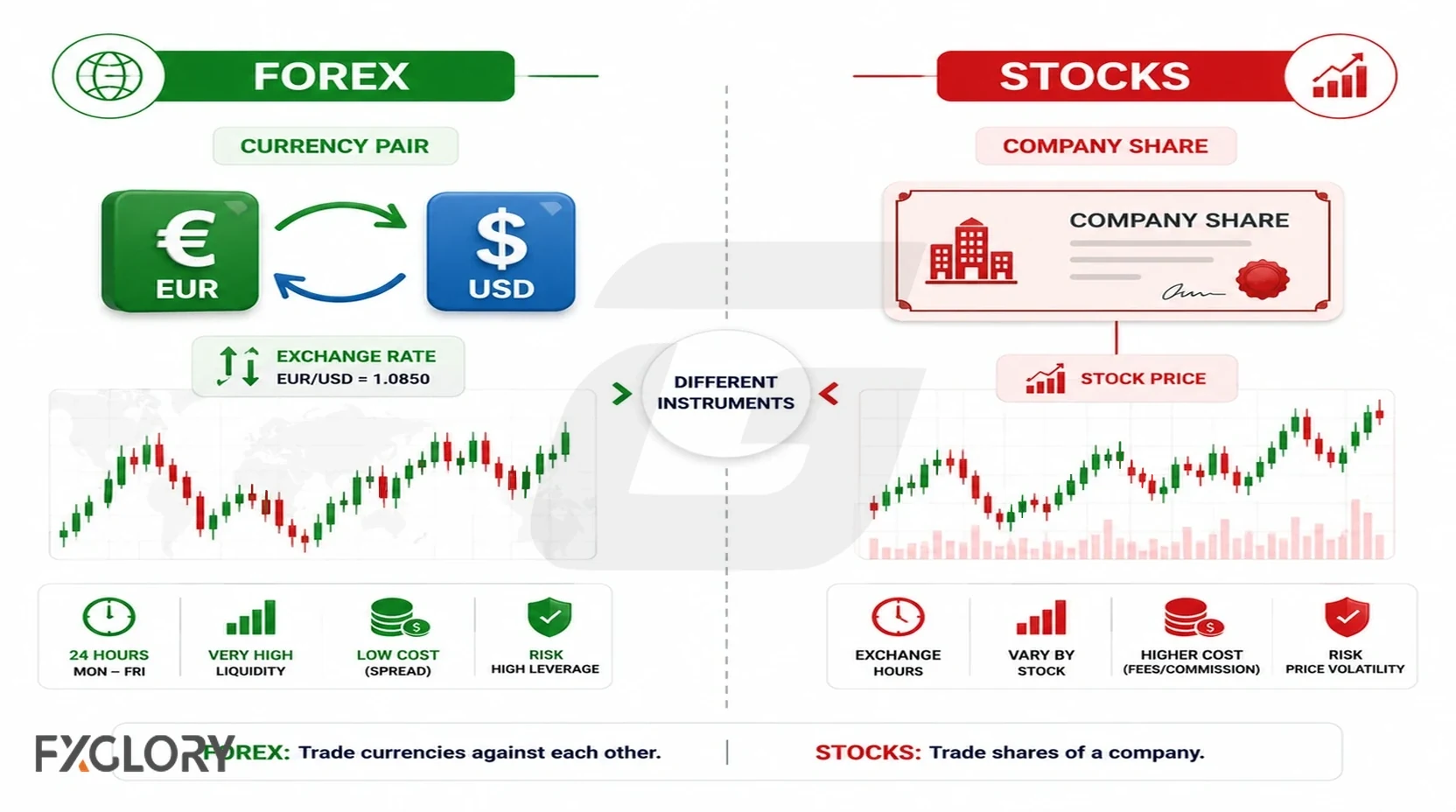
Forex trading means trading one currency against another. In EUR/USD, EUR is the base currency and USD is the quote currency. A forex trader is speculating on the exchange rate between the two currencies.

Stock trading means buying or selling shares of companies, or speculating on stock prices through ETFs, CFDs, options or other stock-based products depending on broker, product and account type. A stock trader may focus on company earnings, valuation, product news, sector conditions and market sentiment.

Simple answer: Forex is currency-pair trading. Stocks are company-share trading. They are different markets with different drivers, risks and use cases.

For the basic meaning of forex, see what is forex.

Ownership vs Currency-Pair Speculation

Ownership is one of the biggest differences between stocks and forex.

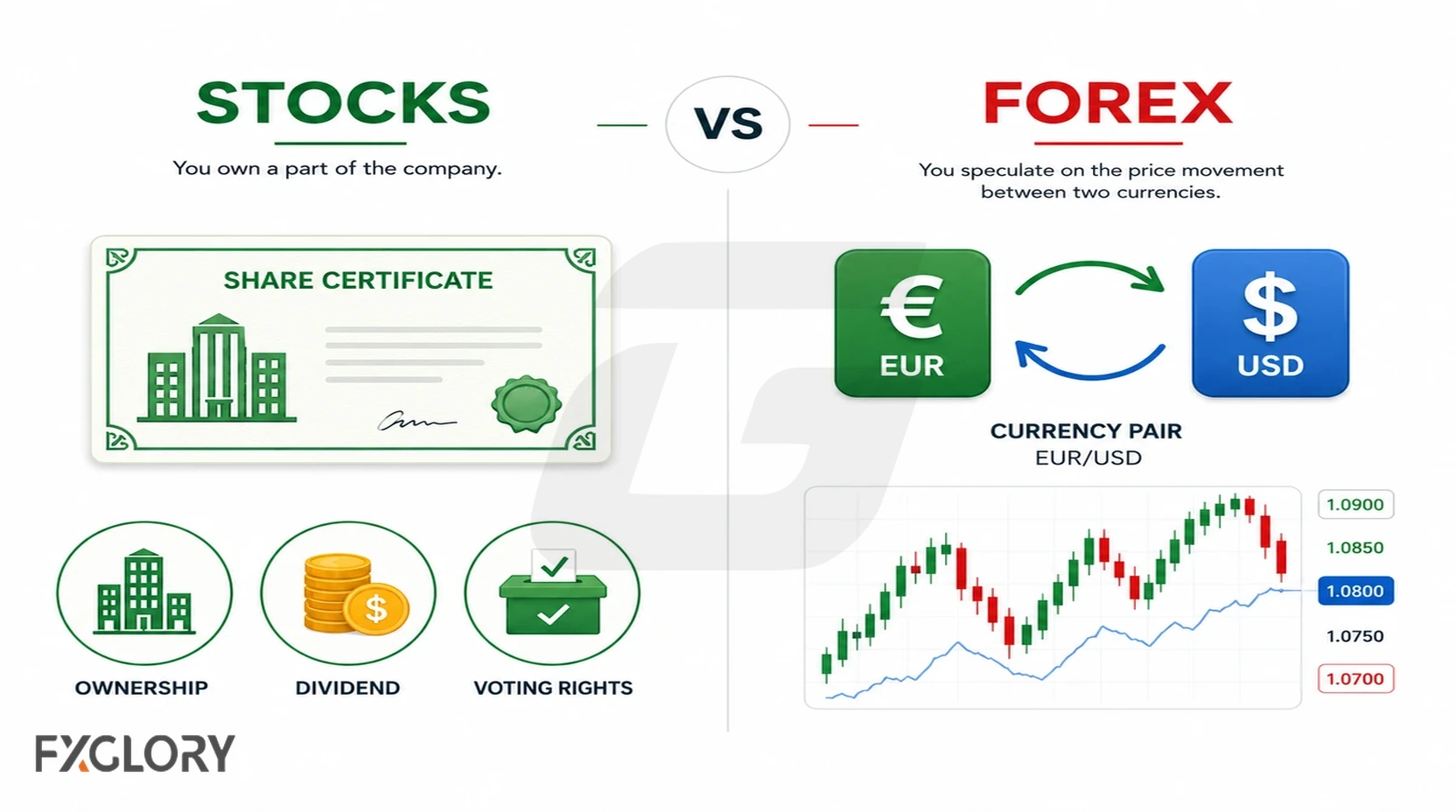
When someone buys direct shares of a company, those shares may represent ownership in that company. Depending on the stock, jurisdiction and account type, shareholders may have dividend rights, voting rights or other ownership-related features.

Forex does not work that way. A forex position is based on exchange-rate movement between two currencies. It does not represent ownership in a company, and it does not provide company dividends.

MarketWhat You May GetWhat You Do Not Get
ForexExposure to exchange-rate movement between currencies.Company ownership, voting rights or dividends.
StocksPossible ownership exposure, company growth participation and dividends, depending on the stock and product.No direct currency-pair structure unless trading currency-linked products.

Product structure matters. Stock trading can mean buying shares directly, or it can mean speculating through ETFs, CFDs, options or other derivatives depending on broker, account type and jurisdiction. A trader should know whether they own the underlying share or are trading a product based on price movement.

How Forex Features Compare With Stock Trading

The main features that attract traders to forex have stock-market equivalents or stock-market tradeoffs. The comparison matters more than the feature by itself.

Market Hours: Forex vs Stocks

Forex is active across much of the weekday because currency trading follows major financial centers around the world. Stocks are usually tied to exchange hours, though some markets and brokers may offer premarket or after-hours trading.

MarketPotential AdvantageHidden Risk
ForexLonger weekday access and more flexibility.More hours can lead to overtrading, fatigue and weak boundaries.
StocksClearer exchange sessions for many traders.Price gaps can occur between sessions, after earnings or after major news.

More trading hours do not automatically make forex better. A market that is open longer can also tempt traders to take low-quality trades.

Liquidity and Volatility: Major Pairs vs Individual Shares

Forex is often known for high liquidity in major currency pairs, especially during active sessions. Stocks vary more by instrument: a large-cap stock may be highly liquid, while a small-cap stock may have wider spreads and thinner order flow.

Market FeatureForexStocks
LiquidityOften strongest in major pairs and active sessions.Depends heavily on the individual stock, exchange and trading volume.
VolatilityCan rise around economic releases, central-bank decisions and geopolitical events.Can rise around earnings, company news, sector moves and broad market shocks.
Hidden riskMinor or exotic pairs may have wider spreads and weaker liquidity.Small-cap or low-volume stocks may have wider spreads and stronger gap risk.

Liquidity should be judged by the specific instrument and time. Major forex pairs, less active currency pairs, large-cap stocks and small-cap stocks can behave very differently.

Volatility creates movement, not guaranteed opportunity. Movement can help a trade reach a target, but it can also trigger stops, increase slippage or make position sizing harder.

For deeper forex context, see what is liquidity in forex and what is volatility in forex.

Long and Short Trading: Currency Pairs vs Shares

Forex trading naturally involves buying one currency and selling another. This can make long and short views feel more direct because every pair already has two sides.

Stock traders can also trade rising or falling prices, but short selling depends on broker rules, product structure, stock availability, margin rules and jurisdiction. Some stock-based products may allow short exposure without directly borrowing shares, but the product structure and risk still matter.

For example, if a trader buys EUR/USD, the trader is buying euros and selling U.S. dollars. If a trader sells EUR/USD, the trader is selling euros and buying U.S. dollars. In stocks, buying a direct share usually creates long exposure to a company, while short exposure usually requires a different process or product.

Watch out: Easier long or short access does not make direction easier to predict. Any trade still needs a setup, risk limit, stop-loss and exit plan.

For practical forex trade examples, see forex trading examples.

Product Access and Position Size

Forex may feel more accessible because many brokers offer demo accounts, smaller position sizes and margin-based trading. Stocks may also be accessible through share dealing, fractional shares, ETFs or stock-based products, depending on broker and jurisdiction.

The important distinction is that access is not the same as suitability. A market can be easy to enter and still difficult to trade well.

Access FeatureForexStocksRisk If Misused
Demo practiceCommon for practicing currency-pair trading.May be available through some brokers or trading platforms.Assuming practice results will match live results.
Small position accessOften available through smaller lot sizes.May be available through fractional shares, small share quantities, ETFs or derivative products.Increasing size too quickly after a few wins.
Easy account accessCan make forex easy to start learning.Can make stock trading easy to start learning.Trading before understanding risk, costs and product structure.

Forex is not automatically better because it can be accessible. Stocks are not automatically safer because companies feel familiar.

Leverage and Margin: Forex vs Stocks

Forex trading often gives retail traders easier access to leverage. That can make capital use more flexible, but it can also make losses larger if position size is not controlled.

Stocks can also be traded on margin, but margin access, day-trading rules, short-selling rules and account requirements depend on country, broker, account type and product. Rules can change, so traders should check current requirements before trading.

Leverage warning: Leverage is not a reason to choose a market by itself. It only helps when maximum loss, position size and stop-loss distance are controlled before entry.

Forex may appear more flexible because of margin-based access, but that flexibility becomes dangerous when traders oversize positions or use leverage to recover losses. Stock margin can also increase losses, especially when a position gaps against the trader or a concentrated position moves sharply.

For more detail, see best leverage for forex.

Market Selection: Currency Pairs vs Stock Universe

Forex traders often focus on a smaller set of major currency pairs. That can reduce screening work, but it does not remove complexity. Currency pairs can react to central banks, inflation, employment data, geopolitics, risk sentiment and liquidity conditions.

Stock traders may have thousands of shares, ETFs and stock-based products to choose from. That creates more choice, but also more research burden. A trader may need to screen for liquidity, earnings dates, sector risk, valuation, news, dividends and company-specific events.

MarketSelection AdvantageSelection Risk
ForexFewer major pairs can make the watchlist simpler.Macro drivers, central-bank policy and currency correlations still add complexity.
StocksThousands of instruments can create more choice and specialization.Too many choices can cause screening overload and inconsistent decisions.

Fewer forex pairs do not automatically make forex easy. More stock choices do not automatically create better opportunities.

Costs: Forex Spreads vs Stock Trading Costs

Forex and stock costs are different. One market is not automatically cheaper in every situation.

Cost TypeForexStocks
SpreadBid/ask spread is usually a major trading cost.Bid/ask spread can matter, especially in less liquid stocks.
CommissionSome accounts are spread-based; others charge commission.Some brokers offer low or zero commission, but terms vary.
Overnight costSwap or rollover charges or credits may apply.Margin interest or financing costs may apply if trading on margin.
Execution costSlippage can occur around news, volatility or thin liquidity.Slippage and gaps can occur, especially around company news or low liquidity.
Other costsBroker fees, conversion fees or inactivity fees may apply.Exchange fees, borrow fees, taxes or account fees may apply depending on jurisdiction and product.

Low commission does not mean no cost. A trader should understand spread, slippage, financing, swap, borrow costs and broker fees before deciding which market is cheaper for their style.

For forex spread basics, see bid and ask price in forex. For overnight forex costs, see what is swap in forex.

Practice Tools and Product Structure

Both markets may offer practice tools, watchlists, charts, alerts and order types through different platforms. The bigger issue is whether the trader understands the product being used.

In forex, the trader should understand currency pairs, spread, swap, margin and leverage. In stocks, the trader should understand whether they are buying direct shares, ETFs, CFDs, options or another stock-based product. Each product can have different rights, costs, risks and protections.

Demo practice can help in either market, but it has limits. It may not fully copy live emotions, spread changes, slippage, execution pressure or the stress of losing real money.

Hedging and Diversification

Forex and stocks can both be used for exposure management, but they do not manage risk in the same way.

Some forex traders use currency pairs to express macro views or hedge currency exposure. Some stock traders diversify across companies, sectors, ETFs or indexes. Both approaches can still fail if correlations shift or risk is concentrated.

Use CaseForexStocks
Currency exposureMay help manage or speculate on exchange-rate risk.Stock portfolios can still have currency exposure if companies operate globally.
DiversificationPairs may still share the same currency or macro driver.Stocks may still share sector, market or index risk.
HedgingCan add spread, swap and execution complexity.Can add product complexity, cost, tracking error or tax considerations.

Hedging may reduce one type of exposure while adding cost, complexity or a different risk.

Stock Features and Hidden Risks

Stocks have strengths that forex does not have, but those strengths also come with risks. A balanced comparison should not treat stocks as automatically safer or forex as automatically more flexible.

Stock FeatureWhy Traders or Investors Like ItHidden Risk
Company ownershipDirect shares may represent ownership in a company.The company can underperform, lose value or face business-specific shocks.
DividendsSome stocks may pay income to shareholders.Dividends are not guaranteed and can be reduced or suspended.
Thousands of choicesTraders can choose from many companies, sectors and themes.Too many choices can create screening overload and random decisions.
Long-term investingStocks can support buy-and-hold strategies for some investors.Long-term positions can still experience drawdowns, concentration risk and company failure.
Exchange sessionsClearer trading sessions may help some traders set boundaries.Gaps can occur outside regular sessions after earnings, news or market shocks.
Company analysisTraders can study earnings, management, products and valuation.Company analysis can be wrong, incomplete or overtaken by unexpected news.

Market Drivers: Forex vs Stocks

Forex and stocks react to different types of information.

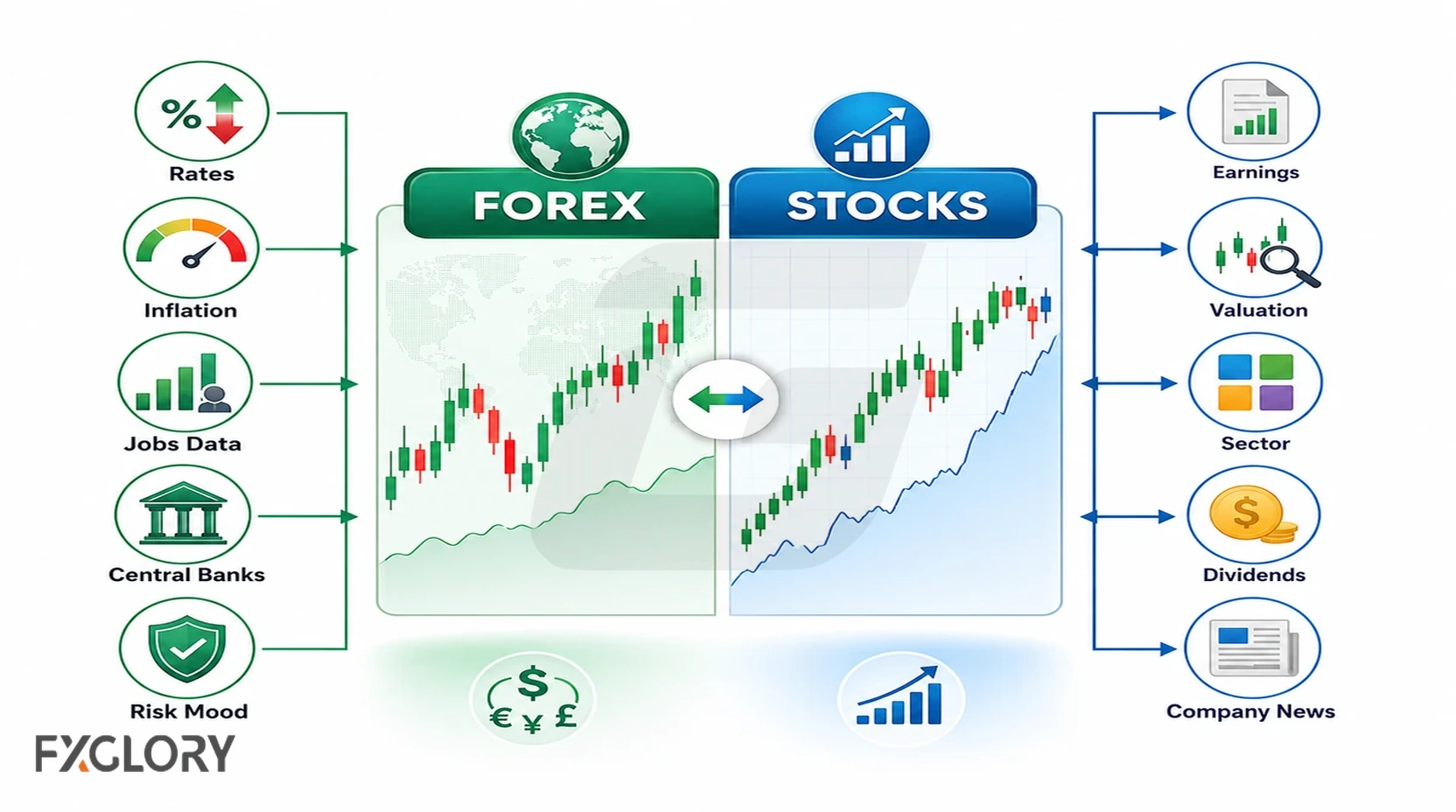
DriverForexStocks
Interest ratesCentral-bank expectations can strongly affect currencies.Rate changes can affect valuations, borrowing costs and sector performance.
InflationInflation data can influence currency expectations and policy outlook.Inflation can affect margins, consumer demand and market valuation.
Economic dataEmployment, GDP, trade and inflation reports can move currency pairs.Economic data can affect broad market sentiment and sector expectations.
Company earningsUsually indirect unless earnings affect broader sentiment.Direct driver for individual stocks.
DividendsForex positions do not pay company dividends.Some stocks may pay dividends, though they are not guaranteed.
Policy and geopoliticsCentral banks, fiscal policy and geopolitical risk can affect exchange rates.Policy and geopolitics can affect sectors, supply chains and market sentiment.

Forex usually requires more attention to macro themes. Stock trading often requires more attention to company and sector details. Neither information set is automatically easier.

For background on currency-market participants, see forex market participants.

Day Trading Stocks vs Forex

Day trading is a trading style, not a market. A trader can day trade forex, day trade stocks, swing trade either market or invest in stocks long term.

QuestionForex Day TradingStock Day Trading
What matters most?Session timing, spread, liquidity, volatility, news and leverage.Stock liquidity, gap risk, company news, sector movement, margin rules and broker conditions.
Main riskOverleverage, news spikes, spread widening and emotional overtrading.Gaps, low-volume stocks, sudden news, borrow issues and account-rule limits.
Instrument selectionOften fewer major pairs to monitor.Thousands of stocks may need screening.
RulesDepend on broker, product, jurisdiction and leverage conditions.Depend on broker, market, account type, margin rules and jurisdiction.

Day-trading rules, margin access and short-selling rules vary by country, broker, account type and product. Check current rules before deciding.

Day trading either market can create fast losses, emotional pressure and high execution demands. It should not be treated as a quick-income shortcut.

Is Forex Better Than Stocks?

Forex is not objectively better than stocks. It may be better for certain active traders, while stocks may be better for long-term investors or company-focused traders.

Forex may feel better if a trader wants:

  • currency-pair trading,
  • longer weekday market access,
  • major-pair liquidity,
  • long and short flexibility,
  • macro-focused trading,
  • fewer major instruments to monitor.

Stocks may feel better if a trader or investor wants:

  • company ownership,
  • dividend potential,
  • company and sector analysis,
  • long-term investing options,
  • thousands of instruments to screen,
  • exchange-listed shares, ETFs or stock-based products.

Fewer forex pairs can reduce screening work, but forex still requires understanding macro drivers, central banks, liquidity, leverage, spread and risk. More stocks can create more choice, but also more research burden.

For more on forex-specific benefits and risks, see advantages of forex trading.

Should You Trade Forex or Stocks?

The better choice depends on goals, time horizon, risk tolerance, schedule, capital, product knowledge and emotional discipline.

Choose Forex IfChoose Stocks IfAvoid Both If
You understand currency pairs and exchange-rate movement.You want to study companies, sectors and earnings.You want fast income or guaranteed returns.
You can manage leverage, spread, swap and macro-event risk.You want possible ownership, dividends or long-term exposure.You cannot accept losses.
You prefer active trading and global macro themes.You prefer company-specific analysis or investing.You trade based on hype, signals or social-media pressure.
You can follow a plan during long weekday market access.You prefer clearer exchange sessions and company reporting cycles.You do not understand costs, margin or product structure.
You can start small and review trades honestly.You can research individual stocks and manage company risk.You increase size after losses or trade emotionally.

Choosing a market is not the same as choosing success. Both forex and stocks require risk control, realistic expectations and a written process.

Is Forex or Stocks Better for Beginners?

Neither market is automatically better for beginners.

Stocks may be easier for some beginners to understand because a share can represent a company. A beginner can study what a company does, how it earns money, how its sector behaves and whether it pays dividends.

Forex may be easier to access because many brokers offer demo accounts, smaller position sizes and currency-pair trading. But forex can be harder to manage because leverage, macro news, spread, swap, liquidity changes and 24-hour access can increase risk.

Beginner QuestionForexStocks
Is it easy to access?Often yes, especially with demo and small position sizes.Often yes, depending on broker, market and account type.
Is it easy to understand?Not always; currency pairs and macro drivers can be abstract.Sometimes easier conceptually because companies are familiar.
Can risk still be high?Yes, especially with leverage and poor position sizing.Yes, especially with volatile stocks, margin, gaps or concentration.
Best beginner ruleLearn pairs, pips, spread, leverage and risk before trading live.Learn company risk, market risk, order types, liquidity and diversification before trading live.

Beginners should not choose forex only because it is accessible or choose stocks only because a company is familiar. Product understanding matters more than familiarity.

Can You Trade Both Forex and Stocks?

Some traders study both forex and stocks. That can broaden market awareness, but it can also create confusion if the trader switches markets without a clear reason.

Forex and stocks require different information, different risk controls and different review habits. A beginner should usually learn one market deeply before adding another.

A practical approach is:

  1. Choose one primary market first.
  2. Learn its instruments, costs, risks and drivers.
  3. Build a trading or investing plan.
  4. Track results and mistakes.
  5. Add another market only when the first process is stable.

For planning structure, see the forex trading plan template. The same idea applies to any active market: rules should come before risk.

Bad Reasons to Choose Forex or Stocks

The market choice should not come from hype, pressure or shortcuts.

Bad ReasonBetter Rule
Choosing forex only because leverage is high.Use leverage only if position size and maximum loss are controlled.
Choosing stocks only because a company is popular.Understand valuation, company risk, liquidity and time horizon.
Choosing either market because of social-media hype.Understand the product and risk before entering.
Choosing day trading because you want fast income.Treat day trading as high-risk active speculation, not guaranteed income.
Choosing forex because fewer pairs sound easy.Learn macro drivers, central banks, leverage and liquidity first.
Choosing stocks because shares feel familiar.Study company risk, sector risk, market risk and position sizing.
Choosing either market without a plan.Write risk, entry, exit and review rules before trading.

Decision Checklist: Forex or Stocks?

Use this checklist before choosing a market.

  • Do I understand what I am trading? Currency pair, share, ETF, CFD, option or other product?
  • Do I understand ownership? Am I buying company shares or speculating on price movement?
  • Do I understand the main drivers? Macro data, central banks, earnings, sectors or company news?
  • Do I understand the costs? Spread, commission, swap, financing, borrow fees, taxes or broker fees?
  • Do I understand leverage and margin? What is the maximum loss if the trade moves against me?
  • Do I understand liquidity? Is the pair or stock liquid enough for my trade size and style?
  • Do I understand volatility? Can price movement fit my stop-loss and risk limit?
  • Do I know my time horizon? Day trade, swing trade, position trade or long-term invest?
  • Do I have a plan? Entries, exits, risk limits and review rules?
  • Am I choosing for the right reason? Not hype, pressure, high leverage or quick-income expectations?

A market is not better because it looks more exciting. It is better only if its structure, risks and time commitment fit the trader.

Quick Recap: Stocks vs Forex

Stocks and forex are different markets. Stocks can represent company ownership, company analysis, sector exposure, dividends and long-term investing options. Forex trades currency pairs and usually focuses on exchange-rate movement, macro events, liquidity, leverage and active trading decisions.

Forex may appeal to active traders because of longer weekday access, major-pair liquidity, long and short flexibility and fewer major pairs to monitor. Those same features can create overtrading, leverage risk and macro-event exposure.

Stocks may appeal to traders or investors who want company ownership, dividends, company-specific research and long-term exposure. Stocks can still involve losses, gaps, liquidity differences, margin risk and company-specific shocks.

Neither market is automatically better. Choose based on product understanding, risk tolerance, time horizon, schedule, costs and discipline.

Final rule: Do not choose forex or stocks because one sounds easier. Choose the market whose risks you can explain, measure and manage before trading.

Frequently Asked Questions

What is the difference between stocks and forex?

Stocks are shares of companies. Forex trades currency pairs, such as EUR/USD or GBP/USD. Stock traders may focus on company earnings, valuation, dividends and sector trends, while forex traders usually focus on exchange rates, interest rates, inflation, central banks, economic data and global risk sentiment.

Is forex stocks?

No. Forex is not stocks. Forex is currency-pair trading, while stocks are shares of companies. The two markets have different instruments, drivers, risks, costs and trading styles.

Is forex better than stocks?

Forex is not automatically better than stocks. Forex may be better for some active traders who want currency-pair trading, longer weekday hours and long or short flexibility. Stocks may be better for people who want company ownership, dividends, long-term investing options or company-focused analysis.

Should I trade forex or stocks?

You may prefer forex if you understand currency pairs, leverage, macro events, spreads, swap and active trading risk. You may prefer stocks if you want company ownership, dividends, company research, sector exposure or longer-term investing options. Avoid both if you want quick income, cannot accept losses or do not understand the product.

What is forex vs stocks trading?

Forex trading means trading one currency against another. Stock trading means buying or selling shares of companies, or speculating on stock prices through a broker or derivative product. Forex is usually more macro-focused, while stocks are often more company-focused.

What is the difference between trading stocks vs trading forex?

Trading stocks often involves company news, earnings, valuation, sector trends and exchange hours. Trading forex often involves currency pairs, interest rates, central banks, economic releases, global risk sentiment, spreads, swap and leverage. Both require risk management.

Is forex better than stocks for beginners?

Forex may be easier to access, but that does not make it easier to trade. Stocks may be easier for some beginners to understand because shares can represent company ownership. Neither market is automatically beginner-friendly.

Is stock trading better than forex trading?

Stock trading may be better for people who want ownership, dividends, company analysis or long-term investing options. Forex may be better for active traders who understand currency pairs, leverage and macro drivers. The better market depends on the trader.

What is the difference between forex and shares?

Forex trades currency pairs, while shares usually represent ownership in companies. Shares may involve dividends and voting rights depending on the stock and jurisdiction. Forex positions are based on exchange-rate movement rather than company ownership.

Can you day trade stocks and forex?

Yes. Day trading is a trading style, not a market. A trader can day trade stocks or forex. Stock day trading depends on individual stock liquidity, company news, gaps, broker rules and margin rules. Forex day trading depends on sessions, spreads, news, liquidity, volatility and leverage.

Is day trading stocks or forex better?

Neither is automatically better. Forex day trading may offer longer weekday hours and major-pair liquidity. Stock day trading may offer company-specific catalysts and many instruments. Both can involve fast losses, emotional pressure and strict risk management needs.

Why do some traders say forex is better than stocks?

Some traders prefer forex because of longer weekday hours, major-pair liquidity, long and short flexibility, fewer major pairs to monitor and margin-based access. Those features can be useful, but they also bring risks such as leverage, overtrading and macro-event exposure.

Can I trade both forex and stocks?

Yes, some traders study both markets. Beginners should avoid switching between markets randomly. It is usually better to understand one market, track results and build discipline before adding another.

Are forex and stocks risky?

Yes. Forex can involve leverage, volatility, spread, swap, slippage and broker risk. Stocks can involve company risk, market drawdowns, gap risk, liquidity differences and margin risk. Both can result in losses.

Related Contents

What Is Forex?Start with the basic meaning of currency-pair trading before comparing forex with stocks.
Advantages of Forex TradingLearn the benefits and risks of forex trading without comparing it directly to stocks.
Forex Trading TipsUse practical rules for risk control, discipline, journaling and trading decisions.
Forex Trading Plan TemplateBuild a written plan before trading forex, stocks or any active market.
Forex Trading ExamplesSee example trades showing pips, profit, loss, spread, margin and leverage.
Best Leverage for ForexUnderstand how leverage affects margin, position size and trading risk.
What Is Liquidity in Forex?Learn why liquidity can affect spreads, fills and slippage in forex trading.
What Is Volatility in Forex?Understand how price movement affects timing, stop distance and risk.
Bid and Ask Price in ForexLearn how bid, ask and spread affect entries and exits.
What Is Swap in Forex?Understand overnight swap or rollover charges in forex positions.
Forex Market ParticipantsLearn who participates in the forex market and how different participants can affect prices.

Practice Before Trading Live

Use a free demo account to test your strategy, risk rules, and execution process before placing a real-money trade.

Open a Free Demo Account