
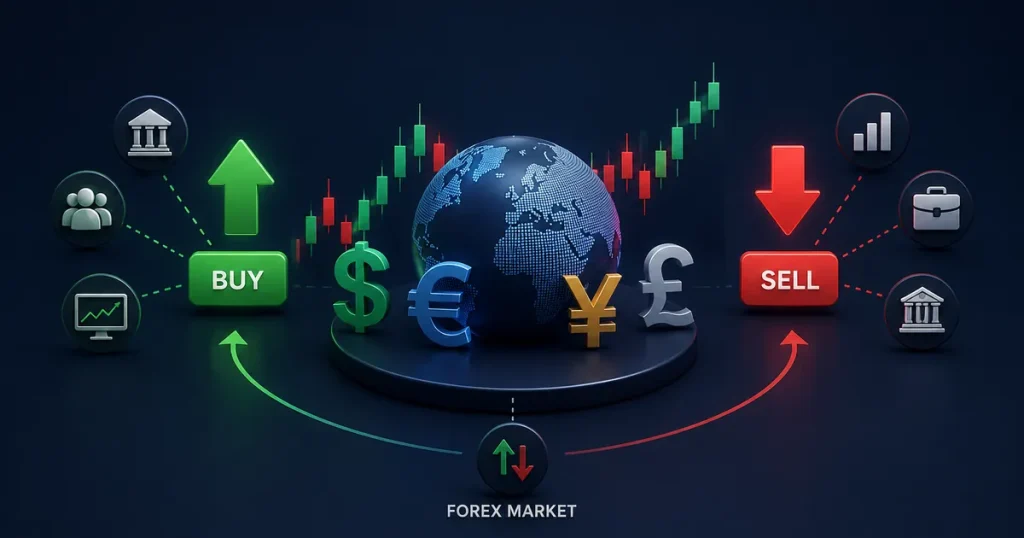
Quick Answer: Forex Trading Example
A useful forex example should show the trade structure, costs, risk controls, and how the final result is calculated.
The key idea is:
Forex trading example = pair + direction + entry + exit + pips + position size + costs + risk + outcome.
This page focuses on trade mechanics, not guaranteed strategies. A profitable example does not prove a setup is good. A losing example does not prove a setup is bad. Examples only show how forex trades are structured and how outcomes are calculated.
How a Forex Trade Works
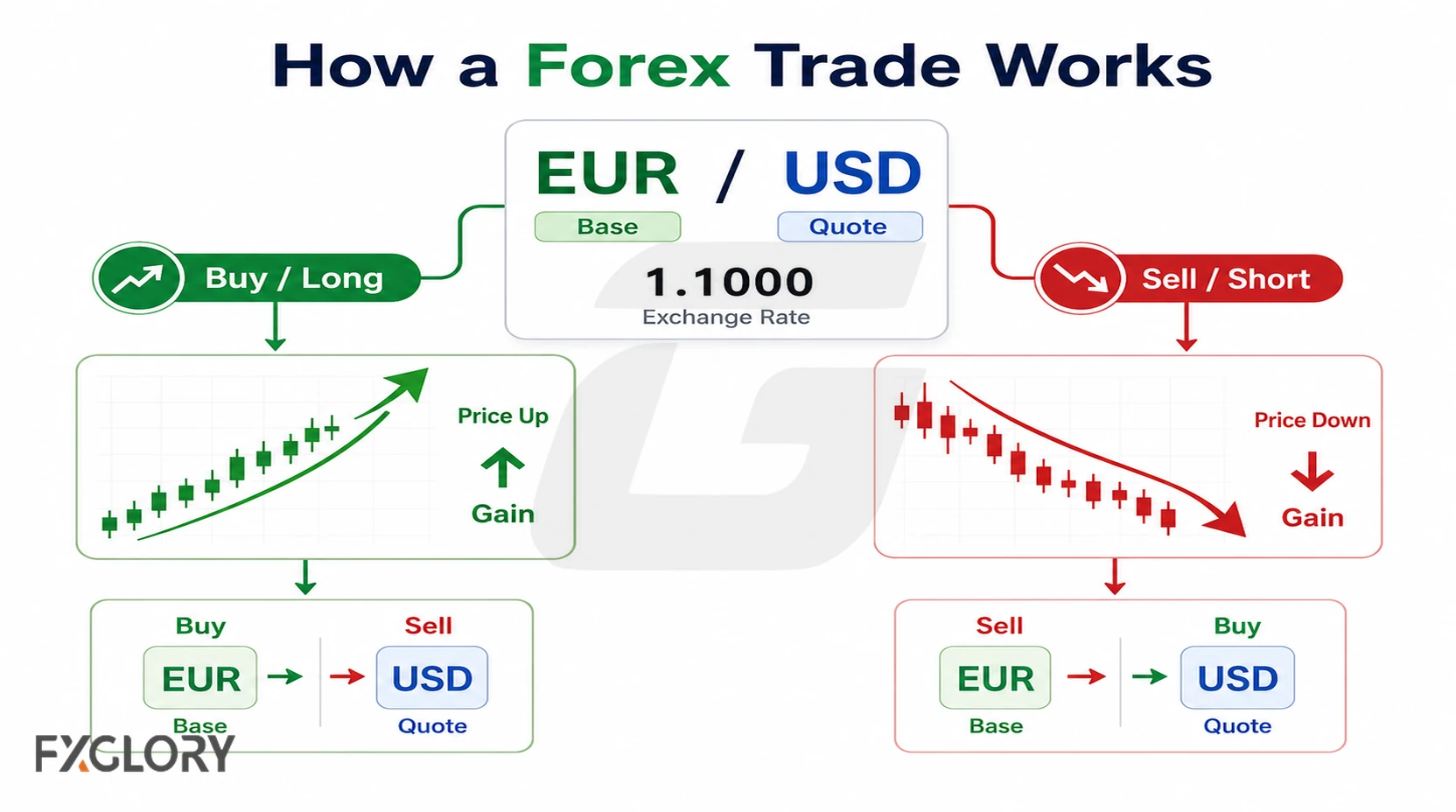
Forex trading means buying one currency and selling another currency at the same time. Currencies are quoted in pairs, such as EUR/USD, GBP/USD, USD/JPY or USD/CAD.
In a currency pair:
- The base currency is the first currency in the pair.
- The quote currency is the second currency in the pair.
- The exchange rate shows how much of the quote currency is needed to buy one unit of the base currency.
For example, in EUR/USD, EUR is the base currency and USD is the quote currency. If EUR/USD is 1.1000, it means 1 euro is priced at 1.1000 U.S. dollars.
If EUR/USD rises, the euro is strengthening against the U.S. dollar. If EUR/USD falls, the euro is weakening against the U.S. dollar.
| Trade Type | Trader Expects | Example |
|---|---|---|
| Buy / long | The base currency rises against the quote currency. | Buy EUR/USD if expecting EUR to rise against USD. |
| Sell / short | The base currency falls against the quote currency. | Sell EUR/USD if expecting EUR to fall against USD. |
A buy trade is closed by selling the position. A sell trade is closed by buying it back. The result depends on the difference between the entry price and exit price, adjusted for position size, spread, fees and execution.
How to Read a Forex Trade Example
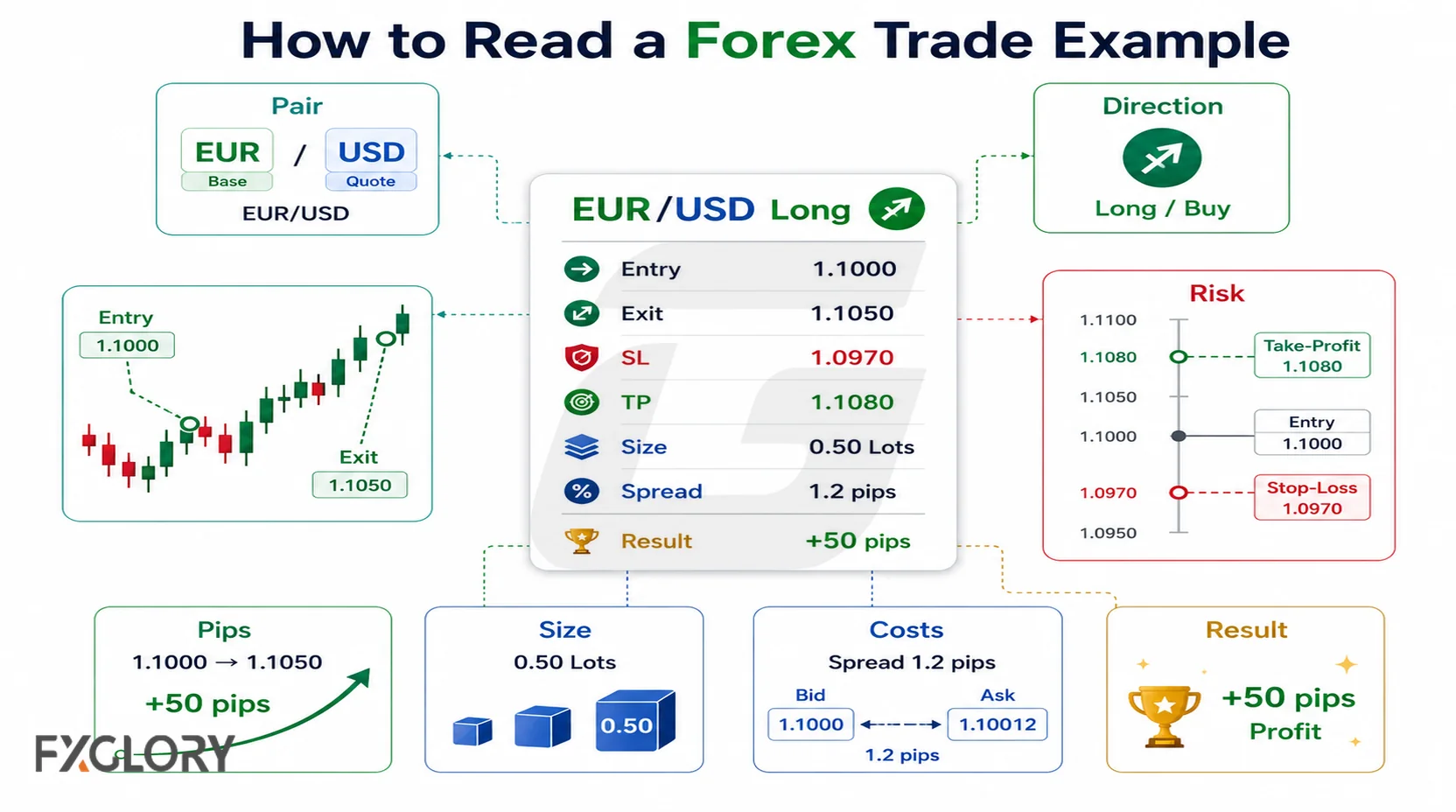
Before looking at sample forex trades, it helps to understand what each field means.
| Field | Meaning |
|---|---|
| Pair | The two currencies being traded, such as EUR/USD. |
| Direction | Whether the trader buys the pair or sells the pair. |
| Entry price | The price where the trade opens. |
| Exit price | The price where the trade closes. |
| Pip movement | The price distance between entry and exit. |
| Position size | How much currency the trade controls. |
| Pip value | The money value of each pip for that position size. |
| Spread | The difference between the bid price and ask price. |
| Margin | The amount required to open or maintain a leveraged position. |
| Stop-loss | An order designed to exit if price moves against the trade. |
| Take-profit | An order designed to exit if price reaches a target. |
| Gross result | The result before spread, commissions, overnight swap or rollover charges, slippage or other costs. |
| Profit or loss | The final result after price movement and trading costs. |
A 20-pip move is not automatically small or large. It depends on position size and pip value. The same price move can produce a small result on a small position and a much larger result on a bigger position.
Many non-JPY pairs commonly measure one pip at the fourth decimal place, such as 0.0001. Many JPY pairs commonly use the second decimal place, such as 0.01. Pip value and pip format can vary by pair, position size, account currency and broker calculation.
Complete Forex Trade Example: EUR/USD Long Trade
This complete example puts the main mechanics in one place: pair, direction, bid/ask spread, entry, stop-loss, take-profit, pip value, margin, leverage, profit path and loss path.
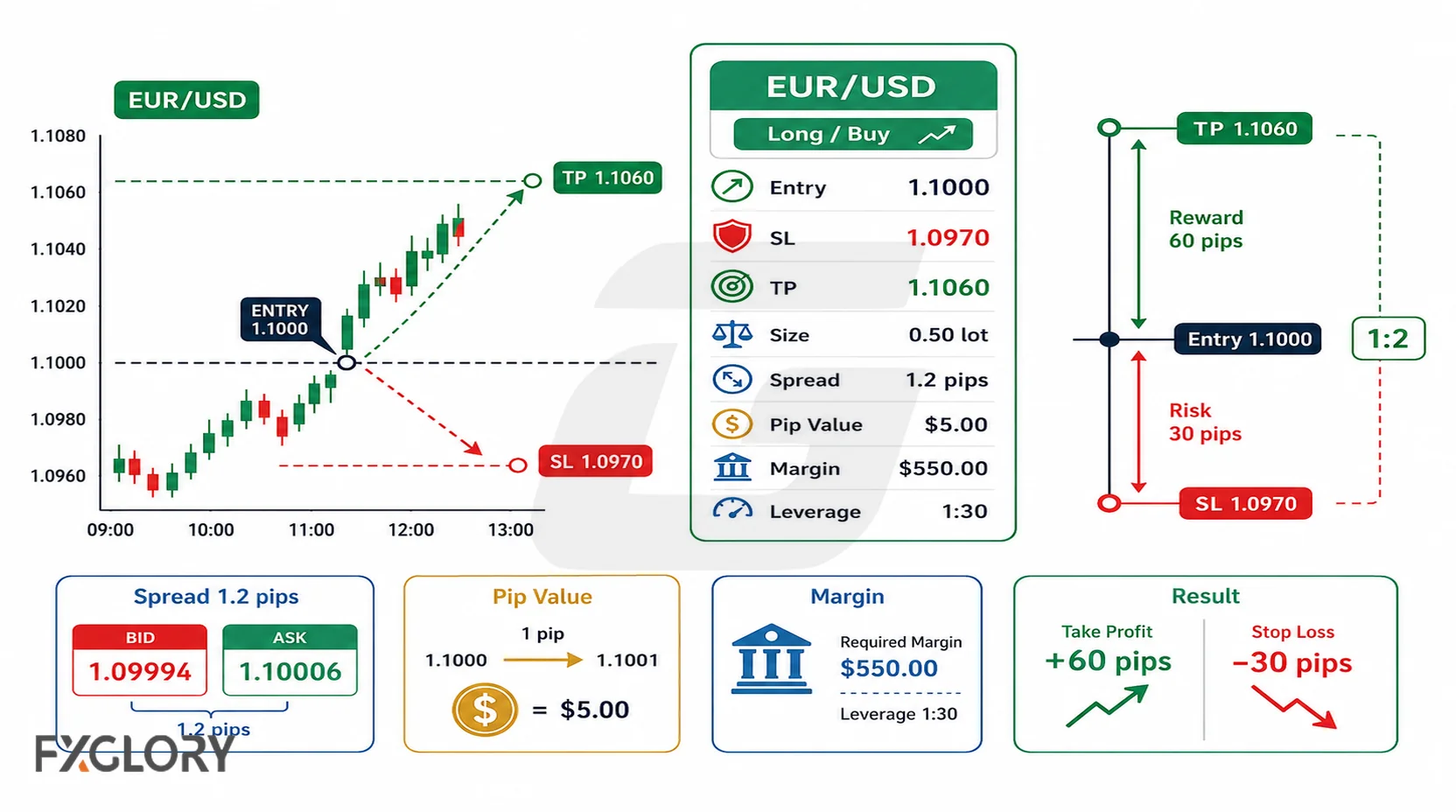
Suppose a trader believes EUR/USD may rise. The trader plans a long trade using simplified EUR/USD numbers.
| Trade Detail | Example |
|---|---|
| Pair | EUR/USD |
| Base currency | EUR |
| Quote currency | USD |
| Direction | Buy / long |
| Bid / ask quote | 1.1000 / 1.1001 |
| Spread | 1 pip |
| Actual entry | Buy at the ask price of 1.1001 |
| Position size | 10,000 units |
| Approximate pip value | $1 per pip for this simplified EUR/USD example |
| Approximate notional value | About $11,001 |
| Margin requirement example | 2%, or about $220 |
| Approximate leverage equivalent | 2% margin is roughly equivalent to 50:1 leverage |
| Stop-loss example | 1.0971 |
| Take-profit example | 1.1061 |
| Planned risk distance | About 30 pips from actual entry |
| Planned target distance | About 60 pips from actual entry |
If price moves in the trader's favor and the trade closes around 1.1061, the trade gains about 60 pips from the actual entry price. With an approximate pip value of $1 per pip, that is about $60 before any other fees, overnight swap or rollover charges, slippage or execution differences.
If price moves against the trader and the stop-loss closes around 1.0971, the trade loses about 30 pips from the actual entry price. With an approximate pip value of $1 per pip, that is about $30 before any additional costs or slippage.
This example uses the actual ask price for entry and shows the spread in the quote. In real trading, spreads can widen, orders can slip, stops may not fill at the exact level, and margin requirements can vary by broker, instrument and market conditions.
Forex Trading Example: Buying EUR/USD
This is a simple long forex trade example. The numbers are simplified for education and ignore spread at first so the pip calculation is easier to see. The complete example and spread section show how bid and ask prices can change the result.
Suppose a trader believes the euro may rise against the U.S. dollar. The trader buys EUR/USD.
| Trade Detail | Example |
|---|---|
| Pair | EUR/USD |
| Direction | Buy / long |
| Entry price | 1.1000 |
| Position size | 10,000 units |
| Approximate pip value | $1 per pip for this simplified EUR/USD example |
| Exit price | 1.1050 |
| Price movement | +50 pips |
| Gross result | About $50 profit before spread, fees or slippage |
In this example, EUR/USD rises from 1.1000 to 1.1050. That is a 50-pip move in the trader's favor. If the position has an approximate pip value of $1 per pip, the gross profit is about $50 before spread, commissions, overnight swap or rollover charges, slippage or other costs.
The same trade can also lose. If the trader buys EUR/USD at 1.1000 and price falls to 1.0970, that is a 30-pip move against the trade. With an approximate pip value of $1 per pip, the gross loss is about $30 before costs.
Forex Trading Example: Selling EUR/USD
A short forex trade means selling the pair first because the trader expects the base currency to fall against the quote currency. This simplified example uses one price to explain direction and pips; real trades use bid and ask prices.
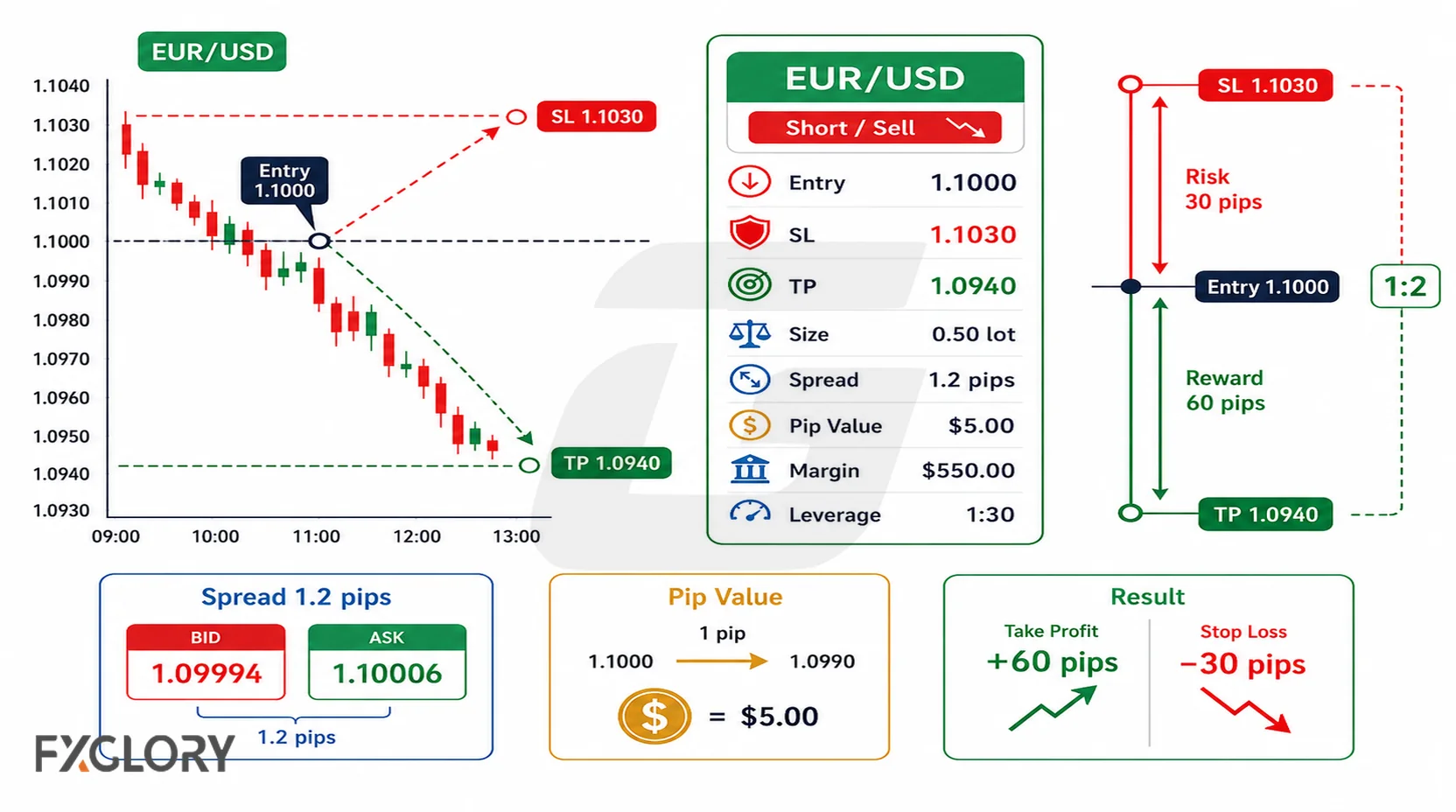
Suppose a trader believes the euro may weaken against the U.S. dollar. The trader sells EUR/USD.
| Trade Detail | Example |
|---|---|
| Pair | EUR/USD |
| Direction | Sell / short |
| Entry price | 1.1000 |
| Position size | 10,000 units |
| Approximate pip value | $1 per pip for this simplified EUR/USD example |
| Exit price | 1.0950 |
| Price movement | 50 pips in the trader's favor |
| Gross result | About $50 profit before spread, fees or slippage |
In this example, EUR/USD falls from 1.1000 to 1.0950. Because the trader sold the pair first, the 50-pip move is favorable. The trader closes the short trade by buying the position back.
If EUR/USD rises instead from 1.1000 to 1.1030, the short trade moves 30 pips against the trader.
Short trading can confuse beginners because the trader can profit from a falling pair. The key is simple: a short trade benefits if the pair falls after entry, and loses if the pair rises after entry.
Forex Profit and Loss Example
Forex profit and loss usually depend on three main parts: pip movement, pip value and trading costs.
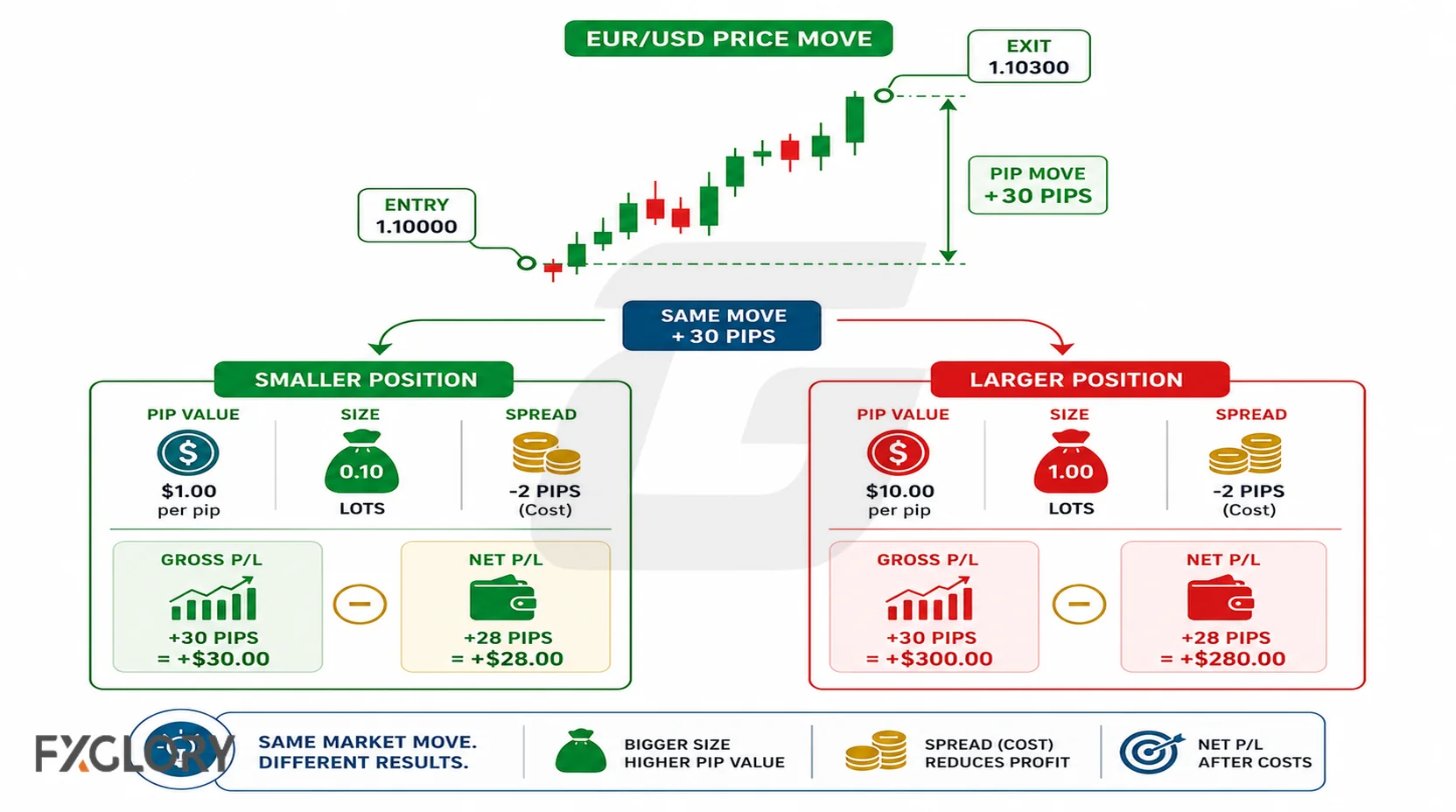
Gross result means the result before spread, commissions, overnight swap or rollover charges, slippage or other costs.
The simplified idea is:
Forex result = pip movement × pip value, adjusted for spread, fees, overnight swap or rollover charges and slippage.
| Scenario | Pip Move | Approximate Pip Value | Gross Result Before Costs |
|---|---|---|---|
| Trade wins | +50 pips | $1 per pip | About +$50 |
| Trade loses | -30 pips | $1 per pip | About -$30 |
| Same move, smaller position | +50 pips | $0.10 per pip | About +$5 |
| Same move, larger position | +50 pips | $10 per pip | About +$500 |
This is why position size matters. A 50-pip move does not mean the same money result for every trader. The pip move may be identical, but the profit or loss changes when pip value changes.
For more detail on pip calculations, see how to calculate pips in forex.
Forex Spread Example
Many beginner examples ignore the spread, but real trades usually involve bid and ask prices.
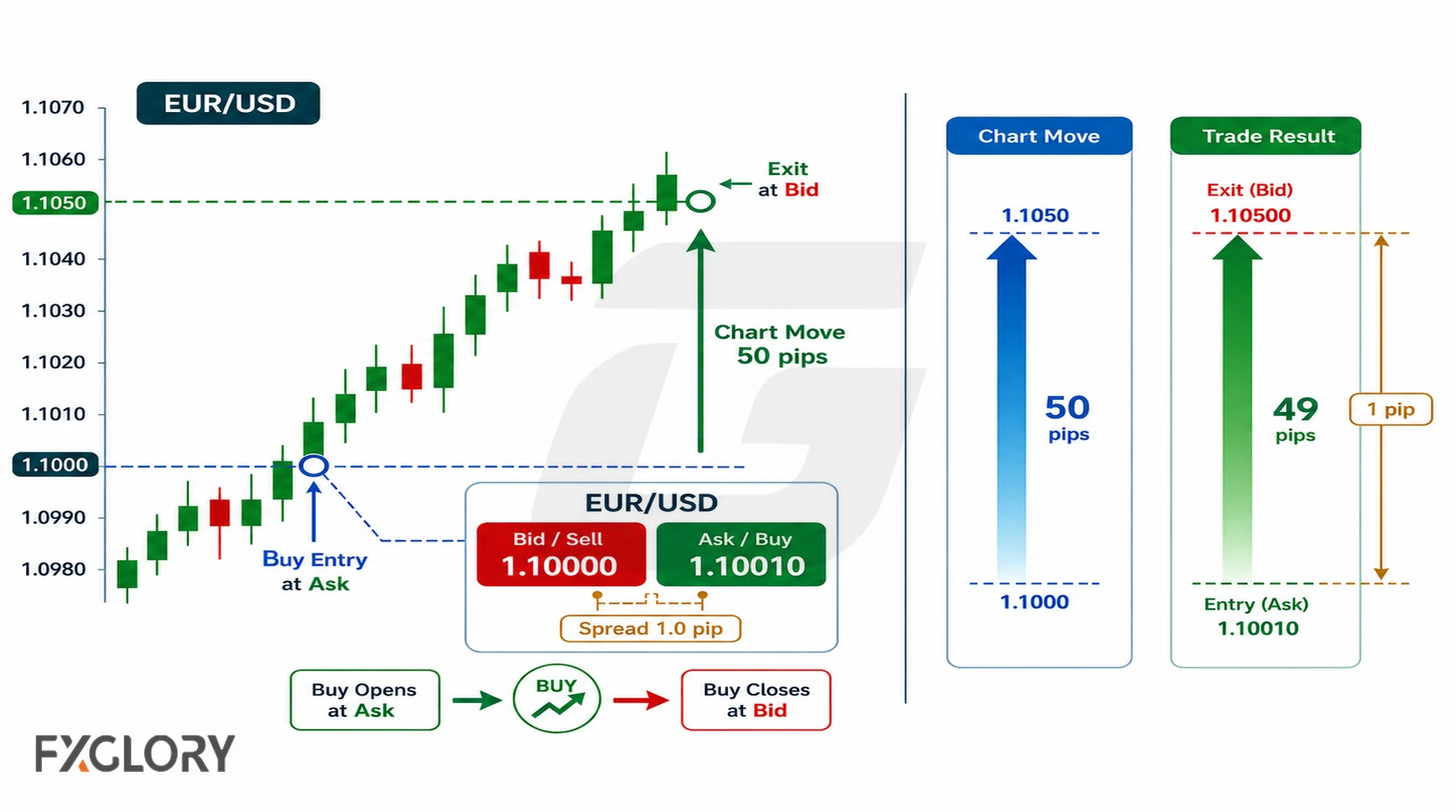
The bid is the price at which a trader can usually sell. The ask is the price at which a trader can usually buy. The difference between them is the spread.
Example:
| Quote Detail | Example |
|---|---|
| Bid | 1.1000 |
| Ask | 1.1001 |
| Spread | 1 pip |
If a trader buys EUR/USD, the trade may open at the ask price of 1.1001. If the trader closes later by selling at the bid price of 1.1050, the actual movement from entry to exit is 49 pips, not 50 pips.
This is why the chart move and the trade result may not match perfectly. Spread, slippage, commissions and execution rules can change the final outcome. Spread can also widen in volatile or low-liquidity conditions, so the cost in a real trade may not stay fixed.
For related basics, see bid and ask price in forex.
Margin and Leverage Example
Leverage allows a trader to control a larger position with a smaller amount of required margin. But leverage does not make the trade smaller. Profit and loss are still based on the full position size.
Suppose a trader opens a 10,000-unit EUR/USD position near 1.1000. The notional position value is roughly $11,000. If the margin requirement is 2%, the required margin would be about $220. A 2% margin requirement is roughly equivalent to controlling a position worth about 50 times the margin amount.
Two traders can take the same EUR/USD trade direction and get very different money results if their position sizes are different. The pip movement is the same, but the pip value and account impact can be very different.
| Trader | Approximate Pip Value | 50-Pip Favorable Move | 50-Pip Unfavorable Move |
|---|---|---|---|
| Smaller position | $0.10 per pip | About +$5 | About -$5 |
| Medium position | $1 per pip | About +$50 | About -$50 |
| Larger position | $10 per pip | About +$500 | About -$500 |
Leverage can make larger position sizes easier to open, but larger positions also make each pip more valuable. This can magnify both gains and losses.
For more on leverage risk, see best leverage for forex.
Stop-Loss and Take-Profit Example
A stop-loss is designed to exit if the trade moves against the trader. A take-profit is designed to exit if price reaches a target.
Here is a simple risk and target example:
| Trade Detail | Example |
|---|---|
| Pair | EUR/USD |
| Direction | Buy / long |
| Entry | 1.1000 |
| Stop-loss | 1.0970 |
| Take-profit | 1.1060 |
| Risk | 30 pips |
| Potential reward | 60 pips |
| Risk/reward | 1:2 before spread, fees or slippage |
If the trader buys at 1.1000 and price falls to 1.0970, the stop-loss may close the trade around a 30-pip loss. If price rises to 1.1060, the take-profit may close the trade around a 60-pip gain.
A 1:2 risk/reward ratio does not mean the trade is likely to win. It only compares the planned risk distance with the planned target distance.
A normal stop-loss does not guarantee a perfect exit price in all conditions. Fast markets, thin liquidity or gaps can cause slippage. For execution context, see what is liquidity in forex and what is volatility in forex.
Sample Forex Trade Checklist
Before using a sample forex trade as a learning tool, check whether the example includes the full trade structure.
- Pair: Which currency pair is being traded?
- Direction: Is the trade long or short?
- Base and quote currency: Which currency is being bought or sold?
- Entry price: Where does the trade open?
- Exit price: Where does the trade close?
- Pip move: How far did price move?
- Position size: How much currency is controlled?
- Pip value: What is each pip worth?
- Spread: What is the bid/ask cost?
- Margin: How much is required to open or maintain the position?
- Leverage: How much exposure is being controlled compared with account funds?
- Stop-loss: Where is the risk exit?
- Take-profit: Where is the target exit?
- Profit or loss: What is the final result after costs?
- Reason for trade: Why was the trade considered?
- Risk before entry: How much could be lost if the trade fails?
If an example only shows profit and ignores loss, spread, position size or risk, it is incomplete.
Common Mistakes in Forex Trading Examples
Many beginner mistakes come from reading forex examples too quickly. Avoid these errors:
- Thinking every pip move equals the same money amount: Pip value changes with position size and pair.
- Ignoring spread: The trade may start at a small cost because of the bid/ask difference.
- Ignoring position size: The same 50-pip move can produce very different money results.
- Confusing buy and sell direction: Buying a pair means expecting the base currency to rise. Selling means expecting the base currency to fall.
- Thinking leverage only increases profit: Leverage can also magnify losses.
- Using examples as predictions: A sample trade does not predict what price will do next.
- Ignoring stop-loss risk: A trade example is incomplete if it does not show what happens when the trade fails.
- Assuming stops always fill perfectly: Slippage can occur in fast or thin markets.
- Thinking demo results guarantee live results: Live trading can involve different spreads, slippage, emotions and execution conditions.
- Ignoring broker or product structure: Retail traders may access forex through different account types, platforms or products. For contract-based access, see forex CFD trading.
Quick Recap: Forex Trading Examples
A complete forex example should explain how price movement, position size, costs, and risk controls affect the final outcome.
A long example shows what happens when a trader buys a currency pair and price rises or falls. A short example shows what happens when a trader sells a currency pair and price falls or rises.
Profit and loss are not based only on the chart move. The final result can change because of position size, pip value, spread, slippage, fees, margin, leverage, overnight swap or rollover charges and execution.
Use examples to understand mechanics, not to copy trades. A forex example is a learning tool, not a signal or prediction.