
Quick Answer: When Did Forex Trading Start?
The answer depends on which stage of foreign exchange you mean. Currency exchange itself is ancient, but the market structure used for modern forex trading developed much later.
Ancient Currency Exchange vs Modern Forex Trading
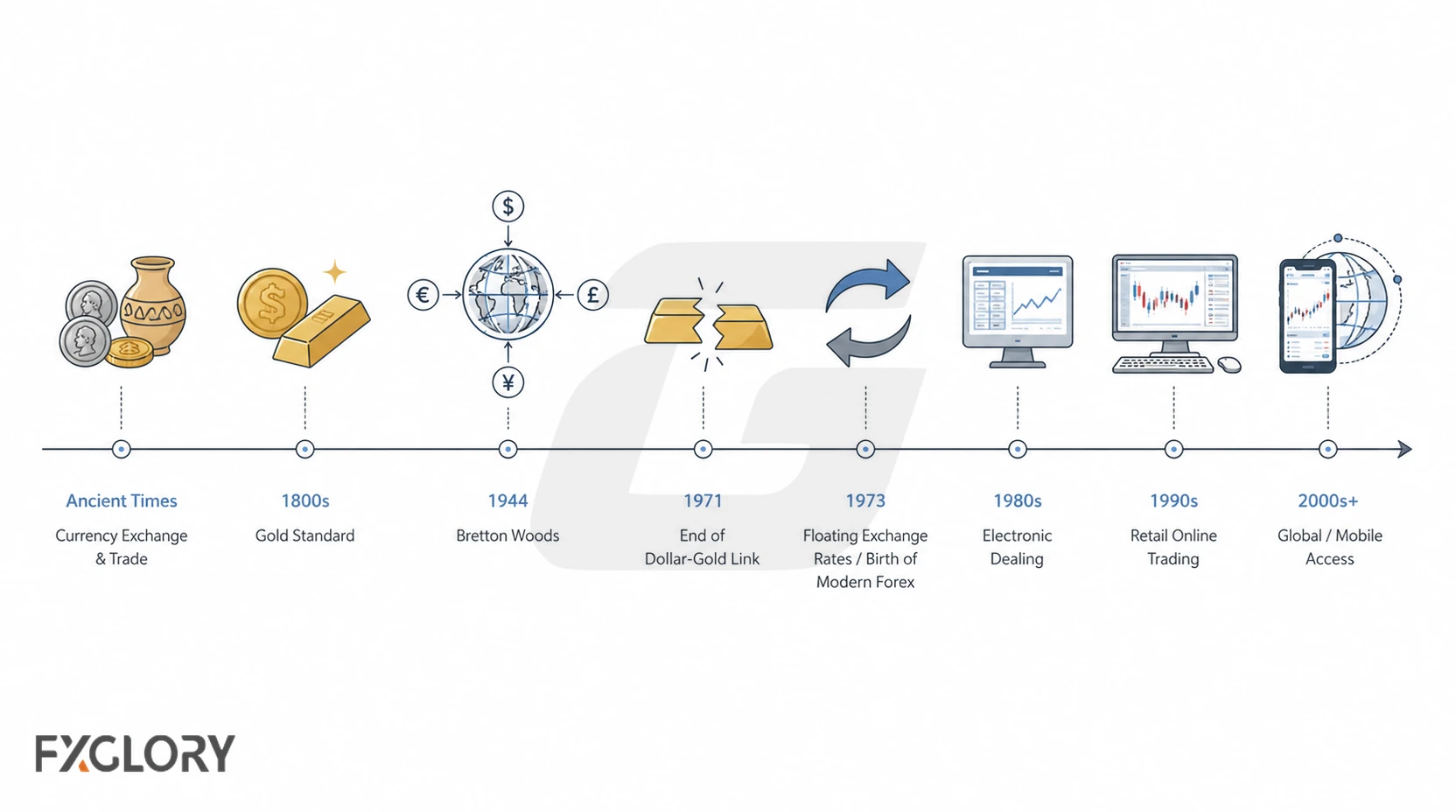
People have exchanged different forms of money for trade and travel for thousands of years. Money-changers, merchants and later banks all handled currency conversion long before electronic trading existed.
That older activity should not be confused with today’s forex market. Modern forex depends on a global financial system in which major currencies can trade against one another at changing market rates.
| Stage | Approximate period | What changed |
|---|---|---|
| Currency exchange | Ancient times onward | People exchanged money or coins to support trade and travel. |
| Organized foreign exchange | Developed over centuries | Merchants, money-changers, banks and financial centers handled cross-border currency conversion more systematically. |
| Modern floating-rate forex | Early 1970s | Major currencies moved away from the Bretton Woods fixed-rate framework toward floating exchange rates. |
| Online retail forex | Mainly 1990s | Internet access, electronic platforms and online brokers expanded direct access for individual traders. |
Early Currency Markets, the Gold Standard and Bretton Woods
As international trade and banking grew, foreign exchange became more organized. Some financial centers became important places for merchants and banks to exchange currencies, but no single city or event can be treated as the founding moment of modern forex.
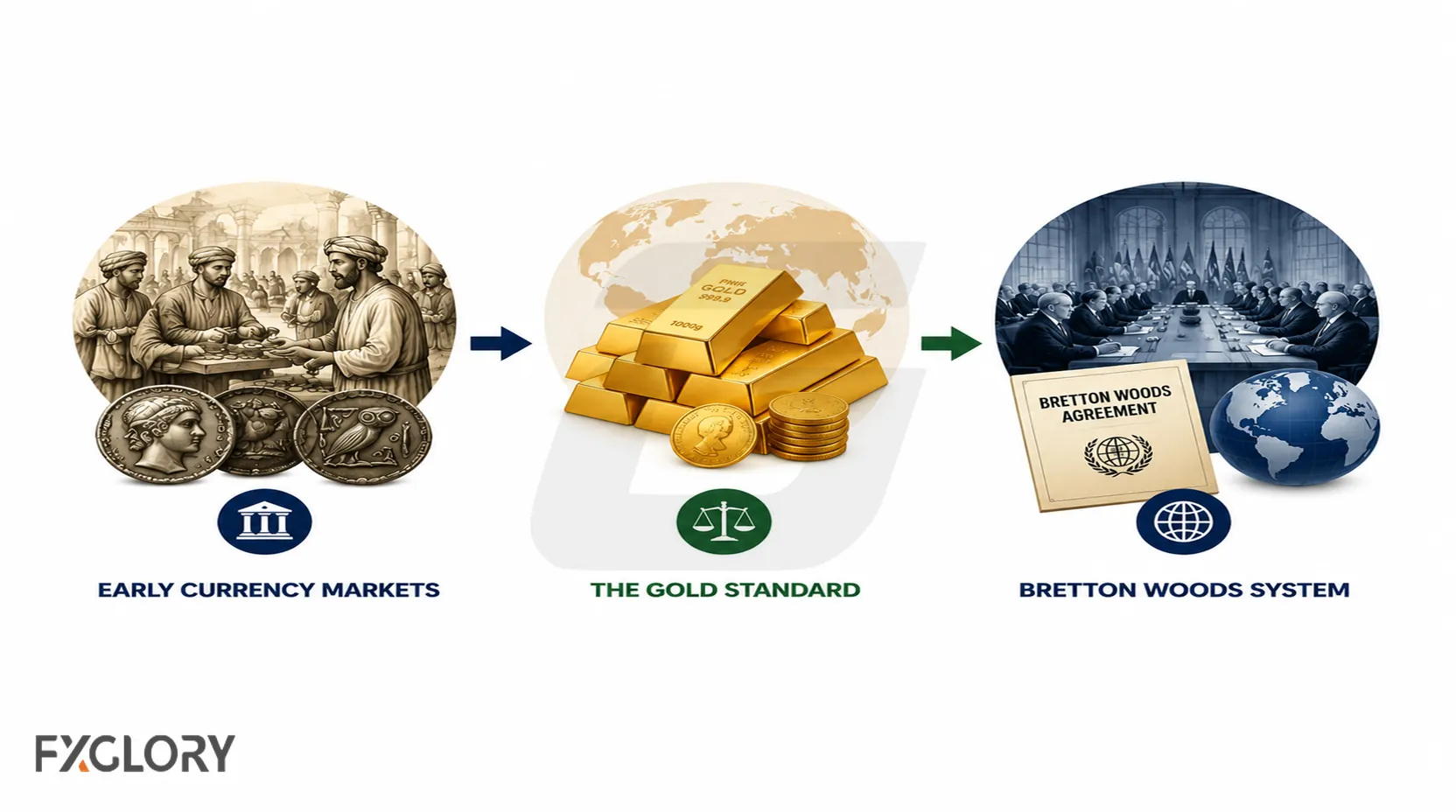
During the 1800s and early 1900s, gold-standard systems linked currencies to specified amounts of gold. Exchange rates were therefore constrained by those monetary rules rather than floating as freely as many major currencies do today.
In 1944, the Bretton Woods agreement established a new international monetary framework. Many currencies were fixed to the U.S. dollar, while the dollar was convertible into gold at an official rate. This created a managed system of exchange rates rather than a broadly floating market.
Over time, economic pressures made that framework increasingly difficult to maintain. Its breakdown set the stage for the major change that followed in the early 1970s.
1971 and 1973: The Shift to Modern Floating-Rate Forex
The clearest answer to when modern forex trading started is the early 1970s, especially the transition between 1971 and 1973.
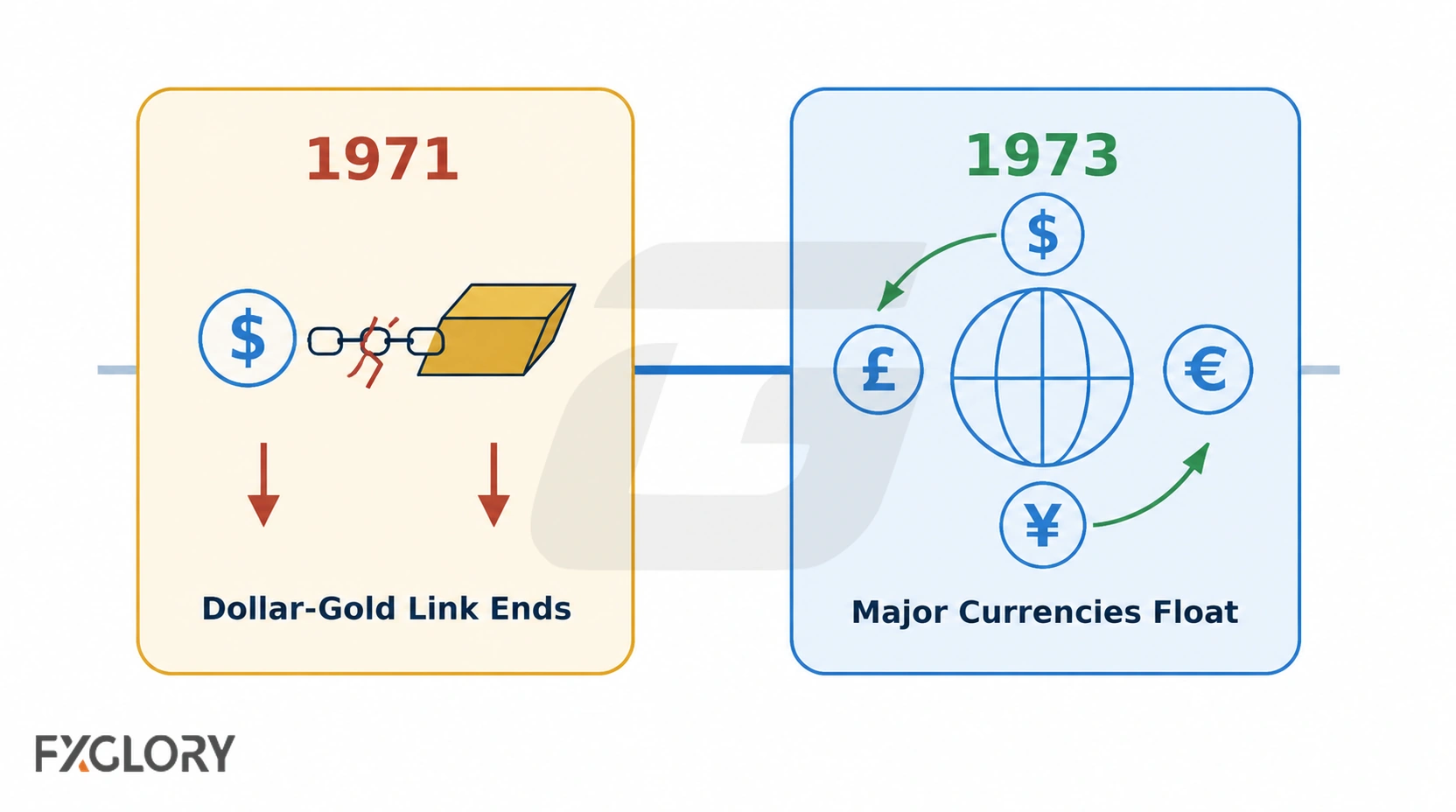
| Year | Event | Why it matters |
|---|---|---|
| 1971 | The U.S. ended the dollar’s direct convertibility into gold under Bretton Woods. | This was a major break with the existing fixed-rate framework. |
| 1973 | Major currencies moved more fully toward floating exchange rates. | Exchange rates increasingly adjusted through market forces rather than the previous Bretton Woods pegs. |
In 1971, the U.S. suspended the dollar’s convertibility into gold, a decision often associated with the “Nixon shock.” Attempts to preserve fixed exchange-rate arrangements continued for a short period, but they did not restore the old system.
By 1973, major currencies were moving more fully into floating exchange-rate arrangements. This transition created the foundation of the modern market, where currency values can change in response to supply and demand, interest-rate expectations, inflation, economic data, central-bank policy and other market forces.
When Online Forex Trading Started
The move to floating rates did not immediately create the retail forex experience familiar today. During the 1970s and much of the 1980s, currency trading remained primarily an institutional market dominated by banks, central banks, corporations and other large financial participants.
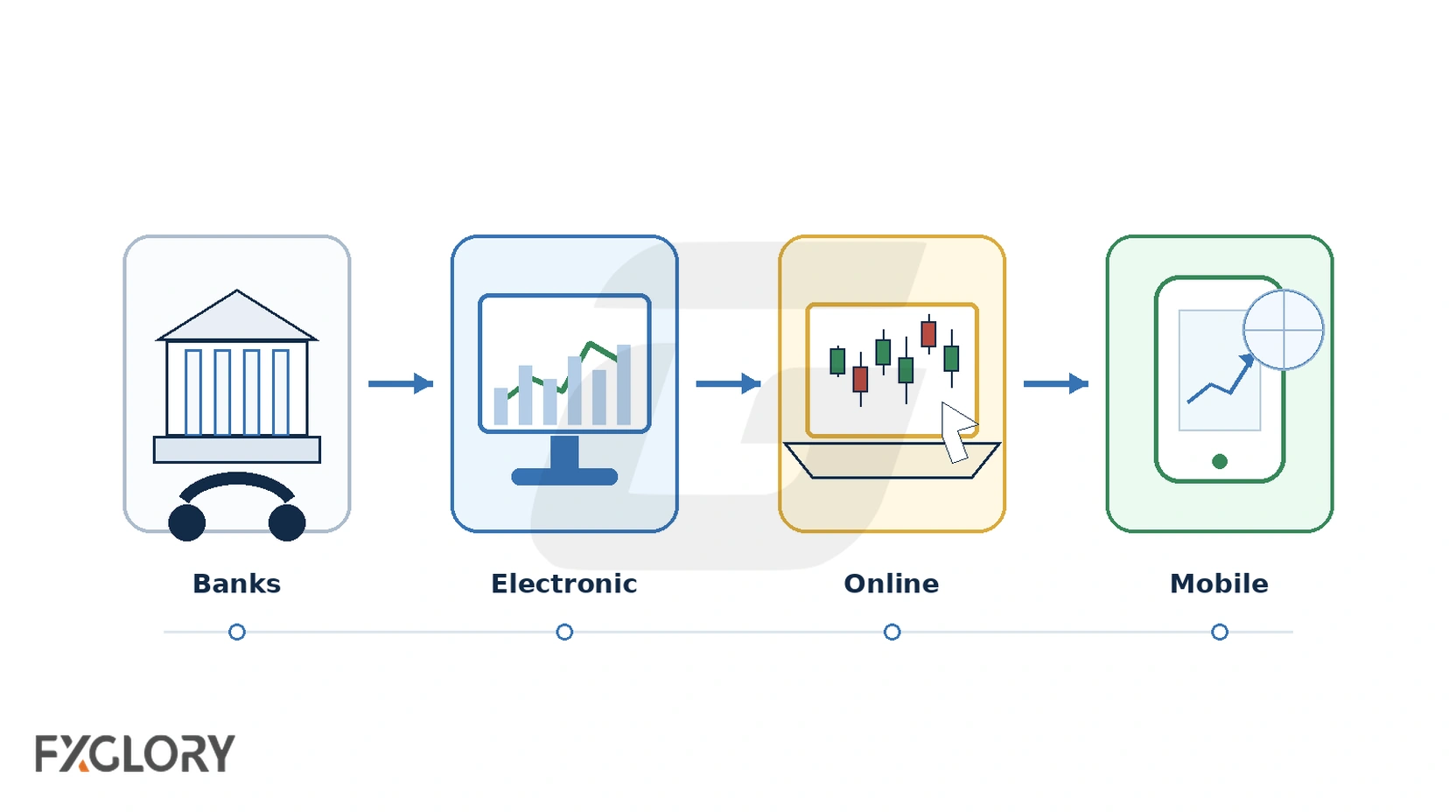
Earlier dealing relied heavily on dealer networks, telephone and telex communication. During the 1980s, computer-based systems and electronic dealing became more important, making institutional price distribution and execution faster.
The 1990s were the key period for online retail forex trading. Wider internet access, electronic trading platforms and online brokers made it practical for individual traders to open accounts, view currency prices and place orders electronically. Retail access later expanded further through faster internet connections, mobile platforms and more sophisticated trading software.
That distinction matters for search questions such as “when did online forex trading start?” Modern floating-rate forex dates to the early 1970s, while practical online retail access arrived roughly two decades later.
Margin-based retail products also became easier to access through online brokers. Margin can magnify both gains and losses, so greater access did not make forex trading low risk.
Who Created or Invented Forex?
There is no single forex founder or inventor. Unlike a company or a particular exchange, the foreign exchange market developed gradually as international trade, banking and monetary systems created a continuing need to convert one currency into another.
The modern form of the market was shaped by major institutional changes rather than one creator: the development of global banking networks, the Bretton Woods system, the move to floating exchange rates in the 1970s, and later electronic dealing and online brokerage.
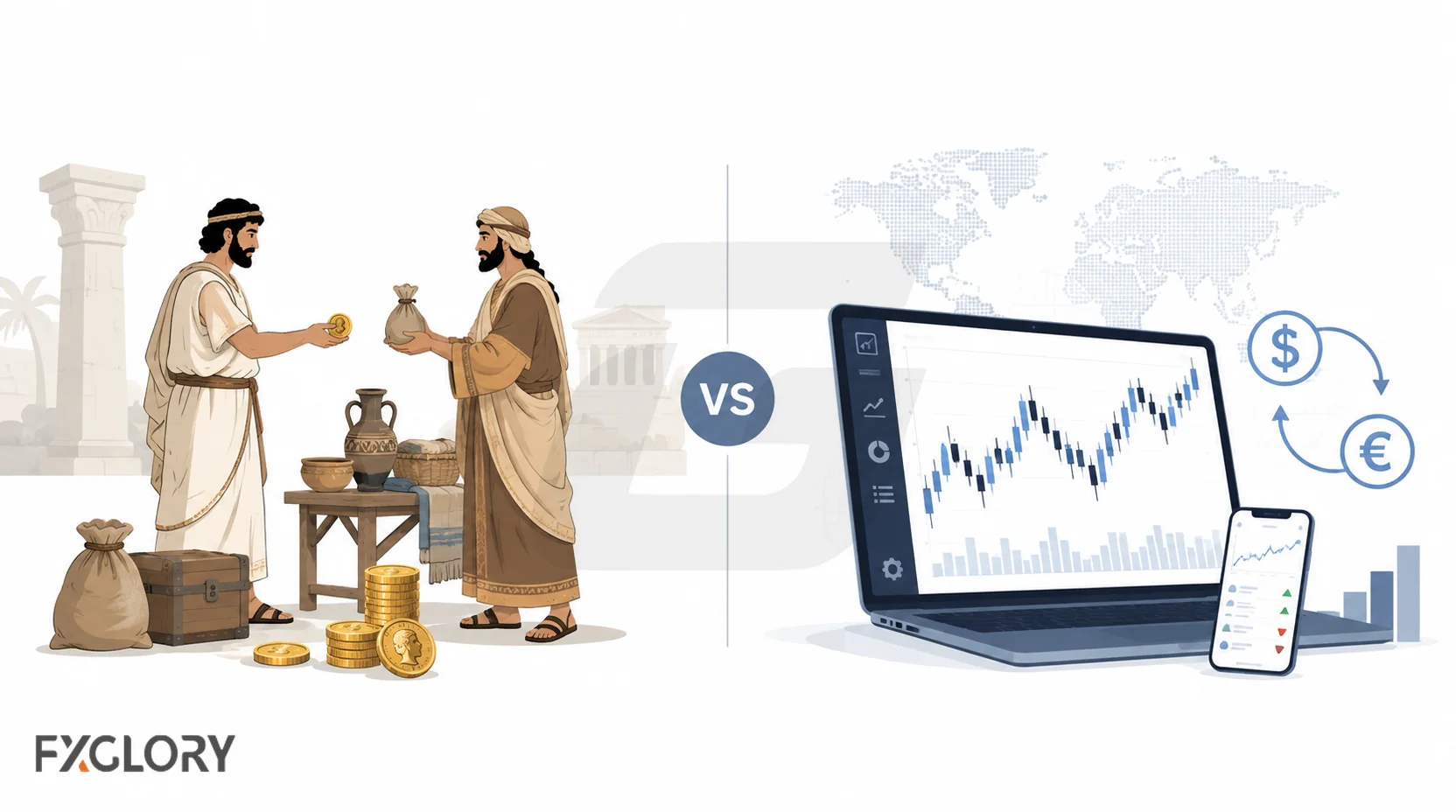
Forex Market History Timeline
The timeline below brings the major stages together without treating any one earlier form of currency exchange as identical to modern forex trading.
| Period | What happened | Why it matters |
|---|---|---|
| Ancient times | Money-changing supported trade and travel. | Foreign exchange has very old roots. |
| Early financial centers | Merchants, money-changers and banks handled cross-border currency conversion. | Foreign exchange became more organized as trade and banking expanded. |
| 1800s–early 1900s | Gold-standard systems linked currencies to gold. | Exchange rates operated under monetary rules very different from today’s floating market. |
| 1944 | The Bretton Woods framework established a dollar-centered fixed-rate system. | Many currencies were pegged to the dollar, while the dollar was linked to gold. |
| 1971 | The U.S. ended the dollar’s direct convertibility into gold. | The existing Bretton Woods framework entered a decisive breakdown. |
| 1973 | Major currencies moved more fully toward floating exchange rates. | This transition formed the basis of the modern floating-rate forex market. |
| 1980s | Electronic dealing systems became more important in institutional forex. | Price distribution and execution became increasingly computer-based. |
| 1990s | Internet brokers and online trading platforms expanded retail access. | Individual traders could access forex much more directly. |
| 2000s onward | Faster internet, mobile platforms and more advanced software expanded digital access. | Retail forex became increasingly platform-based and globally accessible. |
What This History Explains About Forex Today
The history matters because the modern market still reflects the changes that created it. Major currencies float rather than follow the Bretton Woods pegs, so exchange rates can react to interest-rate expectations, inflation, economic data, central-bank decisions and shifts in market demand.
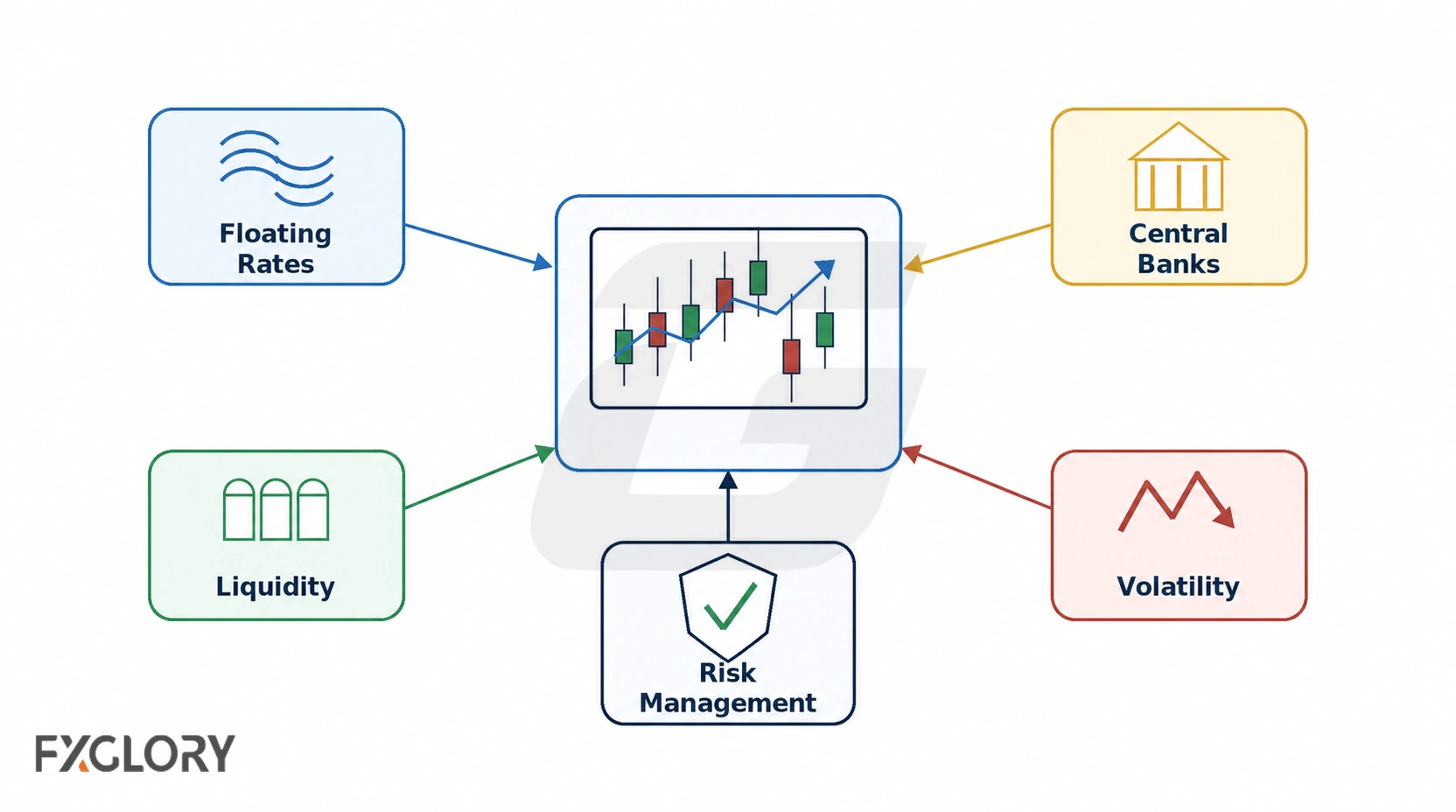
Forex also developed as a decentralized, over-the-counter market rather than one global exchange with a single central order book. Banks, dealers, brokers and other counterparties form interconnected trading networks, which helps explain why pricing, liquidity and execution can vary across participants and market conditions.
For the basic structure of today’s market, see what is forex. For the institutions and traders involved, see forex market participants. You can also read about forex liquidity and forex volatility.
Common Myths About Forex History
- Myth: Forex began when online brokers appeared. Online brokers expanded retail access in the 1990s, but institutional foreign exchange existed long before that.
- Myth: Bretton Woods created forex. Currency exchange predates Bretton Woods by centuries; Bretton Woods was a fixed-rate monetary system that later gave way to the modern floating-rate era.
- Myth: The 1970s created retail forex. The 1970s were crucial for floating exchange rates, while mass online retail access developed later.
- Myth: Forex is traded on one central global exchange. The market is largely decentralized and over the counter, with trading occurring through networks of financial institutions, brokers and counterparties.
Which Forex Start Date Should You Use?
Use the early 1970s when discussing the start of the modern floating-rate forex market, with 1971 and 1973 marking different stages of the transition away from Bretton Woods. Use the 1990s when the question specifically concerns online or retail forex trading.
If the question is about the origins of currency exchange itself, the history reaches back to ancient trade and money-changing rather than a single modern start year.